http://dx.doi.org/10.4236/ijaa.2014.42033
Photon Frequency Shift Caused by Gravity
and Its Electromagnetic Process
Hans W. Giertz
Uppsa Research, Gnesta, Sweden Email: [email protected]
Received 20 March 2014; revised 20 April 2014; accepted 27 April 2014
Copyright © 2014 by author and Scientific Research Publishing Inc.
This work is licensed under the Creative Commons Attribution International License (CC BY).
http://creativecommons.org/licenses/by/4.0/
Abstract
In the present paper, photon frequency shift, e.g. gravitational red and blueshift, is described as the electromagnetic influence from gravity waves on photons, e.g. light waves. Previous reports have described the dynamic electromagnetic processes of the atom, the photon and gravity, and how these characteristics are measured. Results from these reports have been compiled into a the- oretical model. The theoretical model describes the mechanism which results in photon frequency shift caused by a gravitational field. The theoretical model gives results similar to General Relativ-ity using Schwarzschild metric. The theoretical model is mapped on black holes.
Keywords
Gravitational Redshift, Gravitational Blueshift, Gravity, Photon, Schwartzschild Metric, Black Hole
1. Introduction
State of the art science offers no explanation concerning the mechanism which results in gravity and no descrip-tion of the mechanism which results in light and photons. Gravity and photons are described as more or less un-defined particles. It is a cumbersome task to describe astrophysics based on unun-defined mechanisms and poorly defined particles.
Novel research provides a fundamentally new description of the atom [1], its forces including gravity [2] and its energy including emitted photons [3], based on electromagnetic theory. This has resulted in a theoretical mo- del and increased understanding of gravitational lensing [4]. The present paper uses the same definition of gravi- ty and photons and reuses the structure of the theoretical model [4], and this results in a theoretical model of gra- vitational red and blueshift. Consequently, a novel definition of gravity and photon provides simple solutions to unsolved astrophysical phenomena.
positioned energy quanta hv and the frequency 69.9 Hz + v [3]. The superpositioned energy quantum hv is called photon and it explains the photon-wave duality.
The present study shows that gravity waves, i.e. TEM waves with frequency 69.9 Hz, radiated from a gravita-tional body, interact with TEM waves (with frequency 69.9 Hz) contained in light waves. Energy is transferred between the TEM waves, and which influences the light wave’s superpositioned energy quanta hv. Energy is transferred to the light wave when the light wave propagates towards the gravitational body, resulting in that hv and v increase, i.e. blueshift. Energy is transferred from the light wave when the light wave propagates from the gravitational body, resulting in that hv and v decrease, i.e. redshift [5].
The objective with the present paper is to build on results already presented in reports [1]-[4]. This informa-tion is compiled into a theoretical model in Secinforma-tion 2, which describes the mechanism behind gravitainforma-tional red and blueshift. The theoretical model is based on state of the art electromagnetic theory [6], the Standard Model [7], wave theory [8], superposition principle [9] and photon theory [10]. The present theoretical model is com-pared with classical interpretation of redshift based on General Relativity and Schwarzschild metric [11]-[13]. The present theoretical model is mapped on black holes [14]. Discussion and conclusions are found in Section 3. The aim of the study is to present a theoretical model of photon frequency shift caused by gravity, e.g. gravi-tational red and blueshift.
2. Theoretical Model
2.1. Gravity
The theoretical model builds on the observation that atomic oscillators69.9, with natural frequency 69.9 Hz, ab-sorb TEM waves with frequency 69.9 Hz [2]. The TEM waves originate from a singularity in the universe and have been thoroughly described [1] [2]. The absorbed TEM waves are then re-emitted uniformly into space.
The behavior and characteristics of plane TEM waves is independent of their frequency. The field vectors E
and B or H (B = µ0H) are linked and perpendicular. The field vector amplitudes relate as E = cB, where c is the speed of light. The electric and magnetic field vector amplitudes E and B decrease with the distance from the source as 1/r. The Poynting vector S describes the TEM energy flow density [6].
x . =
S E H (1)
The energy stored in the magnetic field is just equal to that in the magnetic field. The direction of energy flow is reversed for a wave travelling in the opposite direction because the phase of E and H is reversed.
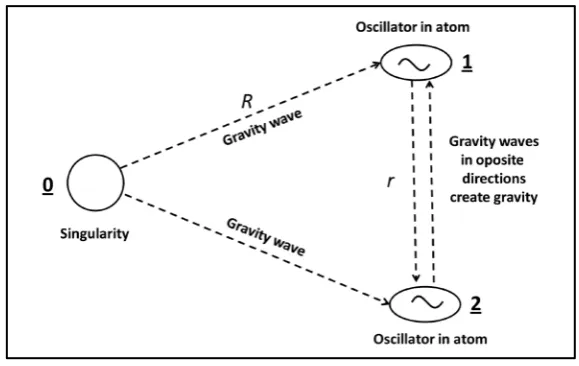
The theoretical model comprises a huge singularity in space, 0 in Figure 1. It emits vast amount of plane TEM waves with frequency 69.9 Hz. Its energy flow density at distance R is described by its Poynting vector
S0(R).
Figure 1. A singularity 0 generates gravity waves (low frequency plane TEM waves). Oscillators69.9 1 and 2 in atoms create resonance with gravity waves and re-emit them unaltered. This causes flow of gravity waves between atoms and their oscillators69.9 1 and 2. The flow of gravity waves in opposite direc-tions between oscillators69.9 results in mutual force of attraction, i.e. gravity.
interact because of the force between their synchronized field vectors. This also implies that there is energy transfer from TEM1 to TEM2 when TEM2 propagates towards Source 1. In equilibrium there is energy transfer in both directions, i.e. from TEM1 to TEM2 vice versa. Note that E and H are always perpendicular and hence S =
ExH can be replaced by S = ⋅E H. Equilibrium is defined by the amount of energy that Source 1 is able to de-liver at Source 2, e.g. at the distance r, S r1
( )
, and the amount of energy that Source 2 is able to deliver at Source 1, i.e. S2( )
r . This results in back reaction force F r( )
, i.e. radiation reaction [11]. This creates mutual force of attraction F r( )
:( )
· 1( ) ( )
2 .F r =γS r ⋅S r (2)
It is here assumed that the distance R to the singularity is constant. Hence, S0
( )
R is constant and thus γ is a constant.The entity which absorbs and re-emits TEM waves with frequency 69.9 Hz is an (forced damped) oscillator69.9 with natural frequency 69.9 Hz. It is now assumed that each source consists of many oscillators69.9 where each atomic oscillator69.9 re-emits TEM waves described by its Poynting vector δS(r) and where r denotes the distance from the source and its oscillator69.9. E and H decrease linearly with the distance r implying that δS(r) decreases with the square of the distance;
( )
( )
20
S r S r
δ =δ . The mutual force of attraction δF(r) between two atomic oscillators69.9 with distance r is
( )
( )
20
( ) 0 .
F r S S r
δ = ⋅γ δ ⋅δ (3)
In order to simplify δS
( )
0 is from now on denoted δS.It is now assumed that one oscillator69.9 acts on p collocated oscillators69.9, belonging to the set P of all oscil-lators69.9 at Source 2, and where each force can be described by δF r
( )
. These oscillators69.9 are synchronized resulting in the force( )
2(
)
2.
p P∈ δF r = ⋅ ⋅γ S p P∈ δS r = ⋅γ δ δS⋅ S ⋅p r
∑
∑
(4)It is now assumed that n collocated oscillators69.9, belonging to the set N of all oscillators69.9 at Source 1, act on p collocated oscillators69.9, belonging to the set P of all oscillators69.9 at Source 2, resulting in the total force
( )
F r :
( )
2(
)
2· .
n N p P
F r = ⋅γ
∑
∈ δS⋅∑
∈ δS r = ⋅γ δ δS S ⋅ ⋅n p r (5)S S
( )
1 0
S is the Poynting vector of Source 1 or body 1 and S2(0) is the Poynting vector of Source 2 or body 2. ξ, G, S1
( )
0 and S2( )
0 in Equation (7) depend on the distance R between the singularity and body 1 respec-tively body 2.2.2. Photon
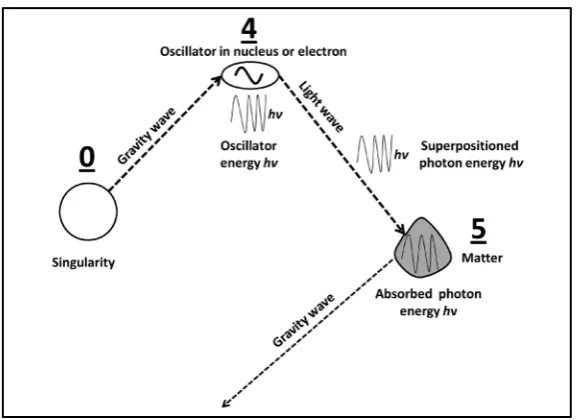
The theory of photon energy transport in space can be illustrated with light waves. It has been shown [3] that light waves are the result of the sum of time limited processes, i.e. acceleration or deceleration of oscillators69.9 in an electron or atomic nucleus, see Figure 2. These oscillators69.9 absorb and re-emit gravity waves with fre-quency 69.9 Hz. Accelerating or decelerating an electron or an atomic nucleus implies that they gain energy, i.e. each of their intrinsic oscillators69.9 increases its energy and this excess energy can be described by one or many energy quanta hv. In this case the oscillator69.94 in the electron or atom contains one energy quantum hv at a time, where h is Planck constant or quantum of action.
The energy quantum hν is discrete and limited in time. The energy quantum hν is superpositioned on a re- emitted TEM wave. This TEM wave contains the superpositioned energy quantum hv and the frequency 69.9 Hz and instant frequency ν. Hence, the re-emitted wave is a gravity wave with superpositioned electromagnetic energy. The superpositioned electromagnetic energy quantum hv with frequency v is the photon. In a continuous process the sum of many photons and their energy quanta hν, superpositioned on re-emitted gravity waves, result in light waves.
The light wave’s amplitude is proportional to the number of photons per time unit, which is proportional to the number of involved energy quanta hv, which in its turn is proportional to the number of involved oscilla-tors69.9. This light wave has the frequency 69.9 Hz + v.
The light wave can be absorbed in matter 5 and where the superpositioned energy quanta hν are absorbed,
re-sulting in that the light wave is converted back to the original gravity wave with frequency 69.9 Hz.
The energy contained in a TEM wave is proportional to its frequency ν. From this follows that the superposi-tioned energy and the photon energy δE is:
.
E h
δ =ω= ν (8) The TEM wave’s superpositioned energy and momentum are related as δE= pc, where p is the magnitude of the momentum vector p. This derives from the following relativistic relation, with m = 0 [8]:
2 2 2 2 4 ,
E p c m c
δ = + (9)
=
p k (10) where k is the wave vector (where the wave number k= k =2πν c), and =h 2π is the reduced Planck constant. Since p points in the direction of the TEM wave propagation, the magnitude of the momentum is:
.
p=k=hν c (11)
Figure 2. Electrons can be accelerated or decelerated. The electron contains oscillators69.9. The oscillator69.9 4 in an electron creates resonance with a gravity wave and excess energy hν, caused by electron acceleration decelera- tion, is superpositioned on the re-emitted wave. The superpositioned energy hv with frequency v represents the photon. This wave with frequency 69.9 Hz and v is re-emitted as a radio wave. The superpositioned energy hν can be absorbed in matter 5, whereby the light wave is converted into the original gravity wave with frequency 69.9 Hz.
that the photon is strictly mass less, has zero charge and propagates with the speed of the low frequency TEM wave, i.e. with the speed of light in free space.
2.3. Classical Gravitational Redshift
The classical definition of gravitational redshift is based on General Relativity and the Schwarzschild metric. Redshift is often denoted with the dimensionless variable z, defined as the fractional change of the wavelength [11]
(
o e)
e.z= λ λ λ− (12) where λo is the wavelength of the electromagnetic radiation (photon) as measured by the observer. λe is the
wa-velength of the electromagnetic radiation (photon) when measured at the source of emission. The gravitational redshift of a photon can be calculated in the framework of General Relativity (using the Schwarzschild metric) as
( )
(
)
lim 1 1 s 1,
r→∞z r = −r r − (13)
with the Schwarzschild radius [12]
2
2 .
s
r = GM c (14)
where G denotes Newton’s gravitational constant, M the mass of the gravitating body, c the speed of light, and r the distance between the center of mass of the gravitating body and the point at which the photon is emitted. The redshift is not defined for photons emitted inside the Schwarzschild radius, the distance from the body where the escape velocity is greater than the speed of light. Therefore this formula only applies when r is at least as large as rs. When the photon is emitted at a distance equal to the Schwarzschild radius, the redshift will be infinitely large.
When the photon is emitted at an infinitely large distance, there is no redshift. In the Newtonian limit, i.e. when r is sufficiently large compared to the Schwarzschild radius rs, the redshift can be approximated by a binomial
[image:5.595.169.459.82.292.2]propagates towards the gravitating body and energy transfer from the light wave to TEM1 when the light wave propagates from the gravitating body. The transferred energy δEtransfered at distance r over a small distance δr is
implicitly described by Equation (16)
( )
1( )
2,transfered
E r S r S
δ = ⋅ς ⋅ (17)
where ϛ is a constant. δEtransfered
( )
r is positive when S r1( )
and S2 propagate in opposite directions and negative when they propagate in the same direction.According to the present theoretical model the system is linear and hence, it applies to the superposition prin-ciple [10]. When the light wave propagates towards the gravitating body the positive energy δEtransfered is superpo-
sitioned on the light wave. Therefore the superpositioned energy results in that the energy quantum hv increases, resulting in that the photon frequency v increases, which is called blueshift in the case of light.
When the light propagates from the gravitating body the negative energy δEtransfered is removed from the light
wave’s superpositioned energy. Therefore the energy in the superpositioned energy quantum hv decreases, re-sulting in that the photon frequency v decreases, which is called redshift in the case of light. A light wave which is created at the distance r and measured at r→∞ experiences redshift described by integrating Equation (17).
Consequently, according to Equation (17) the transferred energy δEtransfered and the change in photon frequency
v are proportional to S r1
( )
, which decreases as 21r . However, the total redshift measured at r→ ∞ is the integral of Equation (17) which decreases as 1r. Equation (7) displays that S1
( )
0 is proportional to GM. Con- sequently, the present theoretical model gives approximately the same redshift as the Schwarzschild metric and Equation (15).2.5. Mapping on Black Holes
A black hole is characterized by its huge mass and extremely large gravitational field [14]. Every photon generated within or close to the black hole experiences extremely large loss of energy according to Equation (17) and will lose all of its energy, i.e. hv = 0. This is valid for all types of photons, ranging from radio waves to gamma rays.
Light waves, and photons in general, passing the black hole at a sufficiently small distance, will be bent towards and into the black hole as reported previously [4].
The consequence is that no photons escape the black hole, i.e. the emitted energy, which can be measured with state of the art methods, is zero. However, the black hole emits vast amount of gravity, i.e. vast amount of energy which cannot be measured with state of the art methods. Hence, it is only black in the eyes of prevailing science. In reality it is a gravity star.
3. Discussion and Conclusions
[2]. Moreover, photons, ranging from extremely low frequency to high frequency, have been produced and mea- sured in laboratory [3]. The force of attraction between TEM waves has been measured. Hence, crucial parts of the present theory have been measured in laboratory and some parts have been simulated and reproduced in la-boratory.
The platform of modern physics is elementary particle physics described in the Standard Model [7]. The Stan- dard Model lacks definition of gravity; hence, it falls short in describing gravitational red and blueshift.
The General Relativity provides a metric description of gravity [11]-[13]. However, it does not define the me- chanism creating gravity and the mechanism creating photons.
A new theory has been launched which describes the mechanism creating gravity [2], the mechanism creating photons and light waves [3] and the mechanism which results in energy transfer between gravity waves and su-perpositioned energy quanta hv, i.e. photons, in e.g. light waves. It explains gravitational red and blueshift. The theory is based on electromagnetic theory and wave theory.
References
[1] Giertz, H.W. (2013) Atoms Absorb Low Frequency Electromagnetic Energy. Open Journal of Microphysics, 3, 115- 120.
[2] Giertz, H.W. (2013) Gravity Caused by TEM Waves Operating on Dipoles in Atoms. International Journal of Astron-omy and Astrophysics, 3, 39-50. http://dx.doi.org/10.4236/ijaa.2013.32A007
[3] Giertz, H.W. (2013) Photons Are EM Energy Superpositioned on TEM Waves. Open Journal of Microphysics, 3, 71-80. http://dx.doi.org/10.4236/ojm.2013.33013
[4] Giertz, H.W. (2014) Gravitational Lensing Described by Its Electromagnetic Processes. International Journal of Astro- nomy and Astrophysics, 4, 294-300. http://dx.doi.org/10.4236/ijaa.2014.41024
[5] Pound, R.V. and Snider, J.L. (1965) Effect of Gravity on Gamma Radiation. Physical Review, 140, 788-803. http://dx.doi.org/10.1103/PhysRev.140.B788
[6] Melrose, D.B. and McPhedran, R.C. (1991) Electromagnetic Processes in Dispersive Media. Cambridge University Press, Cambridge. http://dx.doi.org/10.1017/CBO9780511600036
[7] Burgess, C. and Moore, G. (2007) The Standard Model: A Primer. Cambridge University Press, Cambridge.
[8] Kneubühl, F.K. (1997) Oscillations and Waves. Springer, Berlin. http://dx.doi.org/10.1007/978-3-662-03468-2
[9] Ostrovsky, L.A. and Potapov, A.I. (2002) Modulated Waves: Theory and Application. Johns Hopkins University Press, Baltimore.
[10] Bialynicki-Birula, I. (1994) On the Wave Function of the Photon. Acta Physica Polonica A, 86, 97-116.
[11] Misner, C.W., Thorne, J.K.S. and Wheeler, A. (1973) Gravitation. W. H. Wheeler, San Fransisco.
[12] Schwarzschild, K. (1916) Über das Gravitationsfeld eines Massenpunktes nach der Einsteinschen Theorie. Sitzungsbe- richte der Deutschen Akademie der Wissenschaften zu Berlin, Klasse für Mathematik, Physik, und Technik, 189.
[13] Heinzle, J.M. and Steinbauer, R. (2002) Remarks on the Distributional Schwarzschild Geometry. Journal of Mathema- tical Physics, 43, 1493-1508. http://dx.doi.org/10.1063/1.1448684