McDowall, Almuth and Lindsay, A. (2014) Work-life balance in the police:
the development of a self-management competency framework. Journal of
Business and Psychology 29 (3), pp. 387-411. ISSN 0889-3268.
Downloaded from:
Usage Guidelines:
Please refer to usage guidelines at or alternatively
McDowall, A. & Lindsay, A. Work-life Management in the Police: the Development of a Self-Management Framework. Journal of Business and Psychology. Doi:
10.1007/s10869-013-9321-x
Abstract
Purpose
Addressing a gap in the current work–life balance (WLB) literature regarding individual-focused approaches to inform interventions, we elicited behaviors used to self-manage WLB to draw up a competency-based WLB framework for relevant learnable knowledge, skills, and abilities (KSAs; Hoffmann, Eur J Ind Train 23:275–285, 1999) and mapping this against extant WLB frameworks.
Design/Methodology/Approach
Our participants were from a major UK police force, which faces particular challenges to the work–life interface through job demands and organizational cutbacks, covering a range of operational job roles, including uniformed officers and civilian staff. We took a mixed methods approach starting with semi-structured interviews to elicit 134 distinct behaviors (n = 20) and used a subsequent card sort task (n = 10) to group these into categories into 12 behavioral themes; and finally undertook an online survey (n = 356) for an initial validation.
Findings
Item and content analysis reduced the behaviors to 58, which we analyzed further. A
framework of eight competencies fits the data best; covering a range of strategies, including Boundary Management, Managing Flexibility, and Managing Expectations.
Implications
The WLB self-management KSAs elicited consist of a range of solution-focused behaviors and strategies, which could inform future WLB-focused interventions, showing how individuals may negotiate borders effectively in a specific environment.
Originality/Value
Work-life Balance in the Police: The Development of a Self-management Competency Framework
Widespread debate over how best to define the concept of work-life balance (WLB) continues (e.g. Gattrell, Cooper & Sparrow, 2012; Ӧzbilgin, Beauregard, Tatli & Bell, 2011), however, there is agreement about the concept’s contemporary relevance. Using data from 500 participating organizations, research in the United Kingdom (UK) by Group Risk Development (GRiD) (2012) identified WLB as the key occupational health concern for employers, more critical than role-related stress originating from the work domain. Much research in the field has focused on work-family conflict (WFC), defining balance as an absence of such conflictalongside a parallel and increasing interest in positive paradigms (for a full discussion see Greenhaus & Allen, 2011). Another issue concerns the unit or level of definition. Some scholars have suggested organizationally-focused notions of WLB,
expanded to wider issues such as how workplace performance and competence are measured and understood (Rapoport, Bailyn, Fletcher & Priott, 2002; Bailyn, 1993), others have taken an individually-focused perspective, conceptualizing WLB as individual perceptions and experiences of different life roles in line with current priorities (Kalliath & Brough, 2008).
However, what appears to be missing so far is a conceptualization of how WLB is actually experienced, and what constitutes different degrees of “effectiveness” in striving for WLB. For the purposes of this study, we adopt a definition of WLB based on Greenhaus and Allen (2011), encompassing the notions of (a) effectiveness and (b) satisfaction in roles that are of priority to an individual at any given time, where work is likely to feature centrally given its role for establishing personal identity as well as financial independence and support.
account for the varying success of ‘one size fits all’ approaches to organizational WLB interventions (Ollier-Malaterre, 2010).
The aim of this paper is to elicit a theoretical and practical lens through which to understand how individuals effectively self-manage WLB, taking a competency-based approach to investigate specific behaviors. To facilitate this, we focused our research on a critical sample of individuals, comprising employees of a UK police force. This gave us a highly relevant workplace context where organizational-level WLB initiatives such as flexible working can be constrained, necessitating a role for individual self-management. We begin by outlining the specific police context in which we worked, before discussing various frameworks relevant to WLB which fed into our overall rationale.
Study context
Given current constraints in organizations, a focus on WLB self-management appears not only to fill a theoretical gap, but also to offer practical value. In the UK, the on-going government-led Spending Review (HM Treasury, 2010) continues to result in significant cuts to the public sector. “Doing more with less” has become a widely used catchphrase, signaling that demands have increased whilst rewards, facilities or resourcing have not. This is
particularly pertinent in professions long recognized as inherently stressful, such as the Police, due to operational demands, as for instance frontline officers are likely to witness distressing incidents; and due to organizational demands, such as paperwork and
administration (Kop, Euwema & Schaufeli, 1999). Policing is a 24/7 emergency service, where many roles have to be staffed in shifts, and are subject to ad hoc on call duty.
Invariably, such demands contribute to an increase in WFC, which in turn puts officers at a greater risk of burn out (Burke, 1997).
true in the UK as the national service consists of regional Forces, each a legal entity in itself, with considerable variation regarding factors such as geographical size, staff numbers, resources and also Human Resource (HR) strategies. Current budget restrictions make it unlikely that individual UK Forces are in a position to fund or prioritize large scale organizational-level WLB initiatives. In addition, traditional structural initiatives such as flextime (flexible start and end times) are not feasible for many roles in this particular context, as police stations have to be manned around the clock and there is also an inherent element of unpredictability in police duties.
Individual Differences and Strategies for WLB
Given that organizational-level initiatives to help manage contemporary WLB
challenges may not be practical or effective, there is a growing role for individuals to manage conflict, and enable facilitation (Rotondo & Kincaid, 2008) themselves. We now provide a brief summary of the literature on (a) antecedents of WF and FW conflict with focus on individual differences; (b) the experience of enrichment or facilitation, defined by Greenhaus and Powell (2006) as “the extent to which experiences in one role improve performance or the quality of life in the other role” (p. 73); (c) coping strategies; and (d) the negotiation of borders (the areas of ‘blending’ between work and family domains; Clark, 2000) between different life domains as potentially important aspects of individual navigation of the work-home interface. This discussion makes explicit that experiences may vary across
organizations as well as between individuals, and that research on individual variables relevant to WLB is relatively sparse.
Allen et al., 2011; Amstad, Meier, Fasel, Elfering & Semmer, 2011; Byron, 2005; Ford, Heinen & Langkamer, 2007; Hoobler, Hu & Wilson, 2010; Mesmer-Magnus & Viswesveran, 2005). Numerous studies highlight the negative health effects of such conflict, including greater incidence of increased cholesterol levels and being overweight (van Steenbergen & Ellemers, 2009), psychological strain, depression and anxiety (Kinnunen, Geurts &
Pulkkinen, 2006), lower sleep quality (Williams, Franche, Ibrahim, Mustard & Layton, 2006) and decreased life satisfaction (Hill, 2005). With regards to the antecedents, a recent meta-analysis (Allen et al., 2011) showed that established constructs such as ‘Big Five’ personality traits, for example Neuroticism and Agreeableness, explain considerable variance in both Work in Family Interference (WIF) and Family in Work Interference (FIW). Whilst personality factors may provide important diagnostic information, practical use of this information to create WLB interventions is somewhat limited given that personality
characteristics remain stable over the life span (McCrae & Costa, 1982). More promisingly, the same meta-analysis has shown that positively valenced constructs including self-efficacy or self-esteem are negatively associated with experiences of conflict. There is however a need to augment this emerging understanding at a behavioral level – what are the individual
variables which have a role in managing WLB, and what do individuals actually do at a behavioral level?
context-specific mechanisms need to be considered to understand the ramifications for fostering facilitation in different sample populations. Frone (2003) framed such facilitation as a transfer of skills between different life domains. We argue that a skill-based approach is necessary to fully understand the enhancement of work and life following Kossek, Lewis and Hammer (2010), who argue that the acquisition and development of WLB skills can enhance individual well-being and ultimately act as a trigger for organizational culture change.
A relevant framework in this regard is border theory (Clark, 2000), which
As already mentioned, increased organizational demands highlight a role for individual coping strategies to adapt to such demands. Such strategies include active and solution focused approaches such as good time management skills, which may reduce time-based conflict (Adams & Jex, 1999). Avoidance/resignation coping is associated with higher levels of WFC, indicating that nondirective ways of coping have deleterious effects
(Rotondo, Carlson & Kincaid, 2003). Rotondo and Kincaid (2008) followed up on these findings and found that coping styles vary in effectiveness in relation to their respective origin, where positive thinking is associated with better WFF and family-work (FWF)
facilitation, whilst direct-action (behavioral coping) is associated with lower FWC and higher FWF, and help seeking may accelerate family-work conflict. Other research has shown that problem-focused strategies appear to enhance work-related outcomes (such as work
engagement, job satisfaction) but do not necessarily protect from WFC (Rantanen, Mauno, Kinnunnen & Rantanen, 2011). Thus, it appears the work and family domains respectively are affected by different coping strategies, and that a range of different strategies is necessary to equip individuals with the skills and knowledge to be truly effective in managing their WLB.
Competencies for WLB Self-management
Given that reduction of conflict, facilitation of positive experiences, the negotiation of borders, as well as individual coping between different domains all appear crucial to an individual perspective on WLB management, it is now timely to ask “how can these aspects be understood and facilitated in practice?” Competency frameworks have successfully been introduced and promoted in the UK in organizational initiatives relevant to WLB, for instance as a means to manage stress in the workplace by improving line manager competence
Donaldson-Feilder, 2008), highlighting that there are specific competencies to managing stress in the workplace, which in turn form a basis for training and other interventions. Such a competency-based approach can potentially also be applied to the work-home interface to make explicit relevant self-management behaviors which could then be used in awareness raising programs, or trained and developed as needed.
We therefore focused on making explicit specific WLB self-management behaviors (what individuals actually do in practice to manage their WLB) relating to underlying personal attributes in the form of learnable knowledge, skills and abilities (KSAs; Boyatzis, 1982; Hoffmann, 1999). Competencies are one way of understanding and framing such KSAs in specific jobs or roles and are usually elicited to capture the behaviors necessary for
effective role performance in a specific context (Boyatzis, 1982). Competency frameworks provide a diagnostic structure for organizational interventions, with a long tradition in the context of employee selection and performance management (for a full review see
Shippmann et al., 2000), requiring the elicitation of relevant behaviors (“behavioral indicators”) and description of their content, followed by their sorting or ordering into meaningful themes, and various stages of validation to check validity and reliability
(Shippmann et al., 2000). Resulting competencies provide guidance regarding specific ways in which particular activities should be carried out to promote success, and identify the personal attributes required to do so.
particularly prone to WLC; and (c) to ascertain how a relevant framework may map onto extant theory and frameworks in the WLB field.
Method
We recruited participants from one of the largest police forces, internally known as a ‘Modernizing Force’ for its emphasis on embedding a performance-focused culture, in the South East of England, UK (3,787 police officers and 2,381 police staff in March 2010, Sigurdsson & Dhani, 2010). There are 43 police forces in England and Wales with force size ranging from 47,566 to 1,162 members, with a mean size of 4,184 (not including London Metropolitan due to the extreme size relative to all other forces). Participation was voluntary and all data were anonymized. We proceeded in three stages, adopting a mixed methods approach as in earlier competency elicitations and validations (e.g. Lewis et al., 2007); conducting (a) semi-structured interviews to elicit WLB self-management behaviors; (b) a card sort task to group those behaviors; and (c) a survey to undertake an initial validation of the behavioral framework.
Stage 1: Semi-structured Interviews to Elicit WLB Self-Management Behaviors Interview Sample. We targeted different areas of operations (neighborhood patrols, specialist roles, criminal investigations), with specific focus on frontline roles (i.e. officers or staff who had typical policing duties, as opposed to purely administrative functions such as HR or logistics/operations) to recruit a purposive sample of 20 full-time Police Force members from both Federated Ranks to represent Constables to Inspectors (n = 9) and civilian police staff (n = 11), with 14 males and 6 females.
Interview Process. Semi-structured interviews, incorporating the critical incident technique (CIT, e.g., Chell, 2004) elicited WLB self-management behaviors across different life domains, focusing on instances when participants experienced good WLB and/or
ineffective behaviors. Schluter, Seaton and Chaboyer (2008) point out that the fruitfulness of a study using CIT relies on gaining three important pieces of information, (a) rich and complete descriptions of the situation or event to be explored; (b) the specific actions of the person involved to understand why certain decisions were made; (c) the outcome of the event to ascertain the effectiveness of the behavior. Essentially inductive in nature (Gremler, 2004), CIT allows rich information to be elicited in a short period of time but also relies on people’s capacity to remember relevant details (Chell, 2004). As instances where an individual managed WLB challenges satisfactorily may well be less memorable than ones where they failed to overcome difficulties, interviewees were sent an advance briefing asking them to think about particular incidents to discuss, comprising examples of successful and less successful WLB management.
Interview Schedule. Each interview commenced with an introduction and confirmation of informed consent before moving onto the discussion of salient critical incidents where WLB was perceived as successful. Our prompts were designed to elicit individual contributions and strategies, rather than environmental or organizational factors. Stimulus cards were also used, listing different life domains (for example, work, family, sport, religion) to prompt participants to think of WLB as broadly as possible, and of any relevant behaviors used to effectively manage the interface between different life domains. Where ineffective behaviors were reported, interviewees were asked to describe what they thought they might have done differently that may have brought a more successful outcome, as another route to eliciting positive behaviors. Example interview questions included: What are the things that are important to you when managing your work/life balance?; Try and think of a situation in the last two weeks where a few elements of your life were out of
managed to get things back into balance again? All interviews were recorded and transcribed verbatim.
Behavior Elicitation and Item Development. We elicited an average number of two incidents per interview, 39 in total, of which 11 related to examples where the interviewee had not managed their WLB effectively and 28 to successful WLB self-management. We grouped the incidents into several categories. One category focused on strategies used to ensure that important home life activities were protected; an example was negotiating with a manager to work flexibly so that the individual concerned could take time off during the normal work day to engage in charity work. Another category focused on workload management, for instance a police staff member reported that they were constantly being interrupted meaning they were taking work home to get it done. As this made them feel ‘out of balance’, they now planned ahead and made a conscious effort to ensure they did the administrative work first each day without interruption, resulting in better WLB. A further category focused on maintaining mental and/or physical health through ensuring adequate sleep, exercise and diet.
to the underlying core behavior. Thus, we proceeded with the analysis identifying a total of 302 separate behaviors; an average of 13 behaviors per interview, the range being 6 to 25. Each behavior was then noted separately and recorded in an item database, and subsequently coded as relating to a particular behavioral theme, each representing a preliminary WLB self-management competency. This process enabled a careful review to identify where unique behaviors were recorded, or where replicated behaviors already identified could be eliminated or rewritten. For example, we elicited the behavioral items (a) [When I am at home] I’m not worrying about what I’ve got on at work, work’s work and that’s that, (b) I don’t think I
would go home and talk too much about work, and (c) We usually try not to talk about work when we are out. The subsequent review agreed that these behaviors could be condensed into the new item Actively ensuring that work remains within work hours. We thus refined a total of 134 distinct WLB self-management behaviors. These were cross-checked with two independent subject matter experts, both trained psychologists, to ensure that the behaviors identified (a) were all relevant to the self-management of the work-home interface, (b) tapped into a variety of behavioral strategies relevant to WLB, and (c) represented a distinct aspect. Stage 2: Card Sort
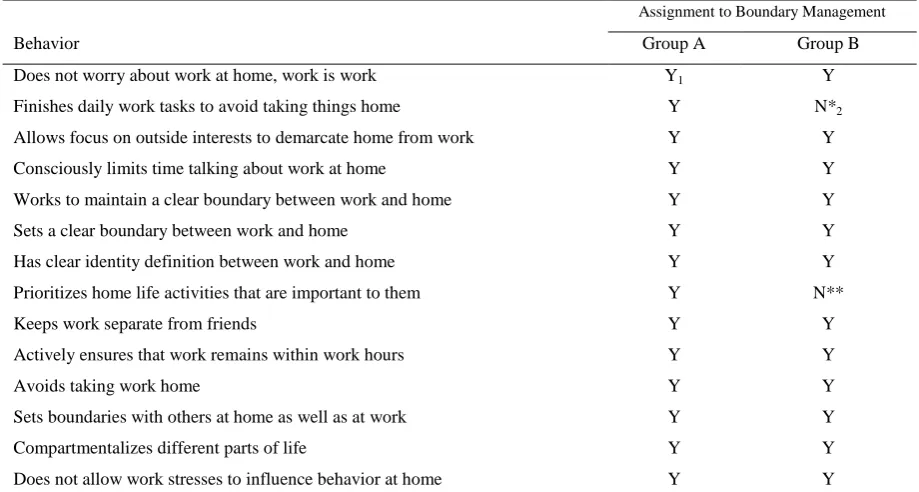
two groups respectively, and the level of agreement for the category Boundary Management, is illustrated in Table 1 where the allocation was consistent across both groups for 11 out of 14 of behaviors (78% agreement). The overall level of agreement between the groups during the card sorting task was 77%.
[Note to Editor: Insert Table 1 about here]
The outcomes of both card sorts were compared in a mapping exercise, and discrepancies between the two groups’ outcomes were resolved through discussion between the author team and two independent subject matter experts who were academics selected for their knowledge of organizational psychology, WLB and competencies, as well as their specific knowledge of the police context. The experts took the role of final arbiter in deciding which behavioral theme and related label a particular card belonged to, taking account of the terminology and understanding of each theme. This process resulted in the agreement on 12 behavioral themes (see Table 2).
[Note to Editor: insert Table 2 about here]
result in further revisions. We recognized that the themes and their content were not
symmetrical, in that some themes were relatively narrow and defined by a relatively small set of behaviors at this stage (e.g. workplace negotiation) and others much broader (e.g.
behavioral coping strategies and time management strategies), which we addressed during the subsequent analysis.
Stage 3: Survey for Initial Validation of the Behavioral Framework
Survey Construction and Distribution. Next, we constructed a questionnaire to test the resulting 12 behavioral themes quantitatively by means of an online survey. First, we piloted the list of behaviors and the instructions for completion with an opportunity sample of police officers and staff (n = 15) and psychology students (n = 10) to ensure that the items and instructions were clear and the web-interface user friendly, before putting the survey online. The pilot resulted in minor amendments to make a small number of items clearer and more understandable to potential respondents. Respondents rated their use of each behavior on a 5-point Likert-type effectiveness scale (1= Do Not Use / 2= Ineffective / 3= Slightly Effective / 4= Quite Effective / 5= Extremely Effective). Given our inductive approach which focused on eliciting a framework per se, rather than cross validation, we did not include other WLB measures apart from a dichotomous item to elicit an overall satisfaction score.
that all possible behaviors were captured; however no extra behaviors were actually identified in this way.
Survey Sample. In total, 356 respondents completed some or most parts of the
survey, 212 participants completed each and every question1. The final sample comprised 185 males and 171 females, employed as police officers (n = 193) or civilian police staff (n = 163), 27% had supervision duties (n = 96). Age was recorded in bands from under 20 to over 61 (the majority of respondents were 31 to 50 years of age). A broad range of ranks and roles were represented, from Police Constable to Chief Inspector amongst the Federated ranks, and roles as diverse as administration, firearms licensing, and force contact and control room responsibilities amongst civilian staff. We checked carefully that different policing operations were represented (e.g. neighborhood patrols, specialist functions; as well as ‘back office’ and customer facing administrative staff, such as control room operators) and found the sample to be broadly representative of the overall police population. Of these respondents, 72% (n = 235) reported overall they had good work life balance, 28% that they did not, indicating a level of generic satisfaction.
Results
It was our overall aim to investigate how the framework elicited by qualitative means would substantiate in the statistical analysis. Initial data screening found no significant univariate outliers. We then undertook reliability analysis (Rust & Golombok, 2009; Kline, 1979). First, we checked for items with extreme facility and inspected skewness and kurtosis values using a cut off value of (+/-1) which is conservative but commonly applied (e.g. Fife-Shaw, 2006). Concurrently, we also considered item content which led to us retaining several items at this stage which exceeded this threshold, but which reflected the content from the
1 We conducted paired sample t-tests to screen for potential systematically biased non-responses, but
CIT interviews particularly well, combining revision of content with a purely psychometric approach. Finally, we conducted an exploratory Principal Components Analysis as
appropriate for data reduction purposes (Costello & Osborne, 2005) considering the item structure and component loadings to eliminate items which did not load on any factor or with cross loadings. This initial item screening resulted in a pool of 58 items for the items
applicable to all participants in the sample. We included a further step of validation by sharing the preliminary set of items with experts from the organization (an experienced officer, an HR practitioner and a member from an employee representation organization) to check that (a) the items were comprehensive, and (b) the behaviors were relevant across individuals in different job roles. They suggested no amends or revisions.
Inspection of the means for respective behaviors showed that respondents found it most effective to use cognitive strategies, such as Not feeling guilty when taking time owed
(M = 3.75, SD= 1.18), or Focusing on the things that you enjoy about the job rather than the things you don’t (M = 3.67, SD = .96), arguably strategies to facilitate detachment, and least effective to use strategies which involved actual changes to work scheduling, for instance
Leaving one day a week clear and appointment-free (M = 2.02, SD = 1.21).
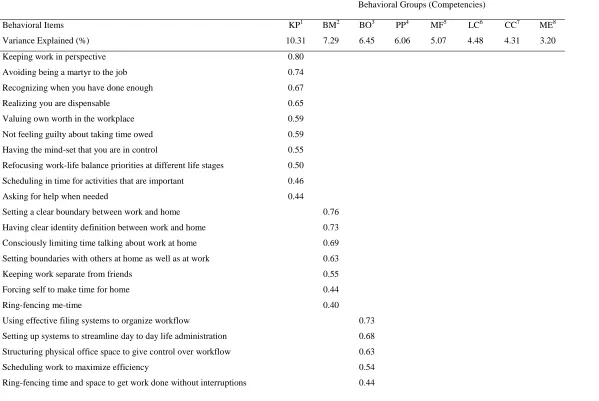
We then undertook exploratory factor analysis (EFA) for behavioral groups 1 to 11 using Principal Axis Factoring (Costello & Osborne, 2005) with Varimax rotation, comparing different factor solutions with regards to their fit to the data (including percentage of variance explained by various factors, and avoidance of cross-loading items), but also their
above retained and assigned to factors. As shown in Table 3, ten items loaded on Keeping Perspective, seven on Boundary Management, six on Being Organized, seven on Proactively Prioritizing WLB, six on Managing Flexibility, three on Lifestyle Changes, three on
Cooperation and Coordination, and three on Managing Expectations. [Note to Editor: insert Table 3 about here]
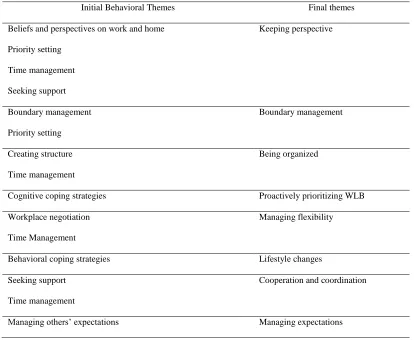
There was some overlap with the initial 12 behavioral themes from the card sort exercise, even given the more parsimonious structure. Beliefs and Perspectives on Work and Home still featured as the renamed Keeping Perspective, which also encompassed items relating to Priority Setting, Time Management and Seeking Support respectively. There was a separate cluster of Boundary Management, which also contained one item previously
pertaining to Priority Setting. Creating Structure and Time Management were subsumed as Being Organized. Cognitive Coping Strategies is now named Proactively Prioritizing WLB (the fourth theme), and items in the qualitative phase pertaining to Behavioral Coping Strategies now formed a small cluster with very distinct behaviors relating to making Lifestyle Changes. Managing Flexibility contained items from the former Workplace Negotiation, Time Management and Behavioral Coping Strategies themes. Seeking Support now featured under Cooperation and Coordination, whilst Managing Expectations remained a distinct cluster. Somewhat to our surprise, as these were an important aspect elicited in the CIT phase, items relating to De-Stress Mechanisms no longer featured in this framework; one potential explanation is that these are perhaps somewhat individualistic, and are not
necessarily relevant to all individuals. Table 4 highlights how the initial 12 behavioral themes mapped against our final eight competencies.
The splitting of some of the previous themes across the final eight categories can be explained through considering the detailed behaviors contained in each final theme as shown here, given that many of these refer to multi-faceted interpretations of behavior which could legitimately be assigned to alternative categories. For example, Time Management was included under the Keeping Perspective, Managing Flexibility and Being Organized categories, whilst Seeking Support featured under both the Keeping Perspective and
Cooperation and Coordination categories. Under Keeping Perspective, the specific behavior was Scheduling in activities that are important, which, whilst referring to time management skills, was ultimately about the individual using their views and perspective (value
judgments) to decide which activities to prioritize most when deciding how to allocate time effectively. The specific time management behaviors subsequently allocated to the Being Organized category were Scheduling work to maximize efficiency, Ring-fencing [protecting] time and space to get work done and Being aware of the stages that tasks are at so can action them immediately when appropriate input is received which were behaviors also relevant to organization and structure. The Time Management behavior allocated to the final theme of Managing Flexibility was Recording extra time worked and ensuring take it back as lieu
which also directly reflected a tactic aimed at taking advantage of flexible working policies. For Seeking Support, the behavior Asking for help when needed was allocated to the Keeping Perspective category as it encompassed the underlying belief that one person does not have to do all duties alone, but that it is often more productive to work as a team. The behaviors Cooperating with partner to juggle work/family demands and Allowing partner to proactively organize home life to ensure balance reflected a specific understanding of the term ‘support’ emphasizing cooperation and collaboration.
We computed coefficient alphas separately for each competency. Overall these indicated good reliability for relatively heterogenous sets of items, ranging from .70 (Managing Expectations) to .87 (Boundary Management).
Given that Managing Others featured as a separate theme in the card sort, we conducted a separate exploratory analysis for Theme 12 which needs to be treated with appropriate caution given the small sub-sample of those with managerial responsibilities (n = 96). This indicated a separate competency for Managing Others, further details are available from the authors on request.
Bivariate Analysis
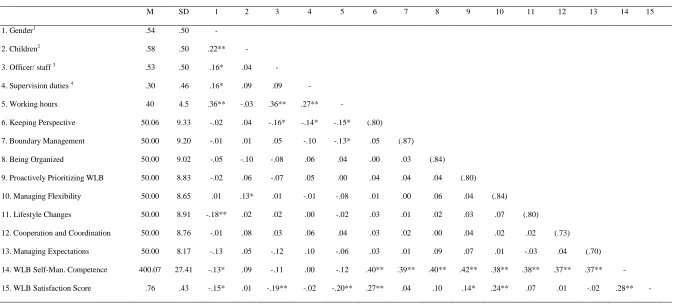
As summarized in Table 5 there were few correlations for the control variables. Gender was correlated negatively with Lifestyle Changes indicating that males were less likely to make such changes, those with children were higher on Managing Flexibility, as were officers. Keeping Perspective was associated negatively with several control variables, indicating that officers, those with supervision duties and those working longer hours were less likely to rate relevant behaviors as effective. The competencies also had no statistically significant associations with each other, indicating that the behavioral content had been separated out well. We computed overall WLB Self-Management Competence by adding all competencies (M = 22.35, SD = 7.45) to include for further exploration in the correlational analysis. All competencies were strongly associated with this additional variable; and Keeping Perspective, Proactively Prioritizing WLB and Managing Flexibility were all associated with the broad WLB satisfaction measure.
[Note to Editor: insert Table 5 about here] Discussion
particularly valuable and indeed necessary in contexts where organizational-level interventions are constrained. We used an inductive approach using mixed methods to identify a range of specific behaviors, covering concrete behavioral strategies (including changes to job roles, and solution-focused strategies such as creatively devising WLB
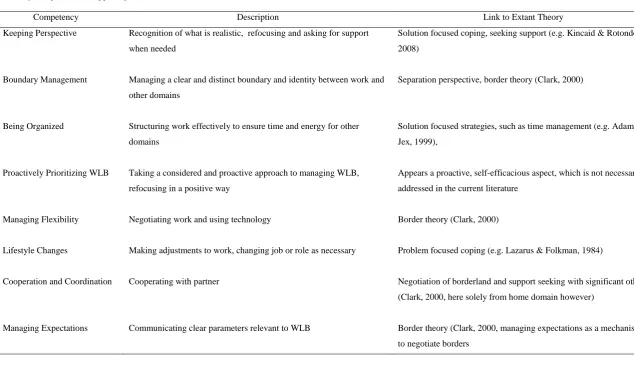
solutions) and cognitively based strategies (such as the adjustment of individual perspectives on WLB challenges). These behaviors were refined and card sorted into 12 behavioral themes as a preliminary framework. Following quantitative analysis, a structure of eight preliminary competencies pertinent to officers and staff (one further competency relating specifically to individuals in managerial roles also emerged) fits the resulting 58 behaviors best. Few associations with the demographic control variables indicate that the behaviors are of general relevance and effective across this sample. The preliminary analysis also indicates good divergent validity of the competencies. The behaviors elicited here map onto, but also transcend, the current literature and in particular facilitate our understanding of how borders may be self-managed in organizational reality. We summarize the mapping against the extant literature and the extended competency descriptors in Table 6, and concentrate our further discussion on the novel contributions of our framework.
[Note to editor: insert Table 6 about here]
individuals need to negotiate how to put clear boundaries in place, and competently manage flexibility, they also need to communicate very clearly what can be expected from them and what they expect in return. This is an aspect which appears crucial to successful WLB management, and deserves following up in future studies as an individual skill that can be developed to negotiate better WLB.
Keeping Perspective and Being Organized tap into solution focused strategies
analogous to the coping literature. The former is emotion-focused, referring to behaviors such as ‘Realizing you are dispensable’. In terms of the core content of the critical incidents
elicited in the initial phase of the research, relevant incidents featured strongly reflecting the need for individuals to recognize that they have a right to a life outside work, and the
importance of keeping the work domain in perspective so that it does not become all-encompassing. The more physical theme of De-stress Mechanisms, in terms of getting enough sleep, rest and exercise, as elicited in the card sort, no longer featured as a separate competency following the quantitative analysis. The above behaviors reflect the notion which ran through the data right from the interviews, that thinking differently about work demands is of importance to individuals, will make them better at approaching work productively, being rested and refreshed by these other activities. Being Organized is rather more problem-focused (Lazarus & Folkman, 1984), featuring behaviors such as Setting up systems to streamline day to day life administration or Ring-fencing time and space to get work done without interruptions, participants having revealed in the interviews that structure and organization in life may make it easier to balance conflicting demands from different domains, facilitating the effective use of time and reducing levels of unproductive procrastination.
behaviors such as ‘Anticipating problems’ and ‘Thinking about work-life balance as a
challenge not a problem’. These reflect an ability to think ahead about potential challenges so that action can be planned in advance to mitigate them, rather than facing problems
‘unexpectedly’, and also encompass reframing strategies which may assist detachment
(Sonnentag & Bayer, 2005), which may in turn encourage positive well-being outcomes. This future-focused aspect merits further attention, as to the best of our knowledge there is no literature specifically considering proactive WLB behaviors. A competency framework such as the present one may provide a basis for diagnosing and developing the relative
effectiveness of relevant behaviors, to determine how we can equip individuals best to
proactively, rather than reactively, self-manage WLB.
Boundary Management, Managing Flexibility and Proactively Prioritizing WLB were most strongly associated with the overall WLB self-management competency, each tapping into a unique but complementary set of behaviors, where Managing Flexibility focuses on communication (for example ‘Negotiating informally with manager for flexibility’),
Boundary Management on the aforementioned separation perspective and of course the proactive element discussed above. Taken together, the range of behaviors underpinning these particular competencies may be effective for self-managing WLB in an active and solution-focused manner for this sample through reframing challenges as opportunities, communicating well, and focusing on the domain of most priority at any particular time.
Nevertheless, one also needs to be mindful that relevant behaviors, whilst effective, might not always be possible. The competency Lifestyle Changes comprises actions for concrete change, which may not always be a feasible option due to organizational constraints. To illustrate, a behavior such as ‘Proactively requesting shifts that suit home needs’ might in organizational reality be less effective than hoped in promoting good WLB since the
Successful implementation of a competency approach to WLB is thus likely to involve a complex balance between individual skill development and practice on the one hand, and the level of support or flexibility offered by a particular occupational context to implement these on the other hand. To this extent competency frameworks such as the present one, which focus on context-relevant and specific KSAs, emphasize the recognition that development of WLB self-management behaviors requires more of organizations than the simple imposition of organizationally determined solutions to challenges. This, we believe, is a contribution of our research given that the competency-based approach taken here may not only build individual skills, but also, by making relevant behaviors explicit, foster dialogue to promote the alignment of organizational aims with individual needs, thus leading to a more engaged and productive workforce.
Potential Research Limitations
We commenced our inductive approach with interviews incorporating CIT, which relies heavily on the interviewees' ability to retrospectively but accurately recall events, any responses to those events and to impart their recollections accurately. We addressed this by means of an extensive pre-interview briefing, the careful construction of our interview schedule and in particular the use of flexible probing questions. Concerns over potential subjectivity bias through our initial qualitative approach were offset via the sequential approach of the research design, which included a card sort and survey. Potential researcher bias was addressed through use of third parties at multiple points during the study, ensuring a degree of objectivity and critical review throughout the process.
appropriate mechanism for validation may be test-retest reliability (see also Yarker et al., 2008), and an intervention design where employees and managers are made aware of the competency model and trained in relevant interventions, to investigate the link to longitudinal outcomes such as well-being and performance, which should be a topic for a follow up study.
Conclusions
Whilst competencies as such are not novel, their application to eliciting WLB self-management behaviors is a fresh approach. Our findings show that WLB self-self-management can be understood as a context specific competency framework to elicit effective behaviors. This approach has potential utility for further development by individuals and organizations, identifying knowledge, skills or ability gaps as well as areas of strength to provide a common point of reference for individuals and their managers alike. Whilst several aspects of the model elicited map onto the WLB and coping literature respectively, the proactive and solution focused WLB-specific element warrants future research, and appears to complement the emergent literature on positive paradigms in WLB research to draw out what individuals actually do. We note the importance of situating a competency framework within an
References
Adams, G. A., & Jex, S. M. (1999). Relationships between Time Management, Control, Work-Family Conflict, and Strain. Journal of Occupational Health Psychology, 4, 72-77. doi: 10.1037/1076-8998.4.1.72
Allen, T., Johnson, R., Saboe, K., Cho, E., Soner, D., & Evans, S. (2011). Dispositional variables and work-family conflict: a meta-analysis. Journal of Vocational Behavior,
80, 17-26. Doi: 10.1016/j.jvb.2011.04.004
Amstad, F. T., Meier, L. L., Fasel, U., Elfering, A., & Semmer, N. K. (2011). A meta-analysis of work-family conflict and various outcomes with a special emphasis on cross-domain versus matching domain relations. Journal of Occupational Health Psychology, 16, 151-169. doi: 10.1037/a0022170
Bailyn, L. (1993). Breaking the mold: women, men and time in the new corporate world.
New York, NY: Free Press.
Barnett, R. C., & Hyde, J. S. (2001). Women, Men, Work and Family: An Expansionist Theory. American Psychologist, 56, 781-796. doi 10.1037/0003-066X.56.10.781 Block, J. (1961). The Q-Sort method in personality assessment and psychiatric research.
Springfield, IL: Charles C Thomas.
Boyatzis, R. E. (1982). The competent manager: a model for effective performance. Chichester, England: John Wiley & Sons.
Burke, R. J. (1993). Toward an understanding of psychological burnout among police pfficers. Journal of Social Behaviour & Personality, 8, 425-438.
Byron, K. (2005). A meta-analytic review of work–family conflict and its antecedents.
Chell, E. (2004). Critical incident technique. In G.Symon & C. Cassell (Eds.), Essential guide to qualitative methods in organizational research (pp. 45-60). London, England: Sage.
Clark, S. C. (2000). Work/family border theory: a new theory of work/family balance.
Human Relations, 53, 747-770. oi: 10.1177/0018726700536001 Costello, A. B., & Osborne, J. W. (2005). Exploratory Factor Analysis: Four
recommendations for getting the most from your analysis. Practical Assessment, Research, and Evaluation, 10(7), 1-9.
Donaldson-Feilder, E., Lewis, R., & Yarker, J. (2009). Research insight: preventing stress, promoting positive manager behavior (No. 4845). London: Chartered Institute of Personnel and Development.
Eby, L.T., Casper, W.J., Lockwood, A., Bordeaux, C. & Brinley, A. (2005). Work and family research in IO/OB: Content analysis and review of the literature (1980)-2002). Journal of Vocational Behavior, 66(1), 124-197. doi:
http://dx.doi.org/10.1016/j.jvb.2003.11.003http://dx.doi.org/10.1016/j.jvb.2003.11.00
3
Frone, M. R. (2000). Work-family Conflict and Employee Psychiatric Disorders: The National Comorbidity Survey. Journal of Applied Psychology, 85, 888-895. doi: 10.1037/0021-9010.85.6.888
Galinsky, E., Peer, S. L., & Eby, S. (2009). When work works: 2009 guide to bold new ideas for making work work. New York: Families and Work Institute.
Gattrell, C., Burnett, S.B., Cooper, C.L. & Sparrow, P. (2012). Work–Life balance and
parenthood: A comparative review of definitions, equity and enrichment. International Journal of Management Reviews. doi:10.1111/j.1468-2370.2012.00341.x
Greenhaus, J. H., & Beutell, N. J. (1985). Sources of conflict between work and family roles.
Academy of Management Review, 10, 76-88. doi: 10.2307/258214
Gist, M. E. & Mitchell, T. R. (1992). Self-efficacy: a theoretical analysis of its determinants and malleability. Academy of Management Review, 17, 183-860. doi: 10.2307/258770 Greenhaus, J. H. & Allen, T.A. (2011). Work-family balance: a review and extension of the
literature. In Quick, J.C. & Tetrick, L.E. (2011). Handbook of Occupational Health Psychology (2nd. Ed). Washington, D.C.: American Psychological Association. Greenhaus, J. H. & Powell, G. N. (2006). When work and family are allies: a theory of
work-family enrichment. Academy of Management Review, 31, 72-92. doi 10.2307/20159186
Gremler, D. D. (2004). The Critical Incident Technique in Service Research. Journal of Service Research 7(1), 65-89.
Group Risk Development [GRiD] (2012). 2011 Employer research. Summary of findings. Available from www.groupriskorg.uk, retrieved on 12th February 2012
Grzywacz, J. G., & Marks, N. F. (2000). Reconceptualizing the work–family interface: An ecological perspective on the correlates of positive and negative spillover between work and family. Journal of Occupational Health Psychology, 5, 111-126.
Fife-Shaw, C. (2006). Questionnaire design. In Breakwell, G. M., Hammond, S., Fife-Shaw, C, & Smith, J. A. Research methods in psychology (pp. 212-231)..London: Sage.
Ford, M. T., Heinen, B. A., & Langkamer, K. L. (2007). Work and family satisfaction and conflict: a meta-analysis of cross-domain relations. Journal of Applied Psychology, 92, 57-80. doi: 10.1037/0021-9010.92.1.57
Hammer, L., Kossek, E. E., Anger, W. K., Bodner, T., & Zimmermann, K. L. (2011).
Clarifying work–family intervention processes: The roles of work–family conflict and family-supportive supervisor behaviors. Journal of Applied Psychology, 96, 134-150. doi 10.1037/a0020927
Hill, E. J. (2005). Work-family facilitation and conflict, working fathers and mothers, work-family stressors and support. Journal of Family Issues, 26, 793-819. doi:
10.1177/0192513X05277542
Her Majesty’s Treasury, The Stationery Office Limited on behalf of the Controller of Her Majesty's Stationery Office (C) Crown Copyright. (2010). Spending Review 2010 (Cm 7942). Retrieved from
https://www.gov.uk/government/uploads/system/uploads/attachment_data/file/203826 /Spending_review_2010.pdf
Hoffmann, T. (1999). The meanings of competency. European Journal of Industrial Training, 23, 275-285.
Hoobler, J. M., Hu, J., & Wilson, M. (2010). Do workers who experience conflict between the work and family domains hit a “glass ceiling?”: A meta-analytic examination.
Innstrand, S. T., Langballe, E. M., & Falkum, E. (2010). Exploring occupational differences in work-family interaction: Who is at risk?International Journal of Stress
Management 17, 38-55. doi: 10.1037/a0018565
Kinman, G., & Jones, F. (2008). Effort-reward imbalance, over-commitment and work-life conflict in UK Academics. Journal of Managerial Psychology, 23, 236-251. doi: 10.1108/02683940810861365
Kinnunen, U., Geurts, S. A. E., & Pulkkinen, L. (2006). Types of work-family interface: Well-being correlates of negative and positive spillover between work and family.
Scandinavian Journal of Psychology, 47, 149-162. doi: 10.1111/j.1467-9450.2006.00502.x
Kline, P. (1979). Psychometrics and Psychology. London: Academic Press.
Kop, N., Euwema, M., & Schaufeli, W. (1999). Burnout, job stress and violent behaviours among Dutch police officers. Work & Stress, 13, 326-340. doi:
10.1080/02678379950019789
Kossek, E, Lewis, S. Hammer. L. (2010). Overcoming mixed messages to move from the margin to the mainstream. Human Relations, 63, 3–19. doi:
10.1177/0018726709352385
Kossek, E.E., Pichler, S. & Bodner, T. (2011). Workplace social support and work-family conflict: a meta-analysis clarifying the influence of general and work-family specific supervisor and organizational support. Personnel Psychology, 64(2), 289-313. doi: 10.1111/j.1744-6570.2011.01211.x
Lazarus, R.S. and Folkman, S. (1984), Stress, appraisal and coping. New York, NY: Springer.
Lewis, R., Yarker, J., Donaldson-Feilder, E., Flaxman, P., & Munir, F. (2010). Using a competency-based approach to identify the management behaviours required to manage workplace stress in nursing: A critical incident study. International Journal of Nursing Studies, 47, 307-313. doi: 10.1016/j.ijnurstu.2009.07.004
Lyness, K. S. & Judiesch, M. K. (2008). Can a manager have a life and a career? International and multisource perspectives on work-life balance and career advancement potential. Journal of Applied Psychology, 93, 789-805. doi:I 10.1037/0021-9010.93.4.789
McNall, L. A., Masuda, A. D., & Nicklin, J. M. (2010). Flexible work arrangements, job satisfaction, and turnover intentions: the mediating role of work-to-family enrichment. Journal of Psychology: Interdisciplinary and Applied, 144, 61-81. doi:
10.1080/00223980903356073
McCrae, R.R. & Costa, P. T. (1982). Self-concept and the stability of personality: cross-sectional comparisons of self-reports and ratings. Journal of Personality and Social Psychology, 43, 1282-92. doi: 10.1037/0022-3514.43.6.1282
Mesmer-Magnus, C. & Viswesveran, C. (2005). Convergence between measures of work-to-family and work-to-family-to-work conflict: A meta-analytic examination. Journal of
Vocational Behavior, 67, 215-232. doi: 10.1016/j.jvb.2004.05.004
Miles, M. B., & Huberman, A. M. (1984). Qualitative data analysis: A sourcebook of new methods. Beverley Hills: SAGE
Ollier-Malaterre, A. (2010). Contributions of work–life and resilience initiatives to the individual/organization relationship. Human Relations, 63(1), 41-62. doi:
10.1177/0018726709342458
Ӧzbilgin, M. F., Beauregard, T. A., Tatli, A., & Bell, M. P. (2011). Work-Life, Diversity and Intersectionality: A Critical Review and Research Agenda. International Journal of Management Reviews, 13, 177-198. doi: 10.1111/j.1468-2370.2010.00291.x
Rantanen, M., Mauno, S., Kinnunen, U. & Rantanen (2011). Do individual coping strategies help or harm in the work–family conflict situation? Examining coping as a moderator between work–family conflict and well-Being. International Journal of Stress
Management, 18, 24-48. doi: 10.1037/a0022007
Rapoport, R., Bailyn, L., Fletcher, J.K. & Priott, B.H. (2002). Beyond Work-Family Balance: Advancing gender equity and workplace performance. San Francisco, CA: Jossey-Bass.
Rotondo, D. M., Carlson, D.S. & Kincaid, J. F. (2003). Coping with multiple dimensions of work-family conflict, Personnel Review, 32(3), 275-296. doi:
10.1108/00483480310467606
Rotondo, D.M & Kincaid, J. F. (2008). Conflict, facilitation, and individual coping styles across the work and family domains. Journal of Managerial Psychology, 23 (5), 484-506. doi: 10.1108/02683940810884504
Schluter, J., Seaton, P. & Chaboyer, W. (2008). Critical Incident Technique: A User’s Guide for Nurse Researchers. Journal of Advanced Nursing61(1), 107–114. doi: 10.1111/j.1365-2648.2007.04490.x
Shippmann, J.S., Ash, R.A., Battista, M, Carr, L., Eyde, I.D. & Hesketh, B. (2000). The practice of competency modeling. Personnel Psychology, 53, 703-39. doi: 10.1111/j.1744-6570.2000.tb00220.x
Sonnentag, S., & Bayer, U. (2005). Switching off mentally: predictors and consequences of psychological detachment from work during off-job time. Journal of Occupational Health Psychology, 10, 393-414. doi: 10.1037/1076-8998.10.4.393
Van Steenbergen, E. F., & Ellemers, N. (2009). Is managing the work–family interface worthwhile? Benefits for employee health and performance. Journal of
Organizational Behavior, 30, 617-642. doi: 10.1002/job.v30:510.1002/job.569 Williams, A., Franche, R., Ibrahim, S., Mustard, C. A., & Layton, F. R. (2006). Examining
the relationship between work–family spillover and sleep Quality. Journal of Occupational Health Psychology, 11, 27-37. doi: 10.1037/1076-8998.11.1.27
UK Home Office, England and Wales (2010). Home Office Statistical Bulletin 14/10: Police Service Strength, England and Wales, © Crown Copyright 2010. Retrieved from
https://www.gov.uk/government/uploads/system/uploads/attachment_data/file/115745/hosb1 410.pdf
Valcour, P. M. (2007). Work-based resources as moderators of the relationship between work hours and satisfaction with work-family balance. Journal of Applied Psychology ,92, 1512-1523. doi: 10.1037/0021-9010.92.6.1512
Yarker, J., Lewis, R., Donaldson-Feilder, E., & Flaxman, P. (2007). Management
the Management behaviours necessary to implement the HSE management standards
(No. RR553). Norwich: Health & Safety Executive, CIPD.
Yarker, J., Lewis, R., & Donaldson-Feilder, E. (2008). Management competencies for preventing and reducing stress at work. Identifying and developing the management
Table 1
Assignment of WLB Self-Management Behaviors Themed as Boundary Management
Assignment to Boundary Management
Behavior Group A Group B
Does not worry about work at home, work is work Y1 Y
Finishes daily work tasks to avoid taking things home Y N*2
Allows focus on outside interests to demarcate home from work Y Y
Consciously limits time talking about work at home Y Y
Works to maintain a clear boundary between work and home Y Y
Sets a clear boundary between work and home Y Y
Has clear identity definition between work and home Y Y
Prioritizes home life activities that are important to them Y N**
Keeps work separate from friends Y Y
Actively ensures that work remains within work hours Y Y
Avoids taking work home Y Y
Sets boundaries with others at home as well as at work Y Y
Compartmentalizes different parts of life Y Y
Does not allow work stresses to influence behavior at home Y Y
Table 2
Behavioral Themes/competencies Arising from the Card Sort with Initial Descriptions Behavioral
Themes/Competencies
Description No of Behaviors Agreement between original Card Sort Groups
Workplace negotiation How the individual negotiates with people in their workplace, helping them
manage different domain demands
3 100%
Behavioral coping strategies A range of behaviors used by the individual to help them cope with the demands of
different life domains
22 68%
Time management strategies Time management strategies used by the individual to help them manage their
time effectively to achieve necessary tasks and feel they have a balance between
work and home
23 65%
Cognitive coping strategies A range of cognitive strategies used by the individual to balance different domain
demands
15 93%
De-stress mechanisms A range of ways in which the individual winds down/relaxes 7 71%
Creating structure Ways the individual streamlines activities at work and at home 3 100% Managing others’ expectations Strategies by which the individual manages the expectations of others 4 75%
Beliefs and expectations on
work and home
The way the individual thinks about different life domains to keep things in
perspective
13 100%
Boundary management Ways the individual takes action to separate work from home 13 78%
Priority setting How the individual uses their own priorities to decide what is the most important
thing they should be doing or focusing on at any one point in time
8 37%
Seeking support How the individual gains support from other people 14 85%
Managing others How the individual reduces the demands on themselves by getting others to do
things or take responsibility for themselves
Table 3
Factor Loadings based on EFA with Varimax Rotation for the Preliminary Competency Framework
Behavioral Groups (Competencies)
Behavioral Items KP1 BM2 BO3 PP4 MF5 LC6 CC7 ME8
Variance Explained (%) 10.31 7.29 6.45 6.06 5.07 4.48 4.31 3.20
Keeping work in perspective 0.80
Avoiding being a martyr to the job 0.74
Recognizing when you have done enough 0.67
Realizing you are dispensable 0.65
Valuing own worth in the workplace 0.59
Not feeling guilty about taking time owed 0.59
Having the mind-set that you are in control 0.55
Refocusing work-life balance priorities at different life stages 0.50
Scheduling in time for activities that are important 0.46
Asking for help when needed 0.44
Setting a clear boundary between work and home 0.76
Having clear identity definition between work and home 0.73
Consciously limiting time talking about work at home 0.69
Setting boundaries with others at home as well as at work 0.63
Keeping work separate from friends 0.55
Forcing self to make time for home 0.44
Ring-fencing me-time 0.40
Using effective filing systems to organize workflow 0.73
Setting up systems to streamline day to day life administration 0.68
Structuring physical office space to give control over workflow 0.63
Scheduling work to maximize efficiency 0.54
Being aware of the stages that tasks are at so can action them immediately
that appropriate input is received
0.43
Anticipating problems 0.60
Thinking about work-life balance as a challenge not a problem 0.56
Consciously managing work-life balance on a day to day basis 0.55
Creatively devising solutions appropriate for work-life balance dilemmas 0.55
Actively thinking about the stresses of the day in a positive light 0.54
Focusing on achieving balance in the long-term 0.54
Avoiding setting self impossible standards 0.43
Negotiating informally with manager for flexibility 0.64
Negotiating work roles/responsibilities with manager 0.61
Recording extra time worked and ensuring take time in lieu 0.48
Proactively requesting shifts that suit home needs 0.48
Offsetting overtime with days in lieu 0.46
Using technology to be able to work flexibly 0.45
Changing role to achieve a better work-life balance 0.79
Changing job if not enjoying it 0.69
Making lifestyle changes to achieve desired work-life balance 0.54
Cooperating with partner to juggle work/family demands 0.72
Allowing partner to proactively organize home life to ensure balance 0.64
Matching time off with that of partner 0.45
Giving people worst case scenarios for delivery 0.56
Managing other people's expectations over deliverables 0.55
Communicating intention to leave at a certain time 0.52
Note. 1 = Keeping Perspective, 2 = Boundary Management, 3 = Being Organized, 4 = Proactively Prioritizing WLB, 5 = Managing Flexibility, 6 = Making Lifestyle Changes, 7 = Cooperation and
Table 4
Correspondence between the Initial 12 Behavioral Themes and the Final Eight Competency Themes
Initial Behavioral Themes Final themes
Beliefs and perspectives on work and home
Priority setting
Time management
Seeking support
Keeping perspective
Boundary management
Priority setting
Boundary management
Creating structure
Time management
Being organized
Cognitive coping strategies Proactively prioritizing WLB
Workplace negotiation
Time Management
Managing flexibility
Behavioral coping strategies Lifestyle changes
Seeking support
Time management
Cooperation and coordination
Table 5
Means, SD and Inter-correlations for Control Variables, Self-management Competencies, Overall WLB Self-management Competency and WLB Satisfaction
M SD 1 2 3 4 5 6 7 8 9 10 11 12 13 14 15
1. Gender1 .54 .50 -
2. Children2 .58 .50 .22** -
3. Officer/ staff 3 .53 .50 .16* .04 -
4. Supervision duties 4 .30 .46 .16* .09 .09 -
5. Working hours 40 4.5 .36** -.03 .36** .27** -
6. Keeping Perspective 50.06 9.33 -.02 .04 -.16* -.14* -.15* (.80)
7. Boundary Management 50.00 9.20 -.01 .01 .05 -.10 -.13* .05 (.87)
8. Being Organized 50.00 9.02 -.05 -.10 -.08 .06 .04 .00 .03 (.84)
9. Proactively Prioritizing WLB 50.00 8.83 -.02 .06 -.07 .05 .00 .04 .04 .04 (.80)
10. Managing Flexibility 50.00 8.65 .01 .13* .01 -.01 -.08 .01 .00 .06 .04 (.84)
11. Lifestyle Changes 50.00 8.91 -.18** .02 .02 .00 -.02 .03 .01 .02 .03 .07 (.80)
12. Cooperation and Coordination 50.00 8.76 -.01 .08 .03 .06 .04 .03 .02 .00 .04 .02 .02 (.73)
13. Managing Expectations 50.00 8.17 -.13 .05 -.12 .10 -.06 .03 .01 .09 .07 .01 -.03 .04 (.70)
14. WLB Self-Man. Competence 400.07 27.41 -.13* .09 -.11 .00 -.12 .40** .39** .40** .42** .38** .38** .37** .37** -
15. WLB Satisfaction Score .76 .43 -.15* .01 -.19** -.02 -.20** .27** .04 .10 .14* .24** .07 .01 -.02 .28** -
Note. **. Correlation is significant at the 0.01 level (2-tailed). *. Correlation is significant at the 0.05 level (2-tailed).
1
Table 6
Preliminary Competencies Mapped against Extant Research
Competency Description Link to Extant Theory
1. Keeping Perspective Recognition of what is realistic, refocusing and asking for support
when needed
Solution focused coping, seeking support (e.g. Kincaid & Rotondo,
2008)
2. Boundary Management Managing a clear and distinct boundary and identity between work and
other domains
Separation perspective, border theory (Clark, 2000)
3. Being Organized Structuring work effectively to ensure time and energy for other
domains
Solution focused strategies, such as time management (e.g. Adams &
Jex, 1999),
4. Proactively Prioritizing WLB Taking a considered and proactive approach to managing WLB,
refocusing in a positive way
Appears a proactive, self-efficacious aspect, which is not necessarily
addressed in the current literature
5. Managing Flexibility Negotiating work and using technology Border theory (Clark, 2000)
6. Lifestyle Changes Making adjustments to work, changing job or role as necessary Problem focused coping (e.g. Lazarus & Folkman, 1984)
7. Cooperation and Coordination Cooperating with partner Negotiation of borderland and support seeking with significant other
(Clark, 2000, here solely from home domain however)
8. Managing Expectations Communicating clear parameters relevant to WLB Border theory (Clark, 2000, managing expectations as a mechanism