N A N O E X P R E S S
Open Access
Functionalized self-assembled monolayers on
mesoporous silica nanoparticles with high
surface coverage
Liangming Wei
1*, Diwen Shi
1, Zhihua Zhou
2, Peiyi Ye
3, Jian Wang
1, Jiang Zhao
1, Liyue Liu
4,
Changxin Chen
1and Yafei Zhang
1*Abstract
Mesoporous silica nanoparticles (MSNs) containing vinyl-, propyl-, isobutyl- and phenyl functionalized monolayers were reported. These functionalized MSNs were prepared via molecular self-assembly of organosilanes on the mesoporous supports. The relative surface coverage of the organic monolayers can reach up to 100% (about 5.06 silanes/nm2). These monolayer functionalize MSNs were analyzed by a number of techniques including transmission electron microscope, fourier transform infrared spectroscopy, X-ray diffraction pattern, cross-polarized Si29MAS NMR spectroscopy, and nitrogen sorption measurement. The main elements (i.e., the number of absorbed water, the reactivity of organosilanes, and the stereochemistry of organosilane) that greatly affected the surface coverage and the quality of the organic functionalized monolayers on MSNs were fully discussed. The results show that the proper amount of physically absorbed water, the use of high active trichlorosilanes, and the functional groups with less steric hindrance are essential to generate MSNs with high surface coverage of monolayers.
Background
Periodic mesoporous silica materials have been inten-sively investigated over the last decade due to their ordered structure, large surface area, and well-defined pore size [1,2]. Mesoporous silica materials with differ-ent morphologies, such as spheres [3], fibers [4], films [5], and vesicles [6] have been developed. Very recently, small mesoporous silica nanoparticles (MSNs) have been receiving much attention [7-14]. Compared with bulk mesoporous silica (typical diameter of 500 nm to several micrometers), MSNs (diameters ranging from 50 to 500 nm) offer additional properties, such as fast mass transfer of molecules into or out of the pore systems, effective adhesion to the substrates, good suspension in solution, and easy permeability across cell membrane [15]. These features make MSNs excellent candidates for drug delivery vehicles [10], sensors [16], and cata-lyst supporter [17]. However, many applications re-quire these materials to have special binding sites,
stereochemical configuration, charge density or sur-face, and interface properties (such as wetting and adhesion) [18-20]. So, it is necessary to develop methods to modification of the large surface by organic functional groups to tailor the surface properties or to bind special targets, thus extending the use of MSNs to wide applica-tion [21,22].
So far, two main pathways are available for functionali-zation of MSNs with organic groups. One is the grafting method based on direct reaction between organosilane and surface silanols [23,24]. The limitation of this syn-thetic method is that the population of the organic groups would be limited to the original number of sur-face silanols on MSNs, and thus, a low sursur-face coverage is obtained (<25%) [23-25]. Another approach for func-tionalization of MSNs is the one-pot synthesis method through co-condensation of tetraalkoxysilanes with
ter-minal trialkoxyorganosilanes in the presence of
structure-directing agents, leading to materials with or-ganic residues anchored covalently to the pore walls [18,21]. Using this method, the organic MSNs with nar-row particle size distribution in the range of about 40 to 150 nm could be synthesized,21but this method leads to * Correspondence:[email protected];[email protected]
1Key Laboratory for Thin Film and Microfabrication of Ministry of Education,
Institute of Micro and Nano Science and Technology, Shanghai Jiao Tong University, Shanghai 200240, China
Full list of author information is available at the end of the article
disordered MSNs, and the content of organic functional-ities in the modified silica phases does not normally ex-ceed 40 mol% [18,21].
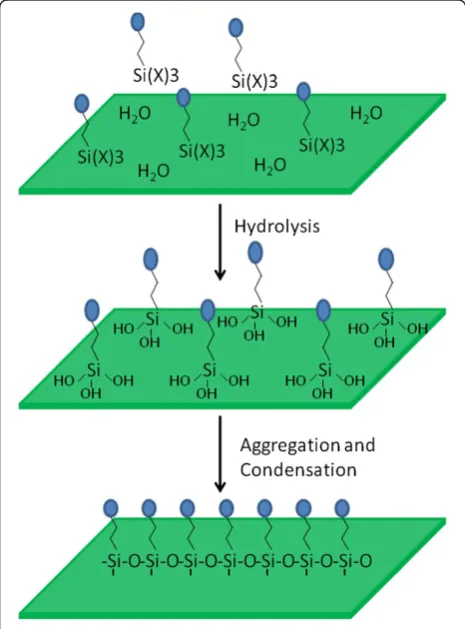
Molecular self-assembly of organosilanes has been proven to be a powerful method to rationally engineer the ceramic oxide surface properties [26-29]. In this process, the organo-silanes are hydrolyzed to create the corresponding hydroxylsilanes on the polar oxide faces, and then, these hydroxylsilanes absorb on the sur-face via hydrogen bond. Aggregation of these hydrogen-bound species, which driven by the attractive van der
Waal’s force between the pendant hydrocarbon chain
and cross-linking between neighboring silanes, as well as condensation between the hydroxylsilanes and the polar oxide surface lead to a closely packed monolayers on the oxide surface (Figure 1) [23]. Using this method, the relative surface coverage of the monolayers can reach 100% [29]. So far, this method has been successfully ap-plied for functionalizing the bulk mesoporous silicas [20,30,31], but application of this method to produce the
monolayer functionalized MSNs with high coverage failed. One possible reason is that the functional mole-cules are very easy transferred out of the pores of MSNs during functionalization process, leading to poor surface coverage.
Here, we extent the self-assembled method toward the generation of self-assembled monolayer functionalize MSNs (SAM-MSNs) and show that the surface coverage of the monolayers can be varied up to 100% within MSNs, as well as retention of ordered structure. As described in the following, various organic monolayers could be assembled onto the porous walls of MSNs using this general method.
Methods
The organosilanes (vinyl-trichlorsilan, propyl-trichlorsi-lan, isobutyl-trichlorosilane, and phenyl-trichlorsilan) were purchased from Sigma-Aldrich Corporation, St. Louis, MO, USA. Other reagents were purchased from Shanghai Zhenxin Reagents Factory, Jiading, Shanghai. Toluene was dried over 10 Å molecular sieves for 10 days and then refluxed over Na for 10 h. Ultrapure water
(σ= 18.2 MΩ cm) was degassed and decarbonated with
argon.
Surface analysis of samples was performed on a Micro-meritics ASAP 2010 analyzer (GA, USA) at the temperature of liquid nitrogen. The surface areas were calculated by the Brunauer-Emmett-Teller (BET) and pore size distribution was measured by Barrett-Joyner-Halenda (BJH) methods. Samples were outgassed at 100°C for 12 h before analysis. The pore volume was taken at a relative pressure of 0.99. Cross-polarized solid
state 29Si NMR experiments were recorded on Bruker
DSX 300 NMR (Bruker Optik Gmbh, Ettlingen, Germany). The following experimental parameters were used: 4.0 KHz spinning frequency, 45opulse width of 2.4 ls, 30 s recycle delay, and 360 scans. Fourier transform infra-red spectroscopy (FTIR) spectra were obtained using a Bruker Vertex70 spectrophotometer using KBr pellets. The transmission electron microscope (TEM) images were obtained from JEOL 2100 operating at 200 kV (Akishima, Tokyo, Japan). The samples were prepared by evaporation of a drop of sample solution on a grid at room temperature.
[image:2.595.57.290.344.659.2]For preparation of organic monolayer functionalized MSNs, MSNs were first prepared according to a reported method [32,33]. Typically, 1 g of cetyltrimethy-lammonium bromide (CTAB) was dissolved in a solution of 480 mL water and 3.5 mL of 2 M NaOH. Mesitylene (7.0 mL) was then added to the solution. The mixture was stirred vigorously at 80°C for 2 h, following which tetraethyl orthosilicate (TEOS) (5.0 mL) was added dropwise. The reaction mixture was stirred for further 2 h at 80°C. The resulting precipitate was collected by
filtration, washed with methanol, and dried under a vac-uum at 100°C for 24 h. The surfactant templates and mesitylene were extracted from the samples using HCl/ methanol solution. A suspension of 1.0 g of the as-synthesized MSNs was stirred for 6 h at 50°C in 100 mL methanol with 0.75 mL concentrated hydrochloric acid. The template-removed product was then collected via filtration and dried under vacuum at100°C for 12 h.
The procedure for functionalization of MSNs with or-ganic monolayers was described as follows: 1 g of MSNs
(1095 m2 of surface area) was suspended in 50 mL of
dried toluene. To this mixture was added 0.33 mL of
water (18.22 mmol, corresponding to 1 × 10¹⁹ water
molecules/m2, just equal to twice the number of silanol groups present on a fully hydroxylated silica surface).19 The suspension was stirred vigorously for 3 h at room
temperature to allow the water to disperse through the mesoporous matrix. Then organic trichlorsilans
(9.11 mmol, corresponding to 5 × 10¹⁸ water molecules/
m2 just equal to the number of silanol groups present
on a fully hydroxylated silica surface) were added via syr-inges, and the mixture was stirred for 12 h at room
temperature under N2. The produces were collected by
filtration, washed with plenty of 2-propanol, and dried under a vacuum.
Results and discussion
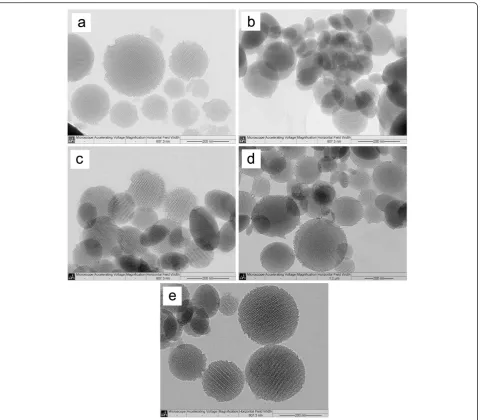
[image:3.595.60.543.297.717.2]To synthesize the SAM-MSNs, the MSNs were first pre-pared. MSNs were synthesized in CTAB/OH, TEOS, and mesitylene solution, which have been reported previ-ously [32,33]. As shown in the Figure 2, MSNs have a particle diameter of 100 to 200 nm and composed of
ordered hexagonal array of mesoporous channels. The nitrogen surface sorption analysis of MSNs gave the BET surface area of 1,095 m2/g−1 and the pore size of 6.5 nm.
SAM-MSNs were synthesized via deposition of organic monolyers on the pore walls of MSNs. First, the surface of MSNs was prehydrated with two monolayers worth of water, followed by treatment with one monolayer worth of organosilanes (based on the available surface area). The organosilanes (vinyl-trichlorsilan, propyl-trichlorsi-lan, isobutyl-trichlorsipropyl-trichlorsi-lan, and phenyl-trichlorsilan) then underwent hydrolysis and became covalently attached to the substrate and cross-linked to one another, generating SAM-MSNs with different organic groups (denoted Vi-SAM-MSNs, Pr-Vi-SAM-MSNs, Is-Vi-SAM-MSNs, and Ph-SAM-MSNs, respectively).
The surface coverage of the functional groups could be estimated by gravimetric analysis [20,31]. Based on the weight change (W%) after functionalization, the sur-face area (SA, 1095 m2/g), the molecular weight (Mn) of the functional groups [OH-Si-(O)-R], and the
assump-tion of 5 × 10¹⁸ silanols per square meter on a fully
hydroxylated silica surface [20,31], surface coverage (X) can be calculated from
X¼ ðW%=MnÞ 6:021023
= SA51018
This gravimetric method of estimating surface cover-age is felt to be accurate within ±10% [31]. It should be mentioned that when this gravimetric method was used to determine the surface coverage, the byproducts (e.g., residual polysiloxanes) trapped within the nano-pores should be excluded. Since only two monolayers worth of water and one monolayer worth of organosilanes (based on the available surface area) were used in preparation of SAM-MSNs, few byproducts within the pores could be expected. This assumption was also confirmed by TEM and BET results, which will be discussed below. The surface coverage could also be calculated from solid state29Si NMR spectroscopy, but this method is less ac-curate than the gravimetric method because of the
signal-to-noise limitation of the solid state 29Si NMR
spectroscopy (accurate within ±15%) [20,31]. Table 1
indicated that the surface coverage was varied from 37% to 100% depending on different organosilanes used.
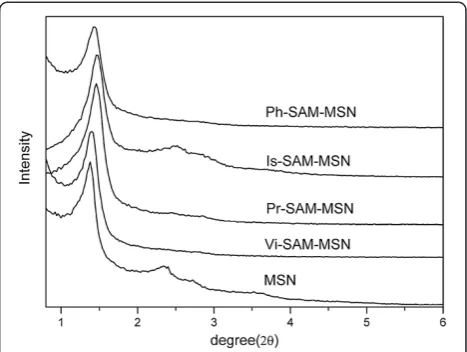
Figure 2 shows the TEM of MSNs and the SAM-MSN samples with different functional groups. It could be found that both MSNs and SAM-MSN samples were comprised of MCM-41-type, hexagonal array of meso-porous channels, suggesting the functionalization of MSNs with organic monolayer did not destruct the order hexagonal array of mesoporous channels. From TEM pictures, no free non-porous silica particles were observed in all SAM-MSN samples. This result con-firmed that all organic functional groups were anchored on the surface of MSNs. The TEM images also show that the pores are still open even though the 100% of full surface was covered by functional groups (Figure 2b). The powder X-ray diffraction pattern (XRD) of SAM-MSNs further confirmed the retention of the hexagonal symmetry of the porous structure (Figure 3) after func-tionalization, as evidenced by the distinctd001peak in all SAM-MSN samples. However, compared with the XRD of pure MSN sample, a lower contrast of XRD and a
slight decrease in the d001 values were observed. This
change in the XRD could be attributed to the covalent linkage of organic groups onto the pore walls [34,35].
[image:4.595.305.539.89.265.2]The nitrogen adsorption-desorption isotherms and BJH pore size distributions for MSNs and SAM-MSNs are shown in Figure 4, the parameters of which are listed
[image:4.595.56.538.639.733.2]Figure 3The XRD spectra of MSN and different SAM-MSNs
Table 1 Properties of different self-assembled monolayer functionalize mesoporous silica nanoparticles (SAM-MAN)
Sample Functional molecules
Weight changes after functionalization
Coverage (%) BET surface
area (m2/g) BJH poresize (nm) Pore volume(cm3/g)
MSN 0 0 1,095 6.5 2.0
Vi-SAM-MSN vinyl-trichlorsilan 81 101 438 4.79 0.5
Pr-SAM-MSN propyl-trichlorsilan 62 65 489 4.63 0.63
Is-SAM-MSN isobutyl-MSN 40 37 582 5.31 0.94
in Table 1. The BET surface area of the functionalized MSNs was about half the value of the pure MSN. The decrease in the surface areas is reasonable because the mass of MSNs increased significantly (by 60% to ap-proximately 100%) after functionalization. The functio-nalization of MSNs also results in the reduction of pore volume and shrinkage of the BJH pore diameter (Table 1), which was ascribed to the lining of pore wall
with the organic functional groups. The BET
characterization shows that all SAM-MSNs show type IV sorption isotherms. These isotherm characterizations
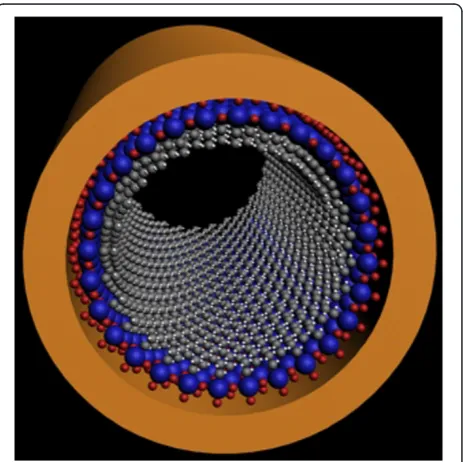
are consistent with the fact that the functional groups were grafted onto the pore walls, and few free polysilox-anes were trapped in the pores (Figure 5) [36,37].
To confirm the grafting of the organosiloxanes onto the pore walls of MSNs, the samples were analyzed by
solid state 29Si NMR and FTIR. The29Si NMR spectra
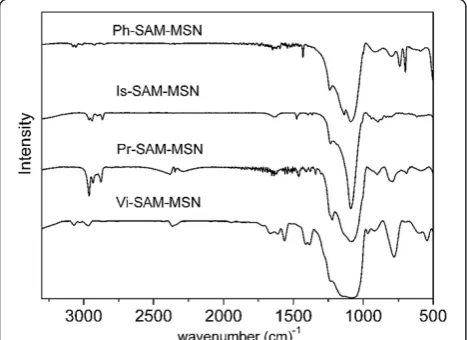
(Figure 6 and Table 2) show the presence of two add-itional peaks, T2and T3[T2= R-Si-(OSi)2(OH), T3= RSi-(OSi)3, R = organic groups] in the functionalized MSNs. These peaks are ascribed to the resonances of the incor-porated organosiloxanes in the functionalized MSNs. FITR spectra further confirmed the functional groups grafted onto MSNs (Figure 7). The peaks around 2,800 to 2,970 cm−1, which were assigned to the aliphatic C-H vibrations, were observed in the Pr- (2,960, 2,930, 2,873 cm−1) and Is- (2,963, 2,939, 2,866 cm−1)
SAM-MAN samples. The alkene C-H vibration (3,067 cm−1)
and C = C stretching vibration (1,570, 1,607 cm−1) were observed in the Vi-SAM-MSN sample. The aromatic
C-H (3,075, 3,055 cm−1) and ring C = C (1,590,
1,432 cm-1) stretching vibrations were clearly observed in Ph-SAM-MSN sample.
The surface coverage and the quality of the organic
functionalized monolayers on MSNs are greatly
[image:5.595.56.294.238.711.2]affected by three facts: the number of absorbed water, reactivity of organosilanes, and the stereochemistry of organosilane. The organic molecules could be anchored onto the mesoporous silica surface through 'direct sila-nation' mechanism, but the population of the organic
Figure 4Nitrogen sorption isotherm (a and b) and BJH pore size distribution of different SAM-MSNs.
[image:5.595.307.539.454.685.2]groups would be limited to the number of surface sila-nols, resulting in a low surface coverage (only 22% of full surface coverage was observed when MSNs reacted with vinyl-trichlorsilan). A proper amount of physically absorbed water is of utmost importance to build the functionalized monolyers on MSNs. This absorbed water provides a hydrated interface to hydrolyze orga-nosilanes, which is one of the critical first steps in the deposition of the monolyers. It was found that only two monolayers worth of water (based on the available surface area) is enough to hydrolyze organosilanes and deposition of functional monolayer. However, excess of water should be avoided because the presence of free water would lead to polymerization of organosilanes in a solution.
The use of trichlorosilanes as functional molecules is necessary for the preparation of SAM-MSNs with high surface coverage. A low surface coverage was obtained (about 20%) when trialkoxyorganosilanes were used for
deposition of monolayers on the MSNs surface, whereas a high surface coverage was possible when trialkoxyorga-nosilanes was used to functionalize the bulk mesoporous silica. The reason for this different behavior might be that the functional molecules are very easy to be trans-ferred out of the pores of MSNs during the functionali-zation process. So, a functional molecule with a higher activity is essential to be hydrolyzed and deposited on the pore walls of MSNs. Trichlorosilanes show higher active toward the absorbed water than trialkoxyorganosi-lanes. Especially, the hydrolysis of trichlorosilanes gener-ates HCl which can greatly enhance the condensation reaction between neighboring silanes, as well as between the hydroxylsilanes and the polar oxide surface,24leading to closely packed monolayers on the oxide surface.
The stereochemistry of organosilane is another elem-ent that significantly affects the surface coverage of the organic functionalized monolayers on SMNs. The vinyl and phenyl-based organosilanes with a short alkane chain generated SAM-MSNs with high surface coverage (100% and 80%, respectively), whereas a relatively low surface coverage (approximately 65%) was obtained when the propyl-based organosilane with a longer alkane chain was used. Isobutyl-trichlorosilane generated the lowest surface coverage (37%). The reason might be that the side methyl groups blocked the condensation reac-tion between neighboring silanes, resulting in less func-tional molecules deposition on the MSN surface.
Conclusions
[image:6.595.57.291.88.262.2]The SAM-MSNs were synthesized, and the relative sur-face coverage of the organic monolayers can reach up to 100%. It was found that an appropriate level interfacial hydration, the use of trichlorosilanes as functional molecules, and the functional groups with less steric hindrance are essential to generate MSNs with high sur-face coverage of monolayers. The functional monolayers provide special attributes (such as binding sites, stereo-chemical configuration, and special interface properties) for mesoporous silica surface. We believed that the combination of unique structure of MSNs and functio-nalized monolayers can extend the use of MSNs to a wide array of applications (such as adsorption, sensing, catalysis, and drug delivery) and also benefit the
[image:6.595.304.539.112.195.2]Figure 629Si -MAS NMR spectra of the different SAM-MSNs.
Table 2 Cross-polarized solid state29Si-MAS NMR
spectroscopy data of SAM- MSNs Sample chemical shift (ppm)
Q4 Q3 T3 T2
Vi-SAM-MSN Q4 Q3 T3 T2
Pr-SAM-MSN −110 −101 −79 −70
Is-SAM-MSN −110 −101 −66 −57
Ph-SAM-MSN −110 −101 −57 −48
[image:6.595.57.291.532.702.2]development of new generation of sophisticated func-tional nanocomposites.
Abbreviations
BET: Brunauer-Emmett-Teller; BJH: Barrett-Joyner-Halenda;
CTAB: cetyltrimethylammonium bromide; FTIR: Fourier transform infrared spectroscopy; Is-SAM-MSNs: isobutyl-functionalized MSNs; MSNs: mesoporous silica nanoparticles; Ph-SAM-MSNs: phenyl-functionalized MSNs; Pr-SAM-MSNs: propyl-functionalized MSNs; SAM-Pr-SAM-MSNs: self-assembled monolayer functionalize MSNs; TEM: transmission electron microscope; TEOS: tetraethyl orthosilicate; Vi-SAM-MSNs: vinyl-functionalized MSNs; XRD: X-ray diffraction pattern.
Competing interests
The authors declare that they have no competing interests.
Authors’contributions
LMW designed the experiment and wrote the manuscript. LMW, DWS, and PYY carried out experiments. ZHZ helped analyze the characterization results. JW, JZ, LYL, CXC, and YFZ characterized the samples and analyzed the data. All authors read and approved the final manuscript.
Authors’information
LMW is currently an associated professor at Shanghai Jiaotong University, China. His research interests include preparation of carbon-based
nanomaterilas and their use for in sensors and energy storage. DWS received her B.Sc. degree in the School of Materials Science and Engineering from Shanghai Jiao Tong University (China) and is currently doing her Graduate thesis in Prof Zhang's group in Research Institute of Micro/Nano Science and Technology, Shanghai Jiao Tong University. Her research focus includes carbon nanomaterials for application in sensors and energy storage. ZHZ received his PhD degree in the Shanghai Jiao Tong University. He is now an assistant professor at the University of Electronic Science and Technology of China. His research focus includes nanomaterials for application in solar cells and energy storage. We are grateful for the financial support from the National Natural Science Foundation of China (No. 51272155), National High-Tech R & D Program of China (863, No. 2011AA050504), and the Analytical and Testing Center of SJTU. His research focus now includes the preparation of CNT and CNT field emission display. LYL is an assistant professor at Shanghai Jiao Tong University. Her research focus is characterization of nanomaterials. CXC is currently an associated professor at Shanghai Jiaotong University, China. His research interests include preparation of carbon-based nanomaterilas and their use for in sensors and energy storage. YFZ is currently a professor at Shanghai Jiaotong University, China. His research interests include synthesis of gas-sensing nanomaterials and their applications in nanodevice.
Acknowledgments
We are grateful for the financial support from the National Natural Science Foundation of China (No. 20504021, 50730008, 61006002, 60871032), The Fund of Defence Key Laboratory of Nano/Micro Fabrication Technology, the Natural Science Foundation of Shanghai (No. 10ZR1416300), Shanghai Science and Technology Grant (No. 1052 nm05500), National High-Tech R & D Program of China (863, No.2011AA050504), SMC Excellent Young Faculty Project of 'ChenXing Scholar', the U-M/SJTU Collaborative Research Program, and the Analytical and Testing Center of SJTU.
Author details
1
Key Laboratory for Thin Film and Microfabrication of Ministry of Education, Institute of Micro and Nano Science and Technology, Shanghai Jiao Tong University, Shanghai 200240, China.2State Key Laboratory of Electronic Thin Film and Integrated Devices, School of Microelectronics and Solid-state Electronics, University of Eectronic Science and Technology of China, Chengdu 610054, China.3School of Materials Science and Engineering, Shanghai Jiao Tong University, Shanghai 200240, China.4School of Chemistry and Chemical Engineering, Shanghai Jiao Tong University, Shanghai 200240, China.
Received: 22 May 2012 Accepted: 24 May 2012 Published: 21 June 2012
References
1. Kresge CT, Leonowicz ME, Roth WJ, Vartuli JC, Bech JS:Ordered mesoporous molecular sieves synthesized by a liquid-crystal template mechanism.Nature1992,359:710–712.
2. Beck JS, Vartuli JC, Roth WJ, Leonowicz ME, Kresge CT, Schmitt KD, Chu CTW, Olson DH, Sheppard EW:A new family of mesoporous molecular sieves prepared with liquid crystal templates.J Am Chem Soc1992,
114:10834–10843.
3. Qi LM, Ma JM, Cheng HM, Zhao ZG:Micrometer-sized mesoporous silica spheres grown under static condition.Chem Mater1998,10:1623–1626. 4. Huo QS, Zhao DY, Feng JL, Weston K, Buratto SK, Stuck GD, Schacht S,
Schuth F:Room temperature growth of mesoporous silica fibers: a new high-surface-area optical waveguide.Adv Mater1997,9:974–978. 5. Zhao DY, Yang PD, Melosh N, Feng JL, Chmelka BF, Stucky GD:Continuous
mesoporous silica films with highly ordered large pore structures.Adv Mater1998,10:1380–1385.
6. Li YS, Shi JL, Hua ZL, Cheng HR, Ruan ML, Yan DS:Hollow spheres of mesoporous aluminosilicate with a three-dimensional pore network and extraordinarily high hydrothermal stability.Nano Lett2003,3:609–612. 7. Slowing II, Trewyn BG, Giri S, Lin VS-Y:Mesoporous silica nanoparticles for
drug delivery and biosensing applications.Adv Mater2007,17:1225–1236. 8. Hong C, Lee JK, Zheng HM, Hong SS, Lee C:Porous silicon nanoparticles
for cancer photothermotherapy.Nanoscale Rese Lett2011,6:321. 9. Mohanty P, Landskron K:Simple systematic synthesis of periodic
mesoporous organosilica nanoparticles with adjustable aspect ratios.
Nanoscale Rese Lett2009,4:1.
10. Lu J, Liong M, Zink JI, Tamanoi F:Mesoporous silica nanoparticles as a delivery system for hydrophobic anticancer drugs.Small2007,
3:1341–1346.
11. Tao ZM, Xie YW, Goodisman J, Asefa T:Isomer-dependent adsorption and release of cis- and trans-platin anticancer drugs by mesoporous silica nanoparticles.Langmuir2010,26:8914–8924.
12. Strømme M, Atluri R, Brohede U, Frenning G, Garcia-Bennett AE:Proton absorption in as-synthesized mesoporous silica nanoparticles as a structure-function relationship probing mechanism.Langmuir2009,
25:4306–4310.
13. Du X, He JH:Hierarchically mesoporous silica nanoparticles: extraction, amino-functionalization, and their multipurpose potentials.Langmuir
2011,27:2972–2979.
14. Wan XJ, Wang D, Liu SY:Fluorescent pH-sensing organic/inorganic hybrid mesoporous silica nanoparticles with tunable redox-responsive release capability.Langmuir2010,26:15574–15579.
15. Lu F, Wu SH, Hung Y, Mou CY:Size effect on cell uptake in well-suspended, uniform mesoporous silica nanoparticles.Small2009,
5:1408–1413.
16. Qi ZM, Honma I, Zhou H:Ordered-mesoporous-silica-thin-film-based chemical gas sensors with integrated optical polarimetric interferometry.
Appl Phy Lett2006,88:053503/1-053503/3.
17. Ren J, Ding J, Chan KY, Wang H:Dual-porosity carbon templated from monosize mesoporous silica nanoparticles.Chem Mater2007,
19:2786–2795.
18. Hoffmann F, Cornelius M, Morell J, Fröba M:Silica-based mesoporous organic–inorganic hybrid Materials.Angew Chem Int Edt2006,
45:3216–3251.
19. Giraldo LF, López BL, Pérez L, Urrego S, Sierra L, Mesa M:Mesoporous silica applications.Macromol Symp2007,258:129–141.
20. Feng X, Fryxell GE, Wang LQ, Kim AY, Liu J, Kemner KM:Functionalized monolayers on ordered mesoporous supports.Science1997,276:923–926. 21. Kobler J, MÖller K, Bein T:Colloidal suspensions of functionalized
mesoporous silica nanoparticles.ACS Nano2008,2:791–799. 22. Ma YH, Xing L, Zheng HQ, Che SA:Anionic−cationic switchable
amphoteric monodisperse mesoporous silica nanoparticles.Langmuir
2011,27:517–520.
23. Fryxell GE, Mattigod SV, Lin Y, Wu H, Fiskom S, Parker K, Zheng F, Yantasee W, Zemanian TS, Addleman RS, Liu J, Kemner K, Kelly S, Feng X:Design and synthesis of self-assembled monolayers on mesoporous supports (SAMMS): the importance of ligand posture in functional nanomaterials.
J Mater Chem2007,17:2863–2874.
25. Descalzo AB, Jimenez D, Marcos MD, Martínez-Máñez R, Soto J, Haskouri JE, Guillém C, Betrán D, Amorós P, Borrachero MV:A new approach to chemosensors for anions using MCM-41 grafted with amino groups.Adv Mater2002,14:966–969.
26. Victor C, Richard MC, Charles MS:Reactions and reactivity in self-assembled monolayers.Adv Mater2000,12:1161–1171.
27. Crooks RM:New organic materials suitable for use in chemical sensor arrays.Acc Chem Res1998,5:219–227.
28. Christen K:Novel nanomaterial strips contaminants from waste streams.
Environ Sci Technol2004,38:453A–454A.
29. Liu J, Feng XD, Glen E, Fryxell GE, Wang LQ, Kim AY, Gong ML:Hybrid Mesoporous Materials with Functionalized Monolayers.Adv Mater1998,
10:161–165.
30. Chow BY, Mosley DW, Jacobson JM:Perfecting imperfect“monolayers”: removal of siloxane multilayers by CO2snow treatment.Langmuir2005, 21:4782–4785.
31. Zemanian TS, Fryxell GE, Liu J, Mattigod S, Franz JA, Nie Z:Deposition of self-assembled monolayers in mesoporous silica from supercritical fluids.
Langmuir2001,17:8172–8177.
32. Slowing II, Trewyn BG, Lin VSY:Mesoporous silica nanoparticles for intracellular delivery of membrane-impermeable proteins.J Am Chem Soc
2007,129:8845–8849.
33. Wei LM, Zhang YF:Emulsion polymerization of ethylene from mesoporous silica nanoparticles with vinyl functionalized monolayers.
J Polym Sci: Part A: Polym Chem2009,47:1393–1402.
34. Lai CY, Trewyn BG, Jeftinija DM, Jeftinija K, Xu S, Jeftinija S, Lin VSY:A mesoporous silica nanosphere-based carrier system with chemically removable CdS nanoparticle caps for stimuli-responsive controlled release of neurotransmitters and drug molecules.J Am Chem Soc2003,
125:4451–4459.
35. Slowing II, Trewyn BG, Lin VS-Y:Effect of surface functionalization of MCM-41-type mesoporous silica nanoparticles on the endocytosis by human cancer cells.J Am Chem Soc2006,128:14792–14793.
36. Wei LM, Tang T, Huang BT:Novel acidic porous clay heterostructure with highly ordered organic–inorganic hybrid structure: one-pot synthesis of mesoporous organosilica in the galleries of clay.Micropor Mesopor Mater
2004,67:175–179.
37. Zhang L, Qiao SH, Jin YG, Chen ZG, Gu HC, Lu GQ:Magnetic hollow spheres of periodic mesoporous organosilica and Fe3O4nano crystals: fabrication and structure control.Adv Mater2008,20:805–809.
doi:10.1186/1556-276X-7-334
Cite this article as:Weiet al.:Functionalized self-assembled monolayers on mesoporous silica nanoparticles with high surface coverage.
Nanoscale Research Letters20127:334.
Submit your manuscript to a
journal and benefi t from:
7Convenient online submission
7Rigorous peer review
7Immediate publication on acceptance
7Open access: articles freely available online
7High visibility within the fi eld
7Retaining the copyright to your article