N A N O E X P R E S S
Open Access
Magneto-Sensitive Adsorbents Modified by
Functional Nitrogen-Containing Groups
Inna V. Melnyk
1*, Karolina Gdula
2, Andrzej D
ą
browski
2and Yuriy L. Zub
1Abstract
In order to obtain amino-functionalized silica materials with magnetic core, one-step synthesis was carried out. Several materials, differ in number and structure of amino groups, were synthesized on the basis of sol-gel method. The synthesized materials were examined by several analytical techniques. The presence and content of amino groups were measured by using Diffuse Reflectance Infrared Fourier Transform (DRIFT) spectroscopy and acid-base titration, respectively. Specific surface areas were measured by nitrogen/adsorption desorption isotherms. It was proved that sol-gel approach leads to obtain materials with high content of amino groups built into their surfaces (in the range 1.6–2.7 mmol/g). As-obtained materials were tested as potential adsorbents for copper(II) ions. The received maximum adsorption capacities were in the range 0.4–0.7 mmol/g.
Keywords: Magnetite nanoparticles, Polysiloxane shells, Nitrogen-containing functional groups, Copper(II) ions adsorption
Background
A number of industrial enterprises have increased sig-nificantly with the simultaneously development of soci-ety. Consequently, a lot of hazardous compounds, such as heavy metal ions or pharmaceuticals, enter into the natural environment. Thus, there is a need to remove those substances from natural environment. Therefore, modern methods which are characterized by high effi-ciency, environmentally safe and are relatively inexpen-sive, should be proposed to remove such substances, especially from water and wastewaters. To separate heavy metal ions from aqueous solutions, a lot of methods based on using nanocomposites of magnetite are used [1, 2]. Many papers are devoted to the removal of copper ions [3–5], lead [4–6], cadmium [4, 5], and so on. From the one hand, using the magnetic nanoparti-cles coated with functionalized silica materials allows to adsorb onto their surface many organic or inorganic compounds; on the other hand, separation of adsorbent with the adsorbed compounds from solution can be eas-ily carried out by using permanent magnet.
In the literature, many variety of methods, describing coating Fe3O4 nanoparticles, can be found, e.g., direct
modification of magnetite by amino-containing silanes [5, 7] and magnetite coated with polysiloxane layer and their further modification by amino containing silane [3, 4, 8, 9] as well as one-step technique using tetraethoxysi-lane and N-containing sitetraethoxysi-lanes [10, 11]. The first method does not allow to obtain tight and continuous layer cov-ered magnetite nanoparticles. What is more, such approach does not result in the introduction of large amounts of amino groups into silica structure, and in consequence, leads to obtain very small adsorption prop-erties of final materials. While the second method some-times includes many steps and requires using very expensive reagents, the third method is a one-step tech-nique and if it is necessary, allows introducing more than one functional group, differing in their chemical nature (Table 1). In this work, we proposed one-step synthesis for obtaining functionalized magnetic silica materials. Such materials were tested as effective adsor-bents of copper(II) ions from aqueous solutions.
Methods
Chemicals and Reagents
Iron(II) chloride, FeCl2∙4H2O (Sigma-Aldrich, 99 %);
iro-n(III) chloride, FeCl3∙6H2O (Sigma-Aldrich, 98 %);
* Correspondence:[email protected]
1Department of Surface Chemistry of Hybrid Materials, Chuiko Institute of
Surface Chemistry, National Academy of Sciences of Ukraine, 17, General Naumov str., Kyiv 03164, Ukraine
Full list of author information is available at the end of the article
ammonium hydroxide, NH4OH (Aldrich, 25 % aqueous
so-lution); tetraethoxysilane, Si(OC2H5)4 (TEOS, Aldrich,
98 %); 3-aminopropyltriethoxysilane, (C2H5O)3Si(CH2)3
NH2 (APTES, Aldrich, 99 %); methyltriethoxysilane,
(C2H5O)3SiCH3(MTЕS, Aldrich, 99 %);
n-propyltriethoxy-silane, (C2H5O)3Si(CH2)2CH3(PTES, Fluka, 97 %);
N-[3-tri-methoxysilylpropуl]ethylendiamine, (CH3O)3Si(CH2)3NH
(CH2)2NH2(TMPED, Aldrich, 97 %);
bis[3-(trimethoxysilyl-propyl)]amine [(CH3O)3Si(CH2)3]2NH (BTMPA, Aldrich,
90 %); ethanol, C2H5OH (EtOH, 96 %); and ammonium
fluoride, NH4F (analytical grade, Reahim, Ukraine) were
used as received, without further purification.
Copper(II) nitrate, Cu(NO3)2∙3Н2О(Merck, 99.5 %).
Am-monium chloride, NH4Cl; sodium nitrate, NaNO3; sodium
chloride, NaCl (chemically pure, Macrochem, Ukraine). Nitric acid, HNO3; hydrochloric acid, HCl; sodium
hydrox-ide, NaOH; ethylenediaminetetraacetic acid EDTA, C10H16N2O8 (fixanal concentrates, Cherkasy State
Chem-ical Plant, Ukraine). Methyl orange, C14H14N3NaO3S
(ana-lytical grade, Reahim, Ukraine); and murexide, C8H8N6O6
(analytical grade, Reahim, Ukraine) were used.
Syntheses
Each of examined amino-functionalized silica adsorbents with magnetic core was synthesized on the basis of sol-gel procedure, which is detailed described in papers [10, 11]. The magnetite nanoparticles were obtained by co-precipitation of iron(II) and (III) salts in a basic medium, reported by [12]. Briefly, iron chlorides(II) and (III) (in molar ratio: Fe2+/Fe3+= 1/2) were dissolved in 450 mL of distilled water at 80 °C, under nitrogen flow. Next, 50 mL of ammonia solution was slowly added to the mixture. The black magnetite precipitate was produced in a few seconds and kept under 80 °C and mechanical stirring, during 30 min. After this time, the heating was switched off, and in 10 min more, the stirrer was also switched off. After cooled to the room temperature, the magnetic nano-particles were separated from solution by decantation on permanent neodymium magnet. In order to remove unreacted reactants, the magnetite particles were cleaned by repeated cycles of water, to obtain final pH = 6.
In order to prepare silica layers onto as-prepared mag-netite nanoparticles, sol-gel procedure was employed. This method is based on hydrolysis and condensation of TEOS and a proper functional monomer (having amino groups), in the presence of catalyst. In order to prepare various materials differing in both, type and amount of amino groups built in the adsorbent structure, and pres-ence of additional aliphatic chain, five different materials were synthesized (three single- and two bifunctional). The resulting samples were labeled as follows: Fe3O4/
TEOS/APTES—A, Fe3O4/TEOS/APTES/MTES—AM,
Fe3O4/TEOS/APTES/PTES—AP, Fe3O4/TEOS/TM
PED—DA, and Fe3O4/TEOS/BTMPA—BA. Briefly,
[image:2.595.58.292.111.221.2]0.75 g of magnetite nanoparticles was placed into the three-neck flask and dispersed in 62.5 mL of distilled water. To ensure better particle dispersion, ultrasound treatment was used. In a separate beaker, calculated
Table 1Composition of initial reactants and properties of magneto-sensitive adsorbents
Sample Functional groups Molar ratio of componentsFe3O4/
TEOS/N-silane/R-silane
Cf.gr.,
mmol/ g
Ssp.,
m2/ g A ≡Si(CH2)3NH2 1/15.5/2.7 2.2 122
AM ≡Si(CH2)3NH2/≡SiCH3 1/15.5/1.3/1.3 1.6 29
AP ≡Si(CH2)3NH2/
≡Si(CH2)2CH3
1/15.5/1.3/1.3 1.6 43 DA ≡Si(CH2)3NH(CH2)2NH2 1/15.5/2.7 2.7 160
BA [≡Si(CH2)3]2NH 1/15.5/2.7 1.9 33
Cf.gr.—concentration of amino groups present in adsorbent structure; Ssp.—specific surface area; N-silane—functional monomer having amino
groups; R-silane—functional monomer having aliphatic chains
Fig. 1DRIFT spectra of pristine samples and with adsorbed copper(II) ions (100 °C)
[image:2.595.57.541.537.714.2]amount of a proper functional monomer was mixed with ethanol (3 mL) and ammonium fluoride (1.9 mL of 1 % aqueous solution), acting as a catalyst role. After 5 min, the monomer solution was added to magnetite nanoparti-cles and stirred during 5 min. Next, 11.3 mL of TEOS was added dropwise. The stirring was continued during 6 h. After this time, the reaction was completed. In order to remove unreacted compounds and impurities, the amino-functionalized silicas with magnetic core were cleaned by repeated cycles of decantation on the magnet and redis-persion in distilled water, (3 × 50 mL) and ethanol (2 × 50 mL). As-prepared adsorbents were dried overnight in the oven at 100 °C. In the case of bifunctional samples (AM and AP), mixtures of initial monomers were mixed with ethanol in two separate beakers.
Characterization
The diffuse reflectance infrared Fourier transform (DRIFT) spectra were recorded on the Thermo Nicolet Nexus FT-IR at 4 cm−1 resolution, using the special thermal vacuum adapter “Collector II” at 100 °C. The samples were mixed with KBr (1:20).
The nitrogen adsorption/desorption isotherms for all the samples were measured on the “Kelvin-1042”
adsorption analyzer (Costech Microanalytical). Before the measurements, the samples were degassed at 110 °C, in the helium atmosphere. The BET specific surface area [13] was evaluated in the 0.03–0.35 range of relative pressures.
The content of amino groups was determined by acid-base titration. Batches of the samples (0.05 g) were treated with a 0.1 M HCl solution (20 mL) for 6 h. The precipitates were removed by a magnet, and supernatant was titrated with 0.1 M NaOH, in the presence of indi-cator (methyl orange) [14]. Concentration of the amino groups was determined from the difference between the content of protons in solution before and after sorption.
Cu(II) Adsorption Experiments
The batch mode processing was used to examine ad-sorption of Cu(II) ions. In every experiment, 0.01 g of adsorbent and 10 mL of copper(II) water solution (in the range of 0.15–15 mmol/L) were contacted for 3 h, at 25 °C, except for the kinetic research, where the contact time was different for each experiment (5–180 min). The ionic strength was maintained by adding 1 M NaNO3 solution. Metal concentration in aqueous
solu-tion was determined by direct titrasolu-tion of metal ions by
Fig. 2Kinetic curves (a) and adsorption isotherms (b) of Cu(II) ions on magnetite nanoparticles, functionalized with N-containing groups
[image:3.595.62.540.88.273.2] [image:3.595.64.538.602.713.2]EDTA solution (in the range of 0.0125–0.025 M), in am-moniac buffer and murexide as complexometric indica-tor [15]. The adsorption capacities were calculated according to the following equation:
A¼ ðC0CeqÞ⋅V=m
where A—adsorption capacity (in mmol/g), C0 and
Ceq—initial and equilibrium concentration of Cu(II) ions (in mmol/L), V—total volume of the solution (in L),
m—mass of the adsorbent (in g).
Results and Discussion
The magnetite nanoparticles (Fe3O4) were obtained by
co-precipitation of iron(II) and (III) salts in a basic medium, under a nitrogen atmosphere [12]. Five differ-ent magnetic amino-functionalized silica-based materials were synthesized and tested as potential adsorbents for copper(II) ions. Each of examined adsorbents was syn-thesized on the basis of sol-gel procedure, which is detailed described in papers [10, 11]. In order to com-pare sorption measurements, three different monomers containing different number and structure of amino groups were used to modify surface of magnetic silica materials (Table 1).
The presence of functional groups was confirmed by IR spectroscopy, and their content was calculated using acid-base titration (Table 1). The results obtained by acid-base titrations are very close to those published
previously [10, 11]. The small differences in the content of amino group values could be attributed by the nature of sol-gel procedure, in which a number of synthesis fac-tors can influence on the properties of the final material. Therefore, such small deviations may fit in a limit of error. What is more, the obtained materials were exam-ined by nitrogen adsorption/desorption measurements. In the Table 1, values of specific surface area (Ssp) are
presented. As before, the values of Ssp are very similar,
when compared with the previous results [10, 11]. Small deviations in the values of Ssp may be caused by
meas-urement error or small differences in the structure of materials, obtained by sol-gel method.
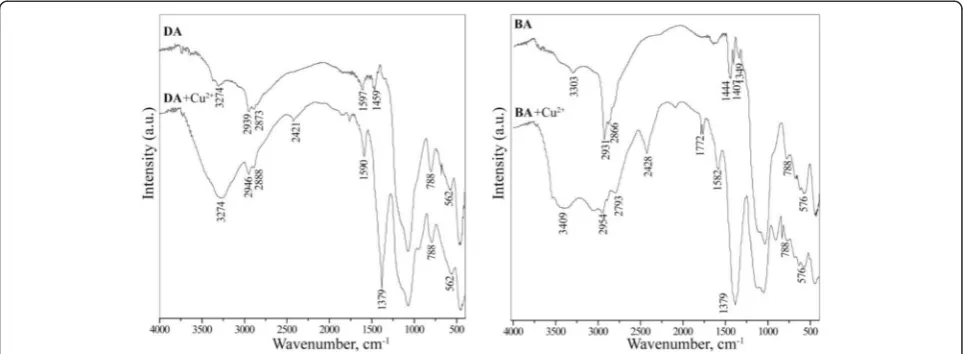
DRIFT spectra were recorded by heating the samples to 100 °C, in order to remove adsorbed water, which absorption bands overlap the absorption bands of amino groups (Fig. 1). In all DRIFT spectra, intense and broad absorption band, in the region 550–580 cm−1, corre-sponds to ν(FeO), can be observed. In addition, the DRIFT spectra of the samples with polysiloxane layer contain an intense absorption band with high-frequency shoulder in the region of 1000–1200 cm−1, which is characteristic of the νas(SiOSi) stretching vibrations. In
the DRIFT spectra of the samples A and DA, the absorp-tion band at 1590–1597 cm−1, corresponding to δ(NH2)
bending of the amino groups, is clearly visible. In addition, at 3270–3370 cm−1, two low-intensity absorption bands belonging toνs,as(NH) of amino groups are observed. The
[image:4.595.60.539.99.196.2]presence of propyl chains (Si–CH2CH2CH2–N) in the
Table 2Kinetic adsorption parameters obtained by using pseudo-first- and pseudo-second-order models for Cu(II) adsorption
Adsorbent Pseudo-first orderln (aeq−at) = lnaeq−k1t Pseudo-second ordert/at= 1/(k2 aeq 2
) +t/aeq
k1 R2 aeq k2 R2
A 0.039 ± 0.01 0.954 0.381 ± 0.038 0.122 ± 0.039 0.957 AM 0.045 ± 0.001 0.844 0.268 ± 0.009 0.122 ± 0.048 0.949 AP 0.026 ± 0.005 0.993 0.476 ± 0.047 0.307 ± 0.047 0.988 DA 0.014 ± 0.001 0.969 0.54 ± 0.003 1.996 ± 0.599 0.999 BA 0.006 ± 0.001 0.846 0.73 ± 0.114 0.061 ± 0.031 0.915
atandaeq—the amounts of adsorbed Cu(II) ions, at time (t) and (at) equilibrium (in mmol/g);k1andk2—the rate constants of pseudo-first-order (in min−1) and
pseudo-second-order adsorption process (in g/mmol/min)
Table 3Parameters of copper(II) adsorption calculated from Langmuir and Freundlich isotherm models
Adsorbent Langmuir isothermaC
eq/aeq= 1/(KL am) + (1/am) Ceq Freundlich isothermblgaeq= lgKF+ (1/n) lgCeq
am, mmol/g KL, L/mmol R 2
KF R
2
A 0.452 1.358 0.958 0.232 0.966 AM 0.345 1.123 0.989 0.142 0.969 AP 0.487 0.336 0.862 0.149 0.846 DA 0.591 1.111 0.981 0.308 0.924 BA 0.712 4.198 0.997 0.453 0.978
a
aeq—the amount of solute adsorbed in the same condition (in mmol/g);KL—the Langmuir’s constant characterizing the adsorption energy;Ceq—the
concentration of solute remaining in solution after equilibrium to be reached (in mmol/L);am—the maximum adsorption capacity in the monolayer ba
eq—the amount of solute adsorbed (in mmol/g);KF—the Freundlich’s constant, maximum adsorption capacity (in mmol/g); 1/n—the Freundlich’s constant
characterizing the intensity of adsorption;Ceq—the concentration of solute remaining in solution after equilibrium (in mol/L)
[image:4.595.55.539.602.698.2]DRIFT spectra is indicated by a group of absorption bands of weak intensity in the region 1340–1470 cm−1: ~1349, ~1407 cm−1 (weak), and ~1444-66 cm−1, which can be attributed to (CH2),δ(Si–CH2), and δas(CH2),
respect-ively. Two absorption bands of medium intensity in the region 2850–2940 cm−1 are characteristic of symmetric and asymmetric stretching vibrations of C-H bonds. In addition, the DRIFT spectrum of the sample with amino/ methyl groups (AM, not presented here) has sharp absorption band at 1273 cm−1, which is absent in the DRIFT spectra of other samples and can be attributed to δs(CH3) of methyl group bond to a silicon atom [16].
IR results, obtained from IR spectroscopy, clearly show that the surface of the obtained Fe3O4particles is coated
by polysiloxane layers with amino-containing functional groups.
Kinetic experiments were performed to estimate the equilibrium time needed to adsorption of Cu(II) ions onto synthesized materials (Fig. 2a). As it is shown in Fig. 2a, adsorption of Cu(II) occurs in two steps for A, AM, BA, and AP samples. The first step involves a rapid metal uptake within the first 30 min of contact. It have to been noticed that the highest value of thek2constant
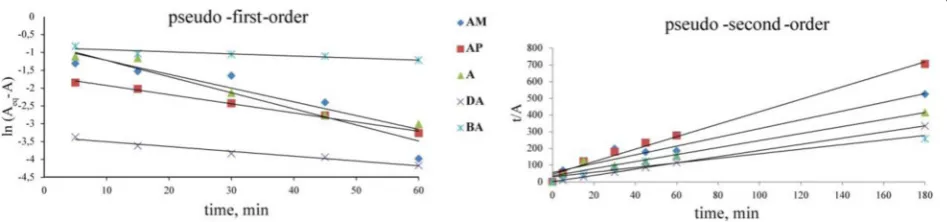
and the correlation coefficient is for DA sample. A high content of amino groups ensures almost 98 % of cop-per(II) ion adsorption from the first minutes. To ensure reaching the equilibrium, the contact time between adsorbent and Cu(II) solutions was set to 3 h. In order to analyze the Cu(II) adsorption kinetics, pseudo-first-and pseudo-second-order equations, as kinetic models [17], were calculated (Fig. 3, Table 2). It can be seen that aeqcalculated by the equation of pseudo-second order is
close to the experimental one. The high values of correl-ation coefficients for pseudo-second-order equcorrel-ation show that the removal of Cu(II) ions by functionalized magnetic materials could be attributed to chemisorption. The adsorption isotherms and calculated values, using Langmuir [18] and Freundlich [19] isotherm equations, are shown in Fig. 2b and Table 3. While the Langmuir the-ory assumes that the adsorption is located on identical and energetically homogeneous and equivalent sites, the Freundlich theory treats about heterogeneous nature of adsorbent surface. The high correlation coefficients indi-cate that the obtained results fitted better to the Langmuir isotherm.
In addition, DRIFT spectra were obtained and analyzed before and after adsorption of copper(II) ions (Fig. 1). As it is seen from the IR spectra, at the 3150–3250 cm−1 re-gion, there are visible absorption bands (even when heated sample), characteristic for stretching vibrations of coordinated 3-aminopropyl groups. An intense absorp-tion band at ~1371 cm−1 relating to fluctuations anion NO3−can be observed [20]. It is worth to noticed that, in
[image:5.595.60.540.86.264.2]Fig. 4Demonstration of sorption experiment with the sample BA
Table 4Comparative characteristic of the magnetite/amine-containing composites
Sample Cf.gr., mmol/g SSC, mg/g (Cu2+) References
2 N-MSM-e 4.04 32 [3] Fe3O4@SiO2–
NH2
1.61 29.8 [4] Fe3O4/γ-АПС 4.6 [5]
APTES-NPs 0.69 8.55 [7] Magnetic
chitosan nanoparticle
35.5 [21]
MNP-NH2 25.8 [22]
[image:5.595.57.290.522.731.2]the case of samples with adsorbed Cu(II) ions, an ab-sorption band of deformation vibrations of amino groups is shifted toward to the lower frequency region.
[image:6.595.305.537.124.701.2]It is known that copper(II) ions can form complexes with amino groups as rule 1:2. If in our case we suggest the formation of such complexes, we can calculate, for all samples, that the part of groups is not involved in complexation, but they are still available for protons. It could be connected with the particles specific structure with the surface layers and groups, located on their surface.
Figure 4 shows the process of adsorption of copper(II) ions from aqueous solution by BA sample. These photos show adsorption properties of functionalized magnetite sample in relation to copper(II) ions and the preserva-tion of the magnetic properties of the adsorbent even after functionalization process.
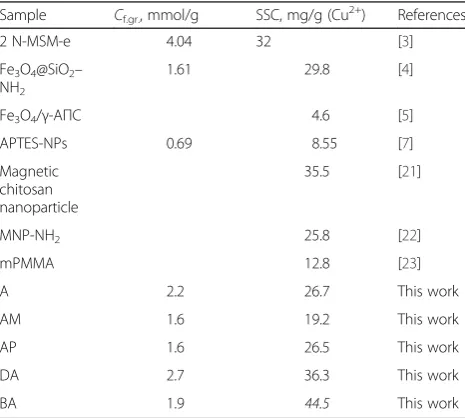
In Table 4, comparative characteristics of magnetite composite materials as copper(II) ions adsorbents are summarized. The results presented in this paper indicate that the best adsorption capacity has the sample BA and others materials, synthesized by our research group, when compared to the other references.
Conclusions
Adsorption properties of magneto-sensitive materials in relation to copper(II) ions were studied. It was shown that the amount of adsorbed metal ions depends on the number of functional groups present in the structure of the adsorbent, as well as on their nature. The best ad-sorption properties showed material functionalized with monomer having secondary amine group (BA), while the fast adsorption kinetic shows sample functionalized with ethylenediamine (DA). Thus, the synthesized materials can be used as efficient adsorbents of Cu(II) ions from aqueous solutions.
Competing Interests
The authors declare that they have no competing interests.
Authors’Contributions
IM and YZ set the objectives of the study. KG and IM synthesized the materials, studied their properties, and carried out sorption experiment and calculations based on the sorption data. KG, IM, YZ, and AD discussed, interpreted, and generalized the results. All authors read and approved the final manuscript.
Acknowledgements
IM is grateful to Programme SASPRO 3rd call, grant agreement no. 1298/03/ 01, and KG is grateful to People Programme (Marie Curie Actions) of the FP7/2007-2013/ under REA, grant agreement no. PIRSES-GA-2013-612484 for the financial support of the work.
Author details
1Department of Surface Chemistry of Hybrid Materials, Chuiko Institute of
Surface Chemistry, National Academy of Sciences of Ukraine, 17, General Naumov str., Kyiv 03164, Ukraine.2Faculty of Chemistry, Maria
Curie-Sklodowska University, 3, Maria Curie-Sklodowska Sq., Lublin 20-031, Poland.
Received: 30 November 2015 Accepted: 21 January 2016
References
1. Suleiman JS, Hu B, Peng H, Huang C (2009) Separation/preconcentration of trace amounts of Cr, Cu and Pb in environmental samples by magnetic solid-phase extraction with Bismuthiol-II-immobilized magnetic nanoparticles and their determination by ICP-OES. Talanta 77:1579–1583 2. Goncharuk VV, Radovenchyk VM, Gomelia MD. Obtaining and using highly
dispersed sorbents with magnetic properties. Kiev; 2003. p. 264
3. Kim Y, Lee B, Yia J (2003) Preparation of functionalized mesostructured silica containing magnetite (MSM) for the removal of copper ions in aqueous solutions and its magnetic separation. Separ Sci Technol 38:2533–2548 4. Wang J, Zheng S, Shao Y, Liu J, Xu Z, Zhu D (2010) Amino functionalized
Fe3O4@SiO2core–shell magnetic nanomaterial as a novel adsorbent for aqueous heavy metals removal. J Colloid and Interf Sci 349:239–299 5. Kusyak NV, Kamіnskiy OM, Petranovska AL, Gorbyk PP (2011) Adsorption of
heavy metal cations on the surface of nanosized magnetite. Surface 3:151–155 6. Tan Y, Chen M, Hao Y (2012) High efficient removal of Pb (II) by amino
functionalized Fe3O4magnetic nano-particles. Chem Eng J 191:104–111 7. Ozmen M, Can K, Arslan G, Tor A, Cengeloglu Y, Ersoz M (2010) Adsorption
of Cu(II) from aqueous solution by using modified Fe3O4magnetic nanoparticles. Desalination 254:162–169
8. Kuzminska M, Carlier N, Backov R, Gaigneauxa EM (2015) Magnetic nanoparticles: improving chemical stability via silica coating and organic grafting with silanes for acidic media catalytic reactions. Appl Catal A-Gen 505:200–212
9. Liu X, Ma Z, Xing J, Liu H (2004) Preparation and characterization of amino– silane modified superparamagnetic silica nanospheres. J Magn Magn Mater 270:1–6
10. Mel’nik IV, Zub YL, Alonso B, Abramov NV, Gorbik PP (2012) Creation of a functional polysiloxane layer on the surface of magnetic nanoparticles using the sol-gel method. Glass Phys Chem+ 38:96–104
11. Melnyk IV, Zub YL (2012) Preparation and characterization of magnetic nanoparticles with bifunctional surface layer≡Si(CH2)3NH2/≡SiCH3(or≡SiC3H7-n). Micropor Mesopor Mat 154:196–199
12. Ma Z, Guan Y, Liu H (2006) Superparamagnetic silica nanoparticles with immobilized metal affinity ligands for protein adsorption. J Magn Magn Mater 301:469–477
13. Brunauer S, Emmett PH, Teller E (1938) Adsorption of gases in multimolecular layers. J Am Chem Soc 60:309–319
14. Zub YL, Parish R. Functionalized polysiloxane sorbents: preparation, structure, properties and use. In: Dąbrowski A, Tertykh VA, editors. Studies in surface science and catalysis 99. Elsevier Science B.V.; 1996;285-299. 15. Shvartsenbah G, Flashka G (1970) Complexometric titration. Chemistry,
Moscow, p 360
16. Lin-Vien D, Colthup NB, Fateley WG, Grasselli JG (1991) The handbook of infrared and Raman characteristic frequencies of organic molecules. Academic, London
17. Azizian S (2004) Kinetic models of sorption: a theoretical analysis. J Colloid and Interf Sci 276:47–52
18. Langmuir I (1918) The adsorption of gases on plane surfaces of glass, mica and platinum. J Am Chem Soc 40:1361–1403
19. Freundlich H, Heller WJ (1939) The adsorption of cis- and trans-azobenzene. J Am Chem Soc 61:2228–2230
20. Nakamoto K (1985) IR and Raman spectra of inorganic and coordination complexes. Wiley, New York
21. Yuwei C, Jianlong W (2011) Preparation and characterization of magnetic chitosan nanoparticles and its application for Cu(II) removal. Chem Eng J 168:286–292
22. Hao YM, Man C, Hu ZB (2010) Effective removal of Cu (II) ions from aqueous solution by amino functionalized magnetic nanoparticles. J Hazard Mater 184:392–399
23. Denizli A, Ozkan G, Arica MY (2010) Preparation and characterization of magnetic polymethylmethacrylate microbeads carrying ethylene diamine for removal of Cu(II), Cd(II), Pb(II), and Hg(II) from aqueous solutions. J Appl Polym Sci 78:81–89