BIROn - Birkbeck Institutional Research Online
Conte, A. and Di Cagno, D. and Sciubba, Emanuela (2015) Behavioural
patterns in social networks. Economic Inquiry 53 (2), pp. 1331-1349. ISSN
0095-2583.
Downloaded from:
Usage Guidelines:
Please refer to usage guidelines at or alternatively
Behavioural Patterns in Social Networks
Anna Contea,b, Daniela T. Di Cagnoc, Emanuela Sciubbad
aMax Planck Institute of Economics, Kahlaische Str. 10, 07745 Jena, Germany b
University of Westminster, EQM Department, 35 Marylebone Road, NW1 5LS London, UK
cLUISS University, Viale Romania 32, 00198 Rome, Italy d
Birkbeck, University of London, Malet Street, Bloomsbury, WC1E 7HX London, UK
Abstract
In this paper, we focus on the analysis of individual decision making for the formation of
social networks, using experimentally generated data. We analyse the determinants of the
individual demand for links under the assumption of agents’ static expectations and
iden-tify patterns of behaviour which correspond to three specific objectives: players propose
links so to maximise expected profits (myopic best response strategy); players attempt
to establish the largest number of direct links (reciprocator strategy); players maximise
expected profits per direct link (opportunistic strategy). These strategies explain
approx-imately 74% of the observed choices. We demonstrate that they are deliberately adopted
and, by means of a finite mixture model, well identified and separated in our sample.
JEL classification: C33; C35; C90; D85
1
Introduction
Individual strategies for network formation can be extremely complex. The main reason for
this is that a network differs from a series of bilateral relationships because of the value
of indirect connections: any two economic agents who have to decide whether to establish
a social tie take into account not only their own characteristics and the characteristics of
the prospective partner but also their (and the prospective partner’s) position in the social
network.
The theoretical literature on endogenous network formation stems from the seminal
con-tributions by Myerson (1991), Jackson and Wolinsky (1996) and Bala and Goyal (2000).
These papers take a game-theoretic approach to the formation of social ties where the main
idea is that players earn benefits from being connected both directly and indirectly to other
players and bear costs for maintaining direct links. Predicted outcomes are typically not
unique. Even for those cases where the stable network architecture is unique (for example
the star network in information communication models `a la Bala and Goyal or Jackson and
Wolinsky), the coordination problem of which agent occupies which position in the network
still remains.
In presence of multiplicity of equilibria and coordination problems, it is hardly surprising
that most experimental contributions on this topic have highlighted the difficulty in obtaining
convergence to a stable network architecture as predicted by the theory.1
Since the observed network structures are ultimately the outcome of individual linking
decisions, one possible approach to overcome this difficulty is to investigate the process of
network formation in order to identify patterns of individual behavior that can be resumed
in prevailing linking strategies.
With this aim, we use data of a computerised experiment of network formation, where all
connections are beneficial and only direct links are costly. The network formation protocol
1More in detail: while convergence may be more easily achieved in experimental settings where the stable
that we adopt, unlike the one used by most of the experimental literature that has focused on
convergence, requires that links are not unilateral, but have to be mutually agreed in order to
form. In particular, players simultaneously submit link proposals, but a connection is made
only when both players involved agree. We collect data from 9 groups of 6 participants each
and a minimum of 15 rounds of network formation.
In this paper, we estimate a system of equations that model each player’s decision on the
opportunity to propose a link to any of her prospective partners in each round of the game.
This approach allows us to take into account the fact that from a player’s perspective the
decision to propose a link to one of her opponents is not separate from the decision to propose
or not a link to another opponent; therefore, decisions made by the player in each round of
the game are the result of a joint valuation.
Relying on the results of such an analysis, we attempt to categorise players’ systematic
behaviour into a set of possible strategies adopted by the experimental subjects in our network
formation game.
An obvious departing point to interpret these results is to consider myopic best response
behavior, where players propose links so to maximise current profits while taking other players’
link proposals as given. This is a useful benchmark because most of the theoretical literature
on strategic network formation makes the assumption that agents behave according to myopic
best response and focuses on Nash Equilibrium (and refinements of Nash Equilibrium) as the
appropriate solution concept for the network formation game.
Given the payoff structure of the network formation game which we consider here, myopic
best response requires subjects to propose (direct) links to all those that in the current network
are not already reached through indirect connections. It is always advantageous, for example,
to propose a link to an isolated node. On the other hand, redundant links (i.e. links to those
nodes that are reached also through indirect connections) should be deleted. Also, given that
links are only established if they are requested by both players involved, proposing a link to
a player from which a link proposal has not been received is always a matter of indifference.
When all agents play according to myopic best response, the emerging network architecture
contains also trivial network structures such as the empty network. The empty network is
a Nash network (i.e. a network structure induced by agents who play myopic best response)
because links have to be mutually agreed in order to form, hence not proposing while not being
proposed is always a best response. To get more interesting and more focused predictions,
the theoretical literature on network formation has proposed pairwise stable networks as a
suitable refinement of Nash networks. A network is pairwise stable when it is: (1) Nash,
and (2) such that all mutually profitable links have been activated. Pairwise stable networks
are both minimal and connected, in that all nodes are connected and through the smallest
number of links.
By accepting pairwise stability as the appropriate solution concept for the network
for-mation game, most of the experimental literature has focused on whether convergence to a
minimally connected network structure, such as the star, or the chain, obtains in the lab.
Minimally connected graphs are often reached in our experimental groups (21 out of 157,
which correspond to a 13% of the total network configurations) but are typically unstable.
Convergence to a minimally connected network is only observed in one out of the nine
ex-perimental groups (group 7), where the same minimally connected graph is reached and then
kept for four rounds until the end of the session. Mostly we observed connected graphs which
are not minimally connected (68 out of 157, which correspond to a 43% of the total network
configurations).
We went on to speculate which behaviour, other than myopic best response, may concur
in explaining the observed network architectures.
We start our analysis with a preliminary investigation of the determinants of individual
linking decisions (see Section 3). In accordance with myopic best response behavior, we find
that subjects are less likely to propose links to those that can already be reached through
in-direct connections. Moreover we find a tendency to reciprocate link proposals and a tendency
to propose links to those who have the largest number of connections which is not necessarily
in accordance with best response behaviour.
This observation motivates the two residual patterns of behaviour we consider in this
“opportunistic” strategies.
A subject who follows the “reciprocator” strategy makes link proposals to all those from
whom link proposals have been received. Other than maximising expected profits, a
recip-rocator aims to establish the largest number of direct links. As for best response behavior,
reciprocators will not leave profitable linking opportunities unexploited; however, unlike best
response behavior, they may keep redundant links. Reciprocators maximise revenues, rather
than profits, and do not care about minimising the cost through which a high connectivity is
obtained.
A subject who follows the “opportunistic” strategy only activates those links (among the
ones which are feasible, in that proposals have been received by the other party involved)
which are most profitable because bring the largest number of indirect connections. While
this behavior may seem closer to profit maximisation because both costs and revenues of link
formation are taken into account, it differs from myopic best response in that profitable link
opportunities may be neglected (and at the same time there is no guarantee that redundant
links will be avoided).
We then go on to verify from our data whether the identified strategies are well represented.
Finally, in order to discriminate among these three types of systematic behaviour, we estimate
a mixture model to establish if these strategies are well identified and separated in our sample.
We find that it is safe to assume that each subject in our sample belongs to one type, with
mixing proportions approximately equal to 45%, 30% and 25% for best response, reciprocator
and opportunistic types, respectively.
We notice that the payoffs achieved by the three types are not too dissimilar, with
oppor-tunists earning marginally less than myopic best responders and reciprocators.
Finally, we note that the propensity to adopt a certain strategy is group-driven, with
subjects being more likely to best respond, to reciprocate and to behave opportunistically
when others in the same group also do.
The fact that behavioural patterns (similar to, but) other than myopic best response
be-haviour are significantly represented in the population may explain why the observed network
My-opic best response agents will always tend to include isolated nodes and delete redundant
links, whereby pushing the network architecture to a minimally connected graph. If at any
stage two reciprocators link up, then that link will not be deleted even when it is redundant,
which may result in stable network configurations which are not minimal. Finally, the
pres-ence of opportunists along with myopic best response agents and reciprocators may favour,
when prevalent, the emergence of asymmetric network configuration such as the star, over
alternative architectures. For example, when there is a single myopic best response agent
and everyone else is an opportunist, the network converges to a star (where the myopic best
response agent is the hub). Hence the exact mix of strategies represented in the population
can help us predict which network architecture will emerge in equilibrium.
The paper proceeds as follows. Section 2 describes the experimental design: the model
and the experimental procedure. Section 3 presents and discusses the results of the model
of link proposals described in Appendix A. Section 4 shows the characteristics of the three
behavioural types that emerged from the analysis in Section 3. Section 5 analyses the data
in the light of these three behavioural types. Section 6 develops the mixture model, and
Section 7 concludes. The econometric model of link proposals is explained in Appendix A.
The instructions (in their English translation) can be found in Appendix B.2
2
The Experimental Design
2.1 The Model
We model network formation as a non-cooperative simultaneous move game. As in Myerson
(1991), we assume that players’ strategies are vectors of intended links and that links are
only formed when they are mutually agreed, i.e. desired by both parties involved. There
are positive network externalities in that both direct and indirect connections are beneficial;
however direct links are costly.
Consider a set N of n ≥ 3 players, indexed by i = 1,2, . . . , n. Each player i submits a
2
vector of intended links:
si = (si1, si2, . . . , sin)
An intended link is sij ={−1,1} wheresij = 1 means that playeriintends to link to player
j while sij = −1 means that playeri does not intend to link to player j. A link between i
and j is formed if and only if sij = sji = 1. We denote the formed link by gij = gji = 1,
while we represent the fact that there is no mutually agreed link betweeniand j by setting
gij =gji= 0. A strategy profile for all players
s= (s1, s2, . . . , sn)
induces an (undirected) network of links g = {gij}i,j∈N, where players are nodes and links
are the edges between them. We say thatiandj are connected in the graphg if there exists a path of adjoining nodesk1, k2, . . . , km such that gik1 =gk1k2 =· · ·=gkm−1km =gkmj = 1.
Denote by ndi the number of direct neighbours of player i, and by ni the number of her
direct and indirect connections. More in detail, denote byndi the number of elements of the setNid={j|gij = 1} and byni the number of elements of the set Ni ={j |there is a path
ingfromitoj}.Notice that ifiand jare directly linked, then there is a path between them (of length 1): hence necessarilyni ≥ndi. Playeri’s payoff, given her position in the network
g, is assumed to be equal to:
πi(g) =b×ni−c×ndi,
wherebandcrepresent, respectively, the unitary benefit from (direct and indirect) connections
and the unitary cost of direct links and are such thatb > c >0.
In this game, players simultaneously announce all the links they wish to form and the
resulting network is formed by the mutually announced links. “This game is simple and
intuitive. But, given that link creation requires the mutual consent of the two involved
parties, a coordination problem arises. As such the game displays a multiplicity of Nash
equilibria, and very different network geometries can arise endogenously.” (Calv´o-Armengol
stable) networks as a refinement of Nash networks. Pairwise equilibrium networks are not
only robust to unilateral deviations (all redundant links are deleted), but also to bilateral
deviations which may make any two players coordinate on the formation of a new link so that
no mutually beneficial links are left inactive.3
Formally:
Definition: A network g is a pairwise equilibrium network if the following conditions hold:
1. there is a Nash equilibrium strategy profile (s∗i, s∗−i) that induces g;
2. for gij = 0,if πi(g+gij)−πi(g)>0 then πj(g+gji)−πj(g)<0
Goyal and Joshi (2006) show that all network architecture which are induced by a Nash
equilibrium strategy profile (Nash networks) are minimal. A minimal graph is such that there
is at most one path connecting any two agents: there are no redundant links. The intuition
why this has to hold is that if there are redundant links, then there are agents who can be
reached both directly and indirectly. Agents could obtain higher payoffs by deleting their
(costly) direct links to all those nodes that they are able to reach indirectly through others.
As long as b > c >0, all pairwise equilibrium networks are both minimal and connected (or minimally connected), i.e. there is one and only one path connecting any two agents.4
The intuition behind this is that if there is any isolated node, given that the benefit from an
extra connection is higher than the cost of a direct link (b > c), then there are incentives for a new link to be formed between the isolated player and at least another node in the graph.
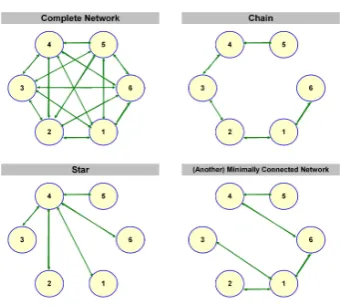
Examples of network architectures are in Figure 1. The complete network, where every
node is directly connected to every other, is an example of connected graph. The complete
network is clearly not minimal as there are many redundant links. Examples of minimally
connected graphs are the star and the chain.
3See Goyal and Joshi (2006), Calv´o-Armengol (2004) and Bloch and Jackson (2006) for applications of
pairwise equilibrium networks.
4
Figure 1: Examples of network architectures.
2.2 The Experimental Procedure
The experimental sessions were conducted in spring 2006 and 2008 at CESARE, LUISS
Uni-versity in Rome with a total of 54 participants.5 Subjects were first-year Economics students.
Each subject participated in only one session and none had previously taken part in a similar
experiment. Each experimental sessions was made of 2/3 groups of 6 participants each,
play-ing together in a network formation game. Each experimental session lasted between 30 and
45 minutes. Subjects’ total earnings were determined by the sum of the profits in each round
and were paid using a conversion rate of 100 points per euro. They earned approximately
e32 on average, on top of a e5 participation fee.
While in the sessions that were conducted in spring 2006 we implemented two alternative
treatments, with different cost parameters, in the present paper we only analyse data from
one of the two treatments, for which detailed parameters are given in the table below:6
Participants Initial Endowment Cost Benefit
Groups 1 - 9 6 500 90 100
5Here we re-analyse the data from Treatment 1 in Di Cagno and Sciubba (2008), plus some newly collected
data. More in detail, of the 9 groups considered here, 7 coincide with those analysed for Treatment 1 in Di Cagno and Sciubba (2008) and were collected in spring 2006. In spring 2008 we collected data for 2 additional groups under the same experimental protocol used for the 2006 data. More independent observations than we had in 2006 were required for the econometric analysis conducted in this paper.
6
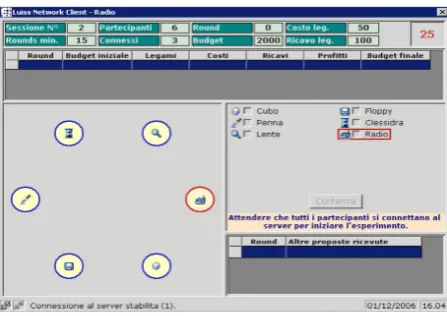
Figure 2: The initial screen
All relevant parameters were equal across participants and displayed on the screen at all
time throughout the experiment.
At the beginning of each session subjects were told the rules of conduct and provided with
detailed written instructions, which were read aloud by the experimenters.
Sessions consisted of a minimum of 15 rounds, with a random stopping rule determining
the end of the experiment.7 In each round, subjects were asked to submit (anonymously and
independently) a vector of intended links. The initial screen for each participant is shown in
Figure 2.
Participants were represented on the screen by different symbols which we considered
neutral in that they did not provide subjects with any particular clue when deciding to
establish a link with another player in the group.8 Subjects did not know their symbol
(or the other participants’ symbols) in advance and could identify themselves on the screen
because their symbol was circled in red. In order to guarantee not only individual but also
group anonymity, participants were invited to the lab in groups of eighteen, with three groups
7
At the end of round 15 (and of each additional round after that), a lottery administered by the computer decided if an additional round had to be played. The probability of new rounds was fixed at 50%. The lottery was visualised on participants’ screens by two flashing buttons, one red (with a NO sign) and one green (with a YES sign).
8In this setting we wanted to avoid any salient coordination device that induces coordination in a particular
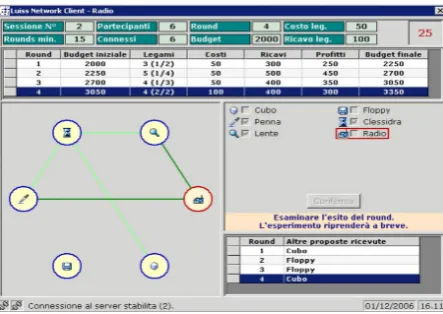
Figure 3: An example of the participants’ screen at the end of a round
being matched at the same time. Participants were not told in which of the three groups of
six they were playing, nor could they identify the group from their seating.9
The screen also displayed the relevant parameters for the session at play. After all
sub-jects had confirmed their choice of network partners, the computer checked which links were
mutually desired and activated them. At the end of each round, profits were computed and
displayed on the screen. Great care was taken in making sure that all available information
was provided to the experimental subjects in a user-friendly way. For this reason the graphical
interface was designed such that actual links were visualised on the screen as a graph rather
than a list of activated ties or as a matrix of−1/1 connections.
As an example, Figure 3 shows the players’ screen at the end of round number 4. It
displays the graph of all active links, total revenues, costs and profits in the round. It also
provides information on past unmatched proposals: at the end of a round each subject was
informed of those players who proposed a link to them but to whom they did not reciprocate.
At any time during the experiment, subjects had access to a great deal of information on past
history: by clicking on the bar corresponding to each round, they were able to visualise the
graph of active links and the profits obtained in that round.
9While we always invited 18 subjects to the lab, in a few occasions we could only collect data for 2 groups
3
The Model of Link Proposals
In this section, we analyse and discuss the determinants of link proposals. In doing so, we
make the assumption of players having static expectations; that is, we assume that each player
expects her opponents to make exactly the same choices in roundtas in roundt−1. This is in line with most of the theoretical literature on network formation; also, to a certain extent,
such expectations are induced by the design of the experiment itself: the networks that result
from choices in previous rounds are portrayed on the computer screen together with all the
relevant information and made accessible throughout the game.10
Using the system of equations described in Appendix A, we estimate the probability of
each subject i proposing a link to any of her prospective partners j, with j = 1, . . . ,5, as a function of the position of i and j in the network reached in the previous round, which is
represented graphically on the subject’s screen. More in detail, we estimate the probability
of subjects proposing a link as a function of a number of variables that can be classified into
four categories: the characteristics of the relationship proposer-recipient, which, in particular,
include the lagged dependent variable; the characteristics of the prospective partner; the
characteristics of the proposer herself; the characteristics of the network of links observed in
the previous round. We also control for experience.
This exercise is meant as a preliminary analysis aiming to verify whether there is
system-atic behaviour in players’ link proposals that might be ascribed to the application of certain
strategies and, consequently, to identify and to study such strategies.
3.1 Estimation Results
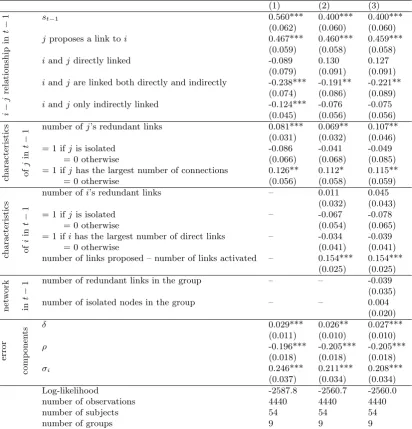
The estimation results of the 5-equation multivariate dynamic probit model derived in
Ap-pendix A are reported in Table 1.11
The relationship between i and her opponent, j, in t−1 is described by the first five
10
In contrast to what we assume here, see Carrillo and Gaduh (2011) and Mantovani et al. (2011) for experimental evidence on farsighted behaviour in network formation.
11We have estimated several specifications of the model of link proposals, using many combinations of
regressors. Let us start observing that the coefficient on the lagged dependent variable,st−1,
is positive and strongly significant, which conveys the idea that subjects tend to build on what
they did in the previous round. Given the strong statistical significance of the coefficient on
‘j proposes a link toi’, it seems more likely that a link is proposed if the recipient demanded a link to the proposer in the previous round. This could denote both a behavioural tendency
to reciprocate and a rational response. In fact, under the assumption of static expectations
(i.e. if players expect their opponents to make the same choices in roundtas they did in round
t−1), given that links have to be mutually agreed, a link can only be established by proposing a link to proposers in the previous round. The fact of i and j being linked directly plays no role here, in that the variable ‘iand j directly linked’, which is an interaction term between ‘st−1’ and ‘j proposes a link toi’, shows not to be statistically significant in any specification.
Anyhow, there is some evidence on the tendency to cut redundant links through the negative
and statistically significant coefficient on the variable ‘i and j are linked both directly and indirectly’. The attitude not to form redundant links is corroborated by the negativity and
statistical significance of the coefficient on the variable ‘i and j only indirectly linked’, even if not in terms of all the specifications of the model. Therefore, the probability of proposing
a link seems to diminish if i and j were previously linked both directly and indirectly and if they were already linked but only indirectly.
This first set of findings essentially describes the behaviour of a myopic best responder, as
delineated in the Introduction, but there is something more. The coefficient on the variable ‘j
proposes a link toiint−1’ showed to be positive and strongly significant in any specification. This makes us conclude that, other than a tendency to best respond to the previously formed
network, there might be subjects who simply reciprocate demanded links.
In our opinion, another possible motive of link formation can be extrapolated from the
results regarding the probability of iproposing a link toj as a function ofj’s characteristics, which seem to portray the figure of a player acting in a rather opportunistic way. In effect,
the estimation results disclose that players tend to propose links to those who have the largest
(1) (2) (3) i − j relationship in t −
1 st−1 0.560*** 0.400*** 0.400***
(0.062) (0.060) (0.060) jproposes a link toi 0.467*** 0.460*** 0.459***
(0.059) (0.058) (0.058) iandjdirectly linked -0.089 0.130 0.127
(0.079) (0.091) (0.091) iandjare linked both directly and indirectly -0.238*** -0.191** -0.221**
(0.074) (0.086) (0.089) iandjonly indirectly linked -0.124*** -0.076 -0.075
(0.045) (0.056) (0.056)
characteristics of
j
in
t
−
1 number ofj’s redundant links 0.081*** 0.069** 0.107** (0.031) (0.032) (0.046) = 1 ifjis isolated -0.086 -0.041 -0.049
= 0 otherwise (0.066) (0.068) (0.085)
= 1 ifjhas the largest number of connections 0.126** 0.112* 0.115**
= 0 otherwise (0.056) (0.058) (0.059)
characteristics of i in t − 1
number ofi’s redundant links – 0.011 0.045 (0.032) (0.043)
= 1 ifjis isolated – -0.067 -0.078
= 0 otherwise (0.054) (0.065)
= 1 ifihas the largest number of direct links – -0.034 -0.039
= 0 otherwise (0.041) (0.041)
number of links proposed – number of links activated – 0.154*** 0.154*** (0.025) (0.025) net w ork in t −
1 number of redundant links in the group – – -0.039 (0.035) number of isolated nodes in the group – – 0.004
(0.020)
error
comp
on
en
ts δ 0.029***(0.011) 0.026**(0.010) 0.027***(0.010)
ρ -0.196*** -0.205*** -0.205***
(0.018) (0.018) (0.018)
σi 0.246*** 0.211*** 0.208***
(0.037) (0.034) (0.034)
Log-likelihood -2587.8 -2560.7 -2560.0
number of observations 4440 4440 4440
number of subjects 54 54 54
[image:15.595.97.510.111.541.2]number of groups 9 9 9
Table 1: Estimation results of three specifications of the model of link proposals detailed in Appendix A. The coefficients on the group fixed effects,λg, are omitted.
∗ ∗ ∗,∗∗and∗indicate ap-value<0.01,<0.05 and<0.10, respectively.
the opponent’s redundant links – an indicator of high connectivity.12 If a player is instead
isolated – that is, she has no connection of any sort – the other players do not seem to be
willing to include her.
Among the variables that describeiin the previous round, we find strong evidence of the fact that the propensity to demand a link increases only if the breakdown rate in the previous
12Here again, the evidence is not extremely robust, making us suspect that only part of the population may
round – measured as the difference between the number of links proposed and the number of
links activated – increases.13
We also estimate the propensity to propose a link as a function of the characteristics of the
network of links that emerged in the previous round. Despite the large number of variables
representing the network structure tested, none of them seem to play a significant role in
subjects’ decision. An example is reported in the third column of Table 1. It shows that
neither the coefficient on the number of redundant links nor that on the number of isolated
nodes in the group are statistically significant. We therefore conclude that players did not
take into account the global structure of the network established in the previous round when
expressing their willingness to demand a link and choosing the receiver of that proposal.
Table 1 also shows that the correlation coefficient ρ is precisely estimated to be about
−0.20. It is also significantly different from zero and negative, as expected. This indirectly supports our reasons for dealing with individual link proposals as being jointly determined.
The considerable magnitude of the standard deviation of the individual-specific propensity
to demand links, σα, puts into evidence the heterogeneity of the population. Finally, the
coefficientδis estimated to be positive and significantly different from zero, so indicating that the noise diminishes, the higher the level of experience that players accumulate by playing
the network game for several rounds.
Given these results, in what follows we study the distribution of three basic patterns of
behaviour adopted by the experimental subjects in our sample:
• players who reciprocate to those who demanded a link in the previous round unless they
can be reached otherwise through indirect connections (under the assumption of static
expectations, this behaviour corresponds, in fact, to profit maximisation);
• players who act by simply reciprocating link proposals from the previous round;
• players who try to reach the largest number of nodes by reciprocating to those who
exhibit a high connectivity.
13In our setting, reaching a node directly when it is already reached indirectly is always more beneficial than
As stated earlier, this exercise was meant to search for the leading motives of individual
linking decisions, which essentially correspond to the maximisation of: expected profits; direct
links; and expected profits per link. In what follows, we will delineate the behavioural rules
which define these types of player, and we will try to establish whether these patterns of
behaviour are deliberately and systematically adopted by the subjects in our sample and, if
so, in which proportion of the observed sample the different types are represented.
4
Strategies of Link Formation
In each round of link formation, individuals have 32 available strategies. For each player, a
strategy is given by a 5-dimensional vector of 0s and 1s. For example, a possible strategy of
player 1 is to propose a link to each of the other 5 players in the game:
(1,1,1,1,1)
Strategy (0,0,0,0,0) corresponds to the choice of not proposing a link to any of the other players, while (1,1,0,0,0) corresponds to the choice of proposing to the first two players (other than player 1) and not the other ones, and so forth.
Under the assumption of static expectations, each player expects the other 5 players to play
the same strategy in roundtthat they played in roundt−1. Hence, given these expectations on what the others will play, each player responds by selecting one of the strategies in the
strategy set. In order to understand whether the behavioural patterns defined in the previous
section are in fact represented in our sample, we have to define the specific characteristics
required of a strategy such that it pertains to each of the behavioural types. The strategies
eligible to be assigned to a type are the following:
• a strategy is ofmyopic best response type if it maximises the player’s expected profit;
• a strategy is ofreciprocator type if it maximises the player’s expected number of direct
links;
expected profit per link.
Notice that a player who adopts a myopic best response strategy proposes a link to all
those that cannot be indirectly reached (and does not reciprocate links to those that can be
indirectly reached). Such a strategy maximises expected profits because, under our parametric
assumptions, the benefit obtained by reaching a node is larger than the cost of a link. Hence,
unless a node can be reached at zero cost through indirect connections, a proposal to connect
directly should always be reciprocated. A myopic best response strategy activates all possible
links, except the redundant ones.
A player adopting a reciprocator strategy reciprocates all link proposals that she has
received in the previous round. Given that only links which are mutually agreed are activated,
by reciprocating all link proposals a player is activating the largest possible number of direct
links. The main difference between myopic best response and reciprocator strategies is that
the latter activate all possible links, including the redundant ones.
A player following an opportunistic strategy does not reciprocate all link proposals, but
only those which bring the largest profit. An opportunist that receives more than one link
proposal always favors the link proposals received by those who have the largest number of
connections. Unlike the reciprocator, an opportunist recognises the value of indirect
connec-tions. However, unlike expected profit maximisers, opportunists may miss out on a profit
generating connection when, for example, they do not reciprocate a link proposal from a
player that does not have any direct links. On the other hand, the fact that opportunists
target highly connected individuals does not prevent them from maintaining redundant links.
While a reciprocator attempts to activate all possible direct links, the opportunist seems
to recognize that larger profits can be obtained by restricting the number of direct links and
by exploiting indirect connections. However, opportunists target the ‘wrong’ lot of links for
deletion: rather than deleting redundant links (as an expected utility maximiser would do),
they delete links to those with lower connectivity.
Given any network configuration, the strategies that fit our behavioural types are not
unique. To start with, the fact that links have to be mutually agreed in order to be formed
links to any number of players from whom a link proposal has not been received in the
previous round brings exactly the same result in terms of network configuration and profits
as not proposing to them at all.
Moreover, for myopic best response behavior, there are non trivial ways in which expected
profit maximising strategies are not unique. Consider, for example, the case of being linked
to two agents who are also linked to one another. One of the two links is redundant; however
a player would be indifferent as to which link to maintain and which link to delete. In this
case, the fact that more than one strategy can be identified as a myopic best response is not
trivial because such multiple strategies will correspond to the same payoff but to different
network configurations.
Finally, there is clearly some overlap among the three strategy types. It may occur that
the same strategy, for a given network configuration, can be classified as belonging to more
than one type.
Consider, for example, the initial configuration of empty network where nobody is
propos-ing any link. Under static expectations, no link proposals will be expected for the next round
as well, hence all types will be indifferent as of making any link proposals or not. Any strategy
choice, in this case, can be classified as a myopic best response, or as a reciprocator strategy,
or as an opportunistic strategy.
Less trivially, it may, for example, occur that expected profit maximisation requires all link
proposals to be reciprocated (imagine the initial network configuration is a minimal network),
so that myopic best response strategies will coincide with reciprocator strategies. Similarly, it
may occur that all agents who propose to a given player have the same number of connections,
so that the strategy of reciprocating to only the most connected agents (opportunist) coincides
with the strategy of reciprocating to all (reciprocator).
While it is easy to construct examples of overlap across strategies, in general the three
types are distinct. In our experimental sample 39% of the strategy choices can be assigned
5
Analysis of Experimental Data and Behavioural Types
In this section, we analyse the experimentally generated data in light of the behavioural types
defined in the previous sections in order to verify whether the strategies, as defined in the
previous section, are represented in our sample.
In our experimental sample, 360 out of 888 (40.54%) of the individual choices appear as
if they were made by best responders. In order to assess whether this is a high percentage
of choices or not, we compare it to the proportion of times a player who selects a strategy at
random ends up selecting a best response strategy. We did this by determining, for each player
in each round, the proportion of strategies which account for best response strategies, given
the network of links arisen in the previous round. This comparison is particularly useful in our
framework where the set of strategies that a best responder may wish to choose contains more
than one strategy. Assume, for example, that in a typical round the experimental network
that has been formed is such that for the next round half of the available strategies are of the
best response type. In that case, even someone choosing a strategy at random would have a
very good chance of selecting a best response strategy.
The result of this exercise shows that the average proportion of best response strategies
in our sample, given the network emerged in the previous round, is 0.3195 (s.e. 0.0067).
Consequently, the proportion of best responses effectively played in the sample (0.4054) is
significantly larger than the proportion of best responses our players would have selected,
had they picked one of the 32 strategies at random in each round, which establishes that
a significant share of choices in our experiment correspond to a ’deliberate’ desire to best
respond.14
We repeat the exercise with the other two types. Both reciprocator and opportunistic
strategies are well represented in our sample: 331 (0.3727) choices can be accounted for as
being dictated by the reciprocator strategy; 357 (0.4020) choices can be accounted for as
being dictated by the opportunistic strategy. By comparing these proportions with the
prob-abilities players had to select a reciprocator strategy (an opportunistic strategy) by picking a
14As each strategy has 1/32 probability of being selected, the proportion of strategies which are of a certain
strategy
frequency % best response reciprocator opportunistic
107 12.05 X × ×
126 14.19 × X ×
112 12.61 × × X
68 7.66 X X ×
108 12.16 X × X
60 6.76 × X X
77 8.67 X X X
230 25.90 × × ×
[image:21.595.159.448.107.239.2]tot. 888
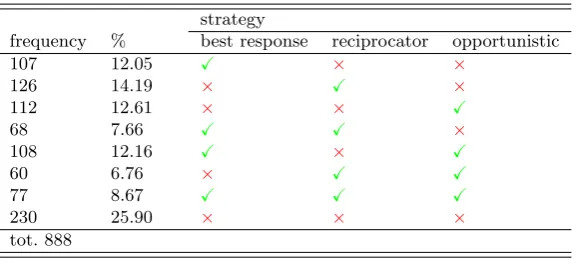
Table 2: The table shows the frequency of choices in our experimental sample explained by each of the three strategies alone and all possible overlaps. The tick indicates when a strategy is represented; the cross when it is not
strategy at random in each round, given the network arisen in the previous round, we notice
that similarly to what observed in the case of best responders, reciprocators (opportunists)
seem to be selecting their strategies deliberately. More in detail, the average proportion of
choices which account for reciprocator choices is 0.2420 (s.e. 0.0071), compared to 0.3727 in
our experimental sample; the average proportion of choices which account for opportunistic
choices is, similarly, 0.2426 (s.e. 0.0071), compared to 0.4020 in our experimental sample.
Many choices can be explained by more than one strategy at a time both in the real
and the simulated samples: there are instances when the reciprocator strategy coincides
with a best response, an opportunistic strategy or both; there are other instances when
reciprocator and opportunistic strategies coincide, or do not coincide, with best response
behaviour, and so forth. Table 2 shows the overlap between the strategies arising from our
experimental sample.15 The table shows that almost 39% of all choices can be ascribed to
only one behavioural type, the remainder being explained by none of the three types, two
types at a time or three. It also reveals that 74% of all choices in our experimental sample
can be explained in the light of one of our three behavioural types. This is quite a high
proportion considering that in many cases playing a certain strategy in such a game might
be rather difficult.
By comparing average profits obtained through each of the three strategies, we find that
15In table 2, the first row shows, e.g., that 107 (12.05%) choices in the experimental sample can be accounted
100
150
200
250
average profit
1 2 3 4 5 6 7 8 9
session
[image:22.595.170.435.108.299.2]best response reciprocator opportunistic
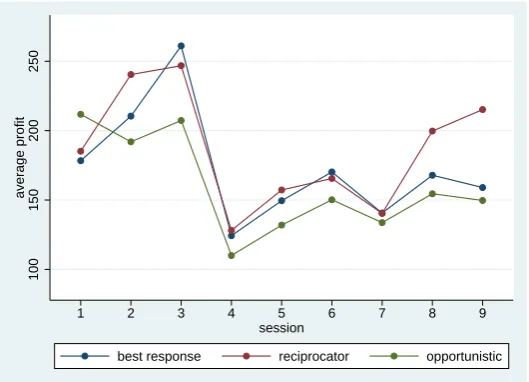
Figure 4: The figure shows average profits by strategy and by session.
the average profits obtained by best response choices are not significantly different from those
obtained by reciprocators, but both best responders and reciprocators earned, on average,
a profit larger than that earned by opportunists: best response choices yielded our
exper-imental subjects an average of 175.056 (s.e. 7.901) experexper-imental units, while reciprocators
earned 182.931 (s.e. 7.433) and opportunists 158.655 (s.e. 7.344) experimental units. Figure
4 shows that this pattern holds not just on average, but also for most sessions. The fact that
opportunists earned on average less than myopic best responders and reciprocators should
not be too surprising. Given our parametric assumptions, connections are always profitable:
indirect connections are more profitable than direct links, however both increase profits. The
opportunist, by only targeting those connections that provide the highest payoff, may often
miss out on linking opportunities by not reciprocating link proposals to those who would
bring in a more modest, but still positive, payoff.
6
The Mixture Assumption
As seen in the last section, patterns of behaviour often overlap so that the choice of a particular
strategy is compatible with more than one behavioural rule. For this reason, discriminating
the strategies selected by them. In this section, we want to verify whether subjects
system-atically adopt one of the three patterns of behaviours under investigation so that the former
can be framed alternatively within our definitions of the reciprocator type (RC), the best response type (BR) and the opportunistic type (OP). In order to assign subjects to these types, we estimate a finite mixture model (see McLachlan and Peel (2000)) that will allow us
to verify if these strategies are well identified and separated in our sample.
We proceed by assuming that a proportion πBR of the population from which the
ex-perimental sample is drawn behaves according to the best response type; a proportion πRC
behaves according to the reciprocator type; and finally a proportionπOP = 1−(πBR+πRC)
behaves according to the opportunistic type. Our mixture assumption is that each subject
belongs to one of these types and that she cannot switch type across rounds. The parameters
(πBR, πRC, πOP) are known as the mixing proportions and are estimated along with the other
parameters of the model.
The likelihood contribution of subject ithen is:
(1) Lig =πBR×lBRig +πRC×lRCig +πOP ×lOPig ,
wherelBRig ,ligRC and lOPig are the likelihood contributions of individualiunder the hypothesis of her belonging to the best response type, the reciprocator type and the opportunistic type,
respectively. These are derived as follows.
We model the individual propensities to behave according to type h ∈(BR, RC, OP) in a very simple way, that is, by assuming that there is an average propensity,γgh, to choose one of the strategies that comply with that type’s rule which is common to all the subjects of
that type. γgh has a subscriptg because we allow it to vary across groups in order to capture possible coordination effects (group-specific fixed effects). In other words, we test whether
players are more likely to adopt a strategy if there are other players in her group of the same
his:
yhig,t∗ = γgh+εhig,t i= 1, . . . ,6 g= 1, . . . ,9 t= 1, . . . , Tg
(2)
εhig,t ∼ N[0,1]
Here, εig,t is an error term, distributed as a standard normal and independent of anything
else in the model. yhig,t∗ is a latent variable representing playeri’s attitude to act according to strategic type h. The available data is an unbalanced panel since the number of rounds in each session (Tc) depends on a random stopping rule that decides, after round 15, whether or
not to continue with another round of the game.
The observational rule is the following:
yig,th = 1 ifsig,t complies with type h’s behavioural rules
yig,th = −1 otherwise
The likelihood contribution of subjecti, conditional on being of type h, is
(3) lhig =Lhig
γgh |sig,1, . . . , sig,Tg
=
Tg
Y
t=1
Φ
h
yig,th ×γgh
i
,
where Φ [·] is the standard normal cumulative distribution function.
Results are displayed in Table 3. In specification 1, where allγgh, withh∈(BR, RC, OP), are estimated as common constants, we find that the predominant type is the best response
type, followed by the reciprocator and the opportunistic type. Adding group fixed effects to
the three types significantly increases the log-likelihood according to the likelihood-ratio test
(χ224= 80.010,p-value<0.0001). This makes again the best response type the most popular with a mixing proportionπBR= 0.452, followed by the reciprocator type with aπRC= 0.296
and the opportunistic type with a πOP = 0.252. Compatible with these results, we observe
that adopting a certain strategy seems group-driven (e.g., players are more likely to best
respond if they are in a group where there are other players who do best response).
probabil-(1) (2)
γBR CC GF E
γRC CC GF E
γOP CC GF E
πBR 0.417 0.452
(0.090) (0.087)
πRC 0.367 0.296
(0.090) (0.073)
πOP 0.216 0.252
(0.072) (0.073)
[image:25.595.97.499.408.471.2]Log-likelihood -512.645 -472.640 observations 888 888 number of subjects 54 54 number of groups 9 9
Table 3: Estimation results of the mixture model. CCindicates that a common constant is estimated;GF E indicates that group fixed effects are estimated. The results are omitted.
All mixing proportions are statistically significant at 1% level.
ities of each experimental subject being of each type. Using Bayes’ rule we have the following
posterior probabilities:
Pr [iis of type h|sig,1, . . . , sig,Tc] =
Pr [type h]×Pr [sig,1, . . . , sig,Tc |type h]
Pr [sig,1, . . . , sig,Tc]
= πh×Pr [sig,1, . . . , sig,Tc |type h]
Pr [sig,1, . . . , sig,Tc]
= πh×l
h i
Lig
(4)
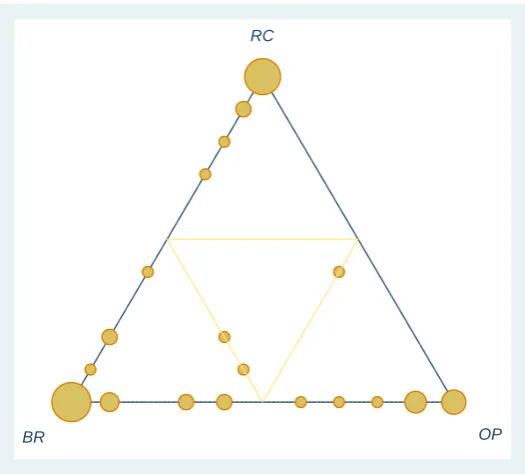
forh∈ {BR, RC, OP}.Posterior probabilities are reported on the simplex displayed in Figure 5. The 54 subjects are represented by circles in the graph: small circles represent a single
subject; larger circles cluster subjects concentrated in that area of the simplex (the larger
the circle the more numerous the cluster). The closer a subject is to a vertex of the simplex
the greater the posterior probability for that subject of being of the type represented on that
vertex.16 Subjects in the bottom left corner are of the best response type; subjects in the
top corner are of the reciprocator type and, finally, those in the bottom right corner are of
the opportunistic type. The majority of subjects are located very close to the vertices of
the simplex, a minority to the edges and only three are in the middle. The yellow simplex
in the centre represents a virtual area of “uncertainty over types” and is empty in the case
under examination. This finding confirms that the mixture model clearly separates the three
16
BR
RC
[image:26.595.170.433.107.344.2]OP
Figure 5: Posterior probability of types from estimation results in Table 3, specification 2.
types of individuals, with most of them being assigned to a particular type with quite a high
posterior probability.17
7
Conclusions
In this paper we use experimentally generated data to analyse individual linking strategies in
a network formation game.
By a system of equations modelling players’ link proposals in each round of the game,
we are able to distinguish between strategies that we name of the reciprocator type, of the
myopic best response type and of the opportunistic type.
We find that approximately 40% of the network formation strategies adopted by the
exper-imental subjects can be accounted for as myopic best response strategies, 37% as reciprocator
strategies and 40% as opportunistic strategies. Adding myopic best response, reciprocator and
opportunistic behaviour, we are able to explain approximately 74% of the observed choices.
We show that each of these types of behaviour is ‘deliberate’ in that we have obtained shares
17
of each behaviour that are significantly different from what we would have obtained if agents
had selected links at random.
Given that there is overlap between strategies, we have tested econometrically if a mixture
assumption can be validated for our sample. We find that it is safe to assume that each
individual belongs to one type, with mixing proportions approximately equal to 45%, 30%
and 25% for best response, reciprocator and opportunistic types, respectively.
We observe that the average profits obtained by subjects following each of the strategies
are not too dissimilar, with opportunists earning marginally less. We argue that this is
because, by targeting only the links which have the highest connectivity, opportunists may
miss out on profitable connections.
Finally, we discover that the individual attitude to adopt a certain strategy is heavily
group-driven, with agents being more likely to best respond, for example, when others in the
same group also do so.
The latter finding has very interesting policy implications. By having more subjects who
have an individual propensity toward a certain behaviour, we increase the attitude to adopt
that kind of behaviour of other members of the same group. Hence by controlling the group
composition in behavioural types one could favour some network outcomes as opposed to
others.
In this paper, we present the reciprocator and the opportunist as behavioural strategies
other than myopic best response behaviour. If agents are myopic and have static expectations,
anything other than myopic best response is ‘irrational’. In a more complex model, where
agents are farsighted and averse to strategic uncertainty, rational behaviour may share features
with the strategies that we have outlined here. A rational farsighted agent may attempt
to establish her reputation as a reliable connection by always reciprocating link proposals.
Equally, an agent who is averse to strategic uncertainty may choose to keep redundant links.
We do not attempt such modelling here, but acknowledge the possibility that in a more
general model of network formation the behavioural patters we outline here may indeed stem
Appendix A. The econometric model of link proposals
In each round of the game, each subject submits a vector of choices concerning the opportunity
to propose or not propose a link to any of her opponents. From a player’s perspective, the
decision to propose a link to one of her opponents is not separate from the decision to propose
or not propose a link to another opponent. For this reason, all decisions made by a player
in a round are not independent but they are the result of a joint evaluation and need to be
analysed as such.18
Let us consider a set of 6 players, indexed byi= 1, . . . ,6. Each playeri in roundt submits a 5-dimensional vector of intended links:
sig,t= (si1g,t, . . . , sijg,t, . . . , si5g,t).
Here, j = 1, . . . ,5 represents i’s prospective players; groups of opponents are indexed by g,
withg= 1, . . . ,9;t= 2, . . . , Tgindicates the round number. The final round number,Tg, may
differ by group because of a random stopping rule that decides, after round t= 15, whether or not to continue with another round of the game. sijg,t equals 1 if subject i expresses his
willingness to be linked toj; it equals−1 otherwise.
The vector of intended links sigt is the result of a complex decision process. In making
her decisions, i needs to jointly evaluate the opportunity to propose a link to each of her 5 prospective players. In other words, ineeds to consider the following system of equations:
s∗ijg,t = αi+λg+β
0
wWijg,t−1+β
0
xXjg,t−1+β
0
yYig,t−1+β
0
zZg,t−1+
uijg,t
(1 +δ(t−2)), for j = 1, . . . ,5 and j6=i.
(5)
Here, Wijg,t−1 is a vector of explanatory variables describing the characteristics of the
re-lationship between i and j in the previous round, including the lagged dependent variable,
sijg,t−1;Xjg,t−1 is a vector of characteristics ofjas shown by the network that emerged in the
previous round; Yig,t−1 is a vector of explanatory variables related to i’s position in the net-18
work in the previous round; the explanatory variables inZg,t−1 describe the main features of
the network resulting from players’ link proposals in the previous round. There are also two
regression intercepts, αi and λg. Intercept αi varies across individuals (individual-specific
time-invariant random effect) and is assumed to be common to all equations in (5). We
also assume that it does not depend on any observable. It represents the individual-specific
propensity to demand links and is assumed to be distributed normal across the population:
αi ∼N 0, σα2
. In a network formation game, individual decisions within a group may well
be correlated because of unobservable common shocks to all individuals in the same group
– for example, because all individuals observe the same sequence of graphs occurring during
a session. Our method of controlling for dependence on unobservables within a session is
to model the intercepts λg as random unobservables (group-specific fixed effects). The term
(1 +δ(t−2)) is introduced in order to capture the effect of experience on players’ decisions. A positive (negative)δ implies that subjects’ choices eventually become less (more) noisy.19
s∗ijg,t– the latent dependent variable representing subject’sipropensity to demand a link toj
– andsijg,t, the observed binary outcome variable, are related by the following observational
rule:
sijg,t=
1 ifs∗ijg,t≥0
−1 else
.
Since players in each round jointly evaluate the opportunity to propose a link to any
of their opponents, we expect that the choice of proposing a link to one of the prospective
partners reduces the probability of proposing a link to the others. In other words, we expect
to observe a negative correlation across the equations in (5).20 i’s decision in each round can be framed within the class of M-equation multivariate dynamic probit models. Anyhow,
we need to place some restrictions on the variance-covariance matrix of the errors and the
19
A positive δwould eventually reduce the error variance (that is constrained to be equal to 1 in round 2 for identification purposes), consequently making the role of the stochastic disturbance less and less relevant in players’ decisions and, in this sense, highlighting the role of experience accumulated throughout the game.
20
coefficients on the system’s variables. In particular, the joint distribution of the error terms
is assumed to take the form:
V
ui1g,t
.. .
uijg,t
.. .
ui5g,t
=
1 · · · ρ · · · ρ
..
. . .. ... ... ...
ρ · · · 1 · · · ρ
..
. . .. ... ... ...
ρ · · · ρ · · · 1
. (6)
Here, error variances on the leading diagonal of V have values of 1 and the off-diagonal
elements are all equal to ρ. This hypothesis of equi-correlation of the error terms of the system of behavioural equations (5) follows from the fact that there is no reason to assume
that a certain pair of equations in (5) are more or less correlated than another pair. Further,
we assume that the coefficients on the variables in system (5) do not vary across equations.
Estimation of the dynamic system (5) requires an assumption about the initial
observa-tions sijg,1. Since players do not know anything about their opponents and the group of
players as a whole before the graph of the network resulting from round 1 link proposals is
shown to them, we can safely assume that the initial conditionsijg,1 is completely random.
Let us define playeri’s likelihood contribution as:
Lig =
Z ∞
−∞
Tg
Y
t=1
Φ5(µig,t; Ω)f α; 0, σ2α
dα,
(7)
where µig,t= (si1g,t×µi1g,t, . . . , sijg,t×µijg,t, . . . , si5g,t×µi5g,t) and µijg,t= (1 +δ(t−2))×
αi+λg+β
0
wWijg,t−1+β
0
xXjg,t−1+β
0
yYig,t−1+β
0
zZg,t−1
, with j = 1, . . . ,5; Ω is a sym-metric 5 ×5 matrix whose elements on the leading diagonal are equal to 1 (σjj = 1 for
j = 1, . . . ,5) and are equal toσjk =sijg,t×sikg,t×ρ(forj, k= 1, . . . ,5 andj6=k) somewhere
else; f α; 0, σ2
α
is the normal density function with mean 0 and varianceσ2
α evaluated atα.
The multivariate normal cumulative distribution function Φ5(.) is evaluated by the
Geweke-Hajivassiliou-Keane (GHK) algorithm.21 The likelihood function is maximised using 20-point
21
Gauss-Hermite quadrature.22
Appendix B. Experimental instructions
Welcome
This is an experiment on the formation of links among different subjects. If you make
good choices you will be able to earn a sum of money that will paid to you in cash immediately
after the end of this session.
You are one of 6 participants to this experiment; at the very beginning the computer will
randomly assign to you an initial budget (equal across participants). The computer will also
randomly assign to you an icon (Dropper,Radio,Cube,Floppy disk,Hand lens,Hour
glass) that will identify you throughout the experiment and will assign you an initial budget
(equal across participants). The icon identifying you is circled in red on your screen.
The experiment consists of a random number of rounds: there will be at least 15 rounds,
after which a lottery administered by the computer will determine whether there will be a
further round or the experiment is over.
Each participant to this experiment represents a node. At the beginning of the experiment
all nodes are isolated. In each round, the computer will ask you whether you want to propose
any link and to whom. You may propose 0, 1 or more links. The computer will collect the
proposals from all participants and activate only the links desired by both of the two subjects
involved (reciprocated proposals).
Your screen will show the graph of active links. The box at the bottom right corner of
your screen will show you who has proposed a link to you in the previous round and to whom
you have not reciprocated.
Each link that you manage to activate has a cost (equal across participants) that is
indicated on the screen. In each round, the computer may reject your link proposals if they
entail an expenditure that is higher than your budget for that round.
Your revenues in each round are automatically computed and are given by the product by
the revenue per node (equal across subjects and indicated on your screen) and the number
of nodes that you manage to reach both through your direct links and the links activated by
other participants.
Computing costs and revenues
Example: subject Radio is directly linked to Floppy disk and Dropper and indirectly,
that is throughDropper, toHand lens.
In each round, the computer calculate out your profit and display it on your screen. The
overall profit from the experiment is given by the sum of your revenues in all rounds. At the
end of the experiment, you will be paid in cash an amount in euros equivalent to 10% of your
total profit.
More in detail
At the beginning of the experiment please wait for instructions from the experimenters
before touching any key.
When the experimenter asks you to do so, please double-click only once on the “Network
Client” icon on your desktop.
The following screen will appear:
The screen gives you all the information regarding the round that you are about to play.
Be careful: each round has a maximum time duration given by the number of seconds
indicated in red at the top right corner of your screen. If you have not managed to make your
choice by then, the computer will immediately proceed to the next round.
Your screen shows all the relevant data useful for the current round (available budget,
costs and revenues) as well as the results that you have obtained from each of the previous
At the end of each round, the graph will show the links activated by you and the other
participants (as shown above). Moreover, the table that summarises your performance in
the current round will be updated. You will have the possibility to review the situation of
previous rounds by clicking on the corresponding bar in the same table. The table at the
bottom right corner of your screen gives you additional information on proposals that you
have received but not reciprocated in the previous rounds.
When the message “Round is now active” appears at the bottom of your screen, you can
make your choice by ticking the boxes corresponding to the icons that you want to propose
a link to. When you are done, press “Confirm”. When all participants have confirmed their
choices, the computer will show the results of the round on the screen.
You will be advised of the beginning of a new round by a “New Round” message. Be
on green, you will play another round; if they stop on red, the experiment is over.
It is very important that you make choices independently and that you do not
communi-cate with other participants during the experimental session.
At the end of the last round the experiment is over, and you will be paid a sum in cash
corresponding to your profit during the course of the whole experiment.
For any problem, please contact the experimenters.
Enjoy.
References
Bala,V., Goyal, S., 2000. A Non-Cooperative Model of Network Formation. Econometrica,
68(5):1181–1229.
Bernasconi, M., Galizzi, M., 2012. Networks, Learning Cognition, and Economics.
Encyclo-pedia of the Sciences of Learning, 2440–2443.
Bloch, F. and Jackson, M., 2006. Definitions of equilibrium in network formation games.
International Journal of Game Theory, 34:305–318.
Berninghaus, S.K., Ott, M., Erhart, K.M., Vogt, B., 2007. Evolution of networks - an
experimental analysis. Journal of Evolutionary Economics, 17:317–347.
Callander, S. and Plott, C., 2005. Principles of Network Development and Evolution: An
experimental Study. Journal of Public Economics, 89(8):1469–1495.
Calv´o-Armengol, A., 2004. Job contact networks. Journal of Economic Theory, 115:191-206.
Calv´o-Armengol, A. and Ilkilic, R., 2009. Pairwise-stability and Nash Equilibrium in
Net-work Formation. International Journal of Game Theory, 38:51–79.
Cappellari, L., Jenkins, S.P., 2006. Calculation of multivariate normal probabilities by
sim-ulation, with applications to maximum simulated likelihood estimation. Stata Journal,
6(2):156–189.
Carrillo, J.D. and Gaduh, A., 2011. The Strategic Formation of Networks: Experimental
Evidence, CEPR Discussion Paper n. DP8757.
Conte, A., Moffatt, P.G., 2014. The econometric modelling of social preferences. Theory
and Decision, 76(1):119–145.
Conte, A., Levati, M.V., 2014. Use of data on planned contributions and stated beliefs in
Di Cagno, D., Sciubba, E., 2008. The Determinants of Individual Behaviour in Network
Formation: Some Experimental Evidence. M.Abdellaoui and J.D. Hey (eds), Springer,
Theory and Decision Library, Cambridge.
Falk, A., Kosfeld, M., 2012. Its all about connections: Evidence on network formation.
Review of Network Economics, 11(3):art. 2.
Goeree, J.K., Riedl, A. and Ule, A. 2009. In Search of Stars: Network Formation among
Heterogeneous Agents. Games and Economic Behavior, 67:445–466.
Goyal, S., Joshi, S., 2006. Unequal connections. International Journal of Game Theory,
34:319–349.
Jackson, M.O., Wolinsky, A., 1996. A Strategic Model of Social and Economic Networks.
Journal of Economic Theory, 71(1):44–74.
Kirchsteiger, G., Mantovani, M., Mauleon, A. and Vannetelbosch, V., 2011. Myopic or
Far-sighted? An Experiment on Network Formation, CEPR Discussion Paper n. DP8263.
McLachlan, G., Peel, D., 2001. Finite Mixture Models. Wiley and Sons, New York.
Myerson, R.B., 1991. Game theory: analysis of conflict. Harvard University Press,