Introducing Economic Order Quantity Model for
Inventory Control in Web based Point of Sale
Applications and Comparative Analysis of Techniques
for Demand Forecasting in Inventory Management
Komal Nain Sukhia, Aliya Ashraf Khan, Mukhtiar Bano
Department of Software Engineering, Fatima Jinnah Women University, Rawalpindi, Pakistan
ABSTRACT
This paper has primary focus on the aspect of inventory management in web based point of sale applications for supermarkets. The major research focus include selection of efficient technique for demand forecasting in retail industry, the introduction of Economic Order Quantity model to reduce the overall inventory related costs and stock-out, analyzing customer transactions to improve sales, determining product shelving and supplier selection. For this purpose, Economic Order Quantity model is applied on the forecasted demands using simple moving average, linear regression, back propagation algorithm and afterwards a comparative analysis is conducted on the basis of costs generated by each demand forecasting technique. The comparison shows that back propagation algorithm is more efficient for demand forecasting and the overall inventory costs after applying Economic Order Quantity model are found to be lowest for back propagation algorithm as compared to the Linear Regression and Simple Moving Average.
Keywords
Apriori Algorithm, Back Propagation Algorithm, Data mining, Economic Order Quantity model, K-means Algorithm, Linear Regression, Naïve Bayesian Algorithm
1. INTRODUCTION
Point of sale (POS) or checkout describes a place of retail transaction occurrence. It is a point where a customer pays a merchant in return of goods or items bought. At the point of sale merchant can adopt the methods such as a manual system, barcode scanners, and electronic cash registers and touch screen displays to calculate the amount owing and to complete the transaction. Moreover, the merchant also issues a receipt for the transaction. The POS is customized by retail industry based on varied needs of small and medium sized retailers. Example can be a grocery store that may require a weighing scale at the point of sale, while restaurants may use automated computerized systems. The modern point of sale must include advanced functionalities such as inventory management, CRM (customer relation management), financials, warehousing, etc. Before the advent of the latest POS, all of the functions like inventory management, financials, warehousing were done independently and manually, which resulted in a lot of errors. The early cash registers were made in proprietary software and they had limited functions. Later, point of sale software was used to receive customer orders at the restaurant's entrance, and printing the preparation details in the kitchen. Such an intelligent process enabled customers to go to their tables where they can find the food already prepared for them. This software had an enhancement as compared to previous one as
it also contained real time labor and food cost reports. With more technology advancements, points of sale applications are becoming common. Therefore, there is a need of incorporating advanced functionalities in a point of sale to cater different needs, like inventory is essential to keep up the pace with technological modernization and increasing retail management demands. Inventory management and inventory control is required to confirm control of quality in businesses in order to manage the transactions that focus consumer purchases. Without handling inventory control efficiently, large retail stores like Wal-Mart or JC Penny may face stock-out on an important product. In short, effective inventory control system will be able to alert the retailer at the reorder time.
1.1
Problem Description
Due to today’s uncertain economy, companies are trying to adopt alternative ways to remain competitive. Different ineffective forecasting methods lead to multiple product stock outs. So research revolves around different forecasting techniques for demand prediction and determining what will be the optimal quantity of inventory to order and when it should be ordered so that out of stock inventory problems can be avoided.
1.2
Research Methodology
The proposed application can determine order quantity, reordering point, product shelving, inventory categorization and supplier selection mainly by using data mining techniques. The point of sale application can manage daily transactions and maintain record of customers, inventory and employees. The historical quarterly sales data for different products is saved in database so that sales behavior can be analyzed and to establish a forecasting trend for each product.
1.2.1 Main Tasks
Demand forecast is done on the basis of three techniques namely Simple Moving Average, Linear Regression and Back Propagation.
Apriori algorithm is used to analyze customer transactional data to determine which products are likely to be bought together in order to solve product shelving issues.
Inventory Categorization (ABC Classification) is done by using K –means algorithm to figure out the products that are critical to control for effective inventory management.
An inventory control model i.e. Economic Order Quantity model is used. The predicted demand is used in Economic Order Quantity model which calculates optimum order quantity and reorder points for each product. At last comparison is done between the three technique results on the basis of cost saving.
The research paper is structured as follows - Section 2 begins with literature review. Section 3 addresses implementation of proposed application. Section 4 presents the results. Section 5 is about conclusion and future work.
2.
LITERATURE
REVIEW
Karthik Sundararaman et al. in [1] employed Baseline prediction as a means to present the marketing strategy for consumer goods. According to paper, in order to generate baseline for future techniques like Simulation techniques and time series algorithms are used. The algorithm that is suitable for a particular point of sales data changes depending on the datasets. POS data for the consumer goods of a store is introduced for a period of two years depending on the types of promotion, duration of occurrence and other requirements. Two methods are used to analyze the POS data. 1) Forecasting by combining Seasonal Adjustment and Linear Exponential Smoothening 2) Winters Model. The baseline prediction is for a period of one year. Results demonstrate that winters model is a better fit for the point of sales data used for testing purpose than LES model.
Further, Numera Tahir et al. in [2] devised a decision support system that contains three different analysis methods which are: Price based Analysis; Quantity based Analysis and ABC Analysis. The research involves extension of the proposed decision support system to a gas plant inventory and a comparative analysis is conducted for the former two methods to separate the critical parts on the basis of their price and quantity respectively. Main inputs include the inventory, their price and quantity consumed. These inputs are then used by DSS to figure out the critical items based on price, quantity, annual cost separately and subsequently critical items considering all three components together. The results describe that according to price based analysis, 85.7% of revenue is used by 1.25% of the items. Whereas 10.1% by 8.45 % and 4.2% by 90.3 % of the items. In the quantity based analysis, 0.33% of revenue is used by 33.01 % of the total items, 0.76% by 33.33 % and 98.89% by only 33.66% of the total items. ABC analysis shows that 23% of items make 60% of annual cost whereas 36% of items make 22% of annual costs and 41% of items make 18% contribution to annual costs. Overall results show that almost 20% of the items make major amount of budget. For these 20% critical items, inventory costs must be decreased.
Yunkang Yue et al. in [3] presented that due to transformation in consumption conception, supermarkets invested a lot on constructing and applying the Information technology, the major aspects include barcode, POS and database technology, etc. Trade information is recorded still its utilization is unsatisfactory. For this, new technology i.e. Data Mining, is used by the supermarket administration which changes management of supermarket to knowledge management. Data mining finds its application in supermarkets, where business handling can be done with POS, customer’s information can be collected and sales data can be accumulated. Paper describes data mining applications in supermarkets to major aspects like analyzing consumption behavior, commodities re-configuration, enhancing customer’s relationship etc.
Qizhi Wu et al. in [4] in his research conducted an analysis of three models based on economic order quantity (EOQ) model in order to reduce inventory costs of items sold in one of the Carrefour supermarket outlets. Paper describes three models which are: 1. model with lots ordered and delivered separately, 2. model with lots ordered and delivered together, and 3. model with lots ordered and delivered for specific subset. These three models are discussed and mathematically compared in this paper. The third model includes greater specific procedures which can lead to an optimal solution due to its lowest cost.
Pradip Kumar Bala et al. in [5] argue that minimum error for demand forecast lead to success in supply chain management. With the advent of data mining systems, business intelligence has been introduced in varied domains of retail and business. The current paper attempts to describe the classification of the customers using decision tree approach which further acts as an input to the demand forecasting. The paper proposes a forecasting model based on decision tree approach for making demand forecast better and to improve the inventory performance in supply chain. The proposed forecasting model with the inventory replenishment system resulted in enhanced customer service level and reduction in inventory level. Goswami D.N.* et al. in [6] presented that frequent pattern mining has large number of applications in data mining field. Frequent pattern mining from large databases results in an important problem in data mining. Apriori algorithm is firstly proposed in this field. With the passage of time Apriori algorithm has undergone various changes to enhance the performance. In this paper three different frequent pattern mining approaches: Record filter, Intersection and Proposed Algorithm are discussed which are based on Apriori algorithm. The findings of this paper are that the proposed algorithm performs better than other frequent pattern mining algorithm.
3. IMPLEMENTATION OF PROPOSED
APPLICATION
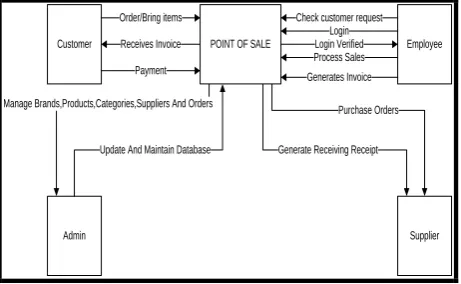
The proposed point of sale application is designed specifically for the supermarket, for which the main features of inventory management, inventory control, real-time sales and purchase orders are considered. The order quantity and Reorder level is determined by using the EOQ (Economic Order Quantity) Model. This model can help to determine what would be the optimal order quantity along with limiting the inventory related costs (Holding cost, Ordering Cost) to minimum. Similarly Reorder point would determine the sufficient stock at hand in order to satisfy the customer demand till the next order arrives. The design of the proposed application is shown in Fig. 1:
Employee Customer Admin Supplier Login Login Verified Order/Bring items Process Sales Check customer request
Generates Invoice Receives Invoice
Payment
Purchase Orders
Update And Maintain Database Generate Receiving Receipt Manage Brands,Products,Categories,Suppliers And Orders
[image:2.595.317.548.611.753.2]POINT OF SALE
Main objectives of application are described as:
3.1
Demand Forecasting
The demand forecast is done using statistical i.e. moving average and data mining techniques i.e. linear regression and back propagation and the parameters used in each technique for forecast are:
Quarters
Unit sales of each quarter Seasonal effect
3.1.1
Simple Moving Average
This statistical technique is mostly used for forecasting demands in the retail industry. But it is an ineffective forecasting technique as it does not take variability in consideration. Here EOQ model is not applied. The technique results for a particular selected product are as under:
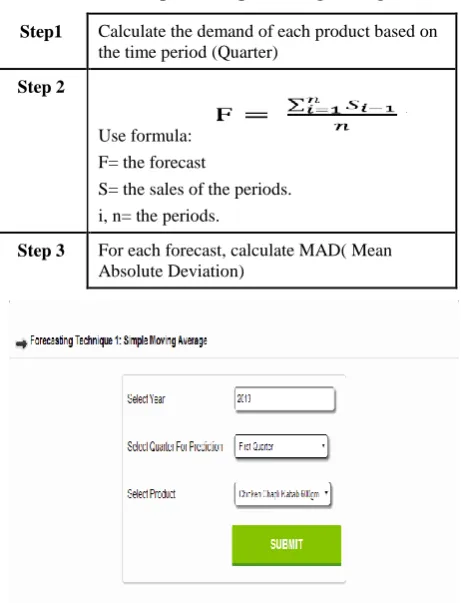
Table 1: Steps for Simple Moving Average
Step1 Calculate the demand of each product based on the time period (Quarter)
Step 2
Use formula: F= the forecast
S= the sales of the periods. i, n= the periods.
[image:3.595.316.544.73.309.2]Step 3 For each forecast, calculate MAD( Mean Absolute Deviation)
Fig. 2 User interface for simple moving average technique
[image:3.595.314.547.82.531.2]Fig. 3 Demand forecast results for one product for first quarter of year 2013
[image:3.595.51.282.281.583.2]Fig. 4 Estimation of total quarter costs using average demand
Fig. 5 Graph for demand forecast of one product using simple moving average
3.1.2
Linear Regression
This technique is used for forecasting demand. It considers quarters, unit sales to predict demand. Here the demand is not considered as constant from quarter to quarter. Here seasonal index is also used to consider the unpredictable demand.
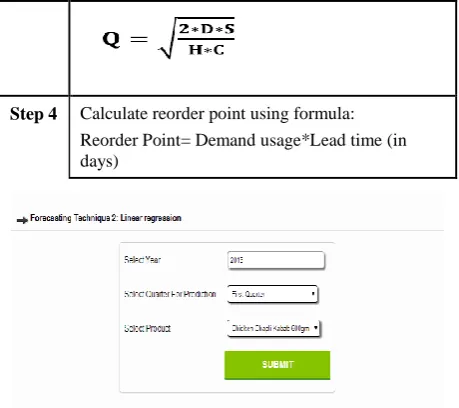
Table 2: Steps for Linear Regression
Step1 Calculate the demand forecast equation for each product using formula: yt= axi+b
Step 2 Calculate seasonal Index=demand/forecast Expected Forecast= yt*(average seasonal index)
[image:3.595.316.552.314.554.2]Step 4 Calculate reorder point using formula: Reorder Point= Demand usage*Lead time (in days)
[image:4.595.55.280.83.458.2]Fig. 6 User interface for linear regression technique
Fig. 7 Demand forecast results for one product for first quarter of year 2013
[image:4.595.315.543.104.332.2]Economic Order Quantity model is applied to determine optimal order quantity for the selected product.
Fig. 8 Estimation of total quarter costs using EOQ Model
Fig. 9 Graph for demand forecast of one product using linear regression
3.1.3
Back Propagation
The algorithm considers quarters, sales and seasonal effect to predict the demand for selected quarter. The algorithm is trained on historical data of products during past two years
[image:4.595.59.276.300.466.2]and gives forecast for the selected quarter of current year for all products.
Table 3: Steps for Back Propagation Algorithm
Step1 Initialize training epoch =1
Step 2 Initialize weights with random values
Step 3 Present training data , calculate output and mean squared error (mse) for each output value and update weights accordingly
Step 4 When mse <= 0.0, stop training. Present testing data and calculate forecasted values
Step 5 Apply Economic Order Quantity Model by using forecasted demand
[image:4.595.316.556.366.706.2] [image:4.595.55.293.524.687.2]Fig. 11 Demand forecast results for 12 products for first quarter of year 2013
[image:5.595.315.546.73.765.2]Economic Order Quantity model is applied to determine optimal order quantity for 12 products.
Fig. 12 Estimation of total quarter costs for 12 products using EOQ Model
Fig. 13 Graph for demand forecast of 12 products using back propagation algorithm
3.2
Analyze Sales Transaction Data for
Product Shelving by Apriori Algorithm
The patterns in transactional data will be analyzed using: Basket data of each customer
Unique code for each customer
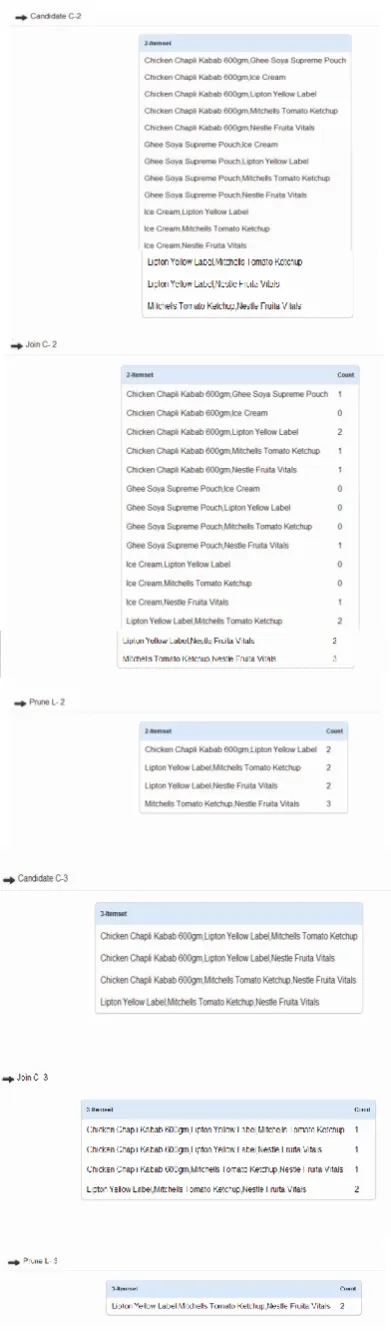
Table 4: Steps for Apriori Algorithm for Analyzing Transactions
Step1 Consider basket data of each customer
Step 2 Generate candidate item sets and define a minimum support
Step 3 When count of each product becomes less than minimum support i.e. 1, eliminate that item set
[image:5.595.58.287.279.546.2] [image:5.595.56.291.387.627.2]Fig. 14 Applying apriori algorithm to find products frequently bought together using customer transactions
3.3
Inventory Categorization(ABC
Classification) Based on Product
Annual Usage Percentage by K-means
Algorithm
The inventory will be classified into 3 categories based on annual usage % of products:
[image:6.595.313.565.195.514.2] Category A Category B Category C
Table 5: Steps for K-Means Algorithm for Categorizing Inventory
Step1 Calculate annual usage = annual demand *unit price
Step 2 Set number of clusters = 3 (A, B and C)
Step 3 Calculate average of each cluster and distance of each value in cluster from the average
Step 4 Group values based on minimum distance
Fig. 15 Estimation of annual usage percentage for each product using annual demand and unit price
Fig. 16 Inventory (product) categorization into A (most critical), B (medium level) and C (low level) products
3.4
Supplier Selection based on Given
Criteria Through Expert System using
Naïve Bayesian Algorithm
Supplier will be selected on the basis of: Item name
[image:7.595.321.551.67.560.2] Delivery duration Payment duration Discount percentage
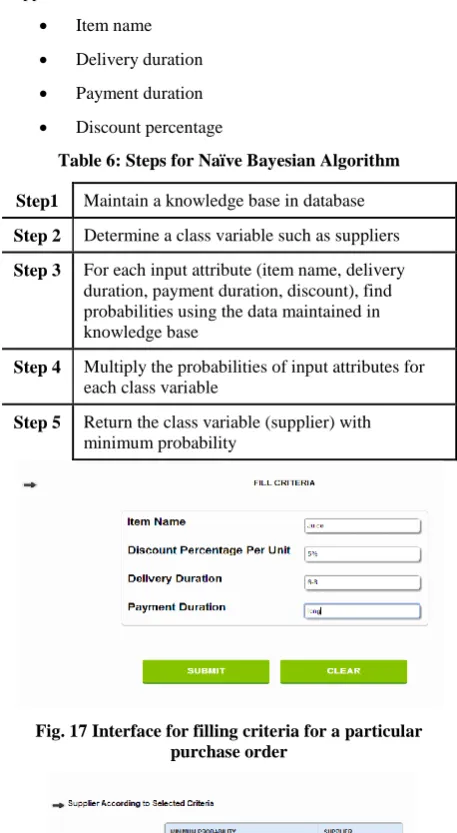
Table 6: Steps for Naïve Bayesian Algorithm
Step1 Maintain a knowledge base in database
Step 2 Determine a class variable such as suppliers
Step 3 For each input attribute (item name, delivery duration, payment duration, discount), find probabilities using the data maintained in knowledge base
Step 4 Multiply the probabilities of input attributes for each class variable
Step 5 Return the class variable (supplier) with minimum probability
Fig. 17 Interface for filling criteria for a particular purchase order
Fig. 18 Applying naïve bayesian algorithm to find suitable supplier for a purchase order
4.
RESULTS
The application uses HTML, JavaScript, Jquery and CSS for front-end development while PHP for the implementation of back-end development and MySQL is used as database server. As a part of research, a comparative analysis of inventory costs determined using three different techniques (Linear Regression, Moving Average and Back Propagation) is carried out. The historical data, past two years (2011 and 2012) on quarterly basis, of 12 products from a supermarket is collected to determine demand forecast for the current year (2013) and to analyze products sales behavior due to demand.
4.1 Cost Comparison
Fig. 19 Calculation of total costs i.e. holding cost and order cost for linear regression, moving average and back
propagation
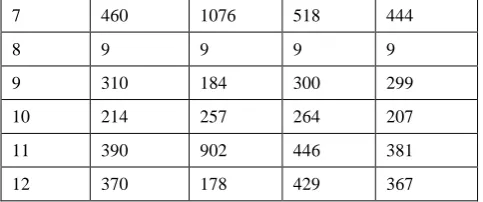
Table 7: Comparison of Demand Forecast Techniques
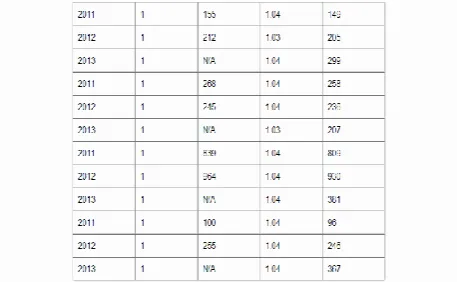
Demand for Year 2013 Quarter 1st
Products Original demand
SMA Forecast
LR forecast
BP forecast
1 176 184 205 174
2 1650 1466 1748 1641
3 9 9 9 9
4 980 1230 1006.4 964
5 900 1711 982 889
[image:7.595.52.281.123.540.2]7 460 1076 518 444
8 9 9 9 9
9 310 184 300 299
10 214 257 264 207
11 390 902 446 381
12 370 178 429 367
[image:8.595.47.289.73.174.2]From table VII, it is evident that demand forecast using back propagation algorithm comes out to be nearest to the original demand for products in first quarter of year 2013 as obtained from the supermarket. Therefore, back propagation algorithm is efficient for demand forecasting purpose in inventory management as compared to simple moving average and linear regression.
[image:8.595.57.286.264.392.2]Fig. 21 Graph showing demand forecast comparison among techniques for first quarter of year 2013
Table 8: Cost Comparison
Cost Comparison of Demand Forecasting Techniques
Techniques EOQ Model Total Annual Costs Savings Percentage Simple Moving Average
No Rs. 357808 ---
Linear Regression
Yes Rs. 155326 57%
Back Propagation
Yes Rs. 149745 58%
Moving Average is mostly used for forecasting demands in the retail industry. But it is considered to be an ineffective forecasting technique as it incurs high costs due to sales loss and multiple stock outs. Table VIII shows that using simple moving average for demand forecasting purpose results in highest costs per year. Moreover using linear regression for forecasting demand and afterwards using this demand in Economic Order Quantity model to calculate annual costs results in 57% savings when compared with simple moving average. Using back propagation for forecasting demand and
putting the forecasted demand in Economic Order Quantity model results in 58% savings when compared with simple moving average. Therefore, it is deduced from the above comparison that the overall inventory costs after applying Economic Order Quantity model are found to be lowest for back propagation algorithm as compared to linear regression and simple moving average.
5.
CONCLUSION
AND
FUTURE
WORK
This work involves the development of point of sale application with the basic features of managing customers, employees, products, categories, brands, suppliers etc. Moreover it focuses on inventory management and inventory control by using demand forecasting techniques of moving average, linear regression and back propagation. Application of Economic Order Quantity model for reducing the costs related to inventory. It also analyzes the sales data of customers to determine which products must be shelved together to increase sales. It also incorporates the functionality of supplier selection based on given criteria by maintaining knowledge base. Another factor of inventory categorization is handled based on annual usage of products. All these features can make inventory management feasible for a supermarket. Future work can be including the credit and debit card processing functionality in application. Moreover further enhancements are required to consider security issues. The application can include wireless security channel.
6. REFERENCES
[1] Karthik Sundararaman, Jinka Parthasarathi, G Subrahmanya VRK Rao, S Nandha Kumar," Baseline Prediction of Point of Sales data for Trade Promotion Optimization", The 2nd International Conference on Communications and Information Technology (ICCIT): Digital Information Management, Hammamet, IEEE 978-1-4673-1950 8/12/$31.00, 2012.
[2] Numera Tahir, Muhammad Abbas Choudhary," Development of a Decision Support System for Inventory Analysis and Control", IEEE 978-1-61284-952-2/11/$26.00, 2011.
[3] Yunkang Yue, Tiebao Zhang, Xingbing Xu," Analysis on the Effect of Data-mining to Supermarket", The 5th International Conference on Computer Science & Education Hefei, China. August 24–27, 2010 IEEE. [4] Qizhi Wu, Aihua Fang, He Gao," A Study on Inventory
Cost Reduction Based on Economic Order Quantity Model", The International Conference on Logistics Systems and Intelligent Management, 2010 IEEE. [5] Pradip Kumar Bala," Decision Tree Based Demand
Forecasts for Improving Inventory Performance", International Conference on Industrial Engineering and Engineering Management (IEEM), 2010 IEEE.