FEB - MAR, 2015, VOL. II/VIII www.srjis.com Page 2027
A STUDY OF SOCIAL ADJUSTMENT OF LEARNING DISABLED
STUDENTS
Ritu Sharma, Lecturer, Cambridge college of education Jhajjar
The present study is aimed at finding out the social adjustment of learning disabled students from elementary classes ( classes 6,7 and 8). A sample of 140 students was taken from rural and urban areas of Shimla district of Himachal Pradesh. It was hypothesised that there will be no significant difference between male and female students regarding their social adjustment. Results also proved that the male and female students from rural areas did not have a difference in their social adjustment but the students from urban areas showed a significant difference in their social adjustment .
Key words: social adjustment, rural, urban, elementary level
Introduction
When we study the social behaviour of an individual it is mandatory to study his social adjustment. Adjustment, in simple words, means the ability of an individual to easily become part of the outer situation. It means the development of such social abilities which help the person to become part of a group. Such a student is able to cope with his personal challenges and frustrations and deal with them in a positive manner.
Adjustment
According to the dictionary, adjustment means “to fit”, adapt, make suitable, modify harmonize or make correspondent. So in simple terms we may say that when there is adjustment between two things it is modification of one or both of them so as to correspond with each other. For example: wearing warm clothes in the winters and vice versa.
FEB - MAR, 2015, VOL. II/VIII www.srjis.com Page 2028 Secondly, the need or struggle to adapt to outer situations by an individual is also adjustment. This is also the basis of Darwin’s theory of evolution. Darwin emphasized on the fact that only those species were able to survive that adapted successfully to outer situations or demands.
According to L.S.Shaffer : “Adjustment is the process by which living organism maintains a balance between his needs and the circumstances that influence the satisfaction of these needs”.
According to C. Coleman : “Adjustment is the outcome of the individual’s attempts to deal with the stress and meet his needs, also his efforts to maintain harmonious relationship with the environment”.
When we speak of adjustment we may describe it in two ways:
Adjustment as an achievement
Adjustment as a process
When we discuss adjustment as an achievement it means how effectively and efficiently the person has been able to play his role or perform his duties in various situations.
On the other hand when we speak of adjustment as a process it means that we study the person longitudinally. Then we get to know how at each step the individual was able to adjust himself to outer challenges. The processes/ mechanisms involved in his life when he adapted himself to different situations.
Social adjustment
Social adjustment refers to the adjustment of an individual to the social set up around him. It involves the efforts made by an individual to cope with standards, values and needs of the society in order to be accepted. It may be easily be called a psychological process.
Gehlawat M. ( 2011) conducted a study on “ Adjustment among high school students in relation to their gender” and found no significant difference in the emotional, social, educational and the total adjustment of students with respect to their gender.
Sharma M.K. ( 2013) carried out a study on school students to find out the correlation between emotional intelligence and adjustment. Results showed that the students who had high emotional intelligence had low degree of stress and better adjustment in their lives which is very useful in achieving success in life.
FEB - MAR, 2015, VOL. II/VIII www.srjis.com Page 2029 the emotional, social and educational adjustment between children from rural and urban areas.
Learning Disabilities
“The term learning disability is used to describe a specific group of children, adolescents and adults who have problems in learning. These problems are generally in the areas of reading, writing, spellings and mathematics”. ( Nakra, 1997)
National Policy on Education (1986) has recommended education for children with disability as far as possible, together with others in general schools. It is seen that students with mild disabilities do enter schools but may drop out, This may be due to lack of facilities in schools, lack of sensitivity and also lack of special trained teachers. The aim of universal education can be achieved when we have the necessary information about these issues such as early identification of the disabled, complete and holistic diagnosis and remedial plan for such students.
The definition of learning disabilities in the Federal Law IDEA 2004 ( Individuals with Disability Education Act) is :The term “specific learning disability” means a disorder in one or more of the basic psychological processes involved in understanding or in using language, spoken or written, and that disorder may manifest itself in imperfect ability to listen, think, speak, read, write, spell or to do mathematical calculations. Such term includes such conditions as perceptual disabilities, brain injury, minimal brain dysfunction, dyslexia, and developmental aphasia. Such term does not include a learning problem, that is primarily the result of visual, hearing, or motor disabilities; of mental retardation: of emotional disturbance; or of environmental, cultural, or economic disadvantage.
Learning disability refers to a delayed development in one or more of the process of speech, language, reading, writing or arithmetic resulting from a possible emotional behavioural disturbance and not from mental retardation, sensory deprivation, cultural or instructional factors.( Kirk, 1962)
Ross ( 1976) opined that a learning disabled child is of at least average intelligence whose academic performance is impaired by a developmental lag in the ability to sustain selective attention and such a child requires specialized instruction in order to permit the use of his or her full intellectual potential.
FEB - MAR, 2015, VOL. II/VIII www.srjis.com Page 2030 with learning disabilities. He suggested further that parents also need counselling in order to understand the characteristics and needs of their gifted children with learning disabilities. Harald ( 1999) revealed that the peers less accepted the students with learning disabilities compared to non-learning disabled students, they had lower self-esteem, felt lonelier and were more depressed. Also, it was revealed that when controlling the variables of age, gender and holding achievement in reading, writing, arithmetic and intelligence constant, learning disabled students when compared to non-learning disabled were less depressed but less accepted by peers and felt lonelier.
These children have a problem in the basic problems of learning, it could be in input, processing or output. These are the various processes that take place in the brain which assist in learning. The causes for learning disabilities are: brain injury, errors in brain development, heredity and environmental influences.
Types of learning disabilities:
The basic types of learning disabilities can be categorised into the following broad types: Attention-Deficit/ Hyperactivity Disorder
This disorder involves a typical lack of attention towards the teaching or any other instructions. Such a student is very hyperactive and finds it difficult to focus for long.
Visual-Perceptual Disabilities
These disabilities involve the difficulty in understanding visual objects, difficulty in understanding distance, volume and other related concepts.
Language-Processing Disabilities
The above disabilities involve difficulties in the usage of language. Fine-Motor Disabilities
These disabilities involve difficulty in using the hands making the child very clumsy. He finds it difficult to hold things properly, is not organized in his work.
Objectives of the study
1. To study the social adjustment of male and female elementary school students with
learning disabilities from rural areas.
2. To study the social adjustment of male and female elementary school students with
learning disabilities from urban areas. Hypotheses
FEB - MAR, 2015, VOL. II/VIII www.srjis.com Page 2031
2. There will be no significant difference in the social adjustment of male and female
elementary school students with learning disabilities from urban areas. Method
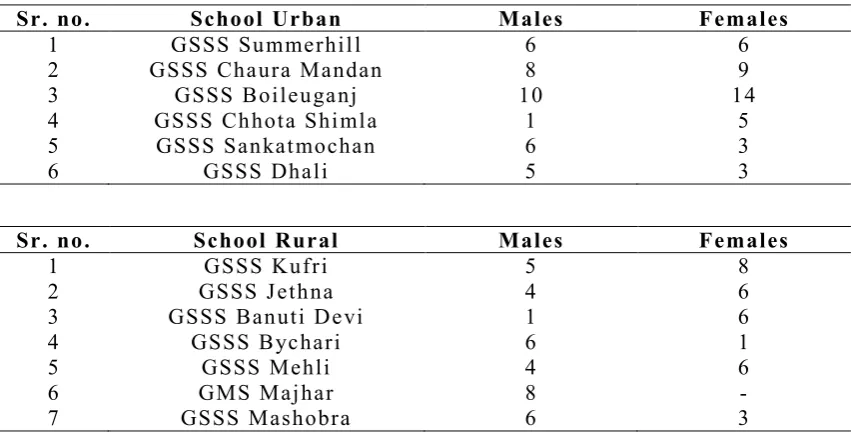
[image:5.595.67.493.194.412.2]For the present study, 140 students were taken from different schools of Shimla. These schools were:
Table 1.1 School wise distribution of elementary school students
Sr. no. School Urban Males Females
1 GSSS Summerhill 6 6
2 GSSS Chaura Mandan 8 9
3 GSSS Boileuganj 10 14
4 GSSS Chhota Shimla 1 5
5 GSSS Sankatmochan 6 3
6 GSSS Dhali 5 3
Sr. no. School Rural Males Females
1 GSSS Kufri 5 8
2 GSSS Jethna 4 6
3 GSSS Banuti Devi 1 6
4 GSSS Bychari 6 1
5 GSSS Mehli 4 6
6 GMS Majhar 8 -
7 GSSS Mashobra 6 3
Tool
For the study of social adjustment of the learning disabled students the social adjustment scale was developed and standardized by the researcher herself. For this initially 34 items were framed, the preliminary draft was administered to 140 students. For item analysis top 27% and bottom 27% of the scores were taken. The ‘t’ value of each item was calculated. 4 items were rejected since the ‘t’ value was less than 1.75. So finally 30 items were retained
Table 1.2 ‘t’ table
Item No. ‘t’ value Remark Item no. ‘t’ value Remark
1 4 Accepted 18 -0.78 Rejected
2 3.58 Accepted 19 1.85 Accepted
3 3.41 Accepted 20 3.06 Accepted
4 2.05 Accepted 21 5.79 Accepted
5 1.06 Accepted 22 0.53 Rejected
6 .21 Rejected 23 3.86 Accepted
7 .80 Rejected 24 2.05 Accepted
8 2.60 Accepted 25 4.51 Accepted
9 3.41 Accepted 26 3.05 Accepted
10 3.32 Accepted 27 3.58 Accepted
11 3.17 Accepted 28 2.08 Accepted
[image:5.595.65.532.573.752.2]FEB - MAR, 2015, VOL. II/VIII www.srjis.com Page 2032
13 5.04 Accepted 30 1.44 Accepted
14 4.65 Accepted 31 4.01 Accepted
15 2.10 Accepted 32 1.86 Accepted
16 2.94 Accepted 33 2.36 Accepted
17 2.75 Accepted 34 3.02 Accepted
Item rejected: 6,7,18,22 Items Retained : 30 Reliability of scale
Reliability means that the test is stable and consistent on repeated administration. The split half method was used for working out the reliability. The test was divided into two equal parts separating the odd and even items. From this the reliability of half the test was found and then the self-correlation was worked out using the Spearman Brown Prophecy formula. Reliability came out to .38
Validity of scale
[image:6.595.63.487.407.484.2]Validity means that the test truthfully measures what it claims to measure. Expert advice was sought from subject experts to establish content validity. The construct validity is established due to the fact that only those items are retained that had ‘t’ value more than 1.75.
Table 1.3 Norms of the Social Adjustment S cale
Raw score Level of social adjustment
49and above Very high social adjustmen t
45-49 High social adjustment
37-45 Moderate social adjustment
33-37 Low social adjustment
33 and below Lowest social adjustment
Results and discussion
SOCIAL ADJUSTMENT
PAIRS OF
COMPARISON N MEAN SD
MEAN
DIFF SED t
BR 36 48.00 5.57 3.64 1.49 2.44
GR 30 44.36 6.40
BU 34 47.17 6.35 1.30 1.44 0.90
GU 40 45.87 6.11
FEB - MAR, 2015, VOL. II/VIII www.srjis.com Page 2033 From the above table the following deductions can be made:
1. Comparison of rural boys with rural girls with regard to their adjustment. The ‘t’ value came out to be 2.44. This is more than the table value at 0.05 level of significance. This means that the hypothesis no.1 there will be no significant difference in the social adjustment of male and female elementary school students with learning disabilities from rural areas was rejected.
2. Comparison of urban boys with urban girls with regard to their social adjustment. The
‘t’ value came out to be 0.90 This is even less than the table value at 0.05 level of significance. This means that hypothesis no 2 there will be no significant difference in the social adjustment of male and female elementary school students with learning disabilities from urban areas was retained.
The above results are in sync with the results obtained by Yadav R. Where it was observed by her that students didnot differ in their social adjustment in both rural and urban areas. In the present study results are similar for urban areas but not for urban areas. The results are quite similar with the result obtained by Gehlawat M. Where she found that there was no difference in the social, emotional, educational and the total adjustment of students with respect to their gender for urban areas only but not in the rural areas .
References
Daniels, P.R. (1983) Teaching the Gifted/ learning disabled child. Rockville Aspen Publications.
Gehlawat Manju ( 2011) A study of adjustment among high school students in relation to their gender. International Referred research Journal ISSN-0974-2832, RNI-RAJBL 2009/29954; Vol 3(33)
Harald Valas( 1999) Students with learning disabilities and low achieving students; peer acceptance, loneliness, self-esteem and depression. Journal of Social Psycho of Education. 3,173-192
Kirk Samuel, A.( 1962) Educating Exceptional Child. Houghton Muffin, Boston
Nakra Onita( 1997) Children and Learning Difficulties. New Delhi: Allied Publishers Ltd. Ross, A.O.(1976) Psychological Aspects of Learning Disabilities and Reading Disorders.
FEB - MAR, 2015, VOL. II/VIII www.srjis.com Page 2034 Sharma, M.K.( 2013) A study of relationship of emotional of emotional intelligence with adjustment, stress and achievement among senior secondary students. PhD thesis, Maharishi Dayanand University.
Yadav Renu (2014) To study the moral judgement among children at formal operational stage and its relationship with emotional intelligence and social adjustment and academic achievement.