www.ijsrp.org
Three Fold Security System
Ashwini Sawant*, Bhavesh Vasandani**, Mitesh Ochaney**, Mohit Tilwani**, Mohit Kataria**
*Assistant Professor, M.E. EXTC, ** B.E. EXTC students, VESIT, Chembur, Mumbai
Abstract:The paper is divided into following sections namely, text password recognition, text-dependant speech recognition, face recognition. The first stage involves simple alphanumeric character recognition. Mel Frequency Cepstral Coefficients (MFCCs) are the most popularly used speech features in many speech and speaker recognition applications. Speaker identification can be Text-Independent or Text-Dependent. This paper describes an approach of Text-Dependent speaker recognition by using the MFC Coefficients extracted from speech signal of spoken words. The third stage comprises of face recognition for which the proposed method is based on the principle component analysis algorithm. The algorithm MFCC used in this project for speech recognition is the best. This is because it analysis the speech signal on the basis of the human perception of the sound i.e. in the Mel scale. The PCA algorithm is a simple algorithm. This algorithm is used to reduce the computational time of the overall project.
Index Terms: MFCC, PCA
I. INTRODUCTION
Speech signal provides information in form of analog signal. It conveys the words and messages being spoken and also provides the identity of the speaker. Speaker recognition is the process of automatically recognizing who is speaking by using the speaker specific information.
Speaker recognition is classified into speaker identification and speaker verification: Speaker identification is the process of determining from which of the registered speakers a given utterance comes. In identification, the number of decision alternatives is dependent on the size of the population. Speaker recognition methods can also be divided into text-dependent (fixed passwords) and text-independent (no specified passwords) methods. This project uses text dependent speaker identification system.
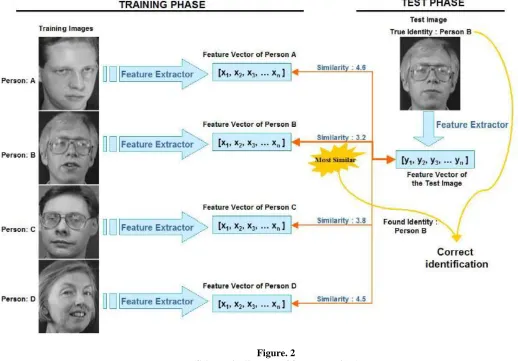
Further, this project implements a face recognition system using the Principal Component Analysis (PCA) algorithm. Automatic face recognition system tries to find the identity of a given face image according to their memory. The memory of a face recognizer is generally simulated by a training set. The training set consists of the features extracted from known face images of different persons. Thus, the task of the face recognizer is to find the most similar feature vector among the training set to the feature vector of a given test image. This project uses PCA as a feature extraction algorithm. This algorithm recognizes the identity of a person where an image of that person (test image) is given to the system.
II. PROPOSED METHOD
A. TEXT PASSWORD
First, the user would be asked to input his or her password which would be a string of minimum 8 alphanumeric characters. Now this password is confirmed and stored in the system. Next time the user logs in, he/she would be required to input his/her password. The password entered would be compared using a string comparison technique. If the password matches, he would be granted access or will be denied.
B. SPEAKER IDENTIFICATION
SPEECH PREPROCESSING
www.ijsrp.org w(n) = 0.54 - 0.46cos , 0≤ n ≤ N-1………..(1)
= 0 , otherwise
Where N is the number of samples in each frame
MFCC
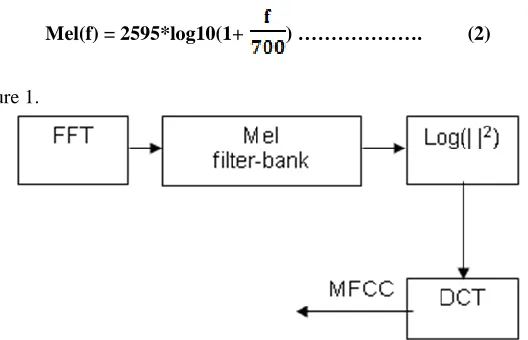
The feature is the spectral envelope of the speech spectrum which is represented by the acoustic vectors. MFCC (Mel Frequency Cepstral Coefficients) is the most common technique for feature extraction which is computed on a warped frequency scale based on known human auditory perception. Based on human perception experiments it is observed that human ear acts as filter i.e.it concentrates on only certain frequency components. Psychophysical studies have shown that human perception of the frequency contents of speech signals does not follow a linear scale. Thus for each tone with an actual frequency, f, measured in Hz, a subjective pitch is measured on a scale called the ‘Mel’ scale [2], [3]. The Mel-frequency scale has linear frequency spacing below 1000 Hz and a logarithmic spacing above 1000 Hz. Therefore we can use the following approximate formula to compute the Mels for a given frequency f in Hz:
Mel(f) = 2595*log10(1+ ) ………. (2)
[image:2.612.172.436.256.426.2]
The idea acts as follows as in Figure 1.
Figure 1. Obtaining Mel cepstrum from windowed frames
Particularly, for the filter banks implementation, the magnitude coefficient of each Fourier Transform speech segment is binned by correlating them with each triangular filter in the filter bank. To perform Mel-scaling, 17 triangular filters having triangular frequency response. The triangular filters are used as they can smoothen the harmonics .There are few filters spaced linearly below 1000 Hz, and the remaining filters spread logarithmically above 1000 Hz. The results of the FFT will be information about the amount of energy at each frequency band. Human hearing, however, is not equally sensitive at all frequency bands. It is less sensitive at higher frequencies, roughly above 1000 Hertz. It turns out that modeling this property of human hearing during feature extraction improves speech recognition performance. Peak (referred to as formants) in the spectrum denote dominant frequency components in the speech signal and carry the identity of the sound. The spectral envelope is used for speaker Identification. We now need to separate spectral envelope and spectral details from spectrum. The next step is to take the logarithm which simply converts the multiplication of the magnitude in the Fourier transform into addition making the extraction of the formants simpler. In general, the human response to the signal level is logarithmic. It is because humans are less sensitive to slight differences in amplitude at high amplitudes compared to the low amplitudes. In addition, using a log makes the feature estimates less sensitive to variations in input (for example, power variations due to the speaker’s mouth moving closer or further from the microphone) [4]. The final procedure for the Mel Frequency Cepstral coefficients (MFCC) computation is to convert the log Mel spectrum back to time domain where we get the so called the Mel frequency cepstral coefficients (MFCC). Because the Mel spectrum coefficients are real numbers, we can convert them to the time domain using the Discrete Cosine Transform (DCT) and get a featured vector. The DCT compresses these coefficients to 13 in number. This features vector is considered as an input for the next stage, which are concern with training the features vector and pattern recognition. The cepstrum is more formally defined as the DCT of the log magnitude of the DFT of a signal and is given by:
…………(3)
For u= 0,1,2,...N-1; x=0,1,2,...N-1 and a(u) is defined as -
X= (x1, x2,…xr)
www.ijsrp.org
The decision is made based on Least Mean Squared Error (MSE). This refers to the mean value of the squared deviations of the predictions from the true values.
MSE Ỳi -Yi) 2 ………. (4)
C. FACE RECOGNITION
2.3.1 TRAINING AND TESTING PHASE
In the training phase, feature vectors are extracted for each image in the training set. Let ΩA be a training image of person A
which has a pixel resolution of M X N (M rows, N columns). In order to extract PCA features of ΩA, we first converted the image into
a pixel vector ɸA by concatenating each of the M rows into a single vector. The length (or, dimensionality) of the vector ɸA will be MXN. In this project, the PCA algorithm is used as a dimensionality reduction technique which transforms the vector ɸAto a vector ωA which has a dimensionality d where d << M X N. For each training image Ωi, feature vectors ωi were calculated and stored. In the
recognition phase (or, testing phase) let j be the identity (name) of a person. As in the training phase, feature vector of this person using PCA were computed to obtain ωj. In order to identify Ωj, the similarities between ωj and all of the feature vectors ωi‘s in the
training set were computed using Euclidean distance. The identity of the most similar ωi will be the output of the face recognizer. If i
= j, it means that algorithm correctly identified the person j, otherwise if i ≠ j, it means that the program has misclassified the person j.
2.3.2 IMPLEMENTATION OF PCA
In this section, the use of PCA as a feature extractor is explained. Assume that there are ptraining images: Ωi; i = 1, 2…... p.
For each training image pixel vectors ɸi where ɸi ɛ Rk; (k = M X N) are formed. The aim is to compute feature vectors ωiwhere ωi ɛ Rd <d; (d<<k). In order to apply PCA to the training set, first a training data matrix A is formed which contains p rows: at each row ɸi’s are stored. Thus the dimensionality of A is pXk. First, the covariance matrix of A: CA is computed. Then the Eigen values and their
responding eigenvectors of CA are computed. There will be k eigen value and eigen vector pairs where each eigenvector ei is of
dimensionality k. The eigen values are sorted in decreasing order, and the biggest d eigen value and eigenvector pairs is selected. The transformation matrix A is formed by simply putting the selected eigen vectors as columns of A. A is used to compute ωi‘s from ɸi’s .The computation of ωi is simply done by:
ωi = Ψ T
ɸi T
………. (5)
whereΨT and ɸi
Tare the transposes of Ψ and ɸi, respectively. Each column of Ψ corresponds to an Eigen vector which is of length
k. This is equal to M x N which is the dimensionality (resolution) of input images. Thus, algorithm converted each eigenvector to an image by reversing the concatenation operation. These converted eigenvector images are called Eigen faces since they are similar to human faces.
Once the ωi’s are obtained using the largest d eigenvectors, the image of person i gets reconstructed. Using all k eigenvectors instead of d when forming Ψ, the reconstructed image will be the same as image Ωi. However, since the aim is dimensionality reduction and d <<k, reconstructed image Ὼi will be an approximation of the actual Ωi. You can reconstruct Ὼi by converting the pixel vector: Ὼi=
www.ijsrp.org Figure. 2
(Schematic diagram of face recognizer)
III. EXPERIMENTAL RESULT
A. PASSWORD
The Text Password Recognition step looks like:
www.ijsrp.org
[image:5.612.89.511.86.386.2]B.
SPEECH
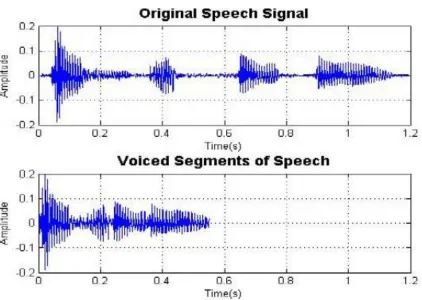
Figure 4. Input and end point detected speech
[image:5.612.189.426.432.614.2]www.ijsrp.org
C.
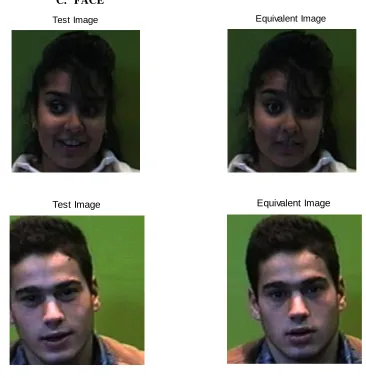
FACE
[image:6.612.70.436.64.442.2]Test Image Equivalent Image
Figure 6. Output of PCA algorithm
IV. CONCLUSION
In this paper, we have presented an approach for a three way Security System allowing access only to authorized users. The text based Password system asks for a login ID and password specific to each user. Further, this paper has evaluated the use of MSE, made using
the feature vectors obtained by doing MFCC on the pre-processed speech signal, for Robust Speaker Identification. The results of experiments show that the method is effective. Our project proposes a data security system having three levels of authentication
processes which are difficult to surpass, thus avoiding access to those who fail the authentication process. This project can be integrated and used for defense, at entry point of atomic and nuclear research centers, museums, accessing a computer system, an
online cloud account which has important documents, online transfer of money for registered user.
www.ijsrp.org
V.
FLOWCHART OF THE PROJECT
VI. REFERENCES
[1] E.C. Gordon “Signal and Linear System Analysis”. Copyright © 1998 John Wiley & Sons Ltd., New York, USA.
[2] S.S. Stevens, J.Volkmann and E.B. Newman, 1937 “A scale for the measurement of the psychological magnitude pitch”. Journal of the Acoustical Society of American,8, 185-190.
[3] S.S. Stevens and J.Volkmann, 1940 “The relation of pitch to frequency: A revised scale”. The American Journal of Psychology,53(3),329-353. [4] B. Chanda and D. D. Majumder, Digital Image Processing and Analysis. Prentice-Hall of India Private Limited, 2005.
[5] ORL database available at: http://www.cl.cam.ac.uk/research/dtg/attarchive/facedatabase.html.
Authors
First author –Ashwini Sawant, M.E. EXTC, Assistant Professor, VESIT, Chembur and [email protected]. Second author – Bhavesh Vasandani, B.E. EXTC, Student, VESIT, Chembur and [email protected] .
Third author – Mohit Tilwani, B.E. EXTC, Student, VESIT, Chembur and [email protected]. Fourth author – Mitesh Ochaney, B.E. EXTC, Student, VESIT, Chembur.