International Journal of Scientific and Research Publications, Volume 5, Issue 5, May 2015 1 ISSN 2250-3153
Synthesis and characterization of Ba
0.5
Sr
0.5
(CO
0.8
Fe
0.2
)
1-x
Ti
x
O
3-δ
(BSCF) Cathode for Solid Oxide Fuel Cell
D. Rama Krishna Sharma*, Dr P. Vijay Bhaskar Rao**
*Department of Physics, Visvesvaraya College of Engineering, Patelguda, Ibrahimpatnam, Hyderabad. India pin 501510 **Professor and Director R & D, St. Mary Engineering College, Deshmukhi (vill), Hyderabad
Abstract- The BSCF, Barium Strontium Cobalt Iron Titanate{Ba0.5Sr0.5 (CO0.8 Fe0.2)1-x TixO3-δ,}[Where δis the
deficiency of oxygen & x is various compositions ], powders have been synthesized by sol-Gel process using nitrate based powdered chemicals for SOFC applications as these powders are more useful for Cathodes and anodes for SOFCs since these powders are considered to be more promising cathode materials for SOFC. Ionic conduction, Adsorption and desorption rates are the major processes that control the electrode reactions. They contribute to the over potential .To obtain the low potential cathode materials suitable for the electrolytes, SOL-GEL method is used and nano powders are prepared. The Chelating agent used is Acetic acid, Ethylene glycol & Ammonia as dispersant. These powders were kept for calcinations at 9000C for 16 hr and at 11000C for about 6 hr in crucibles of high alumina in furnace .These were characterized by XRD, SEM with EDAX, Densities, TGA and conductivities.XRD results proved the formation of Perovskite phase at all calcinations temperatures and the crystallite sizes were found to be 94.49nm, 103.9nm ,295.29 nm. From SEM, it is found that for some samples, there is presence of extreme porous particles present in nano sizes and conductivities, densities are studied
Index Terms- SEM/EDAX, TGA/DSC; XRD; Density; Ba0.5
Sr0.5 (CO0.8Fe0.2)1-xTi xO 3-δ
I. INTRODUCTION
OFC’s (Solid oxide fuel cells) are one of the vital energy conversion devices with high oxygen vacancies. BSCF proved as good materials for solid cathode with appealing properties like ionic conductivity, super conductivity, Ferro electricity, magnetic resistance etc.,Many cathodes were used in LSM, SSC, LSCF, BSCF, etc.,but, the thermo-mechanical suitability between electrolyte and cathode can be improved by mixing cathode material with new element or a small impurity like Titanium. Such composite cathode will have a better ionic conductivity. As the cathode over potential is significant in SOFC’s, it can be reduced by adding Titanium to BSCF. By increasing the percentage of Ti in site ‘B’ of ABO3 (Perovskite
structure), one can increase the efficiency and conductivity.Conventional SOFCs with an Yttria – Stabilized Zirconia (YSZ) cathode are not being operated at 900o C or higher temperature operation causes serious problems such as internal mechanical stress due to the difference in the thermal
[1].because electrochemical and conduction processes in SOFC are strongly thermally activated, a reduced operating temperature leads to another difficulty in large voltage losses due to the ohmic resistance of the materials and polarization at the electrodes. Most of the voltage losses are generated from the ohmic resistance of the electrolyte, a number of approaches have been reported preparing a thinner electrolyte which reduces the corresponding resistance [2, 3], and high power density was obtained using YSZ thin film electrolytes [4, 5].There are generally two categories making a robust anode-electrolyte-cathode cell while maintaining thin electrolyte layer: Cathode supported cell [6, 7] and
Anode supported cell [8-10,]. Despite the fact that Cathode - supported cell can be produced by ceramic process (Toh) as well as by atmospheric plasma spraying (Siemens-Westing house) with scalable processes. Reducing the operating point temperature below 800oC causes an increase of over potential at low temperature. Currently, La Sr Mn O (LSM) is commonly used as cathode material because of its high catalytic activity for oxygen reduction, thermal and chemical compatibility with Yttria stabilized new power generation system for their high - Zirconia (YSZ) [11, 12].Recently strontium doped cobaltite has attracted much attention because of its mixed conduction characteristics and its relatively high ionic conductivity. Strontium doped samarium cobaltite (SmSrCoO: SSC) shows even higher conductivity,up to 10 S cm [13]. It shows good compatibility with ceria cathode. The cathodic reaction mechanism of SSC is not clearly understood. Ionic conduction, Adsorption and desorption rates are known as the major processes that control the electrode reactions. They contribute to the over potential In practical the adsorption and desorption rates of SOFC are not equal. Therefore separate adsorption and desorption rates must be determined.
In the present paper, the objective is to prepare a cathode suitable for SOFC in single chamber fuel cell conditions. Hence, materials with a small percentage of Ti (with increasing values) are prepared and their characterization/values are compared. Out of various fuel cells, solid-oxide fuel cells (SOFCs) have the benefit of eco friendly power generation with fuel [15] flexibility. High operating temperatures resulted in highly expensive, less compactness and low compatibility of cells. Hence, SOFCs [16] have been designed and developed and cathodes are prepared as they exhibit poor response for traditional and conventional cells, by using BSCF (Ba Sr Co Fe) newly, which exhibit high power densities i.e., 1,010mW/cm 2
chamber fuel cell operation. Hence, the alternative Perovskite Cathodes are chosen for high activity oxygen reduction.
These SOFCs will have high oxygen diffusivity. The important requirements for SOFC cathode materials are i)High electronic conductivity ii)Chemically suitable with electrolyte,
iii)Stable in oxidation,iv) Large triple phase boundary, v)High ionic conductivity, vi)Suitable thermal expansion coefficient,
vii)Simple fabrication andviii) Low cost. There are many materials which explain the reaction mechanisms of SOFC cathodes, like transport of oxygen, electrode kinetics, and involvement of chargeable particles in electrochemical processes. Reduction of oxygen at cathode is one of the important factors which contribute to the total resistance of the cell. Electro catalytic activity is also another important factor of SOFC.Hence by enhancing the porosity of cathode; one can increase the oxygen exchange and diffusion in cathode which results to higher current density in thecell.
Since six years Ba0.5Sr0.5Co0.8Fe0.2, Ba0.5Sr0.5Co0.2Fe0.8 and other combinations have got much attention for intermediate temperature of SOFCs but, this reduction in temperature below 800oC causes an increase of the over potential of SOFC cathode. Therefore, to obtain the low potentialcathode materials, the material Ba0.5Sr0.5[Co0.8Fe0.2]1-xTixO3-δ is designed, { where ‘x’ is Various Compositions and ‘δ’ is deficiency of oxygen (0 or 0.1) }. By taking such doping of titanium with BSCF, the weight % was found to be 70%. Compared to SDC (Samaria- doped Ceria) this is 30% defective.
The structure is of ABO3-δ, Perovskite. In this, oxygen ion
vacancies will be pronounced along (B3+/4+)-O2--(B3+/4), due to overlapping of the oxygen p-orbital and transition-metal d-orbital. When Ba is in site ‘A’, it increases the amount of B4+
ions and increases oxygen vacancies. In recent works, Itohet.al-has shown the presence of both covalent and ionic bonds is BSCFO3-δ and increases electron and oxygen ion conductivity at
fairly low values of temperature. This clearly explains that the stoichiometry of oxygen decreases with increase in temperature and hence reduction in cations in site ‘B’ [17, 18]. SOFC performance will purely depend on sample preparation, its reactants, chemicals, stoichiometry, calcinations, sintering, acids, and bases. In recent papers, it is suggested that, by varying x and δ values in the BSCFO3-δ[5582] would affect the performance.
Hence, in the present study, investigation has been studied with
Ba0.5Sr0.5[Co0.8Fe0.2]1-xTixO3-δ by taking δ=o, δ=1 and x=0.10, 0.15, 0.20, 0.25 with different thermal properties. BSCF has proved as a good material for solid oxide fuel cell cathode [20,
21, and 22]. These have properties like ionic conductivity, Ferro electricity.
There are various models developed to explain reaction mechanisms off cathodes, of SOFCs[9, 10]. But, BSCF cathode preparation doped with Titanium and the over potential study is an important factor. A cathode should possess high electro catalytic activity for the reduction of oxygen. A good cathode should have high oxygen exchange and diffusivity so that, there will be rapid movement of oxygen ions [23]. This can also be obtained by increasing the porosity of BSCF cathode[24] which provide more dispersion of gases increasing reduction of oxygen. Hence, the current density will be generated within the cell.
II. EXPERIMENTAL
2.1Materials:
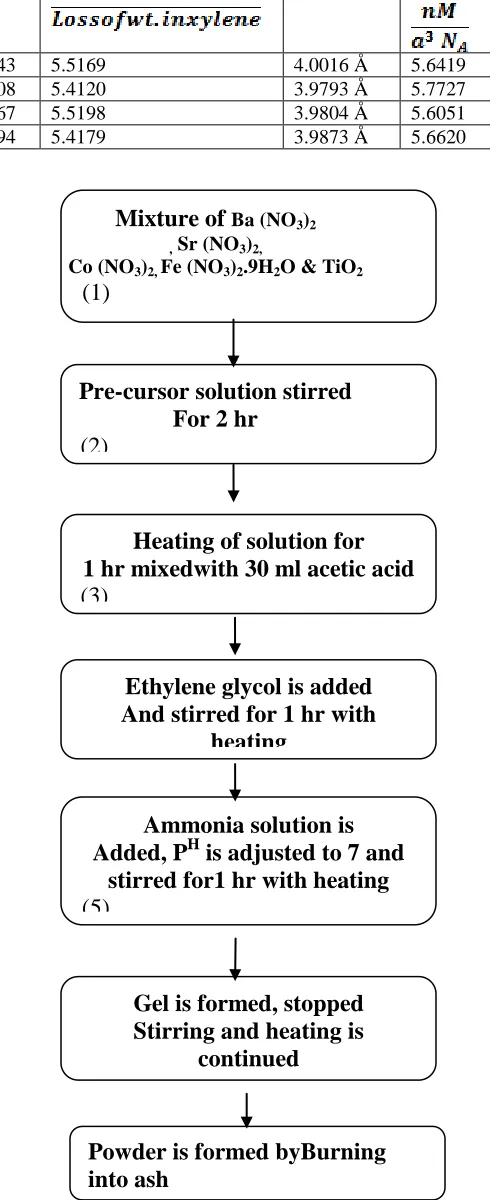
Commercial powders of AR grade of Aldrich Company were used in this work for the preparation of Cathode. Ethylene di-amine-tetra-acetic acid (EDTA), ethylene glycol, anhydrous citric acid, nitrate salts of Barium, Strontium, Cobalt, Iron and Zirconium oxide were purchased from Sigma Aldrich, USA. Ammoniasolution is used as base. In the present observations, the Nano crystalline cathode material of Ba0.5 Sr0.5 (Co0.8 Fe0.2)L-x
TixO3-δ by varying x values, (x = 0, 0.10, 0.15, 0.20) BSCF
Ti(5582Ti) powders were prepared by sol-gel process as it is one of the economical ways and characterizations like SEM/ EDAX of LEO SUPRA 55 VD ultra high resolution of ZEISS , XRD TGA/DTA, Impedance Analyzer were used. Bariumnitrate Ba(NO3)2,StrontiumNitrate Sr(NO3)2 ,.Cobaltous Nitrate
Co(NO3)2, Fluka Fe (NO3)2.9H2O& TiO2, are used. 2.2 Method
International Journal of Scientific and Research Publications, Volume 5, Issue 5, May 2015 3
[image:3.612.169.414.132.732.2]ISSN 2250-3153
Table. 1 Density calculations
Sam ple
Wt. in air (g)
Wt. in xylene
(g) =
a (Lattice constant)
=
Density
%= { } *100
Ti1 0.2376 0.1943 5.5169 4.0016 Å 5.6419 97%
Ti2 0.3773 0.3108 5.4120 3.9793 Å 5.7727 95%
Ti3 0.3866 0.3167 5.5198 3.9804 Å 5.6051 97%
Ti4 0.3183 0.2594 5.4179 3.9873 Å 5.6620 96%
Mixture of
Ba (NO3)2 , Sr (NO3)2,Co (NO3)2, Fe (NO3)2.9H2O & TiO2
(1)
Pre-cursor solution stirred
For 2 hr
(2)
Heating of solution for
1 hr mixedwith 30 ml acetic acid
(3)
Ethylene glycol is added
And stirred for 1 hr with
heating
(4)
Ammonia solution is
Added, P
His adjusted to 7 and
stirred for1 hr with heating
(5)
Gel is formed, stopped
Stirring and heating is
continued
ISSN 2250-3153
Figure 1. Flow chart of method of preparation of sample
III. CHARACTERIZATION
3.1 XRD Characterization:
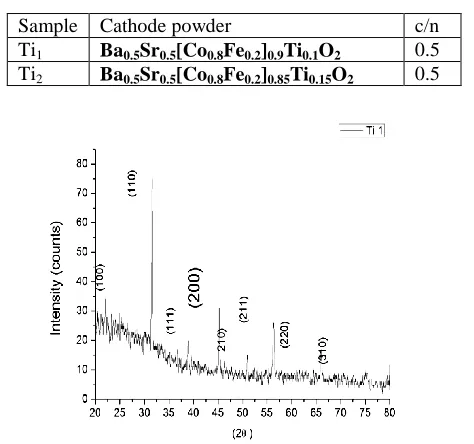
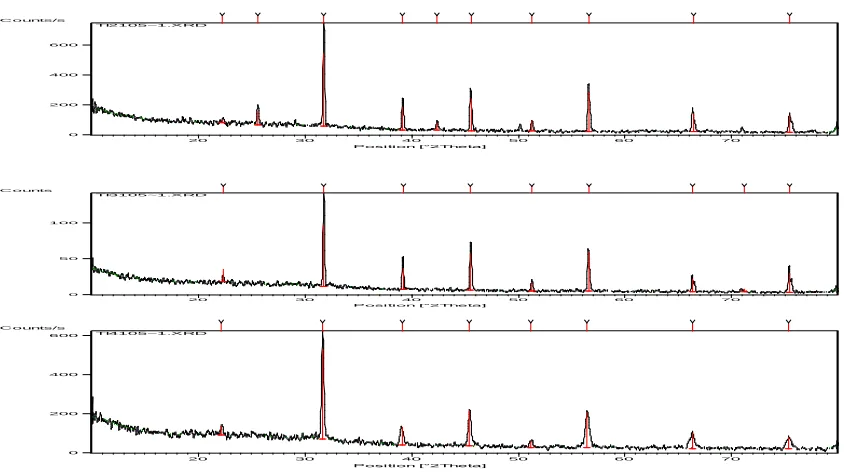
X-ray diffraction (XRD) analysis of the sintered samples is carried out with XRD at 40 KV and 30mA, using CuKά radiation with diffraction angle (2θ) range from 20o to 80o and particle size is determined by line broadening
[image:4.612.189.426.369.591.2]technique as shown below for all four samples. It is clear that, powder is partially amorphous and it is observed that calcined powders were of Perovskite structure and these were found to be similar with other XRD’s of various authors. It is observed that, at higher temperatures, the noise in XRD is reduced and still it can be reduced by calcining the samples at about 1100 0C , 1150 0C or more.
Table 2.Cathode (BSCFTi – 5582Ti)powders by sol-gel process.
Sample Cathode powder c/n
Ti1 Ba0.5Sr0.5[Co0.8Fe0.2]0.9Ti0.1O2 0.5 Ti2 Ba0.5Sr0.5[Co0.8Fe0.2]0.85Ti0.15O2 0.5
Figure.2 XRD Patterns of Ba0.5 Sr0.5 (Co0.8 Fe0.2)L-x TixO3-δwith δ=o, x=0.1
calcined at10500C
Powder is calcined at 900o C
For 8 hr and pellets, powder calcined
at 1050oC , 1100oC each for 2 hr
International Journal of Scientific and Research Publications, Volume 5, Issue 5, May 2015 5 ISSN 2250-3153
Posi ti on [°2Theta]
20 30 40 50 60 70
C ounts/s
0 200 400 600
TI2105~1.XRD
Posi ti on [°2Theta]
20 30 40 50 60 70
C ounts
0 50 100
TI3105~1.X RD
Position [°2Theta]
20 30 40 50 60 70
C ounts/s
0 200 400
600 TI4105~1.XRD
[image:5.612.93.517.54.290.2]Figure3. XRDs of Ti1, Ti2, Ti3 samples
Table. 3XRD data for determining the average particle size of BSCF Ti (5582 Ti)
Sample 2θ θ Cos θ FMHM (
Particle sizeD = nm
Ti1 31.571 15.786 0.96228 0.4723 30.506
Ti2 31.7698 15.8849 0.9618 0.3149 45.77
Ti3 31.6666 15.8333 0.9620 0.4723 30.51
Where = 1.540510 nm
3.2 SEM with EDAX Characterization:
Figure.3 (a) SEM with EDAX of Ti1 sample Figure. 3(b) SEM with EDAX of Ti 2 sample
Figure .4(a) SEM Photograph of sample 1 Figure. 4(b) SEM Photograph of sample 2
Figure.5 (a) SEM of sample 1, particle size Figure. 5(c) SEM of sample 2, particle size
From SEM with EDAX analysis , it is found that the atomic percentage as taken in the formula is not changed and all atoms are present in the same proportion , particle sizes are noted which are in good coincidence with the data taken from XRD .
[image:6.612.26.589.78.235.2] [image:6.612.42.507.280.661.2] [image:6.612.30.494.286.482.2] [image:6.612.279.502.493.650.2]International Journal of Scientific and Research Publications, Volume 5, Issue 5, May 2015 7 ISSN 2250-3153
IV. TGA/DTA CHARACTERIZATION
The curves in figures 6(a) and 6(b) correspond to TGA (weight loss in % Vs temperature) and DTA( Rate of losing weight Vs temperature ) for Ti1 and Ti 2 samples.DTA is studied with difference in temperature and flow of heat between the sample and a
reference. Moisture, Thermal stability and composition are studied simultaneously by TG/DTA referring Exothermic and Endothermic processes.
Powder samples of Ti1of 10.6 mg and Ti 2of 7.6 mg are taken and corresponding curves are recorded. The weight loss is observed for three times in TGA first at 78 0 C due to evaporation of moisture , second at 490 0 C due to evaporation of nitrates and third at 640
0 C due to evaporation of other impurities because of usage of acids,bases etc.,. The melting point can be at about 1070 0C or 1100 0
C.
Figure. 6(a) TGA/DTA Curves forBa0.5Sr0.5[Co0.8Fe0.2]0.9Ti0.1O2
[image:7.612.89.528.179.398.2] [image:7.612.90.524.430.648.2]V. IMPEDANCE ANALYSIS
To characterize the electrochemical properties of BSCFTi cathode, AC impedance values are measured and characterization of cathode processes is based on the application of ac potential
E(t) = EoCos( ωt + ø )of minimum amplitude such that ac current I(t) = IoCos( ωt - ø ) is obtained.
Impedance, Z = is calculated at different AC frequencies up to few MHz
The impedance measurements characterizes the physical and chemical processes related to time constants ,electron transfer at high frequencies and mass transfer at low frequencies. In the present study, the impedance measurements were carried from room temperature to 1500 C and Nyquist plots (Z S = Z Real + Z Imaginary ) are drawn as shown in figures 7(a) for Ti1 sample and 8(a) for Ti2
sample respectively.
The cole-cole plots are observed for Z l and Z ll plots as depicted in figures 7(a) & 8(a) .
0 500 1000 1500 2000 2500 0
500 1000 1500 2000
2500 Z''RT Z''50
Z''100 Z''150 Z ''( Oh m) Z'(Ohm) Ti(1)-2
0 75 150 225 300 0
75 150 225
300 Z''RT Z''50
Z''100 Z''150 Z ''( Oh m) Z'(Ohm) Ti(2)-2
Figure .7(a) COLE-COLE plot of Ti sample Figure .8(a) COLE-COLE plot of Ti2 sample
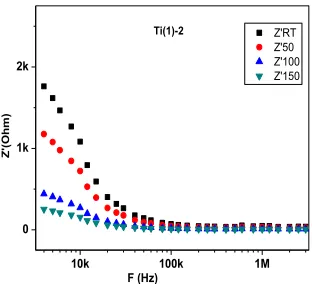
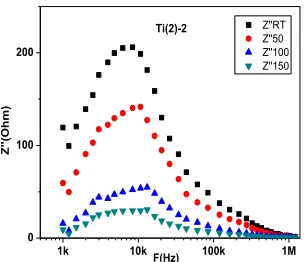
The stable behavior of the real part of the impedance with frequency is observed with increase of temperature as shown in figures 7(b) & 8(b).
From cole-cole plots one can calculate the grain resistance (Rg) and grain boundary (Rgb) resistance and their temperature
dependence can be observed.
10k 100k 1M 0 1k 2k Z'RT Z'50 Z'100 Z'150 Z '(O h m ) F (Hz) Ti(1)-2
1k 10k 100k 1M
0 100 200 300 Z'RT Z'50 Z'100 Z'150 Z '( Oh m) F(Hz) Ti(2)-2
Figure.7 (b) Z Vs Frequency curves Figure.8 (b) Z Vs Frequency curves
[image:8.612.54.210.451.593.2] [image:8.612.67.475.452.612.2]International Journal of Scientific and Research Publications, Volume 5, Issue 5, May 2015 9 ISSN 2250-3153
10k 100k 1M 0.0
400.0 800.0 1.2k
1.6k Z''RT
Z''50 Z''100 Z''150 Z '' (Oh m) F(Hz) Ti(1)-2
1k 10k 100k 1M
0 100 200 Z''RT Z''50 Z''100 Z''150 Z ''( Oh m) F(Hz) Ti(2)-2
Figure.7(c) Z Vs Frequency curves Figure.8( c) Z Vs Frequency curves
[image:9.612.43.197.75.212.2]AC conductivity is calculated by the formula = where Y l is called admittance, t is thickness of the sample and A is area of the sample. The conductivities are tabulated in tables 4 & 5 below.
Table 4. Calculation of conductivities through AC Impedance of Ti 1 Sample:
S.No Temperature Resistance ( ohm)
Admittance ( Y) Area( A) m2 Thickness( t) m
= 1 Room temp. 1750 5.714 X 10 -4 69.42 X 10 -6 1.46 X 10 -3 0.0120
[image:9.612.322.474.80.211.2]2 50 1200 8.33 X 10 -4 69.42 X 10 -6 1.46 X 10 -3 0.01752 3 100 500 2 X 10 -3 69.42 X 10 -6 1.46 X 10 -3 0.042059 4 150 250 4 X 10 -3 69.42 X 10 -6 1.46 X 10 -3 0.08411
Table 5.Calculation of conductivities through AC Impedance of Ti 2 Sample:
S.No Temperature Resistance Admittance Area( A) m2 Thickness( t) m
= 1 Room temp. 320 3.125 X 10 -3 70.6124 X 10 -6 1.42 X 10 -3 0.06284
2 50 230 4.347 X 10 -3 70.6124 X 10 -6 1.42 X 10 -3 0.087417
3 100 95 0.01052 70.6124 X 10 -6 1.42 X 10 -3 0.211556
4 150 50 0.02 70.6124 X 10 -6 1.42 X 10 -3 0.402197
VI. RESULTS AND DISCUSSIONS
In this study, the composition of the material was adjusted in such a way that the dopant will take its place on site B of Perovskite structure ABO3.
The X-Ray diffraction patterns of powdered BSCFTi were studied at different temperatures starting from 750
0 C but diffraction peaks were found to be broad and
very weak and sample was not crystallized perfectly. But, as the sintering temperature is increased, the impurity peaks due to Fe3O4Co. The sharp lines in XRD
pattern depicts a well crystallized structure is formed. All the peaks indicate a Perovskite structure and
correspond to planes (100),
doping of Ti is increased and sintering is done for much time accordingly. The particle sizes of samples are calculated using XRD data.
Densities of samples are calculated and for all samples the density percentage is above 90% .
SEM images of BSCFTi proved the presence of porous spherical particles of nano size for the powders calcined above 8500C.
From TGA plots it can be concluded that there is no weight loss after about 5400C which indicates that combustion process is completed at this temperature and oxide phases are formed.
As the concentration of Ti increases the resistance of the sample has been decreased and conductivity increased.
[image:9.612.70.547.432.510.2]between ac conductivity (along y-axis) and 1000/T along x-axis will be a linear graph.
ACKNOWLEDGEMENTS
Authors thank Chairman, R&D team of St. Mary’s Engineering College, Department of Physics - Osmania University, and Department of physics-JNTU Hyderabad, Chairman, Secretary, Principal & Department of Physics- Visvesvaraya College of Engineering and Technology, Hyderabad, Telangana State, INDIA.
REFERENCES
[1] T. Ishihara, H. Matsuda, Y. Takita, J. Am. Chem. Soc. 116(1994) 3801 [2] K. Huang, M. Feng, J.B. Goodenough, J. Electrochem. Soc.
[3] J.P.P. Hujismans, F.P.F. Berkel, G.M. Christie, J. Power
[4] R. Maric, S. Ohara, T. Fukui, H. Yoshida, M. Nishmura, T. Vol. PV 94-12, Electrochemistry Society, 1994, Inagaki, K. Miura, J. Electrochem. Soc. 146 2006
[5] P. Huang, A. Horks, A. Petric, J. Am. Ceram. Soc. 82 (1999) Electrochem. Soc. 134 (1978) 21412402
[6] F. Chen, M. Liu, J. Solid State Electrochem. 3 (1998) 7.Tuller (Eds) Proceeding 1st International Symposium Ionic
[7] T. Iśhihara, H. Matsuda, Y. Takita, in: Proceedings 2nd Ionic and Mixed Conducting Ceramics, Electrochemistry Soceity,and Mixed Conducting Ceramics, Vol PV 94-12, Electro- 1991, p. 122.ChemistrySoceity, 1994, p. 85.
[8] T. Ishihara, M. Honda, Y. Takita, Recent Res. Dev. Electrochem2 (1999) 15 [9] N.Q. Minh, T. Takahashi, in: Science and Technology of Nishiguchi, Y. Takita, J. Electrochem. Soc. 145 (1999) 3177. Ceramic Fuel Cell,1995, p. 147.
[10] S. Majumdar, T. Claar, B. Flandermeyer, J. Am. Ceram. Soc. 144 (1997) 3620. 69
[11] O. Yamamoto, Y. Takeda, R. Kanno, H.U. Anderson, SolidState Ionics 22 (1989)
[12] A. Hammouche, E. Siebert, A. Hammou, Mater. Res. Bull.24 (1989) 367. [13] T. Ishihara, M. Honda, T. Shibayama, H. Minami, H. Nishiguchi, Y.
Takita,
[14] J. A. Kilner, R.A. De Souza, I. C. Fullarton, Solid state IonicsP. SSC 86-88 (1996) 703. O2
[15] A Boudghene Stambouli and E, Traversa, Renewable and Suitable Energy Rev., 6.433 (2002)
[16] S. J. Skinner, Jnt. T. Inorganic Matter., 3, 113 (2001)
[17] Z. Shao and S. M. Haile, Nature (London) 431, 432, 170 (2004)
[18] Y. Itoh V, Nishida, A. Tomita, Y. Fujie. Solid state communication. 149. 41 (2008)
[19] B. Liu, Y. Zhamg and L. Tang, Int. J. Hydrogen Energy, 34, 435 (2009) [20] X. Sun, S. Li, J. Sun, X. Liu, B. Zhu, Int. J. Electrochem. Sci. (2007) 462 [21] A. Subrahmania, T. Saradha, S. Muzumathi, J. Power Sources 165 (2007)
728
[22] H. Zhao, F. Mauvy, C. Lalanne, J.M. Bassat, S. Fourcade, J.C Grenier, Solid State Zonics 179 (2008)2000
[23] A. Princivalle, E. D. Jurado, SSI 179 (2008) 1921 [24] V. B. Vert, J.M. Serra, Fuel Cells (2009) 663
[25] Y. Li, R. Gemmen, X. Liu, J. Power sources, 195 (2010) 3345[26] S.S. Shimizu, T. Yamaguchi, Y. fujishiro, ECS Tans. 25 (2009) 975
AUTHORS
First Author – D.Rama Krishna Sharma, Department of physics,
Visvesvaraya college of Engineering ,Patelguda ,Ibrahimpatnam, Hyderabad. India pin 501510, Email:[email protected], [email protected]
Second Author – DrP.VijayBhaskarRao, Professor and Director

![Figure. 6(a) TGA/DTA Curves forBa0.5Sr0.5[Co0.8Fe0.2]0.9Ti0.1O2](https://thumb-us.123doks.com/thumbv2/123dok_us/9093353.982265/7.612.90.524.430.648/figure-tga-dta-curves-forba-sr-co-fe.webp)