Journal of Chemical and Pharmaceutical Research, 2014, 6(10):74-80
Research Article
CODEN(USA) : JCPRC5
ISSN : 0975-7384
Analytical method development and validation for simultaneous
determination and quantification of Ethinyl Estradiol and Gestodene in
combined tablet dosage form by RP-HPLC
Kanchan Nautiyal and K. Ramakrishna
College of Science, GITAM University, Visakhapatnam, Andhra Pradesh, India
_____________________________________________________________________________________________ABSTRACT
The present paper describes a simple isocratic reverse phase HPLC method for the simultaneous determination and Quantification of Gestodene and Ethinyl Estradiol in Pharmaceutical dosage forms. The Seperation and estimation was achieved with normal C18(250 x4.6mm,5µ) columns using a mixture of acetonitrile,methanol and
water(35:15:50) as the mobile phase at a flow rate of 2.0 ml/min and detection was carried out at 210 nm.The seperation was achieved within 18 mins and retention of Gestodene and Ethinyl Estradiol is 10.5 and 7.4 mins respectively. The developed method was validated and linearity of the proposed method was in the range of 1.88-11.33mg/mL(r-0.9994) for Gestodene, 0.755-4.531 mg/mL (0.99973) for Ethinyl Estradiol. The proposed method was suitable for simultaneous Determination and Quantification of Gestodene and Ethinyl Estradiol in combined pharmaceutical dosage forms.
Keywords: Development, Validation, Tablet, Assay, HPLC, Column
_____________________________________________________________________________________________
INTRODUCTION
Chromatographic parameters Equipment: HPLC with PDA detector Column: SB C18 (250x4.6, 5µ) Flow rate: 2.0 ml/min
Wavelength: 210 nm Injection Volume: 100 µL Column Temperature: 30°C Run time: 18 mins
Auto sampler Temp: 10°C
Preparation of Mobile phase
Prepared a homogeneous mixture of 350 ml of Acetonitrile (35%), 150 ml of methanol (15%) and 500ml (50%) of Milli Q water and degas in ultrasonic water bath for 5 mins and filtered through 0.45 u filter under vacuum filtration
Diluent:
Mixed and degassed Milli Q water and acetonitrile in the ratio of 50:50
Preparation of solutions Stock Solutions:
Accurately weighed and transferred 47 mg of Gestodene working standard into 50 ml of volumetric flask. Dissolved and diluted to volume with methanol, then diluted 4 ml of above solution to 50 ml with diluent. Weighed about 50 mg of Ethinyl estradiol working standard into 100 ml volumetric flask and dissolved, diluted to volume with methanol, then diluted 3 ml of above solution to 50 ml with diluent.
Standard solution:
Pipetted out 5 ml of Gestodene stock solution and 5 ml of Ethinyl estradiol stock solution to 50 ml with diluent.
Preparation of Test solution:
Accurately weighed 20 tablets and transferred into a 200 ml volumetric flask. Added 10 ml water and sonicated to disintegrate and then added another130 ml of diluent and sonicated for 20 minutes and made up to volume. Filtered the sample through 0.2µ membrane, discarded first few ml of sample and remaining used for analysis.
Method Validation
The proposed method was validated as per ICH guidelines. The preparations were adopted as mentioned in experiment section.
System suitability
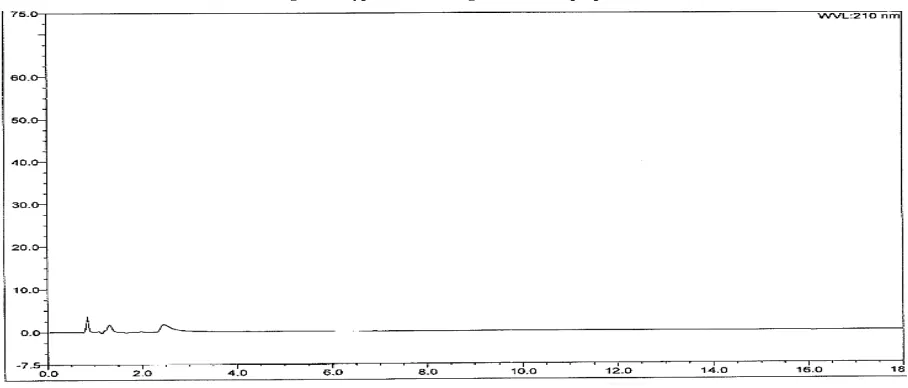
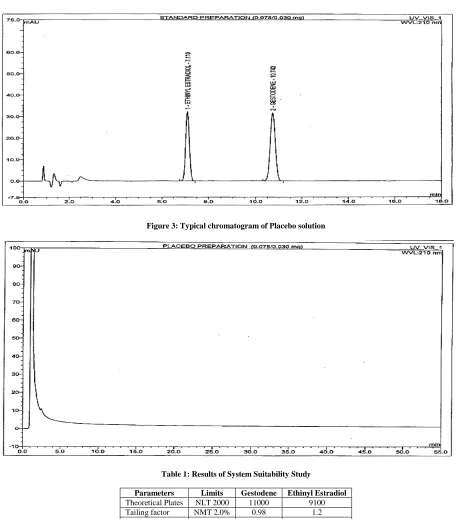
[image:2.595.74.528.552.746.2]System suitability was performed by injecting standard preparation, and measured the system suitability parameters like theoretical plates, tailing factor and % RSD were evaluated and all the results are well within the criteria and results obtained compiled in Table-1 and representative chromatogram in Figure-1,2&3.
Figure 2:Typical chromatogram of standard solution (Gestodene and Ethinyl Estradiol)
Figure 3: Typical chromatogram of Placebo solution
Table 1: Results of System Suitability Study
Parameters Limits Gestodene Ethinyl Estradiol Theoretical Plates NLT 2000 11000 9100
Intermediate Precision (Ruggedness):
This experiment was performed by injecting six sample preparations by Different analyst using different instrument and different column on different day and percentage assay of label claim was calculated along with %RSD and results were compiled in Table-2 and value indicates the precision of method.
Table 2: Results and values of System, Method and Intermediate Precision
S.No Limits
Gestodene Ethinyl Estradiol % Assay(Gestodene) % Assay (Ethinyl Estradiol)
System precision Method
Precision Intermediate precision
Method Precision
Intermediate Precision 1
%RSD- NMT 2.0%
468.666 386.352 97.0 97.6 96.3 98.1
2 472.327 391.516 96.5 97.2 95.6 97.7
3 473.649 392.743 97.3 97.7 96.2 98.4
4 473.084 393.336 97.0 97.5 95.9 98.0
5 473.320 392.974 98.7 97.4 98.0 97.9
6 470.524 390.514 96.9 97.4 96.4 98.4
Mean 471.928 391.239 97.2 97.5 96.4 98.1
%RSD 0.41 0.67 0.79 0.18 0.87 0.28
Figure 4: Typical Chromatogram of Precision study
Linearity
Linearity study was performed by preparing standard solutions in the concentration range of 25% to 150% of working concentration. The area response was calculated and linearity graph derived and its slope, intercept and correlation coefficient was calculated and found well within the acceptance criteria of 0.995 which indicates the method was linear in nature and results were mentioned in Table-3 and representative graphs and chromatograms were highlighted in Figure-5,6 &7.
Table 3: Results of Linearity and Range study
Gestodene Ethinyl Estradiol Concentration 1.88-11.33 0.755-4.531
Slope 64060.822 124214.495
Intercept -5123.6618 -7716.2793
Corr .Coefficient 0.99948 0.99973 Residual Sum of squares 96046087 84393792
Figure 6:Linearity graph of Ethinyl estradiol
Figure 7:Typical chromatogram of Linearity
Table 4: Results of Accuracy (Recovery study)
% Level
Gestodene Ethinyl Estradiol
Accuracy Study (Recovery Study)
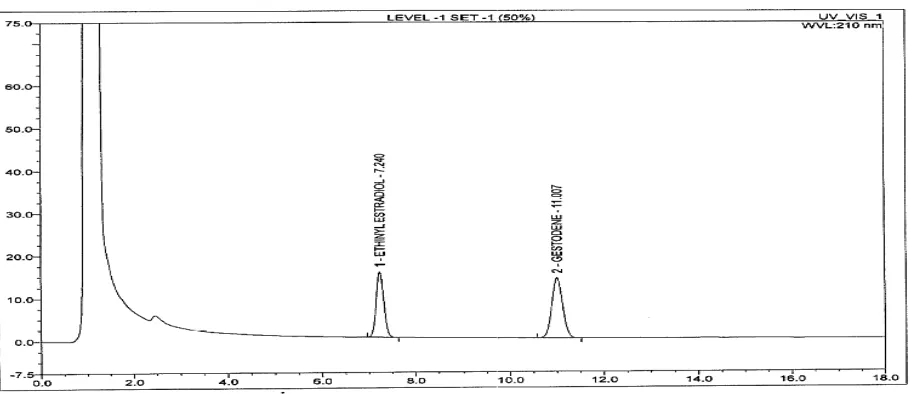
Recovery study was performed by spiking known concentration (50%-150%) with placebo of Gestodene and Ethinyl estradiol in triplicate preparations and recovery was calculated and well within the acceptance criteria of 95% to 105% and shows the method was accurate and precise. The results of recovery study were compiled in Table-4 and representative chromatogram in Figure-8.
Figure 8: Chromatogram of Recovery (Gestodene and Ethinyl estradiol (100%level)
Stability of Analytical solution
Test and standard preparation was prepared and analysed initially and at various intervals which was stored at 10°C and % Area difference with respect to initial were monitored and found all were within the limit of ±2 of area difference and solution stability was established up to 12 hours and concluded that analytical solution was stable up to 12 hrs.
Robustness
The Robustness was performed by deliberately changing the chromatographic condition and impact on system suitability parameters and assay values were monitored and results were recorded and found that the values were well within the acceptance criteria and proved the robustness of the analytical method against the deliberate changes.
RESULTS AND DISCUSSION
The mobile phase consisting of mixture of Water: Methanol : Acetonitrile of definite ratio with isocratic elution, flow rate with 2ml/min was optimized for well Seperation of Gestodene and Ethinyl estradiol with shorter analysis time, UV absorption pattern shows the both the compound were absorbed appreciably at 210 nm, so wavelength was selected as a detection wavelength for analysis, to maintain the sharpness of eluent peaks ,the column temperature was maintained 30°C ,as analytical solution has stability variation on storage, so sampler temperature condition was kept as 10°C.The retention times for Ethinyl Estradiol and Gestodene were 7.0 min and 11.0 min respectively. The proposed method was successfully applied to identification and quantification of Ethinyl Estradiol and Gestodene in dosage forms.
[image:6.595.80.535.156.353.2]CONCLUSION
The Developed reverse phase HPLC method was optimized based on shapes and resolutions of both Ethinyl Estradiol and Gestodene and method was validated, based on validation results and interpretation of values, it is concluded that this RP HPLC was simple, accurate and precise and method presented in this paper can be successfully used for routine monitoring and quantification of Ethinyl Estradiol and Gestodene in Dosage forms.
Acknowledgement
The authors are highly thankful to Gitam University, Visakhapatnam,for providing opportunity to carry this research work.
REFERENCES
[1] Flockhart DA, Drug Interaction Bank Table, 4th Edition, United states of America, 2004, 1010. [2] Flockhart DA, Drug Interaction Bank Table, 4th Edition, United states of America,2004,774. [3] Korany, Eiyazbi, Abdel Razak, Pharmaceutisch week band., 1985 , 7(4) ,163-166
[4] YCao, Yuzhenhan, Yaw Fenxi Zahi, Journal of chemistry sinica., 1982, 2(2), 92-95
[5] Cheng, Wuben, Rong, Domei, Yaoxue Tongbao, Journal of Pharmaceutica sinica, 1982, 17(4), 245. [6] RN Rao, R Ramana, M Sivaramkrishnan, Indian Journal of Pharmaceutical sciences, 1979, 41 (6), 233-235. [7] JJ Berzas, J Rodríguez, G Castaneda, MJ Pinilla, J.Chromatographia., 1999, 49(1-2), 65-70.
[8] MR Bebawy, AJ Mostafa, RM Refaat, Journal of pharmaceutical and biomedical Analysis, 2001, 25(3-4) , 425-436
[9] TA Denisova, VV Chistyakov, NP Sadchikova, Pharmaceutical Chemistry of Journal, 2008, 42(5), 291-293. [10] G Shao, Li Hai-hao, Li-ning, Journal of Shengzhi Yu Biyun., 2010, 30(7), 469-472.
[11] M Ines, RM Santoro, NM Kassab, ER Kedor,Journal of Drug Development industrialPharmacy,2002, 28(6), 741.
[12] Aleksandra Laban, Slavko Markovic, Milena Stankov and Predrag Djurdjevic,AnalyticalLetters, 1998, 37(2) 273-282.
[13] JR Floresa, JJB Nevado, GC Penalvo, FJ Bernardoa FJ, Analytical Letters, 1997, 30(12), 2221-33.
[14] LL Fekete, SS Szabolcs, Fekete, Journal of Pharmaceutical and Biomedical Analysis, 2009, 49 (3), 833-838 [15] H Liu, HH Xiaofen Ding, ZH Cungang, Yaoxue Xuebao,Journal of Acta pharmaceutica Sinica, 2010, 45(1), 87-92.
[16] Sun Li, Yong, Wei, Journal of Chromatography A, 2009, 1216(28), 5416-5423.LC-MS [17] Matejicek, David, Kuban, Analytica Chimica Acta., 2007, 588(2), 304-315.
[18] Z Xiong, X Sun, T Huo, Li N, Y Zheng, Journal of Sun Biomed Chromatographia,2010 , 24(2), 160-68. [19] EAJunior, LF Duarte, MLP Vanunci, ML Teixeira, Journal of bioequivalence, 2010, 2(6), 125-30.
[20] Determination of Gestodene in Human plasma by SLE-LC MS/MS, 7th Edition, Thremofischerlab Publications, India, 2010.
[21]LR Siekmann, AnitaSiekmann, AK Klaukbrill, European Journal of endocrinology, 1998,139 (2), 167- 177 [22] CH Moser, DA Zoderer, Gerhard Leuf, Journal of Anal Bioanalchem.,2012, 403,961-972