International Journal of Emerging Technology and Advanced Engineering
Website: www.ijetae.com (ISSN 2250-2459,ISO 9001:2008 Certified Journal, Volume 5, Issue 10, October 2015)
1
A Model for Summarizing Celebrities with Microblogging
Users' Interest
Shuangyong Song
1, Dong Sang
2, Hongyun Bao
3 1Internet Application Laboratory, Information Technology Research Department, Fujitsu R&D Center Co., Ltd., Beijing 100027, China.
2China Institute of Forensic Science (CIFS), Beijing 100038, China
3State Key Laboratory of Management and Control for Complex Systems, Institute of Automation, Chinese Academy of Sciences,
Beijing 100190, China
Abstract— With the rapid development of Web 2.0, micro-blogging such as twitter is increasingly becoming an important source of up-to-date topics about what is happening in the world. Specially, it becomes one of the main ways for users to understand some celebrities. However, the huge volume of information makes troubles for people to get what they really want. How to filter out needless information through numerous microblogging data and form a brief review of a celebrity become necessary for microblogging users. In this paper, we propose a novel solution for understanding a celebrity by summarizing microblogging users’ interest on him/her, and a framework is outlined. Users’ interest are generally shown on the most salient historical events of the given celebrity, and usually users’ emotion can be reflected with their microblogs contents. Therefore, the proposed model first utilizes a burst detection algorithm to extract burst periods of the time series of given celebrity’s microblogs, and then conduct emotion analysis on the microblogs in burst event periods. Experimental results show that the proposed solution can effectively summarize celebrities with microblogging users' interest.
Keywords—Microblogging; text summarization; celebrity summarization; user interest; burst detection; user emotion analysis.
I. INTRODUCTION
Over the last few years, micro-blogging is increasingly becoming an important platform for users to acquire information and publish some reviews and personal status. In microblogs, information about celebrities account for a very large proportion, and microblogging has become an important way for tracking celebrities [3]. Therefore, summarizing a celebrity with microblogging information can help users quickly know him/her [1]. However, mining useful information from massive microblogs is a very hard task, and it has become an important method for summarizing celebrities that filtering out content with lower importance.
In [4], we try to understand a celebrity with detecting his most salient events from web news dataset, and key sentences about different salient events are used to describe him/her. This proposed method was proved to be useful for describing celebrities. However, this method contains no effective temporal burst detection technique since web news data don‘t have obvious temporal characteristics, and futher microblog content analysis for burst events are not conducted because news content are edited by professional news writers and they cannot reflect real web users‘ emotions on given celebrities. Therefore, we improve this method for adapting it to microblogging data.
In this paper, we propose a novel model for summarizing celebrities based on detecting his/her most concern events in microblogging platform. It contains three steps: 1) for each given celebrity, we collect the related microblogs about him/her and save them into a time series, then we utilize burst detection technique to detect periods with most microblogging users‘ interest; 2) we summarize microblogs in each burst period for detecting the main cause events of this burst; 3) for main cause events in each burst period, we perform a dictionary based user emotion analysis. Based on the above steps, we can get a summarization result of a celebrity‘s most concerning events in different time and the user emotions on those events.
International Journal of Emerging Technology and Advanced Engineering
Website: www.ijetae.com (ISSN 2250-2459,ISO 9001:2008 Certified Journal, Volume 5, Issue 10, October 2015)
2
II. RELATED WORK
In recent years, research work related to microblogging content analysis has attracted many researchers‘ interest [8]. Our work is related to the work on automatic text summarization, user interest detection and friend recommendation. In this section, we discuss those related work respectively.
Liu and Yu [1] summarize a given user with extract three kinds of relation between him/her and other named entities: person to person relationship, person to organization relationship, and person list relationship. Wu et al. proposed a model to generate personalized annotation tags for twitter users [2], which perform a simple description form of users effectively. Purohit et al. locate the problem of automatic generation of informative expertise summary or taglines for Twitter experts in space constraint imposed by UI design. In our previous work, we propose a novel solution for understanding a celebrity by summarizing his most salient historical events [4]. However, this method contains no effective temporal burst detection technique since web news data don‘t have obvious temporal characteristics, and futher microblog content analysis for burst events are not conducted. In this paper, we improve the method in [4] for adapting it to microblogging data, with utilizing both burst detection technique and user emotion analysis technique.
User interest detection is a useful work for user behaviour analysis. Existing studies have focused on detecting users‘ interest by user actions [9], user ontology [10], user navigation patterns [11] or user voting [12, 13]. Besides, classification model [14] and topic model [15] are common methods for user interest detection [16]. In this paper, we detect users‘ interest from user created micro-blog data through the user voting technique in [12, 13], and then create user interest based time series for given celebrity [7].
Many friend recommendation works are based on user
summarization and similarity calculation between
summarized users‘ feature vectors. Eirinaki et al. [17] proposed a trust-aware system for user recommendations which analysed the semantics and dynamics of the implicit and explicit connections between users via a discounting factor. Lo and Lin [18] propose a new recommendation algorithm named weighted minimum-message ratio (WMR) which generates a limited, ordered and personalized friend lists by the real message interaction number among web members. Zheng et al. [19] propose a temporal-topic model to analyse users‘ possible behaviours and predict their potential friends in microblogging. Based on the idea in our paper, similarity calculation between celebrities‘ salient events can be used to recommend celebrities to microblogging users as friends to follow.
Celebrity
Microblogging
tweets & times
Time series statistic
Burst detection
Event detection Emotion analysis
Event Event Event Event
De
sc
ri
pt
ion
Descri
pti
[image:2.612.41.574.452.635.2]on
International Journal of Emerging Technology and Advanced Engineering
Website: www.ijetae.com (ISSN 2250-2459,ISO 9001:2008 Certified Journal, Volume 5, Issue 10, October 2015)
3
III. PROPOSED MODEL
A. System Architecture of the Proposed Model
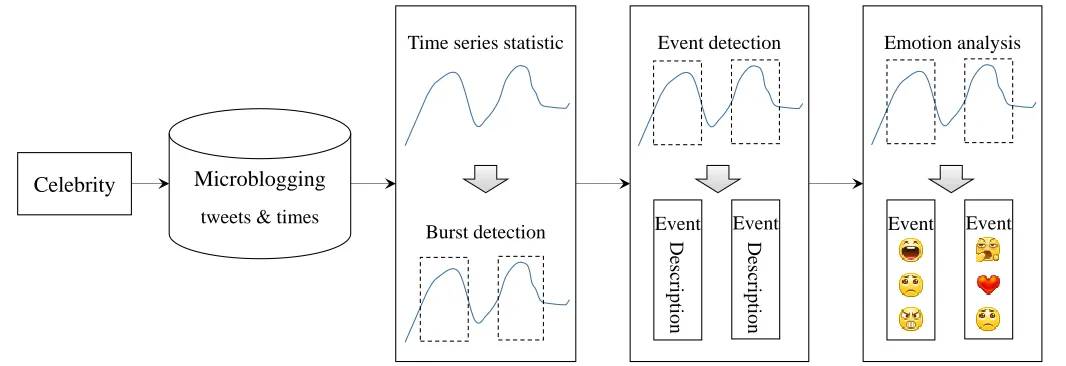
In this section, we present the architectural design of our proposed celebrity summarization model for microblogging content. The overview of the system architecture for our model is shown in Figure 1, which consists of three functional modules, namely, time series statistic & burst detection module, event detection & event description module, and emotion analysis module.
In time series statistic & burst detection module, based on a given celebrity, we first collect microblogs related to him/her, including microblogs mentioning or replying him/her, and then time series of his/her microblogs can be counted, on which we can perform a burst detection algorithm to detect the most famous events of the given celebrity. A ‗state level detection‘ based burst detection model is adopted to handle this step. In event detection & event description module,
In emotion analysis module, a dictionary based user emotion classification technique has been utilized to get a detailed emotion analysis result for each detected burst event, and furthermore, we apply our previous work in [20], which can detect the relation between emoticons and emotions, and then emoticons can be utilized as emotion feature, similar with emotional words in our collected dictionary. The mechanism of each functional module in our proposed model will be discussed in detail in the following sections.
B. Time Series Statistic & Burst Detection
Time Series Statistic: for each given celebrity, we collect the related microblogs about him/her, which includes his/her real name or microblog name. Then we count the each day number of those microblogs and save them into a time series which can reflect the microblogging users‘ interest on this celebrity. Inspired by the idea in paper [2], we define a set of microblogs which are related to a celebrity c as:
Mc = {mc1, mc2, … , mcn} (1)
Where n means the number of microblogs. Then we consider the temporal aspect of the microblogging time series of a celebrity c, and define it as the following state series:
1 2
[ , ,..., ,..., ]
c c c ci cT
S t t t t
(2)
Where Sc represents the time series of c, and tci means
the number of microblogs published by c in the ith day in our dataset. T in the definition means the total number of days in our chosen period of time.
For above mentioned time series, we utilize burst detection technique to detect periods with most microblogging users‘ interest.
Burst Detection: burst detection is used to discover topics‘ event-based bursty periods. For the Mc of a given c, we accordingly define the gaps in time between those microblogs as:
Gc = {gc1, gc2, … , gc(n-1)} (3)
Where gci means the time interval between mci and mc(i+1). Bursts of a celebrity are described as ‗grow in intensity for a period of time, and then fade away‘ [5]. We define bursty periods of celebrity c as:
Bc = {bc1, bc2, … , bcm} (4)
Where bcj means the jth detected burst period of c. For an
arbitrary c, we adopt the burst detection technique proposed in [5] to obtain Bc from Gc. With the number of bursty
intensity states z determined, we can calculate bursty intensity states of all gaps in Gk, which are between 0 and z.
Cj(i) is defined to be the minimum cost of gki ending with
state j, and the state of gki is defined as:
argmin
( )
ki j
j
g
C i
(5)Where the formula of Cj(i) is defined in formula (2), with initial conditions C0(0)0 and Cj(0) for
j
0
.( ) ln ( ) min ( ( 1) ( , )), (0 )
j j ki l l
C i f g C i l j l z (6)
In formula (6), f gj( k*) is a function representing the distribution rule of Gk, and ( , )l j is a function of cost
incurred by moving from state l to state j. In addition, burst of intensity v is defined to be a maximal interval over which states of index v or higher persist. We define the sequence of those intervals as Bt. Finally, we delete the
intervals less than one day, which are unlikely to be real bursty periods, and define Bt’ to save the left intervals.
C. Event Detection & Event Description
International Journal of Emerging Technology and Advanced Engineering
Website: www.ijetae.com (ISSN 2250-2459,ISO 9001:2008 Certified Journal, Volume 5, Issue 10, October 2015)
4
We design a clustering method with self-adaptive threshold for the cause event detection task in burst periods. In different burst periods, microblogs may have different content granularity, for example, in a burst period microblogs may contain contents on sports, movies, and games, and we need to detect events on different domains, while in another burst period microblogs may just contain contents on various sports, so we need to detect events about different kinds of sports. The clustering threshold δ for a burst period in our method is defined in formula (7) as ‗average Euclidean distance value of all microblog couples in this burst period‘, which is based on the ‗content distribution granularity‘. In formula (7), assuming that there are x microblogs in a given burst period, x*(x-1)/2 means the number of ‗microblog couple‘, w is a weight parameter, which we empirically set to be 0.9. V(mi) and V(mj) mean the topic vectors of microblogs mi and mj, and Ed(V(mi),V(mj)) means Euclidean distance between V(mi)
and V(mj). After calculating of δ, we start the clustering
with a random microblog, with assuming that it is a cluster, and if the Euclidean distance between a new microblog and it is smaller than δ, we put the new microblog into this cluster, if not, we assign the new microblog to a new cluster. Then, all the microblogs will be assigned to a steady cluster in the end.
1
1 1
( ( ), ( ))
*
* ( 1) / 2
x x
i j
i j i
Ed V m V m w
x x
(7)
Event Description: For each cause event, we detect keyphrases as the description of it. Furthermore we exhibit those event descriptions together to be the general description of burst cause events. The keyphrase detection technique is detailedly explained below.
Keyphrases mean words or word groups which have high degree of diffusion and influence in special period. If a phrase rarely shows in microblogs, this phrase will not be thought as a candidate. Therefore, phrases whose frequency is lower than a threshold number will not be taken as candidate keyphrases. In the processing of candidate keyphrase extraction, keyphrases are always single word nouns or two-gram nouns empirically with lots of experiments [22]. In this paper, besides all single word nouns and two-gram nouns, we also extract trigram and four-gram nouns from part-of-speech results, and statistic them for ranking with frequency.
Then we process the ‗substring problem‘, e.g. a trigram noun is the substring of a four-gram noun or a single word noun is the substring of a two-gram nouns, with a rule of substring merging similar with the method in [13]: in formula (1), Tlength is the length of a phrase, which is the
number of characters in it, and Tfrequency is the frequency of
this phrase. Tvalue means the ‗value for keeping‘ of a phrase,
which is determined by the above two factors Tlength and Tfrequency.
*
value frequency lengthT
T
T
(8)If a ‗substring noun‘ has a larger Tvalue than the longer
noun which contains it, we keep the substring noun. Otherwise, we keep the longer noun and delete the substring noun. Finally, all the saved phrases whose frequencies are larger than a threshold number will be taken as candidate keyphrases, which in this paper is set to be 5 empirically.
D. Emotion Analysis
[image:4.612.328.562.534.694.2]There are some different methods for user emotion analysis, and we can roughly divide them into content based analysis and emoticon based analysis. For content based analysis, many studies have made contributions, such as research on dictionary based approaches, statistical corpus based approaches and machine learning approaches [23]. For emoticon based analysis, in our previous work [20] we proposed a modified topic-supervised biterm topic model to detect relationship between emoticons and emotions. In this paper, we consider content based analysis and emoticon based analysis together, for completely and accurately detect users‘ emotion expression.
TABLE I
Examples of Emotional Words in Emotion Dictionary
Emotions Chinese emotion words
Esteem 敬佩(jingpei), 敬仰(jingyang), 敬重(jingzhong)
Sadness 哭(ku), 悲痛(beitong), 叹息(tanxi), 悲哀(beiai)
Sympathy 同情(tongqing), 可怜(kelian), 可惜(kexi)
Happiness 惊喜(jingxi), 高兴(gaoxing), 欣幸(xinxing)
Anger 愤恨(fenhen), 愤慨(fenkai), 愤怒(fennu)
Fear 忧惧(youju), 害怕(haipa), 胆怯(danqie)
Inferiority 自卑(zibei),自惭形秽(zijianxinghui),自馁(zinei)
International Journal of Emerging Technology and Advanced Engineering
Website: www.ijetae.com (ISSN 2250-2459,ISO 9001:2008 Certified Journal, Volume 5, Issue 10, October 2015)
5
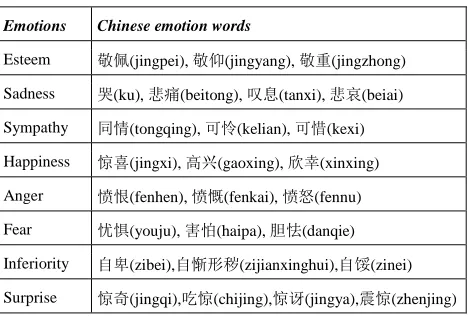
Emotional words are employed in many emotion classification tasks. There are two main approaches in order to compile or collect the emotional word list. Manual approach is very time consuming and it is not used alone. It is usually combined with the other automated approach as a final check to avoid the mistakes that resulted from automated methods. In this paper, we utilize a dictionary-based approach to realize emotion analysis task. A small set of emotional words is collected manually with known orientations. Then, this set is grown by searching in the
well known corpora WordNeti for their synonyms and
[image:5.612.327.560.267.422.2]antonyms. The newly found words are added to the seed list then the next iteration starts. The iterative process stops when no new words are found. After the process is completed, manual inspection can be carried out to remove or correct errors. Some examples of emotional words in emotion dictionary are given in TABLE I. Finally, we search arisen emotional words in microblogging contents and classify them into corresponding emotional categories based on this dictionary.
TABLE II
Examples of Emoticons on Sina Weibo
Emoticon Meaning Emoticon Meaning
[laugh] [sad]
[handshaking] [candle]
[heart] [scold]
[sick] [yawn]
[lovely] [OK]
Emoticon is a portmanteau word formed from 'emotion' and 'icon'. As new visual or nonverbal communication cues used in digital interaction, emoticons can realize pictorial representation of authors‘ facial expressions or behavioural states, which contain rich emotional information of them and make important effects on web user emotion analysis.
Sina Weiboii is a well-known Chinese micro-blogging web service offering a fun and interactive way to discover and discuss information, and several examples of emoticons on
Sina Weibo and their intuitive meanings are given in TABLE II. We utilize the result in our previous work on ‗emoticon-emotion‘ relation detection [20] to detect microblogging users‘ emotion expression as additional information for above dictionary based approach.
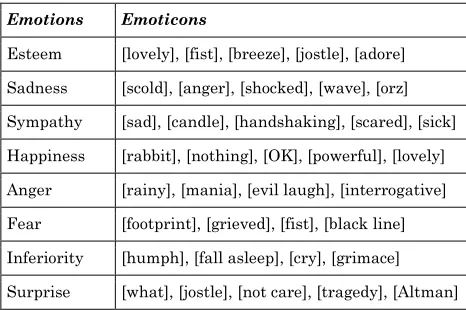
In [20], a modified topic-supervised biterm topic model was proposed to detect probabilistic relation between emoticons and emotions, some examples are given in TABLE III. Emoticons are ranked by classification probability for each emotion. We can see that there are some emoticons show in different emotional classifications, such as [fist], [jostle] and [lovely]. Actually, [fist] has some probability to express esteem and has some probability to express fear, so are the other two emoticons.
TABLE III
‘Emotion-Emoticon’ Relationship Examples
Emotions Emoticons
Esteem [lovely], [fist], [breeze], [jostle], [adore] Sadness [scold], [anger], [shocked], [wave], [orz] Sympathy [sad], [candle], [handshaking], [scared], [sick] Happiness [rabbit], [nothing], [OK], [powerful], [lovely] Anger [rainy], [mania], [evil laugh], [interrogative] Fear [footprint], [grieved], [fist], [black line] Inferiority [humph], [fall asleep], [cry], [grimace] Surprise [what], [jostle], [not care], [tragedy], [Altman]
For each detected burst period, we detect the existing emotional words and emoticons, and count them for analyse the emotional distribution of microblogging users. From user emotion analysis results of different events, we can get the general emotional distribution of users on the given celebrity, which is helpful for the reputation building and crisis management.
IV. EXPERIMENTAL RESULTS AND DISCUSSION
We conduct preliminary case-study experiments of user interest based celebrity summarization, for roughly evaluate the performance of the proposed model.
A. Dataset and Experimental Design
We utilize ‗microblog search function‘iii in Sina Weibo
[image:5.612.51.287.379.533.2]International Journal of Emerging Technology and Advanced Engineering
Website: www.ijetae.com (ISSN 2250-2459,ISO 9001:2008 Certified Journal, Volume 5, Issue 10, October 2015)
6
Finally, we collect related microblogs to those two celebrities from April 01, 2015 to June 30, 2015, which contain 13,501 microblogs and 150,312 microblogs respectively.
[image:6.612.317.564.136.372.2]B. Experimental Results and Discussions
Fig. 2. The F-value results of different values of v for our model on user interest burst detection.
In [4], local highest points of web news statistical curve are detected and 31 day long period around each local highest point is defined as a bursty period. This burst detection method has obvious shortcoming and in this paper we replace it with automatic method in [5]. We still set the number of bursty intensity states z as 8, which was used in the original Burst Detection paper, and what we need to additionally set is the burst of intensity v. For detecting the optimal v, we use F-value as an indicator. For burst detection results with each v, we compare them with manually tagging results to get Precision and Recall value, and then further obtain F-value. In particular, Precision and
Recall means day-level calculated results. Figure 2 shows the F-value results when varying v as eight different integer values from 1 to 8. As shown, the curve peaks at v= 3, which indicates that it can achieve the best performance. Therefore, we set v=3 in the following experiments.
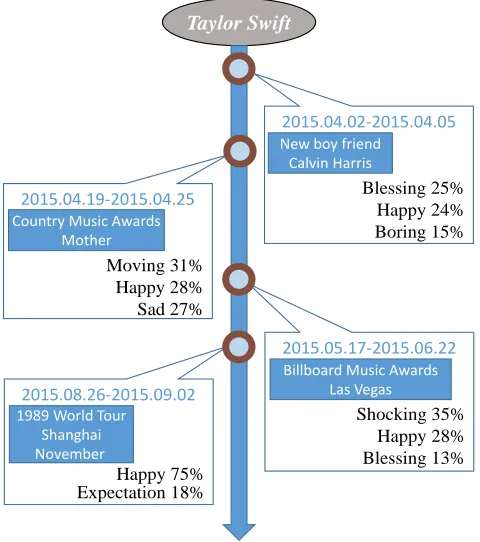
Figure 3 and Figure 4 show the celebrity summarization results. Compared to results in [4], detected burst periods have more flexible length, which can reflect the changes of users' interests more accurately. Besides, more than one events can be detected as cause events of a same burst period [21]. Furthermore, user emotion analysis result can enhance users‘ understanding of celebrities.
Xiang Liu
2015.04.07-2015.04.12
Sad 75% Regret 11%
2015.05.17-2015.05.26
Funny 62% Dislike 21%
2015.05.17-2015.05.26
Sad 55% Ridicule 28%
Regret 10%
2015.06.25-2015.07.15
Surprise 43% Funny 25% Happy 12%
Ceremony Diamond League
Divorce Ge-Tian
Ge-Tian Wife Shocking TV series
Retirement Weibo
Fig. 3. Celebrity Summarization Result of Xiang Liu from April 01, 2015 to June 30, 2015.
Taylor Swift
2015.04.19-2015.04.25
Moving 31% Happy 28% Sad 27%
2015.05.17-2015.06.22
Shocking 35% Happy 28% Blessing 13%
2015.04.02-2015.04.05
Blessing 25% Happy 24% Boring 15%
2015.08.26-2015.09.02
Happy 75% Expectation 18%
New boy friend Calvin Harris
1989 World Tour Shanghai November
Billboard Music Awards Las Vegas Country Music Awards
[image:6.612.57.271.198.378.2]Mother
[image:6.612.324.564.415.686.2]International Journal of Emerging Technology and Advanced Engineering
Website: www.ijetae.com (ISSN 2250-2459,ISO 9001:2008 Certified Journal, Volume 5, Issue 10, October 2015)
7
V. CONCLUSION AND FUTURE WORK
This paper proposes a novel method to extract and summarize the most salient events of a celebrity from Chinese News corpus. With this method, we first extract keywords, which describe an event, and then rank the sentences and remove redundant sentences according to these keywords. The experimental results show that our summary can concisely and accurately describe a celebrity. Innovations of this paper are given below: 1) we propose a method to detect a celebrity‘s most concerning events based on microblogging users‘ interest burst detection; 2) we propose a method to detect the main cause events of microblogging users‘ each interest burst.
Currently, this system works independently out of any search engine. It is our intention to integrate it with a search engine so that it can work in real time. Based on this work, we are going to address the issue of how to find the associated rules between events, and event prediction is also a key point of our future research work.
Acknowledgments
This research is supported by the NSFC project 61501463, the Youth Innovation Promotion Association of the Chine Academy of Sciences, and the Open Project of Key Laboratory of Big Data Mining and Knowledge Management, Chinese Academy of Sciences.
REFERENCES
[1] Xiaojiang Liu, Nenghai Yu. People Summarization by Combining Named Entity Recognition and Relation Extraction. Journal of Convergence Information Technology, 5(10):233-241, 2010. [2] Wei Wu, Bin Zhang, and Mari Ostendorf. Automatic Generation of
Personalized Annotation Tags for Twitter Users. In Proceedings of the 2010 Annual Conference of the North American Chapter of the ACL, pp. 689–692.
[3] Hemant Purohit, Alex Dow, Omar Alonso, Lei Duan, and Kevin Haas. User Taglines: Alternative Presentations of Expertise and Interest in Social Media. In Proceedings of the 2012 International Conference on Social Informatics, pp. 236-243.
[4] Shuangyong Song, Qiudan Li, Nan Zheng. Understanding a celebrity with his salient events. In Proceedings of the 6th international conference on Active media technology, pp. 86-97, 2010.
[5] Jon M. Kleinberg. Bursty and Hierarchical Structure in Streams. Data Mining and Knowledge Discovery, 7(4): 373-397 (2003). [6] Huaping Zhang, Hongkui Yu, Deyi Xiong, Qun Liu. 2003.
HHMM-based Chinese Lexical Analyzer ICTCLAS. In Proceedings of 2nd SIGHAN Workshop on Chinese Language Processing, pp.184-187. [7] Maxim Grinev, Maria Grineva, Alexander Boldakov, Leonid Novak,
Andrey Syssoev, and Dmitry Lizorkin. Sifting Micro-blogging Stream for Events of User Interest. In Proceedings of the 32nd Annual International ACM SIGIR Conference on Research and Development in Information Retrieval, pp. 837, 2009.
[8] Java, A., Song, X., Finin, T., and Tseng, B., Why we twitter: understanding microblogging usage and communities, In WebKDD/SNA-KDD ‘07: Proceedings of the 9th WebKDD and 1st SNA-KDD 2007 workshop on Web mining and social network analysis, pages 56–65, New York, NY, USA, 2007, ACM.
[9] J. Ji, K. Daichi and Q. Zhao, ―A Customer Intention Aware System for Document Analysis‖, In Proc. of the IJCNN 2010, Barcelona, Spain, 18-23 July, 2010.
[10] X. Jiang, A-H. Tan, ―Learning and inferencing in user ontology for personalized semantic web search‖, Information Sciences, 2009, 179, 2794–2808.
[11] H. Liu, and V. Kešelj, ―Combined mining of Web server logs and web contents for classifying user navigation patterns and predicting‖, Data & Knowledge Engineering, 61 (2007), 304-330. [12] R. Mukherjee, N. Sajja, S. Sen, ―A movie recommendation system:
an application of voting theory in user modeling‖, User Modeling and User Adapted Interaction, 2003, 13(1–2), 5-33.
[13] C. Macdonald, I. Ounis, ―Voting Techniques for Expert Search‖, J. Knowledge and Information Systems, 2008, pp. 259-280.
[14] N. Banerjee, D. Chakraborty, K. Dasgupta, A. Joshi,S. Mittal, S. Nagar, A. Rai and S. Madan. User interests in social media sites: an exploration with micro-blogs. In CIKM'09: Proceedings of the 2009 ACM conference on Information and Knowledge Management, pp. 1823-1826.
[15] D. M. Blei, A. Y. Ng, and M. I. Jordan. (2003). Latent dirichlet allocation. The Journal of machine Learning research; 3: pp. 993-1022.
[16] S. Staab, P. Domingos, P. Mika, J. Golbeck, L. Ding, T. W. Finin, A. Joshi, A. Nowak and R. R. Vallacher. Social networks applied. In IEEE Intelligent Systems, Vol.20(1), pp. 80-93,2005.
[17] M. Eirinaki, M. D. Louta, I. Varlamis. (2014). ―A Trust-Aware System for Personalized User Recommendations in Social Networks,‖ IEEE Trans. Syst., Man, Cybern: Systems, vol. 44, no. 4, pp. 409–421.
[18] Shuchuan Lo, Chingching Lin, WMR--A Graph-Based Algorithm for Friend Recommendation, In WI‘06: Proceedings of the IEEE / WIC / ACM International Conference on Web Intelligence, 2006, pp. 121-128.
[19] Zheng, N., Song, S., Bao, H., A Temporal-topic Model for Friend Recommendations in Chinese Microblogging Systems, IEEE Transactions on Systems, Man and Cybernetics: Systems 45(9): 1245-1253 (2015).
[20] Song, S., Meng, Y., Detecting Concept-level Emotion Cause in Micro-blogging, In WWW‘15: Proceedings of the 24th International Conference on World Wide Web, pages 119-120.
[21] Platakis, M., Kotsakos, D., Gunopulos, D., Searching for Events in the Blogosphere, In WWW‘09:Proceedings of the 18th International Conference on World Wide Web, pages 1225-1226.
[22] Paukkeri, M., Nieminen, I., Pöllä, M., and Honkela, T. 2008. A Language-independent Approach to Keyphrase Extraction and Evaluation. In Proceedings of the 22nd Interna-tional Conference on Computational Linguistics, 237–252.
[23] Walaa Medhat, Ahmed Hassan, Hoda Korashy, Sentiment analysis algorithms and applications: A survey. Ain Shams Engineering Journal, Volume 5, Issue 4, December 2014, Pages 1093–1113.
i http://wordnet.princeton.edu/ ii http://weibo.com