International Journal of Emerging Technology and Advanced Engineering
Website: www.ijetae.com (ISSN 2250-2459, ISO 9001:2008 Certified Journal, Volume 4, Issue 6, June 2014)
A Novel Intrusion Detection System Using Neural-Fuzzy
Classifier for Network Security
Nirmal Ratnawat
1, Prof. Anurag Jain
21
M-Tech Research Scholar, 2HOD, Department of CSE RITS, Bhopal
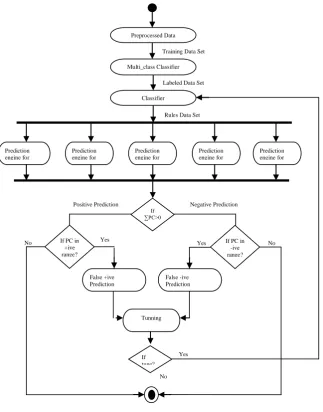
Abstract-An intrusion detection system (IDS) is intelligent engine which is used to identify anomalies (abnormality) in a computer network system. Intrusions are generally unauthorized access signatures which is like a attacks for network that attempts to either prevent normal functioning of nodes in a network or to harm the nodes with malicious scripts or to sniff unauthorized packets. Intrusion detection system (IDS) reports alarms when it detects any attacks (abnormal) condition. IDS is working in dynamically changing environment. It works by detecting a signature from current session of packet transfer and matching it with database intrusion signatures. Basically IDS consists of prediction engine which analyzes data and outputs the prediction on the data. By seeing predictions system operator is able to know that data record is normal or is affected by any attack. Therefore prediction engine is the heart intrusion detection system. Conventionally IDS are complex string matching automata engine which relies on extracting string signature from set of packet fields like IP address, Port number, round trip time etc. However attacker continuously changes the attack signature which makes it difficult to detect the intrusion. Therefore knowledge based classifiers were developed for Intrusion detection system. A knowledge based classifier is one that builds a mathematical model from the signature database with a prior knowledge about the class of the signature {NORMAL, ABNORMAL} and classifies any input signature as one of the known classes by evaluating the incoming parameters in trained model. Such techniques are proven to be more accurate than string matching based automata engines. However conventional machine learning based techniques suffers from training problem. Network intrusion signatures are ever changing. Hence the training model needs to be frequently updated. Therefore any new attack signature would require entire set of the training data to be retrained. In this work we develop a unique machine learning based intrusion detection system for solving the aforementioned problem. In this work we propose a Fuzzy-Neuro system for IDS. First we create prediction model .prediction engine analyzes and data according to prediction model. System operator verifies results and marks false predictions .Only false predictions are fed back to model tuner to tune model automatically. Evaluate the performance of the system with KDD-Cup dataset. Results shows that proposed system produces 100% accuracy interns of recognition and classification accuracy.
Keywords--Intrusion detection system (IDS), Fuzzy C-Means and neural classifier
I. INTRODUCTION
Due to heavy use of the Internet, the importance of information protection has been increased. As such, there is no defined method of interjection deduction. It can be considered as pattern matching problem that differentiate between n/w attack, abnormal n/w behaviors, and normal network behaviors. Any Group of activities which try to compromise on the reliability, accessibility, confidential or privacy of resources is known as interjection or interruption. An intruder is an attacker, person or group of people who initiates the activities during interruption. Attackers can be from within the trust network, person who have the access to use system with normal user rights or someone who uses a hole in some OS to escalate their access level or admin rights. It can be from outside of the system or network that is someone on another network or even in some other country who exploits a weakness, vulnerability in an insecure network service on the system to take unauthorized entry and access of the trust network.
Intrusion recognition systems are in fact a layer of security used to notified continuing interfering activities in some information systems. Conventionally, to avoid this dependency, a list of learning techniques and data mining techniques has been identified for intrusion discovery. Intrusion discovery high volume depends on widespread knowledge of safety experts, in particular, on their knowledge with the processor system that is to be sheltered.
Information security consist the following.
1) Protection- It protects systems to avoid security breaches which are generated by intruders.
2) Detection- Intrusions detected by Security violations as soon as they occur.
3) Reaction – It perform automatic alarming whenever system is intruded such as pursuit of hackers.
4) Recovery – It repairs system automatically in case of any damage happened by intrusion.
International Journal of Emerging Technology and Advanced Engineering
Website: www.ijetae.com (ISSN 2250-2459, ISO 9001:2008 Certified Journal, Volume 4, Issue 6, June 2014)
II. RELATED RESEARCH WORK ON IDS
The field of intrusion detection system in network security has been developed for 30 years. A number of methods and techniques have been proposed and many systems have been affected by variety of intrusions. The various techniques used to detect the intrusions are data mining, neural network, and statistical methods. In this related work, the various methods and techniques are discussed.
Aneetha and S. Back proposed an approach in [1] to detect an attack, which uses neural networks and k-means clustering algorithms. The proposed approach is applied to the KDD CUP'99 data set. Average detection rate was 97.5%
Monaranjan and Sudhir Kumar proposed an approach in [2] to detect an attack, which uses artificial neural networks and Back propagation algorithms. The proposed approach is applied to the KDD CUP'98 data set. Classification rate of 98% . Denial of Service attack type called Neptune went by undetected, and this shows that more testing is needed to find out why this happened. Ghosh and Schwartz bard used system behavior as input for the neural network in their experiment [3]. They used 4 weeks of training data and 161 sessions with testing data. Out of these, they only had 22 attack sessions. The results from this experiment showed a detection rate of 77.3% and a false positive rate of 3.6 %. In their experiments, they used software behavior for the input to the neural network, not user behavior as we used in our experiments.
III. PROPOSED METHODOLOGY
3.1 Feed Forward Neural Network (FFNN)
A multi layered feed forward network to be made up of a fixed multilayer layers and each layer hold number of units. The feed for-forward neural networks provide a basic framework for representing non-linear functional mapping between input data and output variables. Output, Input and other hidden layers receives its inputs directly from previous layer and sends its results directly to units in the next layers. Whereas, in Recurrent network contains feedback information and there are no connections from any of the units. Each and every unit only acts as an input to immediate next layer. Theoretically, this type of networks is easy to analyze compare to other general topologies because their outputs can be represented with explicit functions of the inputs and weights.
3.2 Fuzzy C- Means Clustering
Fuzzy techniques can be applied to large data set that are numerical (quantitative), categorical (qualitative), or a mix-up of both. The clustering of volume data is considered. The data or information is observations of some physical process.
Many clustering algorithms are based on improving the basic c-means objective function. Hence we start discussion with presenting the fuzzy c-means functional.
Fuzzy c-means method allows one piece of data belong to many clusters and minimize the following objective function.
,
Here,
m – Any real number greater than 1.
uij- the degree of membership of xi in the cluster j xi - ith of d-dimensional measured data
|*|| - Any norm expressing the similarity between any measured data and the center.
3.3 Basic Architecture Of IDS
One of the methods of developing a network protect is to describe network nature structure that point out offensive use of the system network and also look for the occurrence of those classifier patterns. So basically intrusion detection system is process based system which have intelligent engine and it is monitoring the behavior of system in given environment and detect, whether these activities are normal (legitimate) or intrusion (abnormal).
3.3.1 Data Sampling
International Journal of Emerging Technology and Advanced Engineering
Website: www.ijetae.com (ISSN 2250-2459, ISO 9001:2008 Certified Journal, Volume 4, Issue 6, June 2014)
It also consists of some type of checksum on which the integrity of a packet is determined. Transport information is added to the packet as a part of the network transmission protocol. Transport information which cannot be made deceptive by fraudulent user is called as unbiased data.
As we do not have access to large scale network and IDS system for logging intrusions for generating of samples, we opt for KDD cup dataset. This dataset presents several thousand signatures which contains forty different fields from packets and the signature type (Attack or normal). Further the dataset also presents type of attacks.
3.3.2 Data Preprocessing:
It is already discussed that the fundamental principle of Machine learning based IDS system is to develop a mathematical or numerical model from string data.
Following is a sample snapshot of KDD data. As can be seen that several fields are numeric in nature. Hence our system first generates a matrix from. Some fields are repeated texts: like the protocol field(C), Transport type(B) and attack type (AP).
We first extract the unique values from the dataset for each of the columns and then replace the string names with those of their index number in the corresponding unique group.
The resultant set is a matrix of numbers.
We extract 10,000 data for our experiment. 7000 data is randomly selected for training and 3000 for testing. A class contains numbers between 1-6 that represents the category of the signature.
3.3.3 Classifier system
The classifier scheme is a similar, law and policy based message passing system. All policies are of the type action (Permit, deny, rejected) form. If the rule is satisfied Then action form is receipt of the messages and the action is the sending of messages. All messages hold a tag specifying their source, destination and an extra information field.
We first cluster the dataset using Fuzzy C means clustering. We extract some sample data from every cluster, then we train neural network with this data, followed by classification of the samples.
International Journal of Emerging Technology and Advanced Engineering
Website: www.ijetae.com (ISSN 2250-2459, ISO 9001:2008 Certified Journal, Volume 4, Issue 6, June 2014)
Fuzzy system(classifier) defines output in probability. i.e. it classifies input as set of all probabilities belonging to all classes with highest priority given to highest
percent. This data when superimposed with neural output produces a strong prediction engine.
System Design
False prediction & confidence
Prediction engine Data set, Rules Set
Rules Set
M/C Learning & Classifier Trained dataset & weights
Training dataset
Input packet from Network Initial Rules
Labeled dataset Preprocessed dataset Rules set
Standard KDD Dataset
: Main UI
: System
International Journal of Emerging Technology and Advanced Engineering
Website: www.ijetae.com (ISSN 2250-2459, ISO 9001:2008 Certified Journal, Volume 4, Issue 6, June 2014)
Sequence Diagram
IV. EXPERIMENT AND RESULTS
For the implementation of the intrusion detection using fuzzy-neuro system we have used MATLAB 7.10.in our test, we have randomly import the data from KDD CUP 99 data set and dividing the dataset into two dataset, training and testing. We have first normalized the data from strings and then we have done labeling of the data with the help of fuzzy c-means algorithm. Experiments shows that proposed System produces 100% accuracy in comparison to Neural classifier (98%) and Fuzzy based system (70%).
[image:5.595.137.461.158.571.2]V. COMPARISON RESULT WITH PREVIOUS WORKS
TABLE
The comparison result with previous works
author/name properties
Dev raju 2011
Nidhi 2012
Sahil 2013
Nirmal 2014
Classification
rate 97% 95% 98% 99.66%
No Yes Tunning
If tune?
No Yes
No
False +ive Prediction
False -ive Prediction Yes
If ∑PC>0
Positive Prediction Negative Prediction Rules Data Set
Labeled Data Set Preprocessed Data
Training Data Set Multi_class Classifier
Classifier
Prediction engine for U2R Prediction
engine for DOS
Prediction engine for R2L Prediction
engine for Normal
Prediction engine for Probe
If PC in -ive range? If PC in
International Journal of Emerging Technology and Advanced Engineering
Website: www.ijetae.com (ISSN 2250-2459, ISO 9001:2008 Certified Journal, Volume 4, Issue 6, June 2014)
The result compare
VI. CONCLUSION AND FUTURE SCOPE
In this work we have developed a machine learning based solution for IDS by combining fuzzy based rules with neural based classifier. Fuzzy rules provides a probability outcome of a signature which is then classified by neuro system. Experiments shows that proposed System produces 100% accuracy in comparison to Neural classifier (99.66%) and Fuzzy based system (70%). This is because a strong fuzzy rule helps neuro system to optimize the hidden layer which can then strongly classify the input signature pattern. The system can be further improved by reducing classification time through more optimization in feature selection and filtering stage.
REFERENCES
[1] A.S. Aneetha and Dr. S. Bose, "THE COMBINED APPROACH FOR ANOMALY DETECTION USING NEURAL NETWORKS AND CLUSTERING TECHNIQUES," in Computer Science & Engineering: An International Journal (CSEIJ),, Vol.2, No.4, August 2012.
[2] Monaranjan and Sudhir Kumar, “ANOMALY DETECTION USING ARTIFICIAL NEURAL NETWORK” International Journal of Engineering Sciences & Emerging Technologies., vol.`1 Issue 1, pp: 29-36 ©IJESET o. 4, pp. 227–261, April 2012 [3] A.K. Gosh and A. Schwartz bard, “A STUDY IN USING
NEURAL NETWORKS FOR ANOMALY AND MISUSE DETECTION”, Proc USENIX Security Symposium, Washington, USA, 23-26 August 1999.
[4] Jiankun Hu, Xinghuo Yu, D. Qiu, Hsiao-Hwa Chen, A simple and efficient hidden Markov model scheme for host- based anomaly intrusion detection, Journal IEEE Network, vol. 23 is. 1, January/February 2009
[5] Dubrawsky and R. Saville, SAFE: IDS Deployment, Fuzzy Neural Network and SVM classifiers”, proceedings of ICCCI,pp1-7,2013
[6] T. Zhou and LI Yang, "The Research of Intrusion Detection Based on Genetic Neural Network", Proceedings of the 2008 International Conference on Wavelet Analysis and Pattern Recognition, Hong Kong, IEEE.2008.
[7] J.Shum and A. Heidar Malki, "Network Intrusion Detection System Using Neural Networks", Fourth International Conference on Natural Computation, IEEE computer society.2008.
[8] A. Honig, A. Howard, E. Eskin, and S. Stolfo, “Adaptive model generation: An architecture for the deployment of data mining-based intrusion detection systems,” in Data Mining for Security Applications. Norwell, MA: Kluwer, 2002.
[9] M. Hossain and S. Bridges, “A framework for an adaptive intrusion detection system with data mining,” in Proc. 13th Annu. CITSS, Jun. 2001.
[10] S.Mukkamala, H. Andrew Sung, and A. Abraham, "Intrusion detection using an ensemble of intelligent paradigms", Journal of Network and Computer Applications 28. Pp167–182.2005. [11] S. Jimmy and A. Heidar, "Network Intrusion Detection System
using Neural Networks", IEEE computer society.2008..
[12] M. Vallipuram and B. Robert, "An Intelligent Intrusion Detection System based on Neural Network", IADIS International Conference Applied Computing.2004
[13] Ahmad, S. Ullah Swati and S. Mohsin, "Intrusions Detection Mechanism by Resilient Back Propagation (RPROP)", European Journal of Scientific Research ISSN 1450-216X Vol.17 No.4, pp.523-531.2007
[14] W. Cohen and Y. Singer, “A simple, fast, and effective rule learner,” in Proc. Annu. Conf. Amer. Assoc. Artif. Intell, 1999, pp. 335–342.
[15] S. Robert and S. Yoram, “Improved boosting algorithms using confidence created predictions,” Mach. Learn., vol. 37, no. 3, pp. 297–336, Dec. 1999.
Author’s Profile