International Journal of Emerging Technology and Advanced Engineering
Website: www.ijetae.com (ISSN 2250-2459,ISO 9001:2008 Certified Journal, Volume 4, Issue 5, May 2014)
763
Implementation Of High Speed FIR Filter Based On Ancient
Vedic Multiplication Technique
Swapnil Manohar Mehkarkar
1,
Snehal J. Banarase
21,2Department of E&TC,G.H.Raisoni College of Engineering and Management, Amravati (444701), Maharashtra, India.
Abstract— This paper proposed the design of high speed FIR Filter using the Vedic Multiplication techniques of Ancient Indian Vedic Mathematics that have been modified to improve performance. The design of an FIR requires three basic building blocks multiplication, addition, signal delay. FIR filter is based on complex arithmetic due to the magnitude and phase responses of the channel impulse
characteristics. A high quality filter will in general require
more complex number multiplications the output of filter suffers if the multiplier is not fast, so there is a need of high speed multiplier in filter. There are so many multiplication algorithms exist now-a-days having different algorithms and structural levels. Our work proved that Vedic multiplication technique is the best algorithm in terms of speed. Further we have seen that the conventional multiplication have some limitations, so to overcome those limitations a novel approach has been proposed to design the Vedic multiplier. Vedic Mathematics is the ancient Indian system of mathematics which based on 16 Sutras which deals with various branches of mathematics like arithmetic, algebra, geometry, etc, from which Urdhva Triyagbhyam sutra is used for multiplication. It enables parallel generation of intermediate products, eliminates unwanted multiplication steps with zeros. To design proposed high speed filter verilog hardware description language (HDL) has been used.
Keywords— Vedic Mathematics, Vedic multiplier, Urdhva Triyagbhyam Sutra, FIR Filter.
I. INTRODUCTION
Multiplication is an important fundamental function in arithmetic operations. Multiplication-based operations such as convolution, Fast Fourier Transform (FFT), filtering and in microprocessors in itsArithmetic Logic Unit (ALU), etc [1]. In many Digital Signal Processor algorithms multiplication dominates the execution time, so there is a need of high speed multiplier.
Since multiplication is a most important factor in speed of the DSP processors. As there are many new developments in the technology there is a need of higher and higher speed of multipliers. Many researchers are still working on to design multipliers which offers high speed, low power consumption, regularity of layout and hence less area or even combination of them in multiplier [19].
The increased complexity of various applications, demands not only faster multiplier chips but also smarter and efficient multiplying algorithms that can be implemented in the chips. Two most common multiplication algorithms followed in the digital hardware are Array multiplication algorithm and Booth multiplication algorithm. The drawback of these two algorithms is a large propagation delay is associated with it.
The word “Vedic” is derived from the word “Veda” which means the store-house of all knowledge. Like
“Ayurveda” which means store-house of all the knowledge regarding Medical field, and “Vedic Mathematics” which means store-house of all the knowledge regarding Mathematics. Vedic mathematics is mainly based on 16 Sutras which deals with various branches of mathematics like arithmetic, algebra, geometry, etc [1],[7]. Jagadguru Shankaracharya Bharati Krishna Teerthaji Maharaja (1884-1960) comprised all this work together and gave its mathematical explanation. After extensive research in Atharva Veda Swamiji constructed 16 sutras (formulae) and 16 Upa sutras (sub formulae).Vedic mathematics deals with several basic as well as complex mathematical operations. The methods of Vedic mathematics are extremely simple and very powerful.
International Journal of Emerging Technology and Advanced Engineering
Website: www.ijetae.com (ISSN 2250-2459,ISO 9001:2008 Certified Journal, Volume 4, Issue 5, May 2014)
[image:2.612.43.307.155.660.2]764
TABLE I II. URDHVA-TIRYAGBHYAM SUTRA
The Urdhva-Tiryagbhyam Sutra from Vedic Mathematics is used for multiplication based on the methodology of Urdhva-Tiryagbhyam Sutra we are designed a new multiplier. This Vedic method of multiplication strikes a difference in the actual multiplication process. It enables parallel generation of intermediate products, eliminates unwanted multiplication steps with zeros. The Urdhva-Tiryagbhyam Sutra is based on the Vertical and Crosswise algorithm of ancient Indian Vedic Mathematics. Multiplier based on Vedic Mathematics is one of the high-speed and low power multiplier.
The step vise architecture of Urdhva Tiryagbhyam Sutra is as shown in Fig.1 for 4x4 binary multiplications.
Fig. 1 4x4 binary multiplication using Urdhva Tiryakbhyam
The multiplication of two numbers (379×657) using Urdhva Tiryakbhyam Sutra is shown in Fig.2 The least significant digit from both the numbers (i.e. 9 of 379 & 7 of 657) are multiplied vertically and the result is added with the previous carry. Initially the carry is taken to be zero. When there are more lines in one step, all the results are added to the preceding carry. The least significant digit of the number thus obtained result acts as one of the final multiplication result digits and the rest act as the carry for the next step. After these the two digits of LSB side are multiplied crosswise and added with the previous carry. Likewise all the digits are multiplied vertically and crosswise as shown in Fig.2.
Sr.No. Vedic Sutras English Meaning
1. Ekadhikina Purvena By one more than the previous One.
2. Gunakasamuchyah The factors of the sum is equal to the sum of the factors.
3. Ekanyunena Purvena By one less than the previous one.
4. Gunitasamuchyah The product of the sum is equal to the sum of the
product.
5. Chalana-Kalanabyham Differences and Similarities.
6. (Anurupye) Shunyamanyat
If one is in ratio, the other is zero.
7. Puranapuranabyham By the completion or noncompletion.
8. Paraavartya Yojayet Transpose and adjust.
9. Sankalana- vyavakalanabhyam
By addition and by subtraction.
10. Yaavadunam Whatever the extent of its deficiency.
11. Sopaantyadvayamantyam The ultimate and twice the penultimate.
12. Vyashtisamanstih Part and Whole.
13. Urdhva-tiryagbhyam Vertically and crosswise.
14. Nikhilam Navatashcaramam
Dashatah
All from 9 and last from 10.
15. Shunyam Saamyasamuccaye
When the sum is the same that sum is zero.
16. Shesanyankena Charamena
[image:2.612.328.558.318.456.2]International Journal of Emerging Technology and Advanced Engineering
Website: www.ijetae.com (ISSN 2250-2459,ISO 9001:2008 Certified Journal, Volume 4, Issue 5, May 2014)
[image:3.612.49.289.111.274.2]765
Fig. 2 Example of Multiplication of two numbers using Urdhva Tiryakbhyam Sutra.
III. IMPLEMENTATION OF PROPOSED MULTIPLIER
To design 64x64 Bit Vedic Multiplier firstly we have designed 2x2 Bit Vedic Multiplier, with the help of this 2x2 Bit Vedic Multiplier we designed a 4x4 Bit Vedic Multiplier, likewise 8x8 Bit, 16x16 Bit, 32x32 Bit and finally 64x64 Bit Vedic Multiplier.
A. 2x2 Bit Vedic Mutiplier
Fig.3. shows the example of 2x2 Bit Vedic Multiplication, here in this example as per the rules of Urdhva-Tiryagbhyam Sutra in first step right most two digits of both the numbers are multiplied vertically. In second step end digits are multiplied crosswise. And in last step left end two digits are multiplied vertically. The carry from the second step is added to the third step, and initial carry is considered as zero.
[image:3.612.327.561.301.424.2]Urdhva Tiryagbhyam sutra for multiplication strikes a difference in the actual process of multiplication itself. It enables parallel generation of intermediate products, eliminates unwanted multiplication steps with zeros. From Fig.3. we can seen that the process of multiplication is a parallel process, to start execution for third step it has nothing to do with step number first and second. That means on the clock pulse all steps are ready to start.
Fig.3 Shows the example of 2x2 Bit Vedic Multiplication
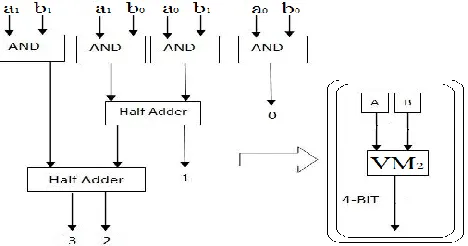
In the design of the proposed Vedic multiplier a 2x2 block is a fundamental block (Basic block) is shown in Fig.4. Also symbol of this fundamental block is shown to be used in 4x4 bit Vedic Multiplier. We know that in binary multiplication basically we AND each two bits in 2-input AND gate. First off all vertical bits (LSBs) are ANDed this will result in the LSB of the result. After that the four bits are multiplied crosswise and then result is added using a half adder. The sum output of the half adder is the next bit of the result right to the LSB. The carry output is also added in half adder with the AND output of the MSBs. The carry of this adder is the MSB of the result [17],[18]. Fig.12 shows the simulation output of Vedic Multiplier for 2x2 Bit using VHDL coding.
Fig.4 2x2 Bit multiplier using Urdhva Tiryakbhyam Sutra & its symbol
B. 4x4 Bit Vedic Mutiplier
The design of 4x4 block shown in Fig.5 is a simple arrangement of 2x2 Bit Vedic Multiplier blocks in an optimized manner. The first step in the design of 4x4 Vedic Multiplier block will be grouping the 2 bit of each 4 bit input. These pair terms will form vertical and crosswise product terms. Each input bit-pair is handled by a separate 2x2 Vedic Multiplier the schematic of a 4x4 Vedic Multiplier designed using 2x2 blocks [17],[18].
[image:3.612.72.274.598.697.2]International Journal of Emerging Technology and Advanced Engineering
Website: www.ijetae.com (ISSN 2250-2459,ISO 9001:2008 Certified Journal, Volume 4, Issue 5, May 2014)
766
Fig.5 Block diagram of 4x4 Bit Vedic Multiplication
C. 8x8 Bit Vedic Mutiplier
The design of 8x8 bit Vedic Multiplier is a similar arrangement of 4x4 bit Vedic Multiplier blocks in an optimized manner as in Fig.5. The first step in the design of 8x8 bit Vedic Multiplier will be grouping the 4 bit (nibble) of each 8 bit input. These quadruple terms will form vertical and crosswise product terms. Each input bit-quadruple is handled by a separate 4x4 bit Vedic multiplier to produce eight partial product rows. These partial products rows are then added in an 8-bit adder [17],[18]. To generate final product bits the output of the 8-bit adder is added together using 16-bit adder. The Fig.6 shows the schematic of an 8x8 Vedic Multiplier designed using 4x4 Vedic Multiplier blocks. Fig.14 shows the simulation output of 8x8 Bit Vedic Multiplier using VHDL coding.
Fig.6 Block diagram of 8x8 Bit Vedic Multiplication
D. 16x16 Bit Vedic Multiplier
The design of 16x16 bit Vedic Multiplier is a similar arrangement of 8x8 blocks in an optimized manner as in Fig.6. The first step in the design of 16x16 bit Vedic Multiplier will be grouping the 8 bit (byte) of each 16 bit input. These lower and upper bytes pairs of two inputs will form vertical and crosswise product terms.
Each input byte is handled by a separate 8x8 bit Vedic multiplier to produce sixteen partial product rows. These partial products rows are then added in a 16-bit adder [17],[18]. To generate final product bits the output of the 16-bit adder is added together using 32-bit adder. The Fig.7 shows the schematic of a 16x16 bit Vedic Multiplier designed using 8x8 bit Vedic Multiplier blocks. Fig.15 shows the simulation output of 16x16 Bit Vedic Multiplier using VHDL coding.
Fig.7 Block diagram of 16x16 Bit Vedic Multiplication
E. 32x32 Bit Vedic Mutiplier
The design of 32x32 bit Vedic Multiplier is a similar arrangement of 16x16 blocks in an optimized manner as in Fig.7. The first step in the design of 32x32 bit Vedic Multiplier will be grouping the 16 bit (byte) of each 32 bit input. These lower and upper bytes pairs of two inputs will form vertical and crosswise product terms. Each input byte is handled by a separate 16x16 bit Vedic multiplier to produce sixteen partial product rows. These partial products rows are then added in a 32-bit adder. To generate final product bits the output of the 32-bit adder is added together using 64-bit adder. The Fig.8. shows the schematic of a 32x32 bit Vedic Multiplier designed using 16x16 bit Vedic Multiplier blocks. Fig.16 shows the simulation output of 32x32 Bit Vedic Multiplier using VHDL coding.
International Journal of Emerging Technology and Advanced Engineering
Website: www.ijetae.com (ISSN 2250-2459,ISO 9001:2008 Certified Journal, Volume 4, Issue 5, May 2014)
767 F. 64x64 Bit Vedic Mutiplier
The design of 64x64 bit Vedic Multiplier is a similar arrangement of 32x32 blocks in an optimized manner as in Fig.8. The first step in the design of 64x64 bit Vedic Multiplier will be grouping the 32 bit (byte) of each 64 bit input. These lower and upper bytes pairs of two inputs will form vertical and crosswise product terms. Each input byte is handled by a separate 32x32 bit Vedic multiplier to produce sixteen partial product rows. These partial products rows are then added in a 64-bit adder. To generate final product bits the output of the 64-bit adder is added together using 128-bit adder. The Fig.9. shows the schematic of a 64x64 bit Vedic Multiplier designed using 32x32 bit Vedic Multiplier blocks. Fig.17 shows the simulation output of Vedic Multiplier for 64x64 Bit using VHDL coding.
Fig.9 Block diagram of 64x64 Bit Vedic Multiplication
G. FIR Filter
In modern electronic systems, complex arithmetic computation plays an important role in the implementation of different Digital Signal Processing (DSP) and scientific computation algorithms. Digital finite impulse response filtering introduces one of many computationally demanding signal processing tasks. FIR filter is based on complex arithmetic due to the magnitude and phase responses of the channel impulse characteristics.
FIR filters are generally characterized by a high order (number of taps) to obtain sharp transition bands that, in case of high speed real time computation, require a lot of resources and have high power dissipation. In particular, for complex FIR filters, the hardware complexity is mostly determined by the number of complex multipliers. So the Complex multipliers determine the performance, area and power dissipation of filters.
In this paper we are designing FIR Filter as an application of Vedic Multiplier. Since to design FIR Filter our first step is to design Complex Number Multiplication using Vedic Multiplier.
1) 64x64 Bit Complex Number Multiplication Using Vedic Multiplier
A Complex Number is a number that can be expressed in the form a + bi in exactly one way, where a and b are real numbers and i is the imaginary unit, which satisfies the equation i2 = −1. In this expression, a is the real part and b is the imaginary part of the complex number. Complex multiplication is a more difficult operation to understand from either an algebraic or a geometric point of view. Let’s do it algebraically, and let’s take specific complex numbers to multiply, say 3 + 2i and 1 + 4i. Each has two terms, so when we multiply them, we’ll get four terms:
(3 + 2i)(1 + 4i) = 3 + 12i + 2i + 8i2
The 12i + 2i simplifies to 14i, of course. So now what about the 8i2, as we know that i is a abbreviation for √–1, the square root of –1. In other words, i is something whose square is –1. Thus, 8i2 equals –8. Therefore, the product (3 + 2i)(1 + 4i) equals –5 + 14i.
(3 + 2i)(1 + 4i) = –5 + 14i
If we generalize this example, we’ll get the general rule for multiplication,
(a + bi) (c + di) = (ac – bd) + (ad + bc)i
Fig.18 shows the Simulation output of 64x64 bit complex number multiplication using vedic multiplier techniques. Here for simulation 64 bit real number and 64 bit imaginary number are used, as discussed in following example,
(3584 + 203776 i) x (896 + 7340032 i) = [ (3584 x 896) – (203776 x 7340032) ]
+ i [ (203776 x 896) + (3584 x 7340032) ] = (3211264 -1495722360832)
+ i (182583296 + 26306674688) = -1495719149568 + 26489257984 i
2) FIR Filter Based On Vedic Multiplier
International Journal of Emerging Technology and Advanced Engineering
Website: www.ijetae.com (ISSN 2250-2459,ISO 9001:2008 Certified Journal, Volume 4, Issue 5, May 2014)
768 The digital filter is described by difference equation in time domain and by transfer function in frequency domain. A digital FIR filter response of 4-taps is mathematically represented as,
Yi = Xi * Wi + Yi-1
Where Wi are weights of the filter, Xi is an input signal,
Yi is an output signal. The direct structure of a FIR filter is
shown in Fig.10.
These structures use many multipliers and adders. Because this work is focused on the speed of a FIR filter, in these 4-tap FIR Filter structure is used. This structure uses four adders and four multipliers and is described in Fig.10. And Fig.19 shows simulation output of FIR Filter using 64x64 bit Vedic Multiplier using VHDL coding
Fig.10 Shows the direct structure of a FIR filter
IV. EXPERIMENTAL RESULTS &ANALYSIS
A. Experimental Results
To show the efficiency of proposed Vedic multiplier at 64 Bit level, it has been compared with conventional multiplier structure based on conventional multiplication algorithms at the 64 Bit level. Fig.11. Shows the Simulation output of 64x64 Bit Conventional Multiplier using VHDL coding.
Fig.11 Simulation output of 64x64 Bit Conventional Multiplier using VHDL coding
Fig.12. Simulation output of Vedic Multiplier for 2x2 Bit using VHDL coding
Fig.13. Simulation output of Vedic Multiplier for 4x4 Bit using VHDL coding
Fig.14. Simulation output of Vedic Multiplier for 8x8 Bit using VHDL coding
International Journal of Emerging Technology and Advanced Engineering
Website: www.ijetae.com (ISSN 2250-2459,ISO 9001:2008 Certified Journal, Volume 4, Issue 5, May 2014)
769
Fig.16. Simulation output of Vedic Multiplier for 32x32 Bit using VHDL coding
Fig.17. Simulation output of Vedic Multiplier for 64x64 Bit using VHDL coding
Fig.18. Simulation output of 64x64 Bit Complex Number Multiplication Vedic Multiplier using VHDL coding
Fig.19.Simulation output of FIR Filter using 64x64 bit Vedic Multiplier using VHDL coding
B. Result Analysis
TABLEII
CAPARISON WITH BASE PAPERS
Type Of
Multiplier
Time Taken For Multiplication (in ns)
Reference
[1]
Reference
[17]
Experimental
Results
2x2 Bit Vedic
Multiplier
-- 4.626 ns 3.885 ns
4x4 Bit Vedic
Multiplier
-- 8.387 ns 7.048 ns
8x8 Bit Vedic
Multiplier
15.418 ns 11.886 ns 10.195 ns
16x16 Bit Vedic
Multiplier
22.604 ns -- 16.888 ns
32x32 Bit Vedic
Multiplier
31.526 ns -- 29.047 ns
64x64 Bit Vedic
Multiplier
-- -- 49.252 ns
TABLEIII
CAPARISON BETWEEN CONVENTIONAL AND VEDIC MULTIPLIER
Type Of Multiplier Time Taken For
Multiplication (in ns)
64x64 Bit Conventional
Multiplier
180.864 ns
64x64 Bit Vedic Multiplier 49.252 ns
TABLEIV
64X64BIT VEDIC MULTIPLICATION
Type Of Multiplier Time Taken For
Multiplication (in ns)
64X64 Bit Vedic Multiplier 49.252 ns
64X64 Bit Complex Number
Multiplication Using Vedic
Multiplier
International Journal of Emerging Technology and Advanced Engineering
Website: www.ijetae.com (ISSN 2250-2459,ISO 9001:2008 Certified Journal, Volume 4, Issue 5, May 2014)
770
V. CONCLUSION
In this project we proposed the design of 64x64 Bit Vedic Multiplier based on Urdhva Tiryakbhyam Sutra of Vedic Mathematics and the design of 64x64 Bit Conventional Multiplier. The design is based on Vedic method of multiplication the worst case propagation delay in the Optimized Vedic multiplier case is 49.252ns. It is therefore seen that the Vedic multipliers are much more faster than the conventional multipliers. FPGA implementation of this multiplier shows that hardware realization of the Vedic mathematics algorithms is easily possible. The high speed multiplier algorithm exhibits improved efficiency in terms of speed.
The time taken for multiplication operation is reduced by employing the Vedic algorithms. Here integrated Vedic Multiplier architecture is proposed for FIR Filter. FIR filter is based on complex arithmetic due to the magnitude and phase responses of the channel impulse characteristics. So here we designed the 64x64 Bit Complex Number multiplications using Vedic Multiplier and using this Vedic Complex Multiplier we design the high speed FIR Filter as an application of the project. In future this work can be used to design Multiply and Accumulate (MAC) unit, Arithmetic and Logical unit (ALU), Digital Signal Processors (DSP), etc
REFERENCES
[1] G.Ganesh Kumar, V.Charishma, “Design of high speed Vedic Multiplier using Vedic Mathematics techniques,” International Journal of Scientific and Research Publications, Volume 2, Issue 3, March 2012, ISSN 2250-3153.
[2] Vaijyanath Kunchigi, Linganagouda Kulkarni, Subhash Kulkarni, “High Speed and Area Efficient Vedic Multiplier,” IEEE Devices, Circuits and Systems (ICDCS), 2012 International Conference,15-16 March 2012.
[3] Wallace, C.S., “A suggestion for a fast multiplier,” IEEE Trans. Elec. Comput., vol. EC-13, no. 1, pp. 14–17, Feb. 1964.
[4] H ThapJiyal, M B Srinivas, and H R Arabnia, “Design and Analysis of a VLSI Based High Performance Low Power Parallel Square Architecture,” in Proc. Int. Con! Algo. Math. Compo Sc., Las Vegas, pp. 72-6, Jun. 2005.
[5] A.P. Nicholas, K.R Williams, J. Pickles, “Application of Urdhava Sutra,” Spiritual Study Group, Roorkee (India),1984.
[6] Neil H.E Weste, David Harris, Ayan anerjee, CMOS VLSI Design, “A Circuits and Systems Perspective,” Third Edition, Published by Person Education, PP-327-328.
[7] Jeganathan Sriskandarajah, “Secrets of Ancient Maths: Vedic Mathematics,” Journal of Indic Studies Foundation, California, pages 15 and 16.
[8] Booth, A.D., “A signed binary multiplication technique,” Quarterly Journal of Mechanics and Applied Mathematics, vol. 4, pt. 2, pp. 236– 240, 1951.
[9] Jagadguru Swami Sri Bharath, Krsna Tirathji, “Vedic Mathematics or Sixteen Simple Sutras From The Vedas,” Motilal Banarsidas, Varanasi(India),1986.
[10] Harpreet Singh Dhillon Abhijit Mitra, “A Digital Multiplier Architecture using Urdhava Tiryabhyam Sutra of Vedic Mathematics,” Indian Institue of Technology, Guwahatti.
[11] Purushottam D. Chidgupkar and Mangesh T. Karad, “The Implementation of Vedic Algorithms in Digital Signal Processing on 8085/8086,” Global J. of Engng. Educ., Vol.8 No.2 © 2004 UICEE Published in Australia.
[12] Madhura Tilak, “An Area Efficient, High Speed Novel VHDL Implementation of Linear Convolution of Two Finite Length Sequences Using Vedic Mathematics,” International Journal of Innovative Technology and Exploring Engineering (IJITEE) ISSN: 2278-3075, Volume-2, Issue-1, December 2012.
[13] Moses, S.L.G., Thilagar, M., “VHDL implementation of high performance RC6 algorithm using ancient Indian vedic mathematics,” Electronics Computer Technology (ICECT), 3rd International Conference on (Volume:4 ), 8-10 April 2011. [14] Kanhe, A. Das, S.K., Singh, A.K. “Design and implementation of
floating point multiplier based on Vedic Multiplication Technique,” Communication, Information & Computing Technology (ICCICT), International Conference on 19-20 Oct. 2012.
[15] Itawadiya, A.K. Mahle, R. Patel, V. Kumar, D. “Design a DSP operations using vedic mathematics,” Communications and Signal Processing (ICCSP), International Conference on 3-5 April 2013. [16] Ramalatha, M. Dayalan, K.D. Dharani, P. Priya, S.D. “High speed
energy efficient ALU design using Vedic multiplication techniques,” Advances in Computational Tools for Engineering Applications, ACTEA '09. International Conference on 15-17 July 2009.
[17] Mr. Abhishek Gupta, Mr. Utsav Malviya, Prof. Vinod Kapse “A Novel Approach to Design High Speed Arithmetic Logic Unit Based On Ancient Vedic Multiplication Technique,” Vol.2, Issue.4, July-Aug 2012 pp-2695-2698 ISSN: 2249-6645.
[18] R.K. Bathija, R.S. Meena, S. Sarkar, Rajesh Sahu, “Low Power High Speed 16x16 bit Multiplier using Vedic Mathematics,” International Journal of Computer Applications (0975 – 8887) Volume 59– No.6, December 2012.