Ahmad Shamiri1, Mohamed Azlan Hussain1, Farouq Sabri Mjalli2, Arash Arami-Niya1
1Department of Chemical Engineering, University of Malaya, 50603 Kuala
Lumpur, Malaysia [email protected]
2Petroleum & Chemical Engineering Department, Sultan Qaboos University, Muscat 123,
Oman
ABSTRACT
Two-phase dynamic model describing gas phase propylene polymerization in a fluidized bed reactor was used to explore the dynamic behavior and process control of the reactor temperature by manipulating the catalyst feed rate and reactor cooling water flow.
The analysis was performed using a two phase model, the presence of particles in the bubbles and the excess gas in the emulsion phase and consequently polymerization reaction in both phases were considered.
A model predictive control (MPC) technique is implemented to control of the nonlinear process and compared its performance with conventional PI controllers tuned using the Internal Model Control (IMC) method as well as the standard Ziegler-Nichols (Z-N) method.
The closed-loop simulations revealed that the Z-N PI controller produced oscillatory responses and the MPC and the IMC-Based PI controllers were able to track the changes in the set point. However the quality of the MPC set point tracking was superior to that of the IMC-Based PI controller.
INTRODUCTION
Modeling and control of the polymerization process in fluidized bed reactors such as polypropylene production are challenging issues in process and control engineering. This is mainly because of the high non-linearity of the process dynamics due to complicated reaction mechanisms, complex flow characteristics of gas and solids, various heat and mass transfer mechanisms and the interaction between the control loops. Many studies were reported for the modeling and control of olefin polymerization processes using various types of algorithms (Choi and Ray, 1985, Dadebo et al., 1997).
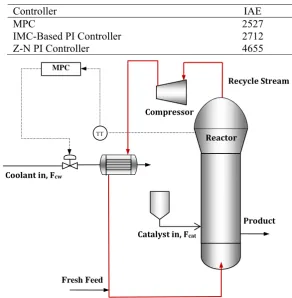
A process schematic of an industrial gas-phase fluidized bed polypropylene reactor is shown in Figure 1. To maintain acceptable polymer production rate which is an important goal for industry it is necessary to keep the reactor bed temperature above the dew point of the reactants to avoid gas condensation and below the melting point of the polymer to prevent particle melting and agglomeration and consequently reactor shut down.
2 of the reactor is influenced by many process variables such as the superficial gas velocity, feed gas temperature, monomer concentration, catalyst activity, catalyst feed rate, etc. Choi and Ray (1985) used a dynamic model considering bubble and emulsion phases in the bed in the first attempt to describe the dynamics of polypropylene production. They showed that a PI feedback control scheme can be used to control the process transients, but it is limited by the recycle gas cooling capacity.
Dadebo et al (1997) showed that for the temperature control of industrial gas phase polyethylene reactors the nonlinear error trajectory controller (ETC) exhibits significantly superior responses in terms of speed, damping and robustness compared with an optimally-tuned PID controller over a wide range of operating conditions.
Due to the high nonlinearities and difficulties involved in the dynamics and control of the gas phase propylene polymerization fluidized bed reactor, an efficient process control scheme need to be implemented. However, it is beyond the capability of the conventional controller with fixed controller settings to achieve excellent control of the reactor variables. In order to achieve good control of the reactor variables, a more intelligent and efficient process control scheme is needed where the controller is able to automatically re-design itself in real time according to the changing process dynamics.
In the present study, a two-phase model with comprehensive kinetics for propylene homo-polymerization in a fluidized bed reactor that considers the presence of particles in the bubbles and the excess gas in the emulsion phase with polymerization reaction in both phases (Shamiri et al., 2011, Cui et al., 2000, Cui et al., 2001) is considered. A Model Predictive Control (MPC) algorithm is used for controlling the reactor temperature by manipulating the coolant flow rate.
MATHEMATICAL MODELING OF PROPYLENE POLYMERIZATION
In the present study, the kinetic model of propylene homo-polymerization over a Ziegler-Natta catalyst based on the kinetic model developed by Shamiri et al (2010, 2011 ) and the dynamic two-phase flow structure proposed by Cui et al (2000, 2001) were combined and implemented to provide a more realistic understanding of the phenomena encountered in the bed hydrodynamics.
For details of the kinetic scheme, definitions of pseudo-kinetic rate constants and the correlations required for estimating the bubble volume fraction in the bed, the voidage of the emulsion phase and bubble phases, the emulsion phase and bubble phases gas velocities and mass and heat transfer coefficients for two-phase model, the reader is referred to a paper by Shamiri et al (2011).
3
(
)
[ ],( ) [ ] [ ] ([ ] [ ] ) (1 )
[ ]
Ab
Mib inU Ab b M U Aib b b Rv bMib Kbe Mib MieVb b R dzi b VPFR d
Vb bMib dt
e e
e
- - - ò
= (1)
For emulsion:
(
)
[ ],( ) [ ] [ ] ([ ] [ ] ) (1 )
1
[ ]
Mie in U Ae e Mie e eU A Rv e Mie Kbe Mib Mie eV e Ri e
d
Ve e Mie dt d e e d e - - + - - -= æ ö÷ ç ÷ ç ÷ ç ÷
çè ø (2)
The direction of mass transfer was assumed to be from bubble to emulsion phase. Furthermore, the energy balances can be expressed as:
For bubbles:
(
)
( ,( ) ) [ ],( ) ( ) [ ]
1 1
( ) [ ] (1 ) , (1 )
1
( ) ( ) ([ ] )
1
( [ ] (1 )
1
m m
U A Tb b b in Tref Mib in Cpi U A Tb b b Tref MibCpi
i i
A H
m b R
R Tv b Tref bCpiMib b pol p polC b R dzpb
i VPFR
m d
HbeTe T Vb b Vb b bT Tref Cpi Mib
i dt
m
Vb b Cpi Mib b i
e e r e
e
e e
- å - - å
= =
D
- - å + - + - ò
=
+ - - - å
=
= å +
-=
(
pol p polC , ))
d (Tb Tref)dt r (3) For emulsion:
(
)
( ,( ) ) [ ],( ) ( ) [ ] 1 1( ) [ ] (1 ) , (1 )
1 ( ) ( ) ([ ] ) 1 1 ( ([ ] 1 m m
U A Te e e in Tref Mie in Cpi U A Te e e Tref MieCpi
i i
m
R Tv e Tref eCpi Mie e pol p polC e Rpe HR i
m d
H Vbe e Te Tb Ve e eT T Cpi Mie ref i dt m
Ve e Cpi Mi i
e e r e
d
e d
e
- å - - å
= =
- - å + - - - D
=
- - - - å =
= -å = æ ö÷ ç ÷ ç ÷ ç ÷ çè ø
(
e) (1 e) pol p polC , ))
d (Te Tref) dte r
+ -
(4)
The initial conditions for solution of the model equations are as follows:
( 0) , 0
Mi Mi and T tb Tin
b t= = in = =
é ù é ù
ê ú ê ú
ë û ë û (5)
( 0) , 0
Mi Mi and T te Tin
e t= = in = =
é ù é ù
ê ú ê ú
ë û ë û (6)
NONLINEAR MODEL PREDICTIVE CONTROL SCHEME (NMPC)
4 prediction horizon. In this study a dynamic process model is used in MPC in order to predict the controlled variable, in this system a process model is used in parallel to the plant.
A usual MPC formulation solves the following online optimization:
2 2
( ) ( ) ( 1)
1 1
P M
J y Y t i R t i u u t i
i i
= G å + - + + G å D +
-= éêë ùúû = éêë ùúû
Where J is the cost function to be minimized and Γy and Γu are the input and output weighting parameters and R = [ (r t + 1), ...., (r t + P)]T is a vector of the future setpoint andD =u [ ( ), (u t u t + 1), ...., (u t+ M - 1)]T is a vector of manipulated variable values of length
M. Y = [ (Y t+ 1), ...., (Y t + P)]T includes the predicted outputs over the future horizon P, where y is the output vector. The controller moves horizon (M) and the prediction horizon (P) are used to adjust the speed of the response and hence to stabilize the feedback behavior. Γy is usually used for trade-off between different controlled outputs and Γu is
used to penalize different inputs and thus to stabilize the feedback response.
Depending on the problem formulation, the controller parameters such as sampling time, control horizon, prediction horizon, and weighting matrices in the optimization formulation can be used to tune the performance of the predicted output.
In this study Y represents the emulsion phase temperature which is the controlled variable and variable u represents the cooling water flow rate.
The presented mathematical model for the gas phase propylene polymerization fluidized bed reactor consists of cooling water flow rate (Fcw) as a manipulated variable and emulsion phase temperature (Te) as a controlled variable.
A model-predictive controller was designed using the MPC toolbox GUI and implemented in simulink using the MPC simulink block.
RESULTS AND DISCUSSION
The process was simulated at the operating conditions shown in Table 1.
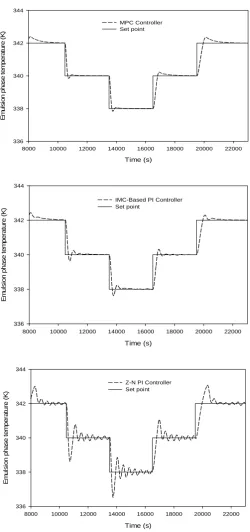
The closed loop performance of the MPC scheme in tracking series of setpoint changes for the emulsion phase temperature in the polymerization reactor is evaluated. For this purpose, series of setpoint changes in opposite directions were introduced. The magnitude of the setpoints introduced for this loop was typical of the respective nominal operating range. For comparison purposes, conventional PI controllers tuned using the IMC (Chien and Fruehauf, 1990) method and the standard Z-N (Ziegler and Nichols, 1942) method, were included in this simulation. Both the IMC and Z-N PI controller tuning parameters were calculated based on analyses of the open loop process reaction curve for a particular operational region of the process.
5 imposed on loop are based on practical considerations acquired through real operational experience of the authors.
The resulting controller had a sampling time of 10 sec, a prediction horizon of 17, a control horizon of 1, an output variables weight of 0.09, and a manipulated variables weight of 0.008.
Figs. 3 and 4 show the performance of the MPC as compared to the IMC and Z-N PI controllers in tracking series of setpoint changes for the temperature loop as well as the corresponding controller moves. From Fig. 3, the failure of the Z-N PI controller to track the changes in the setpoints for the temperature loop was obvious. The Z-N PI controller produced oscillatory responses. Furthermore, as shown in Fig. 4, the controller moves observed were vigorous. However the shortcomings exhibited by the Z-N PI controller were not observed for the cases of MPC and the IMC-Based PI controllers. In general, both the MPC and the IMC-Based PI controllers were able to track the changes in the set point. However, the quality of the set point tracking as demonstrated by the MPC was superior to the IMC-Based PI controller in terms of their ability to attain minimal overshoot. Moreover, the MPC was able to not only produce controller moves which were well within the specified input constraints, but also the controller moves produced were non-aggressive and smooth for practical implementations. These were attributed to the ability of the MPC to handle constraints in the inputs, of which the conventional PI controller was unable to achieve. To summarize, Table 2 shows the Integral Absolute Error (IAE) for the three controllers in tracking the series of set point changes. The values of the IAE calculated were consistent with the previous discussions, where the performance of the MPC was superior to the conventional PI controllers.
CONCLUSIONS
Two-phase dynamic model describing gas phase propylene polymerization in a fluidized bed reactor was used to control the reactor temperature. The hydrodynamics of the fluidized bed reactor of polypropylene production was based on the dynamic two-phase concept of fluidization.
Two control algorithms namely, the conventional Proportional-Integral (PI) and model predictive controller (MPC) were tested for the stabilization of the process.
6 Tab. 1: Operating conditions and physical parameters considered in this work for modeling
fluidized bed polypropylene reactors.
Operating conditions Physical parameters
V (m3)=50 μ (Pa.s)=1.14×10⁻⁴ Tref (K)=353.15 ρg (kg/m3)=23.45
Tin (K)=317.15 ρs (kg/m3)=910
P (bar)=25 dp (m) =500×10-6
Propylene concentration (kmol/m3)=0.9 εmf =0.45
Hydrogen concentration ( kmol/m3)= 0.015
Catalyst feed rate (kg/s)= 0.0003
Tab. 2: Integral absolute error (IAE) for the MPC, IMC-Based PI controller, and the Z-N PI controller in tracking series of setpoint changes for the emulsion phase temperature.
Controller IAE
MPC 2527
IMC-Based PI Controller 2712
[image:6.595.147.440.347.646.2]Z-N PI Controller 4655
Fig. 1: Simplified schematic of the MPC design on the gas phase propylene polymerization fluidized bed reactor.
Coolant in,Fcw
Catalyst in,Fcat
Product
RecycleStream
Compressor
Reactor
Fresh Feed
MPC
7
Time (s)
8000 10000 12000 14000 16000 18000 20000 22000
E
m
ul
s
ion
ph
as
e t
e
m
p
e
ra
tur
e
(
K
)
336 338 340 342 344
MPC Controller Set point
Time (s)
8000 10000 12000 14000 16000 18000 20000 22000
E
m
ul
si
o
n
p
hase
t
e
m
p
er
at
ur
e
(K
)
336 338 340 342 344
IMC-Based PI Controller Set point
Time (s)
8000 10000 12000 14000 16000 18000 20000 22000
E
m
ul
s
ion phas
e
te
m
per
at
ur
e (
K
)
336 338 340 342 344
[image:7.595.168.419.128.662.2]Z-N PI Controller Set point
Fig. 3: Comparison of the performance between the MPC, IMC-Based PI controller (Kc =
-18.5345, τI = 858.0787, τD = 0), and the Z-N PI controller (Kc = -33.3620, τI = 266.4696, τD
8
Time (s)
5000 10000 15000 20000
C
o
n
tro
ll
e
r m
o
v
e
s
(
%
)
0 20 40 60 80 100
MPC Controller
Time (s)
5000 10000 15000 20000
C
o
n
tro
ll
e
r m
o
v
e
s
(
%
)
0 10 20 30 40 50 60
IMC-Based PI Controller
Time (s)
5000 10000 15000 20000
C
ont
ro
ll
er
m
o
v
e
s
(
%
)
0 20 40 60 80 100
9 Fig. 4: Comparison of the corresponding controller moves between the MPC, IMC-Based
PI controller, and the Z-N PI controller for the emulsion phase temperature.
NOMENCLATURE
A cross sectional area of the reactor, (m2)
Cpi specific heat capacity of component i (J/kg.K) Cpg specific heat capacity of gaseous stream (J/kg.K) Cp,pol specific heat capacity of solid product (J/kg.K) db bubble diameter (m)
dp particle diameter (m) Dt reactor diameter (m)
Fcat catalyst feed rate (kg/s)
Fcw cooling water flow rate (kg/s) H height of the reactor, (m)
Hbe bubble to emulsion heat transfer coefficient, (W/m3.K) Kbe bubble to emulsion mass transfer coefficient, (s-1) M monomer (propylene)
[Mi] concentration of component i in the reactor (kmol/m3) [Mi]in concentration of component i in the inlet gaseous stream Rp production rate (kg/s)
Ri instantaneous rate of reaction for monomer i (kmol/s)
Rv volumetric polymer phase outflow rate from the reactor (m3/s) T temperature of the gas entering the exchanger, (K)
Tin temperature of the inlet gaseous stream, (K)
Twi temperature of the cooling water entering the heat exchanger, (K) U0 superficial gas velocity (m/s)
Ub bubble velocity (m/s) Ue emulsion gas velocity (m/s)
Umf minimum fluidization velocity (m/s) Vb volume of the bubble phase
Ve volume of the emulsion phase VPFR volume of PFR
Greek letters
∆HR heat of reaction (J/kg)
δ volume fraction of bubbles in the bed
εb void fraction of bubble for Geldart B particles
εe void fraction of emulsion for Geldart B particles
εmf void fraction of the bed at minimum fluidization
ρg gas density (kg/m3)
ρpol polymer density (kg/m3)
10
e emulsion phase
i component type number
ref reference condition
REFERENCES
Ali, M. A.-H., Betlem, B., Weickert, G. & Roffel, B. (2007) Non-linear model based control of a propylene polymerization reactor. Chemical Engineering and Processing, 46, 554-564.
Chien, I. L. & Fruehauf, P. S. (1990) Consider IMC tuning to improve controller performance. Chemical Engineering Progress, 86, 33-41.
Choi, K. Y. & Ray, W. H. (1985) The dynamic behavior of fluidized bed reactors for solid catalysed gas phase olefin polymerization. Chemical Engineering Science, 40,
2261-2279.
Cui, H., Mostoufi, N. & Chaouki, J. (2000) Characterization of dynamic gas-solid distribution in fluidized beds. Chemical Engineering Journal, 79, 133-143.
Cui, H., Mostoufi, N. & Chaouki, J. (2001) Gas and solids between dynamic bubble and emulsion in gas-fluidized beds. Powder Technology, 120, 12-20.
Dadebo, S. A., Bell, M. L., Mclellan, P. J. & Mcauley, K. B. (1997) Temperature control of industrial gas phase polyethylene reactors. Journal of Process Control, 7, 83-95.
Shamiri, A., Azlan Hussain, M., Sabri Mjalli, F., Mostoufi, N. & Saleh Shafeeyan, M. (2011) Dynamic modeling of gas phase propylene homopolymerization in fluidized bed reactors. Chemical Engineering Science, 66, 1189-1199.
Shamiri, A., Hussain, M. A., Mjalli, F. S. & Mostoufi, N. (2010) Kinetic modeling of propylene homopolymerization in a gas-phase fluidized-bed reactor. Chemical Engineering Journal, 161, 240-249.
Shridhar, R. & Cooper, D. J. (1997) A Tuning Strategy for Unconstrained SISO Model Predictive Control. Industrial and Engineering Chemistry Research, 36, 729-746.
Ziegler, J. G. & Nichols, N. B. (1942) Optimum settings for automatic controllers.
Transactions of the ASME, 64, 759-768.
BRIEF BIOGRAPHY OF PRESENTER
Ahmad Shamiri: