Estimation of phenotypic divergence in a collection
of Cucumis melo from Kerala State, Southern India
Sunita Premnath Koli, Hosakatte Niranjana Murthy
*Department of Botany, Karnatak University, Dharwad, India;
*Corresponding Author: [email protected]
Received 21 April 2013; revised 22 May 2013; accepted 15 June 2013
Copyright © 2013 Sunita Premnath Koli, Hosakatte Niranjana Murthy. This is an open access article distributed under the Creative
Commons Attribution License, which permits unrestricted use, distribution, and reproduction in any medium, provided the original
work is properly cited.
ABSTRACT
A collection of melon (Cucumis melo L.) from
Kerala state, Southern India, consisting of thirty
three accessions was evaluated for 22 quantita-
tive and 14 qualitative characteristics to esti-
mate the phenotypic diversity. The collection
showed appreciable phenotypic diversity in fruit
related traits. Principal component analysis
(PCA) was performed to determine the relation-
ships among the populations. The analysis re-
vealed that the variations in stem hair length,
number of nodes per plant on 60th day, fruit
shape, fruit length, fruit weight, fruit colour at
ripening, fruit rind hardness, flesh colour, flesh
firmness, quality of flesh, shelf life, seed colour
were the principle characters to discriminate
melon accessions evaluated in the present
study. When the 33 populations were plotted on
the first two principal components, accounting
for 49.97% of the total variation, three clusters
were identified, accounting for 36 morphological
attributes used in the study. The greater part of
diversity was accounted for fruit diameter, fruit
weight, fruit length and width, fruit cavity length
and diameter, seed length and colour. Flesh area
of fruit, flesh thickness, leaf size, seed weight,
seed index did not account for variation in the
first six principal components of the melon col-
lection. Scatter diagram segregated the acidulus
and momordica into different clusters. This
evaluation of fruit trait variability can assist ge-
neticists and breeders to identify populations
with desirable characteristics for inclusion in
various breeding programmes.
Keywords:
Cucumis melo
; Genetic Diversity;
Phenotypic Traits; Principle Component Analysis
1. INTRODUCTION
Cucumis melo L. (2n = 2x = 24) is an economically
important horticultural crop belonging to the family Cu-
curbitaceae. A great morphological variation exists in
fruit characteristics such as size, shape, colour, texture,
taste and composition. Therefore, C. melo is considered
as the most diverse species of the genus Cucumis [1-3].
The cultivated varieties include sweet “dessert” melons
as well as non-sweet forms that are consumed raw, pick-
led or cooked. Such a variation provides breeders with a
rich genetic resource and thus there is an increased inter-
est in understanding their genetic diversity.
The melon germplasm of the humid tropics of South-
ern India has been collected and assessed by Fergany et
al.
[4]. They reported that the collected populations be-
long to two groups: C. melo var. acidulus Naudin and C.
melo var. momordica (Roxb.) Duthie et Fuller. They also
recommended that additional collections of melon ge-
netic resources should be made from Southern India as
this could lead to the discovery of genetic diversity not
present in the existing world collections of melon.
Poor keeping quality of some melon varieties which
produce climacteric fruits limits their wide commercial
acceptance and thus long shelf life has become an im-
portant character in modern cultivars of melon. Variation
exists among C. melo varieties [5-8] and studies were
carried out in few varieties including inodorus, reticula-
tus, makuwa, sacharinus, cantalupensis,
acidulus and
momordica [8-14]. Hence, the main objectives of present
study were to evaluate the diversity among melon acces-
sions collected from Kerala state, Southern India and to
estimate the distribution of shelf life among these popu-
lations.
2. MATERIALS AND METHODS
2.1. Plant Materials and Bio-Agronomic
Traits
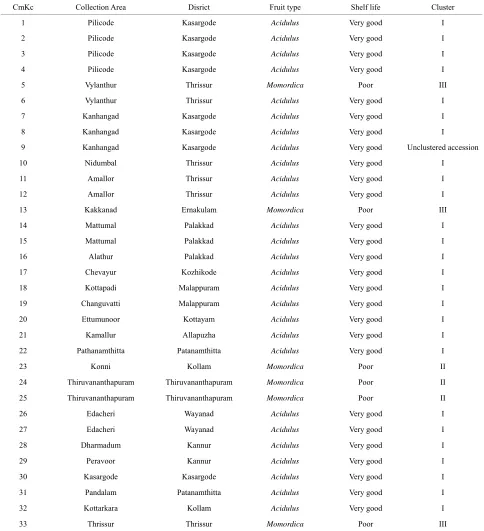
typic diversity among thirty three landraces of C. melo
collected in the Kerala state, Southern India (
Table 1
).
The landraces were evaluated in field trials using a
randomized complete-block design in triplicates during
December 2012 to March 2013. Each plot consisted of 1
row, 7.5 m long, spaced 2 m apart, with 1.5 m spacing
between plants within the row. All characters (quantita-
[image:2.595.56.540.198.729.2]tive and qualitative characters) were measured in the
field and at the normal harvest time for the estimation of
phenotypic diversity. The characters selected for the
analysis were pertaining mainly to C. melo breeding aims
and were recorded for all genotypes in triplicates
[1,15,16]. The fruit characters studied at maturity in-
cluded length, diameter, shape, colour, skin and flesh
Table 1
. Details of melon accessions used in the present study.
CmKc Collection Area Disrict Fruit type Shelf life Cluster
1 Pilicode Kasargode Acidulus Very good I
2 Pilicode Kasargode Acidulus Very good I
3 Pilicode Kasargode Acidulus Very good I
4 Pilicode Kasargode Acidulus Very good I
5 Vylanthur Thrissur Momordica Poor III
6 Vylanthur Thrissur Acidulus Very good I
7 Kanhangad Kasargode Acidulus Very good I
8 Kanhangad Kasargode Acidulus Very good I
9 Kanhangad Kasargode Acidulus Very good Unclustered accession
10 Nidumbal Thrissur Acidulus Very good I
11 Amallor Thrissur Acidulus Very good I
12 Amallor Thrissur Acidulus Very good I
13 Kakkanad Ernakulam Momordica Poor III
14 Mattumal Palakkad Acidulus Very good I
15 Mattumal Palakkad Acidulus Very good I
16 Alathur Palakkad Acidulus Very good I
17 Chevayur Kozhikode Acidulus Very good I
18 Kottapadi Malappuram Acidulus Very good I
19 Changuvatti Malappuram Acidulus Very good I
20 Ettumunoor Kottayam Acidulus Very good I
21 Kamallur Allapuzha Acidulus Very good I
22 Pathanamthitta Patanamthitta Acidulus Very good I
23 Konni Kollam Momordica Poor II
24 Thiruvananthapuram Thiruvananthapuram Momordica Poor II
25 Thiruvananthapuram Thiruvananthapuram Momordica Poor II
26 Edacheri Wayanad Acidulus Very good I
27 Edacheri Wayanad Acidulus Very good I
28 Dharmadum Kannur Acidulus Very good I
29 Peravoor Kannur Acidulus Very good I
30 Kasargode Kasargode Acidulus Very good I
31 Pandalam Patanamthitta Acidulus Very good I
32 Kottarkara Kollam Acidulus Very good I
thickness. Traits of fruit size and shape, such as flesh
thickness, fruit length and width, placenta length were
measured using the drawing ruler. Cotton blue in lacto
phenol stain was used for the analysis of pollen viability.
Finally, with an aim to compare together qualitative and
quantitative data, a numerical transformation was applied
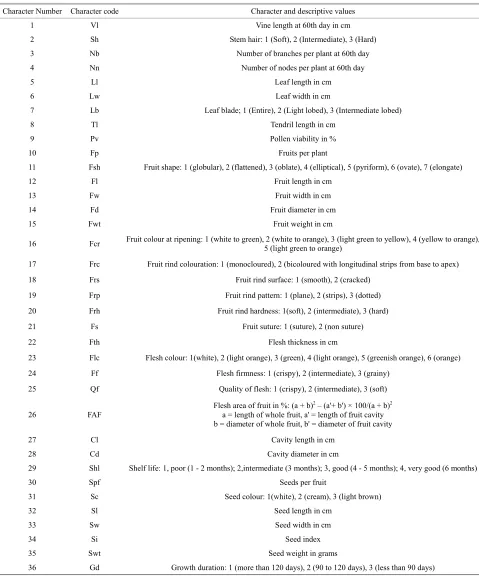
to traits such as flesh and rind color (
Table 2
). A nu-
[image:3.595.57.536.158.740.2]merical value, ranging from 1 to k (k equal to number of
Table 2
. Morphological characters measured in
Cucumis melo
collection.
Character Number Character code Character and descriptive values
1 Vl Vine length at 60th day in cm
2 Sh Stem hair: 1 (Soft), 2 (Intermediate), 3 (Hard)
3 Nb Number of branches per plant at 60th day
4 Nn Number of nodes per plant at 60th day
5 Ll Leaf length in cm
6 Lw Leaf width in cm
7 Lb Leaf blade; 1 (Entire), 2 (Light lobed), 3 (Intermediate lobed)
8 Tl Tendril length in cm
9 Pv Pollen viability in %
10 Fp Fruits per plant
11 Fsh Fruit shape: 1 (globular), 2 (flattened), 3 (oblate), 4 (elliptical), 5 (pyriform), 6 (ovate), 7 (elongate)
12 Fl Fruit length in cm
13 Fw Fruit width in cm
14 Fd Fruit diameter in cm
15 Fwt Fruit weight in cm
16 Fcr Fruit colour at ripening: 1 (white to green), 2 (white to orange), 3 (light green to yellow), 4 (yellow to orange), 5 (light green to orange)
17 Frc Fruit rind colouration: 1 (monocloured), 2 (bicoloured with longitudinal strips from base to apex)
18 Frs Fruit rind surface: 1 (smooth), 2 (cracked)
19 Frp Fruit rind pattern: 1 (plane), 2 (strips), 3 (dotted)
20 Frh Fruit rind hardness: 1(soft), 2 (intermediate), 3 (hard)
21 Fs Fruit suture: 1 (suture), 2 (non suture)
22 Fth Flesh thickness in cm
23 Flc Flesh colour: 1(white), 2 (light orange), 3 (green), 4 (light orange), 5 (greenish orange), 6 (orange)
24 Ff Flesh firmness: 1 (crispy), 2 (intermediate), 3 (grainy)
25 Qf Quality of flesh: 1 (crispy), 2 (intermediate), 3 (soft)
26 FAF
Flesh area of fruit in %: (a + b)2 – (a'+ b') × 100/(a + b)2
a = length of whole fruit, a' = length of fruit cavity b = diameter of whole fruit, b' = diameter of fruit cavity
27 Cl Cavity length in cm
28 Cd Cavity diameter in cm
29 Shl Shelf life: 1, poor (1 - 2 months); 2,intermediate (3 months); 3, good (4 - 5 months); 4, very good (6 months)
30 Spf Seeds per fruit
31 Sc Seed colour: 1(white), 2 (cream), 3 (light brown)
32 Sl Seed length in cm
33 Sw Seed width in cm
34 Si Seed index
35 Swt Seed weight in grams
classes), was assigned to each phenotrait, to indicate
dif-ferent degrees of expression. For seed characters, 10
measurements were averaged for each plant.
2.2. Statistical Analysis
All the original data were standardized to eliminate the
difference in the variance of each character. Principal
component analysis (PCA) was performed to generate a
cluster diagram. Eigen values and contribution percent-
age of each principal component axis were calculated
using the correlation matrix among thirty six characters
for thirty three accessions [17]. All computations were
performed using the unscrambler 10 software (CAMO
Software India Pvt. Ltd., Bangalore, India) and SPSS
17.0 for MS Windows (SPSS Inc).
3. RESULTS AND DISCUSSION
Thirty three accessions of melons collected from Ker-
ala state, Southern India were evaluated to estimate the
genetic diversity among the melon populations. Thirty
six selected qualitative and quantitative characters were
assessed in the uniform field trials (
Table 2
). All the
[image:4.595.58.540.364.738.2]melon accessions used in the analysis were monoecious
and substantial genetic diversity was observed. These
accessions showed a large genetic variability with re-
spect to fruit shape and size. Principal component analy-
sis was used to assess the variability in melon accessions.
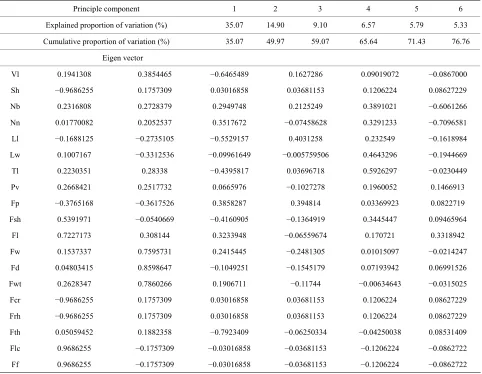
The percentage of variation explained by the first six
components was 35.07, 14.90, 9.10, 6.57, 5.79 and 5.33
respectively, and the principle characters with higher
Eigen vectors that delineated the accessions into separate
groups in the first six components are represented in the
Table 3
. The variations in stem hair length, number of
nodes per plant on 60th day, fruit shape, fruit length, fruit
weight, fruit colour at ripening, fruit rind hardness, flesh
colour, flesh firmness, quality of flesh, shelf life, seed
colour were the important characters for the formation of
different clusters.
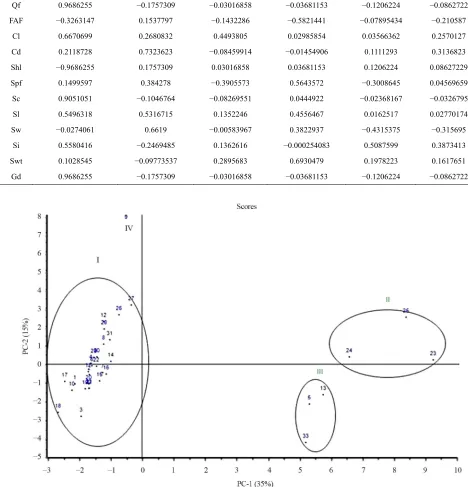
Figure 1
depicts the formation of three
clusters with one un-clustered melon landrace. By these
Table 3.
Contribution percentage and major characters associated with the first principle components of 33 melon accessions and
their Eigen vector.
Principle component 1 2 3 4 5 6
Explained proportion of variation (%) 35.07 14.90 9.10 6.57 5.79 5.33
Cumulative proportion of variation (%) 35.07 49.97 59.07 65.64 71.43 76.76
Eigen vector
Vl 0.1941308 0.3854465 −0.6465489 0.1627286 0.09019072 −0.0867000
Sh −0.9686255 0.1757309 0.03016858 0.03681153 0.1206224 0.08627229
Nb 0.2316808 0.2728379 0.2949748 0.2125249 0.3891021 −0.6061266
Nn 0.01770082 0.2052537 0.3517672 −0.07458628 0.3291233 −0.7096581
Ll −0.1688125 −0.2735105 −0.5529157 0.4031258 0.232549 −0.1618984
Lw 0.1007167 −0.3312536 −0.09961649 −0.005759506 0.4643296 −0.1944669
Tl 0.2230351 0.28338 −0.4395817 0.03696718 0.5926297 −0.0230449
Pv 0.2668421 0.2517732 0.0665976 −0.1027278 0.1960052 0.1466913
Fp −0.3765168 −0.3617526 0.3858287 0.394814 0.03369923 0.0822719
Fsh 0.5391971 −0.0540669 −0.4160905 −0.1364919 0.3445447 0.09465964
Fl 0.7227173 0.308144 0.3233948 −0.06559674 0.170721 0.3318942
Fw 0.1537337 0.7595731 0.2415445 −0.2481305 0.01015097 −0.0214247
Fd 0.04803415 0.8598647 −0.1049251 −0.1545179 0.07193942 0.06991526
Fwt 0.2628347 0.7860266 0.1906711 −0.11744 −0.00634643 −0.0315025
Fcr −0.9686255 0.1757309 0.03016858 0.03681153 0.1206224 0.08627229
Frh −0.9686255 0.1757309 0.03016858 0.03681153 0.1206224 0.08627229
Fth 0.05059452 0.1882358 −0.7923409 −0.06250334 −0.04250038 0.08531409
Flc 0.9686255 −0.1757309 −0.03016858 −0.03681153 −0.1206224 −0.0862722
Continued
Qf 0.9686255 −0.1757309 −0.03016858 −0.03681153 −0.1206224 −0.0862722
FAF −0.3263147 0.1537797 −0.1432286 −0.5821441 −0.07895434 −0.210587
Cl 0.6670699 0.2680832 0.4493805 0.02985854 0.03566362 0.2570127
Cd 0.2118728 0.7323623 −0.08459914 −0.01454906 0.1111293 0.3136823
Shl −0.9686255 0.1757309 0.03016858 0.03681153 0.1206224 0.08627229
Spf 0.1499597 0.384278 −0.3905573 0.5643572 −0.3008645 0.04569659
Sc 0.9051051 −0.1046764 −0.08269551 0.0444922 −0.02368167 −0.0326795
Sl 0.5496318 0.5316715 0.1352246 0.4556467 0.0162517 0.02770174
Sw −0.0274061 0.6619 −0.00583967 0.3822937 −0.4315375 −0.315695
Si 0.5580416 −0.2469485 0.1362616 −0.000254083 0.5087599 0.3873413
Swt 0.1028545 −0.09773537 0.2895683 0.6930479 0.1978223 0.1617651
[image:5.595.55.539.100.288.2]Gd 0.9686255 −0.1757309 −0.03016858 −0.03681153 −0.1206224 −0.0862722
Figure 1.
Cluster diagram constructed on the basis of the first two principle component axes, which contain 50% of the
total variation.
components, accessions showing large variation in vine
length (101 cm to 220 cm), number of branches on 60th
day (12 to 20), number of nodes on 60th day (25 to 43),
tendril length (24 cm to 51 cm), fruit shape (ovate to
oblate), fruit length (15 cm to 43 cm), fruit width (7 cm
to 12 cm), stem hair length, fruit colour at ripening, seed
colour, larger fruit diameter with medium growth dura-
tion (within 120 days) were grouped into a larger cluster
in the left and the collections in this cluster were mainly
acidulus (
Figure 1
). Accessions with longer vine length
and leaf length, larger fruit length, heavy fruit weight,
light green to yellow fruit colour, soft rind, light orange
flesh colour, grainy and intermediate flesh, poor shelf life
(1 - 2 months), light brown seeds, short growth duration
(within 90 days) were on the right of the scatter diagram,
and these accessions on the right of the scatter diagram
were
momordica (
Figure 1
). Cluster 3 included land-
[image:5.595.57.525.102.589.2]the landraces grouped in cluster 2 with heavy fruit weight,
light green to yellow fruit colour, soft rind, grainy and
intermediate flesh, light orange flesh colour, moderate
fruit length, poor shelf life (1 - 2 months), light brown
seeds, short growth duration (within 90 days). These ac-
cessions on the right of the scatter diagram were mo-
mordica (
Figure 1
). The unclustered landrace CmKc-9
had long vein length, higher number of nodes on 60th
day, smaller leaf size, higher fruit width, heavy fruit
weight, medium growth duration (within 120 days). This
landrace included the acidulus. The range for primary
branches per plant was from twelve to twenty in acidulus
which was almost similar to the branch profile of the
momordica. The minimum and maximum vein length
and number of nodes per plant was almost same in both
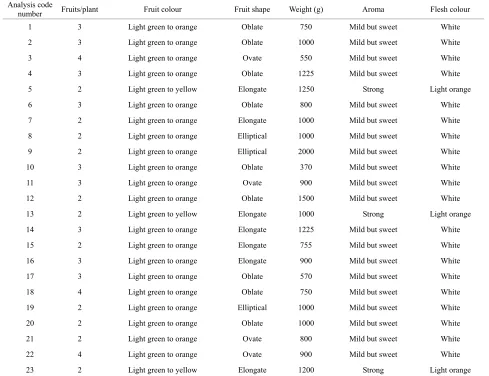
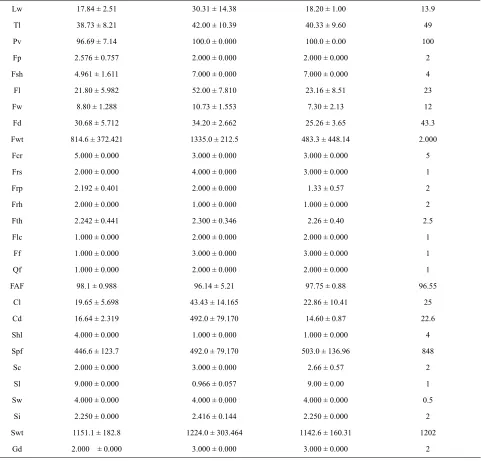
the varieties. A detailed description of the melon fruits
used in the study is given in
Table 4
and mean trait val-
ues of each cluster for their quantitative characters are
mentioned in
Table 5
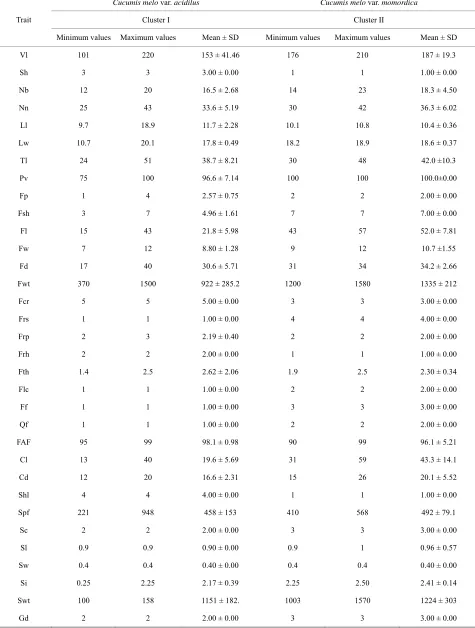
. The range of variability of phenol-
[image:6.595.54.543.234.610.2]typic characters in terms of minimum
Table 4
. Fruit traits of melon accessions.
Analysis code
number Fruits/plant Fruit colour Fruit shape Weight (g) Aroma Flesh colour
1 3 Light green to orange Oblate 750 Mild but sweet White
2 3 Light green to orange Oblate 1000 Mild but sweet White
3 4 Light green to orange Ovate 550 Mild but sweet White
4 3 Light green to orange Oblate 1225 Mild but sweet White
5 2 Light green to yellow Elongate 1250 Strong Light orange
6 3 Light green to orange Oblate 800 Mild but sweet White
7 2 Light green to orange Elongate 1000 Mild but sweet White
8 2 Light green to orange Elliptical 1000 Mild but sweet White
9 2 Light green to orange Elliptical 2000 Mild but sweet White
10 3 Light green to orange Oblate 370 Mild but sweet White
11 3 Light green to orange Ovate 900 Mild but sweet White
12 2 Light green to orange Oblate 1500 Mild but sweet White
13 2 Light green to yellow Elongate 1000 Strong Light orange
14 3 Light green to orange Elongate 1225 Mild but sweet White
15 2 Light green to orange Elongate 755 Mild but sweet White
16 3 Light green to orange Elongate 900 Mild but sweet White
17 3 Light green to orange Oblate 570 Mild but sweet White
18 4 Light green to orange Oblate 750 Mild but sweet White
19 2 Light green to orange Elliptical 1000 Mild but sweet White
20 2 Light green to orange Oblate 1000 Mild but sweet White
21 2 Light green to orange Ovate 800 Mild but sweet White
22 4 Light green to orange Ovate 900 Mild but sweet White
[image:6.595.56.539.640.734.2]23 2 Light green to yellow Elongate 1200 Strong Light orange
Table 5.
Mean trait values used in
Cucumis melo
cluster identification.
Traits Cluster I Cluster II Cluster III Unclustered accession
Vl 153.0 ± 41.46 44.75 ± 506.4 147.6 ± 34.195 210
Sh 3.00 ± 0.00 1.000 ± 0.000 1.000 ± 0.000 3
Nb 16.50 ± 2.68 313.7 ± 590.84 17.33 ± 2.08 21
Nn 33.65 ± 5.19 39.16 ± 8.207 32.66 ± 5.68 38
Continued
Lw 17.84 ± 2.51 30.31 ± 14.38 18.20 ± 1.00 13.9
Tl 38.73 ± 8.21 42.00 ± 10.39 40.33 ± 9.60 49
Pv 96.69 ± 7.14 100.0 ± 0.000 100.0 ± 0.00 100
Fp 2.576 ± 0.757 2.000 ± 0.000 2.000 ± 0.000 2
Fsh 4.961 ± 1.611 7.000 ± 0.000 7.000 ± 0.000 4
Fl 21.80 ± 5.982 52.00 ± 7.810 23.16 ± 8.51 23
Fw 8.80 ± 1.288 10.73 ± 1.553 7.30 ± 2.13 12
Fd 30.68 ± 5.712 34.20 ± 2.662 25.26 ± 3.65 43.3
Fwt 814.6 ± 372.421 1335.0 ± 212.5 483.3 ± 448.14 2.000
Fcr 5.000 ± 0.000 3.000 ± 0.000 3.000 ± 0.000 5
Frs 2.000 ± 0.000 4.000 ± 0.000 3.000 ± 0.000 1
Frp 2.192 ± 0.401 2.000 ± 0.000 1.33 ± 0.57 2
Frh 2.000 ± 0.000 1.000 ± 0.000 1.000 ± 0.000 2
Fth 2.242 ± 0.441 2.300 ± 0.346 2.26 ± 0.40 2.5
Flc 1.000 ± 0.000 2.000 ± 0.000 2.000 ± 0.000 1
Ff 1.000 ± 0.000 3.000 ± 0.000 3.000 ± 0.000 1
Qf 1.000 ± 0.000 2.000 ± 0.000 2.000 ± 0.000 1
FAF 98.1 ± 0.988 96.14 ± 5.21 97.75 ± 0.88 96.55
Cl 19.65 ± 5.698 43.43 ± 14.165 22.86 ± 10.41 25
Cd 16.64 ± 2.319 492.0 ± 79.170 14.60 ± 0.87 22.6
Shl 4.000 ± 0.000 1.000 ± 0.000 1.000 ± 0.000 4
Spf 446.6 ± 123.7 492.0 ± 79.170 503.0 ± 136.96 848
Sc 2.000 ± 0.000 3.000 ± 0.000 2.66 ± 0.57 2
Sl 9.000 ± 0.000 0.966 ± 0.057 9.00 ± 0.00 1
Sw 4.000 ± 0.000 4.000 ± 0.000 4.000 ± 0.000 0.5
Si 2.250 ± 0.000 2.416 ± 0.144 2.250 ± 0.000 2
Swt 1151.1 ± 182.8 1224.0 ± 303.464 1142.6 ± 160.31 1202
Gd 2.000 ± 0.000 3.000 ± 0.000 3.000 ± 0.000 2
and maximum and mean values are presented in
Table 6
.
Morphological variation was most apparent in fruit
length which varied from 15 cm to 43 cm per fruit in
acidulus whereas in momordica it was from 15 cm to 57
cm per fruit. Fruit colour was also quite similar
ranging-from light green to yellow or orange (
Figure 2
). The fruit
colour of the accessions, CmKc-5, CmKc-13, CmKc-23,
CmKc-24, CmKc-25 and CmKc-33 was mainly light
green to yellow which were grouped in cluster 2 and 3
which included mainly momordica (
Figure 3
). The fruits
of
acidulus were generally ovate to oblate in shape ex-
cept in CmKc-8, but those of momordica were elongated
except in CmKc-3 which was ovate. The average fruit
weight of the collections varied greatly. The fruit weight
varied from 420 g to 1250 g per fruit in acidulus, in mo-
mordica it varied from 200 g to 1580 g per fruit with
CmKc-9 gaining the maximum fruit weight of 2000 g per
fruit. The flesh of the fruits was generally white to light
orange in color and crispy to grainy in nature. The flesh
colour was white in acidulus and it was light orange in
momordica (
Table 4
). Most of the
momordica landraces
had a strong odour at maturity except for CmKc-3 which
had a mild and sweet odour. The fruits of acidulus were
non climacteric, very firm and did not crack at maturity
(
Figure 2
) and these fruits are used for cooking purpose
in Kerala. The fruits of momordica were, climacteric,
soft and cracked at maturity (
Figures 3(e)-(f)
), hence had
[image:7.595.58.539.99.560.2]Table 6
. Variability in some quantitative characters of
acidulus
and
momordica
landraces.
Cucumis melo var. acidilus Cucumis melo var. momordica
Cluster I Cluster II
Trait
Minimum values Maximum values Mean ± SD Minimum values Maximum values Mean ± SD
Vl 101 220 153 ± 41.46 176 210 187 ± 19.3
Sh 3 3 3.00 ± 0.00 1 1 1.00 ± 0.00
Nb 12 20 16.5 ± 2.68 14 23 18.3 ± 4.50
Nn 25 43 33.6 ± 5.19 30 42 36.3 ± 6.02
Ll 9.7 18.9 11.7 ± 2.28 10.1 10.8 10.4 ± 0.36
Lw 10.7 20.1 17.8 ± 0.49 18.2 18.9 18.6 ± 0.37
Tl 24 51 38.7 ± 8.21 30 48 42.0 ±10.3
Pv 75 100 96.6 ± 7.14 100 100 100.0±0.00
Fp 1 4 2.57 ± 0.75 2 2 2.00 ± 0.00
Fsh 3 7 4.96 ± 1.61 7 7 7.00 ± 0.00
Fl 15 43 21.8 ± 5.98 43 57 52.0 ± 7.81
Fw 7 12 8.80 ± 1.28 9 12 10.7 ±1.55
Fd 17 40 30.6 ± 5.71 31 34 34.2 ± 2.66
Fwt 370 1500 922 ± 285.2 1200 1580 1335 ± 212
Fcr 5 5 5.00 ± 0.00 3 3 3.00 ± 0.00
Frs 1 1 1.00 ± 0.00 4 4 4.00 ± 0.00
Frp 2 3 2.19 ± 0.40 2 2 2.00 ± 0.00
Frh 2 2 2.00 ± 0.00 1 1 1.00 ± 0.00
Fth 1.4 2.5 2.62 ± 2.06 1.9 2.5 2.30 ± 0.34
Flc 1 1 1.00 ± 0.00 2 2 2.00 ± 0.00
Ff 1 1 1.00 ± 0.00 3 3 3.00 ± 0.00
Qf 1 1 1.00 ± 0.00 2 2 2.00 ± 0.00
FAF 95 99 98.1 ± 0.98 90 99 96.1 ± 5.21
Cl 13 40 19.6 ± 5.69 31 59 43.3 ± 14.1
Cd 12 20 16.6 ± 2.31 15 26 20.1 ± 5.52
Shl 4 4 4.00 ± 0.00 1 1 1.00 ± 0.00
Spf 221 948 458 ± 153 410 568 492 ± 79.1
Sc 2 2 2.00 ± 0.00 3 3 3.00 ± 0.00
Sl 0.9 0.9 0.90 ± 0.00 0.9 1 0.96 ± 0.57
Sw 0.4 0.4 0.40 ± 0.00 0.4 0.4 0.40 ± 0.00
Si 0.25 2.25 2.17 ± 0.39 2.25 2.50 2.41 ± 0.14
Swt 100 158 1151 ± 182. 1003 1570 1224 ± 303
(a) (b) (c) (d) (e) (f)
Figure 2
. Variability in fruits of
Cucumis melo
var.
acidulus
landraces: (a) Tender oblate fruit of CmKc-3 landrace (Bar = 2.66 cm);
(b) Ripe fruit of CmKc-3
landrace (Bar = 3.21 cm); (c) Tender fruit of CmKc-14 landrace (Bar = 4.92 cm); (d) Ripe fruit of
CmKc-22
landrace (Bar = 5.04 cm); (e) Tender elongated fruit of CmKc-15 landrace (Bar = 3.5cm); (f) Ripe fruit of CmKc-27
landrace (Bar = 3.26 cm).
[image:9.595.81.513.294.435.2](a) (b) (c) (d) (e) (f)
Figure 3
. Variability in fruits of
Cucumis melo
var.
momordica
landraces: (a) Tender plane fruit of CmKc-5 landrace
(Bar = 4.95 cm); (b) Ripe fruit of CmKc-13
landrace (Bar = 5.4 cm); (c) Tender fruit of CmKc-24 landrace (Bar = 5.07
cm); (d) Ripe fruit of CmKc-23
landrace (Bar = 5.78 cm); (e) Peeled fruit of CmKc-25 landrace (Bar = 3.17 cm); (f)
Fruit cracking in CmKc-33 landrace (Bar = 3.4 cm).
cooking before maturity. The seeds of acidulus and mo-
mordica were medium sized, white in colour and maxi-
mum seed length was 0.9 and 1.0 cm respectively. The
present survey of morpho-metric analysis of Kerala land-
races of melon revealed considerable variability espe-
cially with fruit characteristics. The landraces belonged
to two varieties, acidulus
and momordica which pos-
sessed non sweet fruits which are consumed as cooked
vegetables. These observations support the views of Fer-
gany et al. [4], Manohar and Murthy [14] that South In-
dian melon landraces comprises of acidulus and mo-
mordica. The data on shelf-life and its correlation with
other characteristics is presented in
Table 7
. Fruit shape,
[image:9.595.308.538.518.708.2]fruit weight, flesh colour, quality of flesh, flesh firmness
were highly correlated with shelf-life of melon fruits.
Accessions with good shelf-life belong to acidulus vari-
ety and these accessions were characterized by fruits
possessing firm skin, non-climacteric, non-juicy, crisp
with white flesh. The fruits of such accession could be
stored more than six months without loss of quality. As-
Table 7
. Correlation coefficients between shelf life and other
characters.
Character Shelf life
Fruit shape 0.31087
Fruit colour 0.16896
Fruit weight 0.37343
Flesh colour 0.33142
Flesh thickness 0.18398
Quality of flesh 0.33142
Flesh firmness 0.57446
Rind hardness 0.21542
100 seed weight 0.15917
Growth duration 0.16923
out in C. melo var. sacharinus (Hami-melon) [18], and
selected accessions have been used for breeding
pro-gramme.
4. CONCLUSION
It was reported that melon germplasm (acidulus and
momordica) of Southern India possess resistance to Cu-
cumber mosaic virus, Zucchini yellow mosaic virus,
Powdery mildew (races 1, 2, 3 and 5), Fusarium
wilt
(races 1 and 2), Aphis gossypii and leafminer [4]. The
landraces collected from Kerala state showed increased
shelf-life. However, these land races should be assessed
for disease resistance characteristics by using molecular
markers. These landraces need to be analyzed for their
ability to be used as bred cultivars for commercial breed-
ing purpose.
5. ACKNOWLEDGEMENTS
The authors express sincere thanks to Dr. N.P.S. Dhillon and Dr. Balvir Kaur, Department of Vegetable Crops, Punjab Agricultural Uni-versity, Ludhiana, India, for helpful comments on the manuscript. Au-thors are thankful to Department of Biotechnology (DBT-KUD-IPLS program BT/PR14555/INF/22/126/2010), University Grants Commis-sion [Project No. F.No. 41-423/2012 (SR)], New Delhi and Department of Atomic Energy (BRNS project No. 2013/35/BRNS/20), Mumbai for financial assistance.