Munich Personal RePEc Archive
E-learning role in higher education and
corporate environment
Wawak, Slawomir and Woźniak, Krzysztof
Cracow University of Economics
2012
Online at
https://mpra.ub.uni-muenchen.de/47958/
13. E-learning role in higher education and
corporate environment
13.1. The idea of distant learning
Distant learning is not a new idea. Despite this, it has never gained popularity in higher education as well as in companies until internet has become widely ava-ilable mean of communication. Since then, many educational organizations and corporations has tried to implement idea of e-learning – distant learning using internet as communication medium.
The purpose of this article is to discuss the possibility of using e-learning in hi-gher education and corporations to improve quality and employee effectiveness. There is no agreement about its influence on results of education among authors of publications regarding e-learning. Some authors indicate that using internet in education will reduce level of education quality, by restricting studying only to solving tests, removing direct discussion with teacher (trainer) and decreasing student creativity. Others stresses greater flexibility and cost effectiveness of this method of education.
E-learning becomes also more popular in employee training in corporations. This happens, because [G. Dick et al. 2007]:
▪ removing staff from workplace is expensive,
▪ physical resources needed for learning (e.g. rooms, equipment, papers) con-tribute to a large corporate expense,
▪ HRM systems can indicate lack of skills of individual workers, and e-lear-ning is able to effectively eliminate this lack,
▪ not all employees start from the same level of competence, thus method used for training should be easy to adjust to their capabilities,
▪ learning materials may be easily prepared for particular employees, there is no need to buy expensive training programs for large groups of employees.
Not every company could afford to let employees to study face-to-face which may involve leaving their offices and work places. Therefore e-learning is the best method of training and becomes widely used. It gives opportunity to study while at work and remain in one location with no need to travel. E-learning the-refore gives opportunity of improving work competence for employees who live in remote places [S. Sitnikov et al. 2010, p. 43].
The Opportunities for and Constraints to Organizational Development...
126
In contrast, higher education institutions are more conservative. They are re-luctant in changing methods of training, due to specific organizational culture, role of direct communication and discussion, as well as different conditions of functioning. For example, while cost of renting rooms is important in training budget of company, for university it’s not an meaningful cost, because usually there are a lot of lecture rooms available. In case of higher education, main bene-fits are mostly noticeable for students, not for the institutions:
▪ reduction of transport costs (students may study at home, there is no need to frequent travel to the university),
▪ students can take up work, which allow them gather funds to finance stu -dies, as well as enrich their knowledge by practice,
▪ reduction of number of face-to-face lectures allows to take up additional courses and fields of study,
▪ lecturers may create diverse paths of their courses for different levels of students skills, therefore students lacking knowledge, may do more introductory exercises, while those having outstanding knowledge may focus on tasks that go beyond the basic program,
▪ actions of every student is easily monitored, they can be accountable not only for prepared exercises, but even every mouse click in the e-course.
In long run, however, higher education institutions that widely use e-learning may also have other goals, such as: lowering costs, increasing number of students and improving quality of education.
13.2. E-learning range of application
Each academic and practical subject can be trained using e-learning, but not always in the full extent. In every subject it is possible to utilise e-learning me -thods for:
▪ review of literature, ▪ introductory exercises, ▪ knowledge tests,
▪ preparation for advanced tasks (e.g. preparation for laboratory assignments), ▪ provision of materials for self-studying.
Corporate uses of e-learning stresses achieving of practical skills needed in various work situations, so e-learning methods should consist of presentation of various problems and cases specific to given work conditions and their solutions. E-learning is ideal tool for preparation of students before practical exercises.Stu -dents who don’t pass introductory e-tests may be disallowed to participate in fa-ce-to-face or laboratory exercises. This assures high level of students preparation during classes and is often required for security reasons.
In some subjects it is also possible to use e-learning for advanced assignments or complex multi stage projects, This is possible only in subjects that don’t requ -ire specific technical equipment or special laboratory instruments.
In corporations e-learning is mostly used to achieve results important for ma-naging employees and achieving company goals. Following areas of e-learning has highest potential for work training [A. Rossett, J. Marshall 2010, pp. 22-23]:
▪ fulfilling compliance expectations, ▪ standardizing employee efforts,
▪ capturing great ideas and best practices.
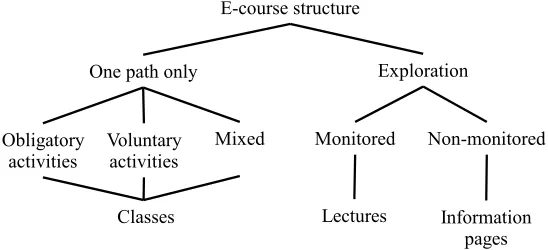
Above mentioned uses of e-learning makes it crucial tool for modern know-ledge based companies, in which all processes are based on knowknow-ledge sharing and distribution. Many internet based on-line applications are used to achieve effective process execution, which leads to satisfying customer needs. Applica -tions such as Moodle or Blackboard, are very sophisticated tools, that allow lec-turers to adjust e-course structure to specific requirements of subject provided (fig. 13.1). E-course may be organized along one path, which forces students to follow it, learn and perform assignments in given order. This can be useful if lat-ter task bases on results of former one. Another way of learning is e-course as an exploration field, where students may choose what to do, when and in what order. Usually one path only e-courses are more useful for classes (involving practical exercises), while exploration ones – for lectures (orderly content presentation). Both methods can be effective in corporate environment. One-path course could be use to teach some important practical skill involving specific production of se -rvice process, in which proper order of activity is important. Exploratory course can be used to present broad range of matters oriented around some specific work related subject.
E-course structure
One path only Exploration
Obligatory activities
Voluntary activities
Mixed Monitored Non-monitored
[image:4.468.97.371.303.428.2]Lectures Information pages Classes
Fig. 13.1. Main types of e-courses
Source: own elaboration.
-The Opportunities for and Constraints to Organizational Development...
128
thods. This makes e-course more interesting for students, as well as more easily manageable for lecturers. It also increased motivation for self studying by using peer pressure to timely solving of given problems and executing required tasks.
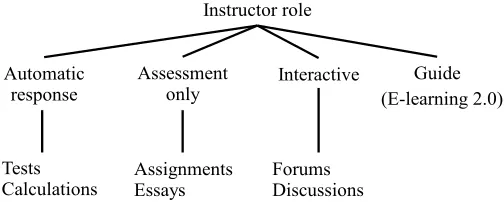
In recent years distant learning theory evolve to e-learning 2.0 idea. It is a step towards implementation of lifelong learning concept which is very important for every modern corporation This changes the role of lecturer, who is no more cen-tral figure in course, but becomes a guide and leader (most experienced partici -pant). Students become active participants, not only performing assignments, but contributing to the e-course in other ways. Lecturer participates in discussions and evaluates student’s progress, however it is also possible to use peer-review methods to evaluate some of assignments by colleagues. Various roles of instruc-tor are presented on fig. 13.2.
Instructor role
Automatic response
Assessment only
Interactive Guide
Tests Calculations
Assignments Essays
Forums Discussions
[image:5.468.108.360.210.311.2](E-learning 2.0)
Fig. 13.2. Role of instructor and example types of activities
Source: own elaboration.
In corporate environment most important methods of e-learning involves mostly interactive lectures and discussion groups. These methods could incre-ase social competences of employees and could increincre-ase their communication capabilities. Other methods include role playing and computer simulation, which could improve problem solving capabilities in various simulated work situations without costly process of learning on real world mistakes.
Companies use also modern communication technology like video-confe-rencing which gives opportunity for public discussion without wasting time for travel and work absence. This technology could also be used for delivering of lectures and sharing opinion, and this in turn eliminate feelings of isolation which may occur in traditional e-learning methods. Corporate e-learning environment stresses interaction between teacher and student (employee) as well as between students (employees). This interactivity influences motivation of students by in -volving social pressure for e-learning and need for achievement.
Corporate educational environment includes [S. Sitnikov et al. 2010, p. 43]: ▪ electronic learning material (books, course, audio books, video lectures), ▪ learning software (group learning, course management),
▪ monitoring software (assessment methods, testing of acquired knowledge), ▪ simulations systems (simulation of production processes and decision, role playing games).
13.3. Benefits of e-learning
The research made by P.C. Borstorff and S.K. Lowe [2007] has shown, that 88% of students have reported positive experience after finishing e-courses. As much as 79% would recommend this type of studying to other students, and 88% would participate in e-courses in future. Survey made in Cracow University of Economics in years 2009-2011 has shown, that students particularly appreciate:
▪ ease of obtaining information about subject, ▪ communication speed with lecturer,
▪ clear presentation of requirements, ▪ very high flexibility,
▪ possibility of performing assignments for disabled or ill students, as well as those who study abroad.
Aforementioned research has also shown, that groups of students using e-le-arning have finished courses 34% faster than in face-to-face method. In e-course each student may set his or her own learning speed, while in traditional classes lecturer sets the speed according to the specific needs of students and level of subject matter complexity.
Another research [D.E. Smith, D.J. Mitry 2008] has shown that there is no significant difference in outcomes between classroom and online learners. This research has indicated, that students who experience face-to-face learning might be more satisfied, but they will accept a distance learning experience for the sake of convenience.
E-courses are usually organized in small modules, which can be easily combi-ned and separated to meet the needs of students or employees. Size and number of modules can be adjusted to allow better time management. It is particularly important in case of training for employees or working students, who’s time is limited by other responsibilities.
Basing on experience of authors gathered during conducting of various e --learning courses, this forms leads to higher quality of education. Often face-to--face learning is passive – e.g. students come to classroom, but do not willingly participate in discussion – e-learning is active form of education (it forces acti-ve participation). Unlike traditional methods, web-based learning is non-linear, which is better, more engaging and interesting way of learning. It is also allows to achieve higher level of consistency in learning material. Learning is not limi-ted by duration of the lesson. During traditional lesson, not every student can ask his question or participate in discussion, in contrast using electronic medium they can also overcome various barriers of communication (such as shyness, and language barrier).
In corporate environment e-learning results are mostly visible in cost reduc-tion, but some authors indicate also another benefits of corporate e-learning. The -se are [A. Ros-sett, J. Marshall 2010, pp. 22-23]:
▪ reducing errors made during work, ▪ increase in customer satisfaction ▪ reducing production cycle time,
▪ better understanding of organization culture especially in global organiza-tions,
The Opportunities for and Constraints to Organizational Development...
130
▪ increasing safety in organizations.
Research done by J. Szandurski in polish medium and small business corpora-tions indicated growing potential of using e-learning techniques in employee de-velopment (2009). Respondents indicated few groups of small business employ-ees for which, e-learning has the most potential to use. Over 90% of respondents indicated e-learning as a crucial tool of skill development for employees who do not have time to time consuming travel. Over 70% of respondents mention em-ployees working from abroad, as a group having most benefits from e-learning. Subsequent two groups of employee which could gain most from e-learning co-urses are disabled people (indicated by 59% of respondents) and women working in home and caring about family (34%).
According to aforementioned study, main benefits of e-learning in polish small and medium companies are [J. Szandurski 2009, p. 77]:
▪ space and time flexibility (79% of respondents indicated this benefit), ▪ reduction in logistics costs (41%),
▪ widespread availability (39%),
▪ opportunity to life long learning (22%).
Summing up, either academic or corporate uses of e-learning are associated with considerable tangible and intangible advantages which should be taken in consideration by management of these institutions.
13.4. Shortcomings of e-learning
Problems with communication are indicated as a central issue while discus-sing about shortcomings of e-learning either in academic and corporate environ-ments. Others are: technical problems, information overload, isolation of e-co-urse participants and poor construction of e-coe-co-urses mostly based on materials from face-to-face course put in electronic form.It is agreed, that the means of communication in e-learning are not full substitutes for high-level cognitive le-arning [P. Drucker 2000, p. 84]. Pedagogical research done in pre-e-lele-arning era has supported the possibility that learning and student satisfaction are always positively correlated with the extent and the quality of the dialogue [P.H. Specht 1985, p. 285]. However the research hasn’t been repeated after spread of internet, e-learning and social media, possibly it currently plays even greater role.
Additionaly way teachers talk, their face, tone and volume of voice, speaking rate, movement are very important parts of communication and learning process. Therefore it is easier to communicate using rich media that give possibility to in-clude verbal as well as non-verbal cues. Text communication filters all non-verbal cues and therefore e-teachers should utilize different methods of learning using video, audio, graphics, practical exercises, etc.
Another problem in e-learning emerge from social isolation of course partici-pant. This in turn leads to decrease of motivation and decreases learning results. Students and employees who are involved in traditional face-to-face training are more willing to engage in discussion and debate long after course has ended. E--courses that give little possibility to interact exclude synergistic effects of group learning process.
not require meetings face-to-face thanks to instant messaging and voice-over-IP applications (such as Skype). Other method of reducing isolation involves using forums and discussion, which allows students and employees to share thoughts, discuss and learn through communication with others.
Next problem appearing during e-learning process is information overload which may easily reduce students engagement in e-courses. Technology can give lecturer possibility to upload thousands of pages of articles, presentations and assignments. It is not possible for every students to learn all required material if it exceeds their cognitive capabilities. One method of reducing information over -load involves limiting content of e-course to the topics which were discussed in face-to-face course. Later it is possible to create additional, parallel paths of study for particular groups of students. This reduces main consequences of information overload in particular decrease in motivation for learning and increase of learning time.
The last shortcoming is problem of transfer contents from traditional learning course to electronic form. Simple putting presentations and tasks online is not a good solution. Presentations should be enriched with additional comments, that teacher usually gives during traditional lectures. They should also be cut into smaller pieces to facilitate proper management of the learning process. Assign-ments given to participants should be prepared in a way that requires creativity and problem solving and they should stress practical application of theoretical knowledge.
13.5. Conclusion
Students and employees who are taking part in traditional courses are unable to listen for two or more hours to one lecturer while sitting in classroom. Lectu-rer have to switch between topics every 30 minutes or do several things at once to maintain interest and attention. It is an effect of rapidly changing technology, media and communication methods. By using e-learning it is possible to enga-ge students and employees by allowing them to study in the way that is more friendly for them, time effective. It increases quality of education and is flexible enough to adjust to needs of universities (students) and corporations (employees) [B. Ilic, V. Jovanovic 2012].
Among shortcomings of e-learning, the most important are limitation of in-ternet communication methods. Although there are computer applications and methods of learning which are able to reduce adverse impact of communication limitations on motivation, group synergy and students satisfaction this problem is not satisfactory solved yet.
The Opportunities for and Constraints to Organizational Development...