http://www.scirp.org/journal/jmp ISSN Online: 2153-120X
ISSN Print: 2153-1196
Fundamental Harmonic Power Laws Relating the
Frequency Equivalents of the Electron, Bohr
Radius, Rydberg Constant with the Fine Structure,
Planck’s Constant, 2 and π
Donald William Chakeres
Department of Radiology, The Ohio State University, Columbus, OH, USA
Abstract
We evaluate three of the quantum constants of hydrogen, the electron, e−, the Bohr
radius, a0, and the Rydberg constants, R∞, as natural unit frequency equivalents, v.
This is equivalent to Planck’s constant, h, the speed of light, c, and the electron charge, e, all scaled to 1 similar in concept to the Hartree atomic, and Planck units. These frequency ratios are analyzed as fundamental coupling constants. We recog-nize that the ratio of the product of 8π2, the ve− times the vR divided by va0 squared
equals 1. This is a power law defining Planck’s constant in a dimensionless domain as 1. We also find that all of the possible dimensionless and dimensioned ratios corres-pond to other constants or classic relationships, and are systematically inter-related by multiple power laws to the fine structure constant, α; and the geometric factors 2, and π. One is related to an angular momentum scaled by Planck’s constant, and another is the kinetic energy law. There are harmonic sinusoidal relationships based on 2π circle geometry. In the dimensionless domain, α is equivalent to the free space constant of permeability, and its reciprocal to permittivity. If any two quanta are known, all of the others can be derived within power laws. This demonstrates that 8π2 represents the logical geometric conversion factor that links the Euclid geometric
factors/three dimensional space, and the quantum domain. We conclude that the relative scale and organization of many of the fundamental constants even beyond hydrogen are related to a unified power law system defined by only three physical quanta of ve−, vR, and va0.
Keywords
Fundamental Physical Constants, Unification Models, Hydrogen, Electron, Bohr Radius, Rydberg Constant, Fine Structure Constant
How to cite this paper: Chakeres, D.W. (2016) Fundamental Harmonic Power Laws Relating the Frequency Equivalents of the Electron, Bohr Radius, Rydberg Constant with the Fine Structure, Planck’s Constant, 2 and π. Journal of Modern Physics, 7, 1801-1810.
http://dx.doi.org/10.4236/jmp.2016.713160
Received: August 3, 2016 Accepted: September 27, 2016 Published: September 30, 2016
Copyright © 2016 by author and Scientific Research Publishing Inc. This work is licensed under the Creative Commons Attribution International License (CC BY 4.0).
1. Introduction
The quantum properties characterizing hydrogen are fundamental constants important in many divergent areas of physics [1]. We focus on the electron, e−, Bohr radius, a0,
and the Rydberg constant, R∞, within hydrogen as a unified physical and mathematical
system. These constants represent a mass, a distance, and a frequency (1/time) so they span the physical units. These constants are all known to be inter-related through pow-er laws with the geometric factors of 2, π, the fine structure constant, α, the speed of light, c, and Planck’s constant, h. In fact, each one of the hydrogen quantum constants is defined utilizing α, c, h in its derived unit value. None of them are experimentally di-rectly measurable. This system is associated with all of the elements through Mosley’s law. These quanta are related to the kinetic energy equation through Sommerfeld’s original physical interpretation of α as a velocity divided by c, a dimensionless β. For the hydrogen system, the product of the rest mass of the electron times the speed of light times α both squared divided by 2 equals the hydrogen ionization energy. Through α and these constants, broad segments of physics are directly mathematically and con-ceptually inter-related within systematic power laws [2][3].
Our goal is to evaluate these three quantum values as frequency equivalents: vR,
0 a
v , and
e
v− in the simplest fundamental manner, ratios, which are independent of any
arbitrary physical unit system. We evaluate these three quantum constants all as natural unit frequency equivalents, v Hz similar to Planck’s time, and the Hartree atomic units
[4]-[6]. This unit transformation is equivalent to Planck’s constant, h, the speed of
light, c, the electron charge, e, all scaled to 1. By definition when h equals 1, its angular momentum is dimensionless. Their SI unit values can be reconstructed by multiplying the dimensionless calculation times the SI units. The final results are identical. We are searching for power law and harmonic sinusoidal patterns since these quanta are asso-ciated with quantum oscillators that have wave properties, and these constants are in-ter-related by many different power laws utilizing their SI units. Any other physical units such as mass, energy, or distance would result in the identical coupling constants, and not change the conclusions or dimensionless calculations. We conceptually choose frequency as our physical unit of choice since we are searching for wave properties.
We find that these three quantum ratios and α represents an integrated power law system broader than presently recognized. They are fundamentally related to the geo-metric factors of 2 and π as a composite in 8π2[7]. It is possible to define any of these
quantum values as a power law of any other quantum value utilizing these geometric factors. We also find that many other fundamental constants can be simply defined in terms of these three quanta in this dimensionless domain simplifying and unifying the unit system greatly.
2. Methods
All data for the constants’ transformations to frequency equivalents were obtained from the websites: http://physics.nist.gov/cuu/Constants/, and
unit converter that can be used for these types of calculations. The respective frequency equivalents are: the Rydberg constant, vR, 3.28984196(17) × 1015 Hz, Bohr radius, va0,
5.66525639(28) × 1018 Hz, and the electron, e
v−, 1.23558996(05) × 1020 Hz. The
reci-procal of α is 137.0359999(78). The relative precision of the calculations is 5 × 10⁻⁸, and
limited by the uncertainty of h.
The italic number 1 is utilized after the standard constant’s symbol to notate that is it scaled in the units of 1 for h, c, and e rather than SI units, or in the dimensionless do-main. Two examples are ε01, and h1. Many of the possible dimensionless and
dimen-sional ratios of vR, va0, and ve− define fundamental integer power laws, and
har-monic circle sinusoidal relationships.
We use a specialized notation to abbreviate the power law ratio relationships. These all represent fundamental constants. The notation allows for complicated ratios and powers to be expressed as text. Fundamental constants are commonly associated with super and subscript notations characterizing them. Capital A is chosen to represent ra-tios. The superscript are the symbols for the frequencies of vR, va0, ve− or α of the
numerator. The subscript is for the denominator. The powers of vR, va0, ve− or α are
within parentheses to their right. These represent power laws so different points along a single power line are all inter-related. For example, 0( )( )1415
a
e
Aνν
− Hz, 1.028140195(51) Hz, and 0( )( )
14
15 e a
Aνν− s, 0.972630001(49) s are reciprocals. All three of the following A values fall on a common power law line, 0( )( )1415
a
e
Aνν Hz
− ,
( ) ( )
015 14 1 14
a
e
Aνν− Hz 1.00198421(05) Hz(1/14), and
( ) ( )
0 1 15
14 15
a
e
Aνν− Hz , 1.00185181(05) Hz(1/15). Note that within the dimensional domain the A powers related to Hz vary, but add to an integer power of Hz when transformed back to the SI units.
Equation (1a) demonstrates a pure geometric factor. 1/8π2 equals the ratio of the
product of ve− and vR divided by the square of va0 [7]. This is the foundation of all
of the other power laws. Different arrangements of equivalent relationships are shown as lettered Equations. Equation (1b) rearranges the equation to an identity Equation equaling 1.
0 0 0
0
(2)
2 2
1 8π
R
e e R
a a a
R e
a
Aνν ν Aνν Aνν
ν ν ν
− − −
= = =
(1a)
0 0 0
0
2 2 2 2
(2) 2
1
1 8π 8π 8π 8π
2π 4π
R
e R e
a a a
R e
a
Aνν ν Aνν Aνν
ν ν α
α ν
− − −
= = = =
(1b)
Equations (2a), (2b), (3a, 3b), (4a), (4b), (4c) are all of the possible dimensionless frequency ratios of vR va0, and ve−; and are systematically related to α and the
geome-tric factors: 2, 2π, and 4π [7]. Each represents another fundamental constant or rela-tionship. a01
e
Aνν− is related to the ratio of 0 a
v divided by
e
v−, or 2πα, and equals 0.
0458506184(23). AaR01 equals vR divided by va0, α/4π, and equals 5.80704866(29) ×
10−4. 1
e R
Aν− equals vR divided by ve−, α2/2, and equals 2.66256772(13) × 10−5.
0
2π
a
e ν
α ν−
=
0 2π a01
e
a
e
Aνν
ν α ν − − = =
(2b)
0
4π R
a ν α ν =
(3a)
0 0
1 4π aR
R
a
Aνν
ν α ν = =
(3b)
(
)
1 22ν νR e− =α (4a)
2 1 2 R e R e
Aνν
ν α
ν −
−
= = (4b)
2
1 2
R
e
R e e A
ν ν α
ν = ν − =ν − − (4c)
The derivation of the dimensionless values for permittivity, ε01 and permeability, μ01,
are shown in Equations (5)-(11). Here ε01 equals 1/α, 137.0359999(78), and
permeabil-ity, μ01 equals α, 7.29735256(36) × 10−3. Equation (5) demonstrates the relationship
between α, electron charge, e, ε0, 2, 4π, h, ħ, and c used in the derivation. Equation (6)
derives the ionization energy of the electron in hydrogen. Equation (7) transforms the ionization energy from joules to frequency in Hz by dividing by h. In Equation (7) the a0 is converted to a frequency equivalent utilizing a ratio with c. Equation (8)
trans-forms the relationship to the dimensionless coupling constant of vR divided by va0.
Substitution of Equation (5) converts to the ratio of α and 4π, identical to Equation (3b). 2 2 2 0 0 1 2 4π e k e e e
hc c c
α ε ε = = =
(5)
2 0 0 1 4π 2 R e E a ε =
(6)
0 2 0 8π a R R e E h hc ν ν ε = =
(7)
0 0 2 2 0 0 1 1 1
8π 4π 2 4π
R a R e a e e A k hc hc ν ν ν α
ν ε ε
= = = = =
(8)
Coulomb’s dimensionless unit 1 constant, ke1, must equal α/4π, 5.80704866(29) ×
10−4. Equations (8) and (9) derive the dimensionless ε01 constant from ke1. Here, ε01
must equal 1/α, 137.0359999(78).
( )
00 0
1 1
1 1
1
4π 1 4π 4π aR
R e
a
k α ν Aνν
The dimensionless relationship of ε01, μ01, and c1 is shown in Equation (10). μ01
equals α, 7.29735256(36) × 10−3.
2 2
0 0
1
1 1 1c c1 1
µ ε α
α
= =
(10)
The following is an example a power law derivation of one hydrogen quantum value from another utilizing a different, but parallel method. This example derives va0 from
R
v , α, and 4π based on Equation (3). Equation (11) evaluates the ratio of 4π/α or a0
R
Aνν raised to a consecutive integer power series divided by vR in search of the value in
seconds that is closest to 1 second. All of the constants demonstrate this power pattern. This is equivalent to when 4π/α or a0
R
Aνν raised to a power is nearly equal to vR1. This can be substituted for a v1 value. The powers of va0 and vR must be separated by 1,
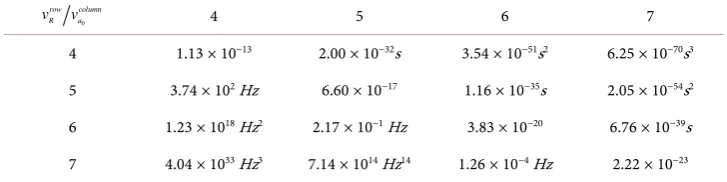
[image:5.595.191.555.541.632.2]so the ratio is not dimensionless. The A values are related to identity relationship with-in these equations, but these A values represent fundamental constants. These powers represent natural quantum number powers. They can be derived by searching arbitra-rily through ratio power matrix of consecutive integer series for each constant’s power. The ratio where the scalar is closest to 1 represents the A ratio and the natural powers.
Table 1 is an example of the type of arbitrary search for natural powers linking vR and
0 a
v All of the constants demonstrate this pattern with scalars near 1.
( )( ) 0 0 0 1 1 4π 1 a R n n a n n a R n n
R R R
s s s Aνν s
ν
ν ν
α
ν ν ν + +
= = = ≈
(11)
For these two hydrogen constants, the 0( )( )1
a
R n n
Aνν + value closest to 1s occurs when the n power is 5. The ratio of 4π/α to the fifth power, equals vR times 0
5
a
ν divided by 6
R
ν
,or the product of vR and ( )
( )
05 6
a
R
Aνν s, Equation (12). Here, 4π/α to the fifth power equal 1.514337482(75) × 1016.
( )( )
( )
0 0 5 5 5 6 6 4π4.60307060 23 s
a
R
a
R R R
R
Hz ν s HzAνν s Hz
ν ν ν
α ν
= = =
× (12)
Table 1. Power law ratio matrix.
0
row column
R a
v v 4 5 6 7
4 1.13 × 10⁻¹³ 2.00 × 10⁻³²s 3.54 × 10−51s2 6.25 × 10−70s3
5 3.74 × 10²Hz 6.60 × 10⁻¹⁷ 1.16 × 10⁻³⁵s 2.05 × 10−54s2
6 1.23 × 10¹⁸Hz2 2.17 × 10⁻¹Hz 3.83 × 10⁻²⁰ 6.76 × 10−39s
7 4.04 × 1033Hz3 7.14 × 10¹⁴Hz14 1.26 × 10⁻⁴Hz 2.22 × 10⁻²³
Table 1 is a power ratio matrix of vR raised to the row power divided by va0 raised to the column power where the powers are consecutive integer series. The ratio with a scalar value closest to 1 is searched for within an arbitrary matrix. Those powers represent the natural quantum number powers linking those two constants. This occurs with
R
v raised to the 6th power divided by va0 raised to the 5th power. The ratio is 2.17 × 10⁻¹ Hz. Note that all of the other
values are widely divergent from 1. Here 2.17 × 10⁻¹ Hz is the reciprocal of
( )( ) 05
6
a R s
Aνν , and the reciprocal of 4.06 s as
The ratio relationships in Equations (2)-(4) are solved for any hydrogen quantum value, and are raised to the ninth power which is closest to a scalar value of 1, for this example va0, and the power of 5. This exposes the powers of Hz and seconds, Equation
(13). The derived value for 4π/α raised to the fifth power is substituted from Equation (12) into Equation (13). The fifth power of va0 is derived from the product of vR
raised to the sixth power and 0( )( )
5 6
a
R
Aνν s.
( )( )
0 0
0
5 5
5
5 5 6 6 6 6
6 5
4π a
R
a
a R R R
R
Hz ν s Hz Aνν s
ν ν ν ν
α ν
= = =
(13)
In Equation (14) va0 is derived from fractional powers of vR. Here, ( )
( )
0 1 5
6 5
a
R
Aνν s equals 1.35709274(07) s(1/5).
( )
( ) ( )
0 0
0
1 5 1 5
6 5 6 5 6 5 6 5
6 5 6 5
4π a
R a
a R R R
R
Hz ν s Hz
A
νν sν ν ν ν
α ν
= = =
(14)
Equation (15) is another power law variation of this relationship deriving va0
from vR. ( )
( ) 0 6 5 R a
Aνν Hz equals 0.21724628739519 Hz. The sixth power of 4π/α equals 2.60775752(14) × 1019.
( )
( )
( )
( )
( )( )0 0
0
6 6 6
6 5
6 5 6
4π R 4π R
a a
a
v ν Hz A Hz
α ν α
= =
(15)
Equation (16) is another example that derives
ν
e− from vR. Here, ( )( )2 7 9 7
e R
Aνν− s equals 1.38426983(05) s(2/7).
( ) ( )
( ) ( ) ( ) ( ) ( ) ( )
9 7 9 7 2 7 9 7 9 7 2 7
9 7 9 7 e R e R R e R
Hz ν s Hz Aνν s
ν ν ν
ν
− −
−
= =
(16)
3. Results
Equation (1) is related to Planck’s constant in the dimensionless domain, and equals 1, Equations (17a), (17b). This is logical since h1 is intentionally scaled as 1 in this system since energy and frequency are scaled identically in a pure frequency domain. This ratio is equivalent to an angular momentum since the ratio represents the product of a mass, a frequency, a distance squared, (kg∙m2/s) in the SI dimensional domain. Since this ratio
is in the frequency domain, a distance is related to the reciprocal of the frequency equivalent. This relationship is related to the annihilation energy of a mass. Equation (17b) demonstrates that the reduced Planck’s constant, ħ, equals 1/2 in the dimension-less domain, ħ1.
0 0 0
0
2 2 2 2
(2) 2
1
1 8π 8π 8π 8π 1
2π 4π
R
e R e
a a a
R e
a
h Aνν ν Aνν Aνν
ν ν α
α ν
− − −
= = = = =
(17a)
( )
( )
( )
0 21
1 4π
2
R e
a
v s s
v ν − = =
Equations (18a) and (18b) demonstrate that this same relationship is valid in the standard SI unit equations of h and ħ.
2 2
0
8π e R
h= m v a− (18a)
2 0
4πm v ae− R
=
(18b)
Equation (4c) is equivalent to the prototype kinetic energy equation where the prod-uct of a mass times the velocity divided by c, β squared divided by 2.
Equation (2) demonstrates that the α derivation from va0 and
ν
e− is within acir-cle equation related to a radius, circumference, and 2π. This must be related to a sinu-soidal harmonic system, and a fundamental momentum relationship.
The dimensionless constants that define ε01, μ01, and ke1 are all very simple values
related to α and geometric factors, Equations (8)-(10). ke1 logically is related to α/(4π)
since the energy is proportional to the distance frequency equivalent. This is a universal relationship for any distance as a frequency equivalent. Here, va0 times α/(4π) equals
R
v , Equation (3).
Equations (12)-(16) demonstrate that if any two of the quantum values, including an A factor, are known then all of the constants can be derived.
The A factors do not represent errors, but are fundamental essential constants in-corporating the geometric factors that are imbedded within the quantum domain scalar values. These geometric factors represent conversion factors that bridge between Euclid geometry; and the power laws of vR, va0,
ν
e− and α. The geometric factors areessen-tial in projecting the power laws into the harmonic linear domain, and three dimen-sional spaces from a system solely defined by sinusoidal waves. Here, 2 is related to ki-netic energy, Equation (4). In Equations (17a) and (17b), the factor 2 is similar to the 2 in the Schwarzschild equation since it refers to the transition of matter to an annihila-tion boson state. This is not a kinetic state. Here, 2π is related to a radius and its asso-ciated circumference as seen in Equations (17a) and (17b). Here, 4π is related to 4π times the radius squared that defines the surface of the sphere seen in force fields such as electrical charges, or magnetic fields, as in ke1, Equations (3), (5), (7)-(9), (11)-(15).
4. Discussion
physical systems is well established, and states that physical systems can be analyzed in a dimensionless domain. These reasons are the rationale for the methods utilized to search for the most fundamental quantum relationships.
This paper demonstrates that many of the fundamental constants in this hydrogen system demonstrate very simple, and integrate definitions as ratios of three hydrogen quanta and geometric factors. It is logical that all of these ratios should be related to fundamental constants and relationships. These are truly the only three constants in this global power law system. This is not the typical concept of these individual con-stants. Though they are inter-related they are not thought of as being only ratio or product projections of just three quanta. Equations (1), (17a), (17b) demonstrate that Planck’s constant is related to the dimensionless ratio of the frequencies defining an angular momentum scaled to the number 1. This is anticipated in a natural unit system. Planck’s reduced, ħ1, constant is scaled to 1/2. This is logical since Planck’s constant times one Hz represents at minimum unit of energy per cycle. This equates the annihi-lation energy of a mass to an equivalent frequency. The h1 is directly related to a spin of 1 since it refers to 1 Hz times a dimensionless value associated with the energy of a wave with a frequency of 1 Hz. Photons have a spin of 1. The reduced Planck’s constant ħ1 is 1/2, and associated with a spin of 1/2 of a fermion, in this case the electron. The 8π2 geometric factor is the composite of 2π squared, 4π2; and 2. The 2π squared scales
the circumference distance an electron orbiting the proton. The 2 is related to the fact this angular momentum refers to the process of mass annihilation to photons, not to a kinetic energy. 8π2 is also found as the geometric factor of the Schrodinger equation.
Multiple different ratios of vR, va0,
ν
e−, and geometric factors are related to α,Equations (1)-(4). One of them is equivalent to the kinetic energy of a mass as a proto-type form for all kinetic energies. One of the ratios is related to 2π a relationship of va0
and
ν
e−, Equation (2). This demonstrates a harmonic sinusoidal nature to this system.This must also define a fundamental relationship between distance and mass, (Equation (2)) similar to that seen with distance and energy in Equation (3). This must be related to a linear momentum. The Coulomb constant’s dimensionless value, ke1 is related to
the ratio of vR divided by va0, or α/4π. Here 4π is the classic geometric factor related
to a spherical surface and a force field. Dimensionless permittivity and permeability equal 1/α, and α. This is a remarkably unified and simplified system of units demon-strating their most fundamental scaling inter-relationships.
con-stants drop out from the scaling of the calculations as 1’s. The other two are in-ter-related by a geometric factor. Two of the constants are both related to the same natural unit value, α. There is really only one essential quantum constant that in-ter-relates all five of the SI values.
These power law relationships are not felt to coincidental or mathematically con-trived, but rather fundamental. The ratio of the va0 to the 15 power divided by
ν
e−to the 14 power equals 1.028140195(51) Hz. This is a ratio of 1.987438 × 10281 Hz15
di-vided by 1.933042 × 10281 Hz14. It is highly unlikely that ratios of the integer powers of
these quantum values, that represent gigantic scalar values far beyond what is typical, are all nearly equal to 1 by chance. Every hydrogen quantum constant demonstrates a similar pattern. It is also essential that they not be equal to 1 so that is not a logic or mathematical error. They cannot be equal to 1 since the geometric factors are imbed-ded in their scalar values. There are many similar fundamental ratio power laws, and most are not known. A recent paper describes the quantum mechanical derivation of the Wallis formula for π [8]. Therefore, these types of relationships between the quan-tum constants and geometric factors of 2 and π do not represent inappropriate specula-tion, but are logically imbedded within the constants’ natural unit scaling.
5. Conclusion
This paper describes the fundamental scaling relationships between the unified physical system of the electron, Bohr radius, and Rydberg constant of hydrogen within a natural unit dimensionless or dimensional system. It is found that classic geometric factors are embedded within the scaling of these quanta. This system bridges from the quantum wave domain to three dimensional space domains. When the relationships of these three constants are analyzed, their simple ratios and products project out to a wide ar-ray of other fundamental constants and relationships. There are also a myriad of power laws, and A values, some known and some new, inter-relating these constants so that they can all be derived from the knowledge of just two. These finding demonstrate that the fundamental constants of hydrogen represent a highly integrated logical harmonic power law system that extends beyond hydrogen. This represents a new perspective on the Standard Model within a parallel power law system.
Acknowledgements
I would like to thank Richard White M. D., Vola Andrianarijaon PhD, Keshab Sapkota PhD, and Richard Vento MS for their help.
References
[1] Zhao P., Lichten, W. and Zhou, Z. (1989) Physical Review A, 29, 2888.
http://dx.doi.org/10.1103/PhysRevA.39.2888
[2] Saichev, A., Malevergne, Y. and Sornette, D. (2009) Lecture Notes in Economics and
Ma-thematical Systems, 632.
University Press, Cambridge. http://dx.doi.org/10.1017/CBO9781139165372
[4] Mills, J. (1932) The Journal of Physical Chemistry, 36, 1089-1107.
http://dx.doi.org/10.1021/j150334a001
[5] Karshenboima, S. (2008) The European Physical Journal Special Topics, 163, 141. [6] Flowers, J. and Petley, B. (2001) Reports on Progress in Physics, 64, 1191.
http://dx.doi.org/10.1088/0034-4885/64/10/201
[7] Chakeres, D. (2011) Particle Physics Insights, 4, 33. http://dx.doi.org/10.4137/PPI.S8269
[8] Friedmann, T. and Hagen, C. (2015) Journal of Mathematical Physics, 56, 112101.
http://dx.doi.org/10.1063/1.4930800
Submit or recommend next manuscript to SCIRP and we will provide best service for you:
Accepting pre-submission inquiries through Email, Facebook, LinkedIn, Twitter, etc. A wide selection of journals (inclusive of 9 subjects, more than 200 journals)
Providing 24-hour high-quality service User-friendly online submission system Fair and swift peer-review system
Efficient typesetting and proofreading procedure
Display of the result of downloads and visits, as well as the number of cited articles Maximum dissemination of your research work