Graphs and Degree Equitability
Ahmad N. Al-Kenani1, Nandappa D. Soner2, Anwar Alwardi2
1
Department of Mathematics, King Abdulaziz University, Jeddah, Saudi Arabia 2
Department of Studies in Mathematics, University of Mysore, Mysore, India Email: [email protected],[email protected],[email protected]m
Received March 5, 2013; revised April 5, 2013; accepted April 14, 2013
Copyright © 2013 Ahmad N. Al-kenani et al. This is an open access article distributed under the Creative Commons Attribution License, which permits unrestricted use, distribution, and reproduction in any medium, provided the original work is properly cited.
ABSTRACT
Let G
V E,
be a graph. If is a function from the vertex set V G
to the set of positive integers. Then twovertices u v, V
G are -equitable if
u v 1. By the degree, equitable adjacency between vertices can be redefine almost all of the variants of the graphs. In this paper we study the degree equitability of the graph by defin-ing equitable connectivity, equitable regularity, equitable connected graph and equitable complete graph. Some new families of graphs and some interesting results are obtained.Keywords: Equitable Domination Number; Equitable Path; Equitable Walk; Equitable Connected Graph; Equitable Regular Graph; Equitable Complement Graph; Equitable Cut Vertex; Equitable Line Graph
1. Introduction
All the graphs considered here are finite and undirected
with no loops and multiple edges. As usual pV and
q E denote the number of vertices and edges of a
graph G, respectively. In general, we use X to de-
note the subgraph induced by the set of vertices X and
and
N v
N v
G
denote the open and closed neigh-
bourhoods of a vertex , respectively. The degree of the
vertex in is denoted by or
v
v degG
v deg
v .For graph theoretic terminology, we refer to Harary [1]. The degree equitable domination has been studied in [2].
A subset of V G is called an equitable dominat-
ing set of a graph if for every , there ex-
ists a vertex such that uv and
D
G D
v V
E G
D u
deg u deg v 1. The minimum cardinality of such
a dominating set is denoted by e and is called the eq-
uitable domination number of . The set is mini-
mal if for any vertex , is not an equita-
ble dominating set of . The equitable neighbourhood
of denoted by is defined as
G D
D uD
G
u
uu Ne
, deg
deg
1
e
N u vV vN u u v and
e e
u I N u
dege uu G
G
. The cardinality of is de-
noted by and it is called equitable degree of
the vertex in . The maximum and minimum equi-
table degree of are denoted respectively by
e
N u
e G
and e
G . That ise
G maxu V G Ne
u ,
min
e G u V G Ne
u . An edge is called an
equitable edge if
euv
deg u deg v 1. A subset S of
V
u
is called an equitable independent set, if contains
no vertices such that . If a vertex
S ,
u v vNe
u V satisfies deg
u deg
v 2 for all vN u
, then is in the equitable dominating set. Such vertices are called equitable isolated vertices.u
Let be a simple graph with n vertices
. Then its adjacency matrix
G ,vn
1, 2,
v v A aij is a
n n matrix whose entries aij are given by
1, if and are adjacent;
0, otherwise.
i j
ij
v v
a
In the same way, the degree equitable adjacency ma-
trix denoted by Ae bij is a matrix whose
entries are given by
n n
ij
b
1, if and are equitable adjacent ;
0, otherwise.
i j
ij
v v
b
where The equitable adjacency between any two verti-
ces in V is defined as follows: the vertex v is
equitable adjacent to if and only if is adjacent to ,
u v
u u
v and also dege
v dege
u 1.nodes with nearly equal capacity may interact with each other in a better way. In society, persons with nearly equal status, tend to be friendly. In industry, employees with nearly equal powers form associations and move closely. Equitability among citizens in terms of wealth, health, status, etc is the goal of a democratic nation. These ideas motivated us in this paper to study the de- gree equitability of a graph by defining and studying some basic properties of degree equitable connectivity, degree equitable regularity, and degree equitable com- pleteness of a graph. Some new families of graphs and some interesting results are obtained. In this paper for brevity we use equitable instead of degree equitable.
2. Elementary Results
Let be a graph. An equitable walk is de-
[image:2.595.56.248.611.735.2]fined as a finite alternating sequence of vertices and equi- table edges, beginning and ending with vertices, such that each equitable edge is incident with the vertices preceding and following it. No equitable edge appears (is covered or traversed) more than once in the equitable walk. A vertex, however, may appear more than once. An equitable walk
which begin and end at the same vertex called closed eq-
uitable walk. An equitable walk is not closed if the ter-
minal vertices are distinct. An open equitable walk in
which no vertex appears more than once is called an eq-
uitable path. The number of edges in an equitable path is called the length of the equitable path. A closed equitable walk in which no vertex (except the initial and the final
vertex) appears more than once is called an equitable
circuit.
, G V E
Now, we prove some results representing the relations between the sum of the equitable degree of the vertices, the number of edges and the number of equitable edges.
Theorem 2.1. For any graph G
V E, with pvertices v v1, 2,,vp and q edges,
.1
dege i 2
i
v q
pFurther, the equality hold if and only if every edge in is equitable edge.
G
Proof. We have , for any vertex in
a graph . Then it is clear that
e
N v N v v
G Ne
v N v
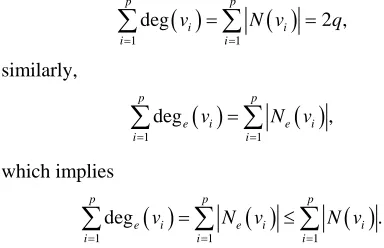
andwe have:
1 1
deg 2 ,
p p
i i
i i
v N v
qsimilarly,
1 1
deg ,
p p
e i e i
i i
v N v
which implies
1 1 1
deg .
p p p
e i e i i
i i i
v N v N v
Hence . Further, if every edge in
is equitable edge, then for any vertex
in G that means . The converse
is obvious, if , then every edge in
is equitable edge.
1deg 2
p
e i
i v
e
1deg
p i
1deg
p
e i
i v
q
q
G
v
N v N v
2e vi
2q G
For any graph , the number of equitable edge de-
noted by e is called the equitable size. The vertex
G m
vV G is called equitable odd vertex (equitable
even vertex) if dege
v is odd number (even number).Theorem 2.2. The sum of the equitable degrees of a graph is twice the number of equitable edges in it, that is
1deg 2
p
e i e
i v m
.Proof. Let be a graph. Then any equitable edge contributes to the equitable degrees of two distinct verti- ces. Thus when the equitable degrees of the vertices are added, each equitable edge is counted exactly two times. Thus the sum of the equitable degrees is twice the equita-
G
ble size of the graph, that is p1dege
i 2 e.i v m
Theorem 2.3. Every graph has an even number of eq- uitable odd vertices.
Proof. Suppose that the sum of the equitable degrees of the equitable odd vertices is x and the sum of the equi-
table degrees of the equitable even vertices is . The
number is even, and the number
y
y x y 2me is even.
Hence x is even. If there are equitable odd vertices, the even number
t
x is the sum of t odd numbers. So t
even. is
We can define the equitable complete graph as a
connected graph which all its edges are equitable edges. and analogous to the equitable complete graph we can
defined the equitable complement graph of a graph
as following:
G
G
Definition 2.4. For any graph , the equitable com- plement graph of denoted by
G
G Ge is the graph with
the same vertices as and any two vertices are
adjacent if and v are not equitable adjacent in .
G u v,
G
u
The relation between the complement of the graph and the equitable complement graph of a graph can be found in the following theorem.
Theorem 2.5. For any graph G, GGe.
Proof. Let f uv be any edge in G. Then and
are not-adjacent vertices in , which implies and
are not equitable adjacent in . Hence
u u uv v
v
G
G e is an
edge in the graph Ge. Therefore GGe.
Theorem 2.6. For any graph G with p vertices,
e
G G if and only if is isomorphic to an equitable
complete Graph.
G
Proof. Let G be an equitable complete Graph and let
f uv be any edge in the graph Ge. Then is non-
adjacent to in G. Hence is an edge in
u
v euv G,
Hence Ge G. Conversely, suppose that Ge G and is not an equitable complete graph. Then there exists
at least one edge in which is not equitable
edge. That means and v are not equitable adjacent,
which implies that is an edge in
G
euv u
eu
G
v Ge. But clearly
and are not adjacent in
u v G, a contradiction.
A graph is called an equitable edge-free graph if
for any two adjacent vertices and in G,
G
u v
deg u deg v 2 .
Proposition 2.7. For any graph G with p vertices,
e p
G K if and only if G is an equitable edge-free.
Proof. Let be an equitable edge-free graph with vertices. Then any two vertices in
G
p Ge are adjacent.
Hence e
p
G K .
Conversely, suppose GeKp. Hence any two verti-
ces in Ge are adjacent, then has no any equitable
edge. Therefore is equitable edge-free.
G G
Theorem 2.8. For any graph G with p vertices,
e p
G K if and only if is isomorphic to the com-
plete Graph
G
p
K .
Proof. Let GKp. Then any two vertices
,u vV G are equitable adjacent. Hence Ge
does not contain any edge. Therefore GeKp.
Conversely, suppose that e
p
G K , and if possible
is not complete Graph. This implies that there exist at
least two nonadjacent vertices u and in G which
are adjacent in
G
v
e
G . Thus u and v are adjacent in
p
K , a contradiction. Hence G is complete graph Kp.
Corollary 2.9. For any equitable edge-free graph G
with
p
vertices,e e
G G .
Theorem 2.10. Let be a graph with p ver- tices and contains at least one non equitable edge with the
property that any two vertices in , we have
,E
G V
,
u v G
V
e e
N u N v G . Then ee
p
G K .
Proof. Let be any two vertices in . Then we have two cases:
,
u v G
Case 1: If and v are adjacent vertices in , then we have two subcases:
u G
a) If is equitable edge, then u and are not
adjacent in
uv v
e
G . Thus u and are adjacent in v
e e
G .
b) If uv is not equitable edge that means
e Ne v
N u and since N ue
N ve
V G
.Then and v are adjacent but not equitable adjacent
in u
e
G . Therefore, u and are adjacent in v
e e
G .
Case 2: If and v are nonadjacent vertices in ,
then and v are adjacent vertices in
u G
u Ge. Since
V
e e
N u N v G , we get and are not equi-
table adjacent in
u v
e
G . Hence u is adjacent to in v
e e
G . Therefore any two vertices in
e e
G are adjacent.
Hence ee
p
G K .
3. Equitable Connectivity and Equitable
Regularity
A graph is said to be equitable connected if there is at least one equitable path between every pair of vertices
in . Otherwise, G is equitable disconnected. It is
easy to see that an equitable disconnected graph consists of two or more equitable connected graphs. Each of these
equitable connected subgraphs is called equitable com-
ponent. Clearly any equitable connected graph is con- nected but the converse is not true equitable in general.
For example, the graph 1,m
G
G
K , where is connected
but not equitable connected.
3 m
Theorem 3.1. The isomorphism between the graphs preserve the number of equitable component.
Proof. Let G
V E,
and H
W F,
be isomor-phic graphs. Let f V: W be an isomorphism. If
v v1, 2,,vr
is an equitable path in G from uv1 tor
wv , then f v
1 ,f v2 , ,f v
r is an equitable path in
H from f u
to f w
G. Thus, u and
are in the same equitable component of if and only if
w
f u to f w
are in the same component of H.Theorem 3.2. A graph is equitable disconnected if
and only if its vertex set can be partitioned into two
nonempty, disjoint subsets V1 and V2 such that there
exists no equitable edge in whose one end vertex is in
subset and the other in subset .
G V
G
1 2
Proof. Suppose that we have the partition of
V V
V Ginto disjoint subsets 1 and V2 such that there exists no
equitable edge in whose one end vertex is in subset
1 and the other in subset . Consider two arbitrary
vertices and of
V G
b
V V2
a V G
, such that aV1 and2
V
b . Then there is no equitable path between the ver-
tices and . Hence, if a partition exists, is not
equitable connected.
a b G
Conversely, let be a disconnected graph. Consider
to be a vertex in . Let 1 be the set of all vertices
that are joined by equitable paths to . Since is eq-
uitable disconnected, 1 does not include all vertices of
. The remaining vertices will form a (nonempty) set
2. No vertex in 1 is joined to any in by an equi-
table edge. Hence the partition. G
G
V a
G V
V
a G
V
2
V
Theorem 3.3. If a graph (equitable connected or equi- table disconnected) has exactly two vertices of odd equi- table degree, then there exists an equitable path joining these two vertices.
Proof. Let be a graph with all even vertices except
vertices 1 and 2, which are odd. From Theorem 2.3,
no graph can have an odd number of equitable odd verti-
ces. Therefore, in graph , 1 and v2 must belong to
the same equitable component, and hence must have eq- uitable path between them.
G
v v
Definition 3.4. Let be a graph on vertices. An equitable disconnecting set of edges is a subset
such that G is equitable disconnected.
The edge equitable connectivity, e , is the smallest
number of edges in any equitable disconnecting set.
G n2
DE G D
G
We adopt the convention that . Thus
if and only if G 1
1 0e K
0e G
K or is equitable
disconnected. If e then is a connected
graph having an equitable edge
G G
G 1
f such that G f is
equitable disconnected. An equitable edge whose removal increases the number of equitable components is called
equitable cut-edge (equitable bridge) of G.
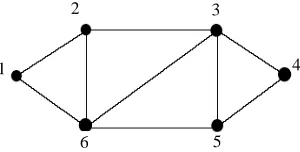
Example. In the graph in Figure 1, the edge (12) is equitable cut edge but not cut edge. So we have
but .
G
1e G
G 2G
Proposition 3.5. If is a graph, then
. That is, the edge equitable connectivity
of can be no larger than the minimum equitable de-
gree of .
e G e
G G
G
Proof. let G be an equitable connected graph on
vertices and suppose is a vertex of
equitable degree
2
n uV G
G 0 dege u e
u
. Since
v v: e
D u N is an equitable disconnecting set of
edges, e G D e
G .The following result is straightforward.
Proposition 3.6. Suppose G is an equitable connected
graph. Let be equitable edge. Then is an eq-
uitable cut-edge of if and only if
euv e
G P u v,
is theonly equitable path in G from to u v.
Definition 3.7. Let G be an equitable connected graph. An equitable vertex cut (or an equitable separate- ing set) of G is a set SV G
such that GS isequitable disconnected. The connectivity, e , is the
smallest number of vertices in any equitable vertex cut of . A vertex whose removal increases the number of eq-
uitable components of is called equitable cut-vertex
(or point of equitable articulation). For the graph in Fig- ure 1, but
G kG
G
k G
1e
k G
2.The maximal equitable connected subgraph of that
has no equitable cut-vertex is called an equitable block
of .
G
G
Theorem 3.8. For any graph G, k Ge
e
G .Proof. If , then is equitable discon-
nected and . If , then this
0e G
e e
k G
G
G 0 e
G 11
2 3
4
[image:4.595.333.514.621.720.2]5 6
Figure 1. Equitable cut edge but not cut edge.
graph is equitable connected with equitable bridge x,
that means GK2 or one of the vertices which incident
with x is equitable cut vertex. Therefore, k Ge
1. If
2e G
, then removal edges results in equi-
table disconnected graph, that means the removal
e G
1e G
of this edges results in a graph with an
equitable bridge
G
xuv. For each of these e
G 1edges select an incident vertex different from or v.
The removal of these
u
G 1e vertices remove all the
1e G
edges. If the resulting graph is disconnected,
then k Ge
e
G . If not, x is equitable bridge ofthis subgraph and hence the removal of or v results
in an equitable disconnected. Hence, u
e e G
k
k G .
Definition 3.9. A graph G is called -equitable regular graph if e
G e
G kk .
Observation 3.10. Every -regular graph is -eq- uitable regular graph but the converse is not true, in gen- eral.
k
Example. The graph in the Figure 2 is 2-equitable regular graph but not regular.
4. An Equitable Line Graph and an
Equitable Total Graph
Definition 4.1. Given a graph G, its equitable line graph
e
L G is a graph such that
1) Each vertex of L Ge
represents an equitable edgeof G; and
2) Two vertices of L Ge
G
are adjacent if and only if their corresponding equitable edges share a common endpoint (are adjacent) in .
Proposition 4.2. The line graph of equitable connected graph is connected.
Proof. If is equitable connected, it contains equi- table path connecting any two of its edges, which trans- lates into a path in
G
e
L G containing any two of the
vertices of Le
G . Hence L Ge
is connected.Observation 4.3. Let G be any graph. Then
e
L G L G .
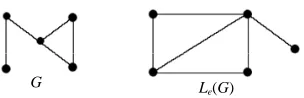
Remark. The equitable line graph of equitable con- nected graph is connected but not equitable connected in general. In Figure 3, the equitable line graph of equitable connected graph is connected but not equitable con- nected.
[image:4.595.96.246.642.718.2]Proof. If G is cycle, then clearly GL Ge
G
. Con-
versely, if is isomorphic to e , that means
is an equitable complete graph, and by Proposition 4.7.
G L
G
Ge . Hence G L . Therefore G is
cycle.
L G L
GLe(G)
G
Definition 4.9. The equitable total graph TeT Ge
[image:5.595.97.249.85.134.2]of a graph G is a graph such that
Figure 3. Equitable line graph of equitable connected graph.
Definition 4.4. Let be a graph. The equi-
table graph e of is defined as the graph with ver-
tex set V G and two vertices , are adjacent if
and only if and are equitable adjacent in .
,G V E
2
G
u
G
v
u v
G
1) The vertex set of e corresponds to the vertices and
equitable edges of and
T G
2) Two vertices are adjacent in e if and only if their
corresponding elements are either adjacent or incident in .
T
G
The following result is immediate.
Proposition 4.5. For any graph with at least one equitable edge, the following hold.
G Observation 4.10. For any graph the equitable to- tal graph is a subgraph of the total graph of a graph .
G
G
1) L Ge
L G
e .
L G L G equitable edge in a graph Proposition 4.11. If v is a vertex and , then the degree of the ver- xuw be
tex is
G
v d v
de
v and the degree of x is
d
we
d u
2) e if and only if is an equitable
complete graph.
G
3) If 1 2, then but the con-
verse is not true.
G G L Ge
1 L Ge
Theorem 4.6. If G
V E, is a graph and V p, E q whose vertices have equitable degree
de i, then
e
L G has qe vertices and
2
1 2
e
L e e i
q q
d
,where e is the number of equitable edges in .
Proof. Clearly from the definition of equitable line
graph has vertices the equitable
q G
e
L G qe
de iedges incident with a point vi contribute
2e i
d
to
, so
e
q
21 1
2 2
1 2
e
e i
L e i i
e e i
d
q d
q d
e
d
Proposition 4.7. If G
V E,
Gis a graph, then
if and only if is an equitable com-
plete graph.
e
L G L G
Proof. If is an equitable complete graph then
clearly .
G
e
L G L G
Conversely, let L Ge
L G
. Then L Ge
andhave the same number of vertices that means
. Hence is an equitable complete graph.
L Ge
q q G
Theorem 4.8.A connected graph is isomorphic to its equitable line graph if and only if it is a cycle.
e
in e
GProposition 4.12. If is a graph with
vertices and edges and its vertices have equitable de-
gree
T .
,G V E
pq
de i, then T Ge
has pqe vertices and
21 2
e
T e e i
q q q
d where is the number ofequitable edges in .
e
q
G
Proof. The number of vertices of the graph T Ge
isthe sum of number of equitable edge and number of ver- tices in G, that is T Ge
has e vertices. By thedefinition of total graph of , the number of edges in
pq G
e
T G is the sum of edges in G and the number of
edges in the equitable line graph of G and twice the
number equitable edges in G, that is;
21 2
2
e
T e e e i
q q q q
d . Hence,
21 2
e
T e e i
q q q
d .REFERENCES
[1] F. Harary, “Graph Theory,” Addison-Wesley, Reading, 1969.