Financial crisis response plan
Aldean, Cory
University of Texas at San Antonio
May 2010
Online at
https://mpra.ub.uni-muenchen.de/28166/
FINANCIAL CRISIS
RESPONSE PLAN
By
ABSTRACT
Despite the recent highs and lows in international finance, the need for better
understanding on the part of policy-makers, business leaders and the general public is evident to address future crisis. The study of other countries‟ financial difficulties in recent history seems
to be a key element missing in our nation‟s response. The economy is too important to leave up to an ill prepared ad hoc emergency meeting. Rather than throwing together a government response, just-in-time at best, it would be advantageous to have a plan ready to pull off the shelf. For such a plan, this paper suggests guiding principles, a plan outline, and options available to the policy-maker in the form of a Financial Crisis Response Plan (FCRP). It should mirror a typical government disaster response plan to some extent, but tailored to assist the Federal
government‟s response to a myriad of financial crises.
The guiding principles for any financial response could be used for a just-in-time response, or for planning and writing plans in between crisis. The plan should be one that is A-political in nature, clearly identifies the problems, considers legal options available, and roles of responders. Such a plan should have strong measurable goals, and strive for universal
application, cost savings to the tax-payer, consider all parties welfare including overseas counterparts, and a return to profitable business operations. Any plan developed must be comprehensive to all participating parties, with scheduled training and exercises.
FINANCIAL CRISIS RESPONSE PLAN
GUIDING PRINCIPLES OF FINANCIAL CRISIS RESPONSE PLAN
Intro
The need for a pre-approved response plan is apparent from the lack of coordinated and effective government response. “In many countries the framework for financial regulation, supervision, the treatment of problems and the handling of systemic events has been put together
in a series of steps….In particular, major changes have tended to be the result of unfortunate
experience” (Mayes 2009). To avoid that confusion and inefficiency, a plan should be created that prescribes guiding principles, actual components of the plan itself, a clear division of
responsibilities or authority, and several options available. The idea is to allow flexibility for the government to respond to a crisis, but have something immediately available for leaders, and even the general public to understand what the response may entail, thereby taking the fear and malaise out of the equation so that the market players can act in a rational way.
In preparing a plan, there are several principles that will affect the execution of a
response, though flexibility of response must be allowed. Hiroshi Nakaso (2001) formerly of the Japanese Central Bank, argues for a plan with a set of predetermined explicit general principles governing the provision of Lender of Last Resort (LoLR) assistance, but allow for flexibility in policy implementation. The following principles come from compiling recommendations of various experts and sources; organized in no particular order: Timeliness, Limiting of Moral Hazard, A-Political, Universality and Corporate Autonomy, Legal Ramification, Global Coordination, Notification/Media, National Security, Least Cost, Restructuring to maximize Profit, and Return of Credit Activities
Timeliness
just-in-time, as Sweden, paid capital injections only as needed with guaranteed funds (Dziobek & Pazarbasioglu 2008). Certainly time limits on support are another concern. Hoggarth, Reidhill & Sinclair (2004) in describing liquidity assistance, demonstrated that crises were typically shorter with non-open end liquidity support, to encourage banks to seek profits.
Limiting of Moral Hazard
Moral Hazard is always an issue, since any action the government makes will usually benefit one or more groups, who may come to rely on that support if no conditions are set on that support. Strict adherence to the plan and these guidelines will aid in limiting moral hazard. Hoggarth, Reidhill & Sinclair (2004) state that banks expecting bail-outs will contribute to more frequent crisis. Indeed, we‟ve seen many more banking crises in the last couple decades,
possibly from failure to contain moral hazard. Minimizing moral hazard after the fact may be more of a preventative measure for future crises, although the public seeing firm government action will lead to more confidence in the system.
A-political
It‟s understandable that there is skepticism from the public when politicians get involved, as discussed in the causes of crisis. Politicians make decisions based on elections by promoting short term gains for long term troubles; usually involving lobbyists, which do not represent the
entire population‟s interests. The government‟s response to a financial crisis is possibly the greatest issue facing any politician with exception of war; such that political egos need to be checked at the door. While this is an impossibility, the response needs to stand alone with minimal political attachments. Reference the example of the US‟ Emergency Economic Stabilization Act, which added energy and tax concessions. Such additions will delay the passage of laws causing more damage. The Government can still have the final say, as in the case of Norway, where an independent legal entity, Government Bank Insurance Fund, was required to put high visibility cases before the Ministry of Finance (Moe, Solheim & Vale 2004). The planning of the response belongs to the experts, while the execution should be the
government. The experts are many. Foreign leaders, who have already gone through a crisis, and have no domestic agenda, should be some of the top consultants besides past US financial leaders. Also, academics are a tremendous source of information. Too many of these experts sat on the sidelines during the US crisis of 2008.
Universality and Corporate Autonomy
Universality of application stands without reason, but there needs to be identified
confidence in their institutions. “Banks were generally reluctant to be singled out as a weak bank requiring capital injection. Thus all major banks collectively applied for capital
injection…” (Nakaso 2001) The reluctance to avoid standing out often times makes the difference between survival and insolvency in the eyes of their customers. In the Ivory Coast,
“…owners of insolvent commercial banks were given the choice of closing and liquidating, or injecting fresh capital with none considered too big to fail” (Dziobek & Pazarbasioglu 2008). Bank autonomy is ideal, because ultimately it is on management and owners to return a bank to profitability, and a choice to close the institution would indicate they lack the fortitude to do so.
Legal Ramifications
The fallout from any government response necessitates that the government operate in a legal framework. A plan should take into consideration the current legal system to accomplish the various options, and then works towards ensuring those laws are in place. Hoggarth, Reidhill & Sinclair (2004) mention that “…in some countries the supervisory agency may lack the power to write down capital, force a merger or close an institution; and if it does, may face prosecution by creditors and owners for damages.” Sweden had an issue with the legality of their forced write-downs prior to the crisis. Since the government was already a major shareholder in a few of the banks and felt partially responsible, they feared lawsuits from private shareholders on the grounds of misrepresentation.
Global Coordination
Globally, the problem is that the financial markets are international while supervision largely takes place at the national level. We need to match other countries‟ regulatory environment to a degree, or it will drastically affect capital flow. Also, banks will operate in foreign countries to skirt regulations in their country of origin. In the case of Lehman Bros., they moved assets from their balance sheet before the quarter closed only to have those assets bought
back a few days later. Lehman couldn‟t get a US firm to sign off on the practice, so it had a UK law firm to approve the move (Weidner 2010).
Finland suggested a “College of Supervisors” under one country‟s leadership with
everyone having access to a common database. Under this organization, the supervisors from the various countries would be jointly responsible for supervising an international bank, while the home country supervisor would need to know the risks and trends in the markets of the host countries where the bank is operating (Mayes 2009). Examples of international cooperatives will be discussed under Authority for execution of the plan.
Notification/Media
The sharing of macro-economic information amongst government agencies will be vital during a crisis. Keeping the public in the dark is near impossible with such massive bailouts.
Much as FDR did during the “New Deal”, political leaders need to be frank with their
to protect their assets. The plan should identify when such mass notifications should kick in, who the audience is, and how much information is included. This may result in the creation of a system of national Financial Threat Levels, such as we see in the DoD or Homeland Defense, with the primary purpose being public awareness.
National Security
While not an obvious concern during the crisis, national security, to include access to sensitive information, and the oversight of critical industries, like the financial sector, must not be compromised. This includes screening what information is shared across borders. Also, to maintain autonomy of its financial sector, a country should do what it can to keep businesses on its own soil. In Norway, the government‟s ownership of Den Norske Bank and Union Bank of Norway was kept at least 34%, due to the desire of their government to keep head office functions and financial competence within Norway (Moe, Solheim & Vale 2004).
Least Cost vs. Best Value
Of particular importance to the taxpayer is keeping the costs down. The FDIC is required by law to utilize the least cost method in dealing with bank failures (Nakaso 2001). The
contrarian view may be that the least cost method is not always in the country‟s long-run interest. The government must allow for flexibility in this regard, and may opt for best value as this is often used as a justification for government contracts.
Restructuring for Profit
In a free market, banks should be restructured for profit, or fail; the end result having financial institutions that can stand alone. Profitable business plans should be a condition of government assistance. The bank‟s plans should be reviewed by the government. To enforce adherence to the plan, the government can issue preferred stock with an option to convert to common stock depending on the bank‟s profitability and management of the improvement plan.
Return Credit
Ultimately, the goal is to return lending to those that need or can use it most. A
“…successful crisis resolution is a plan to jump-start credit flows in the financial system by
repairing the damaged creditworthiness of the real economy…borrowers may be in no position
to repay any new loan they may get. This was the case in the US during the Great Depression” (Ergungor 2007). A government must help the real economy, if it is indeed damaged either as a
cause or effect of the banking crisis. Here‟s where a government‟s fiscal and/or monetary
FINANCIAL CRISIS RESPONSE PLAN (FCRP)
The FCRP will mirror one of countless government or civilian disaster plans in
circulation with provisions for training, exercising the plan, evaluation for future revisions, and checklists wherever possible. Most disaster plans include elements such as: Identify Team Members, Responsibilities, Contact Lists, Outside Agencies‟ Plans, Third Party Contractors/ Agencies Available, Funding/Resources, Crisis Command Center Operations, Damage Assessment, Incident Commander, Activation Procedures, Communication/Reporting
Procedures, Periodic Updating/Logging Events, Training, Exercising, Evaluation, and Alternate Plans. To translate into financial crisis response, it is recommended that the FCRP contain the following:
Mission– determine what entities need to be supported/protected.
Lead Agency– which agency will take the lead
Command Center– where or how response agency leads will convene
Supporting Agencies/Responsibilities–based on agencies‟ mission and capabilities.
Activation of the FCRP– when to implement the plan, based on pre-determined indicators
Contacts/Notifications– identify who needs to know what, and information flow procedures
Damage assessment– assess damage and threats to financial sector and real economy
Resources – what funds and manpower resources can be drawn on to support the mission
Training– when to meet and what training topics to cover during non-crisis times
Exercise– have table-top discussions to simulate actions under an actual crisis
Evaluation – provide feedback on the exercises or FCRPs past performance
Alternative Plans– alternate solutions as needed
Options– identify the various options available and when to utilize
Attachments– action plans/checklists and supporting agency plans
Mission statement
The Plan should have a mission statement, which above all should stipulate the plan be temporary to return the economy to health. The targeted benefactors could include specific industries, unemployed, exports, currency rates, etc. Moe, Solheim & Vale (2004) describe the desired outcomes, citing Hoggarth (2002), that the “key principles in any restructuring are that only viable institutions are kept open; the costs of restructuring are transparent and those to taxpayers minimized; losses are allocated to existing shareholders, creditors and perhaps large depositors; the resolution preserves incentives for new private capital and discipline is
maintained on bank borrowers” While sifting through the various options and adhering to tested
Lead Agency, the “Command Center”, & Supporting Agencies’ Responsibilities
Much like on a battlefield, clear leadership in responding to a financial crisis will greatly influence the outcome. Although formation of a crisis is usually slow moving, it‟s not until everyone recognizes the fact that it becomes a top priority, and the players begin jockeying for position to take the lead. Many issues cloud the ability to determine a clear leader, as each agency has different regulatory and supervisory practices, besides the various types of
personalities that have oversight at the time of the crisis. Different responsibilities, operations and background make it difficult to choose. To avoid confusion, a Congressional oversight committee should appoint the Lead Agency but not become involved itself.
The Lead Agency could come from a number of government agencies, or perhaps some outside the usual candidates. The usual suspects come to mind, including the Fed Reserve, FDIC, SEC, Secretary of Treasury, or some Congressional committee. The pros and cons of some of these will be discussed below. Each has its merit, though the Lead Agency (or Agencies) should be the one whose responsibilities align most with the FCRP mission in the current crisis. For instance, if it involves interest rates, then the Fed should probably take the lead. If it involves banking sector issues, then perhaps the FDIC would be the logical choice. If it involves Wall St and/or investigations into accounting practices, it might be the SEC, and if it involves helping out the real economy through fiscal spending, then the leadership of the nation, the President and/or Congress, should be directly involved. Civilian leadership involvement is not out of the question. The Bank of Japan‟s Financial Crisis Management Committee (for
oversight of Japan‟s capital injections) consisted of 5 standing members, comprised of 3 from the private sector, the Finance Minister and Governor of Bank of Japan (Nakaso 2001).
Once an appropriate Lead Agency has been established, all other agencies become responders and will collaborate on issues under their purview. Each agency was “beefed” up during a past crisis based on its needs after evaluating their responsibility for their part in the overall plan. Nakaso (2001) describes the delegation of responsibilities to the different
authorities in Japan. In the area of banking supervision, the Financial Supervisory Agency was created as an independent authority. The Deposit Insurance Corp (DIC) was substantially reinforced in terms of financial and human resources. The new deposit insurance system which became effective in April 2001 relieves the central bank of the responsibility to provide risk capital to a troubled bank.
After establishing roles, the Lead Agency should identify a Command Center. This can be a location or simply done via phone or video-conference. It should be a location that is safe, i.e. a government office with maximum security. The Command Center should be staffed by members of its agency, previously identified and trained to assist, and any others deemed necessary. Invitations to join the command center should be extended to outside agencies as needed, and each government agency mentioned above should have a liaison to the Command Center.
When you think of resolving financial crisis, the Federal Reserve most often comes to mind as part of its mission is overall health of the economy. The problem lies in the conflict of interest between the requirement to be a LoLR and setting interest rate policy. “When the central bank is the lead agency, it often gets drawn into financing bank restructuring measures,
exceeding its resources, and taking actions that conflict with its basic responsibilities for
monetary management…The countries surveyed that made only slow progress all relied
excessively on the central bank, using it as lead agency for restructuring, as well as for both immediate liquidity support and medium-term financing…the central bank must stand ready to
provide liquidity support during restructuring to viable banks” (Dziobek & Pazarbasioglu 2008). Unless there is a separate entity in the Federal Reserve that can operate independent of the Federal Open Market Committee, it will be difficult for the Central Bank to operate as the Lead Agency. Goodhart (2007) also shows that the time scope for liquidity injection is in the short term and rate changes are long run. The long maturity of the funds injected will bring downward
pressure on the Fed‟s own policy rate. We‟ve seen this issue in the US, where the Federal Reserve has been called on to assist in the crisis; to lower rates. The main conflict of interest arises due to the fact that the Fed is essentially making loans, while it also has complete
autonomy to set interest rates, which could favor the borrowers, but damage the overall health of the economy.
The Fed has many missions, and its monetary policy is a key response option. In
addition, there are examples of the central bank using its resources to assist. The Swedish central bank, Riksbanken, used its foreign currency reserves as liquidity support through currency deposits in and loans to the banks (Moe, Solheim & Vale 2004). During the US crisis, the Federal Reserve had several funding facilities to inject liquidity, to include: 1) the Asset Backed Commercial Paper Money Market Mutual Fund Liquidity Facility with oversight by Bank of Boston for loans to banks to buy commercial paper from money market funds; 2) the
Commercial Paper Funding Facility with loans for high rated 3 month, unsecured asset-backed commercial paper; and 3) the Money Market Investor Funding Facility with loans to buy CDs, bank notes and commercial paper (Tankersley 2008).
FDIC & Deposit insurance
accounts, money market deposit accounts, certificates of deposit (CDs), cashier‟s checks, interest checks, accounts denominated in foreign currencies.
Global Authority
The difficulty of determining a global authority has been witnessed throughout history, and at best we get a situation where the different countries are even willing to share information. The Basel Accord of 1988 was a good attempt, but without an international governing body, it lacks teeth. Many informal agreements exist between nations. Mayes (2009) explains the territorial approach used in New Zealand and Australia, with Australia insisting that the banks operating in New Zealand be viable entities in their own right, and operate independently should the parent group in Australia become insolvent.
The European Company Statue 2004 is an apt example of a formal cross-border financial agreement. It is a legal instrument that gives international companies the option of forming a public limited-liability company, the “European Company”, being established as one company under community law. The European Company Statute is applicable throughout the European Economic Area (EEA), to include: the 25 EU Member States, Iceland, Liechtenstein and
Norway. This means that European Companies will be able to operate throughout the EEA with one set of rules rather than having to comply with the legislation of each of the countries where they operate. For example, the largest bank of the Nordic countries, Nordea, announced its intent to take advantage of the European Company Statute and operate as a single entity, with Swedish headquarters and branches in Denmark, Estonia, Finland and Norway (Mayes 2009).
Any discussion of international authority should include the IMF, as it has numerous unique responsibilities, though reform is needed. Griffith-Jones & Ocampo (2009) list some key areas for consideration of reform: 1) a global reserve currency; 2) placing the IMF as the lead for global reform; and 3) enable IMF to lend during balance of payments crisis rapidly and
sufficiently without overburdening borrowing nations with unreachable conditions. Countries are allowed to borrow up to 500% of their quota, making it the LoLR to the world. In an international crisis, capabilities of the IMF make it a logical option for Lead Agency.
Activation of the FCRP
The FCRP should clearly identify when a crisis has reached the level necessitating when the Command Center is to be activated with the Lead Agency identified. Kaminsky & Reinhart (2009) outline the steps to make this decision: 1) a definition of a crisis; 2) an agreed on list of leading indicators; 3) determine criteria for whether an indicator is a signal of a crisis or normal; and 4) determine if an event was a signal or a false alarm. In many cases there will be a grey
area, where the crisis doesn‟t fit the pre-determined parameters for activation of the FCRP; instead a gradual activation can be made as a precaution.
Once the Lead Agency is established, be it national or global, all other agencies will need to be contacted, to gather information and determine their level of involvement. Notifying all proper authorities should within a day, and timely press releases should be issued. Authorities receiving communiqués should be identified in the plan, and could include: foreign governments, US government agencies, or the general public. Releases should come from the Command Center, and distributed to other government agencies prior to going public. The Lead Agency may choose to brief all parties before making it public, and establish ground rules for flow of information procedures.
Damage Assessment (Financial)
Once the Command Center is operational and authorities notified, then damage
assessment will be one of the first responsibilities. The initial damage assessment is on-going during the opening phase of the FCRP, and indeed may have been accomplished during various preventative measures or normal operations. If it‟s a banking crisis, there should be agreed upon measures of performance to be reviewed. According to Moe, Solheim & Vale (2004), the most critical ones include the following, with desired outcomes in ( ) s:
Annual growth in lending (should generally be steady) Growth in balance sheet total (positive)
Capital adequacy ratio (8% or greater according to the FDIC for solvency) Ratio of profits to assets, including losses and before tax (positive)
Ratio of loan losses to assets (lower than 3%) Ratio of operating costs to income (trending lower)
Besides indicators of performance, the bank should be evaluated for an expected Default Probability to determine a firm‟s credit risk. Data is derived from the Merton-type model using a
firm‟s share price; a firm defaults when its debt exceeds the market value of its assets (Nakaso 2001). Another method is the Least Cost Solution, in which the liquidation value of the bank‟s assets is estimated against the total value of claims and related administrative expenses involved. This is compared to the cost of the subsidy required to assist in a takeover, either by the
government or a private institution (Hoggarth, Reidhill & Sinclair 2004).
Resources
Besides an assessment of the situation, in order to assist, the Command Center needs to determine what resources are available. Goodhart (2007) explains that the Federal Reserve
“…did not have sufficient instruments to be able to tackle the worsening risk profile…or it may
mainly by loss of tax revenue over previous years, and not entirely from bail-outs, despite media attention. These considerations must be factored into the FCRP for budget programming.
Besides funds, human resources are needed to staff a Command Center, and temporary hires may be required. Standing members of different organizations would supervise the activities of any temporary hires. Nakaso (2001) states that during a crisis the central banks typically provide human resources, information and market expertise, though there never seems to be a shortage of government employees. By comparison, concerning the deposit insurance institutions, the Finnish Deposit Insurer has one employee, and Sweden has two, while the FDIC has 5,200 employees (Mayes 2009). During a crisis, that may change temporarily. Japan went from 16 to 2,250 employees from 1996-99 (Nakaso 2001).
Training, Exercising the Plan, Evaluation, & Alternate Plans
In between crises, there are several administrative duties such as training, exercising, and review of the FCRP. Each of these agencies‟ employees and any new hires must have clear job descriptions and a training program. The training sessions should focus on the plan operations.
Many governments make the mistake of never testing their response plans. The Japanese had a semblance of a plan after creating a new deposit insurance program before their crisis;
“Moreover, the operability of the deposit insurance system was untested…the DIC had an
insurance fund of 300B Yen, far smaller than what would be required in the event of a failure of
a major bank” (Nakaso 2001). If we test or exercise the plans, then adjustments can be made. Exercises can be as simple as a table-top simulation, where a scenario is presented, and the various members are contacted to meet and determine a Lead Agency and activate the FCRP. These exercises could be intra-agency, inter-agency, nationally, and regionally/globally.
A plan can be reviewed annually or as often as the plan itself dictates. Evaluations, or feedback to the plan, can be made at any point in the process; during training, exercises, or even as the actual response develops. This is why logging of events becomes crucial for follow-up studies. In addition, there could be several versions of the plan, which constitute alternate plans. Adjustments are made to any part of the plan and may include proposals for new legislation,
updating an agency‟s responsibilities, or adding new agency members or foreign agencies to the
plan. Crotty (2008) tells us that “The scope and severity of the current crisis is a clear signal that the growth trajectory of financial markets in recent decades is unsustainable and must be
reversed.” Basing a plan on past growth trajectories or any other expectation, can lead to a poor
OPTIONS
In the course of studying various financial crises, in recent memory, especially those of the Nordic countries and Japan, US policy-makers should be aware of the many options to deal with the current and future crises. The responses vary in the range of involvement between the Lead Agency and supporting agencies. As the country moves from initial recognition of a crisis to a full-blown financial crisis accompanied with a recession or depression, the Lead Agency may use one or a combination of several options. Moe, Solheim & Vale (2004) suggest that each Crisis Resolution option could be one of the four types: Emergency Measures, Institutional Measures, Restructuring Measures, and Other. This classification may assist in writing the plan for referencing which options to use in an Emergency vs. Restructuring.
Once the initial response is determined, it may become necessary to adjust and apply other options down the road. The following represent the majority of the options that countries in the modern era, especially Nordic countries and Japan, either succeeded in using, attempted, or considered in response to their crisis with a brief description of each, to include: Prevention, Private Solutions, Liquidity Injection, Guarantees, Write-Downs, Subsidies, Restructuring, Legal Recourse, Capital Ratio, Regulation of Financial Products, Bad Banks, Liquidation,
Nationalization, Capacity Adjustment, Fiscal Stimulus, Interest Rates, and Other Reforms.
Prevention (Prediction)
The inability to recognize the indicators discussed, or recognizing too late, seems to be the norm across all recent crises. Usually after the crisis, the government decides to implement prevention tools. For instance, in Japan, Nakaso (2001) reports that the Financial System
Division, within the Bank of Japan‟s Financial and Payment System Department, has the distinct responsibility for maintaining financial system stability by identifying a build-up of risks in the financial system. Also, the FDIC announced on Sep 29, 2009 that it would assess banks three years in advance for premiums to avoid solvency. The options that follow could be utilized at any time, before, during, and after a crisis. Nakaso (2001) argues that the LoLR, among other tools, should be refocused as a crisis prevention tool rather than a crisis management tool. Quick recognition and action can keep the crisis in check, rather than wait until the banks are totally insolvent. Many of the other options herein can be considered preventative measures.
Private Solutions & Mergers
The private sector solution is typically the first line of defense, as Hoggarth, Reidhill & Sinclair (2004) state, “…the first response is to see whether the bank can be rehabilitated without
government assistance…The bank can be instructed to curtail lending…A request for additional
in 1991-92. The government may direct loan work-outs, but letting the banks handle it before it becomes a crisis is usually the optimal response. The problem is when government works out a loan it becomes a question of conflict of interest, since the government should answer to its constituent taxpayers.
There is precedence for this option, as we saw in the US crisis of 2008, where several big-name corporations merged prior to the melt-down. Nakaso (2001) gave detailed descriptions of conducting a successful merger, where the assuming bank transfers the bank over a weekend. The announced failure usually occurs on Friday with a re-opening on Monday to allow for uninterrupted service. The problem new partners sometimes face is the cultural gap. Nakaso describes the failure of a merger in Japan due to a historical rivalry and culture gap between the two banks that led to the fatal break-up of the merger and eventual collapse. A merger shouldn‟t be a shotgun wedding; forcing it upon all banks involved, but all sides should agree on the outcome with minimum government oversight.
Liquidity Injection
There are just about as many ways to inject liquidity into a bank as there are types of banks, and almost every government has used Lending of Last Resort (LoLR) in returning banks to normal operations. The FCRP must consider liquidity options, which are characterized by the type of institution requiring it, the form it is provided, and what conditions are set on it. Nakaso (2001) lists five types of LoLR: “1) emergency liquidity assistance to a failed bank; 2)
emergency liquidity assistance to a failed non-bank; 3) emergency liquidity assistance to a temporarily illiquid financial institution; 4) provision of liquidity to interbank markets; and 5) provision of risk capital to a financial institution.” To ensure fair and equitable distribution of liquidity, especially with finite resources, it is advisable that one agency oversee all injections.
With regard to the form of liquidity provided, Nakaso describes the Bank of Japan‟s New Financial Stabilization Fund, which invested mainly in Japanese bonds to generate returns back to the government. This turned out to be a money maker for the banks, since it increased the
government‟s interest payments, but it was valuable in that it allowed the banks to convert the
bonds to liquidity when they saw fit. Sweden‟s central bank used their own foreign currencies as liquidity, since many of the banks were hurting from currency exchange valuations affecting the loans they had taken out in foreign denominations. However the liquidity comes, it should be focused on the problem the banks face, and not just some arbitrary injection.
As one of the guiding principles, liquidity should ensure that the bank can return to lending operations. Nakaso describes the liquidity end-game; “Given the net core operating profit of 2.5T Yen, the total scale of capital injection, amounting to 9.5T Yen…was sufficient to cover both the unrealized capital losses from securities holdings and the potential losses arising from the stricter guidelines for write-offs and provisioning. This was considered to leave banks with sufficiently high capital ratios.”
Guarantees
Guarantees to the parties involved, be it share-holders, creditors, or depositors to the banks, is often the first tool used in calming the markets, however, many governments learned that the irresponsible behavior by any of the afore-mentioned parties will continue. Much like the injection of liquidity, the FCRP should contain provisions for requirements set upon the receiver of the guarantees, to minimize moral hazard. A creditor guarantee is a short term cure with long-term problems in the form of moral hazard, while the guarantee doesn‟t actually provide the liquidity; it gives the allusion that it will always be there. Hoggarth, Reidhill & Sinclair (2004) show that the bank guarantee and LoLR function also increase the fiscal costs of the banking resolution, since there is no change in behavior, but the government puts the burden of risk on the tax-payers. The first round of guarantees should protect those who didn‟t create the financial crisis, the depositors, who have little or no say in bank operations. Currently, the US guarantees up to $250K of insured deposits per account, which will move back to $100K.
Write-Downs (Creditors vs. Shareholders)
Like most options, write-downs must keep the risk on the share-holders. Hoggarth, Reidhill & Sinclair (2004) says that “…existing shareholders or creditors could be asked by the supervisor to provide the capital shortfall. This has the advantage of attempting to keep the bank alive as a going concern, while levying a charge on those that have the most to gain from the
bank‟s survival.” Faith in the system is damaged more by writing off the creditors. Writing down shareholders‟ capital seems fair, since they were the ones who benefited from the run-up of the asset bubble preceding the crisis. Another consideration could be that write-downs could be directed to be proportional to how recent the investor or creditor invested in institution. In serious conditions, both shareholders and creditors suffer, as in the Norwegian banks of Christiania Bank and Fokus Bank, which lost their entire share capital (Moe, Solheim & Vale 2004). The current US crisis required an unprecedented number of banks‟ capital to be written down; not just in the US, since 33 of the top 50 largest write-downs in history occurred in 2008.
Subsidize borrowers
of the Punto Final program in December 1998, which targeted mortgage holders, agri-business, and small and medium sized enterprises. Debtors could get a subsidy of up to 60% of a loan‟s book value if they began to repay it, which helped the mortgage holders identify which
borrowers expected to do well in the future, and which ones did not expect to succeed or pay off the loan. This was especially created for the small businesses, which depend heavily on banks for funding and are least likely to receive government funding.
Restructuring
Restructuring the banks and the financial sector is crucial to long term health of the economy. There are many ways to restructure; some of the basic innovations may include: inspections, capital ratio requirements, transparent operations, new services, cost cutting, internal controls, and management changes. Changing of management seems intuitive to most in
redirecting a bank‟s operations, though it is something US politicians are loathe doing. In Japan, however, Nakaso (2001) says that “The senior management of the failed financial institutions was also penalized by being removed. In many cases, civil and/or criminal suits were brought against them.” The Nordic experience offers a clue as to where the focus of restructuring will do the most good. “The design of restructuring packages typically focus more on financial
restructuring at the expense of operational restructuring measures. However, banks in the three
Nordic countries seem to have achieved both stock and flow improvements…due to the fact that
the Nordic restructuring programs put a lot of weight on cost cuts…” (Moe, Solheim & Vale 2004). If no thought is given to structuring the bank to improve the bottom line, then insolvency will continue to be a significant threat.
Legal Recourse (Investigation)
The Whistle Blower program needs to be utilized, so that legal actions may be taken against those who knowingly contributed to fraudulent activities. Corkery (2010) describes the experience of Mr. Matthew Lee, who was fired from Lehman in Jun 08 after steep losses. A
month earlier he raised concerns with Lehman‟s auditor, Ernst & Young, that the securities firm
was temporarily moving $50B in assets off its balance sheet to avoid investor or regulatory scrutiny. Mr. Lee voiced his concerns on May 16, 2008, when he sent a letter to senior Lehman
management about the firm‟s valuations of illiquid investments and the quality of accounting controls. This kind of conduct should raise alarm with government or private auditors, and should require severe legal recourse against institutions using these kinds of hidden accounting transactions. The US government has begun legal recourse, however late it may be, against
institutions that don‟t provide honest and transparent balance sheets, or full disclosures of internal money movements or investments, such as Goldman Sachs.
Capital (Reserve) Ratio
Many banks found ways around capital requirements to increase their investment pool. In the 1990s, banks were allowed to hold risky securities off balance sheets with no capital required against them (Crotty 2008). Banks were also allowed to set their own capital requirements, based on historical data called Value at Risk (VAR). Government officials failed to regulate this aspect of financial institutions, as well as regulate ratings agencies. Later, “In 2004, the
Securities and Exchange Commission rolled back capital requirements, effectively letting broker
dealers set their own…Lehman‟s leverage ratio stood as high as 30.7 to 1, or about three times the leverage ratio most big banks carry now” (Weidner 2010). The Lehman failure was an accident waiting to happen.
The FDIC is primarily concerned in making sure a bank remains solvent. When a bank becomes undercapitalized the FDIC issues a warning to the bank. When the number drops below 6% the FDIC can change management and force the bank to take other corrective action. The FDIC uses guidelines to describe how a bank is capitalized (see below).
Well capitalized: >10% Adequately cap: >8% Undercapitalized: <8%
Significantly undercapitalized” <6% Critically undercapitalized: <2%
Mayes (2009) describes the actions that the FDIC may undertake as a bank becomes progressively undercapitalized, “As the capital ratio falls so the requirements and restrictions become harsher until the point is reached that the bank has to be closed within 90 days if it
becomes „critical‟.” The Nordic countries were significantly undercapitalized, prior to the crisis, and Norway, as a whole, had reached the “critical” stage in the early 1990s (Moe, Solheim & Vale 2004), however the countries intervened at different points of insolvency. Dziobek & Pazarbasioglu (2008) mentioned Ivory Coast in 1991 as learning from its mistakes in capital ratio requirements, saying it introduced stronger capital requirements and lending limits to single borrowers. Other countries have similar requirements but they are not normally so transparent or mandatory. In the case of defining the point of insolvency; New Zealand criteria differs from the Australian definition of book value (Mayes 2009). Some banks may cross the border to avoid capitalization requirements, necessitating increased coordination between countries.
Not just the requirements of other countries should be considered when setting capital requirements, but the business cycle itself. Griffith-Jones & Ocampo (2009) suggest the
principle of counter-cyclicality in the business cycle be addressed, and that capital requirements should increase as risks are incurred during the cycle. If the real economy is experiencing a recession, then the capital ratio should increase to correct for anticipated financial sector losses.
Much like a new product in other industries, i.e. the FDA regulating pharmaceuticals, new financial products should be approved prior to a company operating in such instruments.
It‟s a little late for the government to be considering regulation of a market after it has grown to
immense proportions, such as the estimated $600Trillion derivatives market. If the government is in on the ground floor, they can track the products and determine the type of regulation required. In Japan, Nakaso (2001) says that new financial products require authorization by the Ministry of Finance, and that all institutions received a blanket approval. This may eliminate the advantage that some banks have by producing a new product prior to the others, however it will ensure more transparency in operations, and less risk to the investors. Also, if an institution moves into a new product line, it should experience the same regulations on the product. The World Bank (2009) says that US investment banks were not subject to the same regulation as commercial banks. The government can provide guidance to financial institutions having no experience in a desired financial product if they were required to get approval prior to opening a new product line. A government agency, such as the proposed Consumer Protection Agency, could identify experience level of banks, and inform/protect investors.
Bad Bank
Clearly the use of a “Bad Bank” was used by a number of countries to alleviate the balance sheets of NPLs on their books. Japan‟s Bad bank, the Resolution and Collection Corporation, was available to purchase bad loans not only from failed banks, but also from solvent operating banks (Nakaso 2001), so that solvent banks could take advantage of the program and increase profitability. To only allow the insolvent or nearly insolvent banks the opportunity will create an unfair advantage to those banks, similar to subsidizing select
borrowers. Poor management, incapable of tighter lending constraints, should not be rewarded. In Norway, there were separate Good Bank and Bad Bank funds. The Government Bank
Insurance Fund provided liquidity to banks that were deemed functional, while the Norges Bank loaned institutions experiencing severe liquidity problems (Moe, Solheim & Vale 2004).
Besides the universality of the application, the response plan should identify who will
work at the “Bad Bank”. In Finland and Sweden, specialists from the central banks managed the
“bad banks” (Moe, Solheim & Vale 2004). Even the US had a bad bank of sorts, by enacting the TARP during the crisis, with $700B to buy troubled assets from financials and insurance. The TARP program was headed by the Treasury “Office of Financial Stability”, under a president-appointed assistant secretary, and ended Dec 31, 2009 (Tankersley 2008).
Liquidation
When a bank becomes insolvent, the question of timing is crucial in minimizing damage to the economy. “However, intermediate estate ownership with a gradual selling off at prices not
significantly lower than „underlying value‟ may ensure that the budgetary cost of the crisis
resolution is kept at a minimum…Ultimately this is a question of the optimal timing of
determining timing of liquidation. In the case of Japan, Sanyo was ordered to suspend
operations immediately under the insolvency regime, while a similar institution, Yamaichi, was allowed to continue its operations, under government supervision, to settle existing contracts. Liquidity was used to ensure the smooth return of customer assets, orderly settlement of open contracts and withdrawal from operations overseas (Nakaso 2001).
Nationalization
Many Americans would look on with disgust at the thought of nationalizing a company such as a bank, but as we can see in the case of Sweden there is much good that can come from it. Since the government ordered the write-downs of several banks‟ capital, then purchased stock in the bank prior to injecting capital, the government made a huge sum, off-setting any fiscal or restructuring expenditures. On the other hand, there are several problems arising from
nationalization. The government is not fiscally responsible enough to run its own affairs. They would have a conflict of interest, between bank and clients, if the government were to determine lending decisions. Since the government lacks a profit motive except to recover taxpayer dollars,
it won‟t be concerned with the banks‟ bottom line. Also, ownership of the banks in part may skew the influence of smaller owners since the largest owner, the government, is in a passive role (Moe, Solheim & Vale 2004).
Regarding which banks should be nationalized, a decision that needs to involve the bank owners as well, should be determined on a case-by-case basis. In Japan, Nakaso (2001) argues that larger systemic institutions, like LTCB, would be nationalized, rather than allowed to fail. For both institutions under Financial Reorganization Administration (FRA) and nationalized banks, business operations were to be continued without interruption and full performance of liabilities was assured. LTCB was temporarily nationalized in ‟98 under the Financial
Reconstruction Law; it suffered a change in management, its balance sheets were cleaned up, bad
loans removed, shareholders‟ equity written off, capital injected, and was eventually sold in 2000 to overseas investors, primarily in the US.
How to nationalize a bank is something that needs to be methodically planned out with specific steps that can be articulated to the banks and any would-be investor. In many cases, the threat of nationalization was motivation enough to banks to remain solvent. The people need a guarantee that the government is not in the business to nationalize in the long term; it should be temporary to allow for restructuring and removal of management. During the nationalization in Norway, the parliament required that the state should not mettle in daily affairs during
nationalization as long as the banks were solvent (Moe, Solheim & Vale 2004).
Capacity Adjustment (Too Big To Fail)
One of the most important restructuring activities is to the system itself, in the form of the capacity, or number and size of banks in a particular economy. In the Nordic crisis, this
recognition and loyalty. Many banks spent big to market their products, and have a good
working relationship with their clients. The Cost of Credit Intermediation is an important though time-consuming process to providing sound credit lines to good borrowers, and this would be lost if we allow too many banks to fail. As a guiding principle, we need to allow for credit and lending to continue after the crisis so that the economy may continue to grow. Authorities should be concerned with the supply of credit after the FCRP is exercised. Perhaps an assessment of impact of closing several banks should be done prior to closing or deciding to nationalize certain banks. If there are no other sources of credit, then the creation of such will be costly after the fact; all factors to consider when allowing too many banks to fail.
We are familiar with the too big to fail argument; where the ability to overcome a financial crisis is greater for a big bank which draws support from many industries and regions making it a safer institution. A prime example comes from the Great Depression, with the absence of large banks, where many smaller ones went under. Ben Bernanke (1983) states that
“The dominance of small banks in the U.S. was due in large part to a regulatory environment which reflected popular fears of large banks and „trusts‟; for example, there were numerous laws restricting branch banking at both the state and national level.” The number of banks operating at the end of 1933 was about half the number that existed in 1929. The large banks we currently have in the US are partially a result of the repeal of the 1933 Glass-Steagall Act, which regulated the size a bank could grow, specifically prohibiting certain financial institutions to merge. These conglomerates have tended to cross the borders and grown internationally, becoming fuel to global economic growth. Mayes (2009) describes the situation, saying “…in these cross border
cases we may have banks that are in some sense „too big to save‟.” The banks become almost
too large and the coordination of bailing out an international bank gets complicated with different supervisory regulations. Even large banks operating solely in the US have been difficult to manage, and lack of experience of policy makers in regulating large entities made evaluation of risk difficult. It‟s ironic how a lack of big banks and insufficient credit hurt the economy in the Great Depression, while unregulated banks hurt the US in 2008 and beyond.
To deal with these monster-banks, the FCRP must consider all factors, such as what the
banks products consist of, the regions it affects, and what to do if it can‟t bail-out a bank. Leaving a bank the size of Lehman Bros, for example, to fail has a tremendous impact on the economy. Rather than let it fail, the government should have considered other options. In the Nordic crisis, nationalization of large banks was more common, as private solutions were difficult to facilitate (Moe, Solheim & Vale 2004). Nationalization was preferable to bail-out or failure. The top six American banks have assets equal to 63% of U.S. GDP, and the top five American banks are engaged in over 80% of all over the counter derivatives trades (Task 2010). With capacity like this, it‟s near impossible to allow banks to fail, however they can be dealt with in several ways. The US has paid particular attention to the different bank functions. “ Sen. Kaufman believes commercial and investment banking should be separated, so that the
government-insured deposits of ordinary Americans can‟t be used to backstop the riskier aspects
available tools to the Lead Agency in order to protect depositors. The Lead Agency may even set up a separate Federal authority to handle big firms during the crisis.
Fiscal Stimulus
The need for fiscal stimulus usually comes as a result of the real economy being
impacted, regardless of being a cause or a result of the banking crisis, though stimulus packages were only a major part of the policy response only in the Japanese and US crises, since most governments had no access to international capital markets. A government needs to keep tabs on the impact to the real economy, especially if the politicians want to remain elected, but more-so in the ability to collect revenue. Governments should consider the increase in debt due to loss of tax revenue, and whether it is better to provide fiscal stimulus or cut spending (Reinhart & Rogoff 2008). The debt mostly comes from loss of revenue, and not just liquidity injections or administrative expense in responding to the crisis.
The range of present stimulus responses comes in all shapes and sizes. Identifying whether they have an impact is a real problem when events happen simultaneously that may counter-act the effects. Whether it is government hand-outs or tax credits, all may have some impact. It has been suggested to have a tax exemption for the bottom half of Americans, since that would save time in administrative costs, and the bottom 60% of Americans pay 14% of the
government‟s revenue. It should be part of the Lead Agency‟s goals to recommend strategies to policy makers that will work in tandem with the FCRP response and mirror mission goals.
Interest Rates
Besides fiscal policy, monetary policy is a valuable tool that should be recommended though not controlled by the Lead Agency and Command Center. With that, we can see the value of not having the Central Bank be the Lead Agency, in that there could be conflicts of interest. How to steer rates, is a complicated decision. Allen & Gale (1999) discuss the impact of rate reductions or increases, “in that the government is forced to choose between lowering interest rates to save the banking system or raise them to protect the exchange rate. Even if rates are raised there may still be an exodus of capital.” Simply lowering interest rates doesn‟t mean that lending will continue or that people will pay back their loans. Raising rates won‟t
necessarily decrease inflation with run-away government spending. Rate increases may have an impact on the savings rate, however, since millions of depositors may be enticed to increase savings. The lack of house-hold savings is a good predictor of a financial crisis (Moe, Solheim & Vale 2004). The danger in over-use of monetary policy comes when trying to raise rates too quickly, as was done in Japan in 1989 following a decade of low rates. Sudden rate changes took many businesses by surprise leading to more defaults. The Federal Reserve often tries to couch future rate movements with statements prior to avoid such surprises.
What follows is a list and brief description of other reforms or best practices successfully implemented by various countries in dealing with their financial crisis. The Lead Agency and Command Center wish to consider each when implementing the FCRP.
Investor/Consumer protection agency: various policy makers have suggested a Consumer Financial Protection Agency, which would work towards making investing more transparent. It could cover a wide variety of products, however the most pressing needs would be for loans (i.e. housing) and the derivatives market. The article, titled “Forget Health Care: Big Issue for Voters
is Financial Reform,” (2004) says that the US Chamber of Commerce is against such an agency, stating that it will hurt access to credit, and since people are skeptical of government
intervention, they will probably not trust such an agency anyways.
Inspections: there is a need to beef up the regulatory agencies. One way to do that is to review banks balance sheets. Perhaps they need more inspections or make an effort to have them be unscheduled. Also, reshuffling the different regulators who have oversight of these programs may lead to fewer discrepancies from banks that game the system.
Bank Holiday: this is similar to what was used during the response to the Great Depression.
“Kane and Klingebiel (2004) argue that the best response would be a bank holiday long enough
to allow bank examiners to determine the extent of the damage, while also giving insured depositors access to their funds…uninsured depositors could not move out [their money]…It would also save taxpayers money because banks that were not viable would not receive liquidity support during the holiday and good money would not be thrown after bad to keep a nonviable
institution operating” (Ergungor 2007). This may be successful as long as the public is notified of the bank holiday, and that the holiday is short with a thorough plan of action by the Lead Agency.
Withdrawal laws: banks could disallow immediate withdrawals. Since the banks typically have to go through a clearing house to obtain funds; make the public have to deal in the same way. Bernanke (1983) states that “…before the establishment of the Federal Reserve in 1913, panics were usually contained by the practice of suspending convertibility of bank deposits into currency. This practice, typically initiated by loose organizations of urban banks called
clearinghouses, moderated the dangers of runs by making hasty liquidation unnecessary.” This would lessen the risk of a bank run, or lower the capital ratio requirement.
Currency swaps: the central banks could cooperate with others to promise liquidity support in the form of currency agreements. The Riksbank (Sweden) and central banks of Denmark and Norway agreed to a Euro/Icelandic kronor swap agreement with Iceland, following their
A similar agreement was created with the Riksbank and Danish central banks to aid Latvia, where Latvia can borrow up to EUR 500M in exchange for Lats (Oberg 2009).
T-bill Auctions: During the initial phase of the 2008 crisis in Sweden, there was a run-up of Treasury bonds purchased, similar to events in other developed countries. Sweden‟s National Debt Office acted to meet the dramatic increase in demand for treasury bills (Oberg 2009). Rather than have investors throw money into perceived safe havens, they could be contributing to a national solution.
Flow-charts of Options
The ability to show visually the Lead Agency and Command Center‟s response will increase its
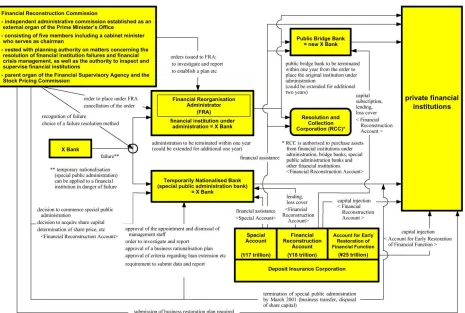
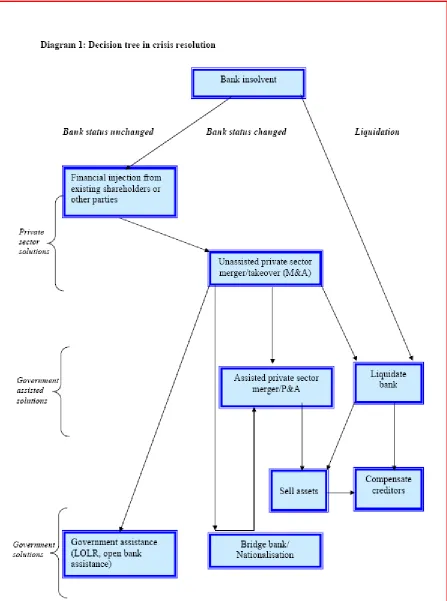
marketability and comprehension among policy makers and the public alike. Several have been suggested that merit researching. Nakaso (1999) provides great detail for each part of the plan that was developed under the Financial Reconstruction Law in Japan, reference Figure 1. In addition, Hoggarth, Reidhill & Sinclair (2004) provide a slightly simplified version of what the various options could look like, reference Figure 2, and are categorized below:
I. Unassisted Resolutions A. Bank status unchanged
B. Bank status changed – private sector merger II. Liquidation (fast) or split-up
III. Assisted resolutions
A. Bank status unchanged - LoLR only use to buy time to assess or get collateral B. Bank status changed –assisted merger/acquisition, Bridge Bank, nationalization
The author recommends a few additions for Figure 2, since the flow chart doesn‟t seem to apply to a big bank or systemic crisis, but only a smaller bank‟s insolvency. Once one of the “bigs”
fall, it‟s imperative that they notify the government who should provide consultation and/or
manpower to advise which course of action to take; be it assisted private sector merger, LoLR assistance, or even liquidation. The bank would have the ultimate say in what path it takes, if it is shown to be solvent, but the government should weigh in due to the systemic implications of a
Figure 1
Figure 2
CONCLUSION
Writing a Financial Crisis Response Plan is not an easy undertaking, and should not be attempted while in the eye of a financial crisis hurricane. The lack of a clear-cut Lead Agency
among the “alphabet soup” of existing government financial agencies is difficult to determine even during good financial times. The number of options is tremendous, and no stone should be overlooked. Providing a recommendation to different customers with a wide variety of
education on the subject, to include policy makers, foreigners, and the public in general must be maneuvered with great skill, as sharing of information is a hall-mark of a capital market. The need for a methodical but flexible FCRP, now more than ever is apparent; one that the policy-makers can pull off the shelf to calm the nerves during a financial crisis.
Something to keep in mind is that a financial crisis can actually be positive in the long
run. As the Central Bank of Norway states, “The three banking sectors [Nordic] were clearly
suffering from over-capacity before the crisis, and the crisis resolutions contributed to the
consolidation process” (Moe, Solheim & Vale 2004). The adjustment of the financial sector capacity is a natural force of the market at work. Lessons learned from each crisis can be studied, and make the government more efficient at regulation. New financial products will make old institutions obsolete, such as money market funds putting Savings & Loans out of business due to the inability to compete, thereby creating more efficient institutions. The advent of online banking has made the process light-years easier for the customer, albeit more
susceptible to security breaches or work-stoppages during a power outage.
Besides the many options available, fiscal and monetary policy should be considered in tandem with any plan that the Financial Command Center creates. In some cases, we should return to the old play-books for eliminating bank-runs, such as the Bank Holidays or clearing houses, which pre-date the Great Depression. Foreign ideas to the American public, such as approval of financial products (Japan) and nationalizing of banks (Nordic countries), merit consideration. Policy makers should not allow the academics, and foreign experts who have been there, to sit on the side-lines during a crisis. “As evidence from the Great Depression shows, banking crisis can have a dramatic adverse impact on the economy, in the absence of intervention. But keeping the fiscal costs low, and avoiding moral hazard in the future, are also prime factors in determining the appropriate scale and character of intervention” (Hoggarth, Reidhill & Sinclair 2004).
Policy makers and the various agencies involved need to keep in mind that they can only do so much to fix the economy. “Ernst & Young‟s performance scouring Lehman‟s numbers, along with Federal Reserve examiners inability to catch the maneuvers and legal advice from the U.K. law firm Link, suggest auditors, regulators and attorneys are about as effective as tiger
WORKS CITED
Allen, Franklin, and Gale Douglas. "Bubbles, Crises, and Policy." Oxford Review of Economic Policy 15.3 (1999): 11, 16-17.
Bernanke, Ben S. 1983. “Non-Monetary Effects of the Financial Crisis in the Propagation of the
Great Depression”, The American Economic Review, 73: 5-7, 12-13.
Corkery, Michael. "Lehman Whistle-Blower's Fate: Fired." Wall Street Journal 16 Mar. 2010: 1. Crotty, James. 2008. Structural Flaws in Deregulated Financial Markets Caused the Current Crisis. At www.economicsofcrisis.com: 566-571.
Dziobek, Claudia, and Ceyla Pazarbasioglu. "Lessons from Systemic Bank Restructuring."
International Monetary Fund, Monetary And Exchange Affairs Dept 14 (2008): 6-13.
Ergungor, O. Emre. "On the Resolution of Financial Crises: The Swedish Experience." Policy Discussion Paper 21, Federal Reserve Bank of Cleveland. (2007): 6,9-10.
"FDIC: Federal Deposit Insurance Corporation." FDIC: Federal Deposit Insurance Corporation. N.p., n.d. Web. 15 Mar. 2010. <http://www.fdic.gov/>.
"Forget Health Care: Big Issue for Voters Is Financial Reform." Yahoo! Finance 18 Mar. 2010: 1.
Goodhart, C.A.E. 2007. The Background to the 2007 Financial Crisis, International Economics and Economic Policy 4(4): 332-334, 339-345.
Griffith-Jones, Stephany and Jose Antonio Ocampo. 2009. The Financial Crisis and its Impact on Developing Countries. Columbia University International Policy Center for Inclusive Growth Working Paper 53: 2-3, 12-13.
Hoggarth, Glenn, Jack Reidhill, and Peter Sinclair. "On the Resolution of Banking Crises: Theory and Evidence." Bank of England, Working Paper 229 (2004): 9-15.
Mayes, David. "Financial Stability in a World of Cross-Border Banking: Nordic and Antipodean Solutions to the Problem of Responsibility Without Power." Viessmann European Research Center 1 (2009): 4, 7-11, 13-15, 18.
Moe, Thorvald, Jon Solheim, and Bent Vale. The Norwegian Banking Crisis (Norges Banks SkriftSerie Occasional Papers, Number 33, Oslo 2004). Oslo: Norges Bank, 2004:26, 78, 80-84, 86-99, 108-110.
Nakaso, Hiroshi. "The Financial Crisis in Japan During the 1990s: How the Bank of Japan Responded and the Lessons Learned." Bank for International Settlements 6 (2001): 2-8, 10-16, 29-40, 63.
Oberg, Svante. "Sweden and the Financial Crisis." Carlson Investment Management. Sveriges Riskbank, Stockholm. 20 Jan. 2009: 1-2, 4, 6, 10-13.
Reinhart, Carmen M. and Kenneth S. Rogoff. 2008. This Time is Different: A Panoramic View of Eight Centuries of Financial Crises. NBER Working Paper 13882: 160, 232, 280, 290, 371, 384.
Tankersley, Michael W.. "Board Leadership for the Company in Crisis." National Association of Corporate Directors (NACD). Gibson, Dunn, & Crutcher LLP. Webcast. 30 Oct. 2008: 7-16.
Task, Aaron. "Sen. Kaufman: Bring Back Glass-Steagall, Break Up „Too Big to Fail‟ Banks."
Yahoo Finance 25 Mar. 2010: 1.