R E S E A R C H
Open Access
Recognizing
L
(
p
)
by its order and one
special conjugacy class size
Yanheng Chen
1,2and Guiyun Chen
1**Correspondence:
1School of Mathematics and
Statistics, Southwest University, Chongqing, 400715, P.R. China Full list of author information is available at the end of the article
Abstract
In the past thirty years, many authors investigated some quantitative characterizations of finite groups, especially finite simple groups, such as quantitative characterizations by group order and element orders, by the set of lengths of conjugacy classes, by dimensions of irreducible characters,etc.In this article the projective special linear groupL2(p) is characterized by its order and one special conjugacy class size, wherep
is a prime. This work implies that Thompson’s conjecture holds forL2(p).
MSC: 20D08; 20D60
Keywords: finite simple groups; conjugacy class size; prime graph; Thompson’s conjecture
1 Introduction
All groups considered in this paper are finite, and simple groups are non-Abelian. For con-venience, we useπ(n) andnpto denote the set of prime divisors andp-part of the nature
numbern, respectively. For any groupG, we also denote byN(G) the set of conjugacy class
sizes ofGand byπ(G) =π(|G|).
In s, a simple graph calledprime graphof the groupGwas introduced: the vertex
set of this graph isπ(G), two verticespandqare joined by an edge if and only ifGcontains
an element of orderpq(see []). Denote the connected components of the prime graph of
the groupGbyT(G) ={πi(G)|≤i≤t(G)}, wheret(G) is the number of the prime graph
components ofG. If the order ofGis even, we always assume that ∈π(G). Then|G|
can be expressed as a product ofm,m, . . . ,mt(G), wheremi’s are positive integers with
π(mi) =πi(G). Thesemi’s are called theorder componentsofG. In particular, ifmiis an
odd number, then we call it an odd-order component ofG.
In , Thompson posed the following conjecture (ref. to [, Problem .]).
Thompson’s conjecture Let G be a group with trivial central.If L is a simple group sat-isfying N(G) =N(L),then G∼=L.
In , Chen proved in his Ph.D. dissertation [] that Thompson’s conjecture holds for all simple groups with a non-connected prime graph (also ref. to [–]). In , Vasil’ev first dealt with the simple groups with a connected prime graph and proved that Thomp-son’s conjecture holds forAandL() (see []). Later on, Ahanjideh in [] proved that Thompson’s conjecture is true for some projective special linear groups. Recently, Chen and Li contributed their interests on Thompson’s conjecture under a weak condition. They
only used group order and one or two special conjugacy class sizes of simple groups and characterized successfully sporadic simple groups (see Li’s Ph.D. dissertation []) and sim-pleK-groups (a finite simple group is called a simpleKn-groupif its order is divisible by
exactlyndistinct primes), by which they checked Thompson’s conjecture for sporadic
sim-ple groups and simsim-pleK-groups. Hence, it is an interesting topic to characterize simple groups with their orders and few conjugacy class sizes. In this paper, we characterize the projective special linear groupL(p) by its order and one special conjugacy class length, wherepis a prime. This work partially generalizes Chen and Ahanjideh’s work [, ], which proved that Thompson’s conjecture holds for all the projective special linear groupLn(q).
For convenience, we use to denote±. In addition, we denote byGp andSylp(G) a
Sylowp-subgroup of the groupGand the set of all of its Sylowp-subgroups forp∈π(G),
respectively. We also denote byA:Ban extension of a normal subgroupAby another
sub-groupB. The other notation and terminologies in this paper are standard and the reader
is referred to [] and [] if necessary.
2 Some lemmas
A group Gis called a-Frobenius groupif there exists a normal series HKG
such thatK andG/Hare Frobenius groups with kernelsHandK/H, respectively. Now,
we quote some known lemmas which are useful in the sequel.
Lemma .[, Theorem ] Suppose that G is a Frobenius group of even order and H,K are the Frobenius kernel and the Frobenius complement of G,respectively.Then t(G) = , T(G) ={π(H),π(K)}and G has one of the following structures:
(i) ∈π(H)and all Sylow subgroups ofKare cyclic;
(ii) ∈π(K),His an Abelian group,Kis a solvable group,the Sylow subgroups ofKof odd order are cyclic groups,and the Sylow-subgroups ofKare cyclic or generalized quaternion groups;
(iii) ∈π(K),His Abelian,and there exists a subgroupKofKsuch that
|K:K| ≤, K=Z×SL(, ),
|Z|, ××= ,
and the Sylow subgroups ofZare cyclic.
Lemma .[, Theorem ] Let G be a-Frobenius group of even order.Then t(G) = and G has a normal seriesHKG such thatπ(K/H) =π(G),π(H)∪π(G/K) =π(G), the order of G/K divides the order of the automorphism group of K/H,and both G/K and K/H are cyclic.Especially,|G/K|<|K/H|and G is solvable.
Lemma . Let G be a group of orders(s– )(s–– ),wheres– is a Mersenne prime
and s is a natural number.Assume that G is a-Frobenius group with a normal series HKG,where H is an elementary Abelian-group of ordersand K/H is a cyclic group of orders– .Then G∼= (Z×Z×Z:Z) :Z.
Proof By hypothesis,|G/K|= s–– , and so (|K|,|G/K|) = . By the Zassenhaus theorem,
there exists a complement subgroupCofKinGsuch thatG=KC. LetBbe a complement
subgroup ofHinK. ThenG=HBC, whereHandHBare normal subgroups ofG;HBand
GF(s) and soHis the additive group ofF. Also,|B|= s– and soBis the multiplicative
group ofF. Now,Cacts by conjugation onHand similarlyCacts by conjugation onB, and
this action is faithful. Therefore,Ckeeps the structure of the fieldFand soCis isomorphic to a subgroup of the automorphism group ofF. Hence,|C|= (s–– )||Aut(F)|=s. Since s– is a Mersenne prime,sis a prime. It follows thats= or . Ifs= , thenGis a
group of order . By the structures of groups of order , we have that any group of order
is not a -Frobenius group, a contradiction. Hence,s= , and thenGis a group of
order that contains eight subgroups of order seven. By [], we have that the total number of groups of order with eight subgroups of order seven is three, which are (Z×Z×Z:Z) :Z, (Z×Z×Z:Z)×Z, andL(). SinceGis a -Frobenius
group, we obtain thatG∼= (Z×Z×Z:Z) :Z.
Lemma .[, Theorem A] Let G be a group with more than one prime graph component. Then G is one of the following:
(i) a Frobenius or-Frobenius group;
(ii) Ghas a normal series⊆H⊆K⊆G,whereHis a nilpotentπ-group,K/His a
simple group andG/Kis aπ-group such that|G/K|divides the order of the outer
automorphism group ofK/H.Besides,each odd-order component ofGis also an odd-order component ofK/H.
Lemma .[, Theorem ..] Let G be a p-group with order pn, n≥,and d is the number of minimal generators of G.Then|Aut(G)||pd(n–d)(pd– )(pd–p)· · ·(pd–pd–).
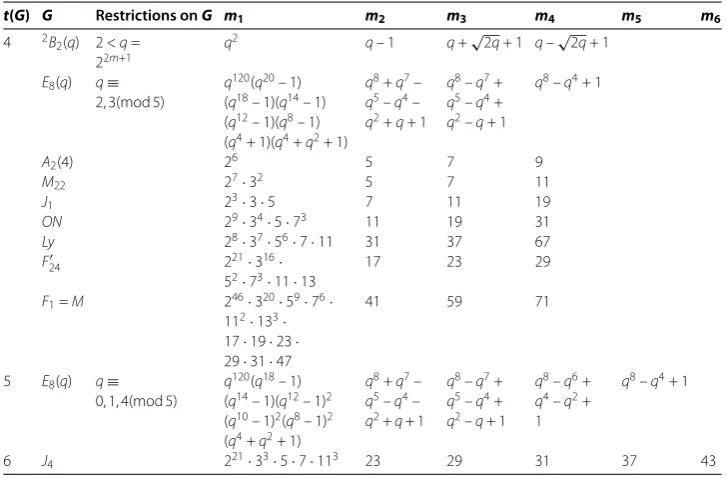
Lemma . Let G be a simple group with a disconnected prime graph.Then its order com-ponents are exhibited in Tables-,where p is an odd prime and q is a prime power.
Proof By [, , ] and the definition of order component, we easily get order components
ofGin Tables -. Note that some mistakes and misprints in [, , ] are amended in
this paper.
3 Characterization ofL2(p)by its order and one special conjugacy class size
By Lemma ., we know thatL() is some special such that we have to choose a different
way from other cases to deal with it. In fact, Chen and Li have characterizedL() by its order and the smallest conjugacy class size larger than one in their unpublished paper
which characterized simpleK-groups. The following theorem is their one result.
Theorem . Let G be a group with|G|= ··.Then G∼=L()if and only if G has a conjugacy class size of.
Proof The necessity of the theorem can be checked easily, so we only need to prove the sufficiency.
By hypothesis, there exists an elementxofGsuch that|xG|=|G:C
G(x)|= ·. In view of
Z(G)≤CG(x), one has thatZ(G) is a proper subgroup ofG, and , /∈π(Z(G)). We assert
that every minimal normal subgroup ofG=G/Z(G) is non-solvable. LetSbe any minimal
normal subgroup ofG. Suppose thatSis solvable. ThenSis an elementary Abelian group,
from which we get the preimageTofSinGis a nilpotent group. If|S|=rt, then the Sylow
Table 1 The order components of simple groupsGwitht(G) = 2
G Restrictions onG m1 m2
An 6 <n=p,p+ 1,p+ 2 and
one ofn,n– 2 is not a prime
n!
2p p
Ap–1(q) (p,q)= (3, 2), (3, 4) q
p(p–1) 2 p–1
i=1(qi– 1)
qp–1 (q–1)(p,q–1)
Ap(q) (q– 1)|(p+ 1) q
p(p+1)
2 (qp+1– 1)p–1
i=1(qi– 1)
qp–1
q–1 2A
p–1(q) q
p(p–1) 2 p–1
i=1(qi– (–1)i)
qp+1 (q+1)(p,q+1) 2A
p(q) (q+ 1)|(p+ 1) and
(p,q)= (3, 3), (5, 2)
qp(p2+1)(qp– 1)p–1
i=1(qi– 1)
qp+1
q+1
Bn(q) n= 2m≥4 andqis odd qn
2
(qn– 1)n–1
i=1(q2i– 1)
qn+1 2
Bp(3) 3p
2
(3p+ 1)p–1
i=1(32i– 1) 3
p–1
2
Cn(q) n= 2m≥2 qn
2
(qn– 1)ni=1–1(q2i– 1)
qn+1 (2,q–1)
Cp(q) q= 2, 3 qp
2
(qp+ 1)p–1
i=1(q2i– 1)
qp–1 (2,q–1)
Dp(q) p≥5 andq= 2, 3, 5 qp(p–1)pi=1–1(q2i– 1)
qp–1
q–1
Dp+1(q) q= 2, 3 (2,q1–1)qp(p+1)(qp+ 1) (qp+1– 1)p–1
i=1(q2i– 1)
qp–1 (2,q–1) 2D
n(q) n= 2m≥4 qn(n–1)ni=1–1(q2i– 1)
qn+1 (2,q+1) 2D
n(q) n= 2m+ 1≥5 ifq= 2
andn= 2m+ 1≥9 ifq= 3
1 (2,q–1)q
n(n–1)(qn+ 1)
(qn– 1)n–2
i=1(q2i– 1)
qn–1+1
(2,q–1) 2D
p(3) p= 2m+ 1 andp≥5 3p(p–1)pi=1–1(32i– 1)
3p+1 4
G2(q) q≡(mod 3) andq> 2 q6(q3–)(q2– 1)(q+) q2–q+ 1 3D
4(q) q12(q6– 1)(q2– 1)(q4+q2+ 1) q4–q2+ 1
F4(q) qis odd q24(q8– 1)(q6– 1)2(q4– 1) q4–q2+ 1
E6(q) q36(q12– 1)(q8– 1)
(q6– 1)(q5– 1)(q3– 1)(q2– 1)
q6+q3+1
(3,q–1) 2E
6(q) q> 2 q36(q12– 1)(q8– 1) (q6– 1)(q5+ 1)(q3+ 1)(q2– 1)
q6–q3+1
(3,q–1) 2A
3(2) 26·34 5
2F
4(2) 211·33·52 13
M12 26·33·5 11
J2 27·33·52 7
Ru 214·33·53·7·13 29
He 210·33·52·73 17
McL 27·36·53·7 11
Co1 221·39·54·72·11·13 23
Co3 210·37·53·7·11 23
F22 217·39·52·7·11 13
HN 214·36·56·7·11 19
contradiction. Hence, every minimal normal subgroup ofGis non-solvable, as desired.
It follows thatM≤G≤Aut(M), whereM=S× · · · ×Sk andSiis a direct product of
isomorphic non-Abelian simple groups fori= , , . . . ,k.
It is clear that and must belong toπ(M). Otherwise,Mis solvable, a contradiction.
Hence,Mis a simpleK-group andπ(M) ={, , }. By checking possible order ofM,M
must be isomorphic toL(), which implies thatG∼=L(), as claimed.
Theorem . Let G be a group.Then G∼=L(p)if and only if|G|=p(p– )/(,p– )and G has a special conjugacy class size of(p– )/(,p– ),where p is a prime and not equal to seven.
Table 2 The order components of simple groupsGwitht(G) = 3
G Restrictions onG m1 m2 m3
Ap 6 <pandp,p– 2
both are primes
(p– 3)!/2 p p– 2
A1(q) 3 <q≡(mod 4) q– q q+2
A1(q) q> 4 is even q (q– 1) q+ 1
2D
p(3) p= 2m+ 1≥5 2·3p(p–1)(3p–1– 1)pi=1–2(32i– 1)
3p–1+1 2
3p+1 4
G2(q) q≡0(mod 3) q6(q2– 1)2 q2+q+ 1 q2–q+ 1 2G
2(q) p= 32m+1> 3 q3(q2– 1) q+√3q+ 1 q–√3q+ 1
F4(q) 2 <qis even q24(q6– 1)2(q4– 1)2 q4+ 1 q4–q2+ 1 2F
4(q) 2 <q= 22m+1 q12(q4– 1) (q3+ 1)(q2+ 1)(q– 1)
q2–2q3+
q–√2q+ 1
q2+2q3+
q+√2q+ 1 2A
5(2) 215·36·5 7 11
E7(2) 263·311·52·73·
11·13·17·19·31·43
73 127
E7(3) 223·363·52·73·
112·133·19·37·41·61·73·547
757 1,093
M11 24·32 5 11
M23 27·32·5·7 11 23
M24 210·33·5·7 11 23
J3 27·35·5 17 19
HS 29·32·53 7 11
Sz 213·37·52·7 11 13
Co2 218·36·53·7 11 23
F23 218·313·52·7·11·13 17 23
F2=B 241·313·56·72·
11·13·17·19·23
31 47
F3=Th 215·310·53·72·13 19 31
Table 3 The order components of simple groupsGwitht(G)≥4
t(G) G Restrictions onG m1 m2 m3 m4 m5 m6
4 2B
2(q) 2 <q= 22m+1
q2 q– 1 q+√2q+ 1 q–√2q+ 1
E8(q) q≡ 2, 3(mod 5)
q120(q20– 1) (q18– 1)(q14– 1) (q12– 1)(q8– 1) (q4+ 1)(q4+q2+ 1)
q8+q7–
q5–q4–
q2+q+ 1
q8–q7+
q5–q4+
q2–q+ 1
q8–q4+ 1
A2(4) 26 5 7 9
M22 27·32 5 7 11
J1 23·3·5 7 11 19
ON 29·34·5·73 11 19 31
Ly 28·37·56·7·11 31 37 67
F24 221·316·
52·73·11·13
17 23 29
F1=M 246·320·59·76·
112·133· 17·19·23· 29·31·47
41 59 71
5 E8(q) q≡ 0, 1, 4(mod 5)
q120(q18– 1) (q14– 1)(q12– 1)2 (q10– 1)2(q8– 1)2 (q4+q2+ 1)
q8+q7–
q5–q4–
q2+q+ 1
q8–q7+
q5–q4+
q2–q+ 1
q8–q6+
q4–q2+ 1
q8–q4+ 1
[image:5.595.116.480.494.733.2]Ifp= , , thenGis a group of order six or twelve and not an element of order six. By the structures of the groups of order six and twelve, one has thatG∼=SorA, whereS
is a symmetric group of degree three andAis an alternating group of degree four. Note
thatL()∼=SandL()∼=A, as desired.
Letp≥ but not equal to seven. By hypothesis, there exists an elementxof orderpin
Gsuch thatCG(x) =xandCG(x) is a Sylowp-subgroup ofG. By the Sylow theorem, we
have thatCG(y) =yfor any elementyinGof orderp. So,{p}is a prime graph component
ofGandt(G)≥. Therefore,Ghas one of the structures in Lemma .. In addition,pis
the maximal prime divisor of|G|and an odd-order component ofG.
Suppose that G is a Frobenius group with a kernel H and a complement K. Then
|K||(|H|– ). Ifp∈π(H), then by Lemma .,|H|=pand|K|= (p– )/. It follows that
p–
|(p– ), and thusp= , a contradiction. Ifp∈π(K), then|K|=pand|H|= (p– )/ by Lemma ., and sop|p–. Sincepis odd, we have thatp|(p– ), which impliesp= ,
a contradiction. Hence,Gis not a Frobenius group.
Assume thatGis a -Frobenius group. By Lemma ., we have thatGhas a normal series
HKGsuch thatπ(K/H) ={p}=π(G),π(H)∪π(G/K) =π(G), and|G/K||(p– ).
Then we have thatK/His of orderpandπ((p+ )/)⊆π(H).
(a) Letpbe not a Mersenne number. Then there exists an odd primer∈π((p+ )/)
such that|Hr|<p. By Lemma .,(p,|Aut(Hr)|) = , which implies that an element of orderpofGcan trivially act onHr. In other words,rcan be connected topin the prime graph ofG, a contradiction.
(b) Letpbe a Mersenne number, andp= s– ,s≥. Thensis a prime and(p– )/is an odd number. Recall that|G/K||(p– ).
If|G/K|=p– , then|H|= (p+ )/ = s–<psuch that (p,|Aut(H)|) = by Lemma ..
It follows that andpconnect in the prime graph ofG, a contradiction.
If|G/K|= (p– )/, then|H|= (p+ ) = s. IfH is not an elementary Abelian -group,
then (p,|Aut(H)|) = by Lemma ., a contradiction. IfH is an elementary Abelian
-group, then by Lemma .,s= , and thusp= , a contradiction.
Regarding other cases of|G/K|, we always can find an odd primer∈π(H) andr|p– such that (p,|Aut(Hr)|) = , which implies thatGhas an element of orderpr, a contradiction.
Therefore,Gis not a -Frobenius group either.
Now,Ghas a normal series ⊆H⊆K⊆G, whereHis a nilpotentπ-group,K/His a
simple group,G/Kis aπ-group such that|G/K|divides the order of the outer
automor-phism group ofK/Hand each odd-order component ofGis also an odd-order component
ofK/H. It follows thatpis an odd-order component ofK/H, andt(K/H)≥t(G)≥, and
alsoK/H≤G/H≤Aut(K/H). We now proceed with the following proof in five steps by
the possible number of the prime graph component ofK/Hin the Tables -. Note that
t(K/H) = , , , or .
Step . Assume thatt(K/H) = . ThenK/His isomorphic to one of simple groups in
Table . We assert that it is impossible.
.. IfK/H∼=An, where <n=p,p+ ,p+ , and one ofn,n– is not a prime, then
p=pand n!|p(p–). Ifn=p, then (p– ) <p+ , and thusp< , a contradiction. The casesn=p+ orp+ can be ruled out similarly.
.. IfK/H∼=Ap–(q), where (p,q)= (, ), (, ), thenp= q
p–
(q–)(p,q–) andq p(p–)
×
p–
i= (qi– )|
p–
. Sincepis an odd prime andq is a prime power, we have thatp
=
(qp–)
[(q–)(p,q–)] <qp
andqp
(p–) <p
–
<p. It follows thatq p(p–)
p, which implies thatp= . Hence,p= (q–)
[(q–)(,q–)] andq(q– )(q– )≤
p–
. Since
p≥q(q– ) and q=q(q)>q(q+ )> (q+q+ )≥ (q–)
[(q–)(,q–)] =p, we
get that q> q(q–), and soq–q– < . Therefore,q= ifp= , a contradiction. .. If K/H∼= Ap(q), where (q– )|(p+ ), thenp= q
p–
q– andq p(p+)
(qp+ – )×
p–
i= (qi– )|
p–
. Sincep≤qp
andqp
(p+)
<p, we have that p(p+)
< p, and thus p< , a contradiction.
.. If K/H∼= A
p–(q), thenp= q
p+
(q+)(p,q+) andq p(p–)
p
–
i= (qi– (–)i)|
p–
. Since
p<q(p+)andqp(p–) <p, we get that p(p–)
< (p+ ), and thusp
– p– < .
It follows that p= or . Ifp= , thenp = (q+)
[(q+)(,q+)] andq(q– )(q+ )|
p– . Thereforep≤(q–q+ )≤qandq<q(q+ ) <p, a contradiction. Similarly, if p= , thenp≤qandq<p, a contradiction.
.. IfK/H∼=Ap(q), where (q+ )|(p+ ) and (p,q)= (, ), (, ), thenp=q
p+
q+ and qp
(p+)
(qp– )p
–
i= (qi– )|
p–
. Hence,p
≤q(p+)andqp(p+)
<p, and thusq p(p+)
<
q(p+). It follows that p(p+) < (p
+ ), which means thatp= . Therefore,q<p=
(qq++)= (q–q+ )≤q, a contradiction.
.. IfK/H∼=Bn(q), wheren= m
≥ andqis odd, thenp=qn
+ andqn
(qn– )×
n–
i= (qi– )|
p–
. Sincep<q(n
+)
andqn <p, we have thatn< (n+ ), and thus n– n– < , which implies thatn< , a contradiction.
.. IfK/H∼=Bp(), thenp=
p–
and p
(p+ )p–
i= (i– )|
p–
. Thus,p< p
and p<p, and sop< , a contradiction.
.. IfK/H∼=Cn(q), wheren= m
≥, thenp= qn
+
(,q–) andqn
(qn– )n–
i= (qi–
)|p–. Sincep<q(n+)andqn
<p, we have thatn< (n+ ), and thusn– n– < , which implies thatn= . Therefore,p≤(q+ )< qandq(q– )<p, and thus (q– )< . It follows thatq= , a contradiction.
.. IfK/H∼=Cp(q), whereq= or , thenp= q
p–
(,q–) andqp
(qp + )p–
i= (qi–
)|p–. Hence,p<qp andqp<p, and sop< , a contradiction. .. IfK/H∼= Dp(q), wherep≥ and q= , , or , thenp=q
p–
q– andq
p(p–)×
p–
i= (qi– )|
p–
. Hence,p<qp
andqp(p–)<p, and sop(p– ) < p, which implies thatp< , a contradiction.
.. IfK/H∼=Dp+(q), whereq= or , thenp= q
p– (,q–) and
(,q–)qp
(p+)
(qp+ )×
(qp+– )p–
i= (qi– )|
p–
. Sincep<qp
andqp(p+)<p, we get thatp(p+ ) < p, and thus <p< , a contradiction.
.. If K/H∼=Dn(q), wheren= m
≥, thenp= qn
+
(,q+) andqn
(n–)n–
i= (qi–
)|p–. Therefore,p<q(n+)andqn(n–)<p. Then we have thatn(n– ) < (n+ ), and thusn– n– < , which implies thatn= , a contradiction.
.. IfK/H∼=Dn(q), wheren= m
+ ≥ ifq= andn≥ ifq= , thenp=q(,nq––)+
and(,q–)qn(n–)(qn+ )(qn– )n –
i= (qi– )|
p–
. Becausep
<qnandqn(n–)<p, we have thatn(n– ) < n, and so <n< , a contradiction.
.. IfK/H∼=Dp(), wherep= m
+ andp≥, thenp=p+and p(p–)p–
.. IfK/H∼=G(q), whereq≡(mod) andq> , thenp=q–q+ andq(q– )(q– )(q+)|p–
. It follows thatp= (q–q+ )<qandq<p, a contradiction. .. IfK/H∼=D(q), thenp=q–q+ andq(q– )(q– )(q+q+ )|p
–
. Therefore,p= (q–q+ )<qandq<p, a contradiction.
.. IfK/H∼=F(q), whereqis odd, thenp=q–q+ andq(q– )(q– )(q– )|p–. Thus,p<qandq<p, a contradiction.
.. If K/H∼=E(q), thenp=q
+q+
(,q–) andq(q– )(q– )(q– )(q– )(q– )(q– )|p–
. Sincep
≤(q+q+ )<q andq<p, a contradiction can be
ob-tained.
.. IfK/H∼=E(q), whereq> , thenp=q
–q+
(,q–) andq(q– )(q– )(q– )(q+ )(q+ )(q– )|p–
. Hence,p≤(q–q+ )<qandq<p, a contradiction.
.. If K/H is isomorphic to one of A
(),F(), M,J, Ru, He, McL, Co,Co, F, andHN, thenp= , , , , , , , or , and|K/H||p
–
. By [], we have that
|K/H|≥, but (p –
)≤
, a contradiction.
Step . Suppose thatt(K/H) = . ThenK/His isomorphic to one of simple groups in
Table . We assert that it is impossible exceptA(p), wherep≥ is an odd prime and not equal to seven.
.. If K/H∼= Ap, where p> such that p andp– are primes, then p=p and p!
|
p(p–)
. It follows that (p– ) <p+ , and thusp< , a contradiction. .. IfK/H∼=A(q), whereq≡(mod) andq> , thenp=q,q
+
. Letp=q. ThenK/H∼=A(p) =L(p). Recall thatK/H≤G/Hand|G|=p(p
–)
=|L(p)|, we have thatG∼=L(p), as desired.
Letp=q+. Thenq= p– andq(q– )|p–, and thus (p– )≤p+ . Hence we get thatp< , a contradiction.
Letp=q–. Thenq= p+ andq(q+ )|p–. It follows that (p+ )≤p– , and so it is impossible.
.. IfK/H∼=A(q), whereq> is even, thenp=q+ andq(q–)|p –
, and thus
(p–)≤p+. Therefore,p= , which means thatq= , a contradiction. .. IfK/H∼=Dp(), wherep= m
+ andm≥, thenp=p–+ or p+. Let p= p–+
. Then
p+
p(p–)((p–) – )p–
i= (i – )|p –
. Since p
< p and
p(p–)<p, we have thatp(p– ) < p, and sop< , a contradiction. Letp=p+. Then (p–+ )p(p–)((p–)– )p–
i= (i– )|
p–
. Hence,p< (p
+)
and p(p–)<p, and thusp(p– ) < (p+ ). It follows thatp= andp= , contradicting p< (p+).
.. IfK/H∼=G(q), whereq≡(mod), thenp=q–q+ and (q+q+ )q(q– )|p–. It follows thatp= (q–q+ )<qandq<p, a contradiction.
.. IfK/H∼=G(q), whereq= m
+
> , thenp=q–√q+ and (q+√q+ )q(q– )|p–
. Therefore, p
= (q–√q+ )<q andq(q– ) <p, and thus
q– <q, a contradiction.
.. IfK/H∼=F(q), whereq> is even, thenp=q+ orq–q+. Assumep=q+. Thenq(q– )(q– )(q–q+ )|p–
. It follows thatp= (q+ )<qandq< p, a contradiction. Similarly, ifp=q–q+ , thenq(q– )(q– )(q+ )|p–
, and sop= (q–q+ )<qandq<p, a contradiction.
.. IfK/H∼=F(q), whereq= n
+
andq> , thenp=q+q+q+√q+ andq(q– )(q+ )(q+ )(q– )(q–q+q–√q+ )|p–
(q+q+q+√q+ )< (q+ q+ )< (q– )< q<qandq<p, a contradiction.
.. If K/H is isomorphic to one of M, M, and J, then p= , , or and
|K/H||p –
. By [], we have that ≥ |K/H|≥, but (
p–
)≤, a contradiction. .. IfK/His isomorphic to one ofA
(),E(),E(),M,HS,Sz,Co,F,F, andF, thenp= , , , , , , , or ,, and|K/H||p
–
. By [], we have that|K/H|> , but (p–
)≤, a contradiction.
Step . Assume thatt(K/H) = . ThenK/His isomorphic to one of simple groups in
Table exceptE(q),q≡, , (mod) andJ. We assert that it is impossible. .. IfK/H∼=J, thenp= and |p
–
, but
p–
= , a contradiction.
.. IfK/H is isomorphic to one ofA(),E(),M,ON, Ly,F , andF, thenp= , , , , , , or and|K/H||p
–
. By [], we have that|K/H|≥
, but (p– )≤ , a contradiction.
.. IfK/H∼=B(q), whereq= m
+
andq> , thenp=q– orq+√q+ . Letp=q– . Thenq(q–√q+ )(q+√q+ )|p–. It follows thatq<p= (q– )< q, a contradiction.
Letp=q–√q+ . Thenq(q– )(q+√q+ )|p–. Therefore,p<qandq<p, a contradiction.
Letp=q+√q+ . Thenq(q– )(q–√q+ )|p–
. Therefore,p= m
+
+ m++ and p–= m+(m+ )(m+ m+ ). Since|K/H|
|(p –
), we have that (m
+)
|m+,
and thus (m+ )≤m+ , a contradiction.
.. IfK/H∼=E(q), whereq≡, (mod), thenp=q–q+ ,q–q+q–q+ q–q+ or q+q–q–q–q+q+ . Assume thatp=q–q+ . Thenp< q, butq<p, a contradiction. Similarly, for other cases ofp, we can always obtain a contradiction.
Step . Assume thatt(K/H) = . ThenK/H∼=E(q) in Table , whereq≡, , (mod), and thusp=q–q+ ,q–q+q–q+ ,q–q+q–q+q–q+ orq+q–q– q–q+q+ . By the way of ., for all cases ofp, we can always obtain a contradiction. Hence, we omit it.
Step . Assume thatt(K/H) = . ThenK/H∼=Jin Table . It follows thatp= and
|p–, but p–= ···, a contradiction.
Therefore, we have thatG∼=L(p), wherepis a prime and not equal to , as desired.
By Theorems . and ., the following corollary holds.
Corollary . Thompson’s conjecture holds for the projective special linear group L(p), where p is a prime.
Proof LetGbe a group with trivial central andN(G) =N(L(p)). Then it is proved in []
that|G|=|L(p)|. Hence, the corollary follows from Theorems . and ..
Remark . By . of Theorem . and Lemma ., the following conclusion is true. Let G be a group with|G|= ··. Then G has a class size of if and only if G∼=L
Competing interests
The authors declare that they have no competing interests.
Authors’ contributions
All authors contributed equally and significantly in writing this article. All authors read and approved the final manuscript.
Author details
1School of Mathematics and Statistics, Southwest University, Chongqing, 400715, P.R. China.2School of Mathematics and
Statistics, Chongqing Three Gorges University, Chongqing, 404100, P.R. China.
Acknowledgements
The authors are very grateful to the referee for carefully reading the earlier version of this manuscript and providing valuable suggestions and useful comments. This work was supported by the National Natural Science Foundation of China (Grant Nos. 11271301, 11171364, 11001226), Science and Technology Foundation of Chongqing Education Committee (No. KJ111107), Youth Foundation of Chongqing Three Gorges University (Grant Nos. 12QN-22, 12QN-23).
Received: 10 September 2012 Accepted: 15 December 2012 Published: 28 December 2012 References
1. Williams, JS: Prime graph components of finite groups. J. Algebra69, 487-513 (1981)
2. Khukhro, EI, Mazurov, VD: Unsolved Problems in Group Theory: The Kourovka Notebook, 17th edn. Sobolev Institute of Mathematics, Novosibirsk (2010)
3. Chen, GY: On Thompson’s Conjecture. PhD thesis, Sichuan University, Chengdu (1994)
4. Chen, GY: On Thompson’s conjecture for sporadic simple groups. In: Proc. China Assoc. Sci. and Tech. First Academic Annual Meeting of Youths, pp. 1-6. China Sci. & Technol. Press, Beijing (1992) (in Chinese)
5. Chen, GY: On Thompson’s conjecture. J. Algebra185, 184-193 (1996)
6. Chen, GY: Further reflections on Thompson’s conjecture. J. Algebra218, 276-285 (1999) 7. Vasil’ev, AV: On Thompson’s conjecture. Sib. Electron. Math. Rep.6, 457-464 (2009)
8. Ahanjideh, N: On Thompson’s conjecture for some finite simple groups. J. Algebra344, 205-228 (2011)
9. Li, JB: Finite groups with special conjugacy class sizes or generalized permutable subgroups. PhD thesis, Southwest University, Chongqing (2012)
10. Conway, JH, Curtis, RT, Norton, SP, Parker, RA, Wilson, RA: Atlas of Finite Groups. Clarendon, Oxford (1985) 11. Xu, MY: The Theory of Finite Groups. An Introduction, vol. 1. Science Press, Beijing (1993)
12. Chen, GY: On Frobenius and 2-Frobenius group. J. Southwest China Norm. Univ.20, 485-487 (1995) (in Chinese) 13. Miller, GA: Determination of all the groups of order 168. Am. Math. Mon.9(1), 1-5 (1902)
14. Iiyori, N, Yamaki, H: Prime graph components of the simple groups of Lie type over the field of even characteristic. J. Algebra155(2), 335-343 (1993)
15. Kondratev, AS: On prime graph components of finite simple groups. Math. Sb.180(6), 787-797 (1989)
doi:10.1186/1029-242X-2012-310
Cite this article as:Chen and Chen:RecognizingL2(p)by its order and one special conjugacy class size.Journal of