2018 3rd International Conference on Information Technology and Industrial Automation (ICITIA 2018)
ISBN: 978-1-60595-607-7
IC Engine High Altitude Overall
Performance Evaluation Model
Based on Combination Weight
Jiahui Li, Yue Kong, Bo Yang and Hanjie Xiao
ABSTRACT
In order to enhance the operation and maintenance of internal combustion engine (IC engine), and protect the economic returns and environmental benefits, this paper builds an overall performance indicator evaluation system of IC engine, and determines five evaluation dimensions and corresponding sub-dimensional indicators of the power, cost, reliability, emission and intensification. On this basis, a fuzzy evaluation model for the overall performance of IC engine based on combination weighting approach is constructed to make a comparison with different altitudes and obtain the characteristics of altitudes. Results show that, although most single-item indicators are closely linked to the factor of altitude, mainly on emission and power, there is no significant difference in the overall performance of IC engine. Therefore, future improvement should be focused on emission and power.1
KEYWORDS
IC Engine; Combination Weighting Approach; Fuzzy Evaluation; Overall Performance.
1
Li Jiahui Li, Yue Kong, Hanjie Xiao, Business School, Huzhou University, Huzhou Zhejiang 313000, China
INTRODUCTION
A comprehensive evaluation of the performance of the internal combustion engine is of great significance to its maintenance and service. It matters to the lifespan of the engine. To enhance the comprehensive performance of internal combustion engine has made contributions to the environmental pollution and ecological protection.
There are plenty of researches of internal combustion engine (IC engine) dynamics, but few of them are related to the comprehensive evaluation based on quality improvement and performance optimization. Researches on the evaluation of overall performance and local performance of IC engine include the following literature. Lei Y, Uren V, Motta E[2](2006) built a fuzzy evaluation model of engines based on subjective weight; Zhang Zhiqiang, Xu Bin, etc.[3](2008) adopted analytic hierarchy process (AHC) to build a comprehensive evaluation model of tank engine performance; Gu X, Huang Z, Cai J[4] (2012) used attribute recognition theory (ART) to build a mathematics evaluation model of IC engine; Huang Yanxiao[5] (2014) proposed a calculation approach of aero engine based on network hierarchy method and weights of parameters to cope with the problems of negative sequence and mid perpendicular conflict of TOPSIS; Shu Gequn and Huo Yongzhan[6] (2017) put forward a three-level evaluation method with multi-level non-structural fuzzy decision. The above mentioned researches have provided critical reference for the development of IC engine technology. But few take altitude into consideration. And above evaluation models mainly determine the weights by subjective or objective weight methods. In actual practice, it is more rational to adopt a combination weighting approach.
Therefore, we consider altitude as a factor of IC engine performance in this paper, and propose to build a high-altitude overall performance fuzzy evaluation model with combination weights based on expert grading and coefficient of variation. We make a comparison among IC engines of same type under different altitudes to testify altitude’s effects, which offers reference for engine manufacturers to make tailored design.
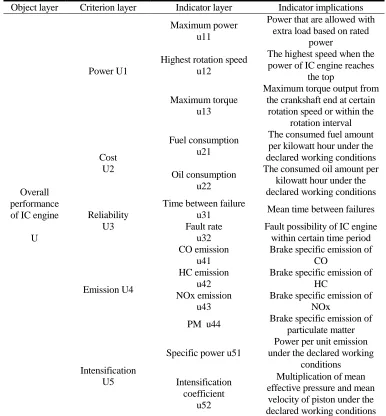
IC Engine Overall Performance Evaluation Indicator System Building
TABLE I. IC ENGINE OVERALL PERFORMANCE EVALUATION INDICATOR SYSTEM.
IC ENGINE OVERALL PERFORMANCE EVALUATION MODEL BASED ON COMBINATION WEIGHTS
Combination Weighting Approach
We adopt expert grading and coefficient of variation methods, and calculate with certain proportion to acquire the combination weight. Let the rate of standard deviation and mean value as CV (CV=σ/μ). Coefficient of variation can address the effects of different mean values on the variation of double or more indicators. In
Object layer Criterion layer Indicator layer Indicator implications
Overall performance of IC engine
U
Power U1
Maximum power u11
Power that are allowed with extra load based on rated
power
Highest rotation speed u12
The highest speed when the power of IC engine reaches
the top
Maximum torque u13
Maximum torque output from the crankshaft end at certain
rotation speed or within the rotation interval
Cost U2
Fuel consumption u21
The consumed fuel amount per kilowatt hour under the declared working conditions
Oil consumption u22
The consumed oil amount per kilowatt hour under the declared working conditions
Reliability U3
Time between failure
u31 Mean time between failures Fault rate
u32
Fault possibility of IC engine within certain time period
Emission U4
CO emission u41
Brake specific emission of CO
HC emission u42
Brake specific emission of HC
NOx emission u43
Brake specific emission of NOx
PM u44 Brake specific emission of particulate matter
Intensification U5
Specific power u51
Power per unit emission under the declared working
conditions
Intensification coefficient
u52
Multiplication of mean effective pressure and mean
weight Wj, we build the following object function, Lagrange multiplier is used to
make resolution and acquire
j (
0.5
0.5
1
( ) n j j
j j j
W a j
W a
)Fuzzy Evaluation Method Based on Combination Weight
Fuzzy evaluation method is based on fuzzy mathematics, where fuzzy subset is built to reflect the fuzzy indicator of the objective, i.e., determine the membership degree, and then adopts the principle of fuzzy transformation to analyze each indicator[23].
Combination weighting approach and fuzzy evaluation method are used to evaluate the overall performance of IC engine, detailed procedures as follows.
Calculation of indicator combination weight. Experts are invited to grade each indicator. The number of experts is noted as m. Normalize the percentage of each indicator and acquire the subjective weight of each indicator. Experimental data are used to calculate the objective weight. Eqs. (1) and (2) are combined to acquire the combination weight.
Determination of factor set and evaluation set. According to the indicator system, the factor set of IC engine performance evaluation is A{ ,B B B B B1 2, 3, 4, 5},
where B B B B B1, 2, 3, 4, 5 stand for its power, cost, reliability, emission and
intensification; the evaluation set is V{ ,v v v v v1 2, 3, 4, }5 with corresponding
connotations as {very bad, bad, general, good, very good}.
Single factor evaluation. IC engine performance evaluation indicators can be divided into qualitative and quantitative indicators. The two categories should be separately evaluated because of different evaluation approaches. For qualitative indicators, we use fuzzy statistics based on the following equation to acquire each membership.
/ =1,2,3 4,5
k k
r M M k ,
(1)
Where Mk represents the evaluation indicator, B B B B B1, 2, 3, 4, 5 the frequency of
1, 2, 3 4, 5
v v v v v, , M the total number of experts. As with positive and negative quantitative indicators, grading membership functions are obtained respectively.
1 1 1 2 1 5 1
2 1 2 2 1 5 2
1 2 5
( ) ( ) ( )
( ) ( ) ( )
( ) ( ) ( )
i i i i
i i i i
i i i i
i
in in in in
R r C r C r C R r C r C r C R
R r C r C r C
(2)
Where ni is the second-order indicator of the ith first-order indicator.
Fuzzy calculation is conducted for single-factor evaluation membership matrix Ri and factor weight vector Wi.
1 2 3 4 5
( , , , , ) i i i i i i i i
U W R u u u u u (3)
Where Wi is acquired by weighting of rough sets. The acquired vector Ui is the membership vector of first-order indicator Bi on evaluation set V, i.e., the fuzzy evaluation outcome of first-order indicator Bi.
(5) Second-order fuzzy evaluation. First, obtain the IC engine overall performance evaluation indicator membership matrix based on the first-order fuzzy evaluation.
11 12 13 14 15
1 21 22 23 24 25
2 31 32 33 34 35
3 41 42 43 44 45
51 52 53 54 55
u u u u u
U u u u u u
R U u u u u u
U u u u u u
u u u u u
(4)
Then, fuzzy calculation is made to this matrix and first-order indicator weighting vector W.
1 2 3 4 5
( , , , , )
ZW R z z z z z (5)
Where, W is obtained by the weighting of rough sets; Z stands for the overall evaluation result of the evaluation object.
IC Engine Overall Performance Evaluation and Result Analysis
DATA SOURCE
CALCULATION OF COMBINATION WEIGHT
According to test data and experts grading data, acquire the combination weight,
u11=0.060 ,
u12=0.054,u13=0.035,u21=0.050,u22=0.077,u31=0.092,u32=0.125,u41=0.115,u42 =0.035,u43=0.093,u44=0.089,u51=0.041,u52=0.066.
We can learn that fault possibility in certain time period (0.125), brake specific emission of CO (0.115), brake specific emission of HC (0.101), brake specific emission of NOx (0.093), mean time between failure (0.092) and particulate matter emission (0.089).
OVERALL PERFORMANCE INDICATOR EVALUATION
Based on expert comments, we classify the performance of IC engine into five categories. Note the evaluation set as {Ⅰ, Ⅱ, Ⅲ, Ⅳ, Ⅴ}. And we adopt membership function of half a trapezoid[11-12]. Maximum power is taken as an example, experimental data as the independent variable, and the membership of j th order ask, each order membership function of maximum power is
,
0,
b x x a k b a
x b
(6)
Testing data of different altitudes including the maximum power, highest rotation speed and maximum torque are substituted into the membership function. The value of a and b are determined by empirical data or standard value. Then, determine the single-factor fuzzy evaluation matrix R of each section. Taking altitude 4850 as an example, its membership matrix is R1. Similarly, the other three evaluation matrix are expressed by
1
0 0 0.008 1 1 0 0 0.154 1 1 0 0 0 0.816 1 1 0.991 0 0 0 1 0.979 0 0 0 0 0 0.839 1 1 1 1 0.575 0 0 1 1 1 0.964 0 1 1 1 0.663 0 1 1 0.292 0 0 1 1 1 0.015 0 0 0 0 0.484 1 0 0 0 0.592 1
R
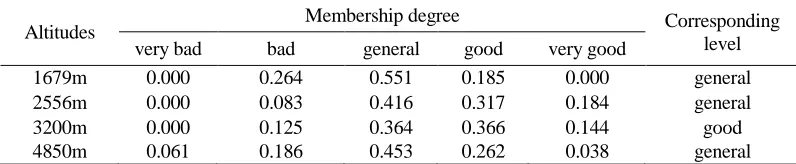
After the determination of single-factor fuzzy evaluation matrix R and weight set W, the overall performance level of IC engine in different altitudes are measured according to the maximum membership degree principle. The evaluation results of the engine overall performance at the altitude of 1679, 2556, 3200 and 4850m are shown in table II.
TABLE II. OVERALL EVALUATION RESULTS.
Altitudes Membership degree Corresponding
level very bad bad general good very good
1679m 0.000 0.264 0.551 0.185 0.000 general
2556m 0.000 0.083 0.416 0.317 0.184 general
3200m 0.000 0.125 0.364 0.366 0.144 good
4850m 0.061 0.186 0.453 0.262 0.038 general
TABLE III. SIGNIFICANCE ANALYSIS OF OVERALL PERFORMANCE OF IC ENGINE. Paired Differences
t df Sig. (2-tailed) Mean 95% Confidence Interval of the Difference
Lower Upper
Pair
1 -133.74379 -344.62194 77.13435 -1.382 12 .192 Pair
2 -63.36569 -171.94836 45.21697 -1.271 12 .228
Pair
3 -101.27662 -241.24203 38.68879 -1.577 12 .141
SIGNIFICANCE ANALYSIS OF OVERALL PERFORMANCE UNDER DIFFERENT ALTITUDES
In order to verify the effects of altitudes on the overall performance indicator evaluation and single item performance of IC engine, t tests are used for analysis. Taking 1679m (VAR00004) as the reference, comparisons are made with 2556m (VAR00003), 3200m (VAR00002) and 4850m (VAR00001). Testing results are shown in table 4. where Pair 1 refers to VAR00001 - VAR00004, Pair 2 VAR00002 - VAR00004, and Pair 3 VAR00003 - VAR00004.
CONCLUSIONS
(1) In term of weight, emission and reliability account for a big percentage of the indicator weight, which means it should be paid due attention to.
(2) As for the evaluation result, at the altitude of 3200m, its overall performance level is “good”; the other three altitudes are “general”. Therefore, to give full play to the capability of IC engine, it is more favorable to put into operation at the altitude of 3200m when using or purchasing.
(3) For the significance analysis, the Sig. values after comparison are all over 0.05, that is, altitudes exert no significant impacts on the overall performance of IC engine.
REFERENCES
1. Zhiping Guo, Yanfei Wang, Huijie Zhang, et al. Dynamic Analysis of the Micro Swing Engine [J].Chinese Internal Combustion Engine Engineering, 2014, 35(2):119-124.
2. Y Lei, Uren V, Motta E. Semsearch: A search Engine for the Semantic Web[C] International Conference on Knowledge Engineering and Knowledge Management. Springer, Berlin, Heidelberg, 2006:238-245.
3. Zhiqiang Zhang, Bin Xu, Yongling He, et al. Engine Performance Evaluation Based on Analytic Hierarchy Process [J].Acta Armamentarii, 2008, (5):625-628.
4. X Gu, Z Huang, J Cai, Etal. Emission Characteristics of a Spark-Ignition Engine Fueled with Gasoline-N-Butanol Blends in Combination with EGR[J]. Fuel, 2012, 93: 611-617.
5. Yanxiao Huang. Aero-Engine Performance Evaluation Based on Improved TOPSIS Method [J].Manufacturing Automation, 2014, (8):73-77.
6. Gequn Shu, Yongzhan Huo, Hua Tian, et al. A Three-Level Evaluation Method for Internal Combustion Engine Waste Heat ORC Recovery Systems [J].Journal of Tianjin University, 2017, (4):411-420.
7. Hubing Zhou, Yulei Wang, et al. Comprehensive Fuzzy Evaluation of Effectiveness of Secondary Equipment in Smart Substation Based on Entropy Method [J]. Electrical Measurement & Instrumentation, 2018, 55(3):73-79.
8. Changbao Xu, Yulei Wang. Fuzzy Comprehensive Evaluation of Intelligent Substation Relay Protection System State Based on Information Trend Prediction and Combination Weighting [J].Electric Power Automation Equipment, 2018, 38(1):162-168.
9. Yong Qian, Shuzhou Sun, Dehao Ju, et al. Review of the State-of-the-Art of Biogas Combustion Mechanisms and Applications in Internal Combustion Engines [J]. Renewable and Sustainable Energy Reviews, 2017, 69: 50-58.
10. Ireneusz Pielecha, et al. Application of IMEP and MBF50 Indexes for Controlling Combustion in Dual-Fuel Reciprocating Engine [J]. Applied Thermal Engineering, 2018, 132(5): 188-195. 11. Bernardo Tormos, Jaime Martín, et al. A General Model to Evaluate Mechanical Losses and
Auxiliary Energy Consumption in Reciprocating Internal Combustion Engines [J]. Tribology International, 2018, 123: 161-179.