2018 International Conference on Computer, Communications and Mechatronics Engineering (CCME 2018) ISBN: 978-1-60595-611-4
Study on the Rate Performance of Porous Na
2Ti
3O
7for Sodium-ion
Battery Anode Material
Fei GAO, Kai YANG, Mao-song FAN, Hao LIU and Kang-kang WANG
*State Key Laboratory of Operation and Control of Renewable Energy & Storage Systems, China Electric Power Research Institute. Beijing 100192, China
*Corresponding author
Keywords: Template method, Porous structure, Rate performance, Capacity retention rate.
Abstract. In this paper, carbon spheres with active groups on the surface were prepared by
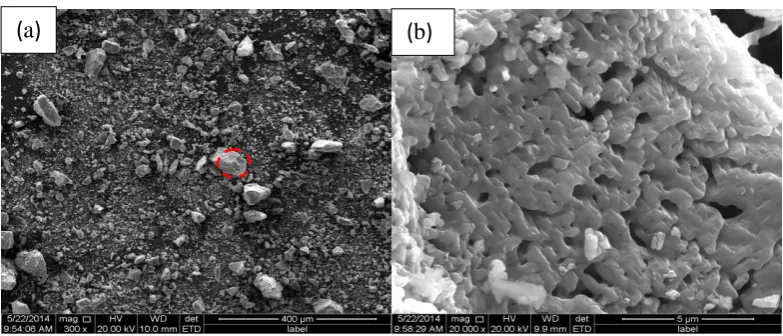
hydrothermal method. And porous Na2Ti3O7 material was prepared by sol-gel method with the carbon spheres as template. The results of scanning electron microscopy (SEM) showed the porous structure and the pore size ranged from hundreds of nanometers to 2 micron. XRD test results showed that pure phase materials were synthesized and the grain size was 47.6 nm. The results of electrochemical performance test showed the good rate performance of this material. The charge capacity of the material were 64.4 mAhg-1 and 50.4 mAhg-1 at 5C and 10C after 150 cycles, and the capacity retention rates were 62.5% and 66.3%, respectively.
Introduction
The development of electrochemical energy storage has expanded the application of lithium-ion batteries, but the large-scale use of lithium-ion power batteries has led to the shortage of lithium resources and rise of price, therefore, it is necessary to find alternative electrochemical energy storage technologies. Sodium-ion batteries use electrode materials containing cheap element sodium. The process of Na+ insertion and release is similar to that of Li+. E0 (Na+/Na) is 0.3 V higher than E0 (Li+/Li) and these characteristics make sodium-ion batteries competitive in the field of energy storage.
Usually, hard carbon materials are used as negative electrodes for sodium-ion batteries, but these materials have low coulombic efficiency in the first week and poor cycling performance. Titanium-based anode materials reported in recent years, such as P2-Na0.66[Li0.22Ti0.78]O2[1], NASICON-structured NaTi2(PO4)3[2], Na2Ti3O7[3], anatase TiO2[4] showed excellent sodium storage properties. Among them, Na2Ti3O7 has the advantages of layered structure, quasi-3D Na+ channel, sodium storage potential is about 0.3 V (vs.Na/Na+), theoretical capacity close to 180 mAhg-1. However, the structural distortion caused by Na+ deintercalation leads to a faste capacity decay. Wang et al[5] synthesized Na2Ti3O7 with a micro-rod-like structure, the structure distortion was effectively alleviated and the cycling performance was improved. In this paper, porous Na2Ti3O7 particles were prepared by template method. This structure enlarged the contact area between the active material and the electrolyte, shortened the Na+ migration path, and improved the cyclic performance and the rate performance of this material obviously.
Experiment
Preparation of Carbon Sphere Template
Preparation of Electrode Materials
A certain amount of Na2CO3 was dissolved in the mixture of anhydrous alcohol and deionized water to prepare solution A. A certain amount of four butyl titanate was dissolved in anhydrous ethanol and the carbon spheres were added to make B solution. The molecular weight ratio of Na2CO3 in solution A and four butyl titanate in solution B is 1.1:3. Liquid A was added to liquid B dropwise and stirred continuously. The mixture was fully hydrolyzed and placed in a vacuum drying box at 150 ℃ until the liquid evaporates completely. The obtained powder was calcined at 900 ℃ for 20h in muffle furnace and the final sample was obtained, named P-NTO.
Battery Assembly
Electrode active materials (P-NTO), conductive carbon black (Super P), binder (PVDF) were stirred and blended in the milling bowl at a mass ratio of 7:2:1, solvent N-methylpyrrolidone (NMP) was added to make the material into uniform slurry, which was evenly coated on the copper foil collector with a thickness of 100 microns. Then place it in a drying oven at 80 ℃ drying for at least 12h, and finally cut into a circular wafer with a diameter of 1 cm. CR2032 button cells were assembled in argon glove box (H2O<0.1ppm, O2<0.1ppm) with 1 mol/L NaFP6/EC+DEC solutions as electrolyte (EC:DEC=1:1, ratio in volume), glass fiber as separator and sodium metal as negative electrode.
Results and Discussion
Morphology and Functional Group Characterization
Figure 1. Carbon sphere morphology (a) and surface functional groups (b).
Figure 2. SEM diagrams of porous Na2Ti3O7.
Structural Characterization
XRD structural characterization showed that the peaks of P-NTO samples corresponded to that of the standard spectra one by one, and the pure phase Na2Ti3O7 product obtained. The cell parameters of the sample are a=9.0114 Å, b=3.7864 Å c=8.4749 Å, α=90°,β=103.67°,γ=90° with an average grain size of 47.6 nm.
Figure 3. XRD diagram of porous Na2Ti3O7 material.
Electrochemical Performance Test
Charge and discharge curves in the voltage range of 2.5-0.01V (vs.Na/Na+) of P-NTO materials for
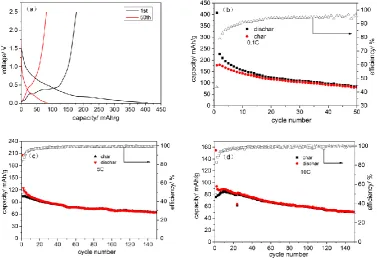
the first and 50th weeks at 0.1C (17.8mA) are shown in Fig 4.(a). The first discharge/charge specific capacity is 407/178mAhg-1 with a coulombic efficiency of 44%. After 50 weeks, the charge/discharge capacity is 81.3/83.8 mAhg-1, with the coulombic efficiency close to 100%. The lower first week coulombic efficiency is due to the decomposition of electrolyte during the first discharge. The coulombic efficiencies have been improved continuously after the continuous cycles, with increased close to 100% by the 15th week, meanwhile the charge capacity retention rate is 46% by the 15th week, shown as Fig 4.(b). When charged and discharged at large ratios of 5C and 10C, the first cycle charge/discharge capacities were 103/206 mAhg-1 and 76/154.5 mAhg-1, and the coulombic efficiency were 50% and 49.2%, respectively. Continue to cycle after 100 weeks, the charge/discharge capacities were 64.4/65.2 mAhg-1 and 50.4/50.4 mAhg-1, and the charge capacity retention rates were 62.5% and 66.3%, respectively. And the coulombic efficiency were close to 100% after 10 weeks cycling (Fig 4.(c), Fig 4.(d)). It can be seen that P-NTO materials maintain good cycling performance at rate of 5C and 10C compared to 0.1C.
Figure 4. Figure of the electrochemical performance (a) Charge discharge curve at 0.1C; (b) Cycling performance at 0.1C; (c) Cycling performance at 5C; (d) Cycling performance at 10C.
Summary
Porous structure can obviously improve the rate performance of Na2Ti3O7 anode material. The material exhibits excellent capacity retention and coulomb efficiency at high rates of 5C and 10C. After 150 weeks of cycling, the charge capacity retention rate reached to 62.5% and 66.3% respectively, but the coulomb efficiency approaches 100% after 10 weeks of cycling.
Acknowledgment
This work was financially supported by Science and Technology Project of National Power Grid Corp “Research on key technologies of sodium based low strain and long life layered battery materials” (DG71-16-027) Foundation.
References
[2] P. Senguttuvan, M. R. Palacínet, J. M. Tarascon. Low-Potential Sodium Insertion in a NASICON-Type Structure through the Ti(III)/Ti(II) Redox Couple, J. J. Ame. Chem. Soc. 135 (2013) 3897−3903.
[3] A. Rudola, K. Saravanan, P. Balay, Na2Ti3O7: an intercalation based anode for sodium-ion battery applications, J. J. Mate. Chem. A. 1(2013) 2653–2662.
[4] Y. Xu, E. M. Lotfabad, H.L. Wang, Nanocrystalline anatase TiO2: a new anode material for rechargeable sodium ion batteries, J. Chem. Commun. 49(2013) 8973-8975.
[5] W. Wang, C.J Yu, S.Q. Jiao, Single crystalline Na2Ti3O7 rods as an anode material for sodium-ion batteries, J. RSC Adv. 3 (2013) 1041–1044.
[6] X.M. Sun, Y.D. Li, Colloidal Carbon Spheres and Their Core/Shell Structures with Noble-Metal Nanoparticles, J. Ang. Chem. Inte. Edi. 43 (2004) 597-601.