2019 International Conference on Computer Science, Communications and Big Data (CSCBD 2019) ISBN: 978-1-60595-626-8
Research and Application on Numerical Simulation of Heavy Rail Steel in
Continuous Casting Process
Liang CHEN
PanGang Group Research Institute Co., Ltd., Chengdu 611731, Sichuan, China
Keywords: Rail steel, Casting speed, Superheat, Specific water, Equiaxed grains, Columnar grains.
Abstract. According to the solidification process features of rail steel and continuous caster parameters, the solidification heat transfer mathematical model and grain growth models were established. The two models were coupled mathematical model called CA-FE model. Some parameters, such as superheat of molten steel, casting speed, specific water flowrate were researched. Tests show that Reducing super heat and specific water flowrate, improving the casting speed, were beneficial to the growth of the equiaxed grains, opposite to columnar grains. The
superheat was 22℃ to 25℃, casting speed was 0.70 m/min to 0.75m/min and specific water
flowrate was 0.22L/kg to 0.23L/kg that was benefit to the overall quality of rail steel.
Introduction
The organization of solidification numerical simulation has become one of the most active field of materials research in recent decades with increasingly urgent demand for performance prediction of material. Dendrite growth determines morphology at the end of solidification, the redistribution of the solute elements and solidification structure of two phase area in the continuous casting billet, thus it affects the quality of the final product. Oldfield proposed numerical simulation model for microstructure of graphite cast iron in 1966.The cooling curve was firstly applied for checking the model. Macroscopic and microscopic coupling model has tremendously developed from then on.
Pang and Stefanescu[1,2] applied Cellular Automaton to microcosmically simulate the anisotropy
and dendrite arm branching mechanism,then got dendrite morphology and grain group. On the
basis of Dilthey’s research,[3,4]
Nastac proposed probability model to simulate the dendrite braching, equixed grain growth and columnar-to-equiaxed transition(CET).Li Qiang and Li Dianzhong
simulate the dendrite growth of Fe-C alloy[5-8]. Wang Tongmin and Jin Junze proposed the CAMC
model by using the computer to simulate the solidification structure in metal[9-10]. Chen Jin
simulated the crystal structure in casting process by using the CA. The composition, degree of supercooling and interfacial energy were considered in the model. Huang Jianfeng simulated the solute diffusion and interfacial energy of grain growth by using the CA.
In recent years, the rail way steel is required to have safety, comfort and long life with the development of high speed railway. High purity, high surface and internal quality, high section size precision and straightness were required in rail steel. The composition and structure homogenization should be confirmed in the casting bloom. Based on macro solidification heat transfer of continuous casting bloom and grain nucleation theory, dendrite growth CAFD mathematical model of heavy rail steel in casting process was established. The growth process of solidification structure was predicted in different continuous casting process conditions. The influence factors of columnar grains size, equiaxed grains size and CET position in casting process were simulated quantitatively. The correct casting parameters were confirmed by using the model.
Mathematic Model
Table 1. Parameters of the casting machine.
Items parameter
Bloom transverse 280mm×380mm
Strand 6-straightener and 6-strand
Radius of caster 15000 mm
Height of crystallizer 850mm
Casting speed Main 0.6~0.8m/min
metallurgical length 40m
Heat Transfer Model in Solidification
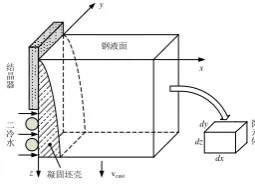
On ideal condition, the mathematic model was established by using slice mobile method. The height
direction of microelements was set as dz from crystallizer meniscus to bloom center. The thickness
and width direction of microelements were set as dy and dx respectively. Microelements move downward with bloom speed as shown in figure 1. Heat equilibrium of microelements was shown as following,
Heat accumulation of microelements = receiving heat of microelements reduce heat spending of microelements
z
y
x
二 冷 水
vcast
凝固坯壳 钢液面
dz dy
dx
微 元 体 结
[image:2.595.247.375.326.418.2]晶 器
Figure 1. Schematic diagram of the solidification of the billet.
Heat equilibrium of directions were shown as fig. 2.
vcTdxdy dxdy dz z T T vc dxdz y T keff
dydz x T keff
dxdydz
x T k x x T
keff eff
dxdz dy y T k y y T
keff eff
z y x
Figure 2. Schematic diagram of the process of heat transfer of the micro unit.
The equation of heat equilibrium was shown as equation(1).
dxdydz t T C
=vCTdxdy- dxdz y T keff - dydz x T keff
- dz dxdy
z T T vC + dxdz dy y T k y y T
keff eff
+ dx dydz
x T k x x T
keff eff
+So (1)
[image:2.595.173.425.454.603.2]o S x T k x y T k y z T vc t T
c eff eff
(2)
If the coordinate system was put on the bloom, the microelements move downward with the bloom. The speed of height direction is zero. The heat transfer differential equation of two-dimensional slices in solidification process was shown as equation(3).
o S x T k x y T k y t T
c eff eff
(3) in equation(3),T was temperature, ℃. ρwas density, kg·m-3. c was heat capacity, J·kg-1·℃-1. keff was coefficient of thermal conductivity, W·m-1·℃-1. So was inner heat, W·m-3.
Grain Growth Mathematical Model
Continuous nucleation model was applied in CA-FE mathematic model. When the nucleation was
heterogeneous,the nucleation was located in different position. The nucleation position was
described by continuous discrete distribution function, that was Gauss function.
2 max max 2 ( ) exp
( ) 2 2
n T T
dn
d T T T
(4)
In the equation, ΔTmax was undercooling of nucleation, K. ΔTσ was standard variance of
undercooling,K. nmax was density of nucleation from 0 to infinite in normal distribution function.
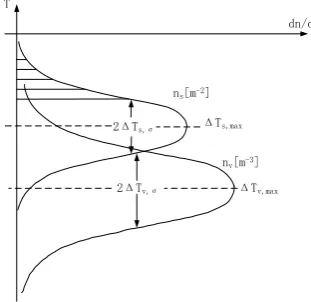
Gauss distribution function was described in heterogeneous cube and heterogeneous face nucleation as shown in fig. 3.
T
dn/dT
ns[m-2]
nv[m-3]
2ΔTs,σ
2ΔTv,σ
ΔTs,max
ΔTv,max
Figure 3. Gauss distribution function of mold wall and internal nucleation.
The parameters of Gauss distribution function interact with each other. It was influenced by some external factors, such as the shape of bloom, the casting temperature and the cooling condition.
Nucleation parameters were chosen mainly referring to Fe—C alloy microstructure. Meanwhile,the
[image:3.595.217.373.423.574.2]microstructure tested by experiences was applied in the Gauss distribution function. The last parameters of Gauss distribution function was shown in Table 2.
Table 2. Parameters of Gauss distribution function.
ΔTs,max/K ΔTs,σ/K ns,max/K ΔTv,max/K ΔTv,σ/K nv,max/K
1.0 0.1 1.2×10⁸ 8 1.5 2×10⁹
Initial Condition
Through the simulation, the temperature field of bloom, the secondary dendrite arm spacing and dendrite growth were calculated by every effective variable. Because of bloom symmetry, the simulation was calculated 1/4 cross section.
Table 3. Initial condition.
Superheat/℃ Casting speed/ (m·min-1) water ratio in secondary cooling / (L·kg-1)
25 0.68 0.25
Simulation Results and Discussion
Superheat
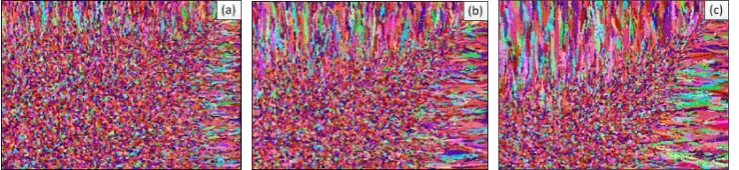
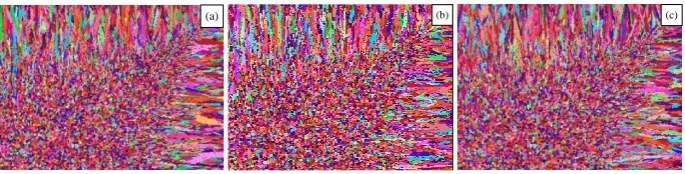
On the initial conditon as table3 shown,the superheat was changed.The relationship between superheat and solidification structure was presented by simulation. The characteristic value of
solidification structure was caculated by software ipp6.0. When the superheats were 15℃, 25℃ and
35℃, the averages area of columnar grain in bloom were 2.01mm2, 2.59 mm2 and 3.14mm2
respectively. The averages radius of columnar grain in bloom were 0.58mm, 0.69 mm and 0.77mm
respectively. The averages equiaxed grain area were 1.41mm2,1.35mm2 and 1.33mm2 respectively,
[image:4.595.115.485.423.508.2]The averages equiaxed grain radius were 0.85 mm, 0.83 mm and 0.82 mm respectively, The averages equiaxed grain ratio in cross-sectional were 75.6%, 68.2% and 51.6% respectively. The heat loosed a lot while the superheat was high in solidification process. The temperature of position in bloom is high with high superheat. On the position, the time to loss heat was more than that with low superheat. The secondary dendrite arm spacing increased. The equixed grain area was reduced with columnar grain area increased on the high superheat condition. Therefore, low superheat is benefit to equixed grain growth.
Figure 4. Solidification structure of bloom with different superheat ((a).15℃, (b).25℃, (c).35℃)
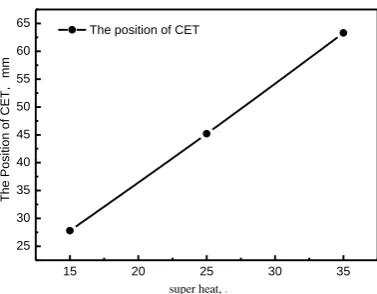
CET positions of bloom on three superheat conditions were shown as fig5.when the superheat
were 15℃, 25℃ and 35℃ respectively, the CET positions were located 27.8mm, 45.2 mm and
15 20 25 30 35 25
30 35 40 45 50 55 60 65
The position of CET
T
h
e
Po
si
ti
o
n
o
f
C
ET
,
mm
[image:5.595.205.394.70.217.2]super heat, ℃
Figure 5. Relationship between CET position and super heat.
Casting Speed
On the initial condition as shown in table3, the casting speed was changed. The relationship between casting speed and solidification structure was presented by simulation.
When the superheats were 0.68m/min,0.75 m/min and 0.82 m/min, the averages area of
columnar grain in bloom were 2.59mm2,2.45 mm2 and 2.35mm2 respectively. The averages radius
of columnar grain in bloom were 0.69mm,0.65 mm and 0.63mm respectively. The averages
equiaxed grain area were 1.32mm2,1.36mm2 and 1.37mm2 respectively, The averages equiaxed
grain radius were 0.82 mm, 0.83 mm and 0.84 mm respectively, The averages equiaxed grain ratio in cross-sectional were 63.8%, 67.3% and 70.2% respectively.
Because residence time of molten steel in mould and secondary area reduced, the dissipation heat of molten steel reduced. The bloom temperature rose with casting speed rising. The microelements temperature rose at the same position. When the casting speed reached 0.82 m/min, the central bloom temperature at the end of mould is near the liquid line, the molten steel does not nucleate. Because residence time is short, the cooling intensity is not strong and the molten steel heat can not be removed by the cooling water. That led the temperature under bloom shell rose and temperature gradient of solidification front reduced. It is benefit to expanding the equiaxed grain area opposite to restraining columnar grain area.
(a) (b) (c)
Figure 6. Solidification structure of bloom with different casting speed ((a).0.68m/min, (b).0.75 m/min, (c).0.82 m/min).
[image:5.595.129.469.494.580.2]0.66 0.68 0.70 0.72 0.74 0.76 0.78 0.80 0.82 0.84 42.5
43.0 43.5 44.0 44.5 45.0 45.5
The position of CET
T
h
e
Po
si
ti
o
n
o
f
C
ET
,
mm
[image:6.595.193.400.70.224.2]Casting Speed, m/min
Figure 7. Relationship between CET position and casting speed.
Water Ratio in Secondary Cooling Area
On the initial condition as shown in table3, the water ratio in secondary cooling area was changed. U75V is high carbon steel. Because the solidification temperature range is wide, the water ratio in secondary cooling is very strick. When the water ratio in secondary cooling area is strong, the temperature gradient in bloom increased, it is easy to form thermal stress and cracks in bloom internal. When the water ratio in secondary cooling area is weak, the bloom shell is thin, the bloom strength is very low, the bloom is easy to be out of shape. The simulation calculated the relationship between water ratio in secondary cooling area and nucleation structure when the water ratio in secondary cooling area were 0.22 L/kg, 0.24 L/kg and 0.27 L/kg respectively.
When the water ratio in secondary cooling were 0.22 L/kg,0.24 L/kg and 0.27 L/kg, the
averages area of columnar grain in bloom were 2.13mm2、2.59 mm2 and 2.76mm2 respectively. The
averages radius of columnar grain in bloom were 0.57mm, 0.69 mm and 0.78mm respectively. The
averages equiaxed grain area were 1.38mm2,1.36mm2 and 1.32mm2 respectively, The averages
equiaxed grain radius were 0.84 mm, 0.82mm and 0.81 mm respectively, The averages equiaxed grain ratio in cross-sectional were 72.3%,66.6% and 56.4% respectively. The water ratio in secondary area increased, the columnar grains expanding area opposite to restraining equiaxed grains area. Low water ratio is benefit to expanding equiaxed grains area.
(a) (b) (c)
Figure 8. Solidification structure of bloom with different water ratio of secondary cooling.
[image:6.595.127.470.497.584.2]0.22 0.24 0.26 0.28 40.0
40.5 41.0 41.5 42.0 42.5 43.0 43.5 44.0 44.5 45.0 45.5 46.0 46.5 47.0 47.5 48.0 48.5
Specific water flowrate ,L/kg
The Position of CET
T
h
e
Po
si
ti
o
n
o
f
C
ET
,
[image:7.595.197.401.70.222.2]mm
Figure 9. Relationship between CET position and specific water flowrate.
Parameters Chosen
The CET position in bloom should be controlled to expanding equixed grains in rail producing process. On the one hand, the equixed grains area is bigger, the rail performance is more homogeneous. On the other hand, the biggest shear stress of rail is located under the surface of rail tread from 10mm to 15mm. Serious composition segregations did not be allowed existed at that area. Comparing casting bloom with rolling rail, the same positions were 10 to 15 mm area under rail head tread and 25 to 40mm under bloom surface. Therefore, bloom CET position should not be controlled in these areas by modifying the continuous casting parameters.
The simulation results show that CET positions were more than 40mm under the bloom surface
while superheat was more than 22℃. Therefore, the superheat should be controlled more than 22℃.
When the casting speeds were ranged from 0.66m/min to 0.82m/min, the CET position under the surface of bloom is located from 25mm to 40mm.however, the high casting speed was benefit to expanding equixed grains with adding risk of bloom bleed-out. Therefore, casting speed should be chosen the middle line at 0.70 m/min to 0.75 m/min. whatever were the water ratio in secondary cooling area from 0.22L/kg to 0.27L/kg, the CET positions did not locate at 25 to 40mm under the bloom surface. To get more equixed grains, the water ratio should be chosen from 0.22 L/kg to 0.23 L/kg.
Testing Results
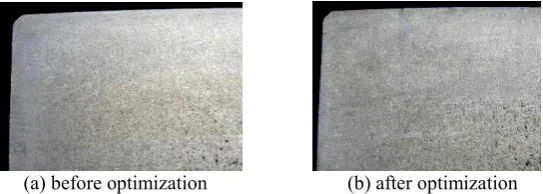
The bloom macrostructures were shown in fig10 between the optimization. The columnar grain areas in fig10 (b) were bigger than that in fig10(a).The CET position under the bloom surface was not located from 25mm to 40mm.
(a) before optimization (b) after optimization Figure 10. Macrostructure of bloom between optimization.
Conclusions
The solidification heat transfer model and grains growth model were established on the basis of rail steel character and caster performance. The superheat, casting speed and water ratio in secondary cooling were calculated in the simulation. The results are shown as following.
[image:7.595.162.434.562.659.2]benefit to equixed grains growth opposite to columnar grains growth. CET position moved into the bloom center with superheat improving and water ration improving.
(2) When the superheats was 25℃, the CET position is 27.8mm under the bloom surface, the
averages area of columnar grain in bloom was 2.59 mm2. The average radius of columnar grain in
bloom was 0.69 mm. The average equiaxed grain area was 1.35mm2, the average equiaxed grain
radius was 0.83mm, the average equiaxed grain ratio in cross-sectional was 68.2%.
(3) When the superheats was 0.75 m/min, the average area of columnar grain in bloom was 2.45
mm2. The average radius of columnar grain in bloom was 0.65 mm. The average equiaxed grain
area was 1.36mm2, the average equiaxed grain radius was 0.83 mm, the average equiaxed grain
ratio in cross-sectional was 67.3%.
(4) When the water ratio was 0.22 L/kg, the CET positions was located 40.7mm under the bloom surface. When the water ratio in secondary cooling was 0.22 L/kg, the average area of columnar
grain in bloom was 2.13mm2. The average radius of columnar grain in bloom was 0.57mm. The
averages equiaxed grain area was 1.38mm2, the averages equiaxed grain radius was 0.84 mm, the
average equiaxed grain ratio in cross-sectional was 72.3%.
(5) The best continuous casting parameters were as following ,superheat should be controlled 22℃ to 25℃, casting speed should be controlled 0.70 m/min to 0.75m/min,the water ratio in secondary area should be controlled 0.22L/kg to 0.23L/kg.The practices test show that the parameters after optimization were benefit to bloom. CET positions were not located from 25mm to 40mm under bloom surface. The CET positions avoided the biggest shear stress, it is good to rail performance.
References
[1] Pang H, Stefanescu D M. Stochastic modeling of dendritic and eutectic grain structure
evolution during solidification,Solidification Science and Processing, 1996: 149-156.
[2] Stefanescu D M,Pang H. Modeling of casting solidification stochastic or deterministic,
Canadian Metallurgical Quarterly, 1998, 37(3-4): 229-239.
[3] Nastac L. Numerical modeling of solidification morphologies and segregation patterns in cast
dendritic alloys, Acta Materialia, 1999, 47(17): 4253-4262.
[4] Dilthey U, Pavlik V, Reichel T. Numerical simulation of dendritic solidification with modified
cellular automata [A], Mathematical Modelling of Weld Phenomena, 1997: 85-105.
[5] Nastac L, Stefanescu D M. Stochastic modelling of microstructure formation in solidification
processes, Modelling and Simulation in Materials Science and Engineering, 1997, 5(4): 391-420.
[6] Li Q,Li D Z,Qian B N. Modelling of the dendrite growth by using continuous method. Acta
metallurgica sinica.2004,40(6): 634-638.
[7] Li Q,Li D Z,Qian B N. Modeling of dendritic growth by means of cellular automaton method.
Acta Physica Sinica.2004, 53(10): 3477-3481.
[8] Li Q. Research on numerical simulation of solidification dendrite evolution[D],Shen Yang:
Institute of metal research, Chinese Academy of Sciences,2004.
[9] Wang T M.Resarch on the Mico-Modelling of metal solidification process.Dalian Uninversity
of Technology.2000.
[10] Jin J Z,Wang Z Y,Zhen X S.Study on the simulation of solidification structure. Foundry .1998,