Received: 26 November 2018 Accepted: 22 March 2019 Published: 03 April 2019 http://www.aimspress.com/journal/agriculture
Research article
Quantitative priority estimation model for evaluation of various
non-edible plant oils as potential biodiesel feedstock
Zul Ilham* and Farhana Haque Nimme
Institute of Biological Sciences, Faculty of Science, University of Malaya, 50603, Kuala Lumpur, Malaysia
* Correspondence: Email: [email protected]; Tel: +60379674014.
Abstract: Energy security, fluctuating petroleum prices, resource depletion issues and global climate change have driven countries to consider adding alternative and renewable energy options to their conventional energy share. The use of biofuel such as non-edible oils-based biodiesel is as an option over conventional diesel and could be important for the development of a sustainable and eco-friendly energy resource. The aim of the present study was to select the most feasible non-edible plant oil as biodiesel feedstock by using Analytic Hierarchy Process (AHP), one of the multi-criteria decision making methods based on priority estimation model. Among various non-edible plant oils which are widely available in the South-East-Asian region, selection of the most feasible plant oil was evaluated based on seven criteria; seed oil yield, oil yield, free fatty acid (FFA) content, cold filter plugging point, oxidation stability, easiness to grow in marginal land, and availability in tropical areas. The obtained results from priority determination showed that nyamplung was the most efficient feedstock of biodiesel for the industry with the criteria weightage of 0.180. It was followed by kemiri sunan (2nd order) having weightage of 0.164, physic nut 0.150 (3rd order), indian beech 0.107 (4th order), indian milkweed 0.095(5th order), lead 0.092 (6th order), kapok 0.076 (7th order), cassia 0.049 (8th order), soursop 0.043 (9th order) and monkey pod 0.043 (10th order). This study highlights an insight into multi-criteria decision making technique to assess the feasible plant oil for biodiesel production that could aid decision-making in the industry and policy development, particularly for the South-East-Asian region.
1. Introduction
Energy is the primary requirement of human survival and actions. The key source of energy is fossil fuels which have been used predominantly since the industrial revolution. Modern civilization has been the major cause of continuous extraction and utilization of fossil fuels (coal, natural gas and petroleum) for different kind of purposes [1]. However, these sources are finite in nature and could be depleted in the near future because of its non-renewable characteristic. As fossil fuels are carbon-based energy, it is the reason of various environmental problems due to the the emission of carbon dioxide (CO2), sulfur dioxide (SO2), nitrogen oxide (NO2), carbon monoxide (CO) upon combustion [1].
As a result, researchers are now focusing more towards renewable energy resources which have the potential of solving many environmental concerns as well as improving the current environmental status [2].
To be an efficient alternative to fossil fuel, a substitute should not only have superior environmental benefits, but it should also be economically competitive and be able to meet energy demand to make a positive impact [3]. Because of the fluctuating price, possible depletion of fossil fuel and harmful effects to the environment, transportation biofuel have gained interest as a promising alternative.
Biodiesel has been well received almost globally because of various factors such as renewability, eco-friendliness, non-toxicity, and biodegradability [3]. Compared to the conventional petroleum fuel, biofuel reduces emission of carbon dioxide by 78% (lifecycle basis) [4]. Biodiesel can be defined as the mono-alkyl esters of long fatty acid resulted from transesterification or other methods by using renewable lipid feedstock. It can be found in different phases such as solid, liquid, or gaseous fuels that are produced from different parts of the plant, residues, agricultural crops, municipal waste and agricultural and forestry by-products [5].
Fulfillment of the oil and energy requirement depends on oil production as well as the resources. Among different kind of biofuel resources, it is considered that first generation biofuels which are mostly produced from edible seed oils and food crops are limited in their ability to attain targets for biofuel production and could be conflicting with food production. These concerns have catalyzed the interest in exploring the second generation biofuels, commonly produced from non-edible feedstock and agricultural residues.
This study was aimed at determining priority plants (non-edible) to be used as feedstock for biodiesel production, particularly in the South-East-Asian region whereas priority was determined based on some criteria. A multi-criteria decision making tool, known as Analytic Hierarchy Process (AHP) was used to determine biodiesel producing plant priority.
Analytic Hierarchy Process (AHP) is an effective tool to deal with complex decision which was developed by Saaty (2008) with an aim to aid decision maker in setting priorities and making the best possible decision. AHP is helpful to cover both the objective and subjective aspect of a complex decision by reducing it into pairwise comparisons which synthesize the result. In addition, AHP consist a technique to check consistency of decision maker’s evaluation and thus reduce the scope to be biased [6].
study so that the chosen criteria will be the representation of the experience and knowledge of the experts in the concerned area [7,8]. On the other hand, AHP Hierarchy Evaluation includes a multi-level hierarchical structure which is the composition of objectives, criteria, sub-criteria, and alternatives. A set of pairwise comparisons are later executed to obtain data whereas the comparisons are used to get weightage of the criteria as well as the priority vector of the alternatives in terms of each selected criterion [9].
Identification of biodiesel producing plant, determination of the criteria, assessment of the importance of each criterion as well as alternative plants in each determined criterion were done by using literature review and conducting FGD method.
2. Materials and methods
2.1. Selection method of non-edible plants
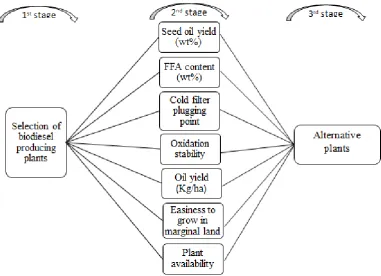
[image:3.595.107.489.440.716.2]The priority plants that can be used to produce biodiesel were determined by using Analytic Hierarchy Process (AHP) method. Seven criteria have been considered in the determination of the inedible plants. These criteria included seed oil yield, free fatty acid (FFA) content, cold filter plugging point, oxidation stability, oil yield, easiness to grow in marginal land and availability in tropical areas. Three stages were followed while evaluating the selected plants. The first stage of hierarchy was the selection of potential biodiesel plants. Subsequently, the second stage involves the consideration of criteria which were used to select the potential plants and the alternatives (non-edible plants) selection was the third stage. This plant selection hierarchy is depicted in Figure 1.
2.2. Non-edible plants
Based on existing information about biodiesel producing plants which has been found in previous literatures and conducted FGD sessions, several non-edible oil producing plants were chosen for this study. Most of the plants have several common names in accordance to its geographical locations and the discussion below could give some insight into its characteristics and properties.
2.2.1. Calophyllum inophyllum (Nyamplung)
Belonging to the family clusiaceae, it is a multipurpose tree which is commonly familiar as penaga laut in Malaysia and nyamplung worldwide [10]. This plant has multiple origins including wide availability in tropical areas [11]. It is one of the most efficient biodiesel feedstock because of its high seed oil yield [12]. The seed oil content is 51.2% (weight basis) having higher productivity or oil yield of 2000 (kg/ha). In addition, it has high oxidation stability, cold filter plugging point, and FFA content which are 8.5 h, −2 °C and 20 (wt%) respectively. Moreover, it can grow easily in marginal land[13].
2.2.2. Albizia saman (Monkey pod)
Monkey pod is a species from the pea family, fabaceae [14]. The oil production capacity of monkey pod plant is 180 kg/ha while its seed oil yield is 4.7% (w/w). Although, it has higher oxidation stability (6.5 h) and cold filter plugging point (−1 °C), it has low free fatty acid content (2 wt%). However, easiness to grow in marginal land as well as wide availability in tropical areas have been considered as important characteristics of this plant to be used as biodiesel feedstock [15].
2.2.3. Reutealis trisperma (Kemiri sunan)
Kemiri sunan or ‘Philippine tung’ is a monotypic plant which belongs to the family euphorbiaceae [16]. Compared to other biodiesel feedstock, higher oil content is considered as the major advantage of kemiri sunan [17]. Its oil yield is 5500 kg/ha and oil content of seed is 40.2 % of its weight. Its oxidation stability is 7 h while cold filter plugging point and FFA content are respectively −1 °C and 7 (wt%) [15]. In addition, it has specific oil characteristics, relatively rapid growth, wide distribution in tropical areas, easy growing capacity in marginal land as well as suitability for land conservation [17].
2.2.4. Calotropis gigantea (Indian milkweed)
2.2.5. Ceiba pentandra (Kapok)
Silk-cotton tree or kapok is the common name of Ceiba pentandra (family-malvaceae) [19]. It is found in tropical areas and can grow in marginal land as well. The seeds of the plant contain relatively high non-edible oil which makes it a potential source of biodiesel. The oil content of seed is 23.1 (wt%) having oil yield of 450 kg/ha. Its FFA content, cold filter plugging point and oxidation stability are respectively 15 (wt%), −4 °C and 0.8 h [15].
2.2.6. Jatropha curcas (Physic nut)
Purging nut or physic nut, is a multipurpose deciduous small tree or shrub, belongs to euphorbiaceae family [20]. Among the non-edible oil sources, this plant has gained tremendous importance as it has higher seed oil yield (45 wt%) and oil productivity of 2800 kg/ha. It is quite easy to grow in marginal land having distribution in tropical areas. FFA content of the oil is 14 (wt%). The oxidation stability and cold filter plugging point of the fuel produced from physic nut seed oil is 6.7 h and −2.5 °C respectively [15,21].
2.2.7. Leucaena leucocephala (Lead)
It is a leguminous fast growing tree which belongs to fabaceae family. Since, it was predominantly populated in Mexico and Central America but now it is naturalized in most of the tropical and sub-tropical regions around the world [22]. The advantages of using the plant in biodiesel industry is its capacity to grow in marginal land very easily and high oil yield (3000 kg/ha). The oil content of seed is 4.2% of its weight. It has lower FFA content (6%), cold filter plugging point (20 °C), and oxidation stability (1.7 h) [15,23–25].
2.2.8. Pongamia pinnata (Indian beech)
Belonging to the family fabaceae, the plant is mostly familiar as indian beech and karanja [26]. Although, the plant has been considered as a viable source of non-edible oil for the burgeoning biodiesel industry recently, this plant has been used predominantly for various purposes in India and some other parts of Asia [27]. The plant has a productivity of 2300 kg/ha oil while seed oil yield is 39.2 % of its weight. It can grow in marginal land easily. The oxidation stability of the fuel is 4.5 h. FFA content and cold filter plugging point are respectively 3 (wt%) and −3°C [15,28].
2.2.9. Senna siamea (Cassia)
2.2.10. Annona muricata (Soursop)
It is a broadleaf, flowering, and evergreen tree which is widely known as soursop, has emerged as a potential candidate for biodiesel production [30]. The plant is found in tropical areas and can grow in marginal land as well. The plant seed is rich in oil (20.5% of weight) with oil productivity of 300 kg/ha. The FFA content (4 wt%) and oxidation stability (0.6 h) are lower in the fuel whereas it has good cold filter plugging point (−1 °C) [15].
[image:6.595.61.542.233.675.2]The description summary of all the criteria is presented as Table 1.
Table 1. Criteria assessment of the non-edible plants.
Criteria evaluation Plants Name Seed oil yield (wt%) FFA content (wt%) Cold filter plugging point (°C) Oxidation stability (h) Oil yield (Kg/ha) Easier to grow in marginal land Plant availability in tropical area
Senna siamea (Cassia) 5.4 17 4 3.9 280 Easy Medium
Ceiba pentandra
(Kapok) 23.1 15 −4 0.8 450 Medium Medium
Leucaena
leucocephala (Lead) 4.2 6 20 1.7 3000 Very Easy Wide
Albizia saman
(Monkey pod) 4.7 2 −1 6.5 180 Medium Wide
Calotropis gigantean
(Indian milkweed) 33.3 28 8 1.4 500 Medium Wide
Annona muricata
(Soursop) 20.5 4 −1 0.6 300 Medium Medium
Pongamia pinnata
(Indian beech) 39.2 3 −3 4.5 2300 Easy Medium
Jatropha curcas
(Physic nut) 45.0 14 −2.5 6.7 2800 Very Easy Medium
Reutealis trisperma
(Kemiri sunan) 40.2 7 −1 7 5500 Easy Wide
Calophyllum inophyllum
(Nyamplung)
51.2 20 −2 8.5 2000 Easy Wide
2.3. AHP (Analytic Hierarchy Process)
structuring the hierarchy, (b) pairwise comparisons of criteria and alternatives (c) synthesis of the priorities and (d) consistency check [6,9].
2.3.1. Structuring the hierarchy
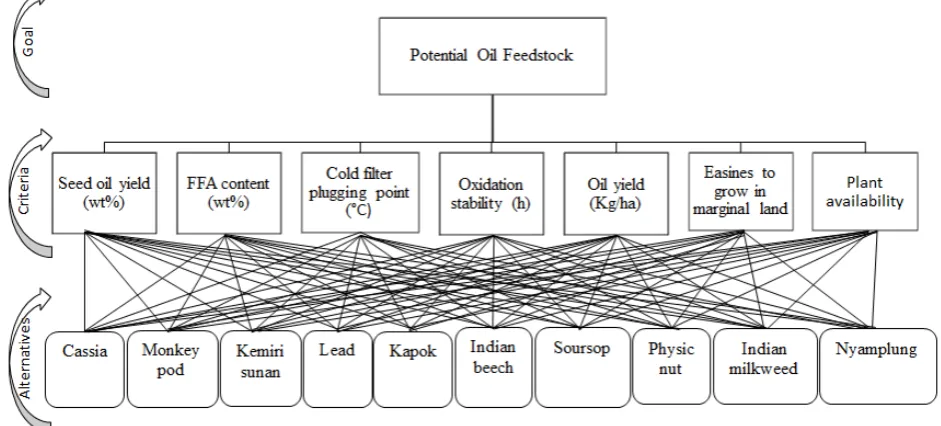
[image:7.595.62.533.296.509.2]A hierarchy, considered as a fundamental of AHP, is structured by breaking down a complex multi-criteria decision problem into interrelating decision elements; goal, criteria and alternatives. Hierarchy shows the relationship among different level of the hierarchy. The relationship is filtered down to the lower level representing the connection of one element with every other element (direct or indirect) [6,31]. In this study, a hierarchy is constructed to have three levels; the top level is the objective to be achieved, the middle level which is the criteria used to evaluate alternatives and the bottom level representing the alternatives to achieve the goal (Figure 2).
Figure 2. AHP Hierarchy.
2.3.2. Comparative judgment of the criteria and alternatives
The AHP computation was done based on pairwise comparison matrix which gives the relative importance of various attributes with respect to the objective. After decomposing the problem into the hierarchy, prioritization procedure starts to determine relative importance of criteria and alternatives. Saaty, (2008) considered the comparison or judgment as a numerical representation of the relationship between two elements which share a common parent. In AHP multiple pairwise comparisons, a standard comparison scale of nine levels is used to express degree of preference of one element over another (Table 2) [6,9].
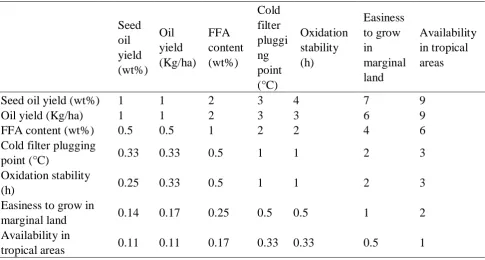
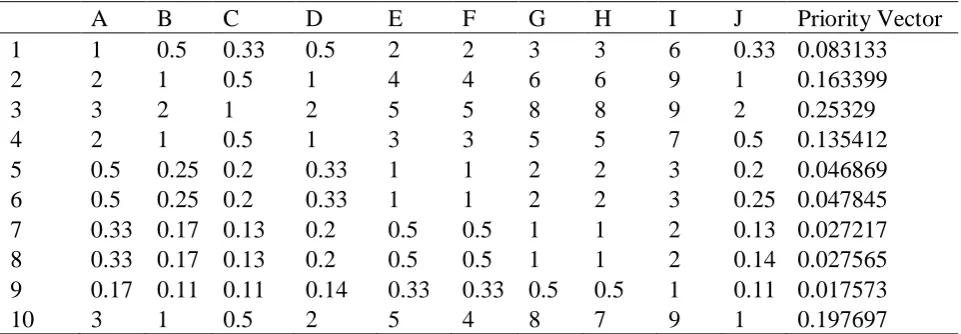
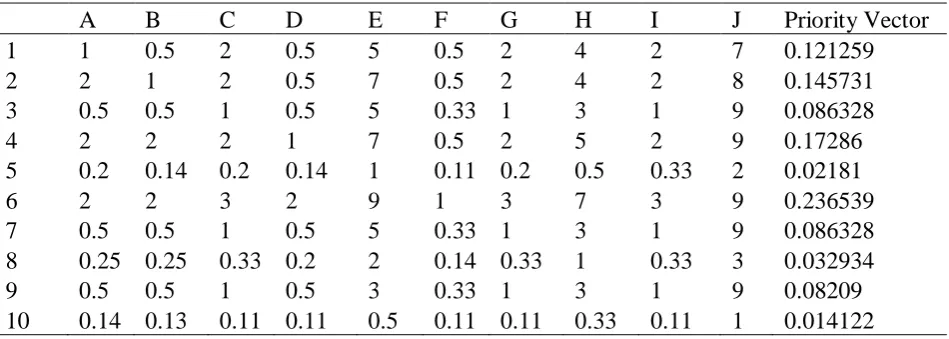
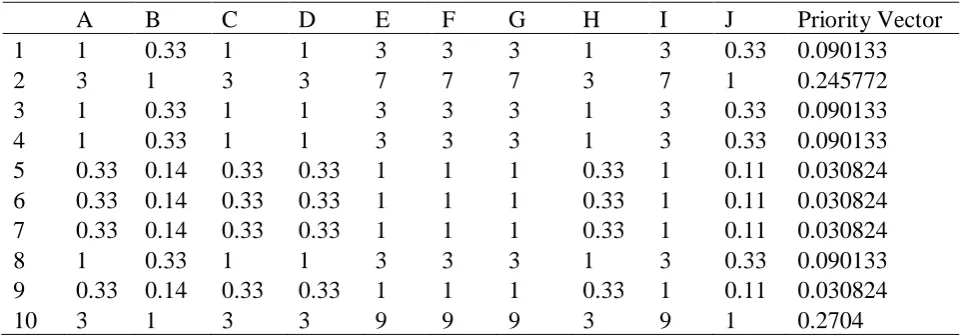
matrix was determined by Focus Group Discussion (FGD). In our study, FGD were conducted in three independent sessions, involving two experts from academia and two experts from the industry. The FGD is crucial in order to ensure that the criterion being chosen are not biased and based on a knowledge-based consensus. This procedure, although qualitative, is very important so that the vocabulary and terminology being used in biodiesel research area are correctly used, giving insight into public thought as well as supplying indicators of false criterion. The assessment regarding the importance (criteria weightage) of each criterion is presented as pairwise comparison matrix in Table 4 and the pairwise comparison matrix of alternatives regarding each criterion is listed as Tables 6–12.
Table 2. Fundamental scale of AHP.
Importance
value Degree of preference Explanation
1 Equally important Two elements have equal contribution to the objective.
3 Moderately important One element is slightly favored over another element. 5 Strongly important One element is strongly favored over another.
7 Very strongly important One element favor very strongly over another toward objective.
9 Extremely important One element is favored to the highest possible order over another.
*Note: Intermediate values are expressed by the values 2, 4, 6, and 8.
Table 3. Random Index (RI).
n 1 2 3 4 5 6 7 8 9 10
[image:8.595.57.543.511.771.2]RI 0.00 0.00 0.58 0.90 1.12 1.24 1.32 1.41 1.45 1.49
Table 4. Pairwise comparison matrix of criteria.
Seed oil yield (wt%) Oil yield (Kg/ha) FFA content (wt%) Cold filter pluggi ng point (°C) Oxidation stability (h) Easiness to grow in marginal land Availability in tropical areas
Seed oil yield (wt%) 1 1 2 3 4 7 9
Oil yield (Kg/ha) 1 1 2 3 3 6 9
FFA content (wt%) 0.5 0.5 1 2 2 4 6
Cold filter plugging
point (°C) 0.33 0.33 0.5 1 1 2 3
Oxidation stability
(h) 0.25 0.33 0.5 1 1 2 3
Easiness to grow in
marginal land 0.14 0.17 0.25 0.5 0.5 1 2
Availability in
Table 5. Results obtained from AHP computations for criteria.
Criteria Criteria
Weightage λmax, CI, RI CR
Seed oil yield 0.3002
λmax = 7.02
CI = 0.033
RI = 1.32
CR = 0.025
Oil yield 0.2817
FFA content 0.1664
Cold filter plugging point 0.0899
Oxidation stability 0.0865
[image:9.595.57.540.271.439.2]Easiness to grow in marginal land 0.0463 Availability in tropical areas 0.0289
Table 6. Pairwise comparison matrix of alternatives for seed oil yield criterion.
A B C D E F G H I J Priority Vector
1 1 2 2 2 3 4 4 9 9 9 0.266743
2 0.5 1 1 1 2 3 3 5 5 5 0.154008
3 0.5 1 1 1 2 3 3 5 5 5 0.154008
4 0.5 1 1 1 1 2 2 4 4 4 0.124057
5 0.33 0.5 0.5 1 1 2 2 3 3 4 0.098365
6 0.25 0.33 0.33 0.5 0.5 1 1 2 2 2 0.056923
7 0.25 0.33 0.33 0.5 0.5 1 1 2 2 2 0.056923
8 0.11 0.2 0.2 0.25 0.33 0.5 0.5 1 1 1 0.029929
9 0.11 0.2 0.2 0.25 0.33 0.5 0.5 1 1 1 0.029929
10 0.11 0.2 0.2 0.25 0.25 0.5 0.5 1 1 1 0.029114
*Note: A: Nyamplung, B: Physic nut, C: Kemiri sunan, D: Indian beech, E: Indian milkweed, F: Kapok G: Soursop, H: Cassia, I: Monkey pod, J: Lead. (λmax = 10.05507, CI = 0.00612, RI =1.49, CR = 0.00 ≤ 0.10).
Table7. Pairwise comparison matrix of alternatives for oil yield criterion.
A B C D E F G H I J Priority Vector
1 1 0.5 0.33 0.5 2 2 3 3 6 0.33 0.083133
2 2 1 0.5 1 4 4 6 6 9 1 0.163399
3 3 2 1 2 5 5 8 8 9 2 0.25329
4 2 1 0.5 1 3 3 5 5 7 0.5 0.135412
5 0.5 0.25 0.2 0.33 1 1 2 2 3 0.2 0.046869
6 0.5 0.25 0.2 0.33 1 1 2 2 3 0.25 0.047845
7 0.33 0.17 0.13 0.2 0.5 0.5 1 1 2 0.13 0.027217
8 0.33 0.17 0.13 0.2 0.5 0.5 1 1 2 0.14 0.027565
9 0.17 0.11 0.11 0.14 0.33 0.33 0.5 0.5 1 0.11 0.017573
10 3 1 0.5 2 5 4 8 7 9 1 0.197697
[image:9.595.58.539.507.674.2]Table 8. Pairwise comparison matrix of alternatives for oxidation stability criterion.
A B C D E F G H I J Priority Vector
1 1 2 2 5 9 9 9 6 2 9 0.27646
2 0.5 1 0.5 2 7 7 7 3 1 7 0.147196
3 0.5 2 1 3 9 9 9 5 2 9 0.221918
4 0.2 0.5 0.33 1 3 3 3 2 0.5 3 0.071724
5 0.11 0.14 0.11 0.33 1 1 1 0.5 0.2 1 0.024451
6 0.11 0.14 0.11 0.33 1 1 1 0.5 0.17 1 0.023989
7 0.11 0.14 0.11 0.33 1 1 1 0.5 0.14 1 0.02366
8 0.17 0.33 0.2 0.5 2 2 2 1 0.33 3 0.047745
9 0.5 1 0.5 2 5 6 7 3 1 7 0.139985
10 0.11 0.14 0.11 0.33 1 1 1 0.33 0.14 1 0.022873
*Note: A: Nyamplung, B: Physic nut, C: Kemiri sunan, D: Indian beech, E: Indian milkweed, F: Kapok G: Soursop, H:
[image:10.595.57.543.323.501.2]Cassia, I: Monkey pod, J: Lead. (λmax = 10.108094, CI = 0.012, RI = 1.49, CR = 0.01 ≤ 0.10).
Table 9. Pairwise comparison matrix of alternatives for FFA content criterion.
A B C D E F G H I J Priority Vector
1 1 2 3 7 0.5 2 6 2 9 4 0.196796
2 0.5 1 2 4 0.5 1 4 1 6 3 0.119766
3 0.33 0.5 1 2 0.25 0.5 2 0.5 5 1 0.063011
4 0.14 0.25 0.5 1 0.13 0.25 1 0.25 2 0.5 0.030116
5 2 2 4 8 1 2 8 2 9 6 0.253417
6 0.5 1 2 4 0.5 1 3 1 7 3 0.118284
7 0.17 0.25 0.5 1 0.13 0.33 1 0.25 2 1 0.033751
8 0.5 1 2 4 0.5 1 4 1 7 3 0.121619
9 0.11 0.17 0.2 0.5 0.11 0.14 0.5 0.14 1 0.5 0.018751
10 0.25 0.33 1 2 0.17 0.33 1 0.33 2 1 0.04449
*Note: A: Nyamplung, B: Physic nut, C: Kemiri sunan, D: Indian beech, E: Indian milkweed, F: Kapok G: Soursop, H: Cassia, I: Monkey pod, J: Lead. (λmax = 10.121698, CI = 0.013, RI = 1.49, CR = 0.01 ≤ 0.10).
Table 10. Pairwise comparison matrix of alternatives for cold filter plugging point criterion.
A B C D E F G H I J Priority Vector
1 1 0.5 2 0.5 5 0.5 2 4 2 7 0.121259
2 2 1 2 0.5 7 0.5 2 4 2 8 0.145731
3 0.5 0.5 1 0.5 5 0.33 1 3 1 9 0.086328
4 2 2 2 1 7 0.5 2 5 2 9 0.17286
5 0.2 0.14 0.2 0.14 1 0.11 0.2 0.5 0.33 2 0.02181
6 2 2 3 2 9 1 3 7 3 9 0.236539
7 0.5 0.5 1 0.5 5 0.33 1 3 1 9 0.086328
8 0.25 0.25 0.33 0.2 2 0.14 0.33 1 0.33 3 0.032934
9 0.5 0.5 1 0.5 3 0.33 1 3 1 9 0.08209
10 0.14 0.13 0.11 0.11 0.5 0.11 0.11 0.33 0.11 1 0.014122
[image:10.595.62.537.562.731.2]Table 11. Pairwise comparison matrix of alternatives for easiness to grow in marginal land criterion.
A B C D E F G H I J Priority Vector
1 1 0.33 1 1 3 3 3 1 3 0.33 0.090133
2 3 1 3 3 7 7 7 3 7 1 0.245772
3 1 0.33 1 1 3 3 3 1 3 0.33 0.090133
4 1 0.33 1 1 3 3 3 1 3 0.33 0.090133
5 0.33 0.14 0.33 0.33 1 1 1 0.33 1 0.11 0.030824
6 0.33 0.14 0.33 0.33 1 1 1 0.33 1 0.11 0.030824
7 0.33 0.14 0.33 0.33 1 1 1 0.33 1 0.11 0.030824
8 1 0.33 1 1 3 3 3 1 3 0.33 0.090133
9 0.33 0.14 0.33 0.33 1 1 1 0.33 1 0.11 0.030824
10 3 1 3 3 9 9 9 3 9 1 0.2704
*Note: A: Nyamplung, B: Physic nut, C: Kemiri sunan, D: Indian beech, E: Indian milkweed, F: Kapok G: Soursop, H: Cassia, I: Monkey pod, J: Lead. (λmax = 10.012673, CI = 0.0014, RI = 1.49, CR = 0.00 ≤ 0.10).
Table 12. Pairwise comparison matrix of alternatives for plant availability in tropical areas criterion.
A B C D E F G H I J Priority Vector
1 1 5 1 5 1 5 5 5 1 1 0.172449
2 0.2 1 0.2 1 0.2 1 1 1 0.2 0.2 0.03449
3 1 5 1 5 1 5 5 5 1 1 0.172449
4 0.2 1 0.2 1 0.25 1 1 1 0.25 0.25 0.036852
5 1 5 1 4 1 4 4 4 1 1 0.157735
6 0.2 1 0.2 1 0.25 1 1 1 0.25 0.25 0.036852
7 0.2 1 0.2 1 0.25 1 1 1 0.25 0.25 0.036852
8 0.2 1 0.2 1 0.25 1 1 1 0.25 0.25 0.036852
9 1 5 1 4 1 4 4 4 1 1 0.157735
10 1 5 1 4 1 4 4 4 1 1 0.157735
*Note: A: Nyamplung, B: Physic nut, C: Kemiri sunan, D: Indian beech, E: Indian milkweed, F: Kapok G: Soursop, H:
Cassia, I: Monkey pod, J: Lead. (λmax = 10.017945, CI = 0.002, RI = 1.49, CR = 0.00 ≤ 0.10)
2.3.3. Synthesis of the priorities
The data obtained from pairwise comparisons were organized in a matrix form as well as summarized based on Saaty (2008) eigenvector procedure. The pairwise comparison data were translated into numerical values and the normalized weight vector (w) was obtained by solving following equation (Eqs 1 and 2) [6,32].
Aw = λmax w (1)
w = (w1, w2, w3,…….., wn) (2)
[image:11.595.60.536.362.531.2]Maximum eigenvalue (λmax) was calculated by the Eq 3.
λmax = � �𝑎𝑖𝑗 𝑤𝑗
𝑤𝑖�
𝑛
𝑗=1 (3)
In Eq 3, the results showed a positive reciprocal matrix A= �𝑎𝑖𝑗� with 𝑎𝑗𝑖 = 1
𝑎𝑖𝑗. Here, 𝑎𝑖𝑗 is the
representation of numerical equivalence of the comparison between two criteria (criterion i and criterion j [6].
In case of complete consistency of pairwise comparisons, the matrix A hold the rank 1 and λmax = n. In this scenario, normalization of any of the rows or columns of A could be done to obtain criteria weightage [33].
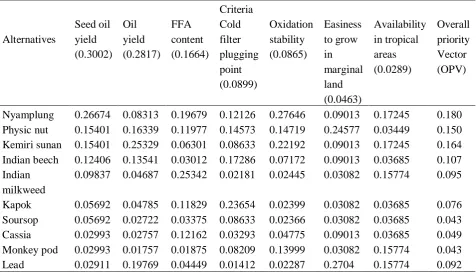
[image:12.595.61.538.345.620.2]The final stage of AHP calculation is the determination of Overall Priority Vector (OPV). The OPV was obtained by summing the product of the priority vector of alternative and the criteria weightage, with respect to that criterion. The Overall Priority Vector shows the rank of the alternatives with respect to the goal (Table 13) [6].
Table 13. Result of priority determination calculation of biodiesel producing plants.
Criteria Alternatives Seed oil yield (0.3002) Oil yield (0.2817) FFA content (0.1664) Cold filter plugging point (0.0899) Oxidation stability (0.0865) Easiness to grow in marginal land (0.0463) Availability in tropical areas (0.0289) Overall priority Vector (OPV)
Nyamplung 0.26674 0.08313 0.19679 0.12126 0.27646 0.09013 0.17245 0.180 Physic nut 0.15401 0.16339 0.11977 0.14573 0.14719 0.24577 0.03449 0.150 Kemiri sunan 0.15401 0.25329 0.06301 0.08633 0.22192 0.09013 0.17245 0.164 Indian beech 0.12406 0.13541 0.03012 0.17286 0.07172 0.09013 0.03685 0.107 Indian
milkweed
0.09837 0.04687 0.25342 0.02181 0.02445 0.03082 0.15774 0.095 Kapok 0.05692 0.04785 0.11829 0.23654 0.02399 0.03082 0.03685 0.076 Soursop 0.05692 0.02722 0.03375 0.08633 0.02366 0.03082 0.03685 0.043 Cassia 0.02993 0.02757 0.12162 0.03293 0.04775 0.09013 0.03685 0.049 Monkey pod 0.02993 0.01757 0.01875 0.08209 0.13999 0.03082 0.15774 0.043 Lead 0.02911 0.19769 0.04449 0.01412 0.02287 0.2704 0.15774 0.092 *Note: Equation for OPV calculation is modified from Albayrak and Erensal (2004) [6].
2.3.4. Consistency check
Since, the result quality is strictly related to the consistency of the assessment of the pairwise comparison, the relation between the entries of A define the consistency (Eq 4). Such as:
Consistency of the matrix of n order has been evaluated. As the comparisons are subjective in this method, AHP result might contain inconsistency because of the redundancy. If the consistency is higher than standard level the assessment or comparisons might be re-examined [9]. The Consistency Index (CI) has been calculated by using following equation (Eq 5).
CI = (𝜆𝑚𝑎𝑥−𝑛)
(𝑛−1) (5)
The final Consistency Ratio (CR), based on which it can be concluded whether the consistency of the assessment is sufficient, was calculated as a ratio of Random Index (RI) (Table 3) and Consistency Index (CI) (Eq 6) [6].
CR = CI/RI (6)
Consistency Ratio has been calculated carefully as the standard upper limit of CR is 0.1. If the final CR value exceeds the standard value, the evaluation procedure has to be repeated. It is useful in evaluating the consistency of decision makers and the hierarchy as well [6,9].
3. Results and discussion
According to the result of AHP computation on the importance of criteria weightage, seed oil yield (wt%) was the criterion of highest influence while determining biodiesel producing plant priority. On the other hand, the criterion with least influence was the availability in tropical areas. The results obtained as criteria weightage is listed from the highest to the lowest as follows–seed oil yield (0.3002), oil yield (0.2817), FFA content (0.1664), cold filter plugging point (0.0899), oxidation stability (0.0865), easiness to grow in marginal land (0.0463), and availability in tropical areas (0.0289) (Figure 3).
Figure 3. Results of criteria weighting.
[image:14.595.63.534.364.660.2]4. Conclusions
This study introduces a priority estimation model known as AHP which determines the priority vector of different non-edible plant oils that could be used as a biodiesel feedstock, particularly in the South-East-Asian region. The AHP methodology could be helpful in assessing relevant criteria critically and logically to make a sensible decision.
Although all the selected non-edible oil producing plants have the potential to be used as a biodiesel feedstock, nyamplung (Criteria weightage: 0.180) is the most feasible one and can be emphasized to be used as a suitable feedstock for biodiesel, according to the result of this study. On the other hand, soursop and monkey pod are the plants with the same importance (Criteria weightage: 0.043) which poses the least preference in case of selecting biodiesel producing plants. However, It should be noted that the recommended feedstocks are only highly potential, if it could be produced at commercial quantities that qualifies a biorefinery concept.
As AHP reduces bias decision by checking consistency, the result will be more reliable for future researchers. The results of the study could be useful to select non-edible plants to be developed in order to support the implementation of the government policy regarding biodiesel development. Moreover, findings from this study could aid decision making in the biodiesel industry to select best non-edible plant oil feedstock for biodiesel production.
Acknowledgments
The authors acknowledge University of Malaya (GPF016B-2018) and the Faculty of Science for providing the opportunity and support to conduct the research.
Conflict of interest
The authors declare no conflict of interest.
References
1. Rastogi RP, Pandey A, Larroche C, et al. (2018) Algal green energy-R&D and technological perspectives for biodiesel production. Renewable Sustainable Energy Rev 82: 2946–2969.
2. Anitha A, Dawn SS (2010) Spent groundnut oil for biodiesel production using supported heteropolyacids. 2nd International Conference on Chemical, Biological and Environmental Engineering, Chennai, India.
3. Ambat I, Srivastava V, Sillanpää M (2018) Recent advancement in biodiesel production methodologies using various feedstock: A review. Renewable Sustainable Energy Rev 90: 356–369. 4. Carvalho J, Ribeiro A, Castro J, et al. (2011) Biodiesel production by microalgae and
macroalgae from north littoral portuguese coast. WASTES: Solutions, Treatments and Opportunities 1st International Conference, September 12th–14th, Guimaraes, Portugal.
6. Albayrak E, Erensal YC (2004) Using analytic hierarchy process (AHP) to improve human performance. An application of multiple criteria decision making problem. J Intell Manuf 15: 491–503.
7. Vaidya OS, Kumar S (2006) Analytic hierarchy process: An overview of applications. Eur J Oper Res 169: 1–29.
8. Abdel-malak FF, Issa UH, Miky YH, et al. (2017) Applying decision-making techniques to Civil Engineering Projects. Beni-Suef Univ J Basic Appl Sci 6: 326–331.
9. Saaty TL (2008) Decision making with the analytic hierarchy process. Int J Ser Sci 1: 83–98. 10. Ong HC, Mahlia TMI, Masjuki HH, et al. (2011) Comparison of palm oil, Jatropha curcas
and Calophyllum inophyllum for biodiesel: A review. Renewable Sustainable Energy Rev 15: 3501–3515.
11. Atabani AE, César ADS (2014) Calophyllum inophyllum L.—A prospective non-edible biodiesel feedstock. Study of biodiesel production, properties, fatty acid composition, blending and engine performance. Renewable Sustainable Energy Rev 37: 644–655.
12. Fadhlullaha M, Widiyantoa SNB, Restiawatya E (2015) The potential of nyamplung (Calophyllum inophyllum L.) seed oil as biodiesel feedstock: Effect of seed moisture content and particle size on oil yield. Energy Procedia 68: 177–185.
13. Zakaria MB, Vijayasekaran, Ilham Z, et al. (2014) Anti-inflammatory activity of Calophyllum inophyllum fruits extracts. Procedia Chem 13: 218–220.
14. Manjunathan M, Vivek T, Sathishkumar S (2016) Performance of Albizia saman oil blend in CI engine. Int J Innovative Res Sci, Eng Technol 5: 14606–14616.
15. Phoo ZWMM, Ilham Z, Goembira F, et al. (2013) Physico-chemical properties of biodiesel from various feedstocks. Green Energy Technol 66: 113–121.
16. Riayatsyah TMI, Ong HC, Chong WT, et al. (2017) Life cycle cost and sensitivity analysis of
Reutealis trisperma as non-edible feedstock for future biodiesel production. Energies 10: 1–21. 17. Supriyadi S, Purwanto P, Anggoro DD, et al. (2018) Enhancing biodiesel from kemiri sunan oil
manufacturing using ultrasonics. E3S Web Conf 31: 1–5.
18. Phoo ZWMM, Razon LF, Knothe G, et al. (2014) Evaluation of Indian milkweed (Calotropis gigantea) seed oil as alternative feedstock for biodiesel. Ind Crops Prod 54: 226–232.
19. Kusumo F, Silitonga AS, Masjuki HH, et al. (2017) Optimization of transesterification process for Ceiba pentandra oil : A comparative study between kernel-based extreme learning machine and artificial neural networks. Energy 134: 24–34.
20. Kumar R, Das N (2018) Survey and selection of Jatropha curcasL. germplasm : Assessment of genetic variability and divergence studies on the seed traits and oil content. Ind Crops Prod
118: 125–130.
21. Ilham Z, Saka S (2010) Two-step supercritical dimethyl carbonate method for biodiesel production from Jatropha curcas oil. Bioresour Technol 101: 2735–2740.
22. Devi M, Ariharan VN, Prasad N (2013) Nutritive value and potential uses of Leucaena leucocephala as biofuel—A mini review. Res J Pharm, Biol Chem Sci 4: 515–521.
23. Ramli N, Ilham Z (2017) Mimosine toxicity in Leucaena biomass : A hurdle impeding maximum use for bio products and Bioenergy. Int J Environ Sci Nat Resour 6: 1–5.
25. Hakimi MI, Goembira F, Ilham Z (2017) Engine-compatible biodiesel from Leucaena leucocephala seed oil. J Soc Automot Eng Malays 1: 86–93.
26. Suryawanshi B, Mohanty B (2018) Modeling and optimization : Supercritical CO2 extraction of
Pongamia pinnata (L.) seed oil. J Environ Chem Eng 6: 2660–2673.
27. Atabani AE, Silitonga AS, Ong HC, et al. (2013) Non-edible vegetable oils: A critical evaluation of oil extraction, fatty acid compositions, biodiesel production, characteristics, engine performance and emissions production. Renewable Sustainable Energy Rev 18: 211–245.
28. Goembira F, Saka S (2015) Advanced supercritical methyl acetate method for biodiesel production from Pongamia pinnata oil. Renewable Energy 83: 1245–1249.
29. Mund NK, Dash D, Barik CR, et al. (2016) Chemical composition, pretreatments and saccharification of Senna siamea (Lam.) H.S. Irwin & Barneby: An efficient biomass producing tree legume. Bioresour Technol 207: 205–212.
30. Folorunsho AT, Ojediran J, Olawale O (2014) Solvent extraction of oil from soursop oilseeds & its quality characterization. Inte J Sustainable Energy Environ Res 3: 80–89.
31. Daǧdeviren M, Yavuz S, Kilinç N (2009) Weapon selection using the AHP and TOPSIS
methods under fuzzy environment. Expert Syst Appl 36: 8143–8151.
32. Morteza Z, Reza FM, Seddiq MM, et al. (2016) Selection of the optimal tourism site using the ANP and fuzzy TOPSIS in the framework of integrated coastal zone management: A case of Qeshm Island. Ocean Coastal Manage 130: 179–187.
33. Bitarafan M, Hosseini SB, Sabeti N, et al. (2016) The architectural evaluation of buildings’ indices in explosion crisis management. Alexandria Eng J 55: 3219–3228.