© 2018, IRJET | Impact Factor value: 6.171 | ISO 9001:2008 Certified Journal | Page 1240
DEVELOPING A COMPUTER BASED TECHNOLOGY FOR COST
ESCALATION IN CONSTRUCTION INDUSTRY
Joe M Vazhathara
1, Jeena Mathew
21
PG Student, Structural Engineering and Construction Management, Dept. of Civil Engineering, Sree Narayana
Gurukulam College of Engineering, Kadayiruppu P.O, Kolenchery, Ernakulam, Kerala, India
2
Assistant Professor, Dept. of Civil Engineering, Sree Narayana Gurukulam College of Engineering, Kadayiruppu
P.O, Kolenchery, Ernakulam, Kerala, India
---***---Abstract - The effective movement of events plays an
important role in successful operation of any organization. The project is said to be successful if it is completed on desired time and cost. The construction project delays are the major problems in public and private works. Delays frequently occurs in the life time of the construction projects and it cause cost overrun of the planned cost. Some major factors such as bad or inclement weather due to heavy rains and floods, scope changes, environmental protection and mitigation costs, schedule delay, strikes, technical challenges, inflation and local government pressures also causes of cost escalation. The escalation clauses provided in contracts are a means to cover unexpected costs resulting from the fluctuations in the prices for raw materials, fuels and labour during the construction project. By conducting surveys on some construction companies, it was found that the calculation for escalated cost is done manually. The aim of this study is to identify the causes and effects of cost escalation and schedule delays in the construction projects and to develop a software for calculating the escalated cost for entire project. This study also aims to analyse the benefits and obstacles of using computer applications for estimating the escalation of any construction projects.
Key Words: Inflation in all commodities, inflation in
cement, Inflation in steel, inflation in fuel, Inflation in bitumen, Inflation in labor rates, Price variation.
1. INTRODUCTION
Construction Industry is the backbone of our economy. But being an unorganized sector is always been surrounded by various problems relating to quality, contract administration safety. The contractor works in an environment of risk and uncertainty caused by the economic factors such as fluctuations in the costs of materials, labour and equipment [1]. In the construction industry Cost and time are the two major factors that are considered in construction project. When there is delay in any activity, the cost of construction is affected. The project is said to be successful when it is completed in desired time and cost. The construction delays are the major problems in public and private projects. This problem frequently occurs in the life time of the construction projects that may cause cost overrun of the planned cost.
Cost escalation and schedule overruns can occur due to a wide range of causes on various types of projects. If project costs or schedules exceed their planned targets, client satisfaction would be compromised. The funding profile would no longer match the budget requirement and further slippage in schedule could result. On the other hand, if the project quality does not meet design standards, the client’s satisfaction would be compromised, thus cost escalation and schedule overruns would result in an effort to improve the situation [3]. Contractors and suppliers working in today’s volatile materials market find that estimating, bidding and financing the construction projects are challenges. Many face significant losses or erosion of anticipated profits because many of them are locked into fixed price construction contracts where contractors bear the risk of material price and supplier cost increases [5]. If there is an unexpected rise in the market prices of key construction materials, a contractor will have no respite from such increases. It is necessary to have an escalation clause in the contract to guard against a sudden spurt in the cost of materials. On the other hand, if the contractor does not allow for inflation and interest rate correctly, his initial tender would be too low and he would suffer significant losses.
Cost escalation associated with government construction projects differ according to the country and the specific sector in which they are implemented. So, the study carried out for identification and evaluation of factors affecting cost escalation in Indian building construction projects. The preparation of preliminary list factor categories and factors affecting cost escalation, questionnaire formulation and survey details, analysis of survey responses for identification of factor affecting cost escalation and brief discussion on each identified cost escalation factors are presented. A case study analysis with respect to significant factors and factor categories affecting cost escalation realization and impact for various construction projects.
1.1 Concept of escalation
© 2018, IRJET | Impact Factor value: 6.171 | ISO 9001:2008 Certified Journal | Page 1241 original contract or base cost of a project due to passage of
time. Escalation means changes in price levels driven by underlying economic conditions. Escalation affects the budget and causes severe financial overrun by the contractor. It also adds to contingency in the contractor’s bid and is a major contributor to the overall cost uncertainty of escalation in his tender rates from the employer. Construction work is carried out according to the pre-confirmed contract agreement. To cope up with the sudden price escalation, regulated provision is necessary in construction contract document.
2. METHODOLOGY
In this research design, data collection methods were used, including observation, documentation, interviews, questionnaires and documentation analysis. The good design of the questionnaire is a key to obtain good results and warranting at a high rate of return. The methodology for the research includes:
Literature review
Preliminary data collection
Identify cost escalation in construction industry and its causes in construction industry.
Preparation of the questionnaire.
Distribution of questionnaire to the targeted response group.
Interviewing a person in charge of managing construction accounts.
Data collection and analysis.
Development of computerized system.
The study is based on the construction companies in Kerala and other states in India, and considers only first class and second class contracting companies.
2.1 Design of questionnaire
The questionnaire was built mainly using closed questions, and it was divided into four sections as follows.
Section one: Personnel information, which includes six items.
Section two: Company profile, which includes six items.
Section three: Previous works about cost escalation, which includes four items.
Section four: Cost escalation factors in construction projects, which includes 39 items.
After the preparation of the structured questionnaire, it was presented to three experts to examine its validity. They provide some comments and suggestions which were taken into consideration while re-modifying the questionnaire structure.
3. DATA ANALYSIS AND RESULT
As 20 respondent views are collected by field survey and so many other were collected by online survey from other districts and states in India regarding cost escalation in construction industry. From the respondents experience in the construction industries, the data were analyzed based on the Mean-score method using SPSS tool.
3.1 General Information
The general information of government contracting companies was investigated. The respondents for the survey includes 50% of the respondents were project managers, 30% were site engineers and 20% were owners of the organization. On considering the work experience 20% of the respondents have experience from 1 to 3 years, 30% have experience from 3 to 5 years, 15% have experience from 5 to 10 years and 35% have experienced more than 10 years. In 65% of the companies executing values more than 2 crores, 20 % of contracting companies executed projects with a value between 1.1 to 2 crores, and 15 % of contractors executed projects with a value of less than 50 lakhs. This indicates that most of executing projects are of bigger size.
3.2 Cost escalation in construction industry
1. Factors influence in cost escalation in construction industry (field survey).
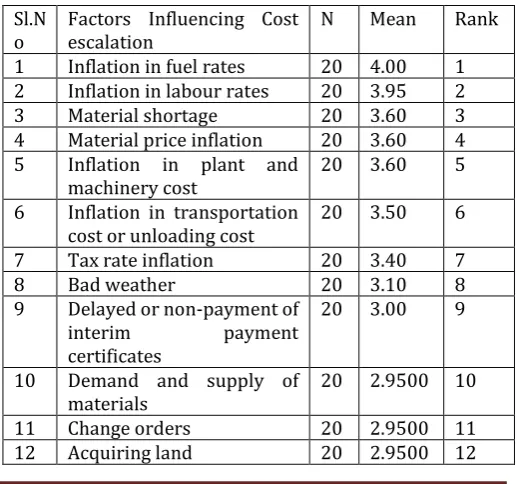
[image:2.595.307.566.536.778.2]From the questionnaire interview highlighted a number of factors that would cause cost escalation [11]. The factors were compared and analyzed to assess which ones would be said to be common as appraised by various interviewees. The important factors of cost escalation is ranked by using mean score method. The factors highlighted in table -1:
Table-1: Cost escalation factors
Sl.N
o Factors Influencing Cost escalation N Mean Rank 1 Inflation in fuel rates 20 4.00 1 2 Inflation in labour rates 20 3.95 2
3 Material shortage 20 3.60 3
4 Material price inflation 20 3.60 4 5 Inflation in plant and
machinery cost 20 3.60 5
6 Inflation in transportation
cost or unloading cost 20 3.50 6
7 Tax rate inflation 20 3.40 7
8 Bad weather 20 3.10 8
9 Delayed or non-payment of
interim payment
certificates
20 3.00 9
10 Demand and supply of
materials 20 2.9500 10
11 Change orders 20 2.9500 11
© 2018, IRJET | Impact Factor value: 6.171 | ISO 9001:2008 Certified Journal | Page 1242 13 Schedule delay or overrun 20 2.8500 13
14 Insufficient initial analysis
of costs 20 2.7500 14
15 Lack of coordination on site 20 2.6000 15 16 Project location 20 2.6000 16 17 Size of project 20 2.6000 17
18 Strikes 20 2.6000 18
19 Suspension of works 20 2.6000 19 20 Technical challenges 20 2.5500 20 21 Project condition 20 2.5500 21 22 Environmental protection
and mitigation cost 20 2.4500 22
23 Local government
pressures 20 2.4500 23
24 Poor contract management 20 2.3500 24 25 Unforeseen constructability
issues 20 2.3500 25
26 Unforeseen engineering
complexities 20 2.3000 26
27 New technology
requirements 20 2.2500 27
28 Poor technical performance 20 2.2500 28 29 Changes or unclear
regulatory requirements 20 2.2000 29 30 Disruption of political
continuity 20 2.2000 30
31 Lack of organizational
capabilities 20 2.1500 31
32 Corruption 20 2.1500 32
33 Safety and health issues 20 2.1500 33
34 Complexity of
administrative structure 20 2.1500 34 35 Disruption of management
continuity 20 2.0500 35
36 Illegal encroachment on
project sites 20 2.0000 36
37 Inexperienced
administrative personnel 20 2.0000 37
2. Factors influencing cost escalation in construction industry (Online survey)
Sl.N
o Factors Influencing Cost escalation N Mean Rank
1 Corruption 20 4.15 1
2 Acquiring land 20 3.89 2
3 Disruption of management
continuity 20 3.85 3
4 Tax rate inflation 20 3.95 4
5 Inflation in labour rates 20 3.75 5 6 Inflation in transportation
cost and labour cost 20 3.75 6
7 Material shortage 20 3.65 7
8 Delayed payment or non-payment of interim non-payment certificates
20 3.65 8
9 Poor contract management 20 3.65 9
10 Safety and health issues 20 3.65 10 11 Material price inflation 20 3.65 11
12 Project condition 20 3.55 12
13 Inflation in plant and
Machinery cost 20 3.55 13
14 Inflation in fuel rates 20 3.55 14
From the structured questionnaire survey results, the influencing key factors of the cost escalation and the constraints of implementing computerized applications in the cost escalation were analyzed. It was found that most of the companies use manual calculation for calculating cost escalation. But still it needs some improvement for this calculation method. For small construction projects manual calculation takes less time, but in large construction projects the manual calculation is difficult for manage. So the survey also identifies the important factors for cost escalation. This leads a possibility for developing cost escalation system for different construction projects.
3.2 Background study of cost escalation
By checking the past few years materials prices there has been a variations in the prices of steel, cement, brick, coarse aggregates, sand, bitumen, labour and other building materials.
The most of the government works like Central Public Works Department, Public Works Department, Military Engineering Services, Airport Authority of India and Bharath Sanchar Nigam Limited were using escalation clauses. In the CPWD Contract agreement, there are three escalation clauses namely Clause 10C, Clause 10CA and Clause 10CC (General conditions of contract for CPWD works (2008)). The price adjustment of the construction resources are based of the following equations:
Adjustment of Labour component
Price adjustment for increase or decrease in the cost due to labour shall be paid in accordance with the following formula:
VL = 0.85 x PL/100 X R X (Li - Lo)/Lo (1) VL = increase or decrease in the cost of work during the quarter under consideration due to changes in rates for local labour.
Lo = the average consumer price index for industrial workers for the quarter preceding the date of opening of Bids as published by Labour Bureau, Ministry of Labour, Government of India.
Li = the average consumer price index for industrial workers for the quarter under consideration as published by Labour Bureau, Ministry of Labour, Government of India.
© 2018, IRJET | Impact Factor value: 6.171 | ISO 9001:2008 Certified Journal | Page 1243 Adjustment of Cement component
VC = 0.85 x Pc/100 X R X (Ci - Co)/Co (2) Adjustment of Steel component
Vs = 0.85 x Ps/100 X R X (Si - So)/So (3) Adjustment of Bitumen component
Vb = 0.85 x Pb/100 X R X (Bi - Bo)/Bo (4) Adjustment of POL (fuel and lubricant) component Vf = 0.85 x Pf/100 X R X (Fi - Fo)/Fo (5) Adjustment of Plant and Machinery Spares component Vp = 0.85 x Pp/100 X R X (Pi - Po)/Po (6) Adjustment of Local materials (All commodities) Vm = 0.85 x Pm/100 X R X (Mi - Mo)/Mo (7)
4. DESIGN OF COST ESCALATION SYSTEM
A computer-based application is any program that can access only the registered users. The computer-based applications run with the .exe application. Computer-based applications are also known as software. The chapter describes the software components, the software evaluation, and benefits of CES. In computer-based construction cost escalation system, the application is designed using visual basic language. VBA (VB: Visual basic application) is a computer programming language which allows the user to create functions and the automation of specific computer processes and calculations. In this language the user do not have to buy a copy of visual basic professional because visual basic for application is a standard feature of Microsoft office packages. Also visual basic application (VBA) allows users additional customization beyond what is normally available in Microsoft Office products, such as Excel, Access, Word and PowerPoint. In VBA, user’s type commands into an editing module to create a macro. Macros allow users to automatically generate customized charts, reports and perform other data processing functions. This application can access only by the registered users only. They can access only by providing username and password. This provide security and protect it from information stealing.
Fig-1: Overall procedure of cost escalation
4.1 Functions of cost escalation system
Start sheet:- The authorized owner can login into the application by providing password. This must be made to establish in advance to ensure the privacy of the company itself.
Home page: - price escalation method
Type of work: - In this type of work link, displays to select which type of work escalation are going to do. From this page we have to select the type of work.
Price adjustment procedure: - Price adjustment link is to provide the managing ways to do cost escalation of specific work and its formulas.
Project details: - Project details link is to manage the complete details about the project and its payment certificates.
a. About work - used to enter the details of the current work. b. Agreement No. – used to enter the current work contractor agreement number.
c. Agreement date – used to enter the date of work commencement agreement date.
d. Authority – current work belongs to which authority. e. Contractor – the contractor’s details
f. Base date - means the last date of that calendar month, which date precedes the Bid Due Date by at least 28 (twenty eight) days.
g. Payment details - Interim payment certificates (including date, amount, description of work)
h. IPC Date - The date precedes the IPC date by at least 90 (ninety) days.
i. Description of work - The IPC based on the project Schedule.
j. Amount - Interim payment of each certificate.
Project percentage: - Project percentage link is to provide to select the appropriate work percentage from the current schedule of work.
Price index: - The price index is a pointer of the price movements of fixed base rate of commodities over time.
Percentage index: - The percentage link is to provide the current percentages which were calculating for the project.
© 2018, IRJET | Impact Factor value: 6.171 | ISO 9001:2008 Certified Journal | Page 1244 Price escalation calculation: - Price escalation is used to
calculate the variation price which may increase or decrease. The escalated price calculated from this link.
Interim payment certificates: - Interim payment certificate link is to provide to identify the variations of the calculations in each payment certificates. And the variation graph is also located in this interim payment certificates
.
Price adjustment summary: - Price adjustment summary link is to provide the entire work details as per schedule and the each payment certificate date and amount and the escalated percentage and the escalated amount is included.
Final contract amount: - Final contract amount link is to provide to calculate the variations of the total contract amount and the total escalated amount.
Memorandum of payments and Running account bill:- In this memorandum of payment is the official form for submitting to the government, the calculations of the escalated amount and the variations is included to submit to the authority.
5. CONCLUSIONS
Cost Escalated System (CES) was developed to satisfy some needs of contracting companies for calculating cost escalation. This chapter introduces the research conclusions. On the basis of case studies and questionnaire survey, the following conclusions were made:
The influencing key factors of the cost escalated system were established.
Based on the analysis of implementation of Cost escalation,
The calculation of cost escalation in large construction project is very complicate, so application for calculating cost escalation is very essential and monitoring the construction payment stages were the most important for cost escalation calculation.
Based on the analysis using computer applications in construction cost escalation,
Use of computer applications in construction cost escalation helps to get an outline and complete details of previous and ongoing works, including the cost, machine, labors etc. The WPI which is considered for calculation of escalation for civil engineering items comprises of construction materials which contain approximately 91% of materials those are not directly related to construction field. The compensation paid to the contractor based on the currently used escalation clause in CPWD contracts is not adequate as it considers WPI for its computation. Hence it is quite evident that the escalation calculated using WPI may not change the correct increase and may be adjust to either owner or contractor.
The study also showed that most of contracting companies did not use any software to calculate cost escalation and thus it leads to the design of cost escalation system.
The cost escalation system manages Company accounts staff. This application has unlimited storage space that based on the computer storage space and manage project documents of all types in a secure on this application.
REFERENCES
[1] K. Vamsidhar, D. A. Eshwarswaroop, K. Ayyappapreamkrishna,R. Gopinath (2014) “ Study and Rate Analysis of Escalation in Construction industry”Department of Civil Engineering, pp 14-25.
[2] S Vaishnavi Dev1, Assistant Professor R Jegan (2017) “Cost Escalation in Construction Projects” Department of Civil Engineering.
[3] ChabotaKaliba, MundiaMuya, KanyukaMumba (2009) “Cost escalation and schedule delays in road construction projects in Zambia” Department of Civil and Environmental Engineering.
[4] Graham M. Winch (2013) “Escalation in major projects: Lessons from the Channel Fixed Link” University of Manchester.
[5] Yaw Frimpong, Jacob Oluwoye, Lynn Crawford (2003) “Causes of delay and cost overruns in construction of groundwater projects in a developing countries; Ghana as a case study” Project Management Program.
[6] ZayyanaShehu, IntanRohaniEndut, AkintolaAkintoye, Gary D. Holt (2014) “Cost overrun in the Malaysian construction industry projects: A deeper insight” Professor of Construction Management and Economics.
[7] David Kinlan and Dirk Roukema (2011) “When is an Escalation Clause Necessary? Dealing with Price Fluctuations in Dredging Contracts” Terraet Aqua.
[8] Nabil Al-Hazim, Zaydoun Abu Salem, Hesham Ahmad (2017) “Delay and Cost Overrun in Infrastructure Projects in Jordan” Department of Civil and Infrastructure Engineering.
[9] Ghulam Abbas Niazi, Noel Painting (2017) “Significant Factors Causing Cost Overruns in the Construction Industry in Afghanistan” Department of Civil Engineering
[10] Ahmed Senouci, Alaa Ismail, Neil Eldin (2016) “Time Delay and Cost Overrun in Qatari Public Construction Projects” Department of Civil and Architectural Engineering
© 2018, IRJET | Impact Factor value: 6.171 | ISO 9001:2008 Certified Journal | Page 1245 [12] Kasimu M.A., Roslan Amiruddin, Fadhlin Abdullah
(2013) “The Significance Impacts of Knowledge Management on Cost Overruns in the Civil Engineering Construction Pojects in Nigeria” Department of Quantity Surveying
[13] M.S.Ramabodu, JJP Verster (2010) “Factors Contributing to Cost Overruns of Construction Projects” Department of Quantity Surveying and Construction Management