2016 International Congress on Computation Algorithms in Engineering (ICCAE 2016) ISBN: 978-1-60595-386-1
1 INTRODUCTION
Remote sensing technology originated in the early 1960s. It is widely used in environmental monitoring, vegetation classification and the military surveying and meteorological observation because of its rapid development in the field of spatial geographic infor-mation. Hyperspectral remote sensing represents one of the directions of the far-reaching modern remote sensing technology. It benefits from the development of imaging spectrum technology to combine the im-aging technology with spectral detection technology perfectly [1]. In recent years, many researchers have found that hyperspectral remote sensing image data sent back from satellite sensor presented high spectral resolution, high spatial resolution and high temporal resolution [2]. It makes the data size has a tendency of massive growth, so it’s complex to handle and time-consuming. The requirement of hardware and software platform needs improving, which makes it extremely important to compress hyperspectral image data, reduce dimension and deal with the noise before the image classification for hyperspectral image data, the decomposition of mixed pixels, target detection and other further researches.
MNF (Maximum Noise Fraction) is one of the
cur-rent mainstream methods, and it is widely applied to the feature extraction of hyperspectral remote sensing image. Scholars at home and abroad have lots of study on hyperspectral image feature extraction algorithm. Xiao Xiong-bin [3] extracted the feature through maximum noise fraction transform to reduce the di-mension of hyperspectral images and then carried on the RX and RX anomaly detection. Xu Yu-ming [4] and his fellows put forward the hyperspectral image classification method of combining the maximum noise fraction with the adaptive enhancement; the method of Wu Jun-zheng [5] and his fellows was based on the MNF and hyperspectral data feature extraction method of singular value decomposition; Tian Jiao-jiao [6] and his colleagues put forward the nuclear MNF algorithm based on the MNF algorithm, which can make the process more effective; Wu Yuan-feng and Gao Lian-ru [7] presented an optimal MNF feature extraction algorithm based on GPU platform, and optimized the hyperspectral image data parallel strat-egy, which achieved good results and shortened the processing time. Liu Xiang and Zhang Bing [8] as well as their colleagues combined the spatial with spectral dimension information. They made a noise covariance matrix assessment on hyperspectral image, making full use of the image space dimension information to
The Multi-Platform Implementation and Research
on MNF Algorithm to Hyperspectral Image
Xiaoqian You & Peng Lu
College of Computer Science and Technology, Chongqing University of Posts and Telecommunications, Chong-qing, China
ABSTRACT: According to the characteristics of hyperspectral remote sensing image data, a processing mech-anism of multi-language platform was proposed, as well as doing the challenging experiment of the hyperspectral image feature extraction. Then, to improve the processing efficiency and effects of hyperspectral image feature extraction, it gives a comprehensive assessment from perspectives of the time consumption and the effect of se-lected characteristics by evaluating pros and cons of the language platform. In this way, a suitable condition for the hyperspectral image data processing will be further found, which also provides a new method for people in this area. Moreover, the experiment result shows that the parallel/MNF algorithm is the most beneficial way. It is obviously and significantly superior to ENVI, Matlab and serial/MNF processing approach in the feature extrac-tion of hyperspectral remote sensing data.
improve the feature extraction and image classifica-tion accuracy. Gao Lian-ru [9] used the remaining local standard deviation analysis to evaluate image noise and obvious treating effect and so on. The algorithms of this study are various and just on one language platform, but there seemed to be little study on what kind of language and platform environment should be used to process hyperspectral image data. All the for-mer studies were unilateral study based on a single platform or one language, but there is a lack of way to catalogue the multiple language platform environ-ments.
This paper is based on this idea, and takes multiple languages and platform environments as the main part. MNF is used to experiment on the feature extraction of hyperspectral image data in the series, parallel and environments such as Matlab and ENVI. Finally, this paper compares and measures the time consumption, speed ratio and the effect of image extraction to ex-plore the suitable language and platform to process hyperspectral image data of three typical characteris-tics. The specific process is: First, use ENVI software and Matlab programming to do an experiment of fea-ture extraction on the intercepted part of Washington DC, and then experiment on the same remote sensing image with serial, parallel/MNF algorithms written in C language. Experiments show that the parallel/MNF algorithm has obvious advantages in the hyperspectral remote sensing image processing, but it is not very ideal in energy consumption and complexity. There-fore, this article also provides a new idea for hyper-spectral image processing in the aspects of energy consumption and speed ratio.
2 MNF ALGORITHM
Maximum noise fraction [10] is a theoretically and relatively complete component decomposition method that Green and his fellows use the SNR indexes to gain. With the SNR as measurement to make a com-ponential decomposition and arrangement on the hy-perspectral image, it is essentially two principal com-ponent transformations and it is usually used to deter-mine the inner dimension of image data, the noise in separated data, the spectral components extraction and image fusion, etc. MNF transformation can be summed up in solving the generalized eigenvalue and eigenvector problem (the generalized Rayleigh quo-tient) [10], among which the most critical step is to estimate the covariance matrix of image data and noise covariance matrix correctly. In many practical situations, these unknown covariance matrixes are usually estimated by covariance matrix of the image.
MNF transformation is mainly divided into three steps. Step one: Adjust and separate the noise of hy-perspectral image, the first high-pass filter template is used to filter the hyperspectral data, and get the noise covariance matrix
N
. Then diagonalize and label as N D . U U D N T
N (1)
In the above formula, DN is the diagonal matrix of
N
, the eigenvalue of which is permuted in descend-ing order.
U
is the orthogonal matrix which is composed of eigenvector. Change the formula (1) as:P P
I N
T
(2)
P is transformation matrix. I is unit matrix. 2
/ 1 UDN
P . When P is applied to hyperspectral data
X
, the original hyperspectral image data is pro-jected to a new space through the transformation for-mula YPX. The noise of transformation data pro-duced has unit variance, and bands are uncorrelated.Step 2: Transform the hyperspectral image se-quence data from step one by the following formula:
P PT D adj D
(3)
In the formula (3),
D is the covariance matrix ofthe hyperspectral image
X
. adj D is the matrix transformed by P. Then diagonalize again to get the formula:
V V D T Dadj
adj
D (4)
In the formula (4), DDadj is the diagonal matrix of
adj D
, whose eigenvalue is permuted in descending order, V is the orthogonal matrix composed of ei-genvector.
Step 3: Matrix P multiplies matrix V to get the transformation matrix
MNF
T :
PV
TMNF (5)
At last, convert the vector into corresponding im-age.
3 PARALLEL/MNF ALGORITHM
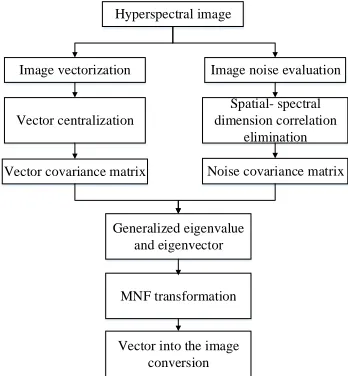
piece, video memory up to 6GB, and memory band-width up to 148GB/sec. Second, the algorithm through using hyperspectral image high correlation in spectral and spatial dimension removes the high correlation of the signal through multiple linear regression method, and then assesses the residual image noise. Algorithm flow chart is as follows:
Hyperspectral image
Image vectorization Image noise evaluation
Vector centralization
Spatial- spectral dimension correlation
elimination
Noise covariance matrix Vector covariance matrix
Generalized eigenvalue and eigenvector
MNF transformation
Vector into the image conversion
[image:3.516.66.240.137.325.2]
Figure 1. Algorithm flow chart.
In Figure 1, the image noise is the most crucial step in the evaluation. In this paper, based on hyperspectral image and the characteristics of MNF algorithm, noise
estimation kernel function is defined as follows: (1) Noise<<<dimGrid,dimBlock>>>(device_dataIn,
width,height,bands,xDims,yDims,devive_noiseData, newWidth,newHeigh);
Three-dimensional dimGrid and two-dimensional dimBlock dimGrid are adopted in Noise (Noise for Kernel function). The third dimension of dimGrid corresponds to band dimension of hyperspectral im-age:
(2) dimBlock(16,16);
(3) dimGrid((xBlock+dimBlock2.x-1)/dimBlock2.x, (yBlock+dimBlock2.y-1)/dimBlock2.y,bands);
The pseudocode of algorithm is shown as follows: 1: the unprocessed hyperspect image Xand band
P.
2:fori1:P
3: Xi (the mean of the ith band)
4:
i
i X
X
5: end
6:Y (the center matrix ofX) 7:YTY/(P1)(the covariance matrix of X)
8:1 9:fori1:P
10: ni (the noise mean of the ith band)
11: nini
12: end
13: N (the noise center matrix) 14: NTN/(P1)
N (the noise covariance
ma-trix) 15:
N 1
16: A (the eigenvector matrix of
1
N) 17: ZATY18: the eigenmatrix Z into image conversion
4 EXPERIMENT AND RESULT ANALYSIS
4.1 The test data
[image:3.516.323.402.314.412.2]The original data of this paper is acquired from HYDICE spectrometer of an area of Washington [11]. The spatial resolution is 18m, and the size is 1280 x 307 pixels, which contains 220 bands and retained the 191 bands after denoising, covering the wavelength range of 0.4um to 2.4um. And then intercept an image area whose pixel size is 307*450 to do an experiment.
Figure 2. False color image (307*450).
4.2 Experimental environment
In ENVI 4.8/32 environment, the MNF transformation process of image is simple, and the steps are concise. Matlab/MNF algorithm is based on R2010b version, using a corresponding language to implement. Seri-al/MNF algorithm is based on C/C++ language and combines with some basic math matrix function li-brary to realize. Parallel/MNF algorithm is based on CUDA architecture platform and combined with effi-cient math function library (MKL) as well as NVIDIA Cula or Cublas library to process matrix operation, which greatly reduces the matrix computation time and improve the overall speed ratio.
4.3 The test result analysis and comparison
edge contour of the image is clear, and the boundary distinguishes obviously, while Matlab/MNF algorithm gets poor result of extracting the same hyperspectral image features, image of fuzzy stripes, hazy outline and poor quality.
ENVI-MNF Matlab-MNF
[image:4.516.55.461.66.157.2]
Serial-MNF Parallel-MNF
Figure 3. Feature extraction results (the first band).
In the experiments, what Matlab/MNF algorithm adopts is tic and toc timing function, serial/MNF algo-rithm using clock function to time, and parallel/MNF using the Parallel Nsight timing tool. While for the extraction of ENVI hyperspectral image feature, it results in the inconvenience of the execution time statistics of algorithm due to the ENVI environment. Adopting other external statistical methods will cause the inaccuracy of the actual execution time of the al-gorithm, so it isn't mentioned.
The time data in Table 2 is the average time, which is respectively tested for 10 times in three kinds of language platform environment. It is more accurate and reasonable. The experimental results show that serial, parallel/MNF’s speed ratio can reach about 15 times, and the speed ratio of the Matlab and
[image:4.516.81.225.246.464.2]Paral-lel/MNF are about 8 times. On operation, ENVI/MNF algorithm is the simplest and most convenient algo-rithm. Though Matlab/MNF experiment which is tested in the platform of Matlab has a good encapsula-tion and conducts a large number of matrix operaencapsula-tions, it is relatively time-consuming and the acquired effect of image features is very poor. Serial/MNF algorithm involving in a large number of matrixes and covari-ance calculations in the calculation process, filled with large amount of complex calculation, it is the most time-consuming among the four kinds of algorithms. Parallel/MNF algorithm which is based on the CUDA GPU architecture and combined with NVIDIA effi-cient parallel acceleration library takes the least time among the four kinds of algorithms, and the image extraction effect is the best.
Table 2. Time-consumption of the algorithms.
Platform Environment
ENVI/ MNF
Matlab/ MNF
Serial/ MNF
Parallel/ MNF
Time (S) --- 20.172 36.745 2.406
From the aspects of feature extraction effect and time consumption, it can be concluded that the paral-lel/MNF algorithm is superior to the other three algo-rithms. Based on CUDA GPU parallel processing mechanism of architecture, the parallel/MNF algo-rithm is suitable for hyperspectral image feature ex-traction in order to improve the time performance of the algorithm while processing mass data level in hyperspectral image. At the same time, this paper also verified that the MNF algorithm is based on the SNR, and useful information of the image is mainly concen-trated in the first few components of hyperspectral image.
5 CONCLUSION
[image:4.516.263.461.372.408.2]The application of hyperspectral remote sensing image has important theoretical significance and practical application value in military, urban remote sensing and target detection. Moreover, nowadays, hyperspec-tral remote sensing image data presents a tendency of massive growth. In addition, the languages and plat-forms to deal with it are various and different, but lack
Table 1. The experiment of software and hardware environment.
ENVI/MNF Matlab/MNF Serial/MNF Parallel/MNF
Hardware Environment CPU: Intel E 5-2460;
Software Environment
Windows 7 32 bit ; Memory: 4GB;
ENVI 4.8 Matlab 2010b
CPU: Intle E5-2460;
NVIDIA Telsa C 2075
(448 processing cores, 6GB memory, 148GB/sec memory bandwidth); Microsoft Visual
Stu-dio 2008 C/C++;
CUDA 4.2 C;
the research on resource integration, analysis and comparison of languages and platforms. The main part of this article is based on the idea—the typical feature extraction algorithm. MNF, as an example, imple-ments and explores the relevant aspects to seek a suit-able language and environment platform, and provides a new idea for processing hyperspectral remote sens-ing image which has three typical characteristics. In the future, we will study the parallel acceleration from the aspects of hyperspectral image data level and en-ergy consumption.
REFERENCES
[1] Haina Zhao. 2014. Hyperspectral images feature extrac-tion algorithm based on GPU. Beijing: Graduate Institute of Chinese Academy of Sciences, pp: 9-30.
[2] Jin Zhao. 2011. Research the remote sensing image par-allel processing algorithm of GPU and optimization technology. Hunan: graduate school of National Univer-sity of Defense Technology, pp: 1-2.
[3] Xiongbin Xiao. 2012. Research on anomaly detection of hyperspectral image based on minimum noise fraction.
Computer Applications and Software. 29(4): 125-129.
[4] Yuming Xu. 2012. Hyperspectral remotely sensed image classification based on MNF and AdaBoosting. Lan-guage and Image Processing (ICAL IP), pp: 605-609. [5] Junzheng Wu. 2013. Feature extraction for hyperspectral
data based on MNF and singular value decomposition. Geoscience and Remote Sensing Symposium (IGARSS), pp: 1430-1433.
[6] Jiaojiao Tian. 2014. Improving change detection in for-est areas based on Stereo Panchromatic imagery using kernel MNF. Geoscience and Remote Sensing, 52(11): 7130-7139.
[7] Yuanfeng Wu & Lianru Gao. 2014. Real-time imple-mentation of optimized maximum noise fraction trans-form for feature extraction of hyperspectral images. Ge-oscience and Remote Sensing, 8(1): 1-17.
[8] Xiang Liu & Bing Zhang. 2009. A maximum noise frac-tion transform with improved noise estimafrac-tion for hy-perspectral images. Science in China series F: Infor-mation Sciences, 52(9): 1578-1587.
[9] Lianru Gao & Bing Zhang. 2013. Optimized maximum noise fraction for dimensionality reduction of Chinese HJ-1A hyperspectral data. EURASIP Journal on Ad-vances in Signal Processing, 65(2): 1-12.
[10] Xuchu Yu, Wufa Feng & Yangguo Peng. 2013. Analysis and application of hyperspectral image. Beijing. Science Press. 2013-2013.