STEP-NC CODE GENERATOR FOR DRILLING OPERATION USING GEN-M
NURUL ZAKIAH BINTI ZAMRI TAN
A thesis submitted in
fulfillment of the requirement for the award of the Degree of Master of Mechanical Engineering
Faculty of Mechanical and Manufacturing Engineering Universiti Tun Hussein Onn Malaysia
v
ABSTRACT
ABSTRAK
vii
CONTENTS
TITLE i
DECLARATION ii
DEDICATION iii
ACKNOWLEDGEMENTS iv
ABSTRACT v
CONTENTS vii
LIST OF TABLES x
LIST OF FIGURES xi
LIST OF SYMBOLS AND ABBREVIATIONS xiii
LIST OF APPENDICES xiv
CHAPTER 1 1
1.1 Research background 1
1.2 Research importance and impact 4
1.3 Research objectives 5
1.4 Research scope and limitation 5
1.5 Thesis organization 6
1.6 Summary 7
CHAPTER 2 8
2.1 Introduction 8
2.2 Manufacturing cycle 9
2.3 G & M code weakness. 10
2.4 Analysis of NC vs. STEP-NC program 12
2.4.1 Code arrangement 13 2.4.2 Character of code 13 2.4.3 Information in coding 15
2.5.1 The advantages of STEP-NC 19
2.5.2 Application of STEP-NC in manufacturing 21
2.6 Researches around the world 22
2.7 Research in Malaysia 24
2.8 Patented research 25
2.9 Programming language 26
2.9.1 STEP-NC 3-D simulation system for milling 26
2.9.2 AB-CAM 27
2.10 Critical review 31
2.11 Summary 32
CHAPTER 3 33
3.1 Introduction 33
3.2 Research Framework 33
3.3 Research Procedure 34
3.3.1 Determine the software requirements 36 3.3.2 Planning and Programming 36
3.3.3 Testing 42
3.3.4 Implementation 43 3.3.5 Verification 43
3.4 Case study 44
3.5 Development Tools 45
3.6 Summary 46
CHAPTER 4 47
4.1 Introduction 47
4.1.1 Header section 49 4.1.2 Data section 50
4.2 STEP-NC program verification 61
4.3 Summary 64
CHAPTER 5 65
ix
5.2 Research contribution 66
5.3 Suggestion for future work 68
5.4 Summary 69
REFERENCES 70
APPENDIX 75
LIST OF TABLES
Table 2.1: Character of code ... 14
Table 2.2: The ability of NC and STEP-NC program ... 17
Table 2.3: Information in NC and STEP-NC program ... 17
Table 2.4: Research around the world... 23
Table 2.5: Research in Malaysia ... 24
Table 2.6: Patented research ... 25
Table 2.7: Programming language ... 30
Table 3.1: Function of windows in GEN-M ... 37
Table 3.2: Object and properties ... 39
Table 4.1: Project ... 62
Table 4.2: Workplan ... 62
Table 4.3: Workpiece ... 62
Table 4.4: Round hole ... 62
Table 4.5: Twist drill ... 62
Table 4.6: Milling technology ... 63
Table 4.7: Material ... 63
Table 4.8: Property parameter ... 63
Table 4.9: Setup ... 63
Table 4.10: Workpiece ... 63
Table 4.11: Machining workingstep ... 63
Table 4.12: Drilling ... 63
xi
LIST OF FIGURES
Figure 2.1: Manufacturing flow ... 9
Figure 2.2: Information include in NC Program ... 15
Figure 2.3: Information include in STEP-NC Program ... 16
Figure 2.4: Possibility using STEP-NC ... 19
Figure 2.5: STEP-NC data transfer ... 22
Figure 2.6: Architecture diagram of 3-DMMSS (Zhu et al., 2006) ... 27
Figure 3.1: Suggestion of GEN-M development (Tan et al., 2009b). ... 34
Figure 3.2: GEN-M development ... 35
Figure 3.3: The Three Step Process ... 35
Figure 3.4: A sketch of GEN-M main window form for planning ... 38
Figure 3.5: GEN-M main windows in programming phase ... 39
Figure 3.6: Verification process ... 44
Figure 3.7: Case study of research ... 45
Figure 3.8: Visual Studio open page ... 46
Figure 4.1: GEN-M icon on desktop ... 48
Figure 4.2: GEN-M Main window ... 48
Figure 4.3: Check header to start ... 49
Figure 4.4: Generated code for header section ... 50
Figure 4.5: Project MDI parent window ... 50
Figure 4.6: New project window ... 51
Figure 4.7: What is Drilling window ... 51
Figure 4.8: Drill size and parameter window ... 52
Figure 4.9: Drilling Type Strategy window ... 52
Figure 4.10: Auto insert of tool information ... 53
Figure 4.11: Generated code for milling machine function ... 54
Figure 4.13: Exit MDI parent window ... 55
Figure 4.14: STEP-NC program for drilling process ... 55
Figure 4.15: Save generated STEP-NC program ... 56
Figure 4.16: STEP-NC program in Notepad ... 56
Figure 4.17: Clearing generated program ... 57
Figure 4.18: Open file ... 57
Figure 4.19: Opening default CAD program ... 58
Figure 4.20: Mail sent ... 59
Figure 4.21: Email receive ... 59
Figure 4.22: Website ... 60
Figure 4.23: About window ... 60
Figure 4.24: View information of workplan and workpiece definition ... 61
Figure 4.25: Exit GEN-M software ... 61
xiii
LIST OF SYMBOLS AND ABBREVIATIONS
ANSI - American National Standards Institute CAD - Computer Aided Design
CAM - Computer Aided Manufacturing CAPP - Computer Aided Process Planning CNC - Computer Numerical control DFX - Drawing Exchange Format
DWG - Drawing
EDM - Electric Discharge Machining EIA - Electronic Industries Alliance
F - Feed rate
G - Preparatory functions GUI - Graphical User Interface
IGES - Initial Graphics Exchange Specification ISO - International Organization for Standardization
M - Miscellaneous
MDI - Multiple Document Interface
MIT - Massachusetts Institute of Technology, NC - Numerical Control
PDM - Product Data Management
R - Radius
S - Spindle speed
SQL - Structured Query Language
STEP - Standard for the Exchange of Product model data
T - Tool
VB - Visual Basic
LIST OF APPENDICES
Appendix A: Interviews ... 75
Appendix B: List of Coding for GEN-M (Main form only) ... 79
Appendix C: Software verification (Similar codes) ... 86
CHAPTER 1
INTRODUCTION
1.1 Research background
The revolution of Computer Numerical Control (CNC) started at the end of Second World War. It was first discovered by John Parson in 1949 (Seames, 2001). Early CNC machine received command from punch card and tape and later computer was introduced to aid the programming (Seames, 2001). CNC may be unfamiliar term to some people but without notice, it has touched a lot of aspect in the daily life where many types of equipment are machined by CNC such as medical equipments, cutleries, war weapons and transportation. In mass production, CNC seems to have met the requirement in giving profit to manufacturers. Products are easily, faster, and repetitively produced using automation system (Smid, 2003).
(Thilmany, 2007) and the program is limited with information only on machine movement and some special features such as coolant. Data exchange with variety of file format is also sticky, when some file is broken and missing due to CNC vendor specific features. Therefore, it always needs new postprocessor every time to start new work piece machining. Due to the limitation of this code, STEP-NC was developed to replace ISO 6983 (Callen, 2002).
Modern manufacturing industries demand CNC a higher level input language than outdated G & M, and less proprietary vendor dependencies. In order to generate G & M programs for different CNCs, CAM tools need to know not only the particular brand and model of a CNC, but also need to have a detail description of the machine tool and their peripherals such as cutting tools and other auxiliary components (Xu et al., 2006).
This information is being handled by a special unit within a CAM tool called postprocessor. The ability to generate an Numerical Control (NC) tool path is now commonplace from CAD/CAM systems, but the technology used to program NC machines is still based on 1950’s standards which is known as G & M code (Smid, 2003).
It is almost fifty years G & M code used in manufacturing industry to machine part (Suh et al., 2008b). Along the way, a lot of enhancement constructed to enhance the way data transferred between CAD/CAM and CNC so it is easier, faster and agile around the world. In fact, the data is adaptable and able to be used at any brand of CNC machine with ignorant to the vendor specific function. This way, the G & M code does not need to recode again. There is no doubt CNC machine is becoming more advance to machine part but the problem of limited information in G & M code and limited data transfer is still there.
ISO 14649 which also known as STEP-NC is still in improvement phase with various research around the world where there are striving to create data transfer medium (software) with a lot more features (International Organization for Standardization, 2003). Due to the low STEP-NC research and acceptance in Malaysia, research is at low level and a lot of thing is possible to explore. As a suggestion to boost the research activities, a group of expert should form a committee to share knowledge, experience and expertise.
3 CAD/CAM system that are the ISO 14649 compliance and their levels of compliant will depend on the industrial use and software vendors acceptance of the standard (Smid, 2003).
Currently, research on STEP-NC is getting improved and when it is come to the implementation it is believed to be the remedy of G & M code’s drawbacks. STEP-NC will affect the manufacturer and production that uses CNC’s machine with G & M code program where the limitations of G & M codes make data transfer not agile and sharable with the CNC’s machine commonly is vendor specific design. From 1996 where ISO 14649 has been established until today, STEP-NC had catch worldwide concern and many researchers had take an opportunity to explore the STEP-NC, which they believe to be the remedy of G & M codes (Ibrahim, 2010; Minhat et al., 2009; Suh et al., 2002; Yusof et al., 2009).
After many years of effort, adaptation of STEP-NC has not started yet. CAM vendors have to add system interface that write STEP-NC data while CNC machine makers have to add interface to read data (Thilmany, 2007). Moreover, without necessary demand vendors are hesitant to invest. CAD/CAM/CNC vendors make their system specific and special. They are unwilling to reveal their algorithms. However, to put STEP-NC becomes reality full collaboration between CAD/CAM/CNC vendors has to be developed. The research questions that describe the goal of this study are listed as following:
i. What is needed to understand the fundamental of STEP-NC? ii. How to create software to generate STEP-NC codes?
1.2 Research importance and impact
This research is important in order to bring a new machining environment in manufacturing industry especially in Malaysia. As STEP-NC can bring ease and agile data transfer, it is an opportunity to develop a system that may replace the old system thus it makes variety in manufacturing industry.
Other significant of this research is to promote the advantages of STEP-NC. This will open an opportunity to hold cooperation between researcher in universities, manufacturing industries, users, software developers and CNC vendors. Consequently, this research brings understanding to ISO 14649 fundamental and concept behind it as the standard is the brain to the key in developing software to generate STEP-NC code. This research is also to bring understand to ISO 14649 fundamental and concept behind it, as the standard is the brain to the key in developing software to generate STEP-NC code.
5 1.3 Research objectives
The objectives of this research are:
i. To develop a software that capable to generate STEP-NC program for drilling in case study.
ii. To verify the generated program from the developed software with ISO 14649.
1.4 Research scope and limitation
The scope and limitation of this research will include as following:
i. The software is built to generate the STEP-NC code for drilling.
ii. This software is declared as non-commercialized application.
iii. The development of software is built using Visual Basic.Net 2010.
1.5 Thesis organization
This thesis is organized into five (5) chapters. Brief descriptions of each chapter are as following:
Chapter 1 describes the purpose of this thesis which encompasses the background and problem statements, the importance and impact of research, objectives, scope, and limitation in this thesis. Basically it visualizes what the research is about.
Chapter 2 is focus on the deep explanation of research background that tells the revolution of CNC usage in manufacturing industry. A summary of history background on discovering of CNC will picture the significant of CNC usage in daily life. This chapter also comprises the theory and basic fundamental of STEP-NC. Other researches regarding STEP-NC were reviewed and self point of view is inserted. It also includes with the analysis of NC and STEP-NC program and it result. From the literature review, a specific goal and direction of this research is determined. It provides an understanding on the fundamental knowledge regarding STEP-NC and how the research has been done.
Chapter 3 presents the methodology used in this research. It mainly contains how the research was conducted. The chapter contains of the research procedure of GEN-M development, selected case study, instrument and verification procedure.
7 1.6 Summary
This chapter gives basic overview of fundamental ideas on the research is about. It has outlined the objectives of the research, scope and limitations, and problem statements.
CHAPTER 2
LITERATURE REVIEW
2.1 Introduction
This literature review chapter contains the review of researches that has been done in the past ten years. It also describes the revolution of machining from conventional skills and machinery to modern CNC. A brief description on STEP-NC is also included to picture how it was discovered.
A comparative study between NC and STEP-NC program is also included. The comparative study contains of NC and STEP-NC program analysis and the result of analysis. This research is also added with some interviews to gain information and suggestion regarding STEP-NC that might help this research. The interview work is included in Appendix A.
9 2.2 Manufacturing cycle
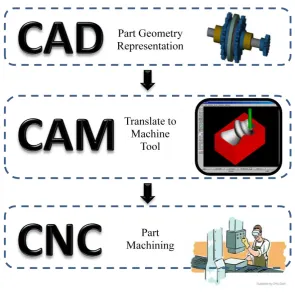
[image:20.595.167.463.370.662.2]Basically, in manufacturing process, it started from generating ideas and then the idea will be depicted into a sketch drawing. Nowadays, CAD is used to visualize the idea. CAD assist engineer to design part from simple line to 3D solid model. After designing with CAD, the drawing will be sent to CAM to generate machining tool paths based on user instruction (Kalpakjian et al., 2006). CAM assembles a series of these commands into machining instruction and converts all of it to G & M code that the machine controller can understand with a postprocessor. Postprocessor is a translator that allows the CAM software to understand the way CNC system work (Smid, 2003). Figure 2.1 depict the flow of machining process using CAD until part is machined using CNC system.
2.3 G & M code weakness.
Manufacturing in its definition is “made by hand” (Kalpakjian et al., 2006). Inside a room, many things can be found which all of them manufactured by human. In real manufacturing industry, many components used to create products are made individually. An example is a printer where each component that builds a printer may be produced by different department or even different factory. All parts that are used to build one product will undergo basic manufacturing flow. It starts from consumer demand, designing, selecting raw material, production batch, inspection, warehouse and shipping to market. The manufacturing process will take a long way and time but in real world, manufacturing become rapid and productivity is one of important factor to ensure products will reach the market in the shortest time as possible. Looking back to the older times, manufacturing started since the primitive era where human survive their everyday life by carving tools and equipments by using their hand. They invent things to ease their everyday lifework. They use raw material such as wood, stone, gold, bronze and suitable material they can get. They carved stone, chiseled wood, and made pottery to create new things. A person instinctively knows how to create and innovate things to support their daily life. From time to time people start creating something that more advanced, sophisticated and ease their work by using high technology that are available in line with the manufacturing era. People start to know how to use technology where they come out with simple machine with mechanical features such as gear, level, handle and dial. Equipment such as spinning wheel, waterwheel, tackle and windmill help people decrease on the work force used while more output can be obtained.
11 Numerical Control (NC) technology arrives when John Parson (1949-1955) (Smid, 2003; Olexa, 2001) at Massachusetts Institute of Technology (MIT) USA succeeded inventing rotor blade for helicopter where IBM computer was used and after few years later in 1955 NC is available in manufacturing industries. NC used a fixed logical function built in and permanently wired within the control unit. The function cannot be changed by machine operator thus its call as hardwired control. NC is an office environment where all changes are done away from the controller. In early NC system, punch tape was used as input for the programmed (Smid, 2003), CNC then arrived where it is called soft wired control (Smid, 2003) which used an internal microprocessor (a computer) but correction was still done away from the controller. There are various types of CNC machines that will do various task. Example of CNC machines that are currently available are mill and machining centers, lathes and turning centre, drilling machines, boring mill and profilers, Electrical Discharge Machining (EDM) machines, punch press and shears, flame cutting machines, routers, water jet and laser profilers, cylindrical grinders, and welding machines (Smid, 2003). As many of CNC machine type, plenty of machining work can be done repetitively without any concern to human weaknesses. The benefits (Smid, 2003) of using CNC machine are as the following list:
i. Setup time reduction ii. Lead time reduction
iii. Accurately and repetitively iv. Contouring of complex shape
v. Simplified tooling and work holding vi. Consistent cutting time
vii. General productivity increase
sharing between manufacturers is reliable as production of product may engage a few factories. CNC system is the brain of manufacturing system and allows a great deal of speed and precision, along with almost perfect repeatability. These factors combine to allow high tolerance parts to be created quickly.
Currently, many devices such as floppy disks, USB flash drives and local area networking has replaced the punch card on the NC controller; however there are controllers that still use punch tape to store machining data. Data transfer is an important thing to assure all parts design is linkable and can be read by others. However, G & M code has become a bottleneck for manufacturing process and even to develop a new generation of CNC system (Xu et al., 2006). There is no doubt that CNC system becoming more advanced and sophisticated but the drawback of the system is it still uses the old code which is the G & M code to transfer data. G & M is under ANSI standard (Kramer, 2007) code was developed by Electronic Industry Association (EIA) in the early 1960s. The code was revised and approved in year 1980 (Kramer, 2007). G & M code was also known as ISO 6983 and RS 247D (Kramer, 2007; Xu et al., 2004). CNC system should have replaced the used of the old code, to make the system more intelligent, autonomous and
multifunctional (Xu et al., 2004).
2.4 Analysis of NC vs. STEP-NC program
13 2.4.1 Code arrangement
STEP-NC program have more information regarding machining is put inside the program. The program must start with project and workplan as it is the executable to the whole program. It is not a compulsory that the arrangement of code is set up in certain line but it may be any line in the program. However, the entity in the program is linked to each other.
In NC program, the program start with the selection of tool and changing of tool is needed. After selecting the tool, the spindle speed and its rotation is selected. Then the position of tool is decided due to the XY plane. Tool length offset will be set and for every time of features machining the CNC system will on the coolant. When starting the machining process, the machine is first determine the fixed cycle, Z cutting motion and define the feed rate of tool. For each time of end features machining the tool will go back to Z0 and spindle motion is stop. In between the program, there will be the temporary stop for machining and lastly the CNC system end the machining process. The program is read line by line down forward where it also called as one dimensional data flow.
2.4.2 Character of code
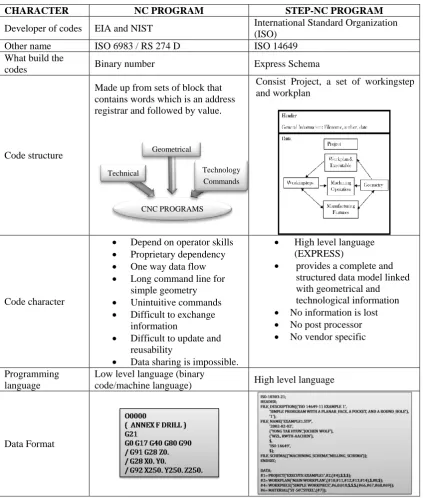
Each program obviously shows the differences of the characteristic. STEP-NC program is written with respectively identifier to each entity that symbolized with # and followed by number.
machining is G, M, T, S, and F. In NC programming there are few symbols to command the machining. From the analysis there is few special token used for NC operation (Seames, 2001). The differences are depicted in Table 2.1.
Table 2.1: Character of code
CHARACTER NC PROGRAM STEP-NC PROGRAM
Developer of codes EIA and NIST International Standard Organization
(ISO)
Other name ISO 6983 / RS 274 D ISO 14649
What build the
codes Binary number Express Schema
Code structure
Made up from sets of block that contains words which is an address registrar and followed by value.
Consist Project, a set of workingstep and workplan
Code character
Depend on operator skills
Proprietary dependency
One way data flow
Long command line for
simple geometry
Unintuitive commands
Difficult to exchange
information
Difficult to update and
reusability
Data sharing is impossible.
High level language
(EXPRESS)
provides a complete and
structured data model linked with geometrical and technological information
No information is lost
No post processor
No vendor specific
Programming language
Low level language (binary
code/machine language) High level language
15 2.4.3 Information in coding
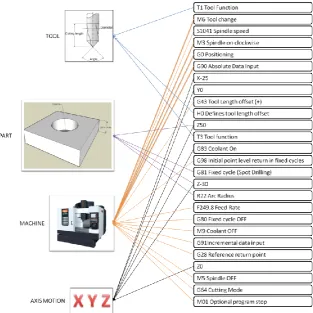
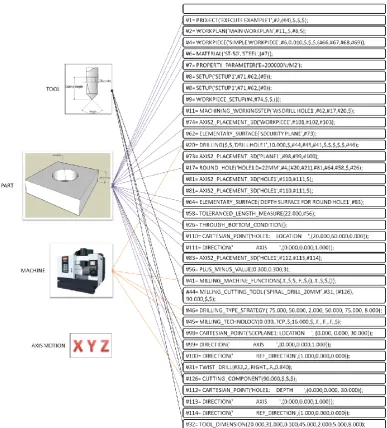
The analyses it can be recognized that information in both program is vary from each other. The information and its differences are pictured in Figure 2.2.
[image:26.595.164.478.318.631.2]In NC program that involved in CNC most information is regarding to the machine setting rather than to describe the part that going to be machined. Less information is on tool and the part. In CAM and CNC system users can check the information of part from CAM software which has detail information inside. However not everybody is able to use and understand to run the CAM software.
Figure 2.2: Information include in NC Program
skillful person to read the program as the program is written in word and number only. However in STEP-NC program, the readable and understandable word can guide the users to describe what is going to be done easily.
Figure 2.3: Information include in STEP-NC Program
17 dimension of tool body, technology specific information, axis placement and its dimension.
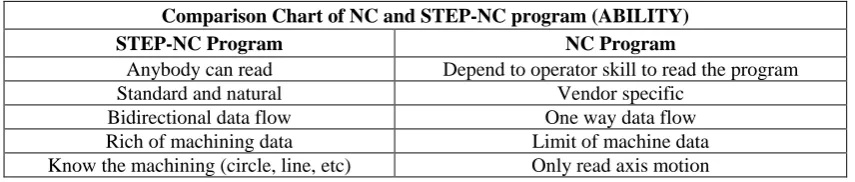
Table 2.2: The ability of NC and STEP-NC program
Comparison Chart of NC and STEP-NC program (ABILITY)
STEP-NC Program NC Program
Anybody can read Depend to operator skill to read the program
Standard and natural Vendor specific
Bidirectional data flow One way data flow
Rich of machining data Limit of machine data
Know the machining (circle, line, etc) Only read axis motion
Table 2.3: Information in NC and STEP-NC program
Comparison Chart of NC and STEP-NC program (INFORMATION)
Type of Information NC Program STEP-NC Program
Workpiece Definition √
Manufacturing √
Catalogue and machine body √
Catalogue and dimension of tool body √
Technology √ √
Axis Placement √ √
Setup √
Machine Function √ √
2.5 STEP-NC: Newcomers to manufacturing cycle
[image:28.595.105.535.323.451.2]2002. Recently, research and development for commercialization have been actively and collaboratively contributed by a large number of nations including Brazil, Canada, China, France, Germany, Japan, New Zealand, Pakistan, South Korea, Switzerland, UK, USA and so on (Suh et al., 2008c). Until today, research and development are still ongoing and no native STEP-NC machine has been build. However countries such as Germany, New Zealand, South Korea, Switzerland, USA, and UK has been succeeded developing a prototype of a native STEP-NC machine (Suh et al., 2008c).
With unpredictable change to market environment, there are demand to make CNC system to be interoperability, agile, adaptable, reconfigurable and sharable world widely and STEP-NC is believed to be its remedy. The data transfer issues is the most important reason STEP-NC is developed. STEP-NC means a new interface language for data exchange between CAM and CNC system. STEP-NC is also known as ISO 14649 which is an international standard specifying the data model for STEP-NC. It specifies information content and semantics for various manufacturing process and resources including the cutting tools and machine tools (Suh et al., 2008c).
The basic concept of STEP-NC is enables a product model database to serve as direct input to a CNC machine tool. There are no separate files of tool paths without G or M codes. The proprietary of postprocessor function can be avoided to machine a part. STEP-NC standardizes how information about CNC machining can be added to parts representation in the STEP-NC product model. STEP-NC provides an object oriented data model for CNC with a detailed and structured data interface that incorporates feature based programming where there is a range of information such as the feature to be machined, type of tools used, the operations to perform, and work plan. STEP-NC is very comprehensive and includes the information about features, operations, strategies, cutting tools, and so on (Albert, 2002).
STEP-NC contains the required functional information, such as workingstep, machining feature, machining operation, machining tool, machining strategy, machine function and work piece. In other words, STEP-NC includes much richer information set including ‘what-to-make’ (geometry) and ‘how-to-make’ (process plan).
19 introduced to solve the interoperability issues where the next generation of CNC machine is to be interoperable and adaptable which they can respond quickly to the changes in market demand and the manufacturing needs of customized product (Yusof, 2009).
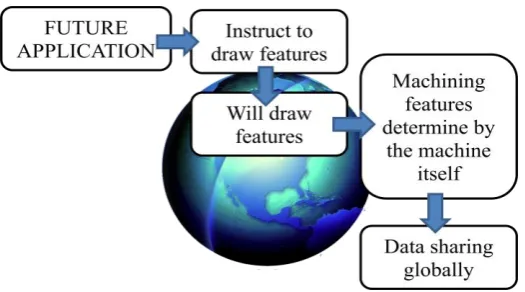
[image:30.595.190.453.337.483.2]The concept of STEP-NC is to enable data transfer around the world. The possibility is, with one click on the internet, data can be shared all over the world. STEP-NC controller not only able to machine part due to machine movement but it will understand overall machining process including geometry and its machine technology. Therewith, this new breed of data transfer method which known as STEP-NC will become new intelligent manufacturing system. Figure 2.4 shows the possibilities using STEP-NC in global arena.
Figure 2.4: Possibility using STEP-NC
2.5.1 The advantages of STEP-NC
with smart data machining. STEP-NC promises the possibilities of sharable and exchangeable machining data among manufacturer.
Ma (2005) stressed that STEP-NC provides a complete and structured data model linked with geometrical and technological information (Ma, 2005). No information is lost between the different stages of the product development process. Its data elements are adequate enough to describe task oriented NC data. Machining time for small to medium sized job can be reduced a lot because intelligent optimization can be built into the STEP-NC controllers. Post-processor mechanism will be eliminated, as the interface does not require machine-specific information. Machine tools are safer and more adaptable because STEP-NC is independent from machine tool vendors. Modification at the shop - floor can be saved and fed back to the design department hence bi-directional information flow from CAD/CAM to CNC machines can be achieved. XML files can be used as an information carrier and enables Web-based distributed manufacturing (Ma, 2005).
21 2.5.2 Application of STEP-NC in manufacturing
Although it has been a few years standard for STEP-NC has establish, the implementation to industries is quit slow (Thilmany, 2007). The specific features of CNC machine for each vendor will be no longer used if STEP-NC is utilized. The specific features make users stay for their technology and give more profit for vendors. STEP-NC provides a standard data format that can be easily shared around the world. In user’s side such as manufacture, to setup new technology took time and costly. CAM programmer will stay for STEP paradigm as CNC vendor and user
don’t want to apply STEP-NC because they do not aware of it benefits (Tan et al., 2009a). Besides that, there are multi-discipline of knowledge involve.
Engineer or people on mechanical engineering background find it is difficult to understand the programming language. Express language becomes an obstacle which the language is very difficult to understand. To develop the software requires a skill of a few of programming language that necessary. Collaboration should be made between people who in engineering and software programming disciplinary where software development process is one of the methods to develop software to generate STEP-NC program and to understand EXPRESS language that model the STEP-NC data structure.
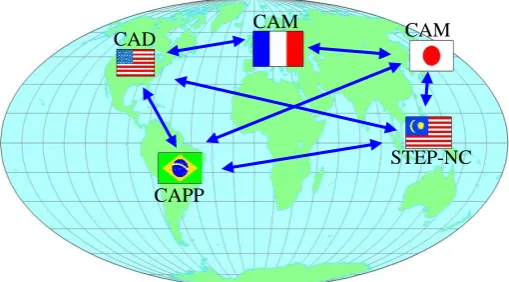
Figure 2.5: STEP-NC data transfer
It concludes the discovery of STEP-NC and here after G & M code will not be used as its weakness. As the technology of G & M code has been used in about 50 years, there are few controversy and breakthrough to implement the new standard. However, as it gain worldwide consensus, many researchers take part in this research field (Ibrahim, 2010; Minhat et al., 2009; Suh et al., 2002; Yusof et al., 2009). It is believe to be good possibilities and new step to bring this research field to the next advance level.
2.6 Researches around the world
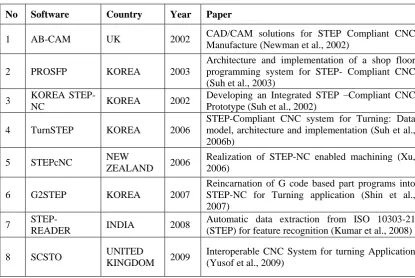
After the code has been established, researchers struggled to make STEP-NC implementable to CNC system. Table 2.4 shows researches that have been established around the world. Countries such as Korea, USA, CANADA and UK have developed a STEP-NC generator, even STEP-NC prototype machine system (Shin et al., 2007; Kumar et al., 2008; Newman et al., 2002; Suh et al., 2002; Suh et al., 2006b; Suh et al., 2003; Xu, 2006; Yusof et al., 2009). They also made a collaboration to boost up the development of STEP-NC research. Without proper planning and study, in short term, manufacturing industries sees implementation of new technology as costly and hard to be implemented, as they have to set up new
CAD CAM
STEP-NC
CAPP
23 machines and production process will be halted due to all the installation and testing done. However in the long term, STEP-NC will help manufacturers overcome the G & M code drawbacks and their data can be shared all over the world, as STEP-NC promised that its data can be transferred globally.
Table 2.4: Research around the world
No Software Country Year Paper
1 AB-CAM UK 2002 CAD/CAM solutions for STEP Compliant CNC
Manufacture (Newman et al., 2002)
2 PROSFP KOREA 2003
Architecture and implementation of a shop floor programming system for STEP- Compliant CNC (Suh et al., 2003)
3 KOREA
STEP-NC KOREA 2002
Developing an Integrated STEP –Compliant CNC Prototype (Suh et al., 2002)
4 TurnSTEP KOREA 2006
STEP-Compliant CNC system for Turning: Data model, architecture and implementation (Suh et al., 2006b)
5 STEPcNC NEW
ZEALAND 2006
Realization of STEP-NC enabled machining (Xu, 2006)
6 G2STEP KOREA 2007
Reincarnation of G code based part programs into STEP-NC for Turning application (Shin et al., 2007)
7
STEP-READER INDIA 2008
Automatic data extraction from ISO 10303-21 (STEP) for feature recognition (Kumar et al., 2008)
8 SCSTO UNITED
KINGDOM 2009
Interoperable CNC System for turning Application (Yusof et al., 2009)
2.7 Research in Malaysia
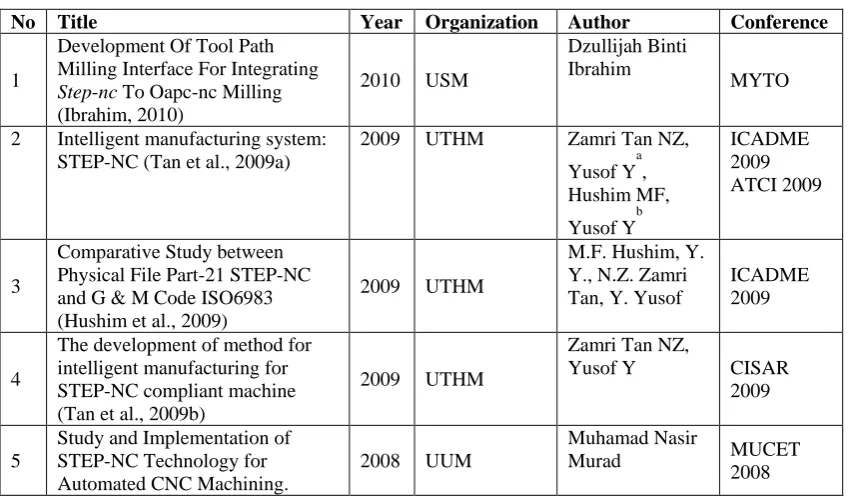
Research in Malaysia started a little bit late and although some academician have started they still hiding their research and insist not to share their knowledge. Looking for other researcher experience such ISO 14649 committee, they are big hearted to hold cooperation and reviewed their research progress to boost their current research. Table 2.5 simplified the number of research that available in Malaysia.
[image:35.595.108.533.377.625.2]From the review, only few names have started but it is a good opportunity to promote STEP-NC and encourage more researcher and relevant industry to cooperate and makes new things in the research.
Table 2.5: Research in Malaysia
No Title Year Organization Author Conference
1
Development Of Tool Path Milling Interface For Integrating
Step-nc To Oapc-nc Milling (Ibrahim, 2010)
2010 USM
Dzullijah Binti Ibrahim
MYTO
2 Intelligent manufacturing system:
STEP-NC (Tan et al., 2009a)
2009 UTHM Zamri Tan NZ,
Yusof Y a , Hushim MF, Yusof Y b ICADME 2009 ATCI 2009 3
Comparative Study between Physical File Part-21 STEP-NC and G & M Code ISO6983 (Hushim et al., 2009)
2009 UTHM
M.F. Hushim, Y. Y., N.Z. Zamri Tan, Y. Yusof
ICADME 2009
4
The development of method for intelligent manufacturing for STEP-NC compliant machine (Tan et al., 2009b)
2009 UTHM
Zamri Tan NZ,
Yusof Y CISAR
2009
5
Study and Implementation of STEP-NC Technology for Automated CNC Machining.
2008 UUM
Muhamad Nasir
Murad MUCET
70
REFERENCES
Albert, M. (2002). Plugging into STEP NC - Emphasis: CNC - CAM software firms offer programs for CNC machines. Retrieved from http://www.cncinformation.com/cad-cam-cad-cam-cad-cam/plugging-into-step-nc-3
Bradley, R. (2001). Understanding Computer Science for Advanced Level: The Study Guide United Kingdom: Nelson Thornes Ltd.
Callen, J. (2002). Enabling Manufacturing's Future Without Limits. Retrieved from http://www.mmsonline.com/
Chunyan, Y., Minghui, W., Nairuo, L., Yueting, Z., & Yunhe, P. (2003). Translating EXPRESS Language Model into C Language Model. ACM SIGPLAN Notices, 38(6), 30-40.
Hushim, M. F., Yusof, Y., Tan, N. Z. Z., & Yusof, Y. (2009). Comparative Study between Physical File Part-21 STEP-NC and G&M Code ISO6983 Conference name. Conference location: 8C1-4
Ibrahim, D. (2010). Development of Tool Path Milling Interface for Integrating Step-nc to Oapc-Step-nc Milling. University of ScieStep-nce Malaysia, Penang.
International Organization for Standardization (2004a). ISO 14649-10:2004 Industrial automation systems and integration -- Physical device control -- Data model for computerized numerical controllers -- Part 10: General process data. Location: Number of Standard.
International Organization for Standardization (2004b). ISO 14649-11:2004 Industrial automation systems and integration -- Physical device control -- Data model for computerized numerical controllers -- Part 11: Process data for milling. Location: Number of Standard.
Kalpakjian, S., & Schmid, S. (2006). Manufacturing, Engineering & Technology Peaeson, Prentice Hall.
Kramer, T. R. (2007). Evaluating manufacturing machine control language standards: an implementer's view. Paper presented at the Proceedings of the 2007 Workshop on Performance Metrics for Intelligent Systems.
Kumar, A., & Saha, J. (2008). Automatic Data Extraction From ISO10303-21 (STEP) For Feature Recognition.
Lee, W., & Bang, Y. B. (2003). Development of ISO14649 Compliant CNC Milling Machine Operated by STEP-NC in XML Format International Journal of the KPSE, 4(5), 7.
Ma, Z. (2005). Database Modeling for Industrial Data Management: Emerging Technologies and Applications: Idea Group Inc (IGI).
Minhat, M., Vyatkin, V., Xu, X., Wong, S., & Al-Bayaa, Z. (2009). A Novel Open CNC Architecture Based on STEP-NC Data Model and IEC 61499 Function Blocks. Robot Computer Integrated Manufacturing, 25(3), 560-569.
72
Olexa, R. (2001). The Father of the Second Industrial Revolution. Manufacturing Engineeering, 127.
Plenderleith, J., & Bunn, S. (2009). Microsoft Visual Studio 2008 Programming: McGraw-Hill.
Roberto, S. U., Shin, J. S., Allen, R. D., & Newman, S. T. (2002). Future Issues For CAD/CAM and Intelligent CNC Manufacturer. Conference name. Conference location: 1-10.
S., A., & R., A. (2006). Express-G, Relational Model For Integrated Feasibility Study System For Building Project. Jurnal Alam Bina.
Seames, W. S. (2001). Computer Numerical Control: Concepts and Programming: Cengage Learning.
Shin, S.-J., Suh, S.-H., & Stroud, I. (2007). Reincarnation of G-code based part programs into STEP-NC for turning applications. Computer Aided Design, 39(1), 1-16.
Smid, P. (2003). CNC Programming Handbook: A Comprehensive Guide to Practical CNC Programming New York: Industrial Press Inc.
Suh, S. H., & Cheon, S. U. (2006a). Intelligent STEP-NC Controller US 7,099,737 B2
Suh, S. H., Cheon, S. U., & Lee, B. E. (2004). Method for automatically genrating part program for use in STEP-NC US 6,795,749 B2
Suh, S. H., Chung, D. H., Lee, B. E., Cho, J. H., Cheon, S. U., Hong, H. D., et al. (2002). Developing an Integrated STEP-Compliant CNC Prototype. Journal of Manufacturing Systems, 21, 350-362.
Suh, S. H., Chung, D. H., Lee, B. E., Shin, S. J., Choi, Y. J., & Kim, K. M. (2006b). STEP-compliant CNC system for turning: Data model, architecture, and implementation. Computer-Aided Design, 38(6), 677-688.
Suh, S. H., Kang, S. K., & Chung, D. H. (2008b). Theory and Design of CNC Systems Springer.
Suh, S. H., Kang, S. K., Chung, D. H., & Stroud, I. (2008c). Theory and Design of CNC Systems: Springer Publishing Company, Incorporated.
Suh, S. H., Lee, B. E., Chung, D. H., & Cheon, S. U. (2003). Architecture and implementation of a shop-floor programming system for STEP-compliant CNC. Computer-Aided Design, 35(12), 1069-1083.
Suh, S. H., & Shin, S. J. (2008d). Transformation method of G Code into STEP-NC part program US 2008/0281462 A1
Suteja, J. (2005). The Role Of STEP-NC in Improving The Performance of Supply Chain. Jurnal Teknik Industri 7(2), 6.
Tan, N. Z. Z., Yusof, Y., Hushim, M. F., & Yusof, Y. (2009a). Intelligent Manufacturing System: STEP-NC Conference name. Conference location: 8D1-6.
74
Technology Park Malaysia. CNC Machine Tools. from
http://www.tpm.com.my/index.php?option=com_content&task=view&id=36 &Itemid=59
Thilmany, J. (2007). Beyond Step: With a New Standard CNC Machines Can Read CAD and CAM Files Directly. Mechanical Engineering from http://memagazine.org/backissues/membersonly/oct07/features/beyond/beyon d.html
Xu, X. W. (2006). Realization of STEP-NC enabled machining. Robotics and Computer-Integrated Manufacturing, 22(2), 144-153.
Xu, X. W., & He, Q. (2004). Striving For a Total Integration of CAD, CAPP, CAM and CNC. Robotics and Computer-Integrated Manufacturing, 20(2), 101-109.
Xu, X. W., & Newman, S. T. (2006). Making CNC machine tools more open, interoperable and intelligent--a review of the technologies. Computers in Industry, 57(2), 141-152.
Yusof, Y. (2009). STEP-NC-Compliant Systems for the Manufacturing Environment. Proceeding of World Academy of Science, Engineering and Technology, 37, 935-940.
Yusof, Y., Newman, S., Nassehi, A., & Case, K. (2009). Interoperable CNC System for Turning Operations. Proceeding of World Academic of Science, Engineering and Technology, 37, 928-934.