INTEGRATED DEBIT CUM CREDIT CARD WITH DYNAMIC
CARD SELECTION AND CARD LOCKING
1S. RAJARAJAN, 2 K.S. SURESH, 3M. PRABHU
SASTRA UNIVERSITY, SCHOOL OF COMPUTING, THANJAVUR, INDIA. E-mail: [email protected], [email protected],[email protected]
ABSTRACT
Banking cards are widely used for performing various financial transactions. The usage of cards is considered to be convenient and safe over transactions by cash payments. There are several types of cards available today and among them, the debit and credit cards are the most commonly used. Debit cards are provided by the banks to the account holders in order access the accounts electronically. A credit card is a payment card issued to the users as a system of payment. Every credit card holder gets a revolving account with the card issuing bank and granted with a line of credit. Most of the banks offer both credit cards and debit cards. Due to the benefits of debit and credit cards, a normal customer would prefer to have both the cards and selectively use either of the cards for a transaction. Even though it is beneficial to have both the cards, carrying two separate cards everywhere is regarded as inconvenient and unsafe. So the objective our work is to devise a model to integrate two card functionalities into one card and let the user choose the mode of the card. In our model, the user may change the card mode using the keypad provided at the backside/front of the card. A four digit security pin has to be entered for that. User could see the present mode of the card on a small LCD screen available in the card. When the card mode is set to ‘lock’, the card gets blocked and any attempt to use the card will be declined. Unlocking could be done by restoring the mode to debit or credit. The proposed model of the card incorporates a Processor, ROM, NVRAM, LCD screen and a keypad. The whole circuit will be powered by battery. Finally a review of the model is done and the benefits, limitations and future research possibilities as identified.
Keywords: Bank, Credit card, Debit card, ATM
1. INTRODUCTION
Today the usage of banking cards for financial transactions is very common in the world. Cards are used to withdraw money from ATMs, to make purchases at point-of-sale counters and to carry out electronic transactions through Internet. The two types of cards that are very popular are the debit and the credit cards. A debit card is issued by the bank to its customers as a tool to access their accounts. Whenever the customer uses his card to withdraw or to purchase, his bank account will be debited for the same. It implies that the maximum amount that may be utilized for any type of transaction is determined by the present account balance. A credit card on the other card is also issued by a bank, but the credit card account is granted with a line of credit by the bank based on a preset limit. The customer may use the card for his financial transactions with the agreement that he will repay them to the bank. Usually the card usage would incur certain transaction charge as a percentage of the actual transaction amount that would be borne by the merchant or the card owner.
Nevertheless, it is very clear that credit cards offer unique benefits to consumers and merchants and profit opportunities to banks. Credit cards also provide consumers a secure, reliable and convenient way of payment. Consumers often receive incentives to use their credit cards like points based on card usage, EMI schemes etc. Today the two most popular card networks are the MasterCard and Visa.
credit card is not generally preferred since banks would normally levy interest on cash withdraws on credit cards. So it will be much more convenient to have a single card as an integrated debit and credit card, and being able to choose the card type dynamically at the time of usage. In our paper, we are presenting a model of an approach which facilitates the integration of credit and debit cards into a single card and with the option of card type selection by the owner.
1.1 Usage of a Bank Card
[image:2.612.314.521.191.693.2]A bank card which is either a debit or a credit card is a thin plastic card, normally 3-1/8 inches by 2-1/8 inches in size, It contains the identification information such as the signature, photograph, card number, date of issue and expiry and a Card Verification Value (CVV) number which is printed at the back of the code. The card authorizes the person named on the card to use it for purchases or withdrawals through his account, charges for which he will be billed periodically. Usually the information on the card is read by teller machines (ATMs), store readers (POS), and Internet enabled computers. The card number is made of 16 digits which organized into four groups with each representing a specific detail.
Figure 1: Representation of Card Numbers
At the bottom of the card, there is a magnetic stripe. It is made up of tiny iron-based magnetic particles in a plastic-like film. When a card is inserted into a magstripe reader, it could read the card number and other credentials through the strip. Once the card is read by the card reader, the card details are forwarded to the card network which is company for interconnecting various bank networks. From there, the details are forwarded to the specific bank which has the account for the customer to verify the details and to authorize the transaction. With the help of the card number, the bank, checks the validity of the card, sufficient fund in the account
or the card limit of the account, whether the card is blocked for any reason etc. Finally they send an authorization code to the POS or to the teller machine. Some times, the card owner would be asked to enter a 4 digit PIN number to establish his authentication. This pin number is either assigned by the bank or chosen by the customer.
Table 1: Comparison of Debit and Credit cards
Criteria Credit Cards Debit Cards
Usage limit User is assigned a credit limit that restricts the usage of the card
Balance amount exist in the user’s savings account determines the usage limit Repayment A bill will be
generated at the end of the billing cycle and payment to be made within a specified date
No repayment
Flexibility Maximum. One
can make
purchases without having the necessary
Only to the extend of the availability of money in account Liability The entire amount
used for purchases is borrowed from the bank and needs to be settled properly
No liability since it is one’s own money that has been utilized
Interests and additional charges
There would be usually be annual maintenance charges and interests would be levied for unpaid money beyond the last date
There are no of little annual charges.
Benefits for card usage
There are many reward programs and free gifts based on card usage
Generally no such benefits offered
Protection against loss of card
Strong. There are card insurances which cover misuse of cards when they are lost
Weak
Money withdrawal
Not recommended since more interest would be charged for money withdrawals
More useful for money
[image:2.612.98.299.431.551.2]2. LITERATURE REVIEW
So far there were numerous research works made in the line of card integration and card protection. A selectable, multipurpose card with a number of features was designed by George Blossom et al.[1]. In one of the models, the card contained separate strips positioned within the card. Swiping each magnetic strip would invoke a separate card feature. In another model, the card included a programmable magnetic strip with buttons and a display. Another laudable invention is made by Robert S. Wallerstein et al [2] in the form of a programmable credit card . It consists of a card with a processor, keypad, display and the memory units. Every time the card needs to be used, the card owner has to choose the account to be accounted associated with the card by entering the multi-digit number on the card. The specific account is selected by combining this input with the remaining digits stored in the card memory. The account number generated will be erased from the magnetic strip control unit after a reasonable time that is required to complete the transaction. In a combined debit and credit card approach by Fleichul et al.[3], the card associated with a credit card account and an interest bearing account. The transaction carried out would incur the balance of both the accounts and the transaction would be approved or rejected depending on availability of the credit the credit card’s credit limit and the sufficient funds in the interest bearing account. In case of the credit card’s limit falling, necessary money would be transferred from the debit account to the credit account. But this approach does not give the option of using a specific account as per the user’s choice. A model of a secure credit card with the pin number generated based on the date is provided by Gongling Li. et al. [4]. This model contains a processor, key or keypad, battery, display Window and a program download port. There is a predetermined program loaded onto the processor so that the processor can generate date and a daily renewed security number that can be shown on the display Window. The credit card company would be able to generate the same pin number using the same program. This generated pin number will be used as the security pin to use the card. In another pioneering work, Rahman et al.[5] have developed a design of secure credit card. The card with a microprocessor and PROM memory will generate a random number in a predefined order. A host computer at the other end could generate the same random number in the same order. Then every transaction will be carried out by
verifying the card generated number and the computer generated number. Only if the numbers are matched, the transaction will be allowed.
Considering the various prior works carried out with regard to card integration and card protection, we have devised a novel approach which is superior to the previously discussed approaches. In our model, the card owner can choose the card mode in which he wants to use the cad for a particular transaction by pressing the preset number assigned for that. A valid four digit pin number will have to be provided by the user before he could change the mode. This is to prevent the mode changes by unauthorized persons. Once selected, the card will remain to be in the selected mode (debit / credit / lock) until changed again by the card owner. So the card owner could set his card to the mode that he frequently uses and only need to change that when he want to use the card in the other mode. The small LCD screen implanted on the card will display the current mode before the change and the new mode after a successful mode change. Sometimes the card owner would feel insecure about keeping the card. For example, he could be travelling in a crowded public transport facility so that he would be anxious about the safety of the card. In such situations, he could simply lock the card by changing the card mode to lock. Even if the card gets stolen, it can not be misused by anybody since unlocking the card requires the ModePin number. There will be sufficient time for the card owner to contact the card issuing bank and ask for the blocking of the card.
3. PROPOSED APPROACH
different from the card pin which is used for the card usage at the teller machine or at the point-of-sale counter. The ModePin number is secretly conveyed to the card owner at the time of card issuing and should be maintained confidentially by the card owner. Though this security pin number is unchangeable, it is possible to surrender the card and get a new card issued by the bank with a different number. The keypad on the card is used to key in the security pin during mode change to choose the desired card mode. Change of mode done by pressing a preset number. For example, numbers 1, 2 and 3 may be assigned for credit, debit and card lock respectively. To enforce a mode change, user need to first press the Mode button. This would cause the present mode in which the card functions to be shown in the LCD display. Then to change the mode, user would type the four digit ModePin number. If the entered pin is correct, the screen will display ‘Ready’, otherwise ‘Error’ will be displayed. Now the user has to press the preset number pertaining to the desired mode of usage. It is also possible to lock the card for some time to prevent any misuse of the card, by pressing the mode number of the lock mode. The LCD screen will show the changed mode after the successful mode change. The whole system would be designed to shut off after two minutes of non-use to save power. The whole circuit functioning on the card will be powered by a battery. The appearance of the card model with the above mentioned components is shown in figure 2.
Figure 2: Model of the Integrated Card
4. ARCHITECTURE OF PROPOSED CARD
The model of the integrated card implementation which is presented in Figure 3, has got the processor, ROM, NVRAM, key pad, LCD screen and the mode button. The requirements and the functions of those components are described below:
1. Mode Button
This acts as a power button for the system. When it is pressed by the user, it invokes the processor to display the present card mode.
2. CPU
This is the brain of the mode. It is responsible for retrieving the mode value from the NVRAM and show the appropriate mode indication as DEBIT, CREDIT, or LOCK on the LCD screen. Similarly, when the user enters the security pin number, it has to be verified with the already stored value in the ROM. If correct, the message READY gets displayed else the message ERROR is displayed. Finally, when the user presses the number for the new mode, the processor retrieves the 7 digits common number plus the 9 digits specific account number from ROM and writes that 16 digits number into the NVRAM overwriting any previous number there. It also updates the mode value in the memory into the newly updated mode. In case of lock mode, it simply erases the card number from NVRAM so that the card can not be used either as credit or debit card.
3. NVRAM
It is a non-volatile RAM. It gets written, read and erased by the processor. It contains two information, the 16 digit card number and a single digit mode value ( 1- debit, 2-credit, 3-lock). Whenever the card is swiped by the user, it feeds the current card number into the stripe. It feeds none in case of the card in lock mode.
4. LCD Screen
The LCD screen functions as a output device. It shows the information sent by the processor to the user. The various possible messages that could be displayed on the LCD screen are DEBIT, CREDIT, LOCK, READY and ERROR.
5. ROM
This is a ready-only memory. This holds the 7 digit common number and the two 9 digit unique numbers of the card and the 4 digit ModePin assigned by the bank.
6. Keypad
Figure 3: Block diagram
The operations of the card initiated by the user pressing the mode button and completed when the mode gets successfully changed. Similarly, the card system would turn off after if it remains unused for two minutes. The usage of the card is described below in terms of the steps for carrying out the mode change:
Step1 : User presses the mode button
Step 2 : The processor invoked and retrieves the
mode value from NVRAM and causes the present mode ( debit / credit/ lock) to be displayed on the LCD screen
Step 3 : User enters the four digit security pin
number using the Keypad and press Ok button.
Step 4 : Processor compares the user entered pin
number with the pin number retrieved from the ROM.
Step 5 : If the pin number is correct, READY
message displayed on LCD screen, otherwise ERROR message displayed.
Step 6 : Now the user presses the number
specified for the desired card mode( 1- debit, 2- credit, 3- lock)
Step 7 : The 7 digit common number along with
the 9 digit number particular to the chosen mode retrieved from ROM and copied into NVRAM. In case of lock mode, the existing card number in NVRAM is replaced with null.
Step 8 : When user swipes card at the POS or
ATM centre, the currently stored value in the NVRAM is read by the card reader accordingly either the debit account or credit account is debited for the transaction amount in the usual way. But is the cad is locked previously, no card number could be read from the NVRAM so an error message such as “Invalid card” is displayed on card reader.
IMPLEMENTATION
We have implemented a prototype of our system in VB.Net 2010. The objective our simulation is to verify the functionalities of our proposed card model, the mode change between debit and credit
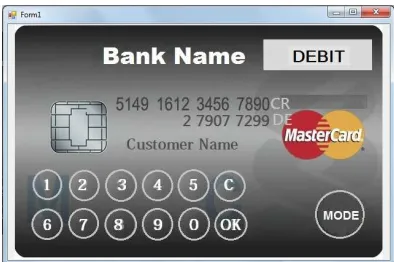
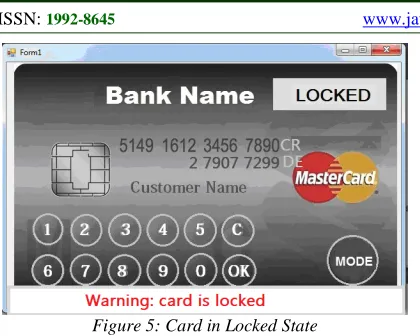
and the locking of the card, controlling the card usage through the ModePin. We first designed a model of our proposed card. Then we developed the code in VB.Net with the functionalities and characteristics as we mentioned in Section 4. We have got memory variables representing ROM, NVRAM and PIN number. We assumed sample numbers for debit, credit and ModePin. We stored the numbers into appropriate memory variables of ROM. We initialized the card_no. in NVRAM with the sample 9 digit debit card number. We have written code for the various buttons in the key pad such that the buttons have the functionalities as per our proposed model. When we press the mode button initially, the current mode which is debit in our implementation is displayed. Then we entered the ModePin number through the keypad. Once the ok button is pressed, the entered pin number validated against stored pin number. On a successful match, the screen displays READY and user chooses a number according to required mode (1- Debit, 2-Credit,3-Lock), presses OK again. Then the modified mode gets shown on screen.
Figure 4: Card in Debit Mode
[image:5.612.318.515.367.498.2]Figure 5: Card in Locked State
Through this simulation of our proposed concept, we have verified that our proposed concept is suitable for real time implementation and it will be beneficial for the banks and the customers.
7. BENEFITS AND LIMITATIONS OF THE PROPOSED APPROACH
Today, user convenience has become an inevitable requirement to be fulfilled by any business. Even when it comes to banking services, user convenience and comfort is considered to be one of the important factors to keep in mind while designing them. Banks are revamping their services to make them more likeable by customers by introducing Internet banking, teller machines, mobile banking etc. Integration of two very commonly used cards is also a necessary task to attract and retain customers. Although there were attempts made and designs proposed to integrate multiple cards, ours is the most economical and feasible model. We have presented a model for the implementation of a dual card eliminating the need for keeping two separate cards.
We have also introduced the unique idea of locking of a card in case of an unsafe situation. Whenever the card owner fears the loss of his card, he could lock the card following the procedure described above. In case that the card is lost or misplaced, it can not be misused by anybody to withdraw money or to buy items. Since unlocking the card requires the security pin number. The person who have stolen the card or confiscated the card will not able to know that. Meanwhile, the card owner may attempt to recover the card by searching for that and if it is not found after a reasonable period, he could contact the card issuing bank to request the blocking of both the card numbers. Presently there is no provision in any of the debit/credit cards to lock the card within the card itself, without requesting the bank. The only safeguard presently available in the cards is the card
PIN number which is typed on the card reader. But generally the pin numbers are required for credit card transactions. So they are highly vulnerable for misuse if they are lost. We consider that the limitations for implementing our model are the dissipation of battery due to the operations and the endurance problems of the NVRAMs. Either a flash or a PCM could be chosen for out implementation and each has its own issues. With a flash memory only block read/write is possible. A PCM consumes more energy for write operations and so wear leveling needs to be incorporated.
8. CONCLUSION AND FUTURE WORK
Banks are witnessing a phenomenal increase in the usage of credit and debit cards in the recent years. This is due to the prevalent availability of teller machines (ATM), card enabled point of sales counters, additional benefits offered for the card usages and the relative safety of banking cards over direct cash payments. So it is high time that the banks take the next step by integrating the two cards and present the customers with a dual card – a single card which is attached to two different accounts. We have presented a of a smart card which may used both as a credit card as well as a debit card with card protection through card locking. This could be implemented in a usual card of 85.60 × 53.98 mm size In future, we wish to address limitations of our model and explore the possibility of integrating more services into a single card. Presently we are working to develop a technique such that the security pin may also be changed by the user to enhance the security further.
REFRENCES:
[1] George Blossom et al., “Selectable
Multi-Purpose Card”, Patent No.: US006631849B2, Date of Patent: Oct 14, 2003
[2] Robert S. Wallerstein et al, “Programmable Credit Card”, Patent No.: 5585787, Date of Patent: Dec 17, 1996
[3] Fleichul et al, “Method And Apparatus to
Process Combined Credit And Debit Card Transactions”, Patent Number: 6038552A, Date of Patent: Mar. 14, 2000
[4] Gongling Li. et al., “Secure Credit Card Having Daily Changed Security Number”, Patent No.: US007051929B2, Date of Patent: May 30,
[5] Rahman et al.,” Secure Credit Card Which Prevents Unauthorized Transactions”, Patent
Number: USO05478994A, Date of Patent: Dec.
26, 1995
[6] Hirka et al., “Multiple Account Advanced Payment Card and Method of Routing Card Transactions”, Patent No.: US7860789B2, Dec 28, 2010
[7] Teicher et al., “Credit Card System Including A Central Unit And A Plurality Of Local Units For Conducting Low-Cost Transactions”,
Patent Number: USO05206488A, Date of
Patent: Apr. 27, 1993
[8] Li, Gongling. "Secure credit card having daily changed security number." U.S. Patent
7,051,929, Issued May 30, 2006.
[9] Sujit Chakravorti et al.,
“
Theory of Credit Card Networks: A Survey of the Literature”, Reviewof Network Economics, Vol.2, Issue 2 – June