159
OPTIMIZED RADIAL BASIS FUNCTION CLASSIFIER WITH
HYBRID BAT ALGORITHM FOR MULTI MODAL
BIOMETRICS
1ANAND VISWANATHAN, 2 S.CHITRA
1
V. S. B. Engineering College, Department of Information Technology, Karur, Tamilnadu, India
2
Er. Perumal Manimekalai College of Engineering, Department of Computer Science Engineering, Tamilnadu, India
E-mail: 1
ABSTRACT
Biometrics is identifying a person using their physiological/behavioral features. Recently, vein pattern biometrics attracted interest from research communities. Finger-vein recognition is a new biometrical identification procedure using the idea that different persons have differing finger-vein patterns. Multimodal biometrics is based on fingerprint and finger vein. Gabor features are extracted from finger vein using Gabor filter with orientation of 0, 15, 45, 60 and 75 degrees. For fingerprint images, energy coefficients are got using wavelet packet tree. Both obtained features are normalized with min max normalization and fused with concatenation. Feature selection is through use of PCA and kernel PCA. Classification is by using RBF Classifier and Euclidean distance. It is suggested that RBF kernel be optimized using BAT algorithm and hybrid BAT with local search.
Keywords:Multimodal Biometrics, Fingerprint, Finger vein, Radial Basis Function (RBF) classifier, BAT, Gravitational Search
1. INTRODUCTION
Biometrics gained popularity in the last decade in applications used to identify individuals. Two important biometric systems utilizations are authentication or verification and identification, based on biometric trait enrolled. The enrolled biometric trait can be physiological or behavioural characteristic of humans satisfying requirements of universality, permanence, uniqueness and collectability. Such biometric systems are non-deterministic [1].
Biometric recognition is based on fundamental premises of body traits: distinctiveness and permanence [2]. Applicability and accurate identification of specific biometric trait depends on what extent the two premises hold good for a population at hand. The choice of specific biometric modality depends on nature and requirements of intended identification application. For example, voice biometric does not suit authentication applications involving mobile phones as a sensor to capture voice (microphone) is embedded in phone. Fingerprint is a popular biometric to access laptops, mobile phones and
PDAs as low cost, small footprint fingerprint sweep sensors are easily embedded in such devices.
Biometric authentication is an automated process to recognize a person. Biometric authentication is classified as unimodal and multimodal biometric systems [3]. Unimodal systems use a single biometric trait to recognize; they suffer many practical problems like noisy sensor data, non-universality, intra-class variation, unacceptable error rate, restricted freedom, failure-to-enrol and spoof attacks. So, single biometric system performance needs to improve. Techniques of multimodal biometric system offer a feasible method to solve problems from unimodal system. Multimodal biometric system uses different biometric traits simultaneously to authenticate a person’s identity. Robustness and high authentication security are achieved using multimodal biometric systems.
160 based on hand vein and finger vein modalities. Various features for identification of biometric system were mentioned in literature. Best results are achieved by multimodal systems and mainly in systems based on vascular characteristics.
Multi-biometric methods are under many categories. One is multi-algorithm, mono-modal, which uses multiple algorithms on a single input, e.g. performing color and edge algorithms on single ear image to achieve recognition [5]. Another is single-algorithm, multi-modal, using one method on multiple inputs, or using many images from same sensor for comparison. The last is multi-algorithm, multi-modal, that uses various approaches for different data.
Multimodal biometric systems are [6]:
• Multi-sensor system for same biometric (optical, capacitive, based on chip fingerprint sensor);
• Multi-method system – using multiple methods to compare test arrays with references (multiple fingerprint matchers based on minutiae or filtering, multiple face matchers like PCA and LDA);
• Multi-characteristic system – (it uses fingerprints from many fingers, left and right iris images);
• Multi-capture/instance system – this acquires samples from same biometric characteristic (same fingerprint is sampled more than once); • Multi-verifier system – this uses more than one
biometric verifier (fingerprint, face, hand, voice).
Fusion of multi-biometrics is performed at the level of their scores, after individual tests results are returned but before assigning ranking. Fusion in a biometrics context can be the following forms:
There are 5 different fusion methods. The first three are known fusion methods; and the last two are novel and use performance of individual matchers in weighting contributions [7].
• Simple Sum (SS). Scores for individual are summed up.
• Min Score (MIS). Choose minimum of individual’s scores
• Max Score (MAS). Choose maximum of individual’s scores
• Matcher Weighting (MW). Matcher weighting-based fusion uses Equal Error Rate (EER) • User Weighting (UW). User Weighting fusion
applies weights to individual matchers differently for other user (individual)
Feature is a function of one or more measurements, each specifying some quantifiable
property of an object, and computed so that it quantifies the object’s significant characteristics.
General features: Application independent features like colour, texture, and shape. According to abstraction level, they are divided into [8]:
• Pixel-level features: Features calculated at every pixel, e.g. colour, location.
• Local features: Features calculated over subdivision results of image band on image segmentation or edge detection.
• Global features: Features calculated over entire image or regular sub-area of an image.
Domain-specific features: Application dependent features like human faces, fingerprints, and conceptual features. These are a synthesis of low-level features for a specific domain.
Extraction transforms rich image content into various content features. Feature extraction is generating features for use in selection and classification tasks. Feature selection reduces features provided for classification. Those features, likely to assist discrimination are selected and used in classification. Features not selected are discarded. Features like shape, texture and colour, describe image content. Image features are classified into primitives [9].
Fingerprint classification assigns a fingerprint to one of several pre-specified types already established in literature (and used in forensic applications) which provide an indexing mechanism. Fingerprint classification is viewed as coarse level fingerprint matching. An input fingerprint is matched first to one pre-specified type and then compared to a database subset corresponding to that fingerprint type [10]. To increase search efficiency, fingerprint classification algorithm classifies a fingerprint into more than one class.
Automated biometrics-based personal identification systems are classified into two categories: identification and verification. In verification (1-to-comparison), an individual‘s biometrics information which claims a certain identity is compared with biometrics on record that represent an identity the individual claims. Comparison result determines whether identity claims is to be accepted or rejected [11]. It is needed, to be able to discover that certain biometrics information’s origin to prove or otherwise the association of such information with specific individuals. This is known as identification (1-to-many comparison).
161 biometrics, based on examining a piece of text or drawing produced by a person. Category two comprises of Human Computer Interaction (HCI)-based biometrics. In daily interaction with computers, humans use different strategies, different styles and use unique abilities and knowledge. The third category is related to the second and is set of indirect HCI-based biometrics that are events obtained by monitoring user’s HCI behaviour indirectly via observable low-level computer software actions.
The fourth and best researched category of behavioural biometrics is dependent on user’s motor-skills to accomplish verification. Motor-skill is a human being’s ability to utilise muscles. The final category includes behavioural biometrics. Behavioural biometrics measures human behaviour indirectly concentrating on body parts measurements or intrinsic, inimitable and lasting muscle actions so that an individual walks, types, or the way he grips a tool are looked into.
Energy coefficients for fingerprint images are from using wavelet packet tree. Both obtained features are normalized using min max normalization and fused through concatenation. Feature selection is through use of PCA and kernel PCA. Classification is achieved using RBF Classifier and Euclidean distance. This study proposes RBF kernel using BAT algorithm and hybrid BAT algorithm with local search. Section 2 discusses related works, Section 3 describes methodologies used and Section 4 explains experimental results and Section 5 concludes the paper.
2. RELATED WORK
Biometrics verification techniques combined with digital signature for multimodal biometrics payment system was introduced by Yang [12]. Considering high universality, distinctiveness, and the easy collectability of face and fingerprint, a multimodal biometrics verification system with fingerprint and face inputs was designed and hybrid fingerprint features and infrared face features for matching was introduced to overcome traditional methods shortcomings, and ensure integrity of registered multimodal biometrics data. Then 9 authentication models to authenticate an open network to ensure data integrity were analyzed. Finally, a digital signature procedure with public key infrastructure was proposed to illustrate a multimodal biometrics payment system with a safe model. The new system is applicable to public key platforms, too.
Mhaske and Patankar [13] introduced a multimodal biometrics system combining fingerprint and palm print features to overcome unimodal biometrics limitations. Modified Gabor filter independently extracted a fingerprint and palmprint feature that was more accurate compared to conventional Gabor filter. Also, short time Fourier transformation was applied for resultant images better quality. The new method had better performance compared to unimodal approaches using only a fingerprint or palm print individually. Multiple biometrics reduced system error rate.
A multimodal biometric prototype that captures a palm vein and three fingerprints simultaneously proposed by Yamada and Endoh [14] was evaluated as to whether their combination was statistically independent. By evaluating false acceptance using palm vein and fingerprint images collected with suggested prototype, the authors confirmed that combining palm vein and fingerprints was almost independent.
A new method to assign weights before performing fusion at match score level was presented by Raghavendra et al., [15]. This was based on False Acceptance Rate (FAR) and Genuine Acceptance Rate (GAR) got for every modality and weights assigned on individual modality match scores before performing match score level fusion. Experiments carried out on three different multimodal biometric databases showed the proposed method’s efficacy.
Hand vein biometric in unimodal status was analyzed by Raghavendra et al., [16] and also combined with palm print in multimodal situation. The authors suggested using non-standard edge mask in schemes to extract hand vein pattern accurately which was then classified using Kernel Direct Discriminant Analysis (KDDA) to make decision about accept/reject. The proposed non-standard edge masks performance was compared to conventional edge detection masks and statistical results validation presented with 90% confidence interval. Robustness of the scheme was analyzed by evaluating schemes and algorithms on data corrupted by noise. Final results showed the proposed scheme’s efficacy.
162 extracted using block-based statistics to reduce required data to be stored. Experimental revealed that multimodal biometric authentication was more reliable and precise than single biometric approach.
Multimodal biometric systems to overcome limitations of using multiple bits of evidence of same identity were implemented by Basha et al., [18]. To improve authentication speed in biometric systems with accuracy, a dynamic fingerprint verification technique was introduced and fused with enhanced iris recognition using adaptive rank level fusion method. The multimodal system has increased verification system speed and performance specially when tested on slow processing and low memory devices.
Multimodal biometrics for palmprint and face images using fusion techniques at feature level was introduced by Ahmad et al., [19]. Gabor based image processing extracted discriminant features, while PCA and LDA reduced dimension of every modality. LDA output features were serially combined and classified by Euclidean distance classifier. Experimental results based on Poly-U palmprint and ORL face databases proved this technique capable of increasing biometric recognition rates compared to those produced by single modal biometrics.
A new approach for combination of multiple biometrics to make sure optimal performance for desired security was presented by Kumar et al., [20]. Multiple biometrics adaptive combination determined optimal fusion strategy and corresponding fusion parameters. Experimental results prove that the new score-level approach achieved increased better and stable performance over decision-level approach. The authors presented the proposed approach’s performance from real biometric samples which further validated contributions.
A revocable and secure biometric bit-string generation method for template protection was proposed by Chin et al., [21]. The method included random tiling and equal probable discretisation. Random tiling, a feature transformation method derives random features from biometric data based on user specific keys. A modified equal probable discretisation was proposed to partition uneven biometric data distribution to different equal probable segments instead of equal width segments. The new method was evaluated with multimodal biometrics - fusion of fingerprint and palmprint at feature level. Encouraging experimental results vindicated the proposed approach’s feasibility.
A fast multimodal verification system using the fingerprint image’s dynamic regions and enhanced
iris segmentation method was presented by Basha et al., [22]. Multimodal system was fused using rank level fusion at verification stage. The biometric system’s performance showed improvement in FAR and EER curves. Also, time taken for training and verification phase had a reduction of 15% compared to the current system tested on slow processing mobile devices.
System-on-Chip (SOC) Field Programmable Gate Array (FPGA) based implementation of multimodal biometric authentication was discussed by Moganeshwaran et al., [23]. Multimodal biometrics solve many problems related to unimodal biometric authentication like accuracy issues due to noisy data acquisition, biometric spoofing, and biometric traits non-universality. Though each biometric system accuracy model is affected, fusion of biometric information overcomes this issue. System accuracy was promising with an Error Equal Rate (EER) of 0.33%.
A multimodal fusion problem involving missing modalities (scores) using Support Vector Machines (SVMs) with Neutral Point Substitution (NPS) method was addressed by Poh et al., [24]. The approach starts processing every modality using a kernel. Experiments based on publicly available Biosecure DS2 multimodal (scores) data set showed that SVM-NPS approach achieved good generalization performance compared to sum rule fusion, specially with severe missing modalities.
An efficient feature level fusion scheme applied on face and palmprint images was presented by Raghavendra et al., [25]. Each modality’s features were obtained using log Gabor transform and connected to form a fused feature vector. Experiments in both closed identification and verification rates revealed that feature fusion improved performance over match score level fusion and that the new method outperformed AdaBoost regarding reduction of features and implementation facility.
163
3. METHODOLOGY
Dataset:
5 finger vein images of left index finger from 100 subjects and 5 fingerprint images of left index finger from 100 subjects were used in experiment. Receiver operating characteristics curve is given.
3.1 Gabor Filters
Parallel ridges and valleys configurations with well-defined orientation and frequency in a Finger Vein image provide information to remove undesired noise. Sinusoidal-shaped waves of ridges and valleys fluctuate slowly in local constant orientation. Hence, a band pass filter tunes corresponding frequency. Also, orientation efficiently removes undesired noise and preserves true ridge and valley structures. Gabor filters had frequency-selective and orientation-selective properties and optimal joint resolution in spatial and frequency domains. Hence, it is appropriate to use Gabor filters as band pass filters to remove noise and preserve true ridge/valley structures [27].
A circular 2-D Gabor filter in spatial domain has a general form [28]:
2 2
2 2
1
( , , , , )
exp
2
2
exp{2 (
cos
sin )}
x
y
G x y
u
i ux
uy
θ
σ
πσ
σ
π
θ
θ
+
=
−
+
where i = -1 ; u is frequency of sinusoidal wave; q controls orientation of function and s is standard deviation of Gaussian envelope. Such Gabor filters were used in various applications.
3.2 Wavelet Packet Transform (WPT)
Wavelet packet offers a complex and flexible analysis, and represents a generalization of multi-resolution decomposition. Approximation component is decomposed in WT whereas in WPT, approximations and detailed components are decomposed [29]. The second stage, Quantization/ Thresholding focused on selecting a value that satisfies HVS constraints for better visual quality and increased CR. The entropy encoder stage reduces overall number of bits needed to represent data set. It removes redundancy in repetitive bit pattern in quantizer output.
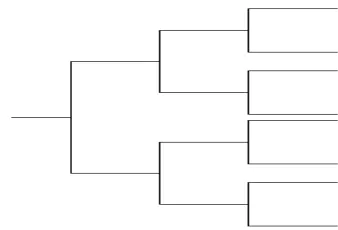
[image:5.595.319.488.149.264.2]WPT is a Dyadic Wavelet Transform (DWT) generalization offering a rich decomposition structures set. Wavelet packet decomposition is achieved when filter bank is iterated over frequency bands at all levels. The final decomposition structure will be a subset of a full tree, chosen by best basis selection algorithm [30].
Figure 1 A Wavelet Packet Decomposition Tree
3.3 Principal component analysis (PCA) PCA uses a linear transformation to form a simplified data set retaining characteristics of original dataset. Assume that original data matrix contains d dimensions and n observations and it is ordered that dimensionality be reduced into a k dimensional subspace [31].This transformation is given by
T
Y
=
E X
Here Ed×k is projection matrix which contains k
eigen vectors equivalent to k highest eigen values, and where Xd×n is a mean centered data matrix.
More generally, PCA’s is to re-express original dataset in new basis hoping that the new basis filters out noise inherently present in data and revealing part of structure underlying data [32].
PCA strength for data analysis is from efficient computational mechanism, and due to it being understood and from general applicability. PCA transforms initial data set represented by vector samples into a new vector samples set with derived dimensions. Following is a description: a set of n-dimensional vector samples X = {x1, x2, x3, ...,xm} ought to be transformed into an additional set Y = {y1, y2, ..., ym} of same dimensionality, but y-s have properties that most information content is stored in first few dimensions. So, data set is reduced to smaller dimensions with low information loss [33].
164
1
Re cov
:
:
*
t
T T T
i i i
T
er basis
Calculate XX
x x and let U
eigenvectors of XX
corresponding
to the top d eigenvectors
Encode training data
Y
U X where Y is a d t matrix of encodings of the origin
==
=
=
∑
.
Re
:
ˆ
:
- dim
Re
:
ˆ
T
T
T
al data
construct training data
X
UY
UU X
Encode test examples
y
U x where y is a d
ensional encoding of x
construct test example
x
Uy
UU x
=
=
=
=
=
3.4 Kernel PCA
Simple PCA models are efficient for linear variabilities in high-dimensional data. But many high dimensional data sets are nonlinear. In such cases high-dimensional data lies on or near a nonlinear manifold. So, PCA cannot be used to model data variability. Kernel PCA finds principal components nonlinearly related to input space by performing PCA in space produced by nonlinear mapping, where low-dimensional latent structure is easily found.
Consider a feature space H so that:
:
x
φ
→ Η
( )
x
a
φ
x
The objective of kernel PCA is,
( )
( )
min
tT
i q q i
x
U U
x
φ
−
φ
∑
The solution is found by SVD.
( )
X
U
V
Tφ
=
∑
3.5 Radial Basis Function (RBF)
RBF is based on gaussian curve. It takes a parameter that determines center (mean) value of function used as desired value. RBF is a real-valued function whose significance depends on distance from the origin, so that [34],
( )
(
)
g x
=
g
x
or alternatively on distance from some other point c, called a center, so that
( , )
(
)
g x c
=
g
x
−
c
RBFs sums approximate given functions. This approximation process can be interpreted as a simple neural network. RBF are normally used to build up function approximations of form
1
( )
(
)
N
i i
i
y x
w g
x
c
=
=
∑
−
where approximating function y(x) is represented as sum of N RBFs, each associated with a diverse center ci, and weighted by an suitable coefficient wi. The weights wi is estimated using linear least squares matrix methods, as the approximating function is linear in weights.
3.6 Bat Algorithm (BA)
BA is a meta-heuristic optimization algorithm inspired from microbats echo location behaviour. In echo location each pulse only lasts a few thousandths of a second (up to about 8–10 ms). But, it has a constant frequency in the range of 25–150 kHz corresponding to wavelengths of 2–14 mm. In BA, micro bats echolocation properties are idealized as the following rules [35]:
1. Bats use echolocation to sense distance, and “know”’ difference between prey/food and background barriers.
2. Bats arbitrarily move with a velocity of vi at position xi with constant frequency f, varying wavelength λ, and loudness A0 to search for prey. Bats can automatically tune wavelength (or frequency) of emitted pulses and tune pulse emission r ߳[0,1] rate depending on target proximity,
165 Pseudo code of bat algorithm (BA) [36]:
1. Objective function ƒ(x), x=(x1,…... xd) T 2. Initialize the bat population xί=(ί = 1,2…n)
and vί
3. Define Pulse frequency ƒί at xί
4. Initialize the rates rί and the loudness Aί 5. While (t < Max number of iterations)
6. Generate new solutions by adjusting frequency, by adjusting frequency, and updating velocities and locations/solutions
min max min 1
* 1
(
) ,
(
) ,
,
it t t
i i i i
t t t
i i i
f
f
f
f
v
v
x
x f
x
x
v
β
+ +
=
+
−
=
+
−
=
+
7. If (rand > rί)
8. Select a solution among the best solutions 9. Generate a local solution around the selected
best solution
10. End if
11. Generate a new solution by flying
randomly
12. If (rand < Aί and ƒ(xί) < ƒ(x*))
13. Accept the new solutions
14. Increase rί and reduce Aί
15. End if
3.7 Gravitational Search
Gravitational Search Algorithms (GSAs) are new heuristic optimization algorithms introduced with a well-balanced strategy to improve exploration and exploitation methods. Possible problem solutions in hand are considered as objects whose performance (quality) is determined by masses, all objects attract each other by gravity force causing a global movement of objects to objects with heavier masses [37]. The position of each object corresponds to solution of the problem, with inertial masses being determined by a fitness function. Heavy masses that represented good solutions move slower than lighter ones, representing algorithm exploitation.
Masses are actually obeying laws of gravity and law of motion as seen in the following Equations
2 1 2
(
/
)
/
F
G
M M
R
a
F
M
=
=
Based on first equation, F represents magnitude of gravitational force, G is gravitational constant, and M1 and M2 are mass of first and second objects and R distance between two objects. The equation shows that in gravity, gravitational force between two objects is directly proportional to the product of masses and also inversely proportional to square of the distance between objects. While for
second equation, Newton’s second law reveals that when force, F, is applied to an object, its acceleration, a, depends on force and mass, M.
GSA basic model was originally meant to solve continuous optimization problem, a set called masses are introduced in the n space of problem to find optimum solution of Newtonian laws of gravity and position of each mass demonstrates a candidate solution to the problem, and hence is represented by vector Xi in problem search space. Masses with a higher performance get greater gravitational mass, as heavy mass has large effective attraction radius and so has a great intensity of attraction [38].
4. EXPERIMENTAL RESULTS
[image:7.595.306.507.372.700.2]Gabor features are extracted from finger vein using Gabor filter with orientation of 0, 15, 45, 60 and 75 degrees. For the fingerprint images, energy coefficients are obtained using wavelet packet tree.
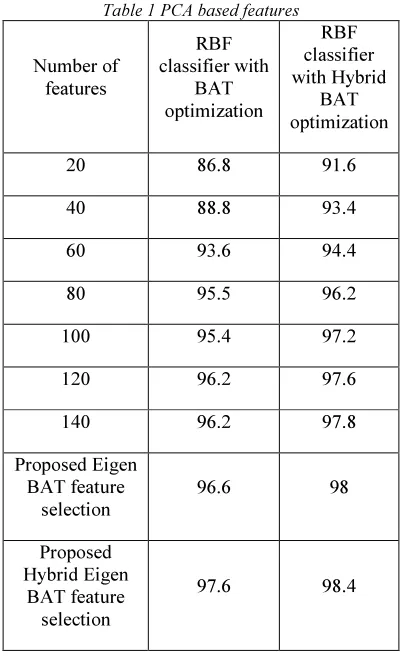
Table 1 PCA based features
Number of features
RBF classifier with
BAT optimization
RBF classifier with Hybrid
BAT optimization
20 86.8 91.6
40 88.8 93.4
60 93.6 94.4
80 95.5 96.2
100 95.4 97.2
120 96.2 97.6
140 96.2 97.8
Proposed Eigen BAT feature
selection 96.6 98
Proposed Hybrid Eigen
BAT feature selection
97.6 98.4
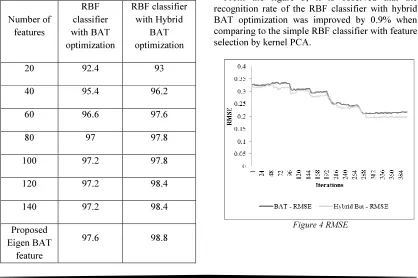
166 PCA and kernel PCA. The classification is achieved using RBF Classifier. Recognition rate with PCA and kernel PCA features in RBF classifiers are compared in the following figures 2 and 3.
Figure 2 Recognition rate of PCA based features
[image:8.595.93.516.72.421.2]From the figure 2, it is observed that the recognition rate of the hybrid BAT optimization was improved by 2.11% when comparing to the conventional BAT with feature selection by PCA.
Table 2 Kernel PCA based features
Number of features
RBF classifier with BAT optimization
RBF classifier with Hybrid
BAT optimization
20 92.4 93
40 95.4 96.2
60 96.6 97.6
80 97 97.8
100 97.2 97.8
120 97.2 98.4
140 97.2 98.4
Proposed Eigen BAT
feature
97.6 98.8
selection
Proposed Hybrid Eigen BAT
feature selection
98.8 99.2
Figure 3 Recognition rate of kernel PCA based features
[image:8.595.93.332.98.387.2]From the figure 3, it is observed that the recognition rate of the RBF classifier with hybrid BAT optimization was improved by 0.9% when comparing to the simple RBF classifier with feature selection by kernel PCA.
[image:8.595.91.509.483.761.2]167 From the figure 4, it is observed that the proposed hybrid BAT reduced the RMSE rate by 4.45% when compared to the conventional BAT algorithm.
5. CONCLUSION
Persons recognition based on biometric features is an emerging phenomenon in society. Use of features physically connected to a person’s body decreases possibility of fraud. Also, biometry offer user-convenience in situations, as it replaces cards, keys and codes. Fingerprint and finger vein are considered most practical features, as it is user friendly, ensures good performance, and uses relatively inexpensive sensors that are integrated easily in wireless hardware. This study proposes an optimized RBF classifier in multimodal biometric system to identify authorized users using fingerprint images and finger vein patterns. Each modality’s features was extracted, normalized and fused prior to applying it to the classifier. To improve recognition rate RBF classifier parameters were optimized by BAT algorithm and gravitational search.
REFRENCES
[1] Prasanalakshmi, B., Kannammal, A., & Sridevi, R. (2011). Multimodal Biometric Cryptosystem Involving Face, Fingerprint and Palm Vein. International Journal of Computer Science Issues (IJCSI), 8(4).
[2] Jain, A. K., & Kumar, A. (2010). Biometrics of next generation: An overview. Second Generation Biometrics.
[3] Shruthi.B.M, Pooja, M., Mallinath & Ashwin.R.G (2013). Multimodal Biometric Authentication Combining Finger Vein and Finger Print. International Journal of Engineering Research and Development, 7(10), pp. 43-54.
[4] Trabelsi, R. B., Masmoudi, A. D., & Masmoudi, D. S. (2013). A New Multimodal Biometric System Based on Finger Vein and Hand Vein Recognition. International Journal of Engineering & Technology (0975-4024), 5(4).
[5] Middendorff, C., Bowyer, K. W., & Yan, P. (2007, June). Multi-modal biometrics involving the human ear. In Computer Vision and Pattern Recognition, 2007. CVPR'07. IEEE Conference on (pp. 1-2). IEEE.
[6] Pop, E. L. P. G. Multimodal biometric systems overview.
[7] Indovina, M., Uludag, U., Snelick, R., Mink, A., & Jain, A. (2003). Multimodal biometric authentication methods: a COTS approach. Proc. MMUA, 99-106.
[8] Choras, R. S. (2007). Image feature extraction techniques and their applications for CBIR and biometrics systems. international journal of biology and biomedical engineering, 1(1), 6-16.
[9] Prabhakar, S. (2001). Fingerprint classification and matching using a filterbank (Doctoral dissertation, Michigan State University).
[10] Bhattacharyya, D., Das, P., Bandyopadhyay, S. K., & Kim, T. H. (2008). IRIS texture analysis and feature extraction for biometric pattern recognition. International Journal of Database Theory and Application, 1(1), 53-60.
[11] Yampolskiy, R.V. and Govindaraju, V. (2008) ‘Behavioural biometrics: a survey and classification’, Int. J. Biometrics, Vol. 1, No. 1, pp.81-113.
[12] Yang, J. (2010, October). Biometrics verification techniques combing with digital signature for multimodal biometrics payment system. In Management of Commerce and e-Government (ICMeCG), 2010 Fourth International Conference on (pp. 405-410). IEEE.
[13] Mhaske, V.D.; Patankar, A.J., (2013). "Multimodal biometrics by integrating fingerprint and palmprint for security," Computational Intelligence and Computing Research (ICCIC), pp.1, 5.
[14] Yamada, S., & Endoh, T. (2012, September). Evaluation of independence between palm vein and fingerprint for multimodal biometrics. In Biometrics Special Interest Group (BIOSIG), 2012 BIOSIG-Proceedings of the International Conference of the (pp. 1-4). IEEE.
[15] Raghavendra, R., Kumar, G. H., & Rao, A. (2009, February). Qualitative weight assignment for multimodal biometric fusion. In Advances in Pattern Recognition, 2009. ICAPR'09. Seventh International Conference on (pp. 193-196). IEEE.
[16] Raghavendra, R., Imran, M., Rao, A., & Kumar, G. H. (2010, November). Multimodal biometrics: Analysis of handvein & palmprint combination used for person verification. In Emerging Trends in Engineering and Technology (ICETET), 2010 3rd International Conference on (pp. 526-530). IEEE.
168
Fusion of face and iris features extraction based on steerable pyramid representation for multimodal biometrics. In Multimedia Computing and Systems (ICMCS), 2011 International Conference on (pp. 1-4). IEEE.
[18] Basha, A. J., Palanisamy, V., & Purusothaman, T. (2011). Efficient Multimodal Biometric Authentication Using Fast Fingerprint Verification and Enhanced Iris Features. Journal of Computer Science, 7(5).
[19] Ahmad, M. I., Woo, W. L., & Dlay, S. S. (2010, July). Multimodal biometric fusion at feature level: Face and palmprint. In Communication Systems Networks and Digital Signal Processing (CSNDSP), 2010 7th International Symposium on (pp. 801-805). IEEE.
[20] Kumar, A., Kanhangad, V., & Zhang, D. (2010). A new framework for adaptive multimodal biometrics management. Information Forensics and Security, IEEE Transactions on, 5(1), 92-102.
[21] Chin, Y. J., Ong, T. S., Teoh, A., & Goh, M. K. (2011, June). Multimodal biometrics based bit extraction method for template security. In Industrial Electronics and Applications (ICIEA), 2011 6th IEEE Conference on (pp. 1971-1976). IEEE.
[22] Basha, A. J., Palanisamy, V., & Purusothaman, T. (2010, December). Fast multimodal biometric approach using dynamic fingerprint authentication and enhanced iris features. In Computational Intelligence and Computing Research (ICCIC), 2010 IEEE International Conference on (pp. 1-8). IEEE.
[23] Moganeshwaran, R., Hani, M. K., & Suhaini, M. A. (2012, October). Fingerprint-fingervein multimodal biometric authentication system in field programmable gate array. In Circuits and Systems (ICCAS), 2012 IEEE International Conference on (pp. 237-242). IEEE.
[24] Poh, N., Windridge, D., Mottl, V., Tatarchuk, A., & Eliseyev, A. (2010). Addressing missing values in kernel-based multimodal biometric fusion using neutral point substitution. Information Forensics and Security, IEEE Transactions on, 5(3), 461-469.
[25] Raghavendra, R., Dorizzi, B., Rao, A., & Hemantha, G. K. (2009, September). PSO versus AdaBoost for feature selection in multimodal biometrics. In Biometrics: Theory, Applications, and Systems, 2009. BTAS'09. IEEE 3rd International Conference on (pp. 1-7). IEEE.
[26] Lu, C., Wang, J., & Qi, M. (2009, May). Multimodal Biometric Identification Approach
Based on Face and Palmprint. In Electronic Commerce and Security, 2009. ISECS'09. Second International Symposium on (Vol. 2, pp. 44-47). IEEE.
[27] Yu, C. B., Qin, H. F., Cui, Y. Z., & Hu, X. Q. (2009). Finger-vein image recognition combining modified hausdorff distance with minutiae feature matching. Interdisciplinary Sciences: Computational Life Sciences, 1(4), 280-289.
[28] Kong, W. K., Zhang, D., & Li, W. (2003). Palmprint feature extraction using 2-D Gabor filters. Pattern recognition, 36(10), 2339-2347.
[29] Chopra, S., & Gupta, D. (2011). Comparative Analysis of Wavelet Transform and Wavelet Packet Transform for Image Compression at Decomposition Level 2. In Pro-ceedings of International Conference on Information and Network Technology. Chengdu:[sn].
[30] Öktem, R., Öktem, L., & Egiazarian, K. (2000). A wavelet packet transform based image coding algorithm. Taemepre University Finland.
[31] Deegalla, S., & Bostrom, H. (2006, December). Reducing high-dimensional data by principal component analysis vs. random projection for nearest neighbor classification. In Machine Learning and Applications, 2006. ICMLA'06. 5th International Conference on (pp. 245-250). IEEE.
[32] Okal, B. (2011). Combining PCA and K-Nearest Neighbor methods in Handwritten Digits Classification. Jacobs University Bremen D-28759, Bremen, Germany.
[33] Novakovic, Ј., & Rankov, S. (1841). Classification Performance Using Principal Component Analysis and Different Value of the Ratio R. International Journal of Computers, Communications & Control, ISSN, 9836, 317-327.
[34] Karlik, B., & Olgac, A. V. (2010). Performance analysis of various activation functions in generalized MLP architectures of neural networks. International Journal of Artificial Intelligence and Expert Systems, 1(4), 111-122.
169 [36] S Goyal, M S Patterh. (2013). Wireless
Sensor Network Localization Based on BAT Algorithm. International Journal of Emerging Technologies in Computational and Applied Sciences, 4(5), pp. 507-512
[37] Eldos, T., & Qasim, R. A. (2013). On The Performance of the Gravitational Search Algorithm. International Journal of Advanced Computer Science & Applications, 4(8).
[38] Sabri, N. M., Puteh, M., & Mahmood, M. R. (2013). A Review of Gravitational Search Algorithm. Int. J. Advance. Soft Comput. Appl, 5(3).