IOT Based Intelligent Toll Gate System using
Raspberry PI
Geethanjali N1, Chiranth R 2, Chaitra J M3
1
Assistant Professor, Department of ECE, SJB Institute of technology, Bengaluru, India
2
PG Student, Department of ECE, SJB Institute of technology, Bengaluru, India
3
PG Student, Department of ECE, SJB Institute of technology, Bengaluru, India
Abstract: The traditional method of handling the increased road demand was to build more roads and remodeling the existing ones. These solutions are proving not to be enough in the long-term. This is because the lower traffic congestion brought by these improvements has also led to an increase in road demand, bringing about increased road congestion and thus resulting in a vicious cycle of congestion on the roads. One of the suggested alternative methods is road pricing by locating toll stations along major highways.
The main aim of this project is to introduce an efficient and cost effective method of collecting the toll charges by the use of RFID tags mounted to the base of the vehicle. This system will eliminate the manual payment and collection of toll fees as well as it will eliminate requirement of motorist& toll authorities. Therefore it will facilitate paperless passage of toll gates, reduce toll gate traffic and avoids illegal passage of the vehicles through the toll gate. The system will be prepaid and the vehicle owner will maintain an account from which they will be charged every time they pass through a toll station. The proposed system mainly works with the concept of tax payment system in automatic toll. In this system transaction of amount & status of vehicle information is updated to automobilists by a technology of IOT and the amount transaction and status of the vehicle information is updated to the motorists through the IOT technology. This technology is an expressway solution for toll collection of automatic network. In this system the composing of frame, system functioning is illustrated and data information is effortlessly swap over between automobilist and authorities of Toll, thus by this system we can reduce a possible errors by human & with a less traffic we get a well organized collection of toll system. Since Raspberry Pi is enabled with IOT vehicles data base can be created and it can be linked to the server using an app installed in any laptop. It gives a flexible frontend for toll gate authorities to have a complete update of the vehicle, toll collected and soon. Vehicle user can also recharge his vehicle card using this web based application. Application also shows the owners balance in the card and soon.
Keywords: RFID, ULN Driver, Load sensor, Theft control, Recharging page.
I. INTRODUCTION
This system is a thruway solution designed for collection in automatic toll. The composing of frame, system functioning is explained and information of data is also effortlessly exchanged between the automobilist and authorities of toll. , thus by this system we can reduce a possible errors by human & with a less traffic we get a well-organized collection of toll system. Since Raspberry Pi is enabled with IOT, vehicles data base can be created and it can be linked to the server using an application installed in any laptop. It gives a flexible front end for toll gate authorities to have a complete update of the vehicle and toll collected. Vehicle user can also recharge his vehicle card using this web based application. Application also shows the owner’s balance in the card. In indirect old method, the operating cost is compensated also allocating a budget to the national income or by the fuel tax payment. The notwithstanding of this mechanism is that a small number of civilians, who do not use any of the carriageways, should pay for allowance. In direct new method, tolls fees are directly collected from the driver who passes that street or road.
toll station /toll system. The owner of the vehicle will get a cost or fees information of the toll station through an application installed in any laptop to his mobile phone. The LCD is used to display the status of the vehicle .The objective of the proposed project is to create Automatic Toll Gate system. When the vehicle enters the toll station, the major aim is to identify the number & sort of the vehicle; the vehicle should first pass through the IR transmitter - receiver gate. Next to IR gate, RFID card system is present. RFID reader that detects the tag of the vehicle & every toll booth has a data base and data is matched with the provided data at the toll. When vehicle is departing towards the load cell plate it has to pass through the IR receiver- transmitter gate.
Major advantage of RFID is to read the objects in motion and out of line-of sight. Tags can also be read under unsympathetic situation of chemicals, temperature and high pressure. The technology of RFID reduces functional expenses by reducing the human operators in systems that collects information & revenue. This technology can be used in collection of fees in toll station & technology enables us to track the vehicles, as well as their carrying goods. The RFID technology provides a Location tests for tracking items in motion, this technology is the best technology for tracking items in motions. IR sensor is used to avoid the collapsing of gate, load sensor is used to check whether the vehicle is carrying overload of goods or not. Metal sensor is used to detect the presence of weapons in the vehicle. Advanced Raspberry Pi is enabled with IOT, vehicles data base can be created and it can be linked to the server using an application installed in any laptop. It gives a flexible front end for toll gate authorities to have a complete update of the vehicle and toll collected. Vehicle user can also recharge his vehicle card using this web based application. Application also shows the owners balance in the card and so on. Owner can recharge his vehicle card timely and can be updated with balance. Using stepper motor gate opening and closing will be done whenever the vehicle pays the required toll amount needed at the gate. As a precaution IR sensor is used to acknowledge that the vehicle has moved successfully from the place and after some delay gate will be closed to prevent collapsing of gate on the vehicles.
II. DESIGNOFTHEPROPOSEDARCHITRECTURE
A. Block diagram of toll Gate System
Fig1.Block Diagram
B. Raspberry Pi 2 Specifications
1) Single Board computer runs at 900MHz with Quad Core Processor, Broadcom BCM2836 Arm7
2) RAM used is 1GB
3) GP10 with 40 pin extension
4) USB 2 ports x 4
Raspberry Pi
16x2
Liquid crystal
display
IOT
Stepper
motor gate
Stepper
motor driver
RFID Reader
Green, red LED’s
IR sensor
Load sensor
Metal sensor
Buzzer
5) Composite video port and output stereo 4 port is implemented
6) HDML i.e., full sized
7) PI 2 camera for connection used is CSI camera port
8) For touch screen display the port employed DSI display port
9) Micro Secure Digital(Micro SD) port handles stacking operating system and hoarding of data
10) The main power source used here is Micro USB.
Fig2: Raspberry Pi 2 model B
C. Model b Traits
1) The powered Single Board computer which runs at frequency of 900MHz which is the Broadcom BCM2836 Arm7 a Quad core processor is implied for execution purposes.
2) To speed up the complex and powerful applications 1GB RAM is employed.
3) The Model B+ has identical board layout and the footprints as well, and in all cases 3rd party board which is designed for, is compatible.
4) Wholly Hardware Attached on Top(HAT) compatible.
5) To upgrade real world projects an extended 40 pin GP10 is implemented. It’s 100% well matched to Model B+ and A+ board. In Model A and B boards first 26 pins are identical which in turn provides full backward suitability across all boards.
6) Pi 2 camera and screen touch display are fastened which are promoted individually.
D. IMPLEMENTATION
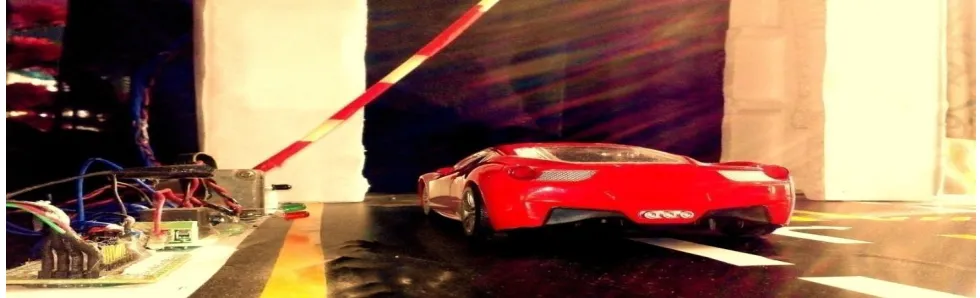
The complete model demonstration for “IOT based intelligent toll gate system using Raspberry Pi for non- stop journey” is shown.
The entire automated, digitized, upgraded, pictorial representation of “IOT based Intelligent Toll gate system using Raspberry Pi” is as shown in the fig: 3
Since RFID card has been attached to the base of the vehicle, RFID reader also implemented under the road. Hence it avoids the unpaid vehicles passes through the toll station. Similarly the other hardware’s like metal sensors, load sensors are also implemented under the road. As soon as the RFID reader reads the card, the server checks for the minimum balance in the card and display the status in the monitor and as well as in the LCD display. As vehicle moves forward the other hardware components like metal sensor and load sensor also checks the conditions of the vehicle for the security and display the status in the monitor as well as in the LCD display. And also these information’s are updated to the server. These information are controlled by the admin through IOT.
Fig4:Pictorial Representation of module
The pictorial representation of the module is as shown in the fig 4. If all the above condition satisfies, the stepper motor gate will be open which is driven by the ULN driver and also for the driver convenience LED indications are provided. If any one of the conditions are not satisfied, the alarm tone will be produced in the toll station to indicate the driver and toll station authority. This alarm tone is produced by the buzzer which is interfaced with the relay. In this project, two lanes are used that is main lane and conventional lane. In case of any condition fails, the gate will be not opened and the vehicle has to pass through the conventional lane for authority checking. Since the conventional lane is used it does not affects the vehicle which are in queue. The IR sensor which is placed after the stepper motor gate is used to avoid the collapsing of gate on the vehicle. If any vehicle stands in front of the IR sensor then the gate will remains open until the vehicle move forward. If no vehicle is found, then the gate remains closed. Using a python language, program is implemented to operate IR sensor. If any of the vehicle is halted near the gate then the IR transmitter sends a signal and results with ‘1’, and also indicates the stepper motor to open the gate. If any of the vehicle is halted near the gate then IR sensor gives ‘0’, and also indicates the stepper motor to close the gate.
III.RESULTSANDDISCUSSION
A. Steps to Perform Intelligent Toll Gate Operation
[image:5.612.50.540.183.332.2]Web pages are created to update the information of vehicle toll tax payment. An application is created which can be installed in any laptop or mobile phone. The fig: 5.shows the home page of the app. For all the vehicles, a separate user ID and the Password is given to login the application. The password must be kept secretly. The fig 6 shows the Home page of the application. It contains all the information of the vehicle like chas is number, vehicle number, insurance number and amount balance.
1) The fig 7 can be used by the user when the vehicle is thefted. If the Theft Control ON, that informs all the toll-stations to track the vehicle if it is passed through it. The fig 8 shows the recharging page, it can be used by the user at the time of low balance in their RFID card.
Fig 7: Theft Control page Fig 8: Recharge Page
2) First, when the program is run the following message will be displayed in the LCD. The following message indicates that the next vehicle to enter the toll station.
Fig 9: Wishes for the travelers Fig 10: Before Vehicle enter
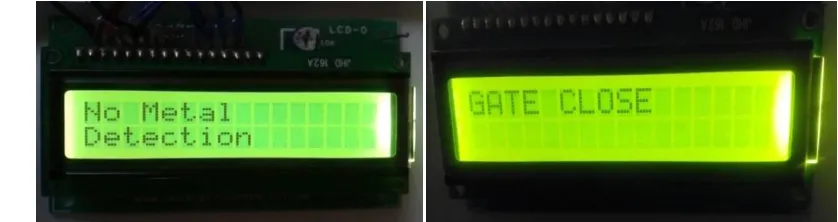
[image:6.612.105.513.296.410.2]3) If vehicle carries any bombs or weapons then the following message will be displayed in the LCD. As soon as the RFID reader reads the card, the server checks for the minimum balance in the card and display the status in the LCD
Fig 11: Informs the traveler about metal detection Fig 12: Informs the traveler about the balance
4) If vehicle carries any bombs or weapons then the following message will be displayed in the LCD. If all the above conditions are not satisfied, the gate will close and it is displayed on the LCD.
[image:6.612.94.513.604.715.2]5) If the vehicle is carrying any overload then the following message will be displayed. If the vehicle doesn’t not carry any overload then the following message will be displayed
Fig15: Informs the traveler vehicle is overloaded Fig16: Informs the traveler that vehicle load is normal
6) If all the above conditions are satisfied, the gate will open and the message will be displayed in the LCD. As soon as the vehicle passes through the toll station, the conditions of the vehicles are checked and the status are displayed on the server.
Fig17: Informs the traveler that gate is open Fig 18: Overall status of the vehicle displayed on the server
IV.CONCLUSION
The proposed IOT road tax system is a unifying feature of an all the hardware components used and broadened Pi processor. The existence of every model is reasoned out and employed carefully. Hence contributing to the best working unit to the smart toll gate system is designed flawlessly. Furthermore, using advanced processor i.e., Raspberry Pi, IOT and Linux operating system, with growing technology, the plan is successfully implemented with a unique idea. Thus the project is successfully designed and well to do.The project “IOT based intelligent toll gate system using Raspberry Pi” was designed such that the tollgates are mainly made for preventing passage until a toll is paid. The advantage of the tollgate automation is the use of automatic equipment in place of manual effort. At the entrance each vehicle will be provided a RFID card which acts as data carriers. Before getting inside every vehicle will be checked properly. The developed automatic billing system for the vehicle, noting vehicle registration number, engine number etc. The thefted vehicles can be tracked while passing through the tollgates and unique id number cannot be modified by thieves. The overloaded vehicles and the bomb carrying vehicles are also detected while passing through the toll gates. Hence it acts as checking station.
V. ACKNOWLEDGMENT
The authors of this paper would like to whole heartedly thank the higher authority of the SJB Institution of technology for the support given in this study. We would like to thank Dr. Puttaraju, principal of SJBIT, for encouraging in doing the innovative things. We would also like to thank Dr. Nataraj. K.R, HOD of Department ECE, SJBIT, for his constant support and guidance in this work.
REFERENCES
[1] Hui Lan, Ming Zhang, and Wee Ser.,”Automatic Tax Plaza” IEEE Transactions on Signal Processing, 2002 Vol.9.
[2] Debi Prasad Das, Swagat Ranjan Mohapatra, Aurobinda Routray and BasuT. K. “RFID Security System”, IEEE Transactions on Signal Processing, 2006,Vol.14
[3] Das D.P, Panda,G. and Kuo,S.M., “Research Trends in RFID Technology”, IEEE Transactions on Signal Processing, 2007, Vol.15, No.8 [4] Jiashu Zhang and Heng-Ming Tai., “Modified Toll Collection System”, IEEE Transactions on Signal Processing, 2007, Vol.5
[5] Górriz, J.M., Javier Ramírez, Cruces-Alvarez, S., Carlos G. Puntonet, Elmar W. Lang, and Deniz Erdogmus, “Multiple Toll Using Passive Technology”, IEEE Transactions on Signal Processing, 2009, Vol.16, No.9
[7] Bram Cornelis, Simon Doclo, Tim Van dan Bogaert, Marc Moonen, FellowandJan Wouters., “RFID Based Toll Deduction System”, IEEE Transactions on Signal Processing, 2010, Vol.18
[8] P Kamalakannan, M Balaji, A Avinash, S Keerthana, R Mangayarkarasi. “Automated toll collection with complex security system”, IEEE 2nd International
Conference (ICETC), 2010
[9] Preethi Rajasekaran, Ragavi Pala Janardhan, Ramaswamy Pillai Vinob Chander, “A smarter toll gate based on Web of Things”, IEEE International Conference (CONECCT), 2013