6
I
January 2018
103
©IJRASET (UGC Approved Journal): All Rights are Reserved
Different Facets of Text Based Automated Question
Answering System
Vaishali Singh1
1,
Department of Computer Science, BBAU, Lucknow
Abstract: The exponential growth of online information has led to the development of technologies that help to deal with it. One of those information retrieval technologies is Question Answering (QA), a research field that has emerged at the intersection of information retrieval and natural language processing techniques, which allows users to find the answers to their questions in precise way. However, to cope up with changing needs of user, the recent QA system differ widely in the manner they interact to the user than the conventional one. Therefore, this paper attempts to present the state-of-the-art in the field of text based automatic question answering systems and provide a qualitative analysis of different facets. Finally, a summarized representation of these facets based on certain features of QA system has been done, to bring an insight for the future research.
Keywords: Automated, multilingual, Interactive, question answering, community.
I. INTRODUCTION
In the beginning of Automatic QA, efforts were made to ease man-machine interaction. It evolved from simple interaction systems without a knowledge database relying on a domain specific to complex systems, which are web-scaling and able to answer elaborate questions in an interactive and context based way. Normal key word based search engines rely on the replying of a set of relevant documents to a specific query. As the information amount is constantly growing in the internet it can be hard to find correct information, so there should be possible way to get specific answers to a query.
Automatic QA is a huge field of diverseness. There exist many different concepts of analysing the question with computational linguistics and natural language processes, retrieving the documents and extract relevant information for the answers, mapping the documents to the answers or to reply to the user and the interaction with the human. The popularity of social media has grown in the recent years. For some social media platforms the alternative search has built an effective counterpart to the usual web search. For Automatic QA social media platforms offer a good field of activity. With its closed system and the large datasets it is possible for Automatic QA systems to easily answer questions about e.g., user activities, hobbies or preference.
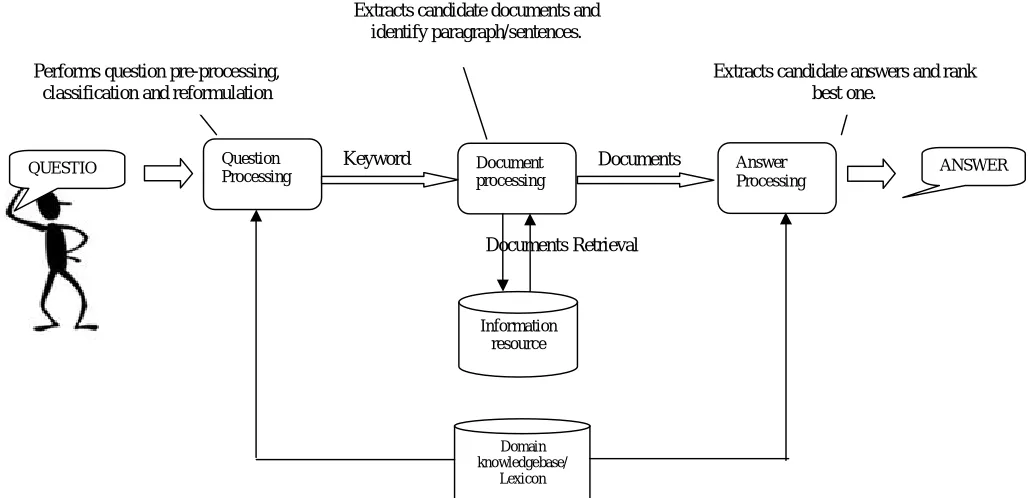
The systems participating in the TREC QA [1] track up to some extent have similar number of features and technologies, and in generalized view the whole design of the systems in most cases can be considered remarkably alike. An automated QA system based on a document collection typically has three main components: question processing, document processing, and answer retrieval. An illustration of this prototypical system architecture is shown in figure 1.
A. Question Processing
Question processing fundamentally consists of pre-processing of question which may involve tokenization, chunking, shallow/ deep parsing derivation of expected answer type (e.g. person, definition) and keywords extraction which are later on submitted to the information retrieval system. In recent times, systems also perform question reformulation, where a question is transformed into a number of equivalent queries to identify various ways of expressing an answer given a natural language question. Parsing is done in order to construct some form of structural illustration of the question with the help of syntax. The extracted keywords are used by extraction engines to fetch relevant documents. The expected answer type is also derived for this purpose.
B. Document Processing
Document processing involves keyword expansion, document retrieval, and passage detection. Keyword expansion typically involves taking the keywords fetched in the question processing stage and looking them up in a thesaurus, or other resource, and adding similar search terms in order to retrieve as many documents as possible.
C. Answer Processing
104
©IJRASET (UGC Approved Journal): All Rights are Reserved
list of top ranked answers is returned to the user. While most of the question answering system presents answer as it was found in the relevant document, some systems also perform answer formulation with the help of question processing module.
Beside these components, designed architecture has some other essential components as:
1) Document Collection: Document collection component described in figure 1 actually refer to the information resource (structured, semi-structured or unstructured) viz., knowledge base, comprehension text, document collection or web data whichever is utilized by the QA system for the extraction of candidate answers.
[image:3.612.42.557.195.444.2]2) Domain Knowledgebase/Lexicon: Domain information is saved in the knowledgebase or lexicon to find semantic relation among keywords, so that system can analyze questins and answers semantically.
Fig 1: Question answering system architecture
II. HISTORICALDEVELOPMENT
Research and development in the field of systems capable of answering questions in natural language started with one of the earliest and best known Artificial Intelligence (AI) dialogue systems as Weizenbaum’s ELIZA [2]. ELIZA was designed to emulate a therapist and operates through sequences of pattern matching and string replacement but it was not a robust dialogue system as many times it produces complete garbage due to strictly applying transformation rules. Another successful system of its time was BASEBALL, by Green et al. [3]. The BASEBALL system was designed to answer questions about baseball games which had been played in the American league during a single season. Another example of a natural language database front-end was the LUNAR system, by Woods [4]. The common feature of all these systems is that they had a core database or knowledge system that was hand-written by experts of the chosen domain. In earlier days, many prominent research works have been done in the field of question answering system and their contribution cannot be ignored. However, here we are going to discuss only ELIZA [2] and SHRDLU [5] considering their important role during evolution of these systems.
Since the early days of Artificial Intelligence in the 60’s, researchers have been fascinated with answering natural language questions. However, the difficulty of natural language processing (NLP) had limited the scope of QA to domain-specific expert systems. These systems include front-ends to structured data repositories, conversational question answerers and systems which try to find answers to questions from text sources, such as encyclopaedias. Some of these systems are tabulated as below:
Documents Retrieval
Information resource
Documents Keyword
s
Question
Processing Document processing Answer Processing ANSWER
QUESTIO N
Domain knowledgebase/
Lexicon
Performs question pre-processing, classification and reformulation
Extracts candidate documents and identify paragraph/sentences.
105
©IJRASET (UGC Approved Journal): All Rights are Reserved
TABLE I. Some QA systems during the evolution of QA system.
QA System Year Developer Domain Description
BASEBALL 1961 Green et al.,[3] Baseball
game
answering questions about baseball games played in the American league over one season
ELIZA 1966 Weizenbaum et al.[2] Medical was a dialogue system and to emulate a therapist
SHRDLU 1972 Winograd[5] Toy SHRDLU was built for a toy domain of a simulated robot moving
objects in a blocks world
LUNAR 1973 Woods et al.[4] Lunar
rocks
answering questions about lunar rock and soil composition that was accumulating as a result of the Apollo moon mission.
MARGIE, 1975 Shank et al.[6] was capable of reading and interpreting a document, and
answering a series of questions.
GUS 1977 Bobrow et al.[7] Airlines simulated a travel advisor
and had access to a restricted database of information about airline flights.
LILIOG 1991 Herzog, Rollinger[8] Tourism Was a text-understanding system that operated on the domain of
tourism information in a German city.
Research in QA has been accelerated due to the inclusion of a QA track by Voorhees at the Text Retrieval Conference (TREC) since 1999. Since then, increasingly powerful systems have participated in TREC and other evaluation for QA systems such as CLEF and
NTCIR. The availability of huge document collections (e.g., the web itself), combined with improvements in information retrieval
(IR) and NLP techniques, has attracted the development of a special class of QA systems that answers natural language questions by consulting a repository of documents.
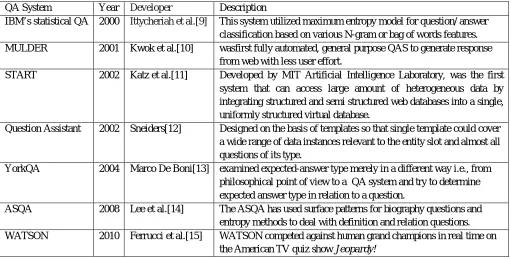
Current research works in QA are now focusing on retrieving answers based on the activity of filling predefined templates from natural language texts, where the templates are designed to capture information about key role players in question. Some concurrent pioneer work in the field of Question Answering (QA) system may be summarized in the below table as:
TABLE III. Some prominent QA systems in recent past
QA System Year Developer Description
IBM’s statistical QA 2000 Ittycheriah et al.[9] This system utilized maximum entropy model for question/ answer
classification based on various N-gram or bag of words features.
MULDER 2001 Kwok et al.[10] wasfirst fully automated, general purpose QAS to generate response
from web with less user effort.
START 2002 Katz et al.[11] Developed by MIT Artificial Intelligence Laboratory, was the first
system that can access large amount of heterogeneous data by integrating structured and semi structured web databases into a single, uniformly structured virtual database.
Question Assistant 2002 Sneiders[12] Designed on the basis of templates so that single template could cover
a wide range of data instances relevant to the entity slot and almost all questions of its type.
YorkQA 2004 Marco De Boni[13] examined expected-answer type merely in a different way i.e., from
philosophical point of view to a QA system and try to determine expected answer type in relation to a question.
ASQA 2008 Lee et al.[14] The ASQA has used surface patterns for biography questions and
entropy methods to deal with definition and relation questions.
WATSON 2010 Ferrucci et al.[15] WATSON competed against human grand champions in real time on
[image:4.612.52.563.435.694.2]106
©IJRASET (UGC Approved Journal): All Rights are Reserved
III.DIFFERENTFACETSOFTEXT BASEDAUTOMATEDQUESTIONANSWERINGSYSTEM
Since evolution till date, automated question answering system has acquired different facets to meet the changing requirements of user. Recent systems are not only enhanced to present answers in more than one language (multilingual) but many of them have also implemented analytical approach(community based)to previous answers of a question to have more refined and accurate answer according to user’s interest in real time (interactive).In next section, we are going to present the diverse facets of automated question answering on behalf of the mechanism acquired to interact with user while giving the expected response.
A. Standard Question Answering System
Most common QA systems those existed so far are monolingual question answering system. Such systems receives question in one language and delivers response in the same language. Most of the systems discussed in related work section belong to this category only. These QA systems might implement different procedures and utilize different resources for extracting answer but will present answer only in the asked language. Main aim of such QA systems is to enhance accuracy of the response rather bothering about enhanced user friendly features. Such features may include presentation of extracted answer in language of user’s choice and that too in real time. In addition to the standard QA functionality, implementation of these features would require consideration of different language structure, anomalies and time constraint.
B. Multilingual Question Answering System
Multiingual question answering as name suggests is a sub-field of question answering that not only allows user to have answer in the asked language but also in other languages. The multilingual version of automated question answering hasn’t gained much attention during earlier days of question answering. Earlier QA systems had only focused on presenting answer in English language. However, with the enhancements of natural language processing mechanisms, later systems started focusing on development of cross-lingual QA systems that allow access to information in non-English language. Cross-lingual (Bilingual) QA systems can be considered as extension to conventional QA research while multilingual can be considered as extended version of cross-lingual QA. Beside following the standard mechanism of QA system development, multilingual systems has main focus on mapping of different language structures, semantics, sense disambiguation and existing anomalies. These tasks become much tedious due to inherent difference existed in representation of syntax and semantics of considered languages. Majority of such QA systems developed so far aims on translating relevant section of the question usually with the help of machine translating systems. This translated text is later on used to access a collection containing relevant information. Most of the popular multilingual QA systems greatly rely on monolingual QA systems to extract relevant response to the question. Likewise, monolingual counterpart, it depends greatly on good corpus and database. Additionally, external lexical resources also plays important role while dealing with different language structures. The JAVELIN [16] system is a modular, extensible and language-independent architecture for building question-answering systems. The system was earlier developed for English version and now it has been extended for cross-language question answering in Chinese and Japanese. The system has evaluated the two modules Chinese (EC) and the English-to-Japanese (EC) separately as a subtask for gold standard data at NTCIR, CLQA evaluation. The work concluded that keyword translation accuracy grealy affects overall performance on the CLQA task.
Power Answer [17], an open-domain Question answering system is presented by Language Computer Corporation (LCC). The paper reports Power Answer participation at QA@CLEF 2007, where it is integrated with its statistical Machine Translation engine for English-to-French and English-to-Portuguese cross-language tasks. Intermediate processing has been performed only in English regardless of the input or source language and mapped back to the source language documents for final output.
Garcia Santiago et al., [18] has analysed the effectiveness of the translations obtained through three of the most popular online translating tools (Google Translator, Promt and Worldlingo). Evaluation has been performed on the basis of automatic and subjective measures. The results reported that the tools and linguistic resources used by automatic translators for German-to-Spanish translations are more limited and less efficient than the French-to-Spanish online translators. The work presents a comprehensive way for understanding online translators and their prospective in the context of multilingual information retrieval.
107
©IJRASET (UGC Approved Journal): All Rights are Reserved
Forner et al., [20] offers an overview of the key issues raised during the seven years’ activity of the Multilingual Question Answering Track at the Cross Language Evaluation Forum (CLEF). The work summarizes testing of both monolingual and cross-language Question Answering (QA) systems that process queries and documents in several European cross-languages,concerned challenging issues, created data sets, different types of questions developed and main evaluation measures utilized.
Eby et al.,[21] has analyzed the main publications from 2000 to 2010 related to multilingual question answering. The survey has identified various information resources, tools and techniques used during this time span. Most popular resources were databases, dictionaries, corpora, ontologies, thesauri, Wikipedia and Euro WordNet while popular linguistic tools were computational grammars and automatic translators. Parallel corpora and machine translation have remained as most popular techniques for cross lingual analysis due to low computational cost and ease of storage.
BRUJA [22], a multilingual QA system developed for English, Spanish and French languages.The BRUJA architecture uses English as Interlingua to make usual QA tasks such as question classifications and answer extractions. Cross Language Information Retrieval (CLIR) techniques are used to retrieve relevant documents from a multilingual collection. Increased number of documents, however, also poses threat of introducing noise to the retrieved information. The issue has been addressed by 2-step RSV merging algorithm for passages in multilingual QA.
QALD-3 [23] is the third version of the open challenge on Question Answering over Linked Data participated at CLEF 2013. The system has a strong emphasis on multilinguality, offering two tasks: one on multilingual question answering and one on ontology lexicalization.
C. Community Question Answering System
Automatic question answering (QA) deals with automatically answering questions that are formulated by humans in natural language. Usually, these systems are good at answering factoid questions (What is cost of iPhone7?) instead of complex non-factoid questions (What do you think about features of iPhone7?). Obviously, answer to such questions cannot be found in pre structured knowledge bases. Also, most of the fact based question answering system and digital assistants fail to provide answer for most of such questions. On the other hand, famous Community Question Answering platform such as Stack Exchange [47] or GuteFrage.net [48]allows users to ask any type of question related to some specific topic which in turn answered by another user using same platform. In recent times, CQA archives have become a rich information source for non-factoid questions[24].These communities explore themselves with the help of small number of highly active user viz., experts, which provide high quality relevant answers. These expert users nurtures the community and expert identification techniques are used to retain them in community which often need more analysis and elaborated text to provide correct response. This research field is closely related to natural language processing (NLP) as well as information retrieval (IR).
Cassan et al., [25] developed Priberam’s QA system that relied on their earlier developed multilingual semantic search engine. However, system has used its own indexing technology LegiX, a legal information tool instead of third party indexation engine used in earlier work. The indexing engine provides indexing to semantic information, ontology domains, question categories and other specificities for QA. Initially the system was tested for Portuguese module but later on also adopted for Spanish language. The work described in paper emphasized on the improvements and changes implemented to adapt Spanish language along with Portuguese for cross-lingual extension. Liu et al., [26]has worked on issue of predicting information seeker satisfaction in collaborative question answering communities. A prediction model has been developed to predict whether a question author will be satisfied with the answers submitted by other community member. The task also includes development of variety of content, structure, and community focused features. Information seeking patterns that lead to user satisfaction is also identified for question answering communities.
108
©IJRASET (UGC Approved Journal): All Rights are Reserved
Liu et al., [29] has worked on predicting popularity of question in CQA by implementing statistical analysis on different factors affecting the same. A supervised machine learning approach has been proposed to identify factors influencing question popularity. Such factors can distinguish the popular questions from unpopular ones in the Yahoo! Answers question and answer repository.
Baltadzhieva et al., [30] has reviewed existing research on question quality in CQA websites. The work discussed various features affecting the quality of asked question. Such analysis of features are useful for forums to help users in formulating improved question so as to retrieve most prompt information they are searching for.Zhao et al., [32] considered the problem of expert finding from the view point of learning ranking metric embedding. The ranking metric network learning framework has integrated users’ relative quality rank to given questions and their social relations for expert identification.
Srba et al., [31]has reviewed 265 articles published between 2005 and 2014 related to Community question-answering (CQA) and presented a comprehensive state-of-the-art survey. They have proposed a framework that defines descriptive attributes of CQA approaches and their classification with respect to problems they are aimed to solve. As a part of the survey, the study also highlighted current trends and the areasthat need to pave further attention from the research community. Song et al.,[32] aimed at non-factoid question-answering that usually expects passages as answers. A sparse coding-based summarization strategy has been proposed that includes three core features: short document expansion, sentence vectorization, and a sparse-coding optimization framework. Each answer is extended to have more comprehensive representation based on such features.
D. Interactive Question Answering System
Interactive question answering allows users not only to have answer to their asked questions but also the related information. These systems somehow give response in a manner as if interacting to a person in real environment. These systems establish a communication to assist user by either suggesting related information or providing refinements to the user’s query. In other words, an interactiveQA can be defined as a question answering mechanism that sets up at least one communication between user and the system and the user has some control over the rendered information and the actions taken afterward[33]. Such systems are quite similar to the text based dialogue system built upon mechanism of question answering systems [34]. Interactive QA systems are capable of answering complex and non factoid questions along with factoid questions in real time. The complex interactive question answering has been included in TREC track since 2006 (TREC 2006 question answering track) that has been also continued in 2007. Initially, the Quarteroni et al., [35] has proposed the design and implementation of a chatbot-based interface for an open domain. Though, later on anaphora resolution strategies are used to achieve real time interaction in response to the user’s query. Anaphora queries are text occurrences where a noun (known as the anaphor) has been replaced by a word or phrase (known as the referent) which refers directly back to a previous occurrence of the missing noun.
E.g., Q: Who is Michael Phelps? A: a retired swimmer and most decorated Olympian of all time, with a total of 28 medals. Q:
Which country does he belong? In this exchange the anaphor is “Michael Phelps” and the referent is “he”.
HITIQA [36] is one of the major initial efforts based on interactive question answering technology. The system allows users not only to pose questions in natural language but also assist them in performing their task. The focus of designed to allow the user to submit exploratory, analytical, non-factual questions, such as “What has been Russia’s reaction to U.S. bombing of Kosovo?” Obviously, such type of diplomatic questions need further communication to know what exactly user is intended to ask. Therefore, the HITIQA dealt with such questions by developing frames covering different classes of events, from politics to medicine to science to international economics, etc. Harabagiu et al., [37] has presented an interactive QA system, FERRET based on predictive questioning. The system makes use of a QA architecture that integrates QUAB (question-answer databases) question-answer pairs into the processing of questions. QUABs are created off-line and their use has greatly improved the overall accuracy of an interactive QA dialogue as they provide access to rapidly adopted users valid suggestions.
Hickl et al., [38] described a methodology for enhancing the quality and relevance of suggestions provided to users for interactive QA systems. The system combines feedback from users with Conditional Random Fields based classifier to enhance the quality of suggestions. The system achieved nearly 90% F-measure by combining the information a user’s interaction with semantic and pragmatic features derived from the structure and coherence of an interactive QA communication.
109
©IJRASET (UGC Approved Journal): All Rights are Reserved
language interfaces to their users. The agent plays key role at interactive layer and rectifies the user’s mistake while formulating complex queries.
Liu et al.,[43]has developed an IQA which extracts answer from FAQ knowledge base which is extracted from community question answering web portals. The syntactic, semantic and pragmatic features between question and candidate answers and context information are used to construct models by ranking learning method to extract the answers. The system has utilized user’s feedback to the retrieved answer as a naive method for interaction. Konstantinova et al., [44] has developed an IQA that helps customer in process of deciding better product based on different features. The system establishes a dialogue with the customer when their needs are not clearly defined. For this purpose acorpus-based method is proposed for weighting the importance of product features depending on how likely they are to be of interest fora user. For further enhancements, asentiment classification system is also employed to distinguish between features mentioned in positive and negative contexts. Schwarzer et al., [45] presented an information retrieval-based question answering (QA) system for the large German e-government domain. The system successfully handles ambiguous questions by combining retrieval methods, task trees and a rule-based approach.
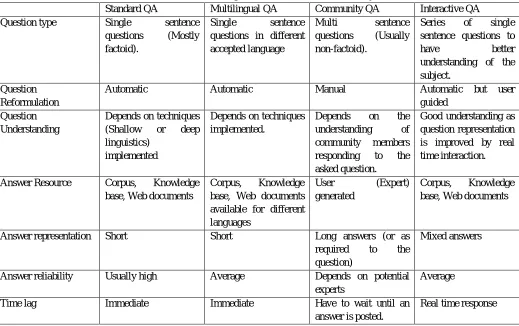
Table 3 gives a comprehensive overview of different facets of automated text based question answering system based on different
[image:8.612.49.568.285.611.2]key features.
TABLE IIIII. Summarized representation of the different QA systems
Standard QA Multilingual QA Community QA Interactive QA
Question type Single sentence
questions (Mostly
factoid).
Single sentence
questions in different accepted language
Multi sentence
questions (Usually
non-factoid).
Series of single
sentence questions to
have better
understanding of the subject.
Question Reformulation
Automatic Automatic Manual Automatic but user
guided Question
Understanding
Depends on techniques
(Shallow or deep
linguistics) implemented
Depends on techniques implemented.
Depends on the
understanding of
community members
responding to the
asked question.
Good understanding as question representation is improved by real time interaction.
Answer Resource Corpus, Knowledge
base, Web documents
Corpus, Knowledge
base, Web documents available for different languages
User (Expert)
generated
Corpus, Knowledge
base, Web documents
Answer representation Short Short Long answers (or as
required to the
question)
Mixed answers
Answer reliability Usually high Average Depends on potential
experts
Average
Time lag Immediate Immediate Have to wait until an
answer is posted.
Real time response
IV.FUTUREDIRECTION
110
©IJRASET (UGC Approved Journal): All Rights are Reserved
Moreover, when an IQA system encounters such an ambiguous construction, it can interact to user to clarify the user request. Therefore, complex question can also be posed to IQA and user is not restricted to ask only single sentence question. Community question answering gives freedom from asking questions to a specified format and allow user to ask question in any human understandable format.
Though, internal processing of multilingual and interactive QA differs widely, but their performance is highly dependent on good information source. Performance of all of the QAS is also affected by the psychology and the skill of the user. Interactive QAs provide solution to this issue but a better framework is required that can track the browsing history and behavioural activities of users and present answers in more effective way. Multilingual QA systems still require better algorithm to deal with heterogeneous multilingual data collections and porting techniques for QA systems of different languages. Community QA has effectively allowed information seekers to obtain specific answers to their questions but, it may also take hours or sometime days until a satisfactory answer is posted.
V. CONCLUSION
In this paper, we surveyed different versions of existing QA system that are available to handle the varying needs of user. We have seen an evolution from earlier simpler model that often answers in constrained environment to the complex one and free from semantic, structural, lingual and time constraints. As a result of survey, we have found that though question answering task has been exploring itself successfully for multilingual and interactive platforms, but pace of research studies for community QA is more popular and faster. The reason for this biasness lies within the requirement of less automatic processing and more human intervention while searching for relevant information.
REFERENCES
[1] Voorhees, E. M. (1999, November). The TREC-8 Question Answering Track Report. In Trec (Vol. 99, pp. 77-82).
[2] Weizenbaum J. ELIZA - a computer program for the study of natural language communication between man and machine. In Communications of the ACM, Vol. 9(1), 1966, pp. 36-45.
[3] Green BF, Wolf AK, Chomsky C, and Laughery K. Baseball: An automatic question answerer. In Proceedings of Western Computing Conference, Vol. 19, 1961, pp. 219–224.
[4] Woods W. Progress in Natural Language Understanding - An Application to Lunar Geology. In Proceedings of AFIPS Conference, Vol. 42,1973, pp. 441–450. [5] Winograd, T. (1980). What does it mean to understand language?. Cognitive science, 4(3), 209-241.
[6] Schank, R. C. (1975, June). Using knowledge to understand. In Proceedings of the 1975 workshop on Theoretical issues in natural language processing (pp. 117-121). Association for Computational Linguistics.
[7] Bobrow, D. G., Kaplan, R. M., Kay, M., Norman, D. A., Thompson, H., &Winograd, T. (1977). Gus, a frame-driven dialog system. Artificial Intelligence, 8(2), 155-173.
[8] Herzog, O. (1991). Text understanding in LILOG: integrating computational linguistics and artificial intelligence: final report on the IBM Germany LILOG-Project. C. R. Rollinger (Ed.). Springer.
[9] Ittycheriah, A., Franz, M., Zhu, W. J., Ratnaparkhi, A., &Mammone R.J.(2000). IBM‘s statistical question answering system. In Proceedings of the Text Retrieval Conference TREC-9.
[10] Kwok, C., Etzioni, O., & Weld, D. S. (2001). Scaling question answering to the web. ACM Transactions on Information Systems (TOIS), 19(3), 242-262 [11] Katz, B.(1997). Annotating the World Wide Web using natural language. In Proceedings of the 5th RIAO conference on Computer Assisted Information
Searching on the Internet.
[12] Sneiders, E. (2002). Automated question answering using question templates that cover the conceptual model of the database. In Natural Language Processing and Information Systems, Springer Berlin Heidelberg, 235-239.
[13] De Boni, M. (2004). Relevance in Open Domain Question Answering: Theoretical Framework and Application.
[14] Lee, Y. H., Lee, C. W., Sung, C. L., Tzou, M. T., Wang, C. C., Liu, S. H., Shih, C.W., Yang, P.W., & Hsu, W. L. (2008). Complex question answering with ASQA at NTCIR 7 ACLIA. In Proceedings of NTCIR-7 Workshop Meetings.
[15] Ferrucci, D., Brown, E., Chu-Carroll, J., Fan, J., Gondek, D., Kalyanpur, A. A., Lally A. et al. (2010). Building Watson: An overview of the DeepQA project. AI magazine, 31(3), 59-79.
[16] Shima, H., Wang, M., Lin, F., &Mitamura, T. (2006). Modular approach to error analysis and evaluation for multilingual question answering. Proc. of LREC’06.
[17] Bowden, M., Olteanu, M., Suriyentrakorn, P., D'Silva, T., & Moldovan, D. I. (2007, September). Multilingual Question Answering through Intermediate Translation: LCC's PowerAnswer at QA@ CLEF 2007. In CLEF (pp. 273-283).
[18] García-Santiago, L., &Olvera-Lobo, M. D. (2010). Automatic Web Translators as Part of a Multilingual Question-Answering (QA) System”. Translation Journal, 14(1).
[19] Olvera-Lobo, M. D., & Gutiérrez-Artacho, J. (2011). Multilingual Question-Answering System in biomedical domain on the Web: an evaluation. Multilingual and Multimodal Information Access Evaluation, 83-88.
[20] Forner, P., Giampiccolo, D., Magnini, B., Peñas, A., Rodrigo, Á.,& Sutcliffe, R. (2010). Evaluating multilingual question answering systems at CLEF.
111
©IJRASET (UGC Approved Journal): All Rights are Reserved
[22] García-Cumbreras, M. Á., Martínez-Santiago, F., &Ureña-López, L. A. (2012). Architecture and evaluation of BRUJA, a multilingual question answering system. Information retrieval, 15(5), 413-432.
[23] Cimiano, P., Lopez, V., Unger, C., Cabrio, E., Ngomo, A. C. N., & Walter, S. (2013, September). Multilingual question answering over linked data (qald-3): Lab overview. In International Conference of the Cross-Language Evaluation Forum for European Languages (pp. 321-332). Springer, Berlin, Heidelberg.
[24] Pal, A., Harper, F. M., &Konstan, J. A. (2012). Exploring question selection bias to identify experts and potential experts in community question answering. ACM Transactions on Information Systems (TOIS), 30(2), 10.
[25] Cassan, A., Figueira, H., Martins, A., Mendes, A., Mendes, P., Pinto, C., & Vidal, D. (2006, September). Priberam's question answering system in a cross-language environment. In CLEF (pp. 300-309).
[26] Liu, Y., Bian, J., &Agichtein, E. (2008, July). Predicting information seeker satisfaction in community question answering. In Proceedings of the 31st annual international ACM SIGIR conference on Research and development in information retrieval(pp. 483-490). ACM.
[27] Zhou, T. C., Si, X., Chang, E. Y., King, I., &Lyu, M. R. (2012, July). A Data-Driven Approach to Question Subjectivity Identification in Community Question Answering. In AAAI.
[28] Anderson, A., Huttenlocher, D., Kleinberg, J., &Leskovec, J. (2012, August). Discovering value from community activity on focused question answering sites: a case study of stack overflow. In Proceedings of the 18th ACM SIGKDD international conference on Knowledge discovery and data mining (pp. 850-858). ACM.
[29] Liu, T., Zhang, W. N., Cao, L., & Zhang, Y. (2014). Question popularity analysis and prediction in community question answering services. PloS one, 9(5), e85236.
[30] Baltadzhieva, A., &Chrupała, G. (2015). Question quality in community question answering forums: a survey. AcmSigkdd Explorations Newsletter, 17(1), 8-13.
[31] Srba, I., &Bielikova, M. (2016). A comprehensive survey and classification of approaches for community question answering. ACM Transactions on the Web (TWEB), 10(3), 18.
[32] Song, H., Ren, Z., Liang, S., Li, P., Ma, J., & de Rijke, M. (2017, February). Summarizing answers in non-factoid community question-answering. In Proceedings of the Tenth ACM International Conference on Web Search and Data Mining (pp. 405-414). ACM.
[33] Kelly, D., Kantor, P. b., Morse, E. l., Scholtz, J., & Sun, Y. (2009). Questionnaires for eliciting evaluation data from users of interactive question answering systems. Natural Language Engineering., 15 (1), 119-141.
[34] Zhao, Z., Yang, Q., Cai, D., He, X., &Zhuang, Y. (2016, July). Expert Finding for Community-Based Question Answering via Ranking Metric Network Learning. In IJCAI (pp. 3000-3006).
[35] Quarteroni, S., &Manandhar, S. (2007). A chatbot-based interactive question answering system. Decalog 2007, 83.
[36] Small, S., Liu, T., Shimizu, N., &Strzalkowski, T. (2003, July). HITIQA: an interactive question answering system a preliminary report. In Proceedings of the ACL 2003 workshop on Multilingual summarization and question answering-Volume 12 (pp. 46-53). Association for Computational Linguistics.
[37] Harabagiu, S., Hickl, A., Lehmann, J., & Moldovan, D. (2005, June). Experiments with interactive question-answering. In Proceedings of the 43rd annual meeting on Association for Computational Linguistics (pp. 205-214). Association for Computational Linguistics.
[38] Hickl, A., &Harabagiu, S. (2006, June). Enhanced interactive question-answering with conditional random fields. In Proceedings of the Interactive Question Answering Workshop at HLT-NAACL 2006 (pp. 25-32). Association for Computational Linguistics.
[39] S. Rosset, O. Galibert, G. Illouz, and A. Max. 2006. Integrating spoken dialog and question answering: the Ritel project. In Proceedings of the Ninth International Conference on Spoken Language Processing (INTER-SPEECH), Pittsburgh, USA.
[40] Toney, D., Rosset, S., Max, A., Galibert, O., &Bilinski, E. (2008, May). An Evaluation of Spoken and Textual Interaction in the RITEL Interactive Question Answering System. In LREC.
[41] Smith, J. (2010). IQABOT: A Chatbot-Based Interactive Question-Answering System. Techical report, 83-90.
[42] Dang, H. T., Kelly, D., & Lin, J. J. (2007, November). Overview of the TREC 2007 Question Answering Track. In Trec (Vol. 7, p. 63).
[43] Liu, S., Zhong, Y. X., &Ren, F. J. (2013). Interactive Question Answering Based on FAQ. In Chinese Computational Linguistics and Natural Language Processing Based on Naturally Annotated Big Data (pp. 73-84). Springer, Berlin, Heidelberg.
[44] Konstantinova, N., &Orasan, C. (2012). Interactive question answering. Emerging Applications of Natural Language Processing: Concepts and New Research, 149-169.
[45] Schwarzer, M., Düver, J., Ploch, D., &Lommatzsch, A. (2016). An Interactive e-Government Question Answering SysteIn LWDA(pp. 74-82). [46] Stackoverflow Websitehttps://stackoverflow.com/