www.hydrol-earth-syst-sci.net/16/1595/2012/ doi:10.5194/hess-16-1595-2012
© Author(s) 2012. CC Attribution 3.0 License.
Earth System
Sciences
Changes in discharge and solute dynamics between hillslope
and valley-bottom intermittent streams
S. Bernal1and F. Sabater2
1Biogeodynamics and Biodiversity Group, Center for Advanced Studies of Blanes (CEAB-CSIC), Acc´es a la Cala St. Francesc 14, 17300 Blanes, Girona, Spain
2Department of Ecology, Faculty of Biology, University of Barcelona, Diagonal 645, 08028 Barcelona, Spain
Correspondence to: S. Bernal ([email protected])
Received: 4 October 2011 – Published in Hydrol. Earth Syst. Sci. Discuss.: 27 October 2011 Revised: 18 April 2012 – Accepted: 14 May 2012 – Published: 4 June 2012
Abstract. To gain understanding on how alluvial zones
mod-ify water and nutrient export from semiarid catchments, we compared monthly discharge as well as stream chloride, car-bon, and nitrogen dynamics between a hillslope catchment and a valley-bottom catchment with a well-developed allu-vium. Stream water and solute fluxes from the hillslope and valley-bottom catchments showed contrasting patterns be-tween hydrological transitions and wet periods, especially for bio-reactive solutes. During transition periods, stream water export decreased >40 % between the hillslope and the valley bottom coinciding with the prevalence of stream-to-aquifer fluxes at the alluvial zone. In contrast, stream water export increased by 20–70 % between the hillslope and valley-bottom catchments during wet periods. During transition periods, stream solute export decreased by 34– 97 % between the hillslope and valley-bottom catchments for chloride, nitrate, and dissolved organic carbon. In annual terms, stream nitrate export from the valley-bottom catch-ment (0.32±0.12 kg N ha−1yr−1 [average±standard devi-ation]) was 30–50 % lower than from the hillslope catch-ment (0.56±0.32 kg N ha−1yr−1). The annual export of dis-solved organic carbon was similar between the two catch-ments (1.8±1 kg C ha−1yr−1). Our results suggest that hy-drological retention in the alluvial zone contributed to reduce stream water and solute export from the valley-bottom catch-ment during hydrological transition periods when hydrologi-cal connectivity between the hillslope and the valley bottom was low.
1 Introduction
Large riparian forests and well-developed alluvial zones are two of the main contrasting landscape features between hill-slope and valley-bottom areas in mountainous regions. The riparian zone is a critical ecotone in the interface between ter-restrial and fluvial ecosystems with high potential for biogeo-chemical processing (Cirmo and McDonnell, 1997; Hedin et al., 1998; Hill, 2000). Riparian vegetation can supply large amounts of fresh particulate organic matter to aquatic ecosys-tems (Fiebig et al., 1990; Meyer et al., 1998). There is a large flux of dissolved organic carbon (DOC) from riparian soils to stream ecosystems (e.g. Seibert et al., 2009; Hornberger et al., 1994), and this source of organic matter can contribute considerably to the annual export of DOC at the catchment scale (Inamdar and Mitchell, 2006; Pacific et al., 2010). At the same time, riparian zones can act as important sinks of essential nutrients such as nitrate, substantially reducing ni-trate export from catchments (Peterjohn and Correll, 1984; Hill, 1996; Vidon et al., 2004a).
can favour the mixing of surface-subsurface water bodies and modify stream flow as well as stream chemistry in many dif-ferent ways (e.g. Hooper et al., 1998; Hill, 2000; Burns et al., 2001). In temperate streams, where aquifer-to-stream fluxes prevail most of the time, highly conductive alluvial sediments can favour that hillslope groundwater passes through the ri-parian area, lowering the mean residence time of groundwa-ter in this compartment and thus, diminishing the ability of riparian biota to remove nutrients from groundwater (Vidon et al., 2004b). On the contrary, in arid and semiarid regions where streams usually lose water toward the aquifer (Mart´ı et al., 2000), highly conductive coarse sediments enhance the retention of nutrients from the stream, because the alluvium enlarges water storage zones, increasing hydrological reten-tion and thus, attenuating the advective transport of stream water (e.g. Valett et al., 1996; Morrice et al., 1997; Mart´ı et al., 1997).
Most of the research showing that alluvial riparian zones affect stream hydrology and nutrient cycling is based on reach- and plot-scale experiments, and thus our current un-derstanding of how this ecotone regulates water and nutrient export at the catchment scale is still limited. Recent studies performed in temperate regions have revealed that the capa-bility of the alluvial riparian zone to change water and nutri-ent export from catchmnutri-ents increases with its size (relative to the hillslope area) and with the turnover time of groundwater in this compartment, which is inversely related to the degree of hydrological connectivity between hillslope and riparian zones (Jencso et al., 2010; Pacific et al., 2010). In semiarid catchments, high water demand by vegetation limits water availability and runoff, so that hydrological connectivity be-tween hillslope and riparian zones tends to be low (Pi˜nol et al., 1991; Meixner et al., 2007). Consequently, the mobiliza-tion of water and solutes from the hillslope to the stream is limited to large storm events when hydrological connectivity can eventually increase (Meixner and Fenn, 2004; Meixner et al., 2007). Thus, the potential of the alluvial riparian zone to change stream water and nutrient fluxes should be high in semiarid systems, especially during dry periods, because hy-drological connectivity between hillslope and riparian zones is limited, and thus, the turnover time of groundwater in the alluvium may be high.
To explore this idea, we compared monthly discharge as well as stream carbon and nitrogen dynamics between two semiarid nested catchments: one located at the hillslope and the other one located at the valley bottom. In addition to bio-reactive solutes, we analyzed a passive solute (chloride) to discern whether changes in water chemistry between the two catchments reflected solely changes in hydrological pro-cesses or integrated differences in biogeochemical propro-cesses as well. The valley-bottom stream was surrounded by a well-developed alluvium and lost water toward the alluvial ri-parian zone during hydrological transitions (from dry-to-wet and from wet-to-dry conditions) (Butturini et al., 2003). By contrast, the alluvial riparian zone surrounding the
hills-lope stream was minimum, and hillshills-lope groundwater flowed directly into the stream all the year around (Bernal and Sabater, 2008). Previous plot-scale studies performed at the valley bottom have shown contrasting carbon and nitrogen patterns between hydrological transition and wet periods at the alluvial riparian zone (Butturini et al., 2003; V´azquez et al., 2007). The current paper extends this previous work by exploring differences in water and solute fluxes with catchment position between these two contrasting hydrolog-ical periods. We expect that differences in water and solute dynamics between the hillslope and valley-bottom streams will be accentuated during hydrological transitions when hydrological disconnection between the two catchments is high. In particular, we expect a decrease in stream water and solute fluxes between the hillslope and valley-bottom catchments during hydrological transitions because stream-to-aquifer water fluxes may favour hydrological retention at the valley bottom.
2 Study site
2.1 Climate
The Fuirosos Stream Watershed (FSW) is located in the Nat-ural Park of Montnegre-Corredor 60 km from Barcelona, in northeastern Spain (latitude 41◦420N, longitude 2◦340, alti-tude range 50–770 m a.s.l.). The climate is typically Mediter-ranean, with temperatures ranging from a monthly mean of 3◦C in January to 24◦C in August. Average annual precipita-tion is 750 mm yr−1, and the climate is Mediterranean subhu-mid (sensu Strahler and Strahler, 1989). The distribution of rainfall throughout the year is irregular, and it rarely snows.
2.2 The catchment
The FSW has a drainage area of 16 km2 and is mainly underlain by granite with minor areas of sericitic schists. Leucogranite is the dominant rock type (48 % of the area), followed by biotitic granodiorite (27 % of the area) (IGME, 1983). There is an identifiable alluvial zone at the valley bottom that resulted from the transport and deposition of coarse material from the catchment (mainly sands and grav-els). The alluvial zone is 50–130 m wide, and it surrounds the stream and the riparian zone for almost 4 km along the stream (Fig. 1).
Biotitic granodiorite
Slope alluvium
1 0 1 km
GRI Ef-1
Ef-2
Ef-3 Ef-4
N
E
S W Alluvial zone
Leucogranite Sericitic schists Slates, lidites, limestones
France
Spain
2º34' 2º34'40'' 2º35'20'' 2º36' 2º36'40'' 2º37'20''
4
1
º42
'4
0''
41
º4
2
'
4
1
º4
1'20
''
4
1
º40
'4
0''
41
º40'
4
1
º39
'2
0''
[image:3.595.48.285.68.323.2]FUI
Fig. 1. Lithological units in the Fuirosos Stream Watershed
(Montnegre-Corredor Natural Park, NE Spain) (sensu IGME, 1983). There is an identifiable alluvial zone at the valley bottom. Circles indicate the sampling stations located at the valley-bottom catchment (FUI, 10.5 km2) and at the hillslope catchments Grimola (GRI, 3.5 km2) and Ef-4 (0.3 km2).
first 10 cm) (Bernal et al., 2003). The catchment is mainly covered by perennial cork oak (Quercus suber), evergreen oak (Quercus ilex ssp. ilex) and pine trees (Pinus pinea, Pi-nus pinaster and PiPi-nus halepensis). In the valley head there is mixed deciduous woodland of chestnut (Castanea sativa), hazel (Corylus avellana), and oak (Quercus pubescens). The riparian forest is conformed by alder (Alnus glutinosa) and plane (Platanus acerifolia). Agricultural fields occupy less than 2 % of the catchment area, and most of them are semi-abandoned.
For the present study, we monitored intensively two third-order streams draining nested catchments: Fuirosos (10.5 km2) that was surrounded by a well-developed allu-vium and a large riparian forest, and Grimola (3.5 km2) with a minimum alluvial riparian zone. The Grimola sampling station was located 1.5 km upstream of the alluvial riparian zone, while the Fuirosos sampling station was located 3 km after the beginning of the alluvial riparian zone (Fig. 1). The alluvial zone occupied 2.1 % of the Fuirosos catchment area and surrounded a large riparian forest (10–20 m width) and the stream channel (3–5 m width). The Grimola streambed was mainly formed by bedrock, and hillslope groundwater flowed directly into the stream channel. The Fuirosos stream had four main effluents (Ef-1, Ef-2, Ef-3, and Ef-4). The Ef-1 and 2 effluents ran dry during the period of study. The
Ef-3 and Ef-4 catchments had similar lithology and vegetation to the Grimola catchment, and they were outside the influence of the alluvial zone (Fig. 1).
Stream flow at the Fuirosos stream and all its effluents was intermittent. The cessation of flow occurred in summer, and it lasted for several weeks or even months depending on the dryness of the year. During the two studied water years, the duration of the summer drought was similar (11 and 14 weeks, respectively). The water year started in September when the stream flow recovered from autumn storm events. During the hydrological transition from dry-to-wet condi-tions, stream water at the Fuirosos site infiltrated into the alluvial riparian zone (Butturini et al., 2003). This valley-bottom stream lost water toward the aquifer until November, and after that, aquifer-to-stream groundwater fluxes predom-inated until early summer (Butturini et al., 2003). Stream wa-ter losses have been detected during the transition from wet-to-dry conditions in late summer (Bernal and Sabater, 2008). At the Grimola stream, aquifer-to-stream fluxes prevailed and there was no evidence of stream water loss (Bernal and Sabater, 2008).
3 Material and methods
3.1 Field measurements and chemical water analysis
Air temperature and precipitation (collected with a tipping bucket rain gage) data were recorded at 15 min intervals at the meteorological station commissioned in April 1999 at the FSW. Stream water level at Fuirosos was monitored at 30 min intervals from September 1998 until May 2002 us-ing a water pressure sensor connected to an automatic stream water sampler (Sigma© 900 Max). From September 2000, similar equipment was used to monitor stream water level at Grimola (Fig. 2). An empirical relationship between dis-charge and stream water level was obtained at each site us-ing the “slug” chloride addition method in the field (Gordon et al., 1992). Slug additions were performed under a wide range of hydrological conditions at both streams: Fuirosos (n=36, from 0.8 to 1425 l s−1) and Grimola (n=27, from 0.8 to 480 l s−1). Stream discharge ranged between the val-ues covered by these additions during>99 % of the time at both sites.
AI
0.1 1 10
Q
(m
m
)
0.001 0.01 0.1 1 10
AI
0.1 1 10
Q (m
m
)
1 10 100
a
[image:4.595.81.252.54.323.2]b
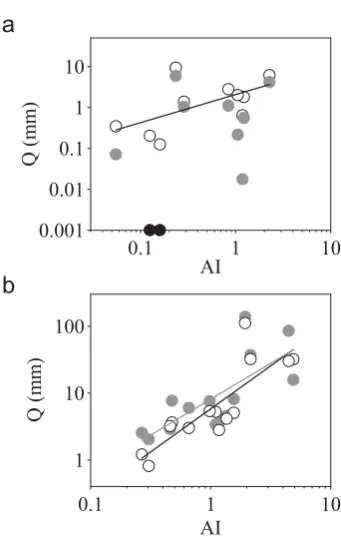
Fig. 2. Relationship between monthly aridity index (AI) and stream
runoff (Q) at the valley-bottom (grey circles) and hillslope (white circles) catchments during (a) the transition and (b) wet periods.
The grey and black lines indicate the power fit between AI andQ
for the valley-bottom and hillslope catchments, respectively (only when significant,p <0.01). The black circles correspond to months when the valley-bottom stream ran dry.
flow conditions. To capture changes in stream chemistry dur-ing the risdur-ing limb of the storm hydrograph, the automatic samplers were programmed to collect water samples at inter-vals of 30–60 min during the first 2–4 h; subsequent samples were collected at intervals of 4–6 h.
We installed an automatic sampler (without water pressure sensor) at the Ef-4 stream. In this case, water samples were collected at regular time intervals either hourly (if storms ex-pected) or daily (if no storms exex-pected). To assess whether the Ef-4 stream water samples were collected during base flow or storm flow conditions, we installed a water pressure sensor connected to a data logger (Campbell©CR10X) next to the automatic water sampler. Although the Ef-4 stream was not sampled as intensively as the other two streams, these data were useful for characterizing the stream water chemistry of the hillslope effluents.
All water samples were filtered through pre-ashed GF/F glass fibre filters and stored at 4◦C until analysed (usually in<7 days). Chloride (Cl−) was analyzed by capillary elec-trophoresis (Waters, CIA-Quanta 5000) (Romano and Krol, 1993). Dissolved nitrogen was measured colorimetrically with a Technicon-Autoanalyser (Technicon, 1976). Nitrate (NO−3) was measured by the Griess-Ilosvay method (Keeney and Nelson, 1982) after reduction by percolation through a
copperized cadmium column; ammonium (NH+4) was mea-sured after oxidation with salicilate using sodium nitroprus-side as a catalyst (Hach, 1992). Total dissolved nitrogen (TDN) was analyzed from March 2000 to March 2002. For measuring TDN, the sample was previously digested with UV light and potassium persulfate (Valderrama, 1981; Walsh, 1989) and then analyzed for NO−3-DON concen-tration was calculated by subtracting NO−3 and NH+4 from TDN. DOC samples were analyzed using a high-temperature catalytic oxidation (Shimadzu TOC analyzer).
3.2 Data analysis
Hydrological stream-aquifer interactions at the Fuirosos stream have been intensively analyzed (Butturini et al., 2002, 2003; Bernal and Sabater, 2008). These previous studies showed that stream-to-aquifer water fluxes occur in the FSW valley bottom during hydrological transition periods (from dry-to-wet and from wet-to-dry conditions) due to highly conductive alluvial sediments. Based on this previous knowl-edge, we considered two hydrological periods: the transition period (from June to October) when there is a high likeli-hood that stream-to-aquifer water fluxes occur, and the wet period (from November to May) when the aquifer-to-stream water fluxes prevail. Accordingly, all the environmental vari-ables included in this study, as well as stream water and so-lute fluxes from the hillslope and valley-bottom catchments, were calculated separately for each hydrological period.
3.2.1 Environmental variables
From the meteorological data set, we calculated monthly pre-cipitation (in mm month−1) and average monthly air tem-perature (in ◦C). We calculated daily potential evapotran-spiration (PET, in mm day−1) with the Penman-Monteith method (Campbell and Norman, 1998). To characterize the environmental conditions for each water year and for each hydrological period, we calculated the UNEP Aridity In-dex (AI), which is P/PET. Values of AI≥1, 0.65<AI<1, 0.5<AI<0.65, 0.2<AI<0.5, 0.05<AI<0.2, AI≤0.05 indicate humid, dry land, dry sub-humid, semi-arid, arid and hyper-arid conditions, respectively (UNEP, 1992).
3.2.2 Stream water export
lower than from the hillslope catchment; positive1Qvalues indicated the opposite.
3.2.3 Stream solute concentrations and fluxes
We calculated monthly volume-weighted solute concentra-tions (in mg l−1) for each of the two catchments. For each solutei, we calculated monthly stream solute export (Ei, in g ha−1) from the hillslope and valley-bottom catchments by multiplying instantaneous concentration by daily discharge. Daily volume-weighted concentration was used when more than one stream water sample per day was available. Daily solute concentrations were estimated by linear interpolation of measured solute concentrations (Hinton et al., 1997). We calculated the relative difference in stream solute export be-tween the two catchments (1Ei, in %) with 100∗(Efui,i−
Egri,i)/Egri,ifor each hydrological period.
To explore differences in stream water chemistry between hillslope streams, we compared instantaneous solute concen-tration for stream water samples collected within the same day from the Grimola and Ef-4 streams.
3.2.4 Statistical analysis
We used a Wilcoxon/Kruskal-Wallis test to examine whether significant differences existed in stream solute concentration between (i) the transition and wet periods for each catch-ment, and (ii) the hillslope and valley-bottom catchments for a given hydrological period. We performed correlation analy-sis between different environmental variables using a Spear-man rank correlation coefficient (ρ).
We used a Wilcoxon signed-rank test to examine whether solute concentration in water samples collected from differ-ent streams within the same day differed significantly tween each other. Non-parametric tests were chosen, be-cause concentrations showed a skewed distribution (Helsel and Hirsch, 1992). In all cases differences were considered significant whenp <0.01.
4 Results
4.1 Environmental variables
AnnualP was 711 and 804 mm yr−1during 2000–2001 and 2001–2002, respectively. Annual PET was similar for the two water years (1050 mm yr−1for 2000–2001 and 931 mm yr−1 for 2001–2002). Annual AI ranged between 0.67 and 0.86. When analyzing each hydrological period separately, we found that the AI was particularly low during the transition period and it exhibited typical values of semiarid conditions (Table 1). In contrast, during the wet periodP and PET were similar and values of AI were≥1.
Table 1. Cumulative precipitation (P) and potential evapotranspi-ration (PET), aridity index (AI), and average air temperature (T) for the transition and wet periods during the study period at the Fuirosos Stream Watershed. The range of monthly temperature for each period is shown in parenthesis.
P(mm) PET (mm) AI T (◦C)
WY 2000–2001
Transition 263 614 0.43 19.6(13.9, 23.5)
Wet 448 436 1.03 10.8(7.5, 17.1)
WY 2001–2002
Transition 256 566 0.45 20.4(17.3, 22.8)
Wet 548 365 1.5 9.8(5.28, 15.6)
4.2 Stream water export
During the transition period, stream runoff decreased between the hillslope and valley-bottom catchments (1Q <0 %), while the opposite trend was observed during the wet period (Table 2). Differences in monthlyQbetween the hillslope and valley-bottom catchments were particularly large during the transition period (Fig. 2).
There was a significant and positive correlation between monthly AI andQfor both the hillslope (ρ=0.7) and valley-bottom (ρ=0.63) catchments (n=24,p <0.001 for both catchments). During the transition period, Q at the valley bottom tended to be lower than at the hillslope for a given AI value (Fig. 2a). By contrast, the hillslope and valley-bottom catchments showed a similar AI-Qrelationship during the wet period (Fig. 2b).
4.3 Stream solute concentrations
At the valley bottom, stream Cl− concentration was higher during the transition period (24.9±5.3 mg l−1) than during the wet period (19.9±4.5 mg l−1), although the difference between the two periods was only marginally significant (Wilcoxon/Kruskal-Wallis test, p=0.06). There were no significant differences in monthly volume-weighted Cl− con-centration between the hillslope and valley-bottom streams (Wilcoxon/Kruskal-Wallis test,p >0.05) (Fig. 3a).
At the valley bottom, monthly volume-weighted NO−3concentration followed a seasonal pattern with maximum in winter and minimum in summer (Fig. 3b). The hillslope stream did not exhibit such a marked seasonality, because NO−3 concentration was high in winter as well as in the transition period (Fig. 3b).
There were no significant differences in stream DON con-centration between the two catchments (Wilcoxon/Kruskal-Wallis test,p >0.05). Both streams showed no significant differences in stream DON concentration between the tran-sition and wet periods (Wilcoxon/Kruskal-Wallis test, p >
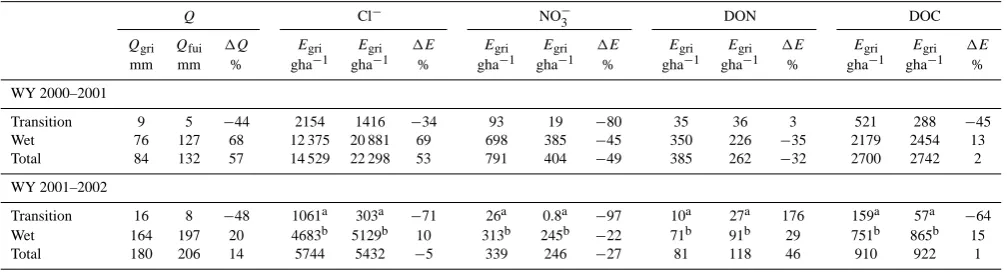
Table 2. Cumulative water (Q) and solute export (Ei) from the hillslope (gri) and valley-bottom (fui) catchments during the transition and
wet periods for the study period. The relative difference in stream water (1Q) and solute (1Ei) export between the two catchments is shown
in each case.
Q Cl− NO−3 DON DOC
Qgri Qfui 1Q Egri Egri 1E Egri Egri 1E Egri Egri 1E Egri Egri 1E
mm mm % gha−1 gha−1 % gha−1 gha−1 % gha−1 gha−1 % gha−1 gha−1 %
WY 2000–2001
Transition 9 5 −44 2154 1416 −34 93 19 −80 35 36 3 521 288 −45
Wet 76 127 68 12 375 20 881 69 698 385 −45 350 226 −35 2179 2454 13
Total 84 132 57 14 529 22 298 53 791 404 −49 385 262 −32 2700 2742 2
WY 2001–2002
Transition 16 8 −48 1061a 303a −71 26a 0.8a −97 10a 27a 176 159a 57a −64
Wet 164 197 20 4683b 5129b 10 313b 245b −22 71b 91b 29 751b 865b 15
Total 180 206 14 5744 5432 −5 339 246 −27 81 118 46 910 922 1
aOnly September and October,bfrom November to March.
from 0.04 to 1.8 mg N l−1 and did not show any seasonal pattern (Fig. 3c).
Monthly volume-weighted DOC concentration peaked in September at both the hillslope and valley-bottom streams (Fig. 3d). Both streams showed no significant differences in stream DOC concentration between the transition and wet periods (Wilcoxon/Kruskal-Wallis test, p >0.05, for both streams).
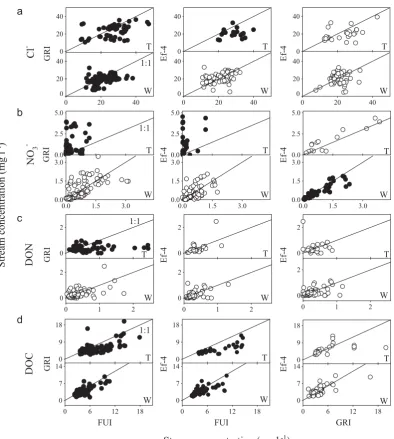
There were no significant differences in stream Cl−, DOC, and DON concentration between the Ef-4 and Gri-mola streams (Fig. 4). Only stream NO−3 concentration was higher at Grimola than at Ef-4 during the wet period (Fig. 4b). During the transition period, instantaneous NO−3 concentration was higher at the hillslope streams than at the valley-bottom stream (Fig. 4b). In contrast, instantaneous DOC concentration was higher at the valley-bottom stream than at the hillslope streams, especially during the transition period (Fig. 4d).
4.4 Catchment solute export
Relative changes in stream Cl− export between the hills-lope and valley-bottom catchments (1ECl) were in agree-ment with those observed for stream discharge during both the transition and wet periods (Table 2). During the tran-sition period, not only 1ECl values, but also 1EDOC and
1ENO3 values, were <0 % (Table 2). Moreover, values of
1ENO3 were <0 % during the wet period, and in annual terms the stream export of NO−3 was∼30–50 % lower from the valley-bottom catchment than from the hillslope catch-ment (Table 2). In contrast, the annual export of DOC was similar between the two catchments (<3 % of difference, Ta-ble 2). Values of1EDONdid not show a consistent pattern between the two studied water years (Table 2).
5 Discussion
There is an increasing body of knowledge showing that ma-jor hydrological and biogeochemical processes change as streams flow from the hillslope to the valley bottom (Covino and McGlynn, 2007; Jencso et al., 2010). Most of this re-search is based on studies performed in temperate regions where hillslope-riparian hydrological connectivity is high, especially during snowmelt (Jencso et al., 2009, 2010). In the current study, we shed some light on the effect of catch-ment position on hydrological and biogeochemical processes at the catchment-scale in semiarid regions by comparing two nested catchments with no snowpack that suffered water lim-itation during long periods. We found substantial differences in water, C and N fluxes between the hillslope and valley-bottom streams during hydrological transitions when semi-arid conditions prevailed. Based on the results presented here and on previous plot-scale studies performed at the FSW, we discuss the potential effect of the alluvial riparian zone on stream hydrology and water chemistry in these semiarid catchments.
5.1 Influence of the alluvial riparian zone on stream water export
We found a positive relationship betweenQand AI for both catchments, an indication that water availability in the FSW drove stream water export, as expected for semiarid catch-ments such as ours (Pi˜nol et al., 1991). Differences in stream water export between the two catchments were small dur-ing the wet period, whereas each catchment showed a dis-tinct pattern betweenQand AI during the transition period. In addition, stream water export consistently decreased (by
9/00 1/01 5/01 9/01 1/02 5/02 9/02
Cl
- (mg l
-1 )
0 10 20 30
9/00 1/01 5/01 9/01 1/02 5/02 9/02
DON (mg
N l
-1 )
0,0 0,3 0,6 0,9
9/00 1/01 5/01 9/01 1/02 5/02 9/02
DOC
(mg C l
-1 )
0 5 10 15
c
d
Time (month/year)
St
ream
con
centr
ation
T T
W
T W
9/00 1/01 5/01 9/01 1/02 5/02 9/02
NO
3
- (mg
N l
-1 )
0 1 2 3
b
W T
T W
a
[image:7.595.54.287.86.628.2]T
Fig. 3. Monthly volume-weighted solute concentration for (a) Cl−,
(b) NO−3, (c) DON, and (d) DOC at the hillslope (grey) and the valley-bottom (black) streams during the study period. T: transition period; W: wet period.
there were no stream-to-aquifer fluxes at the hillslope stream (Butturini et al., 2003; V´azquez et al., 2007; Bernal and Sabater, 2008).
Stream-to-aquifer fluxes at the valley bottom were at-tributed to differences in the hydraulic head between the aquifer and stream surface water, a process favoured by the high hydraulic conductivity of the alluvial sediments (5– 20 m day−1; Butturini et al., 2003). Similar results have been reported for other alluvial streams in semiarid regions world-wide (Triska et al., 1993; Morrice et al., 1997). This dif-ference in stream-aquifer hydrological interactions between the two sites could explain why stream discharge was several times lower at the valley bottom than at the hillslope during transition periods.
Another feasible mechanism that could exacerbate the dif-ference between aquifer and stream water hydraulic heads at the FSW valley bottom is a disproportionately lower contri-bution of hillslope groundwater to stream discharge down-stream of the Grimola sampling station. Even temperate catchments such as those at the Hubbard Brook Experimen-tal Forest (NH, USA) experience severe hydrological dis-connection between hillslope and riparian zones during dry periods (Detty and McGuire, 2010). Moreover, the transi-tion between low and high hydrological connectivity is a complex and nonlinear process (McGuire and McDonnell, 2010), which could explain the large differences in Q ob-served between the hillslope and valley-bottom catchments during the transition period. Our findings suggest that hydro-logical processes and stream runoff generation at the FSW were linked to climatic conditions and that aridness can ac-centuate differences in stream water export between hillslope and valley-bottom catchments.
5.2 Hydrological and biogeochemical solute retention in the alluvial riparian zone
In concordance with the expectation that stream-to-aquifer water flux would increase the hydrological retention of so-lutes at the alluvial riparian zone during hydrological transi-tions, the drop in stream water export between the hillslope and the valley bottom was accompanied by a drop in stream solute export (Cl−, NO−3, and DOC). Other studies in semi-arid regions have reported increased water residence time in alluvial zones when sediments have high hydraulic conduc-tivity, which has important implications for nutrient cycling and retention (e.g. Valett et al., 1996, 1997; Morrice et al., 1997; Mart´ı et al., 1997).
0 6 12 18 0
7 14
0 1 2
0 2
0 6 12 18
0 7 14
0 6 12 18
0 7 14 0 20 40 0 20 40 0 20 40 0.0 2.5 5.0 0.0 2.5 5.0 0.0 2.5 5.0 0 2 0 2 0 2 0 9 18 0 9 18 0 9 18
0 20 40
0 20 40
0 20 40
0 20 40
0 20 40
0 20 40
0.0 1.5 3.0 0.0
1.5 3.0
0.0 1.5 3.0 0.0
1.5 3.0
0.0 1.5 3.0 0.0
1.5 3.0
0 1 2
0 2
0 1 2
0 2 T T W W T W Ef-4 Ef -4 GR I Cl -a Ef-4 Ef-4 GR I NO 3 -T T W W T W b 1:1 1:1 T W GR I
Ef-4 T Ef-4
W T W GR I Ef-4 Ef-4 DON 1:1 1:1 T T W W T W DOC I R G I U F I U F c d
Stream concentration (m
g l )
-1
[image:8.595.104.499.58.498.2]Stream concentration (mg l ) -1
Fig. 4. Dispersion plots between instantaneous solute concentration for valley-bottom (FUI) and hillslope (GRI and Ef-4) stream water
samples collected within the same day: (a) Cl−, (b) NO−3, (c) DON, and (d) DOC. T: transition period; W: wet period. The 1:1 line is shown in black. Circles are black only when differences between solute concentrations were statistically significant (p <0.01).
colonizing fresh leaf litter stored in the streambed during summer and autumn (Mulholland et al., 1992). The ri-parian forest at the valley bottom supplies about 0.15– 0.49 kg C m−2yr−1to the adjacent stream mainly as leaf lit-ter (Bernal et al., 2003; Acu˜na et al., 2007). Such a large supply of organic substrate enhances extremely high peaks of heterotrophic activity in autumn (Acu˜na et al., 2004), which could promote the immobilization of inorganic N by the microbial stream community.
Nitrate uptake by riparian vegetation and/or microbial den-itrification in riparian soils could also contribute to decrease NO−3 concentration in the valley-bottom stream (Peterjohn
soil during the transition period, which otherwise would be flushed to the stream.
In annual terms, NO−3 export from the valley-bottom catchment was 30–50 % lower than from the hillslope catch-ment. A dilution effect due to some other water sources seems unlikely since the drop in NO−3 was not accompanied by a decrease in Cl−flux. Retention of NO−3 in the alluvial ri-parian zone during the wet period could partially explain the decrease of stream NO−3 flux from the hillslope to the val-ley bottom (Butturini et al., 2003). Although previous stud-ies indicated that soil denitrification is small in this semiarid catchment (Bernal et al., 2003), other hot spots and/or hot moments of NO−3 removal can not be ruled out.
5.3 Riparian vegetation as a source of dissolved organic matter to stream ecosystems
Riparian forests typically composed of deciduous species provide fresh leaf litter to the stream and forest floor so that riparian soils are often considered an important source of par-ticulate and dissolved organic matter to streams (Fiebig et al., 1990; Hinton et al., 1997; Acu˜na et al., 2004). For in-stance, the hydrologic flushing of DOC from shallow organic riparian soil layers has been well documented in temperate (e.g. Hornberger et al., 1994) as well as in semiarid regions (e.g. Valett et al., 2005). Therefore, one would expect an in-crease in dissolved organic matter (DOM) between the hills-lope and valley-bottom streams because of the local supply of DOM by the riparian forest at the valley bottom. Supporting this idea, instantaneous DOC concentration was higher at the valley-bottom stream than at the hillslope streams (Grimola and Ef-4) during both the transition and wet periods. Sim-ilarly, other studies have reported higher stream DOC con-centration for catchments with wetlands and riparian zones than for catchments without them (Hinton et al., 1998; In-amdar and Mitchell, 2006; Creed et al., 2008). Other parts of the catchment could act as DOC sources to the valley-bottom stream; yet, the fact that the two hillslope streams had simi-lar DOC concentration suggests a consistent source of DOC through the FSW hillslopes.
In contrast to the idea that the FSW riparian forest acts as an extra source of DOM to the stream, stream DOC export decreased by 45–64 % between the hillslope and the valley bottom during the transition period, despite the large amount of riparian leaf litter stored at the valley-bottom streambed during summer drought (Acu˜na et al., 2004). This finding is not surprising when taking into account that the valley-bottom stream lost water toward the aquifer during transi-tion periods, reducing stream water export as well as stream nutrient flux.
During the wet period, we did measure1EDOC> 1Qas well as a∼15 % increase in the flux of stream DOC between the hillslope and valley-bottom catchments, pointing toward an extra source of DOC at the valley bottom. Yet, the dif-ference in the annual hydrological export of DOC between
the two catchments was small (<2 %), evidencing the lim-ited capacity of this riparian forest to supply DOC to the stream. Recently, Pacific et al. (2010) concluded that ri-parian systems have an impact on annual stream DOC ex-port only when there is a significant riparian-to-hillslope area ratio (at least 5 %). Concordantly, our results indicated that the FSW riparian forest (2 % of the catchment area) was too small to modify annual stream DOC export in this semiarid catchment.
In contrast to DOC, the flux of DON increased between the hillslope and valley-bottom streams during transition pe-riods, although the magnitude of change was extremely dif-ferent between the two water years (3 % vs. 170 %). The
1EDON during the wet period was not consistent between the two water years either (−35 % vs. 29 %). This lack of pat-tern complicates drawing any conclusion about factors driv-ing stream DON dynamics between these two catchments. The DON pool in stream ecosystems is still poorly under-stood; yet, previous research acknowledges that it may be composed of a varying proportion of refractory and labile in-ternally recycled DON (Brookshire et al., 2005; Lutz et al., 2012). The most recalcitrant fraction of DON may be intrin-sically linked to DOC, so that C and N organic solutes may show similar patterns. That DON did not bear the pattern of DOC at either the hillslope or the valley-bottom catch-ments suggests that labile DON could account for a relevant proportion of the organic N pool at the FSW. Alternatively, differences between DOC and DON could respond to differ-ent terrestrial sources and differdiffer-ent biogeochemical cycling in forest soils (Inamdar et al., 2008).
6 Conclusions
Acknowledgements. The authors thank A. Butturini for his support
in the field. S. B. would like to thank E. Mart´ı, F. Bartumeus, and J. W. Kirchner for insightful comments on an earlier version of the manuscript. This study was supported by a Spanish FPI grant (FPI 2001-0281) from the Spanish MCT, a Juan de la Cierva contract (JCI 2008-1777) from the Spanish MICINN, and funds provided by the Spanish CICT (REN 2001-3327 and MONTES-Consolider CSD-2008-00040).
Edited by: L. Pfister
References
Acu˜na, V., Giorgi, A., Mu˜noz, I., Uehlinger, U., and Sabater, S.: Flow extremes and benthic organic matter shapes the metabolism of a headwater Mediterranean stream, Freshwater Biol., 49, 960– 971, 2004.
Acu˜na, V., Giorgi, A., Mu˜noz, I., Sabater, F., and Sabater, S.: Me-teorological and riparian influences on organic matter dynamics in a forested Mediterranean stream, J. N. Am. Benthol. Soc., 26, 54–69, 2007.
Bech, J. and Garrig´o, J.: Algunes dades dels s`ols de les cas-tanyedes del Montnegre (Maresme), Diputaci´o de Barcelona, Monografies, 24, 35–39, 1996.
Bernal, S. and Sabater, F.: The role of lithology, catchment size and the alluvial zone on the hydrogeochemistry of two intermittent Mediterranean- streams, Hydrol. Process., 22, 1407–1418, 2008. Bernal, S., Butturini, A., Nin, E., Sabater, F., and Sabater, S.: Leaf litter dynamics and nitrous oxide emission in a Mediterranean ri-parian forest: implications for soil nitrogen dynamics, J. Environ. Qual., 32, 191–197, 2003.
Brookshire, E. N. J., Valett, H. M., Thomas, S. A., and Webster, J. R.: Coupled cycling of dissolved organic nitrogen and carbon in a forest stream, Ecology, 86, 2487–2496, 2005.
Burns, D. A., McDonnell, J. J., Hooper, R. P., Peters, N. E., Freer, J. E., Kendall, C., and Beven, K.: Quantifying contributions to storm runoff through end member mixing analysis and hydro-logic measurements at the Panola Mountain Research Watershed (Georgia, USA), Hydrol. Process., 15, 1903–1924, 2001. Butturini, A., Bernal, S., Sabater, S., and Sabater, F.: The
influ-ence of riparian-hyporheic zone on the hydrological responses in an intermittent stream, Hydrol. Earth Syst. Sci., 6, 515–526, doi:10.5194/hess-6-515-2002, 2002.
Butturini, A., Bernal, S., Nin, E., Hellin, C., Rivero, L., Sabater, S., and Sabater, F.: Influences of the stream groundwater hydrology on nitrate concentration in unsaturated riparian area bounded by an intermittent Mediterranean stream, Water Resour. Res., 39, 1110, doi:10.1029/2001WR001260, 2003.
Campbell, J. L. and Norman, J. M.: An introduction to environmen-tal biophysics, 2nd ed. Springer-Verlag, New York, Inc., p. 281, 1998.
Cirmo, C. P. and McDonnell, J. J.: Linking the hydrologic and bio-geochemical controls of nitrogen transport in near-stream zones of temperate-forested catchments: a review, J. Hydrol., 199, 88– 120, 1997.
Covino, T. P. and McGlynn, B. L.: Stream gains and losses across a mountain-to-valley transition: Impacts on watershed hydrology and stream water chemistry, Water Resour. Res., 43, W10431, doi:10.1029/2006WR005544, 2007.
Creed, I. F., Beall, F. D., Clair, T. A., Dillon, P. J., and Hesslein, R. H.: Predicting export of dissolved organic carbon from forested catchments in glaciated landscapes with shallow soils, Global Biogeochem. Cy., 22, GB4024, doi:10.1029/2008GB003294, 2008.
Detty, J. M. and McGuire, K. J.: Topographic controls on shallow groundwater dynamics: implications of hydrologic connectivity between hillslopes and riparian zone in a till mantled catchment, Hydrol. Process., 24, 2222–2236, 2010.
Fiebig, D. M., Lock, M. A., and Neal, C.: Soil water in the riparian zone as a source of carbon for a headwater stream, J. Hydrol., 116, 217–237, 1990.
Gordon, N. D., McMahon, T. A., and Finlayson, B. L.: Stream Hy-drology, an introduction for Ecologists, New Jersey, Prentice-Hall, 123 pp., 1992.
Hach, Co: Water Analysis Handbook, 2nd Edn., Hach Company, Loveland, CO, 1309 pp., 1992.
Hedin, L. O., von Fisher, J. C., Ostrom, N. E., Kennedy, B. P., Brown, M. G., and Robertson, G. P.: Thermodynamic constraints on nitrogen transformation and other biogeochemical processes at soil-stream interfaces, Ecology, 79, 684–703, 1998.
Heffernan, J. B. and Sponseller, R. A.: Nutrient mobilization and processing in Sonoran desert riparian soils following artificial re-wetting, Biogeochemistry, 70, 117–134, 2004.
Helsel, D. R. and Hirsch, R. M.: Statistical methods in water re-sources. Studies in Environmental Science, 49, Elsevier Publish-ers, Amsterdam, p. 522, 1992.
Hill, A. R.: Nitrate removal in stream riparian zones, J. Environ. Qual., 5, 743–755, 1996.
Hill, A. R.: Stream chemistry and riparian zones, in: Streams and groundwaters, edited by: Jones, J. B. and Mulholland, P. J., Aca-demic Press, San Diego, CA, p. 425 p, 2000.
Hill, A. R., Vidon, P. G., and Langat, J.: Denitrification potential in relation to lithology in five headwaters riparian zones, J. Environ. Qual., 33, 911–919, 2004.
Hinton, M. J., Schiff, S. L., and English, M. C.: The significance of storms for the concentration and export of dissolved carbon from two Precambrian Shield catchments, Biogeochemistry, 36, 67–88, 1997.
Hinton, M. J., Schiff, S. L., and English, M. C.: Sources and flow-paths of dissolved organic carbon during storms in two forested watersheds of the Precambrian Shield, Biogeochemistry, 41, 175–197, 1998.
Hooper, R. P., Aulenbach, B. T., Burns, D. A., McDonnell, J., Freer, J., Kendall, C., and Beven, K.: Riparian control of stream-water chemistry: implications for hydrochemical basin models. Hydrology, Water resources and Ecology in Headwaters, Pro-ceedings of the Head Water’98 Conference, Merano, Italy, IAHS Publ. no. 248, 1998.
Hornberger, G. M., Bencala, K. E., and McKnigth, D. M.: Hydro-logic controls on dissolved organic carbon during snowmelt in the Snake River near Montezuma, Colorado, Biogeochemistry, 25, 147–165, 1994.
Inamdar, S. P. and Mitchell, M. J.: Hydrologic and topographic con-trols on storm-event exports of dissolved organic carbon (DOC) and nitrate across catchment scales, Water Resour. Res., 42, W03421, doi:10.1029/2005WR004212, 2006.
ground-water conditions in a forested, glaciated watershed in Western New York, J. Am. Water Resour. As., 44, 1458–1473, 2008.
Instituto Geol´ogico y Minero de Espa˜na (IGME): Mapa Geol´ogico de Espa˜na 1:50 000, Map 365, 38–15, Blanes, Madrid, Spain, 1983.
IPCC, Climate Change 2007: Synthesis Report. Contribution of Working Groups I, II and III to the Fourth Assessment Report of the Intergovernmental Panel on Climate Change, edited by: Pachaur, R. K. and Reisinger, A., IPCC, Geneva, Switzerland, p. 104, 2007.
Jencso, K. G., McGlynn, B. L., Gooseff, M. N., Wondzell, S. M., Bencala, K. E., and Marshall, L. A.: Hydrologic connectivity be-tween landscapes and streams: Transferring reach- and plot-scale understanding to the catchment scale, Water Resour. Res., 45, W04428, doi:10.1029/2008WR007225, 2009.
Jencso, K. G., McGlynn, B. L., Gooseff, M. N., Bencala, K. E., and Wondzell, S. M.: Hillslope hydrologic connectivity controls riparian groundwater turnover: Implications of catchment struc-ture for riparian buffering and stream water sources, Water Re-sour. Res., 46, W10524, doi:10.1029/2009WR008818, 2010. Keeney, D. R. and Nelson, D. W.: Nitrogen inorganic forms, in:
Methods of Soil Analysis, Part 2. Chemical and microbiological properties edited by: Page A. L., Agronomy Monographs 9, AA-SSSA Publisher, 643–698, 1982.
Lutz, B. D., Bernhardt, E. S., Roberts, B. J., Cory, R. M., and Mul-holland, P. J.: Distinguishing dynamics of dissolved organic mat-ter components in a forested stream using kinetics enrichments, Limnol. Oceanogr., 57, 76–89, 2012.
Mart´ı, E., Grimm, N. B., and Fisher, S. G.: P and post-flood re-tention efficiency of nitrogen in a Sonoran Desert stream, J. N. Am. Benthol. Soc., 16, 805–819, 1997.
Mart´ı, E., Fisher, S. G., Schade, J. J., and Grimm, N. B.: Flood frequency and stream-riparian linkages in arid lands, in: Streams and Groundwater, edited by: Jones, J. B. and Mulholland, P. J., Academic Press, San Diego, CA, p. 425, 2000.
McGuire, K. J. and McDonnell, J. J.: Hydrological conec-tivity of hillslopes and streams: characteristic time scales
and nonlinearities, Water Resour. Res., 46, W10543,
doi:10.1029/2010WR009341, 2010.
Meixner, T. and Fenn, M.: Biogeochemical budgets in a Mediter-ranean catchment with high rates of atmospheric N deposition-importance of scale and temporal asynchrony, Biogeochemistry, 70, 331–356, 2004.
Meixner, T., Huth, A. K., Brooks, P. D., Conklin, M. H., Grimm, N. B., Bales, R. C., Haas, P. A., and Petti, J. R.: Influence of shifting flow paths on nitrogen concentrations during mon-soon floods, San Pedro River, Arizona, J. Geophys. Res., 112, G03S03, doi:10.1029/2006JG000266, 2007.
Meyer, J. L., Wallace, J. B., and Eggert, S. L.: Leaf litter as a source of dissolved organic carbon in streams, Ecosystems, 1, 240–249, 1998.
Morrice, J. A., Valett, H. M., Dahm, C. N., and Campana, M. E.: Al-luvial characteristics, groundwater-surface water exchange and hydrological retention in headwaters streams, Hydrol. Process., 11, 253–267, 1997.
Mulholland, P. J.: Regulation of nutrient concentrations in a tem-perate forest stream: roles of hillslope, riparian and instream pro-cesses, Limnol. Oceanogr., 37, 1512–1526, 1992.
Pacific, V. J., Jencso, K. G., and McGlynn, B. L.: Variable flushing mechanisms and landscape structure control stream DOC export during snowmelt in a set of nested catchments, Biogeochemistry, 99, 193–211, 2010.
Peterjohn, W. T. and Correll, D. L.: Nutrient dynamics in an agri-cultural watershed: observations on the role of a riparian forest, Ecology, 65, 1466–1475, 1984.
Pinay, G., Ruffinoni, C., and Fabre, A.: Nitrogen cycling in two ri-parian forest soils under different geomorphic conditions, Bio-geochemistry, 30, 9–29, 1995.
Pi˜nol, J., Lled´o, M. J., and Escarr´e, A.: Hydrological balance of two Mediterranean forested catchments (Prades, northeast Spain), Hydrol. Sci., 36, 95–107, 1991.
Romano, J. and Krol, J.: Capillary ion electrophoresis, and environ-mental method for determination of anions in waters, J. Chro-matogr., 640, 403–412, 1993.
Seibert, J., Grabs, T., K¨ohler, S., Laudon, H., Winterdahl, M., and Bishop, K.: Linking soil- and stream-water chemistry based on a Riparian Flow-Concentration Integration Model, Hydrol. Earth Syst. Sci., 13, 2287–2297, doi:10.5194/hess-13-2287-2009, 2009.
Strahler, A. N. and Strahler, A. H.: Geograf´ıa f´ısica, 3rd Edn., Omega, Barcelona, Spain, 636 pp., 1989.
Technicon: Technicon Instrument System, Technicon Method Guide, Tarrytown, NY, 1976.
Triska, F. K., Duff, J. D., and Avanzino, R. J.: The role of water exchange between a stream channel and its hyporheic zone in ni-trogen cycling at the terrestrial-aquatic interface, Hydrobiologia, 251, 167–184, 1993.
UNEP: World Atlas of Desertification, London, Edward Arnold, 69 pp., 1992.
Valderrama, J. C.: The simultaneous analysis of total nitrogen and total phosphorus in natural waters, Mar. Chem., 10, 87–117, 1981.
Valett, H. M., Morrice, J. A., Dahm, C. N., and Campana M. E.: Parent lithology, surface-groundwater exchange, and nitrate re-tention in headwater streams, Limnol. Oceanogr., 41, 333–345, 1996.
Valett, H. M., Dahm, C. N., Campana, M. E., Morrice, J. A., Baker, M. A., and Fellow C. S.: Hydrologic influences on groundwater-surface water ecotones: Heterogeneity in nutrient composition and retention, J. N. Am. Benthol. Soc., 16, 239–247, 1997. Valett, H. M., Baker, M. A., Morrice, J. A., Crawford, C. S., Molles
Jr., M. C., Dahm, C. N., Moyer, D. L., Thibault, J. R., and Ellis, L. M.: Biogeochemical and metabolic responses to the flood pulse in a semiarid floodplain, Ecology, 86, 220–234, 2005.
V´azquez, E., Roman´ı, A. M., Sabater, F., and Butturini A.: Effects of the dry-wet hydrological shift on dissolved organic carbon dy-namics and fate across stream-riparian interface in a Mediter-ranean catchment, Ecosystems, 10, 239–251, 2007.
Vidon, P. and Hill, A. R.: Denitrification and patterns of electron donors and acceptors in eight riparian zones with contrasting hy-drogeology, Biogeochemistry, 71, 259–283, 2004a.
Vidon, P., and Hill, A. R.: Landscape controls on the hydrology of stream riparian zones, J. Hydrol., 292, 210-228, 2004b. Walsh, T. W.: Total dissolved nitrogen in seawater: a new high