Munich Personal RePEc Archive
Inflation, capital accumulation and
economic growth in import-dependent
developing countries
Ahortor, Christian R.K. and Adenutsi, Deodat E.
2009
INFLATION, CAPITAL ACCUMULATION AND ECONOMIC
GROWTH IN IMPORT-DEPENDENT DEVELOPING ECONOMIES
Christian R.K. Ahortor
Department of Economics
University of Cape Coast, Cape Coast, Ghana
Email: [email protected]
and
Deodat E. Adenutsi
Graduate School of Business
University of Stellenbosch, Cape Town, South Africa
E-mail: [email protected]
ABSTRACT
The analytical framework of this paper makes use of a hexa-variate panel vector autoregressive (PVAR) approach on balanced annual panel data from 30 sampled import-dependent developing economies for the period, 1970-2006. The variables included in the empirical PVAR model are inflation, capital accumulation, output growth rate, interest rate, exchange rate, terms of trade and import dependence. Our empirical results suggest that the long-run static impact of capital accumulation and economic growth on inflation is negative. Besides, inflation and economic growth had dampening effects on capital accumulation contemporaneously in the long run. The short-run dynamics also indicate that while it is possible for any previous disequilibrium in inflation, capital accumulation and economic growth relationship to be corrected overtime, the speed of adjustment to equilibrium is so sluggish that it will take a very long time for this to manifest. Exchange rate and money supply produce short-run dynamics that drive price levels in import-dependent developing economies. It is, therefore, recommended that in order to reduce inflation in import-dependent economies, demand management policies should be used in the short run, while macroeconomic policies should be directed at enhancing economic growth and capital accumulation in the long run.
KEYWORDS: Inflation, Capital Accumulation, Economic Growth, Panel VAR,
2
1.0 INTRODUCTION
The crucial role of capital in economic growth and development process has been
recognised since the pre-Keynesian era when the classical ideology monopolised economic
thinking and policy formulation. Without doubt every nation in the world today still lays
tremendous emphasis on capital accumulation by stressing the need for raising the level of
investment in relation to output. This emphasis is traceable to the short-term fiscal policies
and long-term national development plans of both the developed and the developing
economies over the past five decades.
One important trend in development process which has remained consistent since
civilisation is that all developed nations are industrialized. Industrialization is associated with
heavy investment financed through capital accumulation. Rapid and sustainable real
economic growth is a necessary condition for economic development. Meanwhile, for this
type of growth to occur, there is the need for a relatively stable macroeconomic environment
which is an indicator for low risks and a condition for attracting investment and boosting
entrepreneurial activities. Entrepreneurs and investors will always shy away from
undertaking projects associated with high risks. By implication, even though a certain level of
inflation may be important in attracting investment, as rising prices are a signal to investors
that total revenue and expected return on investment are increasing, there is the need to keep
inflation at manageable and attractive limits in order to propel rapid and sustainable
economic growth.
The macroeconomic policy formulation challenge confronting many developing
countries today is how to achieve low rate of inflation, manageable trade and balance of
payments deficits, and higher saving and investment rates to finance long-run economic
growth. This problem has become even more complex in today’s world of globalisation
where developing countries are prone to further underdevelopment if the appropriate
policy-mix is not prudently formulated and cautiously implemented. For example, a country which
is experiencing astronomical rates of inflation risk suffering from low investment, low
productivity, high import-dependence and worsening balance of trade and payments.
Given the scenario above, it is imperative to understand the macrodynamic interlinks
among inflation, capital accumulation and economic growth. This is because while
accumulation and economic growth, empirical literature is still ambiguous on the impact,
direction, and the strength of the relationship across countries, regions and empirical
methodology. This paper, therefore, aims at ascertaining the empirical case for
import-dependent developing countries within the context of panel vector autoregression. The
findings of this paper are of significant contribution to literature since it is novel by exploring
the implications of inflation, capital accumulation, and economic growth in import-dependent
developing economies. The essence of focussing on import-dependent developing economies
lies in the fact that these economies have a unique problem as far as the implications of
inflation for capital accumulation and economic growth are concerned. First, the rate of
inflation in any typical import-dependent country can be decomposed into two: self-inflicted
and imported inflation. Second, import-dependent countries are net consumers with low rates
of capital accumulation which culminates in low production. Third, import-dependent
developing economies that those whose macroeconomic fundamentals are not generally
strong and stable since they are small-open and price-takers in the international market and,
hence there is a higher possibility that inflation might have more devastating effects on these
economies.
The next section of this paper discusses the trends in economic growth, investment
and inflation in developing countries, whilst the literature review and theoretical framework
are presented in Section 3. In Section 4, issues related to the type and sources of data, the
specification of the empirical model and the methodology are presented. Section 5 presents
the empirical findings whilst Section 6 discusses the results. Section 7 concludes and
provides some policy guidelines.
2.0 GROWTH, INVESTMENT AND INFLATIONARY EXPERIENCES IN
DEVELOPING COUNTRIES
Figure 1 below shows the real GDP growth rates of the 30 countries included in the panel1on
regional basis. The real GDP growth rates clearly show that countries in East Asia and the
Pacific (EAP) region experienced the highest economic growth rates whilst those in Latin
America and the Caribbean (LAC) experienced the least growth rates during between 1970
4
sub-regions recorded an average growth rate beyond 10 percent for the three and half
decades. Clearly, these import-dependent economies failed to exhibit any consistent growth
path for the past 35 years. This, notwithstanding, the sub-region which recorded the most
inconsistent real growth is the LAC especially for the period between 1975 and 2004.
Source:Authors’ design based on data from the World Bank (WDI 2007)
The trends in the investment/GDP ratio are shown in Figure 2 below. Generally, there
has not been a consistent investment growing trend in any of the sub-regions. EAP countries,
however, witnessed a more robust and consistently increasing investment/GDP growth trend
particularly from the 1990s. Countries from LAC and Sub-Saharan Africa (SSA) recorded
low growth in investment/GDP ratio over the 35-year period. In fact, the investment/GDP
growth trends of LAC and SSA are approximately the same during the period under
consideration, except for the 1990-2002 period when the ratio for LAC countries was slightly
above that of SSA countries. A clearly observed pattern from Table 1 and Figure 1 is that,
across import-dependent developing economies, EAP region which experienced the highest
real growth is the same region that recorded the highest investment. This is an indication that
there is an apparent direct relationship between investment and economic growth. This
revelation has provided a further incentive for a rigorous analysis of the macroeconomic
dynamic interlinks among inflation, capital accumulation and economic in import-dependent
economies.
3.0 LITERATURE REVIEW AND THEORETICAL FRAMEWORK
3.1 Capital Accumulation and Economic Growth
Generally, economists agree that the stock of capital of a nation increases through the
process of net investment. Once capital accumulation enhances the production capacity of a
nation, there is no gainsaying its critical role in growth and development process of an
economy cannot be underestimated. It is this simple notion that formed the basis of virtually
all growth models that have emerged since the era of the neoclassical school. Barro (1991),
Levine and Renelt (1992) and Ahortor and Adenutsi (2009) have provided evidence that
investment out of capital accumulation is one of the most important determinants of long-run
growth across countries.
From the standpoint of development economists, it is generally believed that capital
accumulation is the springboard for the escape of low level equilibrium trap involving a
vicious cycle of poverty. For instance, Rostow (1960) observes that for the process of
economic development to actually take-off, there is the need for sustained growth in terms of
critical growth in the ratio of investment to national income. Similarly, Lewis (1955) asserts
6
of a 5-percent saver and investor to that which is saving and investing at least 12% of its net
income.
On refining the general works of Neoclassicals and Keynesians, as well as the specific
works of Harrod (1939, 1948) and Domar (1946) growth models, Solow (1956) opens a new
chapter in development economics by pioneering an economic growth model based on the
assumption that increasing capital accumulation, population and technical efficiency are the
sources of economic growth. Even though the Solow model was criticised on the grounds of
its over-simplicity for ignoring many other factors and for the prediction that all economies
would eventually grow at the same rate, the role of the three factors identified by Solow as
propellers of economic growth has not been doubted. Hence, Arrow (1962) and Solow (1986)
made some modifications to the original model by incorporating human capital or knowledge
into the growth model.
Many of the empirical studies on the determinants of economic growth examined the
impact of a set of macroeconomic variables including governance, investment, international
trade, government expenditure, financial sector development and foreign capital inflows. The
general conclusions from these studies are that investment and economic growth have a
positive robust relationship with the former often determining the latter (Levine and Renelt,
1992). Thus, the relationship between investment and growth may be uni-directional from
either side or bi-directional. Probably, this is what might have informed Romer (1986, 1987)
and Lucas (1988) to further emphasize the role of investment in the process of economic
growth under their new growth theory.
3.2 Inflation, Capital Accumulation and Economic Growth
Theoretically, it has been established that inflation causes many distortions in an
economy. When prices of consumables increase, real income of households decreases and
hence, they cannot buy as much as they used to buy previously. In developing economies,
there is a very high possibility that inflation will discourage economic agents from saving due
to the fact that money is worth today than tomorrow2. In the long run, therefore, inflation
2
reduces economic growth because the economy needs a certain level of savings to finance
investment projects which stimulate economic growth. Another devastating effect of inflation
is that it makes it more difficult for entrepreneurs to plan their activities, especially with
regard to how much to produce since under inflationary periods, it is more difficult to predict
effective demand and the average costs of production. Furthermore, higher rates of inflation
may also impair the effective functioning of financial institutions and markets as well as
discourage their integration with global markets. In this regard, higher rates of inflation
usually culminate in increasing the level of uncertainty with respect to future prices, interest
rates, and exchange rates, which in turn increase the risks among potential trade partners, and
thereby discouraging both domestic and foreign trade. With regard to commercial banking,
higher rates of inflation also erode the value of the depositor’s savings as well as the value of
bank loans and other financial credits; and therefore, both the propensity to save and lend
money fall considerably. Accordingly, the uncertainty associated with inflation increases the
risk associated with investment, production and the efficient functioning of markets.
Quite clearly, there may be direct and indirect effects of inflation on investment. By
increasing transactions and information costs, inflation directs adverse consequences for
long-run economic growth. For instance, during inflationary periods, nominal values become
uncertain which makes investment planning difficult, and hence the reluctance of rational
entrepreneurs to engage in contracts under high circumstances of uncertainties. This
reluctance to enter into contracts will, in the long run, inhibit investment and, hence,
undermine the growth of an economy as found by Feldstein (1982), Barro (1995), Madsen
(2003), and Byrne and Davis (2004). In effect, inflation may inhibit investment resulting in
financial recession (Hellerstein, 1997). In an inflationary economic environment, financial
intermediaries will be less willing to offer long-term financing for capital formation and
growth. Both lenders and borrowers will also be less willing to enter into long-term contracts.
High inflation is often associated with financial repression as governments are compelled to
take some actions such as price and interest rate ceilings to protect sensitive sectors of the
economy. However, these controls are detrimental to long-run growth and economic
development, because under this circumstance capital may not be allocated to the most
efficient sectors of the economy. Economic growth may be related to uncertainty and
8
potential investors to wait for its resolution, thereby reducing the rate of investment (Pindyck
and Solimano, 1993).
Given the above, recent theoretical literature has increasingly focussed on the role
uncertainty plays in formulating investment decisions (Dixit and Pindyck, 1994). According
to Chirinko (1996) it is now well-known that the combination of the typically irreversible
nature of investment, uncertainty about the future benefits or costs of the investment project,
and some flexibility about investment timing, may significantly influence the investment
behaviour. Specifically, therefore, there may be a benefit to be achieved by waiting in an
unstable and uncertain environment which is often proxied by fluctuations in the general
price level in an economy.
Conclusions from some recent empirical works by Fischer (1983, 1991, 1993),
Kormendi and Meguire (1985), Grier and Tullock (1989), Gylfason (1991), Grimes (1991),
Burdekin et al (2000), Roubini and Sala-i-Martin (1992), Levine and Zervos (1992), De Gregorio (1993), and Stanners (1993) suggest that the rate of inflation undermines long-run
economic growth. More specifically, De Gregorio (1992a, 1992b) and Cardoso and Fishlow
(1989) have shown that developing countries, especially those of Latin America, which
experienced low growth rates, also suffered from high rates of inflation.
As macroeconomic instability is due to high rates of inflation, the likelihood of the
adverse effect on economic growth is because inflation creates uncertainty about the future
with regard to the outcome of private investment. Serven and Solimano (1992) in a
multi-country panel data study find that macroeconomic instability in the form of real exchange rate
variability or changes in general price level have a negative effect on investment.
Using a sample of countries from Asia and the Organisation for Economic
Cooperation and Development (OECD), Malla (1997) empirically analyzed the relationship
between inflation and economic growth for these countries separately. Having controlled for
labour and capital inputs, the empirical results show that for the Asian developing countries,
there was no statistically significant correlation between inflation and economic growth. For
the OECD countries, however, there exists a statistically significant negative relationship
between economic growth and inflation. It was, therefore, concluded that there is an
Mallik and Chowdhury (2001) examine the short-run and long-run dynamics of the
relationship between inflation and economic growth for four South Asian countries
-Bangladesh, India, Pakistan, and Sri Lanka - using cointegration and error-correction models.
Two interesting results were revealed: (i) the relationship between inflation and economic
growth is positive and statistically significant, and (ii) the sensitivity of inflation to variations
in growth rates is higher than that of growth to changes in inflation rates. These results imply
that although mild inflation stimulates economic growth, rapid economic growth thaws out
into inflation by overheating the economy. However, in more recent times, long-run
empirical evidences seem to suggest that inflation can have positive Tobin-effects by causing
significant reduction in interest rates and thereby promoting growth through increased
investment (Ahmed and Rogers, 2000; Rapach, 2003; Rapach and Wohar, 2005; Lioui and
Poncet, 2008).
Taking Brazil as an example of a country experiencing high rates of inflation, Faria
and Carneiro (2001) examine the inflation-economic growth nexus using annual data for the
period 1980 and 1995 within the framework of a vector autoregression. The findings suggest
that although the relationship between inflation and economic growth was negative in the
short run, inflation does not affect economic growth in the long run.
Khan and Senhadji (2001) investigate the inflation-growth relationship for two groups
of countries classified as industrial and developing with focus on threshold effects using an
econometric methodological approach originally developed by Chan and Tsay (1998) and
Hansen (1999, 2000). The dataset used was on 140 countries which generally covered the
period 1960-1998. The results of this study reveal the presence of threshold beyond which
inflation exerts a negative effect on growth, but rates of inflation below the threshold have no
effects on growth. Specifically, the results suggest that threshold is far higher for developing
countries than the industrialised countries and averaged between 11-12 percent and 1-3
percent respectively.
Sweidan (2004) analyzes the Jordan economy to determine if the relationship between
inflation and economic growth has a structural breakpoint during the 1970-2003 period. The
results point to the fact that there is a significant positive relationship between inflation rate
10
inflation rate equal to 2 percent. Beyond this threshold level, inflation negatively affects
economic growth.
From the empirical results reviewed above, it is quite clear that the impact of inflation
on growth and investment is inconclusive. It suggests that the issue of inflation-growth nexus
is not straightforward, and this can only be resolved under some unique contexts. For
instance, the empirical model and analytical framework could be of some significance just as
the underlying fundamental macroeconomic differences such as whether or not a country is
small-open or large-open as well as import-dependent or a net exporter. Besides, the rate of
inflation and capital accumulation process could be of some relevance in explaining the
actual correlation existing between inflation, capital accumulation and growth in an economy.
3.3 Theoretical Framework
From the literature reviewed, there is no single existing theory sufficiently exhaustive to
address the issue at hand. Therefore, we develop a unique dynamic general equilibrium
model, which takes its root from the perspective of monetarism and supply-side economics,
to constitute the theoretical framework. The premise of this theoretical framework and the
ultimate mechanism that drives and relates the system variables in our empirical model is
based on the assumptions that:
i. import-dependent developing countries have large population sizes and excess human
resources3;
ii. capital accumulation is a necessary condition for technological advancement as
technology-led growth is capital-intensive;
iii. import-dependent developing countries are small-open and hence price-takers in the
international market;
iv. the economies of import-independent developing countries are essentially
supply-constrained and hence these economies are generally deficit in aggregate supply. This
3
implies that although prices response to both cost-push and demand-pull factors, the
origin of inflation is essentially cost-push or supply constraint-driven;
v. of the three main economic agents – private sector, public sector and foreign sector
-in import-dependent develop-ing economies, rather than the public sector, the private
sector and the foreign sector play more crucial role in determining the level of
investment and growth through capital accumulation;
vi. there is dynamic linkage between investment and economic growth in
import-dependent developing economies; and
vii. there is a linkage between the real sector and the monetary sector, so that, given the
perennial government budgetary constraints, deficit financing is a common practice,
which has a direct or an indirect impact on price level and money supply.
Our model is basically an economy-wide inter-temporal dynamic framework with a
representative agent feature, which seeks to establish the static long-run relationship and the
short-run macrodynamic interlinks among inflation, capital accumulation, imports, economic
growth, monetary aggregates and exchange rate in import-dependent developing countries.
Generally, in import-dependent developing economies, rising prices of imported
merchandised commodities necessitates increased demand for foreign exchange which results
in the depreciation of the domestic currency. The rising prices of imported goods will most
definitely result in rising prices of goods and services in a typical import-dependent economy,
which is dominated by imported goods relative to locally-manufactured products,
culminating in imported-inflation, if it follows a persistent trend. This persistent trend in
rising domestic prices is a likely event in imported-dependent economies, given their high
inelastic-demand for imports. It follows that, even if the prices of imported goods remain
stable in the international market, but the domestic currencies of import-dependent countries
depreciate as a result of falling prices for their export commodities, which are largely primary
commodities, there would be a direct upward pressure on domestic prices in these economies,
because they are small-open with irresistible demand for imports.
There is consensus among economists that, the level of investment, to a very large extent,
12
investment. Clearly, low investment leads to low output and hence excess aggregate demand
(since aggregate supply falls short of aggregate demand) resulting in inflation in a typical
import-dependent economy. Again, with low investment and low output, government tax
revenue is low and fiscal budget is further constrained. In a typical import-dependent
developing economy, the government, in most cases, is compelled to resort to deficit
financing in the face of inadequate tax revenue, mounting external debts and hence low
international credit rating which discourages further borrowing from international
institutions. The other alternative source, domestic credit, is negligible given low income
levels of citizens. Meanwhile, deficit financing of social welfare services and non-productive
activities results in excess money supply and, therefore, inflation as predicted by the
Monetarists.
From the foregoing, it has been clearly established that, in import-dependent
developing economies, inflation, capital accumulation, exchange rate, money supply, imports
and economic growth are inter-related theoretically. Indeed, from the exposition above, each
variable is endogenous within the context of our analysis and there is no basis for imposing a
structure. This is the premise for formulating our empirical model and analytical framework.
Therefore, although this paper takes due cognisance of Solow’s 1956-pathbreaking work on
the role of multifactor productivity in enhancing growth, within the context of this particular
study, human capital and technology, are irrelevant.
4.0 DATA AND EMPIRICAL MODEL
4.1 Panel Vector Autoregressive (PVAR) Modelling
The dynamic stochastic general equilibrium framework shows the dynamic
interrelationship between inflation, capital accumulation and output. The desire to make the
empirical econometric model consistent with the dynamic general equilibrium theoretical
framework calls for the use of a vector autoregressive (VAR) model. However, constructing a
tri-variate VAR model using just the three key variables of interest will not be able to unearth
the indirect relationships that are crucial for the understanding of the sluggish response of
investment to inflation as noted in most empirical findings. Hence, to capture both the direct
The key variables to consider, as suggested by the theoretical framework, are inflation,
investment, output, money supply, exchange rate and imports (import-dependence index
which is measured as the ratio of imports to exports). The extension of the VAR model to
include the aforementioned six variables is also informed by the desire to capture both the
demand- and supply-side effects simultaneously.
Given the fact that the hexa-variate VAR framework requires sufficient data points, a
country case study will not produce meaningful results since annual data points for a
particular country will be insufficient to meet degrees of freedom requirements. Thus, this
paper develops a panel VAR (PVAR) for 30 sampled import-dependent developing
economies. This approach is a combination of the traditional VAR methodology with Panel
Data Analysis Technique (PDAT). While the traditional VAR treats all the variables in the
system as endogenous, the PDAT allows for unobserved individual heterogeneity (Love and
Zicchino, 2006). The standard hexa-variate PVAR model is formulated as follows:
, 1,0 1, , 1, , 1, , 1, , 1, , 1, , 1, ,
1 1 1 1 1 1
m m m m m m
c t i c t i i c t i i c t i i c t i i c t i i c t i c t
i i i i i i
INF INF INV GRW IMP MSS EXR
(4.1), 2,0 2, , 2, , 2, , 2, , 2, , 2, , 2, ,
1 1 1 1 1 1
m m m m m m
c t i c t i i c t i i c t i i c t i i c t i i c t i c t
i i i i i i
INV INF INV GRW IMP MSS EXR
(4.2), 3,0 3, , 3, , 3, , 3, , 3, , 3, , 3, ,
1 1 1 1 1 1
m m m m m m
c t i c t i i c t i i c t i i c t i i c t i i c t i c t
i i i i i i
GRW INF INV GRW IMP MSS EXR
(4.3), 4,0 4, , 4, , 4, , 4, , 4, , 4, , 4, ,
1 1 1 1 1 1
m m m m m m
c t i c t i i c t i i c t i i c t i i c t i i c t i c t
i i i i i i
IMP INF INV GRW IMP MSS EXR
(4.4), 5,0 5, , 5, , 5, , 5, , 5, , 5, , 5, ,
1 1 1 1 1 1
m m m m m m
c t i c t i i c t i i c t i i c t i i c t i i c t i c t
i i i i i i
MSS INF INV GRW IMP MSS EXR
(4.5), 6,0 6, , 6, , 6, , 6, , 6, , 6, , 6, ,
1 1 1 1 1 1
m m m m m m
c t i c t i i c t i i c t i i c t i i c t i i c t i c t
i i i i i i
EXR INF INV GRW IMP MSS EXR
(4.6)where INFdenotes rate of inflation measured as annual growth in consumer price index, INV
14
the value of a national currency to the US dollar, c is the panel identity or cross-country identifier, whilst m is the optimal lag length of each variable selected in accordance with the Akaike Information Criterion (AIC) and the Schwarz Bayesian Criterion (SBC). Apart from
INFand IMP,all the variables are in real terms.
The standard PVAR model made up of equations (4.1 – 4.6) can be succinctly put in a
matrix notation as follows:
, 0 1 , 1 2 , 1 ... ,
c t c t c t m c t m t
X A AX A X A X E (4.7)
where X is a (6 1) vector of system variables, A0 is a (6 1) vector of constants, A1,2,...,mis a (6 6) matrix of coefficient estimates, E is a (6 1) vector of system innovations, while c
and m are as defined above. In the presence of cointegration, the PVAR in equation (4.7) is transformed into panel vector error-correction model (PVECM) as
1
, , ,
1
m
c t i c t i t m c t i
X X X
(4.8)where is the difference operator,
1 m i j j i A I
, and1 m i i A I
The rank of the matrix Π in model (4.8) determines the number of cointegrating
vectors. If the matrix Π is of full rank, rn, the PVECM reduces to the usual PVAR in levels of stationary variables within the context of panel data. Hence, model (4.7) will be
estimated instead of model (4.8). If Π is a null matrix, such that r0, the PVECM
represents a panel VAR in first differences, provided Xt I(1) (Enders, 1995, Harris, 1995). In other words, if the rank is zero, there is no cointegrating vector. This implies the
variables are non-stationary and non-cointegrated and model (4.8) will be estimated in first
differences provided the variables are integrated of order one. If the rank is one or more,
0 r n, we have one or multiple cointegrating vector(s). In this case, model (4.8) becomes
The advantages of PVAR framework are that, first of all, it has the capacity to deal
with the simultaneity problem4 between capital accumulation and economic growth, thus
avoiding the difficult task of determining which variables are truly exogenous. Secondly, the
PVAR framework allows for different economic and institutional arrangements in each
country. Thirdly, this framework allows the econometrician to identify not only the short-run
effects but also the long-run cumulative effects of inflation on capital accumulation and
economic growth by allowing for interactions among these variables, including both the
contemporaneous correlation and the dynamic feedback. This particular merit attributable to
our empirical model is highly essential for the analytical framework because the transmission
role in the inflation-growth nexus since investment might have a sluggish response to
inflation. Finally, the PVAR captures both the stochastic patterns and co-movements of
macroeconomic variables and allows for the study of dynamics in terms of deviations from
the equilibrium across countries (Kireyev, 2000; Hoffmann, 2003).
4.2 Data and Estimation Techniques
Annual panel data involving 30 import-dependent countries comprising 12 Latin
America and the Caribbean (LAC) countries, 13 Sub-Saharan Africa (SSA) countries, and
five East Asia and the Pacific countries from 1970 to 2006 was used in the analysis. The main
source of data is the 2008 edition of the International Financial Statistics Yearbookpublished by the International Monetary Fund (IMF). Sample selection into panel was based on data
availability and import-dependency. Whilst the lower study period was largely dependent on
data availability, upper study period was guided by two critical facts – the use of balanced
panel and hence uniform availability data among selected countries, and that the fact that
there is a likelihood of paradigm shift in monetary policy framework for suppressing price
fluctuations in developing countries after the year 2006 due to the ever-increasing interest in
adopting inflation-targeting5.
4
It must also be noted that although the behavioural model (4.1 – 5.6) under traditional simultaneous equation estimation technique requires order and rank identification, we proceeded to specify and estimate a PVAR model which does not suffer from any serious simultaneity bias in view of the fact that the system equations are independently cointegrating (see Mukherjee, White and Wuyts, 2003 for details).
5
16
The time series properties of the data are examined using Levin, Lin and Chu (LLC)
(2002), Breitung t(BT) (2000) and Im, Pesaran and Shin (IPS) (2003) panel stationarity tests and Larsson, Lyhagen and Lothgren (3L) (2001) panel cointegration tests. The choice of 3L
test over those of McCoskey and Kao (MCK) (1998) and Pedroni (1997, 1999 and 2000)
panel cointegration tests is informed by the fact that the 3L is a system panel cointegration
test based on Johansen’s (1988) maximum likelihood estimator (Asteriou, 2006).
5.0 PRESENTATION OF RESULTS
5.1 Unit Test Results
(INSERT TABLE 1 ABOUT HERE)
The panel unit root tests were conducted using three techniques: Levin, Lin and Chu (LLC),
Breitung t(BT) and Im, Pesaran and Shin (IPS). The results are reported in Table 1. LLC and BT statistics assume common unit root process, while IPS assumes individual unit root
process. The results indicate that, at one-percent level of significance, only inflation (INF)
and real GDP growth (RGDPG) were stationary at levels according to all the three statistics.
The real exchange rate in its logarithmic form (LREXR) was also stationary but at
five-percent significant level according to all three panel unit root test statistics. According to
either one or all of the three panel unit root statistics, the import–export ratio (IMPRAT), real
investment (LRINV) and real broad money supply (LRMSS) were not stationary. Indeed, all
the test statistics show that LMRSS was not stationary at levels. The six system variables
were all found to be stationary in first differences according to the three panel unit root tests.
Thus, apart from INF and RGDPG which are I(0), the remaining four variables are stationary
in their first-differences and, hence are integrated of order one or I(1).
5.2 Panel Cointegration Test Results
The cointegration tests were conducted and the results are presented in Tables 2 and
3. In Table 2, the trace statistic of 111.9151 (critical value of 47.85613) indicates that the null
hypothesis of the system having at most two cointegrating equations should be rejected at the
(INSERT TABLE 2 ABOUT HERE)
five-percent significance level. However, the trace statistic of 8.901536 (critical value of
29.79707) indicates that the null hypothesis of the system having at most three cointegrating
equations should be accepted at the five-percent significance level. Thus, according to the
trace statistic, the hexa-variate system has three cointegrating equations.
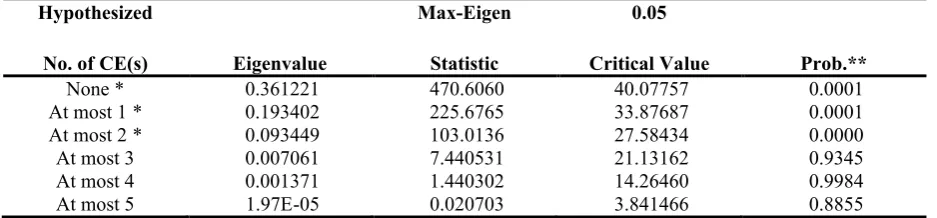
Table 3 below shows that, according to the maximum eigenvalue statistic of 103.0136
(critical value of 27.58434), the null hypothesis of at most two cointegrating equations should
be rejected. However, the maximum eigenvalue statistic of 7.440531 (critical value of
21.13162) indicates that the null hypothesis of at most three cointegrating equations in the
system should be accepted at the five-percent significant level. The maximum eigenvalue
statistics, therefore, indicate the presence of three cointegrating equations in the hexa-variate
model.
The choice of appropriate number of cointegrating equations is informed by economic
theory. Normalising the cointegrating relationships and imposing structural restrictions on the
cointegrating coefficients reveal that the assumption of one cointegrating equation is
consistent with standard economic theories underpinning the hexa-variate model. The study
proceeded, therefore, to estimate the panel vector error-correction model using one
cointegrating equation where normalisation was done on each of the three variables of
interest: inflation, investment and economic growth.
(INSERT TABLE 3 ABOUT HERE)
5.3 Estimated Results of Static Cointegrating Relationships
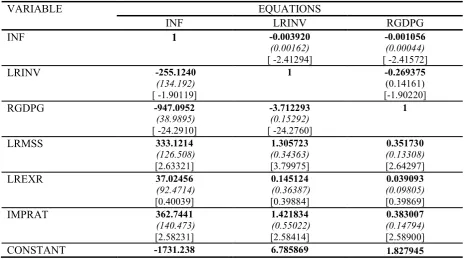
From Table 4 below, the inflation equation shows that capital accumulation and
18
tended to have a long-run static positive impact on inflation but this impact was not
significant at the five-percent level. In the capital accumulation (investment) equation,
inflation and economic growth had dampening effects on capital accumulation
contemporaneously in the long run.
Broad money supply and import-dependency ratio had significant positive impacts on
capital accumulation in the long run. The long-run contemporaneous impact of real exchange
rate on capital accumulation was insignificant during the study period. In the economic
growth equation, inflation and capital accumulation had significant long-run static negative
impact on economic growth. Again, broad money supply and import-dependency ratio had
significant long-run contemporaneous positive impacts on economic growth. The impact of
real exchange rate on economic growth was, however, insignificant though there was a
tendency for long-run contemporaneous positive impact.
5.4 Empirical Results of the Short-Run Dynamics
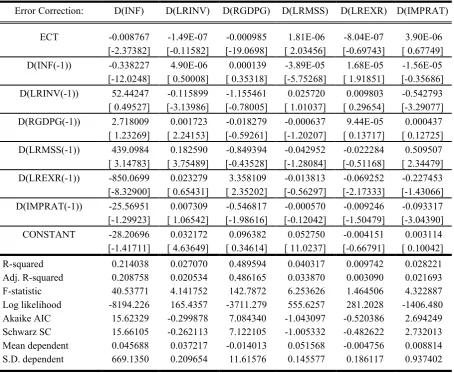
Table 5 below reports the results of the panel vector error-correction model
(PVECM). The error-correction term (ECT) has significant negative coefficients in the
inflation and economic growth equations, indicating that any previous disequilibrium in the
inflation and growth equations will be corrected in the current period. However, the
magnitudes of the coefficients of the ECT in these equations are small, implying that the
speed of adjustment to equilibrium in the inflation and economic growth relationships is very
low. The capital accumulation equation has an insignificant negative ECT coefficient,
indicating that though the speed of adjustment is statistically zero, there is a tendency for any
past disequilibrium to be corrected in the current period.
In the short-run inflation equation, the past level of inflation had a significant negative
impact on the current level of inflation. Capital accumulation and economic growth dynamics
had insignificant positive impact on current level of inflation, while import-dependency ratio
had insignificant negative impact. Broad money supply had significant positive dynamic
impact on inflation. Real exchange rate impacted significantly positively on inflation in
dynamic terms. From the capital accumulation equation, inflation, exchange rate and import
investment had a significant negative impact on current level of investment, economic growth
and broad money supply had significant dynamic impacts on investment. The short-run
economic growth equation (D(RGDPG)) shows that the short-run dynamics of economic
growth, inflation, capital accumulation and money supply did not matter over the study
period. However, the real exchange rate had significant dynamic positive impact, while
import-dependency ratio had significant dynamic negative impact on economic growth in
import-dependent economies over the study period.
6.0 DISCUSSION OF RESULTS
The negative impacts of economic growth and capital accumulation on inflation in the
long run point to the structurally-induced or supply-side inflationary trend in most developing
economies. Thus, as structural bottlenecks are removed for investment and economic growth
to take place, inflation tends to slowdown in import-dependent economies over the long run.
This point is further buttressed by the insignificant impacts of capital accumulation and
economic growth on inflation in the short run. The positivity of the estimated coefficients of
capital accumulation and economic growth is an indication of some kind of overheating in the
short run. This means that supply-side policies could not have short-run impact on inflation in
import-dependent developing economies. To a very large extent, these findings are in support
of the conclusions drawn by Romer (1986, 1987), Lucas (1988) and Levine and Renelt
(1992).
Broad money supply impacted positively on inflation in the long run, confirming the
theoretically-posited positive correlation between money supply and inflation as argued by
the Monetarists. That import-dependency ratio had a positive long-run impact on inflation
corroborates the view that most of the inflationary trend experienced in import-dependent
developing economies are due to imported inflation. The significant short-run dynamics of
inflation emanate principally from broad money supply and the real exchange rate. This
suggests that controlling inflation in the short run could only be achieved by effective
demand management policies.
Contemporaneously, there is a negative correlation between capital accumulation and
20
growth has a positive impact on capital accumulation as predicted by the neoclassical
economic growth and development models. The negative impacts of the past levels of
investment and economic growth on their current levels respectively suggest that
import-dependent developing economies find it difficult sustaining the level of capital accumulation
and economic growth. Since these are short-run phenomena, they cannot be attributed to
changes in the business cycle. The difficulty in sustaining economic growth and investment
in import-dependent developing economies could be explained by the fact that these
economies are bombarded continuously by external shocks, notably terms of trade and oil
price shocks. This fact is supported by the empirical evidence that import-dependency ratio
depresses economic growth in these economies in the short run.
Another interesting result is that, though the real exchange rate does not have any
significant impact on inflation, capital accumulation and economic growth in the long run, it
does have significant dampening effect on inflation and expansionary effect on economic
growth in the short run. This is consistent with output gap theories and competition theories
of international trade. Thus, properly realigning the exchange rate to reflect macroeconomic
fundamentals in the short run can have desirable impact on inflation and growth in
import-dependent developing economies.
7.0 CONCLUSION AND POLICY RECOMMENDATIONS
This study was set out to investigate the empirical relationships between inflation,
capital accumulation and economic growth in import-dependent developing economies. It
adopted an inter-temporal optimization theoretic framework within which the representative
agent derives utility from money balances and financial asset holdings. The super-neutrality
of money was removed by modelling this year’s output as a function of yesteryear’s capital
stock. The empirically analytical framework made use of a panel vector autoregressive
(PVAR) approach on data from 30 sampled import-dependent developing economies. The
key variables included in the PVAR model were inflation, capital accumulation, output
growth rate, money supply, exchange rate, and import-dependency ratio. Levin, Lin and Chu
(LLC), Breitung t (BT) and Im, Pesaran and Shin (IPS) panel unit-root tests were conducted to determine the stationarity of the system variables. Most of the variables were found to be
Lothgren (3L) (2001) panel cointegration test was carried out to determine the long-run
co-movement of the variables. The system variables were found to be cointegrated and the
Granger Representation Theorem was invoked for the specification of the panel vector
error-correction model (PVECM).
From the cointegrating relationships, capital accumulation and economic growth had
long-run static negative impacts on inflation. Broad money supply and import-dependency
ratio had long-run static positive impacts on inflation. The long-run influence of real
exchange rate on inflation was statistically zero. Besides, the study has established that
inflation and economic growth had dampening effects on capital accumulation
contemporaneously in the long-run. Broad money supply and import-dependency ratio were
found to have positive impacts on capital accumulation in the long run. Moreover, while
inflation and capital accumulation had long-run static negative impacts, broad money supply
and import-dependency ratio had long-run contemporaneous positive impacts on economic
growth.
The short-run dynamics also indicate that while it is possible for any previous
disequilibrium in the inflation, capital accumulation and economic growth relationship to be
corrected overtime, the speed of adjustment to equilibrium is so sluggish that it will take a
long time for any imbalance to be corrected. In the short run, real exchange rate has a positive
impact on economic growth but a dampening effect on inflation. Money supply and the
exchange rate generate crucial short-run dynamics for inflation relationship, while exchange
rate and import-dependency ratio produce short-run dynamics that drive economic growth in
import-dependent developing economies.
It is recommended, therefore, that in import-dependent developing economies,
monetary policy such as a reduction in real broad money supply should be adopted to reduce inflation in the short run;
supply-side policy aimed at promoting aggressive domestic production of basic
essential goods should be pursued in order to reduce imports and control inflation in
the long run;
22
availability of critical inputs for industry and agriculture must be adopted for
short-run economic growth; and,
Overreliance on imports should be reduced over the long run through aggressive export promotion and diversification as well as value addition to traditional export
commodities to liberate countries from over-dependence on imports and thereby
enhancing long-run growth in these economies.
REFERENCES
Ahortor, Christian R.K. and Deodat E. Adenutsi (2009), “The Impact of Remittances on
Economic Growth in Small-Open Developing Economies”, Journal of Applied Sciences, 9(18): 3275-3286.
Arrow, Kenneth J. (1962), “The Economic Implications of Learning by Doing,” Review of Economic Studies, 29: 155-173.
Asteriou, Dimitrios (2006), Applied Econometrics: A Modern Approach using Eviews and Microfit, Hamsphire: Palgrave Macmillan.
Barro, Robert J. (1991), “Economic Growth in a Cross Section of Countries”, Quarterly Journal of Economics, 106(2): 401-443.
Barro, Robert J. (1995), “Inflation and Economic Growth”, NBER Working Papers 5326. Breitung, Joerg (2000), “The Local Power of Some Unit Root Tests for Panel Data,” in B.
Baltagi (ed.), Nonstationary Panels, Panel Cointegration, and Dynamic Panels, Advances in Econometrics, 15: 161-178.
Burdekin, Richard C.K., Arthur T. Denzau, Manfred W. Keil, Thitithep Sitthiyot, and
Thomas D. Willet (2000) “When Does Inflation Hurt Economic Growth? Different
Non-Linearities for Different Economies”,Working Papers in Economics, Claremont Colleges.
Byrne, Joseph P. and E. Philip Davis (2004), “Permanent and Temporary Inflation
Uncertainty and Investment in the United States”, Economic Letters, 85(2): 271-277. Cardoso, Eliana A. and Albert Fishlow (1989), “Latin America Economic Development:
1950-1980,” NBER Working Paper 3161.
Chan, Kung-Sig and Ruey S. Tsay (1998), “limiting Properties of the Least Squares
Chirinko, Robert S. (1996), “Investment under Uncertainty: A Review Essay,” Journal of Economics Dynamics and Control, 20: 1801-1808.
De Gregorio, José (1992a), “Economic Growth in Latin America,” Journal of Development Economics, 39(1): 59-84.
De Gregorio, José (1992b), “The Effects of Inflation on Economic Growth: Lessons from
Latin America,” European Economic Review, 36(2-3): 417-425.
De Gregorio, José (1993), “Inflation, Taxation, and Long-Run Growth,” Journal of Monetary Economics, 31: 271-298.
Dixit, Avinash K. and Robert S. Pindyck (1994), Investment under Uncertainty, Princeton: Princeton University Press.
Domar, Evsey (1946), “Capital Expansion, Rate of Growth, and Employment,”
Econometrica, 14: 137-147.
Enders, Walter (1995), Applied Econometric Time Series, New York: John Wiley.
Faria, João R. and Galrão Carneiro (2001), “Does High Inflation Affect Growth in the
Long-and Short-Run?” Journal of Applied Economics, (0):89-105.
Feldstein, Martin (1982), “Inflation, Tax Rules, and Investment: Some Econometric
Evidence”, Econometrica, 50(4): 825-862.
Fischer, Stanley (1983), “Inflation and Growth,” NBER Working Paper 1235.
Fischer, Stanley (1991), “Growth, Macroeconomics and Development,” NBER Macroeconomics Annual, 6: 329-364.
Fischer, Stanley (1993), “The Role of Macroeconomic Factors in Growth,” Journal of Monetary Economics, 32(10): 485-512.
Grier, Kevin B. and Gordon Tullock (1989), “An Empirical Analysis of Cross-National
Economic Growth,” Journal of Monetary Economics, 24(2): 259-276.
Grimes, Arthur (1991), “The Effects of Inflation on Growth: Some International Evidence,”
Weltwirtschaftliches Archiv, 127: 631-644.
Gylfason, Thorvaldur (1991), “Inflation, Growth and External Debt: A View of the
Landscape,” The World Economy, 14: 279-298.
Hansen, Bruce (1999), “Threshold Effects in Non-Dynamic Panels: Estimation, Testing, and
Inference,” Journal of Econometrics, 81: 594-607.
24
Harris, Richard I.D. (1995), Using Cointegration Analysis in Econometric Modelling, London: Prentice Hall, Harvester Wheatsheaf.
Harrod, Roy (1939), “An Essay in Dynamic Theory,” Economic Journal, 49: 14-33. Harrod, Roy (1948), Towards a Dynamic Economics, London: Macmillan.
Hellerstein, Rebecca (1997), “The Impact of Inflation”, Regional Review, Federal Reserve Bank of Boston, 7(1, Winter): 18-24.
Hoffmann, Mathias (2003), “Fixed versus Flexible Exchange Rates: A Panel-VAR Analysis”,
A Research Work which is part of The Analysis of International Capital Markets: Understanding Europe’s Role in the Global Economy, funded by the European Commission under the Research Training Network Programme.
Im, Kyung So, M. Hashem Pesaran and Yongcheol Shin (2003), “Testing for Unit Roots in
Heterogeneous Panels,”Journal of Econometrics, 115(1): 53-74.
Johansen, Sǿren(1988), “Statistical Analysis of Cointegrating Vectors,” Journal of Economic Dynamics and Control, 12(2/3): 231-254.
Khan, Mohsin S. and Abdelhak S. Senhadji (2001), “Threshold Effects in the Relationship
between Inflation and Growth,” IMF Staff Papers 48(1).
Kireyev, Alexei (2000), “Comparative Macroeconomic Dynamics in the Arab World: A
Panel VAR Approach”, IMF Working Paper WP/00/54.
Kormendi, Roger C. and Philip C. Meguire (1985), “Macroeconomic Determinants of
Growth,” Journal of Monetary Economics, 16: 141-163.
Larsson, Rolf, Johan Lyhagen and Mickael Löthgren (2001), “Likelihood Based
Cointegration Tests in Heterogeneous Panels,” Econometric Journal, 4: 109-142. Levin, Andrew, Chien-Fu Lin and Chia-Shang J. Chu (2002), “Unit Root Tests in Panel Data:
Asymptotic and Finite Sample Properties,” Journal of Econometrics, 108(1): 1-24. Levine, Ross and David Renelt (1992), “A Sensitivity Analysis of Cross-Country Growth
Regressions,” American Economic Review, 82: 942-963.
Levine, Ross and Sara Zervos (1992), “What have we Learned about Policy and Growth from
Cross-Country Regressions?” American Economic Papers and Proceedings, 83: 426-430.
Lewis, Arthur (1955), The Theory of Economic Growth, London: Allen & Unwin.
Lioui, Abraham and Patrice Poncet (2008), “Monetary Non-Neutrality in the Sidrauski Model
Love, Inessa and Lea Zicchino (2006), “Financial Development and Dynamic Investment
behaviour: Evidence from Panel VAR”, The Quarterly Review of Economics and Finance, 46: 190–210.
Lucas, Robert E. Jr. (1988), “On the Mechanics of Economic Development,” Journal of Monetary Economics, 22(1): 3-42.
Madsen, Jakob B. (2003), “Inflation and Investment”, Scottish Journal of Political Economy, 50(4): 375-397.
Malla, Suni (1997), “Inflation and Economic Growth: Evidence from a Growth Equation,”
Mimeo. University of HawaiI at Mona: Department of Economics.
Mallik, Girijasankar and Anis Chowdhury (2001), “Inflation and Economic Growth:
Evidence from Four South Asian Countries,” Asia-Pacific Development Journal, 8(1): 123-135.
McCoskey, Suzanne and Chihwa Kao (1998), “A Residual-Based Test for the Null
Hypothesis of Cointegration in Panel Data,” Econometric Reviews, 17: 57-84.
Mukherjee, Chandan; Howard White and Marc Wuyts (2003), Econometrics and Data Analysis for Developing Countries, London: Routledge.
Pedroni, Peter (1997), “Panel Cointegration: Asymptotic and Finite Sample Properties of
Pooled Time Series with an Application to the PPP Hypothesis: New Results,”
Working Paper, Indiana University.
Pedroni, Peter (1999), “Critical Values for Cointegration Tests in Heterogeneous Panels with
Multiple Regressors,” Oxford Bulletin of Economics and Statistics, Special Issue, 61 (November): 653-670.
Pedroni, Peter (2000), “Fully Modified OLS for Heterogeneous Cointegrated Panel,”
Advances in Econometrics, 15: 93-130.
Pindyck, Robert S. and A. Solimano (1993), “Economic Instability and Aggregate
Investment,” NBER Macroeconomic Annual.
Rapach, David (2003), “International Evidence on the Long-Run Impact of Inflation,”
Journal of Money, Credit and Banking, 35(1): 23-48.
Rapach, David and Mark E. Wohar (2005), “Regime Changes in International Real Interest
Rates: Are They a Monetary Phenomenon?” Journal of Money, Credit and Banking, 37(5): 887-906.
26
Romer, Paul M. (1987), “Growth Based on Increasing Returns Due to Specialization,”
American Economic Review, 77: 56-62.
Rostow, Walter W. (1960), The Stages of Economic Growth, Cambridge University Press. Roubini, Nouriel and Xavier Sala-i-Martin (1992), “Financial Repression and Economic
Growth,” Journal of Development Economics, 39(July): 5-30.
Servén, Luis and Andrés Solimano (1992), “Private Investment and Macroeconomic
Adjustment: A Survey,” The World Bank Research Observer, 7(1): 95-114.
Solow, Robert M. (1956), “A Contribution to the Theory of Economic Growth,” Quarterly Journal of Economics, 70: 65-94.
Solow, Robert M. (1986), “What is a Nice Girl Like You Doing in a Place Like this?
Macroeconomics After 50 Years,” Eastern Economic Journal, 12(3): 191-198.
Stanners, Walter (1993), “Is Inflation and Important Condition for High Growth?”
Cambridge Journal of Economics, 17: 79-107.
Sweidan, Osama D. (2004), “Does Inflation Harm Economic Growth in Jordan? An
LIST OF TABLES
Table 1: Panel Unit Root Test Results
VARIABLES PANEL UNIT ROOT TEST STATISTICS
Levin, Lin & Chu t Breitung t Im, Pesaran and Shin At Level 1stDiff At Level 1stDiff At Level 1stDiff
[image:28.595.66.534.431.526.2]IMPRAT -6.64646 (0.0000) -17.0280 (0.0000) -1.00776 (0.1568) -12.2755 (0.0000) -5.43081 (0.0000) -19.4962 (0.0000) INF -10.2740 (0.0000) -8.18126 (0.0000) -8.56026 (0.0000) LREXR -1.88339 (0.0298) -12.1819 (0.0000) -2.14069 ( 0.0161) -14.8010 (0.0000) -1.78144 ( 0.0374) -15.3921 (0.0000) RGDPG -8.50254 (0.0000) -6.86424 (0.0000) -11.7092 (0.0000) LRINV -2.50938 (0.0060) -11.8025 (0.0000) -0.03550 (0.4858) -10.5929 (0.0000) -2.68467 ( 0.0036) -13.5288 (0.0000) LRMSS 1.36409 ( 0.9137) -10.9495 (0.0000) 1.83988 (0.9671) -8.91757 (0.0000) 1.24994 (0.8943) -11.8326 (0.0000) Source: Authors’ Computations Note: Figures in brackets are significance probability values.
Table 2: Unrestricted Cointegration Rank Test (Trace)
Hypothesized
No. of CE(s) Eigenvalue
Trace Statistic
0.05
Critical Value Prob.** None * 0.361221 808.1977 95.75366 0.0001 At most 1 * 0.193402 337.5916 69.81889 0.0001 At most 2 * 0.093449 111.9151 47.85613 0.0000 At most 3 0.007061 8.901536 29.79707 0.9921 At most 4 0.001371 1.461005 15.49471 0.9992 At most 5 1.97E-05 0.020703 3.841466 0.8855 Source: Authors’ Computations
Table 3: Unrestricted Cointegration Rank Test (Maximum Eigenvalue)
Hypothesized
No. of CE(s) Eigenvalue
Max-Eigen
Statistic
0.05
[image:28.595.65.534.633.742.2]28
Table 4: Static Cointegrating Results
VARIABLE EQUATIONS
INF LRINV RGDPG
INF 1 -0.003920
(0.00162) [ -2.41294] -0.001056 (0.00044) [ -2.41572] LRINV -255.1240 (134.192) [ -1.90119] 1 -0.269375 (0.14161) [-1.90220] RGDPG -947.0952 (38.9895) [ -24.2910] -3.712293 (0.15292) [ -24.2760] 1 LRMSS 333.1214 (126.508) [2.63321] 1.305723 (0.34363) [3.79975] 0.351730 (0.13308) [2.64297] LREXR 37.02456 (92.4714) [0.40039] 0.145124 (0.36387) [0.39884] 0.039093 (0.09805) [0.39869] IMPRAT 362.7441 (140.473) [2.58231] 1.421834 (0.55022) [2.58414] 0.383007 (0.14794) [2.58900]
CONSTANT -1731.238 6.785869 1.827945
Source: Authors’ Computations
Table 5: Short-Run Dynamics (PVECM) Results
Error Correction: D(INF) D(LRINV) D(RGDPG) D(LRMSS) D(LREXR) D(IMPRAT)
ECT -0.008767 -1.49E-07 -0.000985 1.81E-06 -8.04E-07 3.90E-06 [-2.37382] [-0.11582] [-19.0698] [ 2.03456] [-0.69743] [ 0.67749] D(INF(-1)) -0.338227 4.90E-06 0.000139 -3.89E-05 1.68E-05 -1.56E-05 [-12.0248] [ 0.50008] [ 0.35318] [-5.75268] [ 1.91851] [-0.35686] D(LRINV(-1)) 52.44247 -0.115899 -1.155461 0.025720 0.009803 -0.542793 [ 0.49527] [-3.13986] [-0.78005] [ 1.01037] [ 0.29654] [-3.29077] D(RGDPG(-1)) 2.718009 0.001723 -0.018279 -0.000637 9.44E-05 0.000437 [ 1.23269] [ 2.24153] [-0.59261] [-1.20207] [ 0.13717] [ 0.12725] D(LRMSS(-1)) 439.0984 0.182590 -0.849394 -0.042952 -0.022284 0.509507 [ 3.14783] [ 3.75489] [-0.43528] [-1.28084] [-0.51168] [ 2.34479] D(LREXR(-1)) -850.0699 0.023279 3.358109 -0.013813 -0.069252 -0.227453 [-8.32900] [ 0.65431] [ 2.35202] [-0.56297] [-2.17333] [-1.43066] D(IMPRAT(-1)) -25.56951 0.007309 -0.546817 -0.000570 -0.009246 -0.093317 [-1.29923] [ 1.06542] [-1.98616] [-0.12042] [-1.50479] [-3.04390] CONSTANT -28.20696 0.032172 0.096382 0.052750 -0.004151 0.003114 [-1.41711] [ 4.63649] [ 0.34614] [ 11.0237] [-0.66791] [ 0.10042] R-squared 0.214038 0.027070 0.489594 0.040317 0.009742 0.028221 Adj. R-squared 0.208758 0.020534 0.486165 0.033870 0.003090 0.021693 F-statistic 40.53771 4.141752 142.7872 6.253626 1.464506 4.322887 Log likelihood -8194.226 165.4357 -3711.279 555.6257 281.2028 -1406.480 Akaike AIC 15.62329 -0.299878 7.084340 -1.043097 -0.520386 2.694249 Schwarz SC 15.66105 -0.262113 7.122105 -1.005332 -0.482622 2.732013 Mean dependent 0.045688 0.037217 -0.014013 0.051568 -0.004756 0.008814 S.D. dependent 669.1350 0.209654 11.61576 0.145577 0.186117 0.937402
30
APPENDIX
List of Countries in the Panel
Country Code Country Region Import-Dependence
1 Barbados LAC 3.176619597
2 Belize LAC 2.149954179
3 Bolivia LAC 1.098931431
4 Costa Rica LAC 1.266790767
5 Dominican Rep. LAC 2.959360441
6 El Salvador LAC 1.414313564
7 Guatemala LAC 1.428935679
8 Honduras LAC 1.305077910
9 Mexico LAC 1.267384625
10 Nicaragua LAC 2.059825502
11 Panama LAC 3.115193727
12 Paraguay LAC 1.665242588
13 Benin SSA 4.203012650
14 Ethiopia SSA 2.612145415
15 Ghana SSA 1.194952870
16 Kenya SSA 1.604581706
17 Mali SSA 1.819756891
18 Niger SSA 1.352621735
19 Rwanda SSA 2.890942999
20 Senegal SSA 1.643822080
21 Seychelles SSA 4.050569438
22 Sierra Leone SSA 2.933656585
23 Sudan SSA 1.905796979
24 Tanzania SSA 2.372739955
25 Togo SSA 1.593922538
26 Bangladesh EAP 2.114087486
27 Fiji EAP 1.559919866
28 Nepal EAP 2.772328268
29 Sri Lanka EAP 1.358798493
30 Thailand EAP 1.232345841