Generality and specialization in
accounting knowledge. Computer-based
modeling delimitations
necula, sabina-cristiana
Alexandru Ioan Cuza University of Iasi
20 July 2010
Online at
https://mpra.ub.uni-muenchen.de/51541/
1Sabina-Cristiana NECULA
1 Alexandru Ioan Cuza University of Iaşi (TNR 10 pt)
Abstract: This paper tries to present an empirical analysis on the quality of accounting information, the
factors that influences this quality, the importance of accounting knowledge in decision making, general knowledge and specific features of the accounting knowledge and some implications in terms of computer modelling.
Keywords: Accounting knowledge, decision-making, quality of accounting information
JEL Codes: D83, L86
1. ACCOUNTING KNOWLEDGE IN DECISION-MAKING HEADING
The research regarding the accounting decisions and their influence upon economic decisions occupy an important place in the positivist theory of accounting. The studies pending of accounting decisions (choices) are
interwoven with the accounting’s relevance in the economic
domain. In the conditions of perfect market existence, the accounting regulations or the representation of information in accounting environments has no role. In the conditions of imperfect market, the accounting regulations and accounting as science and practice prove themselves as significant in facing the imperfections of the market.
The decisions’ modelling constitutes a major
concern of specialists in different areas, with the purpose of augmenting the quality of decision making. The first approach encountered in decision modelling was the mathematical approach. Thus, through the use of economic-mathematical models, depending on utility, the decisional problem becomes one of maximization of decisional making utility. Precisely in the moment in which the researches in economic-mathematical modelling domain were reaching a climax, the decision theory acknowledges a new referential point marked by Herbert Simon. The decisional process is no longer considered one of utility maximization and possible to be modelled in an economic-mathematical way; the decisional factor actions in conditions of limited rationality and it is not perfectly informed; the decisions are classified in structured and unstructured. For structured problems, adequate are the economic-mathematical models for which informational models can be built that are using the algorithms of economic-mathematical models, for the unstructured ones, informational models are built that use AI techniques that are meant to capture the knowledge of decisional problem solving.
Economic-mathematical modelling of decision can be applied only in the conditions in which the result expected by the decisional factor can be monetary quantified and accomplishes an optimization. Modelling the decision through intelligent technologies is applied in the circumstances in which the decisional factor lacks the knowledge regarding the acting ways and the reasoning about the implementation of the best decision and incorporates, through the informational model developed, the knowledge from the domain. The decision modelling through informational technologies has a larger area of coverage. Thus, informational technologies can be used for
developing an informational solution based on an economic-mathematical model through the implementation of this model into a programming language, and for developing an intelligent informational solution which incorporates knowledge from a specific domain of action.
Theories on the organization and the attempts to model the business processes have always suggested that decision makers need useful information, relevant, obtained in real time and of quality [1], [2], [3], [4], [5], [6], [7], [8], [9], [10], [11]. The volume and quality of information has always been inherent to the quality of decision making in business. Any manufacturer of computer applications or application packages [Oracle, IBM, Microsoft etc.] used as a marketing phrase for the developed products the quality of information offered, improved decision making process and increase business value, but the practical application of software has led many times to different benefits than those promised by the manufacturer [9]. We might say that ... we are still looking for solutions that substantially contribute to making "smart" decision (not necessarily rational).
It seems that an accountant should know: to provide financial information from data on economic transactions, to interpret and analyze financial information obtained, certify and validate the information presented in financial reports.
All these activities undertaken by an accountant are specific to accounting knowledge management in a company. Here comes the need for important remarks: the domain model is, namely, "accounting information". While at a game of words would seem that field of study is limited
by the lack of the word “financial", we could say that the field of study is more" generous than the previous because it forces "to take into account non-financial and qualitative information.
2. FACTORS THAT INFLUENCES THE QUALITY OF ACCOUNTING INFORMATION
[image:3.595.40.270.183.441.2]The main aspects that characterize the theory and practice of studying the proposed issue of factors affecting quality of accounting information are presented in Table. 1.
Table 1. Theory and practice In theory it is considered that:
Aspects from the applicative field
Information reduces uncertainty [3], [12], [13].
The information issue in order to reduce uncertainty means for accountants summarizing data to obtain indicators needed to assess operating activities, financing, investment (after economic events happend). Please note that the information provided this way does not reduce uncertainty.
Raising uncertainty recduces risk [14]
Practical solution is derived from the indicators in the anticipated analysis of the effects of possible alternative decisions on profitability. It happens that certain qualitative factors are omitted, and accountants to become concerned about the quantitative aspect.
At the theoretical and applicative level it is considered that probabilistic measure of risk in economic systems is characterized by failure because there is no one interested in the risk of an unwanted event as long as the expected gain can often be decisive.
Lack of information has the effect of producing uncertainty, errors in communication, knowledge development and evolution. Lack of information is due to several factors: poor organization of business, wrong data aggregation, and wrong approach in modelling decisions. Briefly looking information should be seen as an implicit search in knowledge space and not as explicit search. [15]
Informatics has found applicability in modelling the business structure and organization from data processing to information and modelling decisions. Ideally, technology improves information in order and reduces complexity to achieve a balance. In a report in 2007 the company Gartner noted that semantic technologies will be adopted gradually by organizations (around 2014) and will mean an advance in the processing and visualization of information.[Gartner, 2007 Press Releases]
2.1 Semantics of the existing accounting software
It must be admitted that we cannot propose solutions without wondering what might be the causes that led to the reluctance shown by professional accountants in using IT solutions. Accountants often reject information products because they do not meet the concepts and their meanings. Reason for which, detecting the factors influencing quality of accounting information is a goal that our research proposes.
Professional accountants are a category of
“pretentious" technology users. Often, they are not satisfied
with the tools provided, but end up not "understand" to use the software absolutely necessary to conduct their business.
Accountants’ awareness should be given by training as a starting point during the course of university studies by improving specialized analytical programs of compulsory subjects dealing with the use of information technologies. Curricula of universities abroad contain thematic courses on Semantic Web and semantic technologies.
The information sources are diverse for decision-making problems. Data from applications such as: the investigation of business (Business Intelligence), customer relationship management (CRM), supplier relationship management (SCM), enterprise resource planning (ERP), collaborative systems, knowledge-based systems and various Web information sources. In order to have real-time information, decision-maker would need a single interface to locate it. This is what Google is trying to make with its product Google OneBox Enterprise integrating information from different systems and they provide an interface known as search engine Google by making simple searches by members of the organization. Now decides to make queries based on the need for information in a logical sequence to solve its own problem.
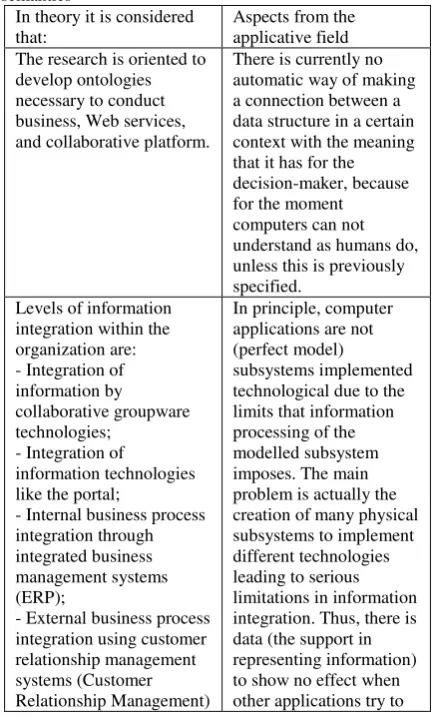
[image:3.595.307.524.428.788.2]The main aspects that characterize the theory and practice of studying the proposed issue of semantics of existing accounting computer applications are presented in Table. 2.
Table 2 Theory and practice of accounting software semantics
In theory it is considered that:
Aspects from the applicative field The research is oriented to
develop ontologies necessary to conduct business, Web services, and collaborative platform.
There is currently no automatic way of making a connection between a data structure in a certain context with the meaning that it has for the decision-maker, because for the moment computers can not understand as humans do, unless this is previously specified.
Levels of information integration within the organization are: - Integration of information by
collaborative groupware technologies;
- Integration of
information technologies like the portal;
- Internal business process integration through integrated business management systems (ERP);
- External business process integration using customer relationship management systems (Customer Relationship Management)
In principle, computer applications are not (perfect model)
and systems supplier relationship management (Supply Chain
Management).
process it. It remains clearly; there is a need to find opportunities for description of data. An alternative description
of the data needed for decision-making processes is the metadata in data warehouses. The metadata specifies the data structure, their origin, rules of transformation, aggregation and calculation.
Sources of instability of the decision models affect data integration. Occur in two expensive phases of the metadata management of a decision model: 1) specify the schema for each data source and 2) for each pair of input source - the application that will use the input data should be made data duplication schemes permitted by input / output system. Applications handling specifications are difficult to build and complicated. The main problem of integration is a representation, understanding and handling of data and structure described by schemes. Automatic generation of overlaps between data models is not possible at present due to the lack of a large expressivity language.
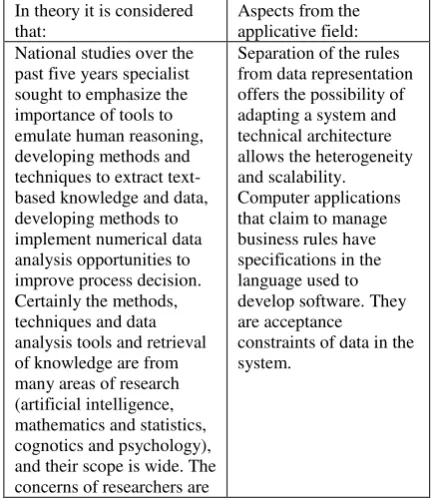
[image:4.595.71.285.94.468.2]The main aspects that characterize the theory and practice of the proposed issue of using semantic technologies in accounting are presented in Table 3.
Table 3. Theory and practice of semantic technologies in accounting
In theory it is considered that:
Aspects from the applicative field: National studies over the
past five years specialist sought to emphasize the importance of tools to emulate human reasoning, developing methods and techniques to extract text-based knowledge and data, developing methods to implement numerical data analysis opportunities to improve process decision. Certainly the methods, techniques and data analysis tools and retrieval of knowledge are from many areas of research (artificial intelligence, mathematics and statistics, cognotics and psychology), and their scope is wide. The concerns of researchers are
Separation of the rules from data representation offers the possibility of adapting a system and technical architecture allows the heterogeneity and scalability. Computer applications that claim to manage business rules have specifications in the language used to develop software. They are acceptance
constraints of data in the system.
focused on the unification of these methods, so any research topic in the field of computer modeling is interdisciplinary. When we talk about interdisciplinary the areas that our research proposes are: economy, finance, information systems, management, accounting, computer science.
Developing intelligent agents and semantic search engines by ensuring interoperability with RDF / OWL / OIL. Applications are developed based on models (MDA).
Using stored procedures and triggers can improve the performance of developed applications. They violate the idea of separation of application logic levels by
incorporating the rules in a database. In the case of structured problems the stored procedures and triggers are ideal techniques for business process management as additional inferences
aren’t necessary.
Currently there are several research projects at EU level in engineering semantic web services: DIP, SECT, Knowledge Web, SeCSE, ASG, Sodium, Infrawebs, WS2.
Basis for highlighting the importance of the theme we have done in the search database Thomson ISI Citation Index, ACM Portal and Google books search a few key phrases. This led to the results shown in the following tables.
Table 4 Articles and books written on "Semantic Technologies"
Keywords Total Past 5
years
Last year semantic technologies
(Portal ACM)
53374 34711 9069
semantic technologies (ISI Web of
Knowledge)
2054 1605 278
semantic technologies (Google books)
4811 1923 646
[image:4.595.78.294.536.787.2]The first article on semantic technologies ISI index is 1996, and was quoted 17 times: Waibel, A, Interactive translation of conversational speech, Computer, Volume: 29, Issue: 7, 1996.
Table 5 Articles and books written on „knowledge decision
-making”
Keywords Total Past 5
years
Last year knowledge
decision-making (Portal ACM)
20854 15016 8890
knowledge decision-making (ISI Web of Knowledge)
23694 9619 2375
[image:4.595.336.557.693.780.2]making (Google books)
[image:5.595.47.268.203.312.2]The first article on Knowledge decision-making ISI indexed is in 1977: Carter J.L., Scientific Knowledge, Inquiry Process, and Political Decision-Making process, American Biology Teacher, Volum 39, Issue: 1, 1977.
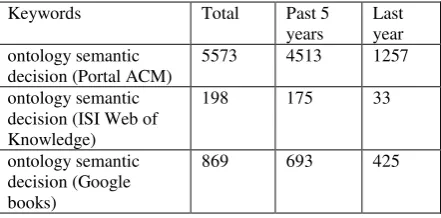
Table 6 Articles and books written on „ontology semantic decision”
Keywords Total Past 5
years
Last year ontology semantic
decision (Portal ACM)
5573 4513 1257
ontology semantic decision (ISI Web of Knowledge)
198 175 33
ontology semantic decision (Google books)
869 693 425
The first 2 articles on ontology semantic decision ISI indexed are from 1996:
Bakhtari, S; BartschSporl, B; Oertel, W, DOM-ARCADE: Assistance services for construction, evaluation, and adaptation of design layouts, 4th International Conference on Artificial Intelligence in Design, Date: jun, 1996 Stanford CA, Artificial Intelligence in Design, 1996
[image:5.595.46.271.470.569.2]Lee, JL; Siegel, MD, An ontological and semantical approach to source-receiver interoperability, Decision Support Systems, Volum 18, nr. 2, 1996
Table 7 Articles and books written on „ontology decision
-making”
Keywords Total Past 5
years
Last year ontology
decision-making (Portal ACM)
4972 3992 1082
ontology decision-making (ISI Web of Knowledge)
706 562 116
ontology decision-making (Google books)
1191 812 605
The first 2 articles on ontology decision-making ISI indexed are from 1992:
Sylvan D.A., Thorson S.J., Ontologies, Problem Presentation, and the Cuban Missile Crisis, Journal of Conflict Resolution, Volum 36, Issue: 4, 1992
Midgley G., Pluralism and the Legitimation of Systems Science, Systems Practice, Volum 5, Issue: 2 , 1992
The use of semantic technologies in providing quality information is the thesis proposed by the Director of the project completed in 2007 and that we intend to use it, apply, test and expand with this research project. It considered the proposal to integrate data stored in different databases by using ontologies and the use of inferences for knowledge discovery.
3. CONCLUSIONS
The idea behind the proposal is the assumption that decisions should be implemented as knowledge of action which changes the existing ontology according to local human meaning.
Thus, we defined the semantic integration steps:
developing of different ontology (using OWL language) corresponding to different schemes database;
output files concatenation RDF (Resource Description Format) built;
achieving semantic overlap created by the ontology language OWL.
The examples made by us concerned the following technologies: relational databases, files that contain unstructured data, ontologies, inference engines.
Because we started from different data sources (internal data sources retrieved from PostgreSQL database organization and sources. Xml that store data retrieved from websites: ex. the market price) linking the two sources we have achieved it by joining the two RDF files and eliminate redundant fields.
Saving the file in RDF format in OWL format was done using OWL ontology editor Swoop. Specifying rules (constraints) on the concepts of OWL ontology was performed using the plugin JessTAB Protege ontology editor.
After firing the rules there are the same facts but present an additional slot whether the condition specified by rule is fulfilled.
What we want to emphasize is that the editing rules must be user-oriented and implementation must be made to enrich the information provided by existing information systems organization. Using rules to solve problems was not successful in the past but has resulted in static models without utility for decision-makers because they capture a model of decision that requires the choice of means of action as the transfer of knowledge from the user model.Please read these instructions carefully. Prepare your paper and data exactly according to the instructions.
AKNOWLEDGMENT
This work was supported by CNCSIS-UEFISCSU, project number PN II-RU code 188/2010.
REFERENCES
[1] I. Andone, N. Tabără (coord.): Contabilitate,
tehnologie şi competitivitate, Academia Română Publishing House, Bucureşti, 2006
[2] D. Airinei: Depozite de date, Polirom Publishing
House, Iaşi, 2002
[3] D. Oprea, G. Meşniţă, F. Dumitriu: Analiza sistemelor informaţionale, Alexandru Ioan Cuza Publishing
House, Iaşi, 2005
[4] S. Nitchi, R. Nitchi: Data mining, o nouă eră în
informatică, Byte România Revue, 1997
[5] P. Goodwin, G. Wright: Decision Analysis for Management Judgment, third Edition, John Wiley & Sons, 2004
[7] J.P. Laudon, K.P. Laudon: Management Information Systems: Managing the Digital Firm, 9th ed., Prentice Hall, 2006
[8] M. Mora, G. Forgionne, J. Gupta: Decision Making Support Systems: Achievements and Challenges for the New Decade, Idea Group Inc, 2002
[9] B. G. Buchanan, D. Bobrow, R. W. Davis, J. McDermott, E. H. Shortliffe: Research Directions in Knowledge-based Systems, Annual Review of Computer Science, no.4, 1989
[10] C.W. Choo: Closing the Cognitive Gaps: How People Process Information, Financial Times of London, 1999
[11] C.W. Choo: The Knowing Organization: How Organizations Use Information to Construct Meaning, Create Knowledge and Make Decisions, International Journal of Information Management, vol.16, no.5, 1996
[12] M. Fotache: Date, informaţii, cunoştinţe, in Sisteme
informaţionale pentru afaceri, Polirom Publishing House, Iaşi, 2002
[13] H. Jiawei, F. Yongjian, T. Ng. Raymond: Cooperative Query Answering Using Multiple Layered Databases Research, Conference on Cooperative Information Systems, 1994
[14] J. Emblemsvåg:Life – Cycle Costing. Using Activity Based Costing and Monte Carlo Methods to Manage Future Costs and Risk, Wiley & Sons, New York, 2003
[15] Z. Chen: Computational Intelligence for Decision Support, CRC Press, 2000
Correspondence to: Sabina-Cristiana NECULA