_______________________________________________________________________________________
© 2016, IRJET ISO 9001:2008 Certified Journal Page 263
EFFICIENT BROADCAST AUTHENTICATION WITH HIGHEST LIFE SPAN IN
WIRELESS SENSOR NETWORKS
I. Jesintha
1, G.Thiraviya Suyambu
2, T.Azhagesvaran
3, K.Priya
41, 2, 3,4
Assistant Professor/ECE,
1,2,3,4
Roever College of Engineering & Technology, Perambalur, Tamilnadu, India.
---***---Abstract
-We consider the problem of Authenticatedbroadcasting messages in a wireless energy-limited network so as to maximize network lifetime. It enabling the base station to send commands and requests to low- powered sensor nodes in an authentic manner is one of the important challenges for securing wireless sensor networks. X-TESLA is a mechanics, which is considering the problem arising from sleep modes, network failures, idle sessions and DoS attacks. But the problem of power energy should not be considered. The lifetime of the sensor nodes may be ended when the broadcasting process. In proposed system we will implement algorithm namely greedy heuristics with X-TESLA for maximize the life time of the sensor networks. The proposed implementation improves network lifetime significantly when compared with network lifetime using the base greedy heuristics in isolation.
Keywords: Wireless networks, network life time, Security, broadcast authentication.
1. INTRODUCTION
Scientific innovation in across-the-board increase network and small sensor devices has led to the development of wireless feeler networks with various applications [1]. Sensor nodes are usually constrained in their computation, communication, storage space, and energy capital for inexpensive reason, but need security functions since they are deployed in unattended or even antagonistic environments. The high risk of substantial attacks and the limited capabilities of sensor nodes make it difficult to apply fixed security techniques to wireless sensor networks, posing new challenges [7]. Authentic broadcast, enabling a base station to send authentic messages to compound sensor nodes, is one of the core challenges [3],
while even the broadcast by nodes is an important topic in wireless sensor networks [2], [6], [4]. For the purpose, digital signatures (public key) are not very useful in a resource-limited environment, while naı¨ve use of HMAC (secret key) do not work either, as node confine can lead to a key compromise.
Battery-operated wireless sensor networks can be there deploy in environment in which it is not practical to recharge/replace the battery of a sensor .Hence, these networks must operate subject to the constraint that the energy available to a sensor isn’t replenish able. In other wireless network applications, even though it is possible to refresh a node’s array (or top off its energy deliver), it is desirable to operate in an energy frugal manner so as to reduce the need for this renew. With this need to conserve energy in many wireless network applications, a number of authors cover residential energy-efficient algorithms for
point-to-point communication, multicasting, and
broadcasting. The in general purpose of these algorithms is to also make the most of the lifetime (number of successful communications before first message that cannot be complete) or the ability of the network (amount of data traffic carried by the network over a number of set period of moment). life span maximization is considered for wireless sensor networks.
In the most common model used for authority reduction in wireless transmit, signal power attenuates at the rate a/rd,
where a is a media independent stable, r is the space from the pointer resource, and d is another constant between 2 and 4 [5]. So, for this model, w(I,J) = w(J,I) = c ∗ r(I,J)d,
_______________________________________________________________________________________
© 2016, IRJET ISO 9001:2008 Certified Journal Page 264 may, for example, be due to obstructions between the
nodes that may cause the attenuations to be larger than predicted. Also, the transmission properties of the media may be asymmetric resulting in w(i, j) ≠ w(j, i). In this paper, we assume the most general case in which edge weights may be asymmetric and may reflect the presence of obstructions in the broadcast path.
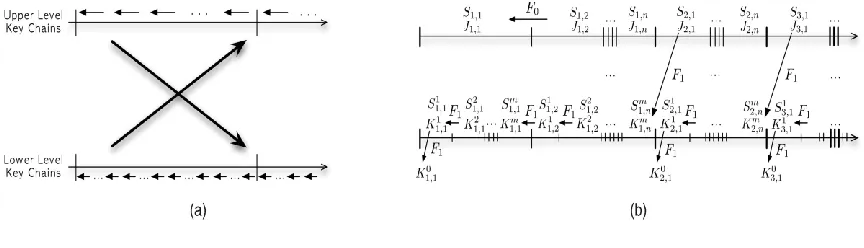
Our basic idea starts from the extendable management of short key chains. In essence, we make two levels of chains having distinct time intervals cross-authenticate each other (Fig. 1a) to provide permanently extendable chains. Our protocol X-TESLA, read either as eks TESLA or cross TESLA, stands for extendable TESLA. As with other TESLA variants, X-TESLA provides broadcast authentication, under the assumption that the base station and sensor nodes are loosely time synchronized with a known maximum synchronization discrepancy.
2. PROBLEM DEFINITION
2.1 64-Bit Key Chain 1
A short 64-bit key chain is desirable for efficiency in resource limited sensor nodes, but care must be taken, even with short time intervals. As we show, if the chain is generated in a straightforward manner, Time-Memory-Data (TMD) tradeoff techniques can be applicable, leading to discovery of future keys.
2.2 Sleep Mode or Network Failure 2
If sensor nodes go into a sleep mode or key disclosure messages are lost frequently, X TESLA may force heavy key computation to be done at once on sensor nodes for chain verification, during which incoming packets get dropped.
If Commitment Distribution Messages (CDMs) are missing, multilevel X TESLA makes nodes wait and buffer for the long interval of upper levels, during which incoming packets are dropped due to the buffer limit.
2.3 Idle Sessions 3
Even for idle sessions with no broadcasts, X TESLA forces chain computation for sensor nodes. Key disclosure messages should be broadcast constantly or heavy
computation needs to be done later. Multilevel X TESLA needs CDMs to be broadcast for higher levels, with the number of CDMs increasing with the number of levels.
2.4 Extended Lifetime 4
With node malfunctions and premature power exhaustion, there are needs for node additions [1] or rechargeable sensor nodes [8]. Thus, the lifetime of a network may extend beyond that of each node. As noted in [5], [19], lifetime extension was not clearly considered in X TESLA. Multilevel X TESLA should also fix the lifetime.
2.5 DoS Attacks 5
To resist DoS attacks, multilevel X TESLA requires many CDMs to be distributed for longer intervals. Its DoS tolerant version needs sufficiently large buffers on sensor nodes for random selection of received CDMs. The DoS-resistant version requires CDMs to be received stably along with a larger packet and additional hash function.
Let T be a broadcast tree. Following a broadcast using the broadcast tree T, the residual energy, re(i, T), at node i is
re(i, T) = ce(i) − max{w(i, j)|j is a child of i in T} ≥ 0
The critical energy, CE(T), following the broadcast is defined to be
CE(T) = min{re(i, T)|1 ≤ i ≤ n}
In the maximum critical energy problem (MCEP), we are given a network and a source node s and are to find a broadcast tree T rooted at s such that CE(T) is maximum. This maximum value of CE(T) is called the maximum critical energy and is denoted MCE(G, s).Intuitively, by using a broadcast tree T that maximizes CE(T), we maximize our chances of being able to complete the next broadcast request. Hence, we expect to prolong network lifetime by maximizing CE(T) following each broadcast.
Algorithm for MCE (G, s)
_______________________________________________________________________________________
© 2016, IRJET ISO 9001:2008 Certified Journal Page 265
Determine Candidate List L
For each node i of G, define the set a(i) of residual energy values as below.
a(i) = {ce(i) − w(i, j)|(i, j) is an edge of G and ce(i) ≥ w(i, j)}
Let l(i) denote the set of all possible values for re(i) following the broadcast. We see that
Consequently, the sorted list of all possible values for MCE(G, s) is given by
We assume that G is represented using adjacency lists [3]. Since each l(i) may be computed in O(diout ) time, where
diout is the out-degree of node i, all l(i) may be computed in
O(n + e) = O(e) time. From the l(i) s, L may be computed in O(e log e) time using a sort method such as merge sort [3]. So, the total time needed to compute L is O(e log e). Note that |L| = O(e). Let compute L(G, s) denote an algorithm that determines the sorted list L using the strategy just described.
3. X-TESLA: SECURE AND EFFICIENT BROADCAST AUTHENTICATION PROTOCOL
3.1 Overview of X-TESLA
Our basic idea starts from the extendable management of short key chains. In essence, we make two levels of chains having distinct time intervals cross-authenticate each other (Fig. 1a) to provide permanently extendable chains. Our protocol X-TESLA, read either as eks TESLA or cross TESLA, stands for eXtendable TESLA. As with other TESLA variants, X-TESLA provides broadcast authentication, under the assumption that the base station and sensor nodes are loosely time synchronized with a known maximum Synchronization discrepancy.
The crossing of Fig. 1a illustrates the followings:
[image:3.612.91.523.516.640.2] The lower level chain naturally authenticates the next upper level chain, as they are connected in a single chain by construction. Commitment of the next lower level chain repeatedly.
_______________________________________________________________________________________
© 2016, IRJET ISO 9001:2008 Certified Journal Page 266 Multiple distinct keys in the upper level chain authenticate
the initial value. The repeated authentication will help in resolving problems from DoS attacks, sleeping nodes, and idle sessions.
4. X-TESLA DETAILS
4.1 Initialization
We assume a base station broadcasts authenticated messages to sensor nodes. A method to choose salt values is fixed at system design phase. The base station generates the first upper level chain by choosing seed key J1;n € K at
random and also generates the first lower level chain together with the second upper level chain by choosing another seed key J2,n € K randomly. The values J1,0 = F1(J1,1,
S1,1) and K01,1 are stored in each sensor node as initial
upper and lower level commitments, respectively. Depending on the way salt is chosen, some extra information may also need to be stored. It would be advisable to keep these values secret until just before deployment. Generation of the second lower level chain together with the third upper level key chain should soon follow, so as to be ready for commitment distribution. When the initialized nodes are deployed, they are to be loosely time synchronized with the base station, as assumed in X TESLA.
4.2 Broadcast authentication
During an Iwu,v, the base station uses Kwu,v as the MAC key for Types 1, 2, and 3 packets being sent out, and reveals Kwu,v after a wait of time δ from the end of Iwu,v, in Type 2 or 3 packets. We shall abuse interval indices, setting
The following is a Type 2 packet for use with “δ=one time interval.” Here, j denotes
concatenation and signifies the index and data portion.
Commitment Hopping With TESLA variants, there are at least two situations in which verification of a newly disclosed key places heavy computational load on a sensor node, resulting in many message drops, for the duration of this computation. First, if a sensor node falls into sleep mode or turns off its radio power to save energy, it may not be able to listen to the key disclosure messages during that period. Second, if there are long idle periods with no broadcast, it would be wasteful to disclose keys on schedule and a base station might minimize the key disclosures for those periods. As a result, there could be a large gap between the current commitment and the key to be verified. Type 3 packets can resolve this problem, by providing commitment hopping. Let Iu’,v’ be an interval
appearing after Iu,v. The distance between the two intervals
depends on the application needs. We set
The future lower level key Kmu’,v’ is masked by the future upper level key Ju’,v’ and distributed in Iwu,v. A node can
authenticate it quickly within a few lower intervals, but Unmask it afterwards only when Ju’,v’ is obtained. After
unmasking, it may replace the current lower level commitment, should it be older. In the opposite direction, Kmu’,v’ can be used to reveal J u’,v’ .If v’ is close to n, Kmu’,v’ an
be used as the next upper level commitment.
4.3 Cross authentication
With X-TESLA, keys of the upper level chain can be authenticated by the previous lower level chain since they are connected in a single chain by construction and since the latest commitment key of the previous lower level is available to sensor nodes. Type 3 packets further help in making this available. After any verification, the commitment for the upper level can be updated. For
_______________________________________________________________________________________
© 2016, IRJET ISO 9001:2008 Certified Journal Page 267
4.4 Flexible constructions
We now place more flexibility, in addition to the choice of chain lengths, into the X-TESLA construction. This will resolve even the most extreme situation that could occur with Type 4 packets. Starting from the basic flow of Fig. 3a, we extend the upper level chain over a Number of lower level chains for better survivability against high communication faults and long idle sessions, as depicted in Fig. 3b. Even a short extension of the upper level chain with only small bits allows many lower level chains to be attached, and these may be generated on the fly.
The extension increases stability of chain verification in both levels. The change also provides longer periods in which to distribute the next chain commitments for both
levels through Type 3 and Type 4 packet variants The reverse flow depicted in Fig. 3c allows reduction of Type 4 packets for environments in which authenticated messages are broadcast very frequently. Since an upper level chain serves as commitments for the next lower level chain.
Type 4 packets distribute Ju+1,0 := F0(Ju+1,1, Su+1,1) instead of
[image:5.612.100.516.306.413.2]K0u+1,1 in this version. But the dependence on Type 4 packets is smaller, because the upper level keys can be recovered stably from Type 3 packets if the authenticated broadcasts of the lower level are very frequent. The hybrid flow of Fig. 3d, offers extreme durability.
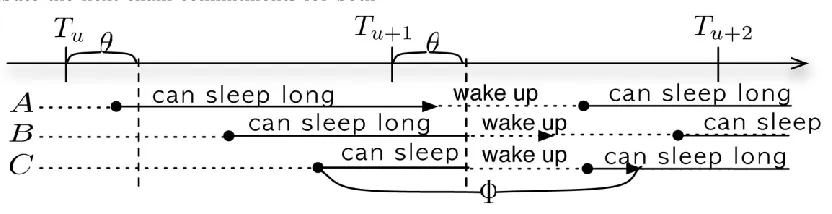
Fig. 4. Sleep mode in X-TESLA.
4.5 Sleep mode management
Energy efficiency is mandatory for sensor networks since tiny nodes are operated on batteries. Various types of sleep modes11 that stop CPUs or radio functions are commonly used but care must be taken [16], as nodes that have been inactive for a long time may need to do much computation for key verification or lose commitment.
Let Tu denote the starting time of interval Iu, and set Φ=
Tu+1 - Tu to the length of one upper level chain. As depicted
in Fig. 4, a sensor node shall not be allowed to go into a long-term sleep or, at the least, not be allowed to stop radio functions for a long-term period unless it has obtained the next lower level commitment, while short-term sleeps are always allowed. More specifically, we fix some threshold value θ that takes the clock discrepancy of nodes into account, and for a node that has verified a Type
4 packet at time T, we allow it to set the maximum sleep length timer () to the duration of up to Φ only if T < Tu + θ
(as in node A of Fig. 4), and to the duration of up to Tu+1 + θ
- T if otherwise (as in nodes B and C of Fig. 4).
5. TWO NEW HEURISTICS FOR BROADCAST TREES
_______________________________________________________________________________________
© 2016, IRJET ISO 9001:2008 Certified Journal Page 268 favors the use of high-energy nodes as relays (non-leaf
nodes) of the broadcast tree so as to preserve the energy of low-energy nodes. This strategy is expected to increase lifetime.
The BIPLA Heuristic:
Let ce (i) be the current energy at node i of the network before sending a message. In BIPWLA, we begin with a tree T that comprises the source node s together with all neighbors of s that are reachable from s using ce(s) energy. Initially, the source node s is colored black, all other nodes in T are gray and nodes not in T are white. Nodes not in T are added to T in rounds. In a round, one gray node will have its color changed to black and one or more white nodes will be added to T as gray nodes. It will always be the case that a node is gray if it is a leaf of T, it is black iff it is in T but not a leaf, it is white if it is not in T. In each round, we select one of the gray nodes g in T; color g black; and add to T all white neighbors of g that can be reached using ce (g) energy. The selection of g is done in the following manner. For each gray node u € T, let nu be the number of white neighbors of u reachable from u by a
broadcast the uses ce (u) energy. Let pu be the minimum
energy needed to reach these nu nodes by a broadcast from
u. Let,
We see that nu = |A(u)| and pu = max{w(u, j)|j € A(u)}.
For each j € A(u), we define the following analogous quantities Node g is selected to be the gray node u of T that maximizes
nu/pu + max{nj /pj | j € B(u)}
required energy. The BIPWLA heuristic is summarized in Figure 5.
Once the broadcast tree is constructed, a sweep is done to restructure the tree so as to reduce.
The is a broadcast tree. Finally, a sweep is done to
restructure the tree so as to reduce
When T contains all nodes of G(i.e., when T
the required energy. The MEN heuristic is summarized in figure 6.
Figure 5: BIPWLA minimum energy
broadcast tree heuristic
_______________________________________________________________________________________
© 2016, IRJET ISO 9001:2008 Certified Journal Page 269
The MEN Heuristic
The MEN (maximum energy node) heuristic attempts to use nodes that have more available energy as non-leaf nodes of the broadcast tree thereby preserving the energy of low-energy nodes, which become,From Q, we
6. CONCLUSION
Our work shows that although minimum energy broadcast tree heuristics result in low-energy broad- cast trees, the use of these broadcast trees doesn’t result in good network lifetime. Network lifetime is enhanced
select the node u that has maximum energy ce (u). All neighbors j of u not already in T and which satisfy w(u, j) ≤ ce(u) are added to T as children of u. This process of adding nodes to T terminates leaves of the broadcast tree (recall that the leaves of broadcast tree expend no energy in our model). In MEN, we start with T = {s}. At each step, we determine Q such that
significantly by incorporating the critical energy constraint into each minimum-energy broadcast tree heuristic. We have proposed X-TESLA, an efficient scheme which may continue indefinitely and securely, that addresses this and many other issues of the previous schemes. With the advent of more powerful sensor node commodities such as iMote2, the future of public-key technique application to broadcast authentication looks bright, but X-TESLA can efficiently be combined with public-key techniques also.
For example, we could modify X-TESLA to use digital signatures on Type 4 packets, keeping everything else the same.
REFERENCES
1. Taekyoung kwon, Member, IEEE.and Jin Hong
“Secure and Efficient Broadcast Authentication in Wireless
Sensor Network”IEE transactions on computers, VOL.59, NO. 8, AUGUST 2010.
2. I.F. Akyildiz, W. Su, Y. Sankarasubramaniam, and E.
Cayirci, “ASurvey on Sensor Networks,” IEEE Comm. Magazine, vol. 40, no. 8, pp. 102-114, Aug. 2002.
3. A. Durresi, V. Paruchuri, S. Iyengar, and R. Kannan,
“Optimized Broadcast Protocol for Sensor Networks,” IEEE Trans. Computers, vol. 54, no. 8, pp. 1013-1024, Aug. 2005. 4. M. Luk, A. Perrig, and B. Willock, “Seven Cardinal Properties of Sensor Network Broadcast Authentication,” Proc. ACM Workshop Security of Ad Hoc and Sensor Networks (SASN), Oct. 2006.
5. J. Park and S. Sahni, “Maximum Lifetime
Broadcasting in Wireless Networks,” IEEE Trans. Computers, vol. 54, no. 9, pp. 1081-1090, Sept. 2005.
6. T. Rappaport, Wireless communications: Principles
and practices, Prentice Hall, 1996.
7. M. Luk, G. Mezzour, A. Perrig, and V. Gligor,
“MiniSec: A Secure Sensor Network Communication Architecture,” Proc. ACM/IEEE Conf. Information Processing in Sensor Networks (IPSN), Apr. 2007.
8. A. Perrig, J. Stankovic, and D. Wagner, “Security in
Wireless Sensor Networks,” Comm. ACM, vol. 47, no. 6, pp. 53-57, June 2004.
9. K. Kar, A. Krishnamurthy, and N. Jaggi, “Dynamic
Node Activation in Networks of Rechargeable Sensors,” IEEE/ACM Trans. Networking, vol. 14, no. 1, pp. 15-25, Feb. 2006.
10. K.Priya , J.Kannadasan, T.Sivasakthi, M.Surya,
I.Jesintha “A proficient recognition method for ML-AHB bus matrix. “
11. Ambiga, S., and M. Ramasamy. "Rural Women Entrepreneurship-A Managerial Perspective."Middle-East Journal of Scientific Research23.3 (2015): 479-484.
12. Ambiga, S., and M. Ramasamy. "Women
Entrepreneurship Development in India."Jurnal
Teknologi64.3 (2013).
_______________________________________________________________________________________
© 2016, IRJET ISO 9001:2008 Certified Journal Page 270
BIOGRAPHIES
Mrs.I.Jesintha1 , M.E., Assistant
Professor Department of ECE, Roever College of Engineering & Technology, Perambalur, Tamil nadu , India. Her research Interests are Network security & Antenna Design. She has 5 years of teaching experience.
Mr.G.Thiraviya Suyambu2 , M.E.,
Assistant Professor Department of
ECE, Roever College of
Engineering & Technology, Perambalur, Tamil nadu, India. His research Interests are Wireless
Communication & Mobile
communication. He has 12 years of teaching experience
Mr.T.Azhagesvaran3, M.E.,
Assistant Professor Department of
ECE, Roever College of
Engineering & Technology, Perambalur, Tamil nadu, India. His research Interests are Network security & Antenna Design. He has 2 years of teaching experience.
Mrs.K.Priya4, M.E.,Assistant