
7245
A STUDY ON RECENT MIXED REALITY PLATFORM AND
APPLICATIONS
1XIAOYUN DUAN, 2SYUNGOG AN, 1*SOO KYUN KIM
1Department of Game Engineering, Paichai University, Daejeon, South Korea
E-mail: [email protected]
ABSTRACT
Mixed Reality (MR) technology has enormous potential, changing the future for a number of fields. Since 2014 MR technology has been developing rapidly in both hardware and software fields. MR is mostly being applied in medicine operation training, architecture design, business, education, and manufacturing. There are various different MR devices, as we know. This study presents the descriptions of categories of MR system, the adverse effects to human health and hardware limits of MR, and finally describes the MR devices and its applications.
Keywords: Head-Mounted Displays, Platform, Devices, Application, Mixed Reality, Virtual Reality.
1. INTRODUCTION
Recent advancements in Mixed Reality (MR) have been widely shown in many applications such as design, education, training, games and medicine. By artificially stimulating the senses, MR makes it possible to trick the human body into accepting another version of reality. MR technology has enormous potential, changing the future for a number of fields. To experience a MR device or an application the player must learn some basic knowledge about MR.
1.1 Virtual Reality
Mixed Reality, MR for short, uses a computer that creates a simulated 3D world. Jerald et al, presented that MR is defined as “a computer-generated digital environment that can be experienced and interacted with as if that environment were real” and asserted that VR is communication, they emphasized the importance of human factor that influence the interaction between the MR system and the users. MR uses computer or other devices, simulates and generates a virtual world that the users can interact with, and get a strong immersive experience.
When people look at the world around them, because of the different positions of the two eyes, the images obtained by each eye are slightly
different. These images are integrated in the brain to form an overall view of the surrounding world. This sight includes information about the distance information. In the MR system, binocular stereo vision plays a big role on the sense of Three-dimensional. Different images seen by the user's each eye are generated separately and displayed on different monitors or on divided part of one monitor, shown in Figure1.
Fig.1. The divided screen for VR [1]
computer-7246 generated imagery. Since Virtual reality can be used to make the simulation scenes more immersive, it is expected to be used for education and professional training.
The development history of VR can be divided into approximately 3 periods: the exploration stage, practical stage, and the high-speed developmental stage. The exploration stage, was between 1930s~70s. In 1935, American science fiction writer Stanley G. Weinbaum presented a concept of a comprehensive and specific fictional model for virtual reality in his short story. Sutherland I.E., the creator of one of the world’s first VR systems, made the foundation that generates a Virtual world that enable users to directly interact and immerse instead of just watching the Virtual scene through the screen. Inspired by Ivan Sutherland’s vision of the Ultimate Display, Dr. Frederick P. Brooks, Jr. established a new research program in interactive graphics at the University of North Carolina at Chapel Hill. The initial focus was on molecular graphics and in 1967, developed the first VR device HMD (head mounted display). Dr. Brooks stated: “The screen is a window through which one sees a virtual world. The challenge is to make that world look real, act real, sound real, feel real.” During the 1980s VR technology systematized from laboratory to practical stage. In 1985, Scott Fisher, now at NASA Ames, along with other NASA researchers developed the first commercially viable, stereoscopic head-tracked HMD with a wide field of view, called the Virtual Visual Environment Display (VIVED). Finally, from the 1990s to now is called the highspeed development stage. VR exploded in this period with various companies (Sega, Disney, and General Motors, as well as numerous universities and the military etc.) focusing mostly on the market and entertainment (movies, books, etc.) and is also active in journals and conferences. Since the 2000s there have been plenty of original stage products published. However, due of the limits of VR technology they are not so popularized yet. In the years to come, more and more VR products with competitive prices will be flowing into the mainstream market.
Virtual reality has 3 main characteristics: namely immersion, real-time interactivity, and imagination[2]. Immersion is the core characteristic which allows a VR system and application to stimulate the sensory receptors of users in a way that is extensive, matching, surrounding, vivid, interactive, and plot informing 2. The user can get the real sense of seeing, hearing, touching and smelling just like in the real world. Second,
real-time interactivity is the basic requirement, as users interact with the environment in the real world. Users’ immersion will be broken if the interaction is unnatural or has time latency. Third, imagination, or creativity, is the ideal purpose of VR. In the very beginning of VR world, VR can be made just like the real or nonexistent things. Through the experiences users get new knowledge and ideas and can establish new cognition.
1.2 VR System
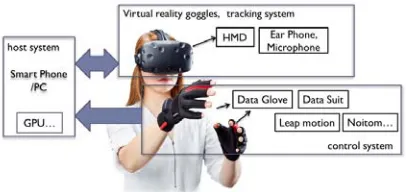
[image:2.612.318.521.465.561.2]VR system has four main categories as follows: Desktop VR system, Augmented VR system, Immersive VR system (consisting of HMD-VR, Projection display based-VR, telepresence system VR), and Distributed VR (DVR) system [4]. Here we show the most common form: HMD-VR Immersive VR system. As shown in figure 1, VR system consists of 4 parts such as VR goggles, host system, tracking system, and control system [5]. The VR goggles generally have a display-integrated screen or smartphone screen inside, and some also have earphones for sound. It can track the user’s head movements. The control system is the interactive part that allows users to use their hands for grabbing or touching objects in the virtual reality world. The host system receives, processes, and reacts to the information from the tracking system and the control system.
Figure 2. Overview of VR System
1.3. The interaction ways of VR
7247 There are diverse VR interaction modes. At present, VR interaction modes primarily include the following seven categories.
- Gesture Tracking: As a kind of mode of
[image:3.612.90.303.299.420.2]interaction, gesture tracking could be divided into optical tracking such as in-depth sensors like Leap Motion and NimbleVR, and data glove which wears sensor on the hand. Microsoft HoloLens is an AR hardware which utilizes gesture in interaction. Once wearing HoloLens glasses, users could control virtual objects and function menu by clicking, dragging and stretching with fingers in the air, such as posing Air tap gesture to open holographic figure or posing Bloom to open the start menu.
Figure 3. Interacting in VR Using LeapMotion[7]
- Motion Capture: Whole-body motion capture is
not necessary in many scenes. Its problem consists in the shortage of feedback. In consequence, users could hardly perceive the efficiency of their own operation.
- Tactile Feedback. Tactile feedback primarily
refers to button and vibration feedback. Next, this section will make a brief introduction to VR hand shank. Nowadays, three leading VR head-mounted manufacturers Oculus, Sony and HTC Valve unanimously adopt the VR hand shank as a standard interaction mode. The so-called VR hand shank is actually a hand shank with two separate handles, tracking function in six free degrees of freedom (including three rotational freedom and three translational freedom), button and vibration functions.
- Eye Tracking: Palmer Laci, founder of Oculus
has credited it as the “core of VR” because it could provide optimal 3D effects from current angle
based on the inspection of human eye position. Therefore, VR head-mounted imaging appears to be more natural out of its less probability of hysteresis and great entertainment. In the eyes of most VR practitioners, eye tracking technology has become an important technical breakthrough in solving VR helmet dizziness. VR head-mounted FOVE in Japan has already introduced this eye tracking technology.
- Voice Interaction: although gesture operation
relieves the two hands, it still has lethal shortcomings – frequent hand raising gesture would cause arm arching. At present, Microsoft Cortana, Google Now, Apple Siri, Amazon Echo are all excellent speech recognition helpers. However, due to their low recognition rate, they could only work as auxiliary operation instrument and corresponding intelligence degree can never reach up to the requirement of AR interaction. By means of speech control, users and the world that they are observing would not interfere each other. More importantly, the voice interaction between users and VR world would turn more natural since users could realize communication in any place and any corner and even do not need to move their heads to seek.
- Sensors. Sensor could help people naturally
interact with the multi-dimensional VR information environment. For instance, Virtuix,Cyberith and domestic KAT all commit to the research and development of universal treadmill. Likewise, people who wear whole-body VR suit Teslasuit could personally perceive the changes in VR environment, including the breeze, and even the sense of being struck by a bullet in shooting games. All of these perceptions generate via sensors on the equipment, such as smart sensor ring, temperature sensor, photosensor, pressure sensor, and visual sensor. Such sensors simulate the skin to produce corresponding feelings via pulse current, or convey all sorts of perceptions like tactile sense and olfactory sense to the brain.
- VR Theme Park: VR theme park The Void
7248 and Scene design can bring users a variety of peripherals cannot bring a good experience. Build the virtual world on top of the physical world so that users can feel the surrounding objects and use real items such as portable lights, swords, guns, etc.
Figure 4. The Void VR Environment [20]
Virtual Reality is a new revolution in an interactive way. People are realizing the transition from interface to space. In the future, multi-channel interaction will be the mainstream interaction form in the VR era. At present, the input mode of VR interaction is not yet unified, and various interactive devices on the market still have their own insufficiencies.
2. LIMITS OF VR
Since the 2000s, there have been plenty of original stage products published. However due of the limits of VR technology, they are not so popular yet. One of the hardware limits is that users can feel vertigo after longtime use. The VR developers can rise to the challenges on hardware limits and adverse effects on human health. This section describes the hardware limits of VR.
- Latency: the sum of delays of rendering,
application, display, tracking, and synchronization among components. Low-accuracy head trackers result in seeing the world from an incorrect viewpoint.
- Vertigo: There are two main causes of vertigo:
First, when the body is moving and the picture is still. Second, the picture is moving but the body remains motionless. The virtual character’s movement in the VR world cannot reflect the movements of a real human body. For instance, in a visual Roller coaster the body is stationary but the picture moves and this confuses the vestibular
system, which leads to vertigo [6].
- HeadsetFit: the degree of comfort the users feel,
including the viewing angle. If visual range is bigger than the screen it’s easy to affect the viewing experience and immersion through eye movement.
- Portability: Mainly refers to the weight, battery
life, and heavy equipment, and after long periods of operation, can cause discomfort and fatigue to the user. For the wired devices, it’s difficult for the user to move around freely; for the VR-all-in-one devices, short battery life and weight are key limiting factors.
- Interaction way: Some unnatural ways such as
touching the screen; pressing a magnet button; controlling a Joypad adaptor or using single Bluetooth; Sensor Devices: The force sensation, haptic sensor cannot provide accurate control for the users.
Another way to bring the user a more immersive experience is the use of the higher quality Virtual World. However, this creates a break between the user and the real world and other people. Although users can interact in the VR spaces, it is very limited in authenticity and naturalness. Any technology that becomes mainstream must be Dense Communication [8], and use VR in combination with the real world, which is called Augmented Reality, AR for short. This has been gaining a following.
3. VR DEVICES AND APPLICATIONS 3.1 VR devices
During 2017, Many Major companies have launched new services or update their Hardware devices. There are a lot of promising headsets across a range of price and power spectrums. Oculus has released the consumer-ready Rift, HTC and Valve have put out the Steam-friendly Vive, Sony has launched the excellent PlayStation VR, Samsung recently added a separate controller to its Gear VR, and Google's Daydream is steadily growing from the remains of Google Cardboard. Meanwhile, Microsoft's Windows 10 mixed reality platform and a variety of hardware manufacturers working on it are waiting in the wings [9].
7249 the connected PC, are more expensive but not as portable as the other two. Mobile +VR devices are easy and convenient for beginners, and its better portability gives it the most potential in future VR development. VR-all-in-one devices are also portable, however disputed for its heavy weight and short battery life. All these categories have the vertigo problems. Figure 5 shows the representative brands of VR HMDs.
Figure 5. Representative brands of VR devices [16]
- Oculus Rift: Gone public on March 25 by Facebook, 2016, it is a PC-VR device that has a configured screen and sensing device. The headset device has two OLED panels, each with a resolution of 1080×1200. The connecting PC must have a high configuration and controller devices.
- Sony PlayStation VR: Launched in October 2016 By Sony. It is also a PC-VR device that has an OLED display, with the resolution of each eye at 960×1080 pixels [10]. The controller is called the PlayStation MOVE. It has a small loss of sense of immersion and is comparatively cheaper than the others.
- HTC Vive Pre: Launched at Consumer Electronics Show 2016, known as HTC Vive Pre[11]. The two display screens have a refresh rate of 90 Hz, and resolution of 1080×1200. The controller is convenient and light and has a front-facing camera called the “Chaperone” [12] . HTC recently unveiled a Vive headset called the Vive Standalone at the China Joy entertainment expo in July. This new VR device does not require a connected PC and can standalone as opposed to the conventional PC+VR HMDs.
- Samsung Gear VR: in the latter half of 2014, Samsung published the first generation mobile-VR device that was only supported on the Galaxy Note 4. While at MWC 2016 (Mobile World Congress), the new generation Gear VR supported by Galaxy S7/S7 Edge, Note5,Note4,Galaxy S6, S6 Edge and S6 Edge+ was published.
- Google Cardboard: Google published Cardboard in 2014 enabling low-cost ($2) VR using existing smart phones. Google Cardboard uses a magnet button as the input device.
- FOVE VR: The first eye tracking VR headset, added two infra-red cameras below the lens that did not disturb users’ experience while aiming at their eyes, tracking the user’s viewpoint. This enables the graphics engine to adjust focus and allocate rendering resources accordingly to look, laugh, and communicate with characters just like in the real world [13].
- Avegant Glyph: Avegant Glyph has no traditional screen. What the user sees is the projection on their eyes and for this reason it has a 120Hz Refresh Rate and 45°viewing angle. The high Refresh Rate leads to no latency, and the narrow viewing angle makes the experience less immersive.
- Google Daydream VR: Published in May 2016 at the Google I/O Conference, Google Daydream VR optimized the algorithm to reduce latency and vertigo sensations effectively. It is supported on various smart phones, with the Pixel phone developed by Google as the first. The developers also further enriched the software in the fields of watching movies, playing games, and watching games.
7250
Table 1. Test Comparison of VR HMDs
3.2 VR Applications
VR has significant applications in fields of data and architectural visualization, medical treatment, military, aerospace, art, business, product design, manufacturing, and also as entertaining education or training tools. VR brings the users to the virtual world from the outside to the inside. For entertainment fields, it is used in games, movies, and scene experiences.
Figure 6. the Virtual Wind tunnel (VWT) system [14]
For Medical fields, Doctors use VR to teach
medical students in surgery, cure patients, and even help paraplegics regain body functions. In business, a variety of industries are benefited by VR technology. Carmakers can create safer vehicles, architects can construct stronger buildings, and travel agencies can even use it to simplify vacation planning. Figure 6 shows an application of the VR interface technology to help visualize the results of modern computational fluid dynamics simulations outside view (left), inside view (right)
11. In the last few days, NBC used VR to live
telecast the American presidential election debate. People who use mainstream VR devices such as Oculus Rift, HTC Vive, or Samsung Gear VR, And NBC used VR to live telecast during the Rio Olympic 2016.
In the educational fields, students can use a VR device to observe how the macrocosmic or microcosmic world works as if it is happening around them. They can also see the internal structures of the human body. Figure 7 shows the World of Comenius - A biology lesson at a school in the Czech Republic that stands as an exemplary model of innovative scientific learning. They implemented a Leap Motion controller and specially adapted Oculus Rift DK2 headsets. These applications give vivid effects that traditional education resources cannot supply, such as galactic kinematics, atomic structure or atomic motions. VR is also useful in training courses, such as medical treatment, flight training, operation training, and other skill training.
(a) interaction using Gesture Recognition
[image:6.612.341.491.479.674.2](b) learning the Human body composition
[image:6.612.91.300.617.696.2]7251
Figure 8. Tilt Brush: Painting from a new perspective[16]
For Artistic Designing, Google developed Tilt Brush in April 2016, Figure 6[15]. This lets users paint in 3D space with the HTC Vive device. Google Earth VR, published in November 2016, can explore the world from totally new perspectives with the HTC Vive, putting the whole world within ones reach. Take a peek at some of the incredible sights you'll experience along the way in the preview gallery in Figure 9 [17].
Figure 9. the Google Earth VR [17]
4. CONCLUSION
This study has provided a broad overview of recent analysis in VR and VR systems, limits of VR technologies and platforms exemplified by relevant applications.
VR-PC helmet developers such as Sony PlayStation VR, Oculus Rift, HTC Vive brings stronger and stronger immersive experiences to users. VR-Mobile also had a great revolution, Google Daydream VR. The developers also further enriched software for watching movies, playing games, and watching videos.
While VR was a non-starter back in the 90s, developers are now creating mind-blowing experiences that look set to revolutionize gaming and entertainment. Today, virtual reality technology is a great experience for consumers. However, VR is still in its formative years and has yet to rise to the level of industry standards. The technology, products, contents and specifications of VR are
slightly immature. More importantly the interaction between users and VR is unrealistic and unnatural, which can absolutely reduce the immersive experience.
With the development of VR technology applications in education, entertainment, medical treatment, military, aerospace, and business, it is becoming more and more attractive. It is changing the way people perceive themselves, concept of time and space, and the world[19]. In the future, VR will be more popular, and people can directly experience it instead of just hearing sounds or seeing images, to a certain extent, the application of VR in education can protect the children’s imagination. According to reports, the 21st century will be the century of VR.
VR is a realistic image that is generated with software and presented to the user. In this paper, we described various VR devices and their characteristics, many applications in the medical, educational, art and other fields. We also summarized the limits of VR technologies and analyzed the differences of recent VR devices such as Oculus Rift, Sony PlayStation VR, HTC Vive Pre, Samsung Gear VR, Google Cardboard, FOVE VR, Avegant Glyph, Google Daydream VR, Pico Neo, and DeepoonM2. We also provided a review of recent issues of VR. Now VR has many proven applications in the fields mentioned above, however, to becoming more popular, the producer must break through its bottlenecks limits.
ACKNOWLEGEMENT
This work was supported by the research grant of PaiChai University in 2018.
REFERENCES:
[1] Stanley G. Weinbaum (1935) "Pygmalion's Spectacles", Sep 10, 2010.
[2] Jason Jerald, “The VR Book: Human-Centered Design for Virtual Reality”, ACM Books, Morgan & Claypool Publishers, October 16, (2015)
[3] Slater, M., & Wilbur, S. “A framework for immersive virtual environments (FIVE) : Speculations on the role of presence in virtual environments”, Presence : Teleoperators and Virtual Environments, Vol 6(6), 603-616, December (1997), Article(CrossRef Link) [4] Lu Juan, “The Classification of Virtual Reality
[image:7.612.101.289.358.443.2]7252 Article(CrossRef Link)
[5] Integral VR system, Article(CrossRef Link) [6] CAO Xuan. Technological bottleneck of virtual
reality. Science & Technology Review, (2016), 34(15): 94-103.
[7] The Best VR, Article(CrossRefLink).
[8] Sony, "PlayStation VR Launches October 2016", Sony. Retrieved, March, (2016), Article(CrossRef Link)
[9] Ars Technica, "HTC Vive Pre impressions: A great VR system has only gotten better". Retrieved Jan.28 (2016), Article(CrossRef Link)
[10] Alex Vlachos, "Advanced VR Rendering", Game Developers Conference, March, (2015), Article(CrossRef Link)
[11] Kickstater, FOVE: The World's First Eye Tracking Virtual Reality Headset, Article(CrossRef Link)
[12] S. Bryson, "The Virtual Wind Tunnel", Article(CrossRef Link)
[13] Google Earth VR, Article(CrossRef Link) [14]Paul James, ‘world of Comenius’ Demonstrates
Powerful Educational Interaction with Leap Motion and Oculus Rift, Oct 17, (2014) [15] Google, "Tilt Brush: Painting from a new
perspective", (2016). [16] www.google.com
[17] Sutherland, I. E. (1965). The ultimate display. In The Congress of the International Federation of Information Processing (IFIP) (pp. 506–508). DOI: 10.1109/MC.2005.274. 9, 23, 30
[18] Google, Goolge Cardbord Application Store. [19] LeapMotion gets a head-mounted upgrate,
becomes a VR controller.
![Figure 3. Interacting in VR Using LeapMotion[7]](https://thumb-us.123doks.com/thumbv2/123dok_us/8901582.955096/3.612.90.303.299.420/figure-interacting-in-vr-using-leapmotion.webp)
![Figure 4. The Void VR Environment [20]](https://thumb-us.123doks.com/thumbv2/123dok_us/8901582.955096/4.612.91.303.167.290/figure-the-void-vr-environment.webp)
![Figure 5. Representative brands of VR devices [16]](https://thumb-us.123doks.com/thumbv2/123dok_us/8901582.955096/5.612.116.311.199.291/figure-representative-brands-vr-devices.webp)
![Figure 7. World of Comenius – Use Leap Motion Interact with the Virtual human body with just hands [15]](https://thumb-us.123doks.com/thumbv2/123dok_us/8901582.955096/6.612.341.491.479.674/figure-world-comenius-leap-motion-interact-virtual-human.webp)

