7077
ARABIC ONTOLOGY-BASED APPROACH FOR CHEST
DISEASES DIAGNOSIS
1ALI ALNADER, 2ISSAM SALMAN, 3KHALIL AJAMI, 4AMMAR ALZEIN
1,3Syrian Virtual University, Web Science program, Syria
2Czech Technical University, Department of software engineering, Czech
4Damascus University, Department of Internal Medicine, Syria
E-mail: 1[email protected], 2[email protected], 3[email protected],
ABSTRACT
Chest diseases are a subgroup of respiratory system diseases. The symptoms of these diseases are similar and this makes the diagnosis process difficult. Therefore, to ease the diagnosis process we gathered Information about fourteen diseases, which attack the chest, with their symptoms and investigations about them. In this paper, we present an Arabic ontology-based approach for chest diseases diagnosis. We focus on ontology building process. This ontology can be used to help physicians and other users, determine the chest disease that a patient is suffering from and what are the investigations that should be applied. While experts can easily gather information from this data, lay users lack the expertise needed to deal with it. Most of the efforts to solve this problem focus on the English language. So also, in this paper, we present a new approach based on natural language processing to translate Arabic language query to SPARQL query
Keywords: Knowledge Representation, Semantic Web, Ontology Development, Arabic Language,
SPARQL, Natural Language Processing
1. INTRODUCTION
No one can ignore the importance of the respiratory system as one of the most important systems in the human body, which provides it with oxygen. Therefore, any trouble in its function will lead to death.
Several diseases can infect the respiratory system, each of them attacks at least one organ and has a set of signs and symptoms. Therefore, the early detection of any defect in the respiratory system functions stands at the top of doctor's tasks.
However, the diagnostic process is not an easy process due to the complexity of the human body and overlapping phenotypes. For that reason, computer science can be helpful to support physicians in the diagnosing's process. So, creating a system based on ontology will facilitate the diagnosis for doctors, by providing it with the patient's symptoms and signs, it will query the ontology and provides feedback about the expected disease. Since there is no research- to our knowledge- that uses ontologies to serve chest diseases in Arabic.
In addition, we propose a natural language processing model, which will enable users to query the semantic data using their natural language. Our approach starts a translation process by removing stop words then identifying the query target after that form triples by mapping the rest of words in the query or their stems or their meanings with the ontology.
The rest of this paper gives a background about ontology development, disease diagnosis and translating natural language queries to SPARQL queries, presents the methodology of ontology development, the implementation of the ontology using Protégé tool and presents the proposed model, and the evaluation of the ontology. Finally, contains the conclusion and future work.
2. CHALLENGES AND IMPORTANCE OF
THE RESEARCH
7078 There are different word derivations and there is an impact of the diacritics marks on the word's meaning. Besides, there are other challenges related to the usage of the stem, in which a word's stem provides words with different meanings. The contributions of this research are represented in:
Design Arabic ontology for chest disease
diagnosis.
Help lay users to query the ontology using their
natural language.
Enrich Arabic content on the web since it is an
Arabic ontology.
3. RELATED WORKS
In this section we discus many works in the domain of ontology development, disease diagnosis and translate natural language query to SPARQL query and vice versa.
3.1.Ontology development
In [1] researchers suggested a
methodology consists of three basic modules: the diagnostic module, the staging module and the treatment recommendation module. In order to detect patient disease, the patient provides his/her signs and symptoms to the diagnostic module, which detects what type of cancer the patient is suffering from. Then the staging module finds the current stage of cancer based on the cancer type, signs and symptoms that are provided by the patient. Based on the determined cancer type and cancer stage, the treatment recommendation module can recommend a specific treatment for the case.
In [2] researchers discussed the problem of knowledge acquisition. They proposed an inference method according to the case at hand. The system takes the ontology and the symptoms as input. Then in the first phase, the system returns a set of diseases. Thus, if the number of these returned diseases is one, then the process of diagnosing is finished. However, if the number of returning diseases is greater than one, the differential diagnosing process begins where the system retrieves similar cases through semantic way depending on a knowledge model.
In [3] Cristina Romero Tris proposed a decision support system based on a knowledge base to help physicians in the diagnosis process, and to verify the diagnosis made by the doctor. Therefore, if the doctor inputs a disease not related to the symptoms, the system will notify the doctor of the
inconsistency. Moreover, it will suggest the disease that best fits the symptoms. The proposed system aims to personalize existing knowledge base through the extraction of a partial ontology, which contains the medical terms that refer to the patient.
In [4] Lakshman Jayaratne proposed a decision support system based on ontology. The proposed system composed of two components, a genotype component and phenotype component. The initial input of the system is genetic sequences of a patient. Firstly, the system identifies whether the gene in input is mutated or not with respect to the referenced gene sequences. Then, according to those mutations, a corresponding common list of phenotypes are identified and shown to the physician. They are listed down according to the frequency and probability of phenotypes that might occur. The physician must first make sure that the phenotypes given by the system are really in the patient’s body and can then get the diagnostics report after choosing the matching phenotype from those listed by the system.
In [5] Researchers proposed a framework composed of three phases wherein the first phase is a text analysis technique would be applied to medical records. In the second phase, the semantic analysis process was applied to store the information extracted from the first phase in a knowledge base, and the last phase involves querying the knowledge base to get the related medical information. Here, they used medical rules to infer additional medical facts about the patients and to generate a rich knowledge base of patient facts.
7079 3.2. Translating Natural Language Query to SPARQL Query
In [7] researchers proposed a generic approach to translate Arabic NL queries to SPARQL. The proposed approach utilizes the off-the-shelf Arabic language toolkit to build the parse tree of the user query. It then analyses the syntactic structure of the tree to extract NPs, identify head and modifier words and represent the query in a triple format, i.e. subject-predicate-object. The proposed approach is independent from the ontology since it can be easily ported from one ontology to another.
In [8] researchers proposed a new version of LODQA which takes as an input natural language query and returns it SPARQL form. It consists of three modules, which are:
First Module is responsible for handling the
natural language query, parsing it, and producing a graph representation called as pseudo graph pattern (PGP), which contains nodes and relations. Typically, the nodes correspond to the nouns and relations to the dependency paths between them. Additionally, PGP specifies the focus of the query.
Second Module is responsible for finding the
URIs and values of the nodes in the PGP through mapping PGP with the ontology. A natural language term may be normalized to more than one RDF terms due to ambiguity. Therefore, more than one Anchor PGPs may be produced.
Third Module is responsible for searching the
target dataset for corresponding parts, considering possible variations. To absorb structural discrepancy between the APGP and actual structure in the target dataset, it attempts to generate SPARQL queries for all the possible structural variations. Then the SPARQL queries were submitted to the target endpoint and the answers were gathered and provided to the user.
In [9] researchers proposed an approach to translate English queries to SPARQL queries based on knowledge stored in ontologies and lexicons. The translation process composed of seven steps, which are:
Delete stop words
Stem the remaining words in the query and
delete punctuation and extract dates.
Map the remaining tokens against the ontology.
Concepts, individuals, relations and properties are matched, the appliance labels are extracted.
Tokens without corresponding entries in the
ontology are checked against the lexicon.
These are either KPIs or keywords, which do not belong to the ontology.
After identifying the tokens in the ontology or
lexicon, the corresponding SPIN rule, which provide the main structure of the SPARQL query, is extracted.
The last step merges the defined SPARQL
body from the SPIN rule with the additional information from the ontology and the extracted dates.
In [10] researchers proposed
SPARQL2NL, a novel approach that can verbalize SPARQL queries. The approach is tailored towards SPARQL constructs typically used in keyword search and question answering. It consists of four main steps: a preprocessing step which normalizes the query and extracts type information for the occurring variables. Processing step which constructs a generic representation of the query. A post-processing step, which applies reduction and replacement rules in order to improve the legibility of the verbalization, and a realization step, which generates the final natural language representation of the query.
In [11] researchers proposed an approach that enabled end-users to query knowledge bases. This approach is based primarily on predefined samples that lead user query translation. The researchers relied on the hypothesis that end-user queries varied among fixed queries. The process of translating the natural language query into the SPARQL query proposed in this search consists of two basic steps. The first step was converting the natural language query to Pivot Query, Where the nominal entities were selected, the dependencies were analyzed, the target was derived from the query, and a set of predefined rules was applied to the reliability statement to extract all elements of the query. The second step involved mapping the predefined samples with the Pivot query. A set of possible interpretations of the user query, which were arranged according to their expected relationship with the user query, were then suggested to the user as a set of rewritten queries.
7080
4. ONTOLOGY DEVELOPMENT
In this section, we present the steps which we follow to build our ontology. The proposed CDDOnto (Chest Disease Diagnostic Ontology) will be very important for diagnosing chest diseases. We gather the ontology content from [13] and from a domain expert who helps to identify concepts and relationships between them. There is a wide range of tools available for creating ontologies such as SWOOP, Onto Track and protégé, but we choose protégé because according to [14] it is the most domain-independent tool. According to [15], building an ontology requires executing the following steps:
Determine the domain of the ontology
We cannot build an ontology without specifying its domain. The domain of our ontology is diagnosing chest diseases.
Our ontology can answer different types of questions like:
o What are the symptoms of a given disease?
o What are the investigations of a given
disease?
o What is the disease of giving symptoms?
Reuse Existing Ontologies
We build CDDOnto from scratch since there is no such ontology in the Arabic language.
Overview the Ontology
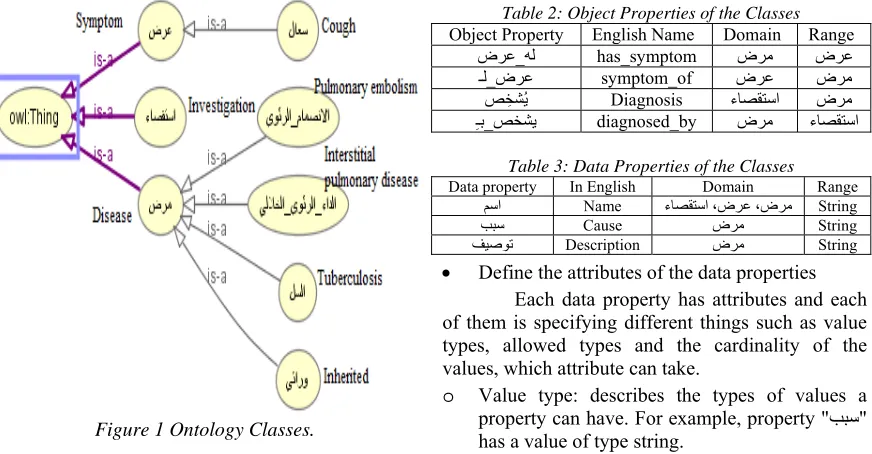
[image:4.612.307.528.166.335.2]We gathered information about fourteen diseases, their symptoms and investigation. Then we organized them in an ontology. Figure 1 shows all classes of the ontology.
Figure 1 Ontology Classes.
Enumerate main terms in the ontology
We find three main classes, a disease (ﺽﺮﻣ) which has four subclasses, symptom (ﺽﺮﻋ) which has one subclass and investigation (ءﺎﺼﻘﺘﺳﺍ).
Table I: Ontology Classes
Name in English Name in Arabic
Investigation ءﺎﺼﻘﺘﺳﺍ
Symptom ﺽﺮﻋ
Disease ﺽﺮﻣ
Cough ﻝﺎﻌﺳ
Pulmonary embolism ﻱﻮﺋﺮﻟﺍ ﻡﺎﻤﺼﻧﻻﺍ
Interstitial pulmonary disease ﻲﻟﻼﺨﻟﺍ ﻱﻮﺋﺮﻟﺍ ءﺍﺪﻟﺍ
Tuberculosis ﻞﺴﻟﺍ
Inherited ﻲﺛﺍﺭﻭ
Define the Properties of the Classes
There are two types of properties: object property, and data property. While the first links object to object, the other link object to XML
schema. We add data properties such as ﻢﺳﺍ, ,ﻒﻴﺻﻮﺗ
ﺐﺒﺳ to the ontology. They are used for giving a value to an instance of a class. For example, "ﺐﺒﺳ" cause of "ﻲﺋﺪﺒﻟﺍ ﻥﺭﺪﺘﻟﺍﺍ" primary tuberculosis is Mycobacterium tuberculosis ﺔّﻴّﻠﺴﻟﺍ ﺕﺍﺮﻄﻔﺘﻤﻟﺍ"" . The data property is applicable to each instance of the class. Table 1 illustrates the object properties, while table illustrates data properties.
Table 2: Object Properties of the Classes Object Property English Name Domain Range
ﺽﺮﻋ_ﻪﻟ has_symptom ﺽﺮﻣ ﺽﺮﻋ
ـﻟ_ﺽﺮﻋ symptom_of ﺽﺮﻋ ﺽﺮﻣ
ﺺ ِﺨﺸُﻳ Diagnosis ءﺎﺼﻘﺘﺳﺍ ﺽﺮﻣ
ِـﺑ_ﺺﺨﺸﻳ diagnosed_by ﺽﺮﻣ ءﺎﺼﻘﺘﺳﺍ
Table 3: Data Properties of the Classes
Data property In English Domain Range
ﻢﺳﺍ Name ءﺎﺼﻘﺘﺳﺍ ،ﺽﺮﻋ ،ﺽﺮﻣ String
ﺐﺒﺳ Cause ﺽﺮﻣ String
ﻒﻴﺻﻮﺗ Description ﺽﺮﻣ String
Define the attributes of the data properties
Each data property has attributes and each of them is specifying different things such as value types, allowed types and the cardinality of the values, which attribute can take.
o Value type: describes the types of values a
[image:4.612.92.528.494.721.2]7081
o Allowed values: describes the allowed values
for the properties. For example, the allowed values for the property "ﻢﺳﺍ" are "ﺽﺮﻣ","ﺽﺮﻋ" and "ءﺎﺼﻘﺘﺳﺍ".
o Cardinality: defines how many values a
[image:5.612.322.517.87.242.2]property can have. For example, the property "ﻢﺳﺍ" has multiple cardinalities, but it has at least one. Figure 2 shows the value type and cardinality of some of the properties.
Figure 2: Data Cardinality of Data Properties.
Creating Instances of CDDOnto
The creation of individuals allows all the properties of the classes to be recorded. We defined 101 instances that represent all ontology concepts, including diseases, symptoms, and investigations.
Applying Ontology Reasoner
We apply an ontology reasoner (e.g. Hermit reasoned) to check that everything is ok and to identify new relations from existing ones.
5. CDDONTO IMPLEMENTATION IN
PROTÉGÉ
This section describes the development of
CDDOntoin protégé as an owl ontology.
5.1. Classes and subclasses
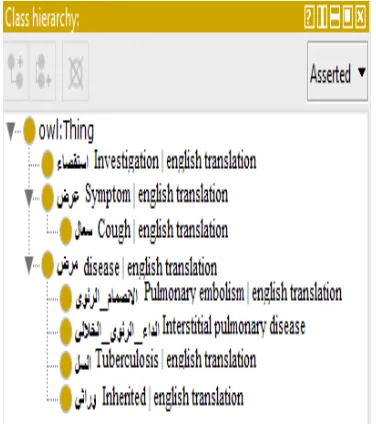
In CDDOnto disease (ﺽﺮﻣ), symptom (ﺽﺮﻋ) and investigation (ءﺎﺼﻘﺘﺳﺍ) are subclasses of
class Thing. Figure3 shows the main classes in the
[image:5.612.324.512.272.484.2]ontology, whereas figure 4 shows all.
Figure 3: Protégé snapshot of the class hierarchy.
Figure 4: Taxonomy of main classes.
5.2. Instances, Properties, and Facets
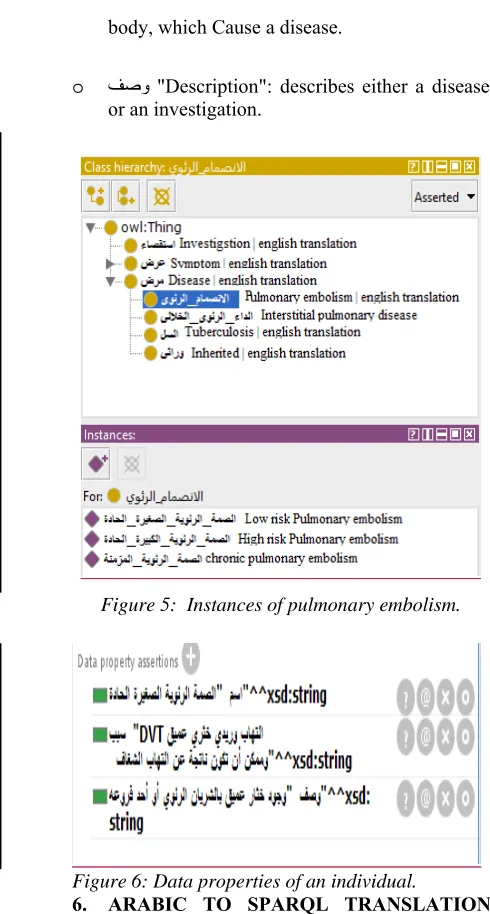
In CDDOnto, individuals are defined with their data properties. In addition to object properties between them. Figure 5 shows data taxonomy such as "ﻱﻮﺋﺮﻟﺍ ﻡﺎﻤﺼﻧﻻﺍ" pulmonary embolism class, which contains three instances. Pulmonary embolism is a blockage in the pulmonary artery, which supplies the blood to the lungs. Data Properties are shown in Figure 6, which contains three properties, these properties, are explained as follows:
ﻢﺳﺍ “name”: the ﻢﺳﺍ refers to the word of circulation of the disease in the world.
7082 body, which Cause a disease.
o ﻒﺻﻭ "Description": describes either a disease
or an investigation.
[image:6.612.54.299.86.543.2]Figure 5: Instances of pulmonary embolism.
Figure 6: Data properties of an individual.
6. ARABIC TO SPARQL TRANSLATION
APPROACH
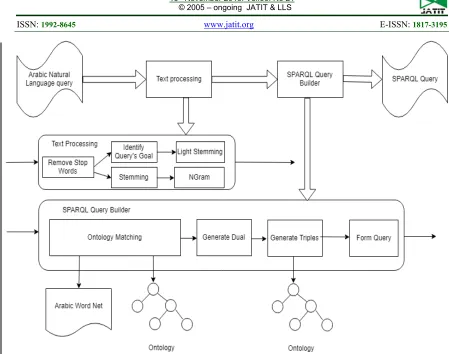
In this section, we will go through the steps of the proposed approach, which is illustrated in the figure 7.
6.1.Removing stop words
The stop words were known from the beginning of information retrieval, which are the most commonly used words in the language and are not meaningful but are used to complete it, such as subjective pronouns, demonstrative pronouns, prepositions, negation, WH questions, adverbs and
adverbs of place. Deleting these words will not affect the content of the query.
6.2.Identifying query goal
We mean by the query goal the word,
which come after the question word, and it, will be
the first word after the previous step (remove stop word). It is mapped to one of the ontology classes or data properties. After that, the goal is passed to light stemming process like removing the "ـﻟﺍ" from the beginning of each word.
6.3.Generating NGram
NGram is a sequence of N elements of a given text string, used in several areas, such as determining the probability of automatic machine translation, predicting the next most likely word in a sentence, checking the spelling of text, or identifying the feeling of part of a given text [16].
6.4.Getting Ontology concepts
In this step, we query the ontology to get all ontology classes and data properties, and then we normalize them by removing the underscore (_) between the terms. After that, we stem them all using the same stemming algorithm which is used in stemming the query terms to get shared roots between the query terms and ontology concepts.
6.5.Mapping Query terms to Ontology
concepts
In this step, we map the query terms, one of their meanings using Arabic WordNet, their stems or one of the meaning of their stems to the ontology concepts, and when we find a correspondence, we replace the query term with it. The stemming process is useful for obtaining the same root for different word forms. There are different algorithms available for Arabic word stemming but, in this research, we use ISRI Arabic stemmer [17].
6.6.Specifying query Individuals
7083 6.7.Generating Duals
In this step, we group the query goal with each individual to form pairs (query goal, Individual).
6.8.Generating Triples
In this step, we generate the triples using the duals generated in the previous step. We get the relation linked between them through querying the ontology. It is known that each relation has two sides, domain and range, and we can get the property using the query, which is shown in Figure 9. Note that the line 2 in the figure 8 and 9 is the ontology URI.
In case the range of the natural language query is an individual, the previous query will return an empty result set. Therefore, we use the query shown in the Figure 10 to get the type of the individual then use the query that is shown in Figure 9 to get the relation.
6.9.Forming the Query
The SPARQL query consists of three sections, which are: SELECT statement, WHERE clause and solution modifiers. In this research, we focus on forming the first two sections and we do
not discuss the forming of the solution modifier section. The RDF triple that was built in the previous step forms the WHERE clause for the SPARQL query. Now we have to construct the SELECT statement and associate it with WHERE clause to form a meaningful SPARQL query. To construct the SELECT statement, we have to identify the target of the query which we specified in step 2, now we have to link the target of the query with the WHERE clause. We have done this by the following:
Add a projection variable to the SELECT clause
which we name it as ?goal.
The forming of the WHERE clause differs
7084
Figure 7: The approach of translating Arabic natural language query to SPARQL query.
Figure 8: Query to get individuals in the ontology.
Figure 9: Query to get object property between two classes.
Figure 10: SPARQL query to get the type of an individual.
6.10. Processing conjunction and
disjunction
7085
following example: ﻭ ﻰﻤﺣ ﺽﺮﻋ ﻪﻟ ﻱﺬﻟﺍ ءﺍﺪﻟﺍ ﻮﻫ ﺎﻣ
ﺔﻴﻔﻧﺃ ﺕﺎﺒﻴﻟﻮﺑ i.e. what is the disease that has a symptom of fever and nasal polyps? (1). In order to solve it we do not delete the conjunction or disjunction letters which are ‘ﻭ’ i.e. ‘and’ and ‘ﻭﺃ’ i.e. ‘or’ when deleting the stop words. Then we form the query and concatenate the triples using the conjunctions and disjunctions.
7. EVALUATION OF CDDONTO
In this section, we evaluate the ability of the ontology in representing all terms, properties, and relations through ontology querying using description logic query, which is a standard Protégé plugin and the SPARQL query to verify and validate the ontology in accordance to competency questions. In addition to verify it with the help of a domain expert since we gathered 22 real case for patients then order doctor to diagnose it. After that, compare it with the result of the ontology.
7.1. Ontology evaluation through ontology querying
We present three querying examples, which answer the main questions that are asked in the development process of the ontology.
Example 1:
The question: what are the diseases that have
the symptom ﻝﺎﻬﺳﺇ?
DL_Query: ﺽﺮﻣ and ﺽﺮﻋ value ﻝﺎﻬﺳﺇ. _ﻪﻟ
Figure 11 shows the result of DL_Query and
illustrates the individuals of the disease class.
Example 2
:
The question: What are the symptoms of cystic
fibrosis disease?
DL_Query is: ﺽﺮﻋ and ـﻟ_ﺽﺮﻋ value
ﻟﺍ_ﻒﻴﻠﺘﻟﺍ
ﻲﺴﻴﻜ .
Figure 12 shows the result of DL_Query and
illustrates the individuals of symptom class. Example 3:
In this example, we show a SPARQL
The question: what are the symptoms of cystic
fibrosis disease?
Figure 13 shows SPARQL query and figure 14
shows the result of the SPARQL query, which illustrates the symptom's individuals. That means all these symptoms are symptoms of the cystic fibrosis disease.
[image:9.612.316.519.67.486.2]Figure 11: Individuals of a disease.
Figure 12: Individuals of cystic fibrosis’s symptom.
7086 Figure 14: SPARQL query result.
7.2.Quality Evaluation through Disease Examples
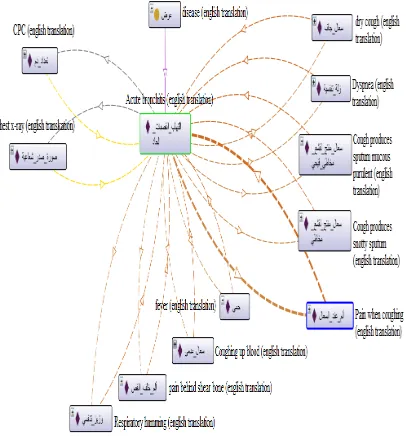
To evaluate the quality of the CDDOnto we chose a disease example to check if the ontology represents terms, properties and relations of a disease sample. Figure 15 shows example of acute bronchitis (ﺩﺎﺤﻟﺍ ﺕﺎﺒﺼﻘﻟﺍ ﺏﺎﻬﺘﻟﺍ) disease, which is an individual of disease (ﺽﺮﻣ) class, and has nine symptoms and two investigations.
[image:10.612.101.304.460.678.2]
Figure 15: Object properties of acute bronchitis disease.
7.3. Ontology evaluation with real cases
In this step, we evaluate the ontology using 22 real cases for patients. Then order a specialist doctors to diagnose them. After that, we compare it with the results we gathered from the ontology. The ontology shows an accuracy of 72.7%.
8. CONCLUSION
In this paper, we proposed an Arabic ontology-based approach for diagnosing chest diseases. We focused on the process of building an ontology. The ontology content is related to the medical domain and It was gathered from [7] and from a domain expert. The ontology provides a knowledge base of chest diseases, symptoms, and investigations. The proposed ontology is evaluated with a help of domain experts and showed an accuracy of 72.7%.
Then we developed a natural language processing model, which enables users query the ontology using their Arabic natural language and get the desired knowledge.
In the future, we intend to save the translation results of the queries, then using data mining techniques to get the translation based on the closest case to the case at hand.
9. ACKNOWLEDGEMENTS
This work was supported by the student
grant CTUSGS16/253/OHK3/3T/14.
REFERENCES
[1] ALFONSE, M., AREF, M., & SALEM, A.-B. (2013). An Ontology Based Cancer Diseases
Diagnostic Methodology. European
computing conference (pp. 95-99). Greece: WSEAS Press.
[2] Wang, h., & Tansel, A. (2013). Composite Ontology-Based Medical Dianosis Desision Support System Framework. Communication. [3] Tris, C. R. (2009). Ontology Based Diagnosis
and Personalization of Medical. Universitat Rovira i Virgili.
[4] Jayaratne, L. (2015). Ontology Based Approach for Diagnosis in Personalized Medicine. GSTF Journal on Computing Vol. 4 No .2. [5] Joshi, A., & Dhariwal, D. (2013). Text And
Ontology Driven Clinical Decision Support
7087 [6] Baraka, R., & El-Askary, M. (2015, August).
An Ontology-Based Approach for diagnosis Date Palm Diseases. Gaza, Palestine: Islamic University of Gaza.
[7] AlAgha, I. (2015). Using Linguistic Analysis to Translate Arabic Natural Language Queries to SPARQL. Gaza: Cornell University Library. [8] Shaik, S., Kanakam, P., Hussain, M., &
Suryanarayana. (2016). Transforming Natural Language Query to SPARQL for Semantic Information Retrieval. International Journal of Engineering Trends and Technology.
[9] Sander, M., Waltinger, U., Roshchin, M., & Runkler, T. (2014 Septemper, Septemper). Ontology-Based Translation of Natural Language Queries to SPARQL. Natural Language Access to Big Data.
[10] Ngomo, A.-C. N., Bühmann, L., Unger, C., Lehmann, J., & Gerber, D. (2013 May). Sorry, I don’t speak SPARQL – Translating SPARQL Queries into Natural Language. Proceedings of the 22nd international conference on World Wide Web (pp. 977-988). ACM.
[11] Pradel, C., Ollivier, & Hernandez, N. (2013). Natural language query interpretation into SPARQL using patterns. Fourth International Workshop on Consuming Linked Data, (pp. 1-12).
[12] kim, J.-D., & Cohen, K. (2013). Natural Language Query Processing for SPARQL
generation a Prototype System for
SNOMEDCT. Proceding of biolink, (pp. 32-38).
[13] Haslett, C., Simmons, D. E., & R. chilvers, E. (2002). Dividson Principles and Practise of Medicine. Churchill Livingstone.
[14] Khondoker, R. M., & Muller, P. (2010). Comparing Ontology Development Tools Based On an Online Survey. Proceedings of the World Congress on Engineering. London: IAENG Online Journal.
[15] Noy, N., & McGuinness, D. (2001). Ontology Development 1010: A Guide to Create Your
First Ontology. California: Stanford
University.
[16] Sookocheff, K. (2015, 7 25). Modeling Natural Language with N-Gram Models. Retrieved
from Kevin Sookocheff:
https://sookocheff.com/post/nlp/n-gram-modeling/