5103
MULTI-OBJECTIVE OPTIMAL REACTIVE POWER
DISPATCH USING HYBRID TIME VARYING PARTICLE
SWARM OPTIMIZATION AND GENETIC ALGORITHM
1SABHAN KANATA, 2SUWARNO, 3GIBSON HILMAN SIANIPAR, 4NUR ULFA MAULIDEVI 1,2,3,4School of Electrical and Informatis, Bandung Institute of Technology, Bandung, West Java, Indonesia
E-mail: 1[email protected], 2[email protected], 3[email protected], 4[email protected]
ABSTRACT
The hybrid time varying particle swarm optimization and genetic algorithm method (TVPSOGA) was introduced to solve multi-objective reactive power dispatch (MORPD) problems. MORPD as a non-linear multi-objective optimization problem that has the characteristics of non-convex, multi-constraint, and multi-variable which consists of a mixture of solutions that have discrete and continuous variables. The feasibility of the proposed method was tested on the IEEE 57-bus and IEEE 118-bus power systems. Comparison of simulation results shows the efficacy of the proposed optimization method compared to methods such as multi-objective enhanced particle swarm optimization (MOEPSO), multi-objective particle swarm optimization (MOPSO) and multi-objective ant lion optimization (MOALO) for the case of IEEE 57-bus power system. As for the case of the IEEE 118-bus power system, this method shows better efficacy compared to biogeography based optimization (BBO), the particle swarm optimization method with an aging leader and challengers (ALC-PSO), the enhanced gaussian bare-bones water cycle algorithm (NGBWCA) and PSO with a gravitational search algorithm (PSOGSA).
Keywords: Time Varying Particle Swarm Optimization, Genetic Algorithm, Multi-Objective Reactive Power Dispatch, The Real Power Losses, The Total Voltage Deviation
1. INTRODUCTION
Increasing the dependency of electric energy will require electricity companies to increase efficiency, quality and security when operating the power system. An increase in active power losses will result in reduced power supply sent by the electrical energy company to consumers. That is, the active power supply generated has been lost due to active power losses but is considered unsold. In this case, the electricity provider company will suffer losses due to generate power at a large cost but do not get financial benefits from the sale of the power. In addition, in order for electricity to provide good quality voltage to consumers, electrical energy supply companies must maintain a constant voltage, especially at the end of the line.
Efforts to minimize active power losses, to maintain the quality of the voltage so that it remains constant and to maintain the security of the power system when operating. This was done so that the electricity supply companies did not suffer even greater financial losses. This motivates the authors to conduct research called the multi-objective
optimal reactive power dispatch (MORPD) strategy.
MORPD is a popular issue in today's modern electricity industry.This is because, the MORPD is able to improve the performance of operations that are more secure and efficient on the power system. MORPD is controlling the optimal solution (control variable) without exceeding the limits of its ability to minimize more than one objective function simultaneously. This objective function is to minimize the real power losses and total voltage deviation.
5104 enhanced gravitational search algorithm (GSA) [9] and hybrid artificial neural network and particle
swarm optimization (HANNPSO) [10].
Optimization with a single objective function is considered inefficient in achieving operating performance in the power system. MORPD is a very complicated problem when it has characteristics that are non-convex, non-linear, multi-variable, multi-constraint and mixed with discrete and continuous variables. The variables to be regulated are control variables such as voltage values on each generator bus, tap transformer ratios, and reactive power compensators. The determination of the optimal control variable will affect the real power losses and total voltage deviation as the function to be minimized.
Some previous researchers have succeeded in solving the MORPD problem. Biogeography based optimization (BBO) method has been presented to solve this problem [11]. This method can repair the grade of solutions and reach near optimal global solutions. However, determining the optimal solution in the control variable is still considered to be all variables as continuous variables.
Solving the MORPD problem using the particle swarm optimization method with an aging leader and challengers (ALC-PSO) has been presented. This method is where the life span of the leader is adjusted adaptively in accordance with the strength of a leader at the helm. The construct of aging in this method actually functions as a mechanism for challenging. Similar to the BBO method, determining the optimal solution in the control variable is still considered to be all variables as continuous variables [12].
Solution to this problem with multi-objective enhanced particle swarm optimization (MOEPSO) has been presented [13]. To increase the diversity of particles so that they are not easily trapped in local solutions and improve the performance of global solutions, this method utilizes evolutionary operators, namely crossover. The selection process is used ranking selection on the pareto set. Setting the optimal solution with the MOEPSO method consists of an association of both discrete and continuous variables.
Water cycle algorithm (WCA) method and the enhanced gaussian bare-bones water cycle algorithm (NGBWCA) have been presented to solve MORPD problems [14]. The water cycle in nature is the inspiration for the creation of this
method. This method utilizes a gaussian mutation mechanism to handle the diversity of solutions that have not been used in the WCA method. Similar to the BBO and ALC-PSO methods, determining the optimal solution in the control variable is still considered to be all variables as continuous variables.
Hybrid PSO with a gravitational search algorithm (PSOGSA) has been presented to solve MORPD problems [15]. The PSOGSA hybrid used is a heterogeneous low-level co-evolutionary. Similar to the BBO, ALC-PSO, WCA, and NGBWCA methods, determining the optimal solution in the control variable is still considered to be all variables as continuous variables.
The multi-objective ant lion optimization (MOALO) method has also been presented to solve MORPD problems [16]. Inspired by the interaction between ant and lion in nature is the origin of this method. The movement point is considered as a solution (control variable). This method is combined with fuzzy set theory to determine the final result as the optimal solution. Similar to the BBO, ALC-PSO, WCA, NGBWCA and PSOGSA methods, determining the optimal solution in the control variable is still considered to be all variables as continuous variables.
The purpose of this paper is to determine the optimal solution of the control variables when all variables are considered as continuous variables or when variables are considered as a combination of discrete and continuous variables to reduce the real power losses and to minimize total voltage deviations. The voltage on each generator bus is set as a continuous variable while the shunt compensator and tap transformer ratio are usually specified as discrete variables.
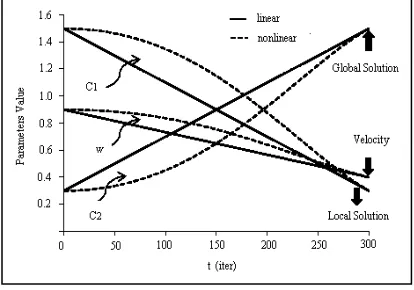
The novelty of this study is the method used to solve the MORPD problem namely hybrid time varying particle swarm optimization and genetic algorithm (TVPSOGA). The GA operators used are crossover and mutation. The TVPSO method is presented with parameters that are made adaptive with changes that are not linear to solve the MORPD problem. Three parameters are made non-linearly. Adaptive parameter on 1st acceleration
factor (c1) will affect the increasing diversity of
local solutions in the early stages and decrease in the final stages. But 2nd acceleration factor (c
2) has
5105 increasing. To maintain a balance of diversity of local and global solutions, the inertia weight (w) parameter is used. The Illustration of the influence of the three parameters used adaptively and not linearly is shown in Figure 1. While the genetic algorithm will add to the diversity of local solutions.
[image:3.612.92.299.287.432.2]Modification of TVPSO parameters with a combination of GA is able to solve MORPD problems better than the methods used by previous studies. The aim is to minimize the real power losses and total voltage deviation. The development of this method is presented in this paper to solve the MORPD problem in the case of the IEEE 57-bus and 118-bus power systems.
Figure 1: The Ilustration of The Influence of Three Parameters
2. PROBLEM DESCRIPTION
The MORPD problem is described as an optimization model with objective and multi-constraints with characteristics that are not linear. The formula is described in (1) - (4).
Minimize: J(x, y) = [J1(x, y), J2(x, y)] (1)
subject to eq(x, y) = 0 (2)
and ineq(x, y) ≤ 0 (3)
The vector of state variables x may be written as in
(4) xT = [V
PQ,1...VPQ,NPQ,QG,1...QG,NG, SL,1...SL,NL] (4)
while the vector of control variables y may be
represented by (5)
yT = [VG,1...VG,NG,T1...TNT, QC,1...QC,NC] (5)
in which J: objective function to be minimized, y: vector of control variable, x: vector of state variable, VPQ: voltage of load bus, QG: injected
reactive power, SL: power flow in branch, VG:
voltage of generator bus, T: transformer tap, Qc: shunt capacitor/reactor, and N: number of variables.
2..1 Constraints
2.1.1 Equality constraints
From formula (2), eq is regulated as
equality constraints which present the equilibrium equations of active power and reactive power. The equation is expressed in mathematical formulas (6) and (7).
PG,i - PPQ,i = Vi
B N
i1
Vj(Gijcosij + Bijsinij) (6)
QG,i - QPQ,i = Vi
B N
i1
Vj(Gijcosij - Bijsinij) (7)
in which in which i= 1,2,...NB: numbering of the
bus, PG,i and QG,i: active and reactive power on each
generator bus, PD,i and QD,i: active and reactive
power on each load bus, Gij and Bij: conductance
and susceptance of line i and j, ij: angle phasa of
bus i and j.
2.1.2 Inequality constraints
From equation (3), ineq is set as inequality
constraints. Constraints of the problem are stated in the equation (8)-(13) with the following description:
a. Generator constraints: The voltage on each
generator bus (including the slack bus) and the reactive power output on the generator (including the slack bus) are not permitted to exceed the limits of its ability. Constraints are stated in equations (8) and (9).
VG,imin VG,i VG,imax, i = 1,2,.., NG (8)
QG,imin QG,i QG,imax, i = 1,2,.., NG (9)
b. Transformer constraints: The transformer tap ratio variable is not permitted to violate its ability limits. As noted, the tap transformer ratio value for the IEEE 57-bus system is determined as discrete variables while the IEEE 118-bus system case is defined as continuous variables. The limits of this variable are not permitted to violate the limits of their abilities stated in the equation (10). Timin Ti Timax, i = 1,2,...,NT (10)
c. Shunt compensator constraints: The reactive power output of the shunt compensator, is assumed to be the same as the tap transformer setting for the case of the power system in point (b). The limits of this variable are not permitted to violate the limits of their abilities stated in the equation (11).
Qc,imin Qc,i Qc,imax, i = 1,2,...,Nc (11)
d. Security constraints: This includes the voltage limits on each load bus and limits on network capabilities. The limits of this variable are not permitted to violate the limits of their abilities stated in equations (12) and (13).
5106 SL,i SL,imax, i = 1,2,...,NL (13)
2..2 MORPD Objective Functions
In this paper, two different objective functions are optimally minimized simultaneously, modeled in the equation (1) without violating equality and inequality constraints. The multi-objective functions are as follows:
a. The real power losses: The purpose of this objective function is to minimize the real power losses in the power system without violating equality and inequality constraints. This objective function is formulated in the equation (14).
Min J1(PL) =
E Nk1
gk(Vi2+Vj2-2ViVjcosij) (14)
in which PL: the real power losses, gk:
conductance of channel k.
b. The total voltage deviation: The purpose of this objective function is to minimize the total voltage deviation in all load buses in the power system without violating equality and inequality constraints. This objective function is formulated in the equation (15).
Min J2(VD) =
PQ N
i1
VPQ,i – VPQ,iref (15)
in which: VD: total voltage deviation, VPQ,iref:
voltage reference on the load bus.
3. OVERVIEW OF TVPSOGA TECHNIQUE
3.1 Time Varying PSO
A very significant effect on the performance of the PSO method with a linear varying inertia weight has been presented. The inertia weight modification is called time varying inertia weight particle swarm optimization (PSO-TVIW). In general, the problem of the population-based search optimization, very high diversity is needed in the early stages of search. On the contrary, the final stage of the search when the algorithm will converge to the optimal solution, the right setting is very important to find the global solution efficiently [17].
Although the method of PSO-TVIW able to find a good solution when compared to other evolutionary optimization methods, the ability to enhance the solution is still relatively weak. This is because the diversity of solutions at the end of the search has been reduced. On the other hand, setting PSO parameters is also a determining factor for finding optimal solutions accurately and efficiently
Therefore, considering this problem, it was introduced the time varying acceleration factor PSO (PSO-TVAC) [17]. The aim is to have a different influence on local search time and global search time. This strategy makes the value of acceleration factors in cognitive components decrease linearly. In contrast, the value of the acceleration factor in social components will increase linearly.
Besides the time difference in the influence of inertia weight, acceleration factors for cognitive components and acceleration factors for social components, the three PSO parameters need to be adjusted smoothly. This happens because the solution area becomes narrower or the diversity of solutions decreases. This paper is presented with the same level of change, but the parameters change non-linearly. The modification of these three parameters was performed in session (16) - (18).
w(t) = w2 +
t t t t t max_ max_ max_
(w1- w2) (16)
c1 = c1,f +
t t t t t max_ max_ max_
(c1,f- c1,i) (17)
c2 = c2,i +
t t t t t max_ max_ max_
(c2,f- c2,i) (18)
in which w(t): inertia weight of iteration t, w1: the
maximum value of inertia weight (0.9), w2: the
minimum value of inertia weight (0.4), c1,2,f:
acceleration factor of from, c1,2,i: acceleration factor
of towards (1.5-0.3), max_t: maximum iteration (50-300); t: current iteration.
3.2 Genetic Algorithm
To add to the diversity of solutions to the algorithm used, In this study, evolution operators used GA, namely crossover and mutation. The crossover is used to get a better combination between an individual and another individual in a population. The type of crossover used in this study is arithmetic crossover as shown in equations (19) and (20).
a1 = b1 + (1-)b2 (19)
a2 = b2 + (1-)b1 (20)
in which a1,2: offspring generated, b1,2: parents, and
5107 solutions. If the vector solution yi, where the
selected element is k, can be modeled in the equation (21).
C =
k i k y
k i i y
, ,
{ (21)
in which yi,k: vector solution, i,k: selected element.
3.3 Strategy MORPD with TVPSOGA 3.3.1 Non-dominated on pareto set
In the equation (1), suppose that there are two variables y1 and y2 where a vector y1 said is
more dominant than vector y2 (denoted y1y2) if Ji(y1) ≤ Ji(y2), i =1,....D and if Ji(y1) Ji(y2) for
some i; vector y1 is less dominant than vector y2
(denoted y1 y2) if Ji(y1) ≤ Ji(y2) for all i. A
collection of vector solutions is said to be the non-dominated set if there is not the dominant vector of solutions from other solution vectors. Optimal pareto is said to be the best if no other vector solution is not dominate [18].
3.3.2The external repository
In addition, in this study adopted [19] a pareto set archive approach (the collection of solutions) with a secondary repository. For each iteration, the particle velocity i in the iteration (t +
1) is given a repository using the equation (22-23). vij(t+1) = w(t).vij(t) + c1r1[xpBest,i - xij(t)] + ...
c2r2[reph – xi(t)] (22)
xi(t+1) = xi(t) + vi(t+1) (23)
in which reph: the value taken from the repository
that corresponds to hypercube, vij(t): particle
velocity i for variable j in iteration t, xij(t): particle
position i for variable j in iteration t, xij(t+1):
particle position i for variable j in iteration t+1, xpBest,i: local solution, c1,2: acceleration factor
coefficients, and r1,2: random value between 0 and
1.
The aim is to reduce the value of the objective function of all hypercubes that contain many particles. In the external repository, there are two main components, namely the archive controller and the grid. The archive controller functions to decide whether the solution needs to be included in the archive or not. While the grid function is to produce a pareto front that is well distributed. The grid is in a hypercube. Hypercube is a search area that has components. The components are as many as the objective function. In this study, there are two objective functions where the x and y coordinate points are as a
function of the real power losses and total voltage deviation.
3.3.3Computation flow
The proposed method used to solve the MORPD problems are explained in the following steps:
Step 1: Define data on power systems such as objective functions, decision variables (control variables), and others. Synchronize the matpower program.
Step 2: Input the MOTVPSOGA algorithm parameters.
Step 3: Initialize position x (t=0)ij and velocity v(t=0)ij each population randomly without violating
the upper and lower limits for each position.
Step 4: Evaluate the objective function of each particle i at x(t=0)ij by running a matpower power
flow that is integrated with coding multi-objective function. The position of non-dominated particles is stored in the repository.
Step 5: Determine x(t=0)pbest. Combine the
non-dominated particles of x(t=0)i in the repository.
Step 6: Perform hypercube generation in the search exploration space. Hypercube location as a coordinate point in the search exploration space. This point presents the value of the objective function on the x and y axes.
Step 7: Initialize each particle's memory as a guide to update the position of the particles later in the search exploration space. The best position
x(t=0)pbest is considered as a guide stored in the
external repository archive.
Step 8: Set t=1.
Step 9: Update velocity and position based on equations (22) and (23) without violating the boundaries of each particle position. Setting inertia weight and acceleration factor based on the proposed modification of the PSO parameter in equations (16) - (18).
Step 10: Perform another position renewal technique by doing crossover and mutation in all particle positions in step 9 according to the percentage of crossover (pC) and percentage mutation (pM). In this study, pC = 0.9 and pM = 0.05 were used.
Step 11: Evaluate the objective function of each particle position on PSO (pop), crossover position (popc) and mutation position (popm) by running a matpower power flow that is integrated with multi-objective optimization.
5108 the previous repository, then the position of the particles will be updated.
Step 13: Determine the position of the particles that should be maintained. To decide on this criterion, pareto dominance is used. Because the size of the repository is limited, then when it's full, a secondary criterion for storage is used. Priority is carried out by giving the opportunity for particles with a low population (the number of particles that have this position is relatively small) to go to the destination space for particles that have a high population (hypercube coordinates).
Step 14: If t ≤ max_t, return to step 9. If t > max_t
then go to step 15.
Step 15: Output the solution set as the pareto set from the repository and finish.
4. NUMERICAL RESULT AND ANALYSIS
To validate the effectiveness of the proposed method in solving MORPD problems, the
method was tested in the case of IEEE 57-bus, and IEEE 118-bus. Programming language written in matlab version 2013b. The computer used has specifications with a 1.8 GHz corei3 of processor and 6 GB of RAM. The Matpower toolbox [20] was used in this study with the matlab programming language to run power flow.
4.1 IEEE 57-bus System
IEEE 57-bus system consisting of 57 buses with 1 bus as a slack bus (bus number 1), 6 buses as generator buses (bus numbers 2,3,6, 8, 9, and 12) and 50 buses as load buses . 17 tap transformers connected to lines 4-18, 4-18, 21-20, 24-25, 24-25, 24-26, 7-29, 34-32, 11-41, 15-45, 14- 46, 10-51, 13-49, 11-43, 40-56, 39-57 and 9-55. 3 shunt compensators are injected on buses 18, 25 and bus 53. Complete data is adopted in [8][13] as shown in Figure 2.
Figure 2: The Single Line Diagram of The IEEE 57-bus System [13]
The total load power used is 1250.8 MW and 336.4 MVar. The total control variables used are 27 variables. This variable consists of 20 variables as discrete and 7 variables as continuous. Voltage constraints on each bus generator are 0.9 - 1.1 per unit (pu). Ratio tap transformer constraints
5109 objective functions is carried out simultaneously with the main objectives, namely:
4.1.1 IEEE 57-bus system with minimum power losses
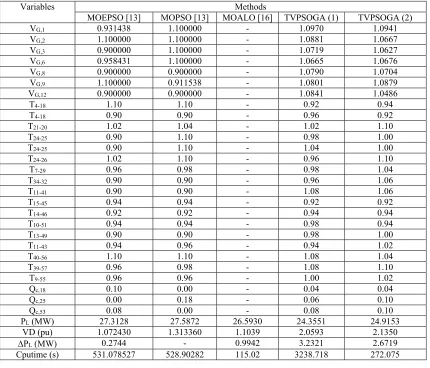
The main purpose in this stage is to minimize the real power losses. The results of the determination of optimal control variables, minimum the real power losses and total voltage deviation, computational time, and comparisons with different methods carried out by previous studies are shown in the Table 1.
The final simulation shows that the TVPSOGA method is able to minimize the real power losses of 24.355 MW and the total voltage deviation of 2.0593 pu. The computing time used is 3238.718 s. For the search for the real power losses with the shortest computation time is 272.075 s where the real power losses are 24,9153 MW and the total voltage deviation is 2.1350 pu. Figure 3 show the search process for the TVPSOGA method in finding the minimum the real power losses.
4.1.2 IEEE 57-bus system with minimum total voltage deviation
The main purpose in this stage is to minimize the total deviation voltage (increasing the voltage profile on the bus load). The results of determining optimal control variables, minimum total deviation of voltage and real power losses, computational time, and comparisons with different methods carried out by previous studies are shown in the Table 2.
[image:7.612.93.523.372.740.2]The final simulation shows that the TVPSOGA method produces a minimum total voltage deviation of 1.9699 pu and real power losses of 26.6720 MW. The computation time used is 537.275 s. The shortest computation time for the search for the total voltage deviation is 271.208 s with the real power losses of 52.1736 MW and a total voltage deviation of 1.9723 pu. Figure 4 show the search process for the TVPSOGA method in finding the minimum the total voltage deviation.
Table 1: Comparison of Previous Methods for IEEE 57-bus with The Power Losses Minimization
Variables Methods
MOEPSO [13] MOPSO [13] MOALO [16] TVPSOGA (1) TVPSOGA (2)
VG,1 0.931438 1.100000 - 1.0970 1.0941
VG,2 1.100000 1.100000 - 1.0881 1.0667
VG,3 0.900000 1.100000 - 1.0719 1.0627
VG,6 0.958431 1.100000 - 1.0665 1.0676
VG,8 0.900000 0.900000 - 1.0790 1.0704
VG,9 1.100000 0.911538 - 1.0801 1.0879
VG,12 0.900000 0.900000 - 1.0841 1.0486
T4-18 1.10 1.10 - 0.92 0.94
T4-18 0.90 0.90 - 0.96 0.92
T21-20 1.02 1.04 - 1.02 1.10
T24-25 0.90 1.10 - 0.98 1.00
T24-25 0.90 1.10 - 1.04 1.00
T24-26 1.02 1.10 - 0.96 1.10
T7-29 0.96 0.98 - 0.98 1.04
T34-32 0.90 0.90 - 0.96 1.06
T11-41 0.90 0.90 - 1.08 1.06
T15-45 0.94 0.94 - 0.92 0.92
T14-46 0.92 0.92 - 0.94 0.94
T10-51 0.94 0.94 - 0.98 0.94
T13-49 0.90 0.90 - 0.98 1.00
T11-43 0.94 0.96 - 0.94 1.02
T40-56 1.10 1.10 - 1.08 1.04
T39-57 0.96 0.98 - 1.08 1.10
T9-55 0.96 0.96 - 1.00 1.02
Qc,18 0.10 0.00 - 0.04 0.04
Qc,25 0.00 0.18 - 0.06 0.10
Qc,53 0.08 0.00 - 0.08 0.10
PL (MW) 27.3128 27.5872 26.5930 24.3551 24.9153
VD (pu) 1.072430 1.313360 1.1039 2.0593 2.1350
PL (MW) 0.2744 - 0.9942 3.2321 2.6719
5110
Figure 3: Pareto Set in Minimizing The Real Power Losses for The IEEE 57-bus System
Table 2: Simulation Results for IEEE 57-bus with The Total Voltage Deviation
Variables Proposed
TVPSOGA (1) TVPSOGA (2)
VG,1 1.0969 1.0798
VG,2 1.0568 0.9511
VG,3 1.0950 1.0886
VG,6 1.0772 1.0462
VG,8 1.0939 1.0940
VG,9 1.0845 1.0941
VG,12 1.0806 1.0871
T4-18 0.94 0.98
T4-18 1.04 0.92
T21-20 1.06 1.02 T24-25 0.94 0.98 T24-25 0.96 0.98 T24-26 1.08 1.04
T7-29 1.08 1.08
T34-32 1.08 0.98 T11-41 0.96 0.98 T15-45 1.00 1.10 T14-46 0.98 1.00 T10-51 1.08 1.00 T13-49 1.08 0.94 T11-43 1.06 0.94 T40-56 1.00 0.94 T39-57 1.02 1.04
T9-55 1.08 1.10
Qc,18 0.16 0.08 Qc,25 0.12 0.14 Qc,53 0.12 0.10
PL (MW) 26.672 52.1736
VD (pu) 1.9699 1.9723
Cputime (s) 537.275 271.208
From the final simulation on the IEEE 57-bus power system in Table 1 shows that the TVPSOGA (1), TVPSOGA (2), MOEPSO [13] and MOALO [16] methods are able to reduce active
power losses by 3.2321 MW, 2.6719 MW, 0.2744 MW and 0.9942 MW against active power losses resulting from the MOPSO method [13]. The ability of the proposed method in reducing active power losses is better than the previous method in Table 1 shows that financial losses in the electric energy company can be significantly reduced.
4.2 IEEE 118-bus System
IEEE 118-bus system consisting of 118 buses where 1 bus as a slack bus, 55 buses as generator buses and 62 buses as load buses. 9 tap transformers connected to lines 5-8, 25-26, 17-30, 37-38, 59-63, 61-64, 66-65, 69-68 and 80-81. 2 reactors were injected on buses 5 and 34. 12 shunt capacitors were injected on buses 34, 44, 45, 46, 48, 74, 79, 82, 83, 105, 107 and bus 110.
The total load power used was 4242 MW and 1438 MVar. The total control variables used are 77 variables. Voltage constraints for each bus generator are 0.95 - 1.1 pu. Ratio tap transformer constraints are 0.9 - 1.1 pu. Shunt compensator constraints with varying limits. Complete data is adopted in [14] [15][12]. To test the ability of the proposed method, the optimization process has been carried out on two different objective functions simultaneously with the main objectives, namely:
4.2.1 IEEE 118-bus system with minimum power losses
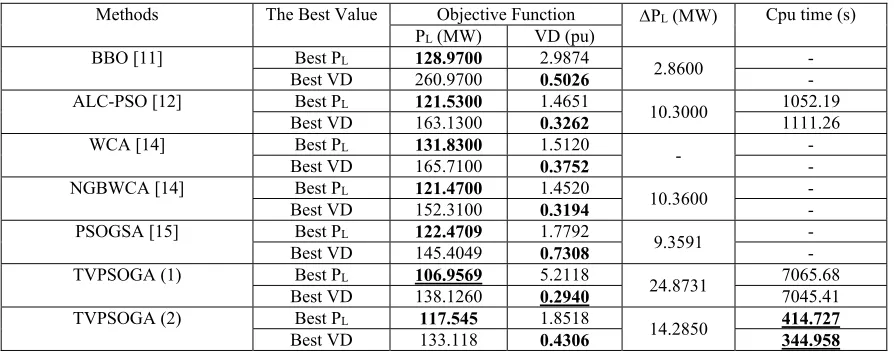
[image:8.612.92.297.322.670.2]5111 able to minimize the real power losses of 106.9569 MW and the total voltage deviation of 5.2118 pu. The computing time used is 7065.684 s. For the search for real power losses with the shortest computation time is 414.737 s where the real power losses is 117.5445 MW and the total voltage deviation is 1.8518 pu. Figure 5 show the search process for the TVPSOGA method in finding the minimum the real power losses.
4.2.2 IEEE 118-bus system with minimum total voltage deviation
The main objective in this stage is to minimize the total deviation voltage (increasing the voltage profile on the bus load). The results of determining optimal control variables, minimum the total deviation of voltage and real power losses, computational time, and comparisons with different
methods carried out by previous studies are shown in the Table 3.
[image:9.612.89.526.304.485.2]The final simulation shows that the TVPSOGA method produces a minimum total voltage deviation of 0.2940 pu and the real power losses of 138.1260 MW. The computation time used is 7045.406 s. The shortest computation time for the search for power losses is 344.958 s with the real power losses of 133.1181 MW and a total voltage deviation of 0.4306 pu. Figure 6 show the search process for the TVPSOGA method in finding the minimum total voltage deviation.
Figure 4: Pareto Set in Minimizing The Total Voltage Deviation for The IEEE 57-bus System
Table 3: Comparison of Previous Methods for IEEE 118-bus System
Methods The Best Value Objective Function PL (MW) Cpu time (s) PL (MW) VD (pu)
BBO [11] Best PL 128.9700 2.9874 2.8600 -
Best VD 260.9700 0.5026 -
ALC-PSO [12] Best PL 121.5300 1.4651
10.3000 1052.19
Best VD 163.1300 0.3262 1111.26
WCA [14] Best PL 131.8300 1.5120 - -
Best VD 165.7100 0.3752 -
NGBWCA [14] Best PL 121.4700 1.4520
10.3600 -
Best VD 152.3100 0.3194 -
PSOGSA [15] Best PL 122.4709 1.7792 9.3591 -
Best VD 145.4049 0.7308 -
TVPSOGA (1) Best PL 106.9569 5.2118 24.8731 7065.68
Best VD 138.1260 0.2940 7045.41
TVPSOGA (2) Best PL 117.545 1.8518
14.2850 414.727
[image:9.612.84.531.529.706.2]5112 From the final simulation on the IEEE 118-bus power system in Table 3 shows that the TVPSOGA (1), TVPSOGA (2), BBO [11], ALC-PSO [12], NGBWCA [14], and ALC-PSOGSA [15] methods are able to reduce active power losses by 24.8731 MW, 14.2850 MW, 2.8600 MW, 10.3000 MW, 10.3600 MW, and 9.3591 MW against active power losses resulting from the WCA method [14]. The ability of the proposed method in reducing active power losses is better than the previous method in Table 3 shows that financial
losses in the electric energy company can be significantly reduced. In addition to the proposed method being able to reduce active power losses better, the proposed method is able to reduce the change in voltage at the receiver side (total voltage deviation) by 0.2940 pu better than the previous method in Table 3. This shows that the voltage at the receiver side is more likely close to the voltage value of 1.0 pu (ideal voltage) so that the quality and safety of the power system is better.
[image:10.612.93.519.235.410.2]
Figure 5: Pareto Set in Minimizing The Real Power losses for The IEEE 118-bus System
Figure 6: Pareto Set in Minimizing The Total Voltage Deviation for The IEEE 118-bus System
However, the proposed hybrid method still needs to be improved in relation to the computational time used for future research. This is seen in the IEEE 57-bus power system where the computational time used by the TVPSOGA method is 272,075 s longer than the MOALO method [16] of 115.02 s.
5. CONCLUSIONS
[image:10.612.102.511.438.619.2]5113 simulation comparison shows the efficacy of the proposed optimization method when compared with methods such as MOEPSO, MOPSO and MOALO for the IEEE 57-bus power system. As for the IEEE 118-bus power system, this method shows better efficacy compared to BBO, ALC-PSO, NGBWCA and PSOGSA. This means, the proposed method is very promising in reducing financial losses to the electric energy company while maintaining the quality and security of the power system. Future research, this TVPSOGA method can be combined with new and simple methods. The goal is that the method applied can accelerate search computing.
ACKNOWLEDGMENT
The authors would like to say a great thank to The Ministry of Research, Technology and Higher Education of the Republic Indonesia for funding doctoral studies and researches at Bandung Institute of Technology.
REFRENCES:
[1] A. M. Shaheen, R. A. El-sehiemy, and S. M. Farrag, “A Novel Adequate Bi-level Reactive Power Planning Strategy,” Int. J. Electr. Power Energy Syst., Vol. 78, 2016, pp. 897–
909.
[2] S. B. Raha and N. Chakraborty, “Tuned Reactive Power Dispatch Through Modified Differential Evolution Technique,” Front. Energy, Vol. 6, No. 2, 2012, pp. 138–147.
[3] H. Falaghi and A. Najafi, “Optimal Reactive Power Dispatch Using Improved Differential Evolution Algorithm,” Majlesi J. Electr. Eng.,
Vol. 8, No. 1, 2014, pp. 69–78.
[4] P. Subbaraj and P. N. Rajnarayanan, “Optimal Reactive Power Dispatch Using Self-adaptive Real Coded GeneticAlgorithm,” Electr. Power Syst. Res., Vol. 79, 2009, pp. 374–381.
[5] S. C. Liu, J. H. Zhang, Z. Q. Liu, and H. Q. Wang, “Reactive Power Optimization and Voltage Control Using an Improved Genetic Algorithm,” in International Conference on Power System Technology, 2010, pp. 1–5.
[6] M. Ghasemi, M. Mehdi, S. Ghavidel, and S. Rahmani, “Modified Teaching Learning Algorithm and Double Differential Evolution Algorithm for Optimal Reactive Power Dispatch Problem : A Comparative Study,”
Inf. Sci. (Ny)., Vol. 278, 2014, pp. 231–249.
[7] A. Rajan and T. Malakar, “Optimal Reactive Power Dispatch Using Hybrid Nelder-Mead Simplex Based Firefly Algorithm,” Int. J.
Electr. Power Energy Syst., Vol. 66, 2015, pp.
9–24.
[8] G. Chen, L. Liu, Z. Zhang, and S. Huang, “Optimal Reactive Power Dispatch by Improved GSA-based Algorithm with The Novel Strategies to Handle Constraints,” Appl. Soft Comput. J., Vol. 50, 2017, pp. 58–70.
[9] G. Chen, L. Liu, and S. Huang, “Enhanced GSA-Based Optimization for Minimization of Power Losses in Power System,” Math. Probl. Eng., Vol. 2015, pp. 1–13.
[10] S. Kanata, G. H. Sianipar, and N. U. Maulidevi, “Optimization of Reactive Power and Voltage Control in Power System Using Hybrid Artificial Neural Network and Particle
Swarm Optimization,” in 2018 2nd
International Conference on Applied Electromagnetic Technology (AEMT), 2018,
pp. 67–72.
[11] P. K. Roy, S. P. Ghoshal, and S. S. Thakur, “Optimal VAR Control for Improvements in Voltage Profiles and for Real Power Loss Minimization Using Biogeography Based Optimization,” Int. J. Electr. Power Energy Syst., Vol. 43, No. 1, 2012, pp. 830–838.
[12] R. Pratap, V. Mukherjee, and S. P. Ghoshal, “Optimal Reactive Power Dispatch by Particle Swarm Optimization with An Aging Leader and Challengers,” Appl. Soft Comput. J., Vol.
29, 2015, pp. 298–309.
[13] G. Chen, L. Liu, Y. Gua, and S. Huang, “Multi-objective Enhanced PSO Algorithm for Optimizing Power Losses and Voltage Deviation in Power Systems,” COMPEL Int. J. Comput. Math. Electr. Electron. Eng., Vol.
35, No. 1, 2016, pp. 350–372.
[14] A. A. Heidari, R. Ali Abbaspour, and A. Rezaee Jordehi, “Gaussian Bare-bones Water Cycle Algorithm for Optimal Reactive Power Dispatch in Electrical Power Systems,” Appl. Soft Comput. J., Vol. 57, 2017, pp. 657–671.
[15] J. Radosavljevi and M. Jevti, “A Solution to the ORPD Problem and Critical Analysis of The Results,” Electr. Eng., Vol. 100, No. 1,
2018, pp. 253–265.
[16] S. Mouassa and T. Bouktir, “Multi-objective Ant Lion Optimization Algorithm to Solve Large-scale Multi-objective Optimal Reactive Power Dispatch Problem,” COMPEL - Int. J. Comput. Math. Electr. Electron. Eng., Vol.
38, No. 1, 2019, pp. 304–324.
5114
Trans. Evol. Comput., Vol. 8, No. 3, 2004, pp.
240–255.
[18] J. E. Alvarez-benitez, R. M. Everson, and J. E. Fieldsend, “A MOPSO Algorithm Based Exclusively on Pareto Dominance Concepts,” in International Conference on Evolutionary Multi-Criterion Optimization, Springer, 2005,
pp. 459–473.
[19] C. A. C. Coello, G. T. Pulido, and M. S. Lechuga, “Handling Multiple Objectives with Particle Swarm Optimization,” IEEE Trans. Evol. Comput., Vol. 8, No. 3, 2004, pp. 256–
279.
[20] R. D. Zimmerman, C. E. Murillo-sánchez, and R. J. Thomas, “Matpower : Steady-state
Operations, Systems Research and
Education,” IEEE Trans. Power Syst., Vol. 26,