2745
INCORPORATION OF NEGOTIATION PROCESS INTO AN
E-COMMERCE PLATFORM TO INCREASE SALES
1FAYSAL MEKKAOUI-ALAOUI, 2EL HIBAOUI ABDELAZIZ
1Faculty of sciences, Abdelmalek Essaâdi University, Department of Computer sciences, Morocco 2Faculty of sciences, Abdelmalek Essaâdi University, Department of Computer sciences, Morocco
E-mail: 1[email protected], 2[email protected]
ABSTRACT
Negotiation is back-and-forth communication designed to reach an agreement when two entities have some interests that are opposed. It is a basic means of getting what one wants from others. The purpose of this study is to incorporate the negotiation concept in an e-commerce platform in order to increase benefit at once for the seller and the buyer.
In this paper, we will introduce a model of negotiation which allows the buyer to negotiate some product characteristics, including price. The proposed model uses game theory to find a compromise between the propositions of the seller and those ones of the buyer. The negotiation process is carried out automatically on the seller’s side. In terms of quality and efficiency of this process, an experimental evaluation shows that the proposed model allows reaching a win-win deal with a reduced number of operations. Thus, the buyer stays in the same e-commerce website and therefore increases the sales of this latter.
Keywords: Automated negotiation, Decision making, E-commerce, Equilibrium, Game theory
1. INTRODUCTION
Recently, the use of Internet has changed and people are increasingly spending more time online, this, in turn, increases the possibilities to engage in online shopping. Against traditional commerce, the e-commerce offers multitude services related to business activities using Information and communication Technologies (ICT), such as the purchase of products via the Internet, payment of invoices, banking transactions, purchase of services and soon. Despite these possibilities, there are restrictions that prevent users from taking advantage of e-commerce even though they can view online catalogues on the Internet with any browser, but without the ability to act or negotiate any of product attributes such as price, warranty or delivery date for example.
In [1], authors define negotiation is a basic means of getting what you want from others. It is back-and-forth communication designed to reach an agreement when you and the other side have some interests that are opposed. Likewise, authors of [2] describe the negotiation as a process for which a group of agents communicates with another group in order to reach a mutually acceptable agreement. In our pieces of knowledge, there lack e-commerce platform that uses negotiation concept to achieve an
agreement between seller and buyer in terms of negotiating some product attributes like reducing the price for example. Certainly, there are many search engines comparing prices for the same product and return the lowest for users, but the buyer has two choices against the exposed products take or leave. So, he has no possibility to negotiate price or attributes such a warranty, date delivery, etc. Thereby, the buyer is lacking a tool to make the best choice and maximizing his profits, this constraint affects the seller as well as decreasing his possibilities to sell products [3].
Although e-commerce is attracting more and more people, the absence of negotiation may have limited its full potential. Therefore, the idea of automating the negotiation between the buyer and the seller becomes necessary for the new generations of e-commerce plate-forms. So that online shopping is interesting an increasing number of researchers, especially with the growing need to automate the negotiation and make it intelligent in the e-commerce platforms [4].
2746 Those aspects lead to different models, theories, and negotiation procedure [5].
The purpose of our study is to explore the negotiation and implement it inside the online shopping process, precisely in the price stage. The remainder of this paper is organized as follows: Section 2 recalls some notions of game theory and exposes the motivation of the use of this discipline in our work. Moreover, it explains the role of the method of Analytic Hierarchy Process for providing a chosen tool. Section 3 exposes our proposed approach for negotiation and decision-making. Section 4 gives an example of negotiation under different situations between seller and buyer. Section 5 presents and discusses the results. Finally, Section 6 concludes our paper and proposes a scope for future work.
2. PRELIMINARIES
In this section we will address tools that are useful to solve the problem of automated negotiation, and then we will detail the choice of these tools. As mentioned earlier in the introduction, the aim of negotiation is to reach a mutually acceptable agreement to participants. In our work, we use game theory to reach this compromise using Nash equilibrium [6] as the last price offered.
The following is a reminder of some notions and elements of the game theory and the method of analytic hierarchy process [7].
2.1 Game Theory
Game theory is useful for mathematical model in many fields in which conflict exists like biology, psychology, political conflict, auctions, bargaining [8], and computer science and so on
[9]
[10]. It can be defined as the formal analysis of the problems posed by the strategic interaction of rational group agents pursuing their own goals. In a mathematical discipline, it studies the situations in which the fate of each participant does not depend on its optimal choice but also on the choices of the other participants and therefore are in a situation of strategic interaction. Game theory is represented by a game, a strategy, a group of agents and outcome which is called utility. The following is a reminder and a definition of the terminology used in game theory.The game is formed by players, actions and choices that are called strategy, and a conduct which reported payoffs. A group is a set of players N.
N= {1,……,n}, for those players, let is a set of all possible strategies. For a player i , the set is the set of its possible strategies. A Strategy of player i is . Possible strategies are called pure strategies. The issue ( , , , ⋯, is a combination of pure strategies of players. The player gets a payment or utility when n players choose the issue ( , , , ⋯, .
Utility notation or payment function for player i is defined as follows: ( , ).
There are two kinds of strategies, pure and mixed of strategies. Even a pure strategy can be viewed as a special case of mixed strategy, however mixed strategy is a strategy which is affected a probability for all possibilities to play pure strategies ,. In other words it is a probability vector that each coordinate describes the probability of playing a pure strategy, hence the notion of pure strategy has a probability to be elected is equal to 1.
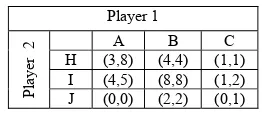
Consider the following sample of negotiation represented in a matrix form given in table 1.This game concerns two player, so we have:
N = {1,2} number of players.
The set of player 1 strategies is S1 = {H; I; J}.
The set of player 2 strategies is S2 = {A;B;C}.
[image:2.612.351.482.458.515.2]The choice of player 1 of the Strategy H and the choice of the player 2 of the strategy A provides a payment function.
Table 1 Representing Game In Matrix Form
Player 1
Player 2
A B C
H (3,8) (4,4) (1,1)
I (4,5) (8,8) (1,2)
J (0,0) (2,2) (0,1)
(H, A) = (3; 8) and so forth.
2747 The most taxonomy used to define a game are:
-Zero-sum games (strictly competitive) or Non- zero sum games.
-Complete information games or Games with incomplete information.
-Two-player games or n player’s games. -Cooperative games or Non-cooperative games. In our case we exploit the latest one in negotiation between seller and buyer.
It’s important to recall that the central and most crucial notion of game theory is reaching an equilibrium point, which is called Nash equilibrium [11]. The mathematician John Nash generalize equilibrium point for three to several players As well as the existence of at least an equilibrium for mixed strategies, in a global way, each game with a finite number of strategies and a finite number of player admits the existence of equilibrium. This equilibrium is called Nash equilibrium in reference to the mathematician John Nash.
The formula of the Nash equilibrium in pure strategy is written as follows:
∗, ∗ , ∗
It’s viewed as the point where players reach an agreement reflecting the best pay-off for them, and no one has the interest to deviate from this point because any change can decrease the pay-off of one of them [12].
Actually, pure strategies do not reflect reality and it is not always possible to find a Nash equilibrium, which justifies the choice of mixed strategies in order to find one or more equilibrium points to reach a mutually acceptable agreement between the buyer and the seller. In terms of game theory, any player has interest to deviate from this point, it reaches the best gain it may have
conditioned the choice of the other player. The adoption of the mixed strategy players converts the utility ( , ) into a payment expectation.
2.2.1 Algorithm for Equilibrium computation
Since the first steps of the game theory, the computation of equilibrium in a finite game, in extensive form or normal form with two players or N players, is not an easy task due to the complexity of the nature of the game and the strategies adopted by players.
Searching algorithms to find equilibrium solutions started at the same time as the development of game theory. The algorithms used to find the Nash equilibrium can take many forms: linear
programming approach [13], graph theory [14], or algebraic approach.
In our study to solve equilibrium problem, we applied the algorithm introduced by Lemke-Howson, which is based on linear programming approach. And since we are interested in the case of two players, we use the following data to write the system of the linear equation having one point equilibrium as the solution.
• The payment matrix of the player i, i ∈ {1, 2} and all elements of are positive.
• v1 and v2 are two scalars.
• S1 = { , ⋯,sm} the set of pure strategies of
player 1.
• S2 = { , ⋯, } the set of pure strategies of player 2 with S1∩S2 =;.
• p = {p1, ⋯,pm}T and q = {qm+1, ⋯, qm+n }T are two
probability vectors. Thus, the system to solve is:
U1.q + r = v11 (1)
UT2 .p + t = v21, (2)
Where r = {r1, ⋯,rm} T, t = {tm+1, ⋯,tm+n} T and
r 0, t 0.
2.3 Analytic Hierarchy Process
The AHP is a method that structures a complex problem to get the best choice. In 1980, Thomas Saaty [7] presented this method. It is an efficacious tool to deal with the complex decision making, it helps the decision maker to establish priorities and make the best decision by reducing the complex decisions to a series of pair comparisons. This method is based on building the hierarchy, establishing the weight of criteria and sub-criteria and writing the binary comparison matrices for each level. In our case, we will exploit this method in the profit of the buyer. He has the possibility to make the right choice according to his preferences and interests. The choice of this method is elucidated during the development of negotiation algorithm.
3. PROPOSED NEGOTIATION APPROACH
Making decision and negotiation is a part in our daily life, particularly in purchasing products and people increasingly use the Internet in order to buy products. So how to improve this trading between buyer and seller to negotiate and make the decision?
2748 interact with several buyers at the same time and each interaction is exclusive treatment, the buyer offers a price based on their interests. Also introducing the negotiation in conventional e-commerce platforms, where products have fixed prices, will make them more interactive and user-friendly. The seller and the buyer are considered as two players; therefore, the use of game theory is justified because it’s a powerful tool providing interactions between players. In the next, we will expose how to achieve this.
3.1 Methods to Extract prices
The idea is to exploit the result of the AHP method which provides weighted weights. These weights are used as probability vector representing the buyer’s strategies. Other elements extracted from the e-commerce website are used to simulate the seller’s strategies. All of this will be useful to develop a model able to simulate a price negotiation of product.
To develop data for the algorithm, consider a product with many features and a percentage of historical sales. All those information are available on the website.
The buyer wants to acquire the best product according to his preferences and financial resources. The AHP method gives the buyer the possibility to choose the best product. It provides weighted weights by defining criteria and sub-criteria, creating a matrix to compare the indicators and other simple mathematical computation steps that will not be detailed here. The xi coefficient values provided is equal to 1. Those coefficients, once they are sorted in descending order, are transformed into a vector:
X= , ,⋯ ⋯ ⋯ ⋯ , ⋯
Furthermore, we use the historical percentage of sales as a vector, then:
Y= , ,⋯ ⋯ ⋯ ⋯ , ⋯
With ∑ y 1
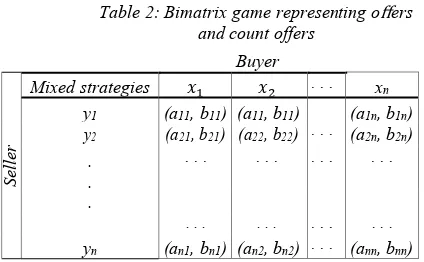
Now, we use those two vectors as mixed strategies for the following matrix game which represents offers and counter-offers proposed by the buyer and seller:
[image:4.612.313.525.93.224.2]After introducing the probability vectors, the utility function converted into expected payment, and is written as follows:
Table 2: Bimatrix game representing offers
and count offers
; 1
; 2
Where A and B are matrices of offers and counter-offers of the seller and buyer respectively and X and Y are two probability vectors seen above. Consider the pair (α, β) which represent Nash equilibrium in mixed strategies obtained by the algorithm given in [13] and the best outcome profit for the buyer and seller. We note that we are interested in one point of equilibrium even though it’s possible that more than one exist.
In the next step, to search for a consensus between all values and all outcomes of matrix payments, then we compute their average, so we have:
2 , 2
2 ∀ , ∈
The algorithm consists of the following steps:
1. Collect the indicators from the web-interface where the products with different features are exposed.
2. Apply AHP method on collected indicators. The resulting weights are sorted in descending order and used as vector probability X where:
X= x ,x ,⋯ ⋯ ⋯ x ⋯ , ⋯ x
3. Use the historical sales and compute the vector Y where: Y= y ,y ,⋯ ⋯ ⋯ y ⋯ , ⋯ y
4. Generate matrix of offers and counter-offers proposed by the seller and buyer.
5. Generate the matrices A and B obtained from payments matrix where A and B represent offers and counter-offers of the seller and the buyer respectively.
Buyer
Selle
r
Mixed strategies ꞏꞏꞏ xn
y1 (a11, b11) (a11, b11)
ꞏꞏꞏ (a
1n, b1n)
y2 (a21, b21) (a22, b22) (a2n, b2n)
. ꞏꞏꞏ ꞏꞏꞏ ꞏꞏꞏ ꞏꞏꞏ
.
.
ꞏꞏꞏ ꞏꞏꞏ ꞏꞏꞏ ꞏ ꞏꞏ
2749 6. Compute the average of expectation payment:
P X Ay X By
2
7. Compute Nash equilibrium (α,β ) and its average which is:
P α,β
2
8. Compute the average of all pairs on the matrix payment and assign them to P K :
∀ i, j ∈ N ; P K
9. Sort all values obtained: P , P and P K in order to send to the seller.
We assign P , P and P K to prices for a product chosen by the buyer.
From these prices, three possible scenarios will be exposed in the sequel:
• First case: If ( ) is in the first column and has a weight greater than other values, then we sort all the result of average values in the first column of matrix (P K and (P ). Then for every step, we send prices obtained from expectation payment (P ) and the matrix payment (P K ) to the seller, until reaching (P ) which is considered as the ceiling price by the buyer. If the seller refuses the offered P , then negotiation is failed.
The same algorithm is repeated in every column containing with the condition it has the greatest value compared to the other values of the weights and Nash equilibrium exist in the same column. • Second case: If no agreement is reached, the negotiation is failed and the buyer has two choices: stop negotiation or changing the values of weighted weight. In this last choice, a new product is chosen by the buyer and starting a new negotiation based on the average of all values contained in the new column that includes the greatest , even no Nash equilibrium exist in this column.
We note all prices are included in the financial range of the buyer.
3. EXPIRIMENTAL STUDY
On one hand, the buyer wants to acquire this product with features such as color, internal memory, camera, power, but his financial resources are limited to between 350$ and 550$.
On the other hand, the seller offers several products with different attributes but the buyer is interested only in a few. All products are exhibited with their attributes on ecommerce website; this offers the possibility to negotiate prices. The seller and buyer have different goals and constraints. The first aims to maximize his profits and exposes a range of prices and historical top sales of his products on the
e-commerce website. The second wants to buy a product according to his preferences, despite his limited budget, even that he can exploit the negotiation tool offered by the e-commerce website.
[image:5.612.324.521.232.284.2]The execution of the proposed algorithm is done according to the steps Sp1 to Sp8 below. Table 3 shows a summary of the products exhibited on the e-commerce website.
Table 3: Feature cellular phones
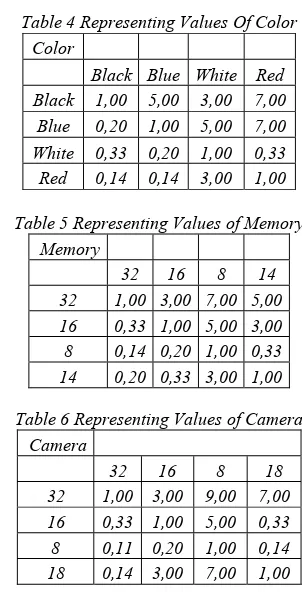
According to this table, the buyer collects all needed indicators to apply the AHP method in order to choose the best phone.
[image:5.612.338.489.381.677.2]In the follows, we present the matrices on which the buyer was based for the automatic calculation of the weights and thus to make a choice, color, Memory, camera and date of delivery.
Table 4 Representing Values Of Color Color
Black Blue White Red
Black 1,00 5,00 3,00 7,00
Blue 0,20 1,00 5,00 7,00
White 0,33 0,20 1,00 0,33
Red 0,14 0,14 3,00 1,00
Table 5 Representing Values of Memory
Memory
32 16 8 14
32 1,00 3,00 7,00 5,00
16 0,33 1,00 5,00 3,00
8 0,14 0,20 1,00 0,33
14 0,20 0,33 3,00 1,00
Table 6 Representing Values of Camera
Camera
32 16 8 18
32 1,00 3,00 9,00 7,00
16 0,33 1,00 5,00 0,33
8 0,11 0,20 1,00 0,14
18 0,14 3,00 7,00 1,00
Features Color Memory Camera Delivery date
Phone 1 Black 32Go 18MP 2 Days
Phone 2 Blue 16Go 8MP 6 Hours
Phone 3 White 8Go 16MP Week
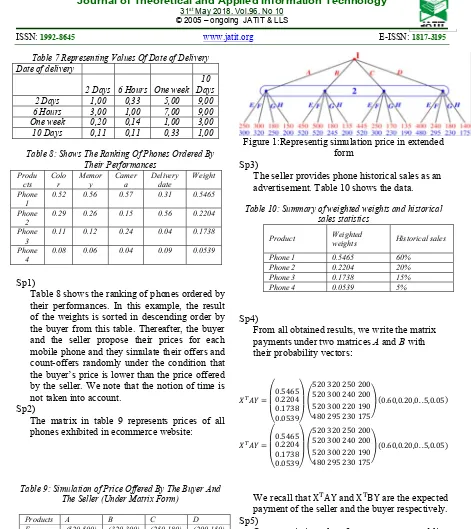
2750 Table 7 Representing Values Of Date of Delivery
Date of delivery
2 Days 6 Hours One week
10 Days
2 Days 1,00 0,33 5,00 9,00
6 Hours 3,00 1,00 7,00 9,00
One week 0,20 0,14 1,00 3,00
10 Days 0,11 0,11 0,33 1,00
Table 8: Shows The Ranking Of Phones Ordered By Their Performances
Produ cts
Colo r
Memor y
Camer a
Delivery date
Weight
Phone 1
0.52 0.56 0.57 0.31 0.5465
Phone 2
0.29 0.26 0.15 0.56 0.2204
Phone 3
0.11 0.12 0.24 0.04 0.1738
Phone 4
0.08 0.06 0.04 0.09 0.0539
Sp1)
Table 8 shows the ranking of phones ordered by their performances. In this example, the result of the weights is sorted in descending order by the buyer from this table. Thereafter, the buyer and the seller propose their prices for each mobile phone and they simulate their offers and count-offers randomly under the condition that the buyer’s price is lower than the price offered by the seller. We note that the notion of time is not taken into account.
Sp2)
[image:6.612.74.545.41.570.2]The matrix in table 9 represents prices of all phones exhibited in ecommerce website:
Table 9: Simulation of Price Offered By The Buyer And The Seller (Under Matrix Form)
Products A B C D
E (520,500) (320,300) (250,180) (200,150)
F (520,450) (300,250) (240,180) (200,135)
G (520,445) (300,250) (220,170) (190,140)
H (480,400) (295,240) (230,180) (175,140)
This play can be represented in the form of a tree:
Figure 1:Representig simulation price in extended form
Sp3)
The seller provides phone historical sales as an advertisement. Table 10 shows the data.
Table 10: Summary of weighted weights and historical sales statistics
Product Weighted weights Historical sales
Phone 1 0.5465 60%
Phone 2 0.2204 20%
Phone 3 0.1738 15%
Phone 4 0.0539 5%
Sp4)
From all obtained results, we write the matrix payments under two matrices A and B with their probability vectors:
0.5465 0.2204 0.1738 0.0539
520 320 250 200 520 300 240 200 520 300 220 190 480 295 230 175
0.60,0.20,0. .5,0.05
0.5465 0.2204 0.1738 0.0539
520 320 250 200 520 300 240 200 520 300 220 190 480 295 230 175
0.60,0.20,0. .5,0.05
We recall that X AY and X BY are the expected payment of the seller and the buyer respectively. Sp5)
2751 Figure 1: computing Nash equilibrium by using Gambit
software
The result is the optimal strategies which provide the buyer and the seller the best deal, even, it is not ideal to maintain this equilibrium because it can coast the buyer much money, consequently, the seller could maximize his profits. The opposite scenario is also possible. In other words, one of the participants will follow his own interests and deviate from this point of equilibrium. This situation can be considered as the last resort of the negotiation. In this case, the result of the gain obtained for the buyer is 500$ while for the seller is 520$. The average of those two values is assigned to (PNE = 510$) and is considered as a price ceiling
by the buyer. In addition, we compute the expectation payments using weighted 200 weights and the percentage of historical sales. Then we compute the average payment obtained from matrix payment pairs and we sort all obtained values. So we have:
Sp6)
The buyer expectation payment:
X= 0.5465, 0.2204, 0.1738, 0.0539 Y= 0.60, 0.20, 0.15, 0.05
X AY 371.6162.
The Seller expectation payement:
X= 0.5465, 0.2204, 0.1738, 0.0539 Y= 0.60, 0.20, 0.15, 0.05
X BY 416, 6445.
The average of those two payments is: = 394.13035 ≈394$.
Sp7)
Using the matrix payments, the second step are to compute the average of each offer and counter offer of the seller and the buyer.
Table 10: shows the average of matrix payment
Buyer
From the previous computation, we have five possibilities of price for the phone chosen by the buyer. Those prices are sorted and the minimal value here = 397$ is sent to the seller. If this price is accepted by the seller, therefore the agreement is concluded. Otherwise, the next minimum value P[k]var = 440$ of possible prices
is
proposed to the seller. This process continues as long as the proposed price is not accepted. Where:
P K = and K=3, 2, 1
If the last proposed price (PNE) is not accepted by the seller, the negotiation fails. Then two possibilities are presented:
Sp8)
• The buyer changes to other product preferences, which imply affecting the same best value of weighted weights to this last.
• The buyer chooses another seller and repeats the same process. It should be noted the number of negotiation round depend on the number of possible prices offered. In the following, we give a possibility of the situation mentioned earlier. According to the new parameters, we have the following expectation payments:
The buyer expectation payment:
X= 0.2204,0.5465, 0.1738, 0.0539 Y= 0.60, 0.20, 0.15, 0.05
X AY 414.9931.
0.5465 0.2204 0.0539 0.1738
0.60 510 310 215 175
0.20 485 275 210 167.5
0.15 482.5 275 195 162.5
2752 The seller expectation payment:
X= 0.2204, 0.5465, 0.1738, 0.0539 Y= 0.60, 0.20, 0.15, 0.05
X BY 378.3244.
Here, the average is 386.5893 ≈ 387$, the price has changed. For this new value, we have one offer for the seller respecting the financial range of the buyer (300$ and 550$). In the same procedure, the buyer sends the minimal price 310$ to the seller and if this one accepts, the agreement is concluded. Otherwise, the next price is sent and the outcome of the negotiation is depending on the response of the seller, however, the pressure of a failed agreement is taken into account in his decision and this procedure is reiterated while the financial range of the buyer is respected.
In conventional e-commerce plate-forms, the buyer has no control over prices. In the approach developed here, the algorithm gives more option to the buyer and at the same time offer opportunities to the seller to sell more products.
5. DISCUSSIONS
The proposed algorithm is operational, the buyer and the seller use the data exposed in e-commerce website. Computing Nash equilibrium is possible due to the offers and count-offer and coefficients which are extracted from AHP and top sales. All this data are used as finite game with probability vectors. Also computing expected payoff is possible by using vectors data.
The algorithm collects all this information, extracts and sorts the prices and sends them to the seller in order to accept or refuse.
In conventional e-commerce plate-forms, the buyer has no control over prices. In the approach developed here; the algorithm gives more options to the buyer and at the same time offer opportunities to the seller to sell more products. In the related literature, many models and techniques are developed; here we list a not exhaustive list: Markov chain [16], genetic algorithm [17], multi-agent technology [18] and the strategy of ranking mechanism [19]. For the first concerning Markov chain, it introduces time, interval price reservation and the deadline, the result is suitable. For the second technique which uses a genetic algorithm, the model of negotiation is based on biology and population evaluation and the result is based on percentage errors. The multi-agent technology needs proprieties such as autonomy, reaction and
pro-activation in order to find a consensus between seller and buyer, which is not an easy task. And the lastly, the ranking mechanism is based mobile agents, and multilateral negotiation model which does not require rational on behalf of the buyer and seller agent, also the notion of protocols is
Introduced in this case, this notion is used in heterogeneous environments, so it is important protocols to unify communications between intelligent agents before to start negotiation.
In our algorithm doesn’t use the notion of time or protocols. We suppose the environment is homogeneous, and if the negotiation is failed it’s possible to choose other products evaluated by the seller, which represent more opportunities to reach an agreement. This makes the difference between other works.
6. CONCLUSION
In this work, we have proposed a model of the negotiation process to be integrated into e-commerce platforms in the goal to keep the buyer in the same website when he is not satisfied. The buyer has a possibility to communicate with the seller in order to reach a mutually acceptable agreement concerning the price and other product characteristics. This will increase the seller’s benefits. The proposed negotiation process is done according to three phases. The first one is the feature extraction from information displayed on an e-commerce website. The second resides on the price proposals made by the buyer to the seller according to his preferences and respecting his financial range. Whereas the third one consists of reach the desired agreement using Nash equilibrium and analytical hierarchy process.
For this phase, the Lemke-Howson method is explored for computing Nash equilibrium. We experimentally evaluated the proposed approach and discuss its interest.
For future work, we will investigate the multi-agent system for designing a negotiation framework. We also aim to study the economic impact once the negotiation process is integrated into an e-commerce platform by implementing the Gambit software, since it offers the possibility to interact with different programming languages and web tools.
2753 REFERENCES:
[1] Fisher R, Ury W, Patton B. Getting to Yes: Negotiating Agreement Without Giving in. 2nd ed.Houghton Mifflin Harcourt; 1991
[2] Lomuscio A, Wooldridge M, Jennings NR. A Classification Scheme for Negotiation in Electronic Commerce. In: Dignum, Sierra C, editors. AgentLink, vol.1991, Springer; 2001, pp. 19–33. [3] Kumar M, Feldman SI. Internet Auctions. In: Yee BS,
editor. USENIX Workshop on Electronic Commerce, USENIX Association;1998, pp 5-5.
[4].Kexing L. A Survey of Agent Based Automated Negotiation. In: Proceedings of the 2011 International Conference on Network Computing and Information Security - Volume 02. NCIS’11. Washington, DC, USA: IEEE Computer Society; 2011. pp. 24– 27. [5] Bichler M, Kersten G, Strecker S. Towards a
Structured Design of Electronic Negotiations. Group Decision and Negotiation. 2003 Jul; 123.pp11–335. [6] Nash JF. Equilibrium points in n-person games. Proc
of the National Academy of Sciences.1950; 36:pp48– 49.
[7] Saaty TL. How to make a decision: The Analytic HierarchyProcess. European Journal of Operational Research. 1990; pp9–26.
[8] Osborne MJ, Rubinstein A. Bargaining and Markets. Academic Press; 1990.
[9] Bauso D. Game Theory: Models, Numerical Methods and Applications. Found Trends Syst Control. 2014. pp. 379–522.
[10] Durlauf SN, Blume L. Game theory / edited by Steven N.Durlauf, Lawrence E. Blume. Palgrave Macmillan Basingstoke,UK; New York; 2010.[11] Nash JF. Non-cooperative Games. Annals of Mathematics. 1951; 54(2):pp286–295.
[12] Nisan N, Roughgarden T, Tardos E, Vazirani VV. Algorithmic Game Theory. New York, NY, USA: Cambridge University Press; 2007.
[13] Lemke CE, J T Howson J. Equilibrium points of bimatrix games. Journal of the Society for Industrial and Applied Mathematics. 1964;.
pp 413–423.
[14] Shapley LS. A note on the Lemke-Howson algorithm. Balinski ML, editor. Berlin, Heidelberg: Springer Berlin Heidelberg; 1974.
[15] Savani R, von Stengel B. Game Theory Explorer –Software for the Applied Game . Theorist. Computational Management Science. 2015;12:5–33.
[16] Narayanan V, Jennings NR. An adaptive bilateral negotiation model for e-commerce settings. Seventh IEEE International Conference on E-Commerce Technology (CEC’05). 2005;p. 34– 41.
[17] Gao T, Chen P. Research on the decision-making of multi-issue/attribute negotiation based on agent technology and the Genetic Algorithm. In: 2010 Chinese Control and Decision Conference; 2010. pp. 3523–3528.
[18] Kim BH, Lee KJ, Kim YC. A dynamic mediation strategy based on agent. In: 2001 International Conferences on Info-Tech and Info-Net. Proceedings (Cat. No.01EX479). vol. 5; 2001. pp. 235–240.