Performance Comparison and Analysis of
AODV and DSDV Gateway Discovery
Protocol in MANET
M.Geetha M.C.A., M.Phil., # , Dr. R. Umarani M.C.A., M.Phil., PhD*, #Assistant Professor in Computer Application Department,
Vivekanandha College of Arts and Sciences for Women, Triuchengodu. *Associate Professor in Computer Science Department,
Sri Sarada College for Women, Salem. Abstract
Connecting the wired and wireless networks particularly the Mobile ad hoc Network is integrated with Internet. Different mechanisms have been proposed to integrate MANETs and the Internet. These mechanisms are differing based on gateway discovery mechanism. When MANET is connected to the Internet, it is important for the mobile nodes to detect an available gateway providing an access to the Internet. The objective of this paper is a survey on the Mobile Ad-hoc Network (MANET) routing protocols used in gateways. The key protocols AODV and DSDV has been analyzed and concluded that AODV provides better usage than DSDV.
Keywords - MANET, AODV, DSDV, Gateway, Routing. 1. Introduction
A mobile ad hoc network is a collection of wireless mobile nodes dynamically forming a temporary network without the use of any existing network infrastructure. Some of the nodes in an ad hoc network may want access to an external network, such as Internet [1].
Ad hoc networks can be connected to an external network such as Internet to facilitate the users with the resources provided by the external network. The routers, or one or more nodes in the ad hoc network, called gateways, connect the rest of network with the external network. A number of gateway routing protocols have been designed for connecting MANET with Internet, and these protocols can be broadly categorized into two classes: proactive routing protocols (e.g. DSDV, OLSR) and reactive routing protocols (e.g. AODV, DSR)[3].
In the proactive solutions, agent advertisement messages are broadcast by gateway nodes and forwarded to the whole ad hoc network. The agent advertisement message is used for gateway discovery, creating default route, movement detection, and handoff decision based on number of hops.
In the reactive solutions, mobile nodes initiate route discovery so as to look for the gateway node. Mobile nodes send a route request message, or an agent request message, to find the gateway node and route to it. It uses invalidate route entry for movement detection and initiates gateway discovery.
In section I, overview of the routing protocols are discussed, in section II the working principle of routing protocols are discussed, in section III & IV the gateway discovery process are discussed ,in section V reactive protocol AODV is compared with proactive protocol DSDV and section VI gives the conclusion.
I. Overview of routing protocol
Reactive On-demand routing protocols (Ad Hoc On-Demand Distance Vector (AODV)[4]build and maintain only needed routes to reduce routing overheads. This is in contrast to proactive protocols Destination Sequenced Distance Vector (DSDV) that maintain routes between all node pairs all the time.
In on-demand protocols, a route discovery process is initiated whenever a route is needed. Each node in on demand routing does not need periodic route table update exchange and does not have a full topological view of the network. Network hosts maintain route table entries only to destinations that they communicate with.
In internetworking, routing is the process of moving a packet of data from source to destination. Routing is usually performed by a dedicated device called a router. Routing is a key feature of the Internet because it enables messages to pass from one node to another and reach the target machine. Each intermediary node performs routing by passing along the message to the next node. Node analyzes a routing tableto determine the best path.
II. Working Principle Of Gateway Routing Protocol
A) Ad Hoc On Demand Distance Vector (AODV)
There are two types of routing protocols which are reactive and proactive. In reactive routing protocols the routes are created only when source wants to send data to destination whereas proactive routing protocols are table driven. Being a reactive routing protocol AODV [4] uses traditional routing tables, one entry per destination and sequence numbers are used to determine whether routing information is up-to-date and to prevent routing loops.
The maintenance of time-based states is an important feature of AODV which means that a routing entry which is not recently used is expired. The neighbors are notified in case of route breakage. The discovery of the route from source to destination is based on query and reply cycles and intermediate nodes store the route information in the form of route table entries along the route.
Control messages used for the discovery and breakage of route are as follows: * Route Request Message (RREQ)
* Route Reply Message (RREP) * Route Error Message (RERR) * HELLO Messages.
1) Route Request (RREQ):
A route request packet is flooded through the network when a route is not available for the destination from source. The parameters are contained in the route request packet are presented in the following table:
Table 1: Route Request Parameters
Source
Address Request ID Source
Sequence
Number Destination Address Destination Sequence Number
A RREQ is identified by the pair source address and request ID, each time when the source node sends a new REQ and the request ID is incremented. After receiving of request message, each node checks the request ID and source address pair. The new RREQ is discarded if there is already RREQ packet with same pair of parameters.
A node that has no route entry for the destination, it rebroadcasts the RREQ with incremented hop count parameter.
A route reply (RREP) message is generated and sent back to source if a node has route with sequence number greater than or equal to that of RREQ.
2) Route Reply (RREP):
Once find out the valid route to the destination or if the node is destination, a RREP message is sent to the source by the node. The following parameters are contained in the route reply message:
Table 2: Route Reply Parameters
Source Address
Destination Address
Destination Sequence Number
Hop Count
Life Time
3) Route Error Message (RERR):
The neighborhood nodes are monitored. When a route that is active is lost, the neighborhood nodes are notified by route error message (RERR) on both sides of link.
4) Hello Messages:
The HELLO messages are broadcasted in order to know neighborhood nodes. The neighborhood nodes are directly communicated. In AODV, HELLO messages are broadcasted in order to inform the neighbors about the activation of the link. These messages are not broadcasted because of short time to live (TTL) with a value equal to one.
5) Discovery of Route:
When a source node does not have routing information about destination, the process of the discovery of the route starts for a node with which source wants to communicate. The process is initiated by broadcasting of RREQ . On receiving RREP message, the route is established. If multiple RREP messages with different routes are received then routing information is updated with RREP message of greater sequence number.
6) Setup of Reverse Path:
The reverse path to the node is noted by each node during the transmission of RREQ messages. The RREP message travels along this path after the destination node is found. The addresses of the neighbors from which the RREQ packets are received are recorded by each node.
7) Setup of Forward Path:
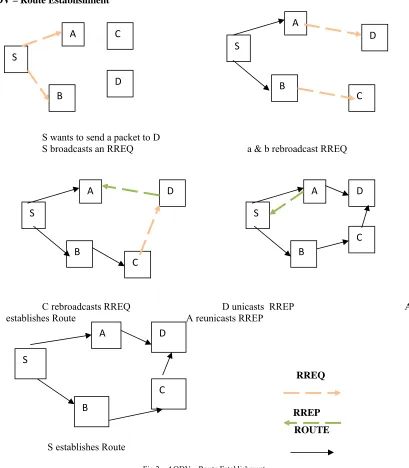
8) AODV – Route Establishment
S wants to send a packet to D
S broadcasts an RREQ a & b rebroadcast RREQ
C rebroadcasts RREQ D unicasts RREP A
establishes Route A reunicasts RREP
RREQ
RREP
ROUTE
S establishes Route
Fig 2. AODV – Route Establishment
B) Destination-Sequenced Distance-Vector Routing (DSDV)
Destination-Sequenced Distance-Vector Routing (DSDV) [4] is a table-driven routing scheme for ad hoc mobile networks based on the Bellman-Ford algorithm. The main contribution of the algorithm was to solve the Routing Loop problem. Each entry in the routing table contains a sequence number, the sequence numbers are generally even if a link is present; else, an odd number is used. The number is generated by the destination, and the emitter needs to send out the next update with this number.
Routing information is distributed between nodes by sending full table infrequently and smaller incremental updates more frequently. It is quite suitable for creating ad hoc networks with small number of nodes.DSDV requires a regular update of its routing tables, which uses up battery power and a small amount of bandwidth even when the network is idle. Whenever the topology of the network changes, a new sequence number is necessary before the network re-converges; thus, DSDV is not suitable for highly dynamic networks.
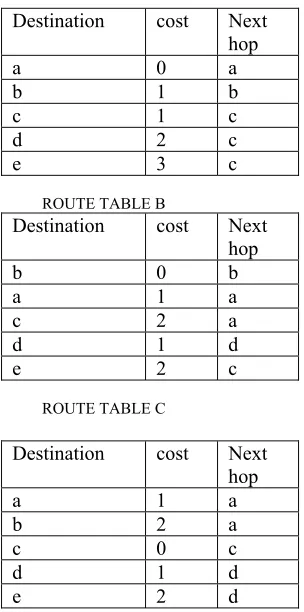
1 )DSDV Routing table:-
Figure 3: An example of the ad hoc networks
Distance Vector Routing Protocol Initialization Phase Cost per hop = 1
Each node:
• Knows its neighbors and the cost to reach them
• Tells its neighbors periodically the distance to every other node in the network
Table 3.DSDV routing table
ROUTE TABLE A
Destination cost Next hop
a 0 a
b 1 b
c 1 c
d 2 c
e 3 c
ROUTE TABLE B
Destination cost Next hop
b 0 b
a 1 a
c 2 a
d 1 d
e 2 c
ROUTE TABLE C
Destination cost Next hop
a 1 a
b 2 a
c 0 c
d 1 d
III. AODV Gateway Discovery Process
In this approach Internet Gateway (IGW) is used for the connection of a MANET node to the global Internet. When an ad hoc network is connected to the Internet the use of single gateway has the drawback of single point of failure. In order to solve these problems, multiple gateways can be used for a particular MANET domain. In multiple gateways, the availability of multiple gateways provides the network with higher robustness and more flexibility for global Internet connectivity. With multiple IGWs, if any one of the IGWs fails, another IGW can take over the failed one, to increase the overall throughput of the MANET to the global Internet.
An Internet gateway periodically broadcasts a GWADV (Gateway Advertisement) [2]. Mobile nodes that receive GWADV [3] create or update reverse route entries for the IGW and maintain such routes as default entries in their routing tables. Mobile nodes that cannot receive GWADV issue Route Request for IGW packets (RREQ) [6] to discover gateway proactively. Each Mobile node maintains a Neighbor Node List (NNL) to record its set of neighbors (i.e., all nodes from which can hear hello message) and it then appends this set in its coming HELLOs. All Mobile nodes broadcast ordinary AODV hello messages periodically and record its neighbor’s information in its NNL through exchanging hello messages. The neighbor’s information is appended in local route broadcasting packets (RREQ, RREQ, and GWADV) rather than in HELLOs. It means that the neighbor’s information is broadcast only when we need to search for a route. When RREQ is forwarded by intermediate node, it appends its address. AODV allows intermediate nodes to forward duplicate RREQ packets.
1) Multiple Gateway Selection
The different methods for multiple gateway selection can be used to forward packets between the Internet and ad hoc. A straightforward solution for gateway selection is to select the gateway that has the shortest number of hops to the mobile node as the default gateway. However, it is desired to discover and select a gateway that is the optimal one among all available gateways. The IGW selection mechanisms for MANET with multiple IGWs take the hop count between MANET node and IGW, the load of IGW or the receiving interval of IGW advertisement (IGWADV) [7] messages as the metric.
In this approach, two metrics – distance based hop count (shortest path to IGW) and offered load by IGW are used to select the gateway. In this scheme, a Mobile Node first computes the optimum IGW and chooses a default IGW among the IGWs.
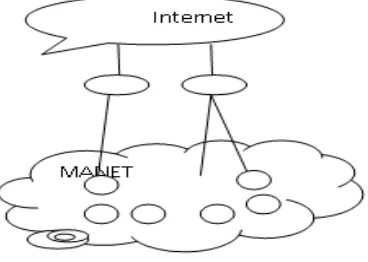
Fig 4. Internet connectivity using AODV protocol
Total offered load that is the sum of all loads on any IGW; µ = ∑λi.ki
Where λ is the average traffic arrival rate per second
k is the average packet length per second; n is the number of nodes connected to an IGW.
IGW opt = min IGW1, …. IGWn
= min IGWi n i=1
Where nis the number of nodes connected to an IGW. - αβ are weighting factors
- µ is offered load
- γ is distance by hop count IV.DSDV Gateway Discovery Process
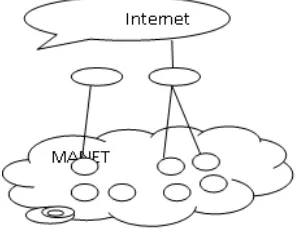
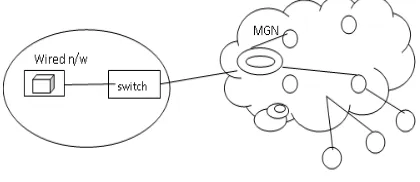
The main objective of DSDV protocol is to provide a full duplex connectivity between the exclusive ad hoc hosts and the wired hosts. One of the ad hoc hosts is used as Mobile Gateway Node (MGN) [4] acting as a bridge between the MANET and the wired network. The Full Duplex communication between MANET nodes and the wired node is through this MGN. The MGN accesses the Switch (like a Router) in the wired network through an Access point. The MGN runs the DSDV protocol and takes care of the addressing mechanisms to ensure the transfer of packets between the hybrid networks. The addressing structure of the MANET nodes and the wired nodes may or may not be the same.
In this framework, it is assumed that the connectivity is provided to exclusive ad hoc hosts only. We are ignoring the case of visiting mobile nodes of the Internet or wireless Infrastructure networks joining the ad hoc Network and access the Internet.
In this approach the gateway is mobile and communicates with the wired hosts using the access point, which is connected to the switch. However, we assume that the MGN is closer to the access point, so that it can be under its radio coverage for ensuring bi-directional communication.
Fig 5. Internet connectivity using DSDV protocol
Each mobile host maintains a routing table that stores the number of hops, and the sequence number for all the destinations. The routing table updates may be time-driven or event-driven. The interval between the two updates is known as the periodic route update interval. In DSDV the low packet delivery is due to the fact that, it uses old routes in case of broken links.
In DSDV the existence of sold route does not imply that there is no valid route to the destination. The packets can be forwarded through other neighbors who may have routes to the destination. When an immediate link from the host say ‘S’ to the destination say ‘T’ breaks, this protocol creates a temporary link through a neighbor which has a valid route to the desired destination. The temporary link is created by sending one-hop ROUTEREQUEST and ROUTE-ACK [7] messages.
Steps for DSDV discovery process:-
1. If the next hop link of Host A for the required destination is active, then it uses the conventional DSDV Protocol. 2. In case if any outgoing link breaks, and if there is no capacity in the buffer, then the incoming packet is discarded. 3. Otherwise the packet is buffered for later transmission. The alternate route discovery process starts.
4. The Host A broadcast a one-hop Route Request packet to its neighbors. If the next hop neighbor has a valid route to the destination in its routing table and if A is not the Next-Hop, then it sends Route Acknowledgement message enlisting its Host ID, the destination, the hop count metric for the destination and the last updated time.
5. The Host A (in the while loop) chooses the best neighbor, based on the least number of hops to the destination. If there is more than one node having the same number of hops, then it selects the host with the latest routing update time. The packets (buffered) are then forwarded using the latest found route till, the routing table of host A is updated by the DSDV routing protocol.
V. Analysis of Gateway Routing Protocols
In the analysis, we have compared the performance of AODV and DSDV protocol using following performance metrics:
AlgorithmDSDV (Host A, Destination D, MAXBufferSize N,Packet X)
if (A. NextHopLink () == ACTIVE) then Use Standard DSDV;
else if (A. BufferLength () == N) then Discard X;
else
place X in A.Buffer;
2. A. Broadcasts (ROUTE-REQ, 1, D, A);
3. if (A. NEXT_NEIGHBOR has route to ‘D’) then A. RECIEVE (ROUTE_ACK)
4. Min_Hops = _; Next_Hop = 0;Updated_Time=0;
5. While (Host A has ROUTE_ACK Packets) {
if ( ROUTE_ACK.HOP_COUNT< =Min_Hops ) {
if ( ROUTE_ACK.HOP_COUNT =Min_Hops ) {
if ( ROUTE_ACK.UPDTD_TIME > Updated_Time )
{
Host_ID = ROUTE_ACK.HOST_ID;
Updated_Time= ROUTE_ACK.UPDTTD_TIME; }
} else
{
Min_Hops = ROUTE-ACK.HOP_COUNT; Host_ID = ROUTE_ACK.HOST_ID;
Updated_Time = ROUTE_ACK.UPDTTD_TIME; }
} else {
Min_Hops = ROUTE_ACK.HOP_COUNT; Host_ID = ROUTE_ACK.HOST_ID;
Updated_Time = ROUTE_ACK.UPDTTD_TIME; }
} }
Packet Delivery Ratio (PDR): Packet delivery ratio is the ratio of the amount of data packets delivered to the destination and total number of data packets sent by source.
Routing overhead: The total number of routing packets transmitted.
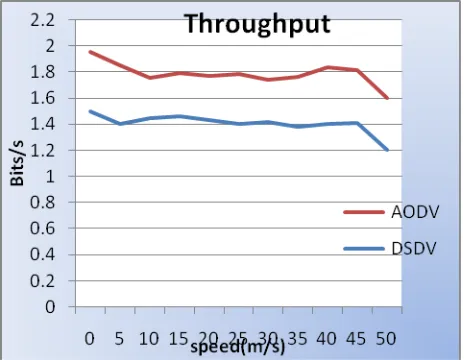
Throughput: It’s the average number of messages successfully delivered per unit time i.e. average number of bits delivered per second.
End to End delay: It’s the time taken for a packet to be transmitted from the source node to the destination node. Packet loss ratio: - The number of data packets that are not successfully sent to the destination. In terms of dropped packets,
a) Throughput
Throughput vs. Speed
The throughput of both protocol decreases as speed increases .DSDV’s throughput decreases in a steeper and more rapid fashion. This is attributed to excessive channel usage by regular route table updates. Furthermore, as mobility speed increases, more event-triggered updates are generated, resulting in even more throughput decrease. This problem is not present in AODV since routes are only generated on-demand. Therefore, we conclude that in cases where bandwidth is a critical issue, AODV is preferred.
Figure 6: Throughput of AODV and DSDV vs. speed
b) Routing Overhead
Routing Overhead vs. Speed
Figure 7: Overhead for AODV and DSDV vs. speed
c) Packet Loss Ratio:-
The graph below, show not much packet loss on AODV side. This is because when a link fails, a routing error is passed back to a transmitting node and the process repeats. For DSDV show the packet loss higher than AODV. But in DSDV, the information on new Routes, broken Links, metric change is immediately propagated to neighbors.
Figure 8: Packet loss ratio of AODV and DSDV vs. speed
VI.Conclusion:-
Two standard protocols AODV and DSDV, where DSDV is a proactive while AODV is a reactive on demand routing protocol, moreover, both are using routing tables to save one route per destination and destination sequence number to refresh that routing tables. The reactive routing protocol AODV performance is the best to maintain connection by periodic exchange of information. AODV performs predictably.
protocols are compared based on some other metrics such as packet delivery ratio, end-end-delay and control overhead.
References
[1] B. Shen, H. Y. Ke, and Z. G. Hu, “Adaptive mechanisms to enhance Internet connectivity for mobile ad hoc networks,” Wireless
Communications, Networking and Mobile Computing, 2006.
[2] WiCOM 2006 International Conference on 22-24 September 2006.
[3] Hu zhonggong, “An Enhanced approach with Adjusting GWADV Interval for Connecting Mobile Ad Hoc Networks to the Internet”,
Journal of Guilin
[4] University of Electronic Technology, 2006.
[5] haleel Ur Rahman Khan, Rafi U Zaman, A.Venugopal Reddy, “Integrating Mobile Ad Hoc Networks and the Internet: challenges and a
review of strategies’, Communication Systems Software and Middleware and Workshops, COMSWARE 2008. 3rd International Conference on 6-10 Jan., (IEEE CNF) page(s):536 – 543
[6] Kumar, R., Misra, M. and Sarje, A.K. (2007) “An Efficient Gateway Discovery in Ad Hoc Networks for Internet Connectivity”, Proc. of the
International Conference on Computational Intelligence and Multimedia Applications, pp 275-281.
[7] Wakikawa R., Malinen J.T., Perkins C.E., Global connectivity for IPv6 Mobile Ad Hoc Networks draft-wakikawa-manet-globalv6-05.txt,
Mar.2006
[8] JeeHyeon Na, Yun Won Chung, et al, “A Novel Routing Path Discovery and Data Delivery Scheme for Ubiquitous Internet Connectivity
Based on Hierachical mobile AODV6 Networks”, Vehicular Technology Conference, 2007. VTC2007-Spring. IEEE 65th Volume , Issue ,
22-25 April 2007 Page(s):61 - 65
[9] algorithms (Table II). The used mobility pattern is the Random
[10] A. J. Yuste, F. D. Trujillo, A. Triviño and E. Casilari, "An adaptive gateway discovery for mobile ad hoc networks", Proc. 5th ACM
International Workshop on Mobility Management and Wireless Access. Chania, pp. 159–162, October 2007.
[11] A. Triviño-Cabrera, J. García-de-la-Nava, E. Casilari and F. J. González- Cañete, "An Analytical Model to Estimate Path-Duration in
MANETs" , Proc. 9th ACM/IEEE International Symposium on Modeling, Analysis and Simulation of Wireless and Mobile Systems (MSWiM), Torremolinos (Spain), October 2006