Pubertal Assessment Method and Baseline
Characteristics in a Mixed Longitudinal Study of Girls
WHAT’S KNOWN ON THIS SUBJECT: Age of onset of puberty in girls has fallen in the past 2 decades. It is unclear whether this trend is continuing or the age of onset of puberty in girls has stabilized.
WHAT THIS STUDY ADDS: The authors describe the method and comparability of maturation assessment across 3 geographically distinct centers. It seems that age at onset of puberty is
continuing to fall in white but not black girls. Black girls continue to mature at younger ages than white girls.
abstract
OBJECTIVES:The objective of this study was to describe the assess-ment methods and maturation status for a multisite cohort of girls at baseline recruitment and at ages 7 and 8 years.
METHODS:The method for pubertal maturation staging was developed collaboratively across 3 sites. Girls at ages 6 to 8 years were recruited at 3 sites: East Harlem, New York; greater Cincinnati metropolitan area; and San Francisco Bay area, California. Baseline characteristics were obtained through interviews with caregivers and anthropometric mea-surements by trained examiners; breast stage 2 was defined as onset of pubertal maturation. Thestatistic was used to evaluate agreement between master trainers and examiners. Logistic regression models were used to identify factors that are associated with pubertal matu-ration and linear regression models to examine factors that are asso-ciated with height velocity.
RESULTS:The baseline cohort included 1239 girls. The proportion of girls who had attained breast stage 2 varied by age, race/ethnicity, BMI percentile, and site. At 7 years, 10.4% of white, 23.4% of black non-Hispanic, and 14.9% of Hispanic girls had attained breast stageⱖ2; at 8 years, 18.3%, 42.9%, and 30.9%, respectively, had attained breast stage ⱖ2. The prime determinant of height velocity was pubertal status.
CONCLUSIONS:In this multisite study, there was substantial agree-ment regarding pubertal staging between examiners across sites. The proportion of girls who had breast development at ages 7 and 8 years, particularly among white girls, is greater than that reported from studies of girls who were born 10 to 30 years earlier.Pediatrics2010; 126:e583–e590
AUTHORS:Frank M. Biro, MD,aMaida P. Galvez, MD, MPH,b Louise C. Greenspan, MD,cPaul A. Succop, PhD,dNita Vangeepuram, MD,bSusan M. Pinney, PhD,dSusan Teitelbaum, PhD,bGayle C. Windham, PhD,eLawrence H. Kushi, ScD,fand Mary S. Wolff, PhDb
aDivision of Adolescent Medicine, Cincinnati Children’s Hospital
Medical Center, Cincinnati, Ohio;bDepartment of Community and
Preventive Medicine, Mount Sinai School of Medicine, New York, New York;cDepartment of Pediatrics, Kaiser Permanente, San
Francisco, California;dDepartment of Environmental Health,
University of Cincinnati College of Medicine, Cincinnati, Ohio;
eCalifornia Department of Public Health, Richmond, California;
andfDivision of Research, Kaiser Permanente Northern
California, Oakland, California
KEY WORDS
puberty, girls, maturation assessment
ABBREVIATIONS
BCERC—Breast Cancer and the Environment Research Centers NIEHS—National Institute of Environmental Health Science NCI—National Cancer Institute
MSSM—Mount Sinai School of Medicine KPNC—Kaiser Permanente Northern California PROS—Pediatric Research in Office Settings
The views in this article are those of the authors and do not necessarily represent the views of the National Institute of Environmental Health Sciences, the National Cancer Institute, the National Center for Research Resources, the National Institutes of Health, the Environmental Protection Agency, or the Agency for Toxic Substances and Disease Registry.
www.pediatrics.org/cgi/doi/10.1542/peds.2009-3079
doi:10.1542/peds.2009-3079
Accepted for publication May 21, 2010
Address correspondence to Frank M. Biro, MD, Cincinnati Children’s Hospital Medical Center, Adolescent Medicine (ML 4000), 3333 Burnet Ave, Cincinnati, OH 45229-3039. E-mail: frank. [email protected]
PEDIATRICS (ISSN Numbers: Print, 0031-4005; Online, 1098-4275).
Copyright © 2010 by the American Academy of Pediatrics
FINANCIAL DISCLOSURE:The authors have indicated they have no financial relationships relevant to this article to disclose.
of puberty in girls,1– 6genetics and
en-vironment are also thought to play roles in pubertal onset. For better un-derstanding of the role of genetic and environmental influences on breast cancer, acting through the risk factor of early maturation, the Breast Cancer and the Environment Research Cen-ters (BCERC) were established in late 2003 as a consortium in a partnership between the National Institute of Envi-ronmental Health Science (NIEHS) and National Cancer Institute (NCI). The fo-cus in the BCERC epidemiologic studies is directed toward prepubertal and early pubertal stages, in recognition of puberty as a potential window of sus-ceptibility for breast cancer. Several epidemiologic studies have observed that women with breast cancer have a younger age of menarche, and those with younger age at menarche have an increased risk for breast cancer.7–10A
pooled analysis of studies of premeno-pausal and postmenopremeno-pausal women revealed that the risk for breast can-cer was decreased by 9% and 4%, re-spectively, for each year that men-arche was delayed.11There are several
possible reasons that later menarche reduced risk for breast cancer, includ-ing the relationship between onset of puberty and lifelong exposure to estro-gen12,13and progesterone,14number of
proliferating cells in the intralobular terminal ducts,15and susceptibility of
rapidly developing breast tissue to en-vironmental exposures.16–18
The principal end point in the BCERC epidemiology studies is the age when breast development begins. Although there is recent interest in studying causative factors in pubertal onset, few epidemiologic studies have been conducted of general populations. Some of the methodologic limitations include reliability and standardization
cedure to define pubertal maturation stages that included pubic hair matu-ration as well as 3 scales for breast maturation. Tanner revised these cri-teria and published his classic mono-graph Growth at Adolescence re-garding pubertal maturation.20 He
proposed using 5 stages of breast de-velopment, recognized by many as “Tanner breast stages,” and 5 stages of pubic hair development. A longitudi-nal study published subsequently by Marshall and Tanner21 provided
de-scriptive detail of these stages in a group of girls. Independent of Marshall and Tanner’s work was a series by van Wieringen et al,22 that used
high-quality photographs of pubic hair and breast maturation stages to stan-dardize outcome assessment. Other breast/areolar maturation systems have been proposed, such as Garn and Falkner’s23areolar maturation system,
which was independent of breast size or degree of obesity.
In the BCERC consortium, breast devel-opment is assessed at each of 3 sites by trained clinical or research staff on the basis of Tanner’s criteria, with cross-site training and quality mea-sures, to optimize validity and compa-rability. In this article, we describe the methods for pubertal assessment and report baseline characteristics of the consortium cohort. The objectives of this article are (1) to describe the methods and training of personnel for determining pubertal stages and (2) to report the maturation status of the co-hort of girls at ages 7 and 8 years.
METHODS
Data Collection
This project was conducted as part of the NIEHS/NCI BCERC, 4 centers with transdisciplinary research collabora-tions across biological and
epidemio-observational longitudinal study of pu-bertal maturation is conducted at 3 sites: (1) Mount Sinai School of Medi-cine (MSSM)/Fox Chase Cancer Cen-ter/University of Alabama Birmingham group, which recruited through clin-ics, schools, and neighborhood cen-ters in East Harlem, New York, with girls seen annually; (2) Cincinnati Chil-dren’s Hospital/University of Cincin-nati (Cincinnati), which recruited through public and parochial schools in the Cincinnati metropolitan area and through the Breast Cancer Regis-try of Greater Cincinnati, with girls seen semiannually; and (3) the Kai-ser Permanente Northern California (KPNC)/University of California San Francisco group, which recruited KPNC Health Plan members in the San Francisco Bay Area, with girls seen an-nually. Enrollment occurred between the years 2004 and 2006, and the girls were 6 to 8 years of age at recruitment. Parents or guardians of the partici-pants identified the girls as black, white, Asian, or other race and ethnic-ity as Hispanic or non-Hispanic. Girls were assigned race/ethnicity by using the criteria that black race super-seded other race/ethnicity designa-tions and Hispanic superseded all oth-ers; all participants were uniquely defined with these criteria.
Before recruitment began, the investi-gators and study coordinators from each center met to prepare a written protocol for the clinical assessment method and to finalize a training man-ual and staging forms. Pubertal matu-ration was assessed by using Marshall and Tanner criteria for breast matura-tion and pubic hair stages,21 with
photographs that demonstrated the maturation stages, published by van Wieringen et al.22The written protocol
palpate for the presence of breast tis-sue and to use accessory light sources for pubic hair, if necessary. During training, the investigators and coordi-nators independently reviewed sets of photographs (“unknown stage”) of anonymous girls at various stages of development, and complete agree-ment was established between the ex-aminers and 3 authors (Drs Biro, Galvez, and Greenspan) by examining initial disparities and establishing unanimity. Clinical staff were certified after completion of training and photo-graphs and then performing dual ex-aminations with an expert on a group of peripubertal girls.
The 3 clinical centers conducted the maturation assessments in different settings, as noted already. Evaluations are performed by physicians and nurse practitioners at 2 sites (MSSM and Cincinnati) and research staff members at KPNC. At each center, training was performed by the local ex-pert investigators (Dr Galvez at MSSM, Dr Biro at Cincinnati, and Dr Greens-pan at KPNC). To maintain comparabil-ity between the centers, the same ex-amination form is used, and 1 of the local experts (Dr Galvez) visited each clinical site to perform interrater as-sessments for quality assurance. Ex-aminers circled the appropriate stage on a standard form that illustrated and described each stage; half-stages were not permitted, and, therefore, ex-aminers graded down unless all crite-ria were met for the next stage. As noted already, participants were seen annually for follow-up assess-ments at MSSM and KPNC; at Cincin-nati, participants were seen semian-nually. For the 7- and 8-year age cohort analyses reported here, data from the first visit at a given age at all sites were used for the analysis of that age cohort. Age was defined as calendar age (age 7 as any age from 7.00 to 7.99).
During the examination visits, trained staff members obtained standardized anthropometric measurements, in-cluding height and weight, making at least 2 measurements of each param-eter, unless the difference exceeded a preset amount or the amount was out-side the 5th or 95th percentile values; in these situations, a third measure-ment was taken and an average of the closest 2 values was taken. BMI was calculated from the mean values of height and weight, weight divided by height squared. BMIzscore was deter-mined from the Centers for Disease Control and Prevention (www.cdc.gov/ growthcharts/zscore.htm). Height ve-locity was calculated from the differ-ence of mean heights obtained from consecutive visits, divided by time be-tween visits, and adjusted to a 12-month interval.
Statistical Analyses
For these analyses, we collapsed breast stage 2 and breast stage 3 to contrast girls who were prepubertal (breast stage 1) from those who had breast development (breast stage
ⱖ2), and contrasted pubic hair stage 1 from those with pubic hair stageⱖ2. Maturation status was described at age 7 and 8 years, as described already. A given participant could have contrib-uted to analyses at both ages 7 and 8 for age-specific maturation status.
Logistic regression models were used to examine factors that are potentially related to breast stage (1 vs ⱖ2) as the outcome. The initial models in-cluded BMI percentile, race, age, and site, as well as all interaction terms of main effects with site. A final logistic regression model, derived from back-ward elimination, included only vari-ables that were significant at a proba-bility level of .05. Linear regression was used to estimate the strength of the relationship between height veloc-ity and potential predictors, including
age, race, breast stage, site, and all sites by main effect interactions. A backward elimination procedure was used to derive a final model with only significant main effects and site interactions.
To assess interrater agreement for pu-bertal staging, 1 of the experts (Dr Galvez) visited each clinical site to per-form maturation assessment in tan-dem with clinical staff. The degree of agreement between the master train-ers and the research staff membtrain-ers who were conducting the examina-tions was measured in 127 dual exam-inations by using thestatistic, which evaluates observed agreement con-trasted to agreement that is attribut-able chance.
RESULTS
The baseline cohort included 1239 girls; across the 3 sites, 8 girls did not have baseline breast stage informa-tion. The racial and ethnic composition of the study varied by clinical center, as noted in Table 1. At baseline, 33.7% of the girls were identified by the par-ents/guardians as white non-Hispanic, 31.6% as black non-Hispanic, 29.9% as Hispanic, and 4.6% as Asian. Mean ages of the cohort at recruitment, by site, were 7.34 years (MSSM cohort), 7.13 years (Cincinnati cohort; 7.63 for the second visit), and 7.38 years (KPNC cohort).
Pubertal breast maturation at 7 and 8 years of age, regardless of examina-tion cycle, is reported in Table 2. At 7 years, breast maturation was at stage
TABLE 1 Site and Race/Ethnicity in the BCERC Cohort
Race/ Ethnicity
MSSM Cincinnati KPNC Overall
White non-Hispanic
231 187 418
Black non-Hispanic
168 127 96 391
Latina Hispanic 248 15 107 370
Asian 5 52 57
Other 1 2 3
Total 416 379 444 1239
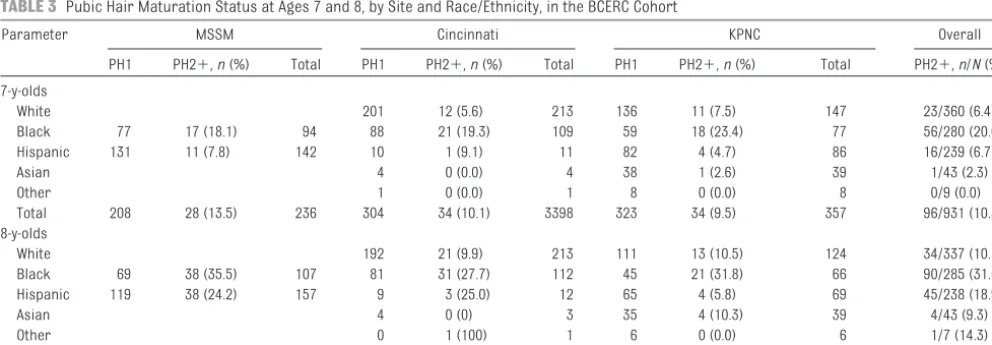
ⱖ2 in 10.4% of white non-Hispanic par-ticipants, 23.4% of black parpar-ticipants, and 14.9% of Hispanic participants; at 8 years, breast maturation was at stageⱖ2 in 18.3%, 42.9%, and 30.9%, respectively. In analyses that used lo-gistic regression with pubertal status at age 7 as the dependent variable, breast stageⱖ2 was associated with higher BMI percentile, older age, black race, and being from the MSSM or Cin-cinnati site. Site interactions were not significant and did not remain in any of these models. Pubic hair maturation results are shown in Table 3. When analyses that used pubic hair status at age 7 as the dependent variable were conducted, significant associations
were seen with higher BMI percentile and black race. In a linear regression model, the strongest predictor for height velocity was pubertal status
(breast development;P⬍.0039); the only other statistically significant pa-rameter was Asian race (lower height velocity when compared with other
groups;P⫽.017).
The proportion of white participants in
the BCERC consortium who had at-tained breast stageⱖ2 at 7 years was significantly greater than that re-ported by Herman-Giddens in the
Pedi-atric Research in Office Settings (PROS)24: for white girls, 10.4% vs 5.0%
(z⫽3.72,P⬍.001), and for black
non-Hispanic girls, 23.4% vs 15.4% (z ⫽ 1.76,P⫽.09). For participants at age 8, the proportion of girls in the BCERC who were at breast stageⱖ2 among white participants was 17.9% con-trasted to 10.5% from PROS (z⫽3.77, P ⬍ .0002) and among black BCERC participants was 37.0%, contrasted to
36.6% (differences not significant) in PROS.
When the dual maturation assess-ments were combined across all 3 sites, 127 dual examinations resulted in 17 inconsistencies between the
master trainers and the research staff; the estimatedstatistic was 0.67 (with 87% agreement observed
be-⫹ ⫹ ⫹ ⫹
7-y-olds
White 184 29 (13.6) 213 179 13 (6.8) 192 42/405 (10.4)
Black 83 11 (11.7) 94 75 34 (31.3) 109 75 26 (25.7) 101 71/304 (23.4) Hispanic 117 25 (17.6) 142 10 1 (9.1) 11 79 10 (11.2) 89 36/242 (14.9)
Asian 4 0 (0.0) 4 40 1 (2.4) 41 1/45 (2.2)
Other 1 0 (0.0) 1 8 0 (0.0) 8 0/9 (0.0)
Total 200 36 (15.3) 236 274 64 (18.9) 338 381 50 (11.6) 431 150/1005 (14.9) 8-y-olds
White 156 57 (26.7) 213 152 12 (7.3) 164 69/377 (18.3)
Black 77 31 (28.7) 108 54 58 (51.8) 112 55 24 (30.4) 79 82/191 (42.9) Hispanic 97 60 (38.2) 157 8 4 (33.3) 12 78 18 (18.8) 96 82/265 (30.9)
Asian 4 0 (0.0) 4 34 6 (15.0) 40 6/44 (13.6)
Other 1 0 (0.0) 1 7 0 (0.0) 7 0/8 (0.0)
Total 174 91 (34.3) 265 223 119 (34.8) 342 326 60 (15.5) 386 270/993 (27.2)
B1 indicates breast stage 1 (no evidence of breast maturation); B2⫹, breast stage 2 or 3 for 7-year-olds and 2, 3, or 4 for 8-year-olds.
TABLE 3 Pubic Hair Maturation Status at Ages 7 and 8, by Site and Race/Ethnicity, in the BCERC Cohort
Parameter MSSM Cincinnati KPNC Overall
PH1 PH2⫹,n(%) Total PH1 PH2⫹,n(%) Total PH1 PH2⫹,n(%) Total PH2⫹,n/N(%) 7-y-olds
White 201 12 (5.6) 213 136 11 (7.5) 147 23/360 (6.4)
Black 77 17 (18.1) 94 88 21 (19.3) 109 59 18 (23.4) 77 56/280 (20.0)
Hispanic 131 11 (7.8) 142 10 1 (9.1) 11 82 4 (4.7) 86 16/239 (6.7)
Asian 4 0 (0.0) 4 38 1 (2.6) 39 1/43 (2.3)
Other 1 0 (0.0) 1 8 0 (0.0) 8 0/9 (0.0)
Total 208 28 (13.5) 236 304 34 (10.1) 3398 323 34 (9.5) 357 96/931 (10.3) 8-y-olds
White 192 21 (9.9) 213 111 13 (10.5) 124 34/337 (10.1)
Black 69 38 (35.5) 107 81 31 (27.7) 112 45 21 (31.8) 66 90/285 (31.6) Hispanic 119 38 (24.2) 157 9 3 (25.0) 12 65 4 (5.8) 69 45/238 (18.9)
Asian 4 0 (0) 3 35 4 (10.3) 39 4/43 (9.3)
Other 0 1 (100) 1 6 0 (0.0) 6 1/7 (14.3)
Total 188 76 (28.8) 264 286 56 (16.4) 342 262 42 (13.8) 304 174/910 (19.1)
tween examiner and master trainers), indicating “substantial” agreement.25
When restricted to girls at breast stage 1 or 2 (n⫽117), thestatistic was 0.68, indicating substantial agree-ment. The values of thestatistic were similar when girls above and below the 85th percentile for BMI were compared.
DISCUSSION
Variations in the timing of pubertal maturation may be sensitive “sensors” of the effects of environmental expo-sure in human populations. An expert panel that discussed secular trends in pubertal maturation noted that recent data suggested a trend toward earlier breast development onset.26They
rec-ommended longitudinal studies with regular observations; maturation as-sessment by using Tanner staging with breast palpation by trained examiners; geographic variation; broad socioeco-nomic representation; defined race/ ethnicity; and body fat and weight covariates, such as BMI.26These
com-ponents have been incorporated into the epidemiologic projects of the BCERC. Inspection and breast palpa-tion are the only practical methods to assess secondary sex characteristics in an epidemiologic research setting; therefore, the accuracy of pubertal stage assignment will be influenced by interrater reliability. In this longitudi-nal investigation, a standardized pro-tocol for pubertal staging and recerti-fication was developed to minimize measurement error between sites and examiners. Thestatistic of 0.67 indi-cates that there is “substantial” agree-ment between the master examiners and the research staff.25 This value
is consistent with other published studies that investigated agreement between examiners: 0.50 (n ⫽ 25 comparisons),270.78 (n⫽20
compar-isons),28 and 0.86 (n ⫽ 56
compari-sons).24Although our study consisted
of a greater number of dual
compari-sons (n⫽127) than the other studies, we had a limited number of inconsis-tent dual observations (17 of 127) to study the impact of factors such as BMI and race on lack of agreement be-tween raters. We did examine those ex-aminations included in this article, as well as an additional 40 dual examina-tions, and found no difference in the statistic between participants whose BMI was above and below at the 85th percentile.
There were important differences among the 3 clinical sites by racial and ethnic characteristics of the partici-pants. Indeed, there were significant differences at baseline by site in the proportion of participants who had en-tered puberty. These differences re-solved when examined by single-year chronological age groups, rather than all baseline participants, in the ad-justed models. In addition, the analy-ses of height velocity, a biological change that is associated with puber-tal maturation, provided a physiologic validation of maturation assessment, in addition to the methodologic valida-tion provided by thestatistic. Site dif-ferences could result from differential exposure to endocrine disruptors or from dietary differences (eg, differ-ences in fiber intake, because dietary fiber has been noted to affect timing of pubertal maturation).29,30These issues
will be examined in future analyses.
The proportion of white participants in the BCERC consortium who had breast development at ages 7 and 8 years was greater than that re-ported from studies of girls who were born 10 to 30 years earlier, such as the PROS study.24Earlier
on-set of breast development was noted in a recent report from the Copenha-gen Puberty Study.31When they
exam-ined differences in age at onset of puberty contrasting 2 groups who were born 15 years apart, they noted that the differences in age of onset
remained significant after adjusting for BMI.31 Several studies and
re-views have addressed the impact of timing of pubertal maturation. Ear-lier maturation in girls is associated with lower self-esteem and less favorable body image,32,33 as well
as greater rates of eating prob-lems,34depression,35and suicide
at-tempts.36,37They were more likely to
be influenced by deviant peers,38with
earlier onset of sexual intercourse39
and norm-breaking behaviors,40,41
although this may be mediated
through greater involvement with and influence by deviant peers.39
Health risks included greater risk for breast cancer7,42 and endometrial
cancer.43,44 Although girls who
ma-tured earlier had a greater BMI in adulthood, most of the apparent ef-fect of early maturation on obesity is attributable to the association of childhood obesity on both earlier menarcheal age and adult obesity.4
Earlier maturation is also associated with hyperinsulinemia and elevated blood pressure.45 A recent review
commented that some of the adverse outcomes that are associated with altered timing of puberty may have been attributable to exposure to po-tential endocrine-disrupting chemi-cals that affect pubertal timing as well as physiologic or metabolic processes.46
Although maturation data presented in this article were cross-sectional, longi-tudinal analyses of our cohort will al-low the determination of the mean age at onset of breast development, which cannot be determined at this time be-cause many have not yet attained breast development. The longitudinal design and accompanying potential for greater statistical power will allow the BCERC researchers to investigate individual changes as well as temporal relationships for earlier exposures. Future analyses within the BCERC
exposure data that are being collected, may help to define more precisely the factors that are associated with onset of puberty. Similar to previous studies, we found that age, race/ethnicity, and BMI were associated with age at onset of puberty.5,47The variability in timing,
as noted by Parent et al,48involves
ge-netic factors, ethnicity, nutritional con-ditions, and secular trends. Longitudi-nal aLongitudi-nalyses from the Bogalusa Heart Study noted a decrease in age of men-arche in black and white girls, with the greater decrease in age in black girls suggesting a combination of environ-mental and race factors.49 Several
studies have examined genetic influ-ences on timing of pubertal events. Treloar and Martin50 noted that the
correlation in age at menarche was greater in monozygotic than in dizy-gotic twins; genetic variance was non-additive, typical of a fitness trait yield-ing a genetic advantage.51
There are several potential weak-nesses of this study. Although families were recruited at 3 distinctly different areas of the United States, with broad racial/ethnic and socioeconomic di-versity, this is not a nationally repre-sentative sample. In addition, recruit-ment levels were relatively low, which could yield recruitment biases. As noted previously, there were baseline differences in maturation by site,
sug-these areas. Subsequent analyses that use additional longitudinal observa-tions and additional exposure and di-etary information may help to define better these differences.
CONCLUSIONS
Initial observations indicate consis-tency of assessment of pubertal matu-ration across the 3 BCERC sites. The ability to capture with reasonable ac-curacy the timing and tempo of puber-tal breast maturation in this prospec-tive study, therefore, should allow us to pool data for detecting associations between specific factors, including diet and environmental chemicals, with variations in patterns of pubertal maturation. The findings of a higher prevalence of onset of breast develop-ment among girls at ages 7 and 8 years, especially in white participants, compared with those observed more than a decade earlier by Herman-Giddens et al24but similar to a
contem-porary group of European girls31
high-lights the importance of identifying such factors.
ACKNOWLEDGMENTS
This study was supported by grants ES/CA12770, 012771, 012800, and 012801 from the NIEHS and the NCI. MSSM acknowledges support from NIEHS (ES009584 and ES012645), US Environmental Protection Agency
National Center for Research Re-sources (NCRR; MO1-RR-00071). Cin-cinnati acknowledges grant support
from P30-ES06096.
This study was conducted within the BCERC, a network of centers that in-clude the Fox Chase Cancer Center, Michigan State University, the Univer-sity of Cincinnati, and the UniverUniver-sity of
California San Francisco Comprehen-sive Cancer Center.
We thank the study investigators and staff at the 3 medical centers involved in this research including Julie Britton, Eunpa Chae, Ana Mejia, Arkeyris
Rich-iez, Jessica Montana, Rochelle Os-borne, Lisa Boguski, Joel Forman, and Barbara Brenner (MSSM); Lorah Dorn, Bin Huang, Cendi Dahl, Chrissy Baker, Shannon Myatt, Kanti Ford, Anuradha Josyula, Erin Baker, Rob Herrick, Heather Foote, Bob Bornschein, Katie Brown, Kim Dietrich, Lusine Yaghjyan, Ann Hernick, Kathy Ball, and the Study Helpers (Cincinnati); and Robert Hiatt, Gayle Windham, Barbara Sternfeld, Kathy Koblick, Christine Ashley, Chris-tine Bonnell, Anoushe Mirabedi, Isaac
Joshua Ergas, Patricia Atkinson, An-gela Beeck, Marissa Brownell, Coralie Chan, Deneshia Davis, Evelyn Landav-erde, Gloria Roman, Gina Saelee, Shanita Burleson, Donneva Johnson, and Michaelynn Trotter (KPNC).
REFERENCES
1. Biro FM, Khoury P, Morrison JA. Influence of obesity on timing of puberty.Int J Androl. 2006;29(1):272–277
2. Biro FM, McMahon RP, Striegel-Moore R, et al. Impact of timing of pubertal matu-ration on growth in black and white fe-male adolescents: The National Heart, Lung, and Blood Institute Growth and Health Study. J Pediatr. 2001;138(5): 636 – 643
3. Davison KK, Susman EJ, Birch LL. Percent body fat at age 5 predicts earlier pubertal
development among girls at age 9. Pediat-rics. 2003;111(4 pt 1):815– 821
4. Freedman DS, Khan LK, Serdula MK, Dietz WH, Srinivasan SR, Berenson GS. The rela-tion of menarcheal age to obesity in child-hood and adultchild-hood: the Bogalusa Heart Study.BMC Pediatr. 2003;3:3
5. Kaplowitz PB, Slora EJ, Wasserman RC, Ped-low SE, Herman-Giddens ME. Earlier onset of puberty in girls: relation to increased body mass index and race.Pediatrics. 2001; 108(2):347–353
6. Wang Y. Is obesity associated with early sex-ual maturation? A comparison of the asso-ciation in American boys versus girls. Pedi-atrics. 2002;110(5):903–910
7. Garland M, Hunter DJ, Colditz GA, et al. Men-strual cycle characteristics and history of ovulatory infertility in relation to breast cancer risk in a large cohort of US women.
Am J Epidemiol. 1998;147(7):636 – 643 8. Okasha M, McCarron P, Gunnell D, Davey
can-cer risk: a systematic review of the litera-ture.Breast Cancer Res Treat. 2003;78(2): 223–276
9. Petridou E, Syrigou E, Toupadaki N, Zavitsa-nos X, Willett W, Trichopoulos D. Determi-nants of age at menarche as early life pre-dictors of breast cancer risk.Int J Cancer. 1996;68(2):193–198
10. Rockhill B, Moorman PG, Newman B. Age at menarche, time to regular cycling, and breast cancer (North Carolina, United States).Cancer Causes Control. 1998;9(4): 447– 453
11. Clavel-Chapelon F. Differential effects of re-productive factors on the risk of pre- and postmenopausal breast cancer: results from a large cohort of French women.Br J Cancer. 2002;86(5):723–727
12. Apter D. Hormonal events during female pu-berty in relation to breast cancer risk.Eur J Cancer Prev. 1996;5(6):476 – 482
13. de Waard F, Thijssen JH. Hormonal aspects in the causation of human breast cancer: epidemiological hypotheses reviewed, with special reference to nutritional status and first pregnancy.J Steroid Biochem Mol Biol. 2005;97(5):451– 458
14. Aupperlee M, Kariagina A, Osuch J, Haslam SZ. Progestins and breast cancer. Breast Dis. 2005–2006;24:37–57
15. Russo J, Calaf G, Roi L, Russo IH. Influence of age and gland topography on cell kinetics of normal human breast tissue.J Natl Cancer Inst. 1987;78(3):413– 418
16. Berkey CS, Frazier AL, Gardner JD, Colditz GA. Adolescence and breast carcinoma risk.
Cancer. 1999;85(11):2400 –2409
17. de Waard F, Trichopoulos D. A unifying con-cept of the aetiology of breast cancer.Int J Cancer. 1988;41(5):666 – 669
18. Moolgavkar SH, Day NE, Stevens RG. Two-stage model for carcinogenesis: epidemiol-ogy of breast cancer in females.J Natl Can-cer Inst. 1980;65(3):559 –569
19. Reynolds EL, Wines JV. Individual differ-ences in physical changes associated with adolescence in girls.Am J Dis Child. 1948; 75(3):329 –350
20. Tanner JM.Growth at Adolescence. 2nd ed. Oxford, England: Blackwell Scientific Publications; 1962:36 –39
21. Marshall WA, Tanner JM. Variations in pat-tern of pubertal changes in girls.Arch Dis Child. 1969;44(235):291–303
22. van Wieringen JC, Roede MJ, Wit JM. Growth diagrams for patient care.Tijdschr Kinder-geneeskd. 1985;53(4):147–152
23. Biro FM, Falkner F, Khoury P, Morrison JA, Lucky AW. Areolar and breast staging in
ad-olescent girls. Adolesc Pediatr Gynecol. 1992;5(4):271–272
24. Herman-Giddens ME, Slora EJ, Wasserman RC, et al. Secondary sexual characteristics and menses in young girls seen in office practice: a study from the Pediatric Re-search in Office Settings Network. Pediat-rics. 1997;99(4):505–512
25. Landis JR, Koch GG. The measurement of ob-server agreement for categorical data. Bio-metrics. 1977;33(1):159 –174
26. Euling SY, Herman-Giddens ME, Lee PA, et al. Examination of US puberty-timing data from 1940 to 1994 for secular trends: panel findings. Pediatrics. 2008;121(suppl 3): S172–S191
27. Hergenroeder AC, Hill RB, Wong WW, Sangi-Haghpeykar H, Taylor W. Validity of self-assessment of pubertal maturation in Afri-can AmeriAfri-can and European AmeriAfri-can adolescents.J Adolesc Health. 1999;24(3): 201–205
28. Britton JA, Wolff MS, Lapinski R, et al. Char-acteristics of pubertal development in a multi-ethnic population of nine-year-old girls.Ann Epidemiol. 2004;14(3):179 –187 29. Berkey CS, Gardner JD, Frazier AL, Colditz
GA. Relation of childhood diet and body size to menarche and adolescent growth in girls.Am J Epidemiol. 2000;152(5):446 – 452 30. Koo MM, Rohan TE, Jain M, McLaughlin JR, Corey PN. A cohort study of dietary fibre in-take and menarche.Public Health Nutr. 2002;5(2):353–360
31. Aksglaede L, Sørensen K, Petersen JH, Skak-kebaek NE, Juul A. Recent decline in age at breast development: the Copenhagen Puberty Study.Pediatrics. 2009;123(5) Avail-able at: www.pediatrics.org/cgi/content/ full/123/5/e932
32. Siegel JM, Yancy AK, Aneshensel CS, Schuler R. Body image, perceived pubertal timing, and adolescent mental health.J Adolesc Health. 1999;25(2):155–165
33. Striegel-Moore RH, McMahon RP, Biro FM, Schreiber G, Crawford PB, Voorhees C. Ex-ploring the relationship between timing of menarche and eating disorder symptoms in black and white adolescent girls.Int J Eat Disord. 2001;30(4):421– 433
34. Swarr AE, Richards MH. Longitudinal effects of adolescent girls’ pubertal development, perceptions of pubertal timing, and paren-tal relations on eating problems.Dev Psy-chol. 1996;32(4):636 – 646
35. Ge X, Conger RD, Elder GH. Pubertal transi-tion, stressful life events, and the emer-gence of gender differences in adolescent depressive symptoms.Dev Psychol. 2001; 37(3):404 – 417
36. Graber JA, Lewinsohn PM, Seeley JR, Brooks-Gunn J. Is psychopathology associ-ated with the timing of pubertal develop-ment?J Am Acad Child Adolesc Psychiatry. 1997;36(12):1768 –1776
37. Wichstrøm L. Predictors of adolescent sui-cide attempts: a nationally representative longitudinal study of Norwegian adoles-cents.J Am Acad Child Adolesc Psychiatry. 2000;39(5):603– 610
38. Ge X, Conger RD, Elder GH. Coming of age too early: pubertal influences on girls’ vulnera-bility to psychological distress.Child Dev. 1996;67(6):3386 –3400
39. French DC, Dishion TJ. Predictors of early initiation of sexual intercourse among high-risk adolescents. J Early Adolesc. 2003; 23(3):295–315
40. Graber JA, Seeley JR, Brooks-Gunn J, Lewin-sohn PM. Is pubertal timing associated with psychopathology in young adulthood?J Am Acad Child Adolesc Psychiatry. 2004;43(6): 718 –726
41. Johansson T, Ritzen EM. Very long-term follow-up of girls with early and late men-arche.Endocr Dev. 2005;8:126 –136 42. Titus-Ernstoff L, Longnecker MP, Newcomb
PA, et al. Menstrual factors in relation to breast cancer risk. Cancer Epidemiol Biomarkers Prev. 1998;7(9):783–789 43. Brinton LA, Berman ML, Mortel R, et al.
Re-productive, menstrual, and medical risk factors for endometrial cancer: results from a case-control study.Am J Obstet Gy-necol. 1992;167(5):1317–1325
44. McPherson CP, Sellers TA, Potter JD, Bostick RM, Folsom AR. Reproductive factors and risk of endometrial cancer: the Iowa Wom-en’s Health Study.Am J Epidemiol. 1996; 143(12):1195–1202
45. Frontini MG, Srivasan SR, Berenson GS. Lon-gitudinal changes in risk variables underly-ing metabolic syndrome X from childhood to young adulthood in female subjects with a history of early menarche: the Bogalusa Heart study.Int J Obes Relat Metab Disord. 2003;27(11):1398 –1404
46. Golub MS, Collman GW, Foster PM, et al. Public health implications of altered pu-b e r t y t i m i n g . P e d i a t r i c s. 2 0 0 8 ; 1 2 1 : S218 –S230
47. Lee JM, Appugliese D, Kaciroti N, Corwyn RF, Bradley RH, Lumeng JC. Weight status in young girls and the onset of puberty.
P e d i a t r i c s. 2 0 0 7 ; 1 1 9 ( 3 ) A v a i l a b l e a t : www.pediatrics.org/cgi/content/full/119/ 3/e624
48. Parent AS, Teilmann G, Juul A, Skakkebaek NE, Toppari J, Bourguignon JP. The timing of normal puberty and the age limits of
668 – 693
49. Freedman DS, Khan LK, Serdula MK, Dietz WH, Srinivasan SR, Berenson GS. Relation of
able at: www.pediatrics.org/cgi/content/ full/110/4/e43
50. Treloar SA, Martin NG. Age at menarche as a
DOI: 10.1542/peds.2009-3079 originally published online August 9, 2010;
2010;126;e583
Pediatrics
Kushi and Mary S. Wolff
H.
Vangeepuram, Susan M. Pinney, Susan Teitelbaum, Gayle C. Windham, Lawrence
Frank M. Biro, Maida P. Galvez, Louise C. Greenspan, Paul A. Succop, Nita
Longitudinal Study of Girls
Pubertal Assessment Method and Baseline Characteristics in a Mixed
Services
Updated Information &
http://pediatrics.aappublications.org/content/126/3/e583
including high resolution figures, can be found at:
References
http://pediatrics.aappublications.org/content/126/3/e583#BIBL
This article cites 47 articles, 8 of which you can access for free at:
Subspecialty Collections
http://www.aappublications.org/cgi/collection/endocrinology_sub
Endocrinology
following collection(s):
This article, along with others on similar topics, appears in the
Permissions & Licensing
http://www.aappublications.org/site/misc/Permissions.xhtml
in its entirety can be found online at:
Information about reproducing this article in parts (figures, tables) or
Reprints
http://www.aappublications.org/site/misc/reprints.xhtml
DOI: 10.1542/peds.2009-3079 originally published online August 9, 2010;
2010;126;e583
Pediatrics
Kushi and Mary S. Wolff
H.
Vangeepuram, Susan M. Pinney, Susan Teitelbaum, Gayle C. Windham, Lawrence
http://pediatrics.aappublications.org/content/126/3/e583
located on the World Wide Web at:
The online version of this article, along with updated information and services, is
by the American Academy of Pediatrics. All rights reserved. Print ISSN: 1073-0397.