Therapeutic Hypothermia for Perinatal Asphyxia
WHAT’S KNOWN ON THIS SUBJECT: Large clinical trials have shown the benefit of hypothermia for neonatal encephalopathy. A number of methods are used to cool infants, but it is unclear whether there are differences in temperature and hemodynamic stability between methods.
WHAT THIS STUDY ADDS: Whole-body cooling by using a servo-controlled system virtually eliminated overshoot at the onset of cooling and maintained core temperature within a narrow range during treatment and rewarming. None of the methods studied had an adverse effect on hemodynamic parameters.
abstract
OBJECTIVE:The objective of this study was to compare cooling meth-ods during therapeutic hypothermia (TH) for moderate or severe peri-natal asphyxia with regard to temperature and hemodynamic stability.
METHODS:A total of 73 newborns received TH in our center between 1999 and 2009 by 4 methods: (1) selective head cooling with mild sys-temic hypothermia by using cap (SHC;n⫽20); (2) whole-body cooling with mattress manually controlled (WBCmc;n⫽23); (3) whole-body cooling with body wrap servo-controlled (WBCsc; n ⫽ 28); and (4) whole-body cooling with water-filled gloves (n⫽2). Target rectal tem-peratures (Trec) were 34.5⫾0.5°C (SHC) and 33.5⫾0.5°C (WBC). Trec, mean arterial blood pressure, and heart rate were collected from retrospective chart review.
RESULTS:Groups had similar baseline characteristics and condition at birth. Trec was within target temperature⫾0.5°C for 97% of the time in infants with WBCsc, 81% in infants with WBCmc, 76% in infants with SHC, and 74% in infants who were cooled with gloves. Mean overshoot was 0.3°C for WBCsc, 1.3°C for WBCmc, and 0.8°C for SHC groups. There was no difference in mean arterial blood pressure or mean heart between groups during the maintenance of cooling. In infants who were rewarmed at similar speed, there was greater variation in Trec in the SHC compared with the WBCsc group.
CONCLUSIONS:Manually controlled cooling systems are associated with greater variability in Trec compared with servo-controlled sys-tems. A manual mattress often causes initial overcooling. It is unknown whether large variation in temperature adversely affects the neuro-protection of TH.Pediatrics2010;126:e124–e130
AUTHORS:Nicholas Hoque, MBBS, Ela Chakkarapani, MBBS, Xun Liu, MD, PhD, and Marianne Thoresen, MD, PhD
Child Health, School of Clinical Sciences, University of Bristol, St Michael’s Hospital, Bristol, Avon, United Kingdom
KEY WORDS
newborn, perinatal asphyxia, therapeutic hypothermia, cooling method, rewarming, cardiovascular
ABBREVIATIONS
TH—therapeutic hypothermia Trec—rectal temperature
MABP—mean arterial blood pressure HR— heart rate
SHC—selective head cooling
WBCmc—manually controlled whole-body cooling WBCsc—servo-controlled whole-body cooling bpm— beats per minute
www.pediatrics.org/cgi/doi/10.1542/peds.2009-2995
doi:10.1542/peds.2009-2995
Accepted for publication Mar 29, 2010
Address correspondence to Marianne Thoresen, MD, PhD, Child Health, School of Clinical Sciences, University of Bristol, St Michael’s Hospital, Southwell St, Bristol, Avon, BS2 8EG, United Kingdom. E-mail: [email protected]
PEDIATRICS (ISSN Numbers: Print, 0031-4005; Online, 1098-4275).
Copyright © 2010 by the American Academy of Pediatrics
Therapeutic hypothermia (TH) has a wide range of clinical applications that include the management of cardiac ar-rest in adults, perinatal asphyxia, and traumatic brain injury and during car-diac surgery. It has been shown to im-prove outcome after perinatal as-phyxia in 3 large clinical trials.1–3
Furthermore, hypothermia has be-come the standard of care for new-borns with asphyxiation in many cen-ters throughout the world. Although the principles of cooling infants re-main the same, the method of cooling has differed greatly both within and outside the trial setting.1–10Since these
trials have been completed, newer technologies that are currently in clin-ical use have emerged, yet many ques-tions regarding the differences be-tween the methods that are being used remain to be answered. The CoolCap trial used a water-filled cap (Olympic Medical Cool Care System [Olympic Medical, Seattle, WA]) applied to the in-fant’s head to induce selective head cooling combined with radiant heating while maintaining core temperature at 34.5°C.1 The Total Body Hypothermia
for Neonatal Encephalopathy (TOBY) trial used a mattress circulated with a coolant fluid (Tecotherm, TS Med 200M [Tec-Com, Munich, Germany]) with man-ual adjustment of mattress tempera-ture to maintain core temperatempera-ture at 33.5°C.3Following these trials, we have
also used a body wrap (CritiCool [MTRE, Yavne, Israel]) that allows servo-controlled, automated adjustment of water temperature. The variability of temperature and hemodynamic pa-rameters among cooling methods has not previously been described in a large number of infants.11,12This is of
interest because fluctuations in rectal temperature (Trec) and consequently brain temperature may adversely af-fect the neuroprotective efaf-fect of TH. Changes in brain temperature may af-fect blood-brain barrier permeability, leading to edema, and allow passage
of neurotoxic substances into the brain.13In particular, the period of
re-warming has been associated with he-modynamic problems and other com-plications, including seizures.14In this
observational study, we sought to com-pare various cooling methods with re-spect to variation in Trec, mean arte-rial blood pressure (MABP), and heart rate (HR).
METHODS
Between July 1999 and January 2009, 73 infants received TH for perinatal as-phyxia in our center. All infants were had either moderate or severe as-phyxia, fulfilling the clinical entry crite-ria that were used in the CoolCap and TOBY trials.1,3Infants were sequentially
recruited to studies in which different cooling methods were used as part of the protocol: 20 (27%) used selective head cooling (SHC), 23 (32%) used manually controlled whole-body cooling (WBCmc), 28 (38%) used servo-controlled whole-body cooling (WBCsc), and 2 (3%) used water-filled latex gloves. We made a retrospective analysis of case notes to calculate mean Trec, BP, and HR at hourly inter-vals; consequently, treatment was not randomized. Other than TH and the use of air in delivery room resuscitation, there were no significant changes in care of infants during the study period.
We chose to examine 3 distinct periods of cooling: (1) initiation of hypother-mia; (2) maintenance of hypotherhypother-mia; and (3) rewarming. For rewarming, we present only infants who were re-warmed at a similar speed, over 6 hours (47% of infants), the remainder being rewarmed at a variety of slower speeds. Initiation of hypothermia was defined as when the cooling device was activated until a stable (at least 15 minutes) target Trec was achieved (34 –35°C for SHC; 33–34°C for WBC). Achieving a stable target temperature was defined as the first time 2
consec-utive hourly measurements within the target range were recorded. The pe-riod of maintenance of hypothermia was defined as starting at the point of achieving a stable target temperature until the start of rewarming. The pe-riod of rewarming was defined as the point of initiation of rewarming until core temperature reached 36.0°C.
Cooling With Gloves
Two infants were cooled by using rub-ber gloves filled with cold water (⬃10°C) placed laterally along the trunk, the axillae, the neck, and the head. Infants were exposed, all heating was removed, and occasionally an electric fan was used. Target Trec was 33.0 to 34.0°C for 72 hours. Because of the small group size, these infants were excluded from the statistical analysis.
SHC With Mild Systemic Hypothermia by Using Cap
Infants in the SHC group were cooled by using a cap filled with water. A ther-mostatically controlled cooling unit and pump circulated water through the cap initially between 8 and 12°C. A radiant heater that was servo-controlled to keep the infant’s abdom-inal skin temperature ⱖ36.5°C was switched on shortly after the initiation of cooling, when Trec had fallen to 35.5°C. The temperature of water cir-culating within the cap was manually adjusted to maintain Trec between 34 and 35°C. During initiation and mainte-nance of cooling, the cap temperature was gradually raised to between 19 and 23°C to maintain Trec within tar-get. Rewarming was achieved by removing the cap and continuing overhead heating to increase core temperature gradually by up to 0.5°C/ hour.
WBCmc With Mattress
was manually adjusted to maintain Trec between 33 and 34°C. The fluid temperature would typically be 10 to 20°C when cooling started and 30 to 25°C at the end of the maintenance pe-riod of cooling.
WBCsc With Body Wrap
Infants in the WBCsc group were cooled by using a body wrap with cir-culating water applied to the chest, trunk, and lower limbs with a target Trec of 33.5°C. Our practice is not to use the portion of the wrap that is in-tended to cover the head. Instead, we insulate the head and neck from the wrap with a pillow by using 4r layers of bubble wrap.15Water temperature
was servo-controlled via an inbuilt algorithm.
Written informed consent for study participation was obtained from par-ents before treatment of infants who were recruited for trials and pilot studies. For infants who were treated after the trials ceased recruitment (November 31, 2006), consent was not routinely obtained before the initiation of treatment, because TH was consid-ered the standard of care in our cen-ter. Ethical permission was obtained for retrospective analysis of anony-mized data from this patient group (09/H0106/64).
Statistical Analysis
Groups were compared by using 1-way analysis of variance, Kruskall-Wallis test, and Dunns posthoc test (SPSS 15.0 [SPSS Inc, Chicago, IL]).P⬍.05 was considered significant.
RESULTS
Baseline Characteristics
Baseline characteristics from 73 in-fants who received TH for perinatal as-phyxia and condition at birth were sim-ilar for the 3 larger groups (Table 1).
Eight infants did not complete treat-ment because they died.
Initiation of Hypothermia
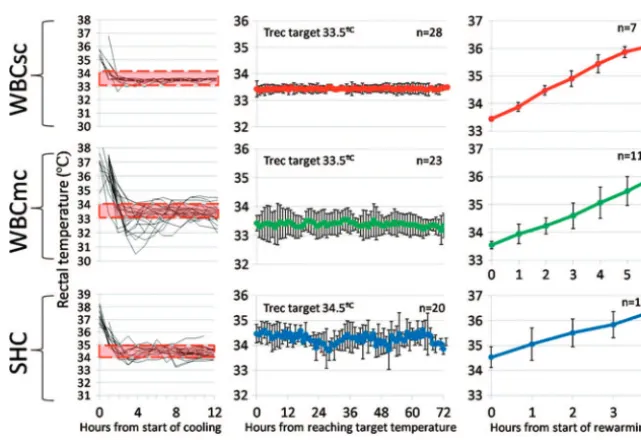
During this period, Trec fell to a mean ⫾ SD of 33.2 ⫾ 0.3°C for WBCsc, 32.2⫾0.7°C for WBCmc, and 33.8 ⫾ 0.3°C for SHC groups (Fig 1, left). Only in the WBCsc group did Trec not fall below target tempera-ture range. When cooling with a manually controlled mattress, Trec would often overshoot (ie, fall below the target range) during the initia-tion of hypothermia. The mean
maxi-mum overshoot was 0.3°C for WBCsc, 1.3°C for WBCmc, and 0.8°C for SHC groups. There was significantly greater overshoot in the manually controlled groups compared with the WBCsc group (SHC versus WBCsc,
P⬍ .05; WBCmc versus WBCsc,P⬍
.001).
Maintenance of Hypothermia
Mean ⫾ SD Trec was maintained within the target range in all 3 groups (33.4⫾0.2°C for WBCsc, 33.4⫾0.4°C for WBCmc, and 34.3⫾0.4°C for SHC; Fig 1, middle). There was a significantly
FIGURE 1
Left, Individual infants’ Trec during initiation phase. Overshoot was greater in WBCmc versus WBCsc group (P⬍.001). Middle, Mean⫾SD Trec during maintenance phase. Variation was greater in SHC and WBCmc groups versus WBCsc group (P⬍.001). Right, Mean⫾SD Trec during rewarming, over 4 hours (SHC) and 6 hours (WBC) as a result of different starting temperatures.
(n⫽2) (n⫽20) (n⫽23) (n⫽28)
Gestational age, mean⫾SD, wk 39.5⫾2.1 39.3⫾1.7 40.1⫾1.5 39.6⫾1.3 .39 Birth weight, mean⫾SD, g 3725⫾884 3075⫾653 3475⫾843 3299⫾554 .30
Girls,n(%) 1 (50) 11 (58) 8 (35) 15 (54) .27
5-min Apgar score, median (IQR) 5 4 (2–5) 2 (0–5) 4 (1–6) .19 10-min Apgar score, median (IQR) 5 5 (4–8) 4 (2–6) 5 (3–7) .19 Worst pH within 60 min of birth,
mean⫾SD
7.10 (0.10) 6.98 (0.10) 6.91 (0.20) 6.93 (0.20) .45
Worst base deficit within 60 min of birth, mean⫾SD
⫺15.5 (0.7) ⫺17.9 (5.6) ⫺17.6 (6.6) ⫺18.3 (5.5) .99
Not completing treatment,n(%) 0 (0) 0 (0) 3 (13) 5 (18) .17
greater variability in Trec with either manually controlled group compared with the WBCsc group (P⬍.001). There was no difference in variation of Trec between the SHC and WBCmc groups.
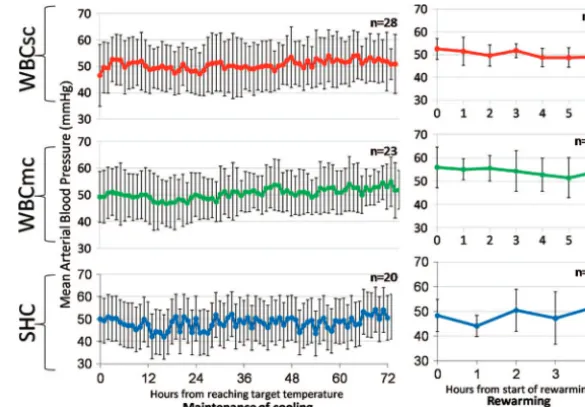
There was no difference in MABP (mean⫾SD) during the maintenance period of cooling between groups (49⫾8 mm Hg, for SHC, 51⫾8 mm Hg, for WBCmc, and 51 ⫾ 9 mm Hg, for WBCsc; Fig 2). Similarly, there was no difference in mean⫾SD HR during the maintenance period of cooling be-tween groups (107 ⫾ 22 beats per minute [bpm] for WBCsc, 105 ⫾ 16 bpm for WBCmc, and 103⫾16 bpm for SHC; Fig 3). There was significantly greater variation of both MABP (P⬍
.01) and HR (P⬍.001) during the main-tenance period in the WBCsc group when compared with the manually controlled groups. There was no statis-tical difference between groups in the number of infants who received inotro-pic support among those who com-pleted treatment (2P⫽.08).
Rewarming
In the CoolCap trial protocol, rewarm-ing time from Trec 34.5 to 37.0°C was 4 hours at a rate of⬃0.6°C/hour. In the TOBY protocol, rewarming time from 33.5 to 36.5°C was 6 hours at a rate of 0.5°C/hour. Since cooling was intro-duced to all infants with perinatal asphyxia (December 1, 2006), the rewarming speed has been individual-ized and may be⬍0.5°C/hour depend-ing on BP and occurrence of seizures. In our infants, median (range) rate of rewarming was 0.38 (0.30 – 0.80)°C/ hour in SHC, 0.39 (0.20 – 0.80)°C/hour in WBCmc, and 0.25 (0.10 – 0.50)°C/ hour in WBCsc groups. We compared infants who were rewarmed at a simi-lar rate with the 3 methods (Fig 1, right). Twelve infants in the SHC group, 11 infants in the WBCmc group, and 7 infants in the WBCsc group were re-warmed at a rate of 0.4°C. There was
significantly greater variation in Trec during the rewarming period in the SHC group when compared with the WBCsc group (P⬍.01). The SD of Trec in the WBCmc group (0.4) was double that of the WBCsc group (0.2), but this difference was not statistically signifi-cant. There was also greater variation in MABP in the WBCmc group when compared with the WBCsc group (Fig
2). There were no other statistical dif-ferences in MABP or HR between the groups during rewarming.
Cooling With Gloves
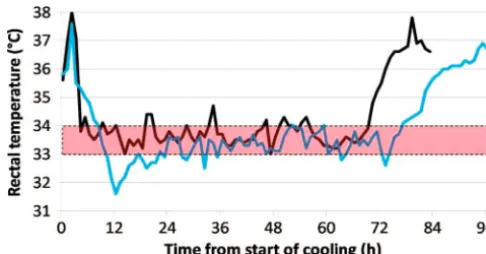
One infant was inadvertently over-cooled, and Trec fell to a low of 31.6°C (Fig 4). This was accompanied by a fall in HR to a nadir of 70 bpm. Trec re-mained within target range 74% of the
FIGURE 2
Left, Changes in mean⫾SD MABP during maintenance of cooling. Right, Changes in mean⫾SD MABP during rewarming.
FIGURE 3
Left, Changes in mean⫾SD HR during maintenance of cooling. Right, Changes in mean⫾SD HR during rewarming.
time. The MABP ranged from 30 to 80 mm Hg and HR ranged from 80 to 116 bpm during the maintenance period of cooling.
DISCUSSION
We compared 4 methods of TH for new-borns after perinatal asphyxia: selec-tive head cooling and 3 methods of WBC, 1 using water-filled gloves, an-other using a cooling mattress, and the other using a body wrap circulated with cold water. We found that using a WBCsc system minimizes overshoot during the initiation of cooling and re-duces fluctuation in Trec during the maintenance period of cooling when compared with WBCmc or selective head cooling. We applied all of these methods of cooling in the past 10 years and are, thereby, as a single institution able to exclude intercenter variability.
An ideal cooling system should induce rapid cooling to reach target tempera-ture without overcooling.16,17 Target
temperature should be maintained with minimal fluctuation. Rewarming should be controlled with minimal fluc-tuation and without overheating.18,19
The effect of the cooling method on he-modynamics should be minimal. A fully automated system with the appropri-ate safeguards is desirable.
Initiation of Hypothermia
The rate of cooling is determined by a complex interplay among the infant’s
endogenous heat production and size as well as the temperatures of the cooling device and environment. The phenomenon of overshoot is widely recognized after initiation of cooling with a manually controlled system1,3,12
but was not seen in infants who were cooled with a servo-controlled sys-tem.11Overshoot most likely occurs as
a result of the difficulty in anticipating the time to reach target temperature. The mattress (WBCmc) or cap temper-ature (SHC) was adjusted in reaction to the core temperature rather than in anticipation of it, whereas the auto-mated system (WBCsc) uses an elec-tronic algorithm that changes water temperature in response to changes in both skin and Trec. Peripheral vaso-constriction in the skin occurs when core temperature is about to drop but before any changes in Trec can be measured.20The algorithm may
antici-pate rather than react to a fall in core temperature, thereby minimizing over-shoot. Overshoot is of clinical signifi-cance because of the potential in-creased risk for adverse effects. Cooling to a core temperature be-tween 33 and 35°C has not been asso-ciated with an increase in serious ad-verse effects such as infection or hemorrhage1–3; however, the safety of
cooling below this point is uncertain. An increase in hematalogic and pulmo-nary complications has been observed when cooling below this range.7,21
Be-the core temperature would remain ⬎33°C despite a mean overshoot of 0.8°C.
Maintenance of Hypothermia
In the 4 cooling methods, Trec was maintained within target temperature ⫾0.5°C for 97% of the time in infants who were cooled with WBCsc, for 76% of the time in infants who were cooled with SHC, 81% of the time in infants who were cooled with WBCmc, and 74% of the time in infants who were cooled with gloves. In our experimen-tal pig model, in which regional brain temperature can be continuously re-corded with invasive temperature probes, a change in Trec is immedi-ately associated with a similar change in all areas of the brain from superfi-cial cortical areas to deep brain struc-tures such as the basal ganglia.22It
re-mains unclear whether large swings in brain temperature are detrimental to the injured brain that is undergoing TH. A method of cooling that maintains temperature within the target range but reduces temperature variability may be advantageous.
In our experimental model, we ob-served fluctuations in brain tempera-ture that coincide with regular changes (every 12 minutes) in water temperature up to 40°C within the servo-controlled wrap. Our practice is to insulate the infant’s head from the warm wrap to abolish these fluctua-tions.15 “Natural head cooling”
in-cludes heat dissipation from the head, and, as a physiologic principle, we do not cover the head with hats or let it rest on a warm surface.
An important practical consideration is that manually controlled systems demanded close observation of tem-perature and frequent adjustments of water/coolant temperature by an experienced practitioner, delivering
FIGURE 4
1-to-1 care. In addition, overcooling is difficult to avoid when endogenous heat production is attenuated by the administration of muscle relaxants, sedatives, or anticonvulsants.11,23 The
servo-controlled system required no adjustment to maintain stable Trec. As TH moves out of the trial setting and becomes a standard of care through-out the world, it is desirable to use a cooling method that is less labor-intensive and requires less specialist knowledge.
Although, the servo-controlled system achieved better stability in tempera-ture with a much reduced propensity to overshoot, there was increased variability in both MABP and HR with this method. Nevertheless, the means of both parameters remained within the desired ranges for a term infant in this clinical setting. Moreover, this magnitude of variation is commonly observed in infants who received in-tensive care and was not greater dur-ing hypothermia.
Rewarming
Good temperature control during re-warming is an important part of TH. Rapid rewarming may cause periph-eral vasodilation and hypotension. The ability of the heart to maintain ade-quate cardiac output may already be impaired by myocardial injury from the asphyxial insult. Furthermore, it has been observed that cerebral met-abolic rate for oxygen is increased and
cerebral fractional oxygen extraction is decreased during rapid rewarming after cardiopulmonary bypass,24,25and
seizures have been observed during rewarming both clinically and in ex-perimental models.14,26Certainly
post-hypoxic hyperthermia is associated with adverse outcome in noncooled infants.18,19
The results presented are from a ret-rospective analysis of infants who were sequentially recruited to studies, consequently, the treatment groups are not randomized. A limitation of small group sizes coupled with multi-ple confounders including occurrence of seizures is the difficulty to draw con-clusions regarding the effect of vari-ous cooling methods on long-term out-come. Clearly, there are inherent differences between WBC and SHC, such as temperature gradients within the brain that may or may not be im-portant in neuroprotection.27,28
Resolu-tion of this quesResolu-tion requires a larger cohort of infants who ideally have been randomly assigned between methods.
Other Servo-controlled Cooling Systems
Infants in the Eunice Kennedy Shriver National Institute of Child Health and Human Development trial of WBC were cooled by using a servo-controlled blanket with circulating water (Blanke-trol II Hyper-Hypothermia System [Cin-cinnati Sub-Zero, Cin[Cin-cinnati, OH]).2
Core temperature was measured with
an esophageal probe and lowered to then maintained at 33.5°C. This system was associated with an initial over-shoot to a mean of 32.7°C that is un-likely to be clinically significant. This method achieved a mean core temper-ature of 33.4 ⫾0.9°C (25th and 75th percentiles, 33.2 and 33.5°C); however, a second, larger blanket attached to the cooling system was needed to at-tenuate the variation in esophageal temperature.29
Recently described is a custom-made servo-controlled fan used in conjunc-tion with a servo-controlled radiant warmer.10 Three fans that normally
are used to cool desktop computers direct room temperature air cephalo-caudally over the infant. They achieved a mean Trec of 33.6°C with an SD of 0.1 to 0.2°C in a pilot study of 10 infants.
CONCLUSIONS
The 4 methods of cooling that we exam-ined all maintaexam-ined Trec within a nar-row target range; however, the over-shoot and variation in temperature were reduced when a servo-controlled system was used compared with a manually controlled system.
ACKNOWLEDGMENTS
We thank University Hospital Bristol, Olympic Medical US, MRC UK, and Lae-rdal Foundation for Acute Medicine Norway for supporting organizational, staff, and equipment costs that were necessary for obtaining and analyzing data.
REFERENCES
1. Gluckman PD, Wyatt JS, Azzopardi D, et al. Selective head cooling with mild sys-t e m i c h y p o sys-t h e r m i a a f sys-t e r n e o n a sys-t a l encephalopathy: multicentre randomised trial.Lancet.2005;365(9460):663– 670
2. Shankaran S, Laptook AR, Ehrenkranz RA, et al. National Institute of Child Health and Human Development Neonatal Research Network. Whole-body hypothermia for ne-onates with hypoxic-ischemic encephalop-athy.N Engl J Med.2005;353(15):1574 –1584
3. Azzopardi DV, Strohm B, Edwards AD, et al.
Moderate hypothermia to treat perinatal asphyxial encephalopathy [published cor-rection appears inN Engl J Med.2010; 362(11):1056].N Engl J Med.2009;361(14): 1349 –1358
4. Simbruner G, Haberl C, Harrison V, Linley L, Willeitner AE. Induced brain hypothermia in asphyxiated human newborn infants: a ret-rospective chart analysis of physiological and adverse effects.Intensive Care Med.
1999;25(10):1111–1117
5. Azzopardi D, Robertson NJ, Cowan FM,
Ruth-erford MA, Rampling M, Edwards AD. Pilot study of treatment with whole body hypo-thermia for neonatal encephalopathy. Pedi-atrics.2000;106(4):684 – 694
6. Thoresen M, Whitelaw A. Cardiovascular changes during mild therapeutic hypother-mia and rewarming in infants with hypoxic-ischemic encephalopathy.Pediatrics.2000; 106(1):92–99
8. Horn AR, Woods DL, Thompson C, Els I, Kroon M. Selective cerebral hypothermia for post-hypoxic neuroprotection in neonates using a solid ice cap.S Afr Med J.2006;96(9 pt 2): 976 –981. Available at: www.abstracts2view. com/pasall/search.php?adv⫽15155.5. Ac-cessed April 24, 2009
9. Robertson NJ, Nakakeeto M, Hagmann C, et al. Therapeutic hypothermia for birth as-phyxia in low-resource settings: a pilot ran-domised controlled trial.Lancet.2008; 372(9641):801– 803
10. Horn A, Thompson C, Woods D, et al. Induced hypothermia for infants with hypoxic- isch-emic encephalopathy using a servo-controlled fan: an exploratory pilot study.
Pediatrics. 2009;123(6). Available at: www.pediatrics.org/cgi/content/full/123/ 6/e1090
11. Thoresen M. Supportive care during neuro-protective hypothermia in the term newborn: adverse effects and their preven-tion.Clin Perinatol.2008;35(4):749 –763
12. Azzopardi D, Strohm B. Temperature control during therapeutic moderate whole body hypothermia for neonatal encephalopathy.
Arch Dis Child Fetal Neonatal Ed.2009;Aug 13 [epub ahead of print]
13. Kiyatkin EA, Sharma HS. Permeability of the blood-brain barrier depends on brain tem-perature. Neuroscience. 2009;161(3): 926 –939
14. Battin M, Bennet L, Gunn AJ. Rebound sei-zures during rewarming.Pediatrics.2004; 114(5):1369
of piglets. E-PAS2009:5155.5 Available at: w w w . a b s t r a c t s 2 v i e w . c o m / p a s a l l / search.php?adv⫽1 5155.5. Accessed April 24, 2009
16. Gunn AJ, Gunn TR, Gunning MI, Williams CE, Gluckman PD. Neuroprotection with pro-longed head cooling started before post-ischemic seizures in fetal sheep.Pediatrics.
1998;102(5):1098 –1106
17. Laptook AR, Corbett RJ, Sterett R, Burns DK, Garcia D, Tollefsbol G. Modest hypothermia provides partial neuroprotection when used for immediate resuscitation after brain ischemia. Pediatr Res. 1997;42(1): 17–23
18. Laptook A, Tyson J, Shankaran S, et al. Ele-vated temperature after hypoxic-ischemic encephalopathy: risk factor for adverse out-comes.Pediatrics.2008;122(3):491– 499
19. Wyatt JS, Gluckman PD, Liu PY, et al. Deter-minants of outcomes after head cooling for neonatal encephalopathy.Pediatrics.2007; 119(5):912–921
20. Froese G, Burton A. Heat losses from the human head.J Appl Physiol. 1957; 10(2): 235–241
21. Compagnoni G, Bottura C, Cavallaro G, Cris-tofori G, Lista G, Mosca F. Safety of deep hypothermia in treating neonatal asphyxia.
Neonatology.2008;93(4):230 –235
22. Thoresen M, Simmonds M, Satas S, Tooley J, Silver I. Effective selective head cooling dur-ing posthypoxic hypothermia in newborn piglets.Pediatr Res.2001;49(4):594 –599
background and its clinical use.Semin Neo-natol.2000;5(1):61–73
24. Enomoto S, Hindman BJ, Dexter F, Smith T, Cutkomp J. Rapid rewarming causes an in-crease in the cerebral metabolic rate for oxygen that is temporarily unmatched by cerebral blood flow: a study during cardio-pulmonary bypass in rabbits. Anesthesiol-ogy.1996;84(6):1392–1400
25. Wardle SP, Yoxall CW, Weindling AM. Cere-bral oxygenation during cardiopulmonary bypass.Arch Dis Child.1998;78(1):26 –32
26. Gerrits LC, Battin MR, Bennet L, Gonzalez H, Gunn AJ. Epileptiform activity during re-warming from moderate cerebral hypo-thermia in the near-term fetal sheep. Pedi-atr Res.2005;57(3):342–346
27. Laptook AR, Shalak L, Corbett RJ. Differ-ences in brain temperature and cerebral blood flow during selective head versus whole-body cooling.Pediatrics.2001;108(5): 1103–1110
28. Karlsson M, Tooley J, Satas S, et al. Delayed hypothermia as selective head cooling or whole body cooling does not protect brain or body in newborn pig subjected to hypoxia-ischemia.Pediatr Res.2008;64(1): 74 – 80
DOI: 10.1542/peds.2009-2995 originally published online June 7, 2010;
2010;126;e124
Pediatrics
Nicholas Hoque, Ela Chakkarapani, Xun Liu and Marianne Thoresen
Perinatal Asphyxia
A Comparison of Cooling Methods Used in Therapeutic Hypothermia for
Services
Updated Information &
http://pediatrics.aappublications.org/content/126/1/e124
including high resolution figures, can be found at:
References
http://pediatrics.aappublications.org/content/126/1/e124#BIBL
This article cites 26 articles, 9 of which you can access for free at:
Subspecialty Collections
sub
http://www.aappublications.org/cgi/collection/fetus:newborn_infant_
Fetus/Newborn Infant following collection(s):
This article, along with others on similar topics, appears in the
Permissions & Licensing
http://www.aappublications.org/site/misc/Permissions.xhtml
in its entirety can be found online at:
Information about reproducing this article in parts (figures, tables) or
Reprints
http://www.aappublications.org/site/misc/reprints.xhtml
DOI: 10.1542/peds.2009-2995 originally published online June 7, 2010;
2010;126;e124
Pediatrics
Nicholas Hoque, Ela Chakkarapani, Xun Liu and Marianne Thoresen
http://pediatrics.aappublications.org/content/126/1/e124
located on the World Wide Web at:
The online version of this article, along with updated information and services, is
by the American Academy of Pediatrics. All rights reserved. Print ISSN: 1073-0397.