S T U D Y P R O T O C O L
Open Access
Design of the Weight-loss Endoscopy Trial
(WET): a multi-center, randomized,
controlled trial comparing weight loss in
endoscopically implanted duodenal-jejunal
bypass liners vs. intragastric balloons vs. a
sham procedure
Marcus Hollenbach
1*, Christiane Prettin
2, Felix Gundling
3, Wolfgang Schepp
3, Jochen Seufert
4, Jürgen Stein
5,
Thomas Rösch
6, Jens Aberle
7, Jürgen Feisthammel
1, David Petroff
2†and Albrecht Hoffmeister
1†Abstract
Background:Obesity is a global problem leading to reduced life expectancy, cardiovascular diseases, diabetes and many types of cancer. Even people willing to accept treatment only achieve a mean weight loss of about 5 kg using commercial weight loss programs. Surgical interventions, e.g. sleeve gastrectomy or gastric bypass are effective but accompanied by risk of serious complications and side effects. Less invasive endoscopic procedures mainly comprise the intragastric balloon (IB) and the duodenal-jejunal bypass liner (DJBL). To date, a randomized comparison between these devices has not been undertaken or shown to be superior to a sham procedure. Methods:We designed a multi-center, randomized, patient and assessor-blinded, controlled trial comparing weight loss in endoscopically implanted IB vs. DJBL vs. a sham procedure. A total of 150 patients with a BMI > 35 kg/m2 or > 30 with obesity-related comorbidities and indication for proton pump inhibitors are randomized to receive either IB, DJBL or a sham gastroscopy (2:2:1 ratio). All participants undergo regular dietary consultation. The IB will be removed after 6 months, whereas the DJBL will be explanted after 12 months. All patients will receive
gastroscopies at implantation and explantation of the devices or sedation without gastroscopy to maintain blinding. Main exclusion criteria are malignant diseases, peptic ulcer or previous bariatric intervention. Weight loss 12 months after explantation of the devices, changes in comorbidities, quality of life, complication rates and safety will be evaluated.
Discussion:This trial could help to identify the most effective and safest endoscopic device, thus determining the new standard procedure for endoscopic bariatric treatment.
Trial registration:16th January 2017. DRKS00011036. Funded by the German Research Foundation (DFG).
Keywords:Obesity, Endoscopy, Diabetes, Weight loss, Intragastric balloon, Bypass liner
* Correspondence:[email protected]; [email protected]
†David Petroff and Albrecht Hoffmeister contributed equally to this work. 1Department of Medicine, Neurology and Dermatology; Division of
Gastroenterology and Rheumatology, University of Leipzig, Liebigstrasse 20, D-04103 Leipzig, Germany
Full list of author information is available at the end of the article
Background
Obesity is a growing global problem and an estimated 312 million people worldwide are affected [1]. Many studies have shown reduced life expectancy, higher risk of cardio-vascular, pulmonary and gastrointestinal diseases, diabetes and many types of cancer to be associated with obesity [2]. Managing obesity is often disappointing as lifestyle alter-ations are an important, but frequently inadequate inter-vention. Although even moderate weight loss of 5–10% of body weight is associated with a meaningful improvement in insulin resistance, blood pressure and dyslipidemia [2,3], only 20% of obese people are willing to accept treatment [1]. In addition, conservative treatment results only in mean weight loss of about 5 kg after one year using commercial weight loss programs and less than 2.5 kg using standard care. Moreover, only two thirds complete their respective programs even in the study setting [4].
Interventional surgical options comprise mostly sleeve gastrectomy and gastric bypass. These are effective but irreversible and associated with risk of serious perioperative complications, malabsorption and necessity of dietary supplementation. Furthermore, gastrointestinal symptoms such as reflux or vomiting occur in up to 20% of cases and in more than 10% of patients repeated surgery is required [5,
6]. Thus, many patients are unwilling to undergo this far-reaching step, and limited resources restrict surgical in-terventions to a small proportion of potential candidates.
In contrast, bariatric endoscopic procedures are revers-ible, minimally invasive, less costly and may offer a poten-tially lower risk approach compared to bariatric surgery [7]. These endoscopic approaches limit oral food intake, gastric exclusion or evoke malabsorption by partially inhi-biting the breakdown or absorption of nutrients [8]. Intra-gastric balloons (IB) have been used for over 30 years and have been evaluated in many studies. They promote weight loss by physically decreasing intragastric volume and increasing gastric empting time. IB is usually removed after 6 months although recent devices allow implantation for up to 12 months [9]. Repeated implantations or imple-mentation as an initial therapy prior to bariatric surgery are also feasible [10]. Serious side effects were very rare, with an incidence of migration and gastric perforation of 1.4 and 0.1%, respectively [11]. A large multicenter data-base analysis found a mean weight loss of 9.2 kg after 6 months and improvements of 5.1 kg after 3 years [12]. Nevertheless, in this analysis patients were included who had received additional therapy (lapband, gastric bypass or sleeve gastrectomy) after explantation of the balloons. In addition, many patients benefit from IB beyond explant-ation and relevant comorbidities such as arterial hyperten-sion, diabetes or dyslipidemia were improved in about 50% of subjects [9, 13]. Nevertheless, although patients with IB reached a weight loss as high as 17.8 kg (> 10% of baseline) after 1 year in nonrandomized trials [14], some
double-blinded, randomized, sham-controlled trials failed to show superiority of this device. Moreover, many pa-tients did not achieve the goal of > 25% excess weight loss (EWL) or > 10% of baseline weight [15–17] and evidence of long-term effects is lacking [14]. Therefore, other endo-scopic devices and strategies for the therapy of obesity have been developed.
The duodenal-jejunal bypass liner (DJBL) is an imperme-able, fluoropolymer tube reversibly anchored to the duo-denal bulb. Thereby, the chyme passes through the liner, while pancreatic and bile fluid passes outside the tube, resulting in an effective prevention of digestion and absorp-tion in the upper intestine. The DJBL also has restrictive ef-fects due to limited diameter of the sleeve and decelerated gastric emptying [18]. DJBL was originally developed for therapy of diabetes but is also known to induce consider-able EWL of 19% [19] or 8.2 kg (EWL 11.9, 62% of partici-pants achieved > 10% EWL) [20] up to 22.1 kg (EWL 47%) [21] after one year. In a six month follow-up after removal of the DJBL, some patients showed weight regain but con-tinued to have a significantly higher weight loss compared to sham group [22]. Nevertheless, in analysis of both DJBL and IB, most studies evaluated excess weight loss (> 25% EWL) for definition of successful weight reduction. How-ever, EWL strongly depends on baseline BMI and thus has unwanted properties [23,24].
DJBL also improved glycemic control in obese patients with diabetes, and HbA1c was reduced from 8.7 ± 0.9% to 7.5 ± 1.6% [25]. These results were confirmed by sev-eral studies and a large meta-analysis [11,18,21,26–29]. Furthermore, data indicating influence of DJBL on incre-tin hormone regulation and amelioration of fatty liver disease exist but remains preliminary [22,26,30,31].
Although both devices were safe and showed mostly minor gastrointestinal complaints [7], a large multicenter study was dropped due to a high incidence of liver ab-scesses (3.5%) and an 11.7% rate of adverse events requiring removal of the DJBL (NCT01728116). In contrast, other studies did not observe such high rates of complications. In detail, serious adverse events in DJBL included migration (4.9%), GI bleeding (3.86%), sleeve obstruction (3.4%), liver abscess (0.126%), cholangitis (0.126%), acute cholecystitis (0.126%), and esophageal perforation (0.126%) secondary to trauma from an uncovered withdrawal [11].
Methods / design
Trial organization and coordination
WET is designed and coordinated by the Division of Gastroenterology and Rheumatology together with the Clinical Trial Center, both at the University of Leipzig. WET will be conducted as a multi-center trial in Germany including the Sachsenhausen Clinic in Frank-furt, Bogenhausen Clinic in Munich, University Medical Center in Freiburg and University Medical Center Hamburg-Eppendorf in Hamburg.
The trial is sponsored by the German Research Foundation (DFG), which is not involved in the data-base management and has no access to randomization codes.
Investigators
Patients will be recruited by the participating centers. All centers committed their participation in a covenant agreement with the trial coordinating institution. All in-vestigators are experienced gastroenterologists and endoscopists and are certified as trial investigators who have attended additional courses on conducting trials ac-cording to the medical devices law.
Data safety and monitoring board
An independent data safety and monitoring board consisting of three independent experts from the fields of gastroenterology, endocrinology and medical statistics will evaluate and supervise the clinical re-search data to assure patient safety and study integ-rity. The board will monitor the trial data, in particular the safety data and give their advice based on the periodical reviews.
Medical device supply
The following medical devices will be used in this study. The EndoBarrier® system (endoscopically im-planted DJBL, GI Dynamics, Duesseldorf, Germany, CE010311) and the Orbera Intragastric Balloon™ (Apollo Endosurgery, San Diego, USA, CE27493) are provided non-commercially by the study center. The DJBL will be implanted over a period of 12 months and the IB for a period of 6 months.
On-site monitoring
On-site monitoring of the centers will be performed according to good clinical practice (ICH-GCP) guide-lines. Personal visits will be carried out according to the SOPs of the Clinical Trial Center at Leipzig Uni-versity. Clinical monitors will review entries into pa-tient files (CRFs) on the basis of source documents (minimum of 30% source data verification). Monitors will verify source data and compliance with the pro-cedures laid out in the trial protocol.
Ethical considerations
The final study protocol was approved by the ethics committee of the Medical Faculty of the University of Leipzig (Trial registration number: DRKS00011036 on DRKS at 16th January 2017) in accordance with the dec-laration of Helsinki, the “Medical Association’s Profes-sional Code of Conduct”and the principles of ICH-GCP guidelines (issued in June 1996, ISO14155 from 2012). In addition, the German Medical Devices Act (MPG, §§ 20-23a) was followed. Furthermore, local legal and regu-latory authorities as well as the medical secrecy and the Federal Data Protection Act will be followed. All local ethics committees of the participating centers consented to the master ethics committee approval. Prior to enroll-ment, each patient will be given detailed information about the aims, scope and possible consequences of the trial by a physician. No diagnostic or interventional pro-cedures required for the clinical trial will be performed without obtaining written consent from the patient.
Study objectives
The primary objective of this study is to compare suc-cess rates (defined as≥10% weight reduction from base-line weight) between the three procedures one year after removal. The primary analysis will use a generalized lin-ear mixed model (GLMM) and a closed-testing proced-ure, meaning the three pairwise comparisons can be made without adjustment of the significance level if the global test is significant. Secondary aims include per-centage weight loss at 12 months and success rates as well as percentage weight loss at 6 months and upon re-moval of the devices. In addition, complication rates and safety will be examined. Changes in obesity-related co-morbidities (diabetes and associated diseases, hyperten-sion, dyslipidemia, renal failure, coronary artery disease, heart failure, endocrinologic and psychiatric disorders, fatty liver and pulmonary diseases) and quality of life will also be assessed.
Study design and setting
Each site is required to have an endoscopy unit which meets all German quality standards. The possibility to per-form endoscopies under fluoroscopy is mandatory. All par-ticipating centers will perform endoscopies under conscious sedation or general anesthesia with qualified anesthetists. All sites will appoint blinded and unblinded investigators and all unblinded investigators are experienced endosco-pists. They are trained in the implantation procedure of the DJBL device in pigs and have independently implanted at least 10 DJBLs and 10 IBs. The blinded investigator will at-tend the patient at all study visits and will be in charge of all
patient contacts except the endoscopies, thus ensuring the assessor blinded nature of the study.
Patients
In all participating sites, adult patients (≥ 18 years of age) with a BMI≥35 kg/m2or≥30 kg/m2and obesity related co-morbidities, will be screened for eligibility for the trial. Obesity-related comorbidities comprise arterial hyperten-sion, diabetes and associated diseases, cardiovascular dis-eases, dyslipidemia, arthrosis, obstructive sleep apnea as well as endocrinologic, psychiatric and gastrointestinal diseases.
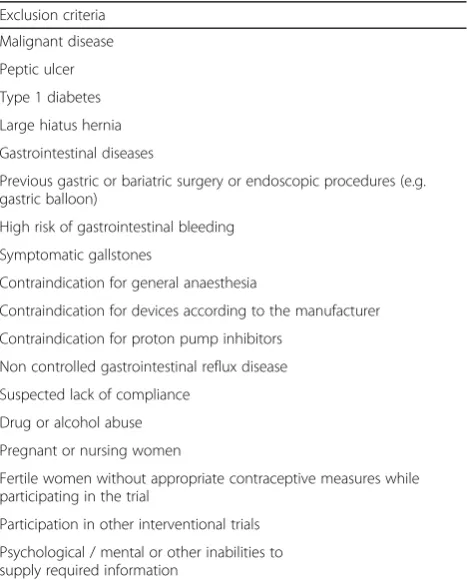
Prior to enrollment, all participants attempted conserva-tive weight-loss therapy that was ineffecconserva-tive. Furthermore, all patients must have a medical indication for the long term use of proton pump inhibitors (PPI), due to the fact that PPI are mandatory for the implantation of DJBLs and could affect the primary endpoint differently from placebo. Exclusion criteria for the study are listed in Table 1. Add-itionally, a gastroduodenoscopy has to be performed in all participants within three months before recruitment to ex-clude gastric or duodenal ulcer or a large hiatal hernia.
Sample size considerations
The primary end point for the trial is successful weight loss 12 months after device removal. Removal is defined to be the true time of removal, if a device is explanted, or the date of endoscopy at 6 months, as will be the case for the sham group. Successful weight loss is defined to be a loss of at least 10% of the baseline weight. Different definitions of success have been recommended including excess weight loss [11]. However, EWL strongly depends on baseline BMI and thereby has considerable inaccuracies [24].
We estimated proportions of weight loss and the de-vices’ failures rates based on previously published work [12, 14–17, 19, 21]. At the end of the intervention, we anticipate 13.6, 8.3 and 6.1% weight loss for the com-pleters in the DJBL, IB and sham arms, respectively. We assume a regain of 74% in the year follow-up for all
three arms leading to estimates of 10.4, 6 and 3.9% weight loss for the “completers” of DJBL, IB and sham. After taking into account the expected failure rates of 15% (DJBL) and 10% (IB) and a drop-out rate of 10%, we estimate weight loss of 7.8, 4.8 and 3.5%, respectively. With a standard deviation of 4.8%, we expect successful weight reduction in 40, 16 and 9% of the respective participants.
Simulations show that at the 5% significance level, one has a power of 93% for the global test, 88% for the com-parison between DJBL and sham and 84% between DJBL and IB with 150 patients. The secondary outcome of percentage weight loss would then have 89% power for the global test, 88% for the comparison between DJBL and sham and 75% between DJBL and IB. The width of the confidence interval for this last comparison would nonetheless be quite narrow at 4.3 percentage points and thus close to the limit of what can be considered a clinically relevant difference of 4 percentage points [32].
Regarding loss of follow up, compliance in the traditional sense is not an issue in this trial. The endoscopic devices cannot be explanted by the patient and any deviations from the recommended diet are part of the“real world”behavior that should be taken into account in the trial. On the other hand, problems with implantation and device failure take the place of compliance and are expected to be an issue. The failure estimates in the available literature vary wildly in the case of the DJBL from 0/16 (0%) over the course of one year [25] to 12/25 (48%) over the course of 12 weeks [20] and it was necessary to base our estimates of 15% for the DJBL and 10% for the IB on experience from our own uni-versity hospital. Loss to follow-up after removal is difficult to estimate because of the lack of data for long-term follow-up in comparable populations, yet we estimate a con-servative 10%.
Blinding and randomization
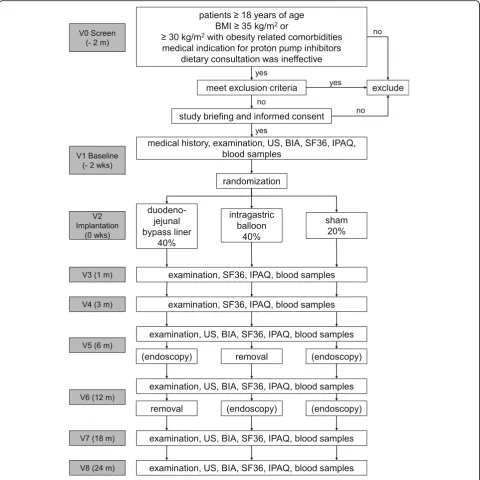
The study will be conducted in a patient and assessor-blinded fashion. Upon recruitment, each pa-tient will receive a unique identification number to en-sure both blinding of the patient and study team as well as identification after the end of the trial. Only the un-blinded study team (implanters) will keep a personal list of patient numbers and names to match to patient re-cords. After patients’ written informed consent has been obtained, the patient will be randomly assigned (1:2:2) either to the sham group (endoscopy in sedation) or one of the interventional groups (DJBL or IB), stratified with respect to diabetes status (yes/no) and center. The randomization will be performed electronically and every study participant can be identi-fied by an ongoing unique randomization number. Randomization is organized and performed by the Cen-ter for Clinical Studies at the University of Leipzig and
Table 1Exclusion criteria
Exclusion criteria
Malignant disease
Peptic ulcer
Type 1 diabetes
Large hiatus hernia
Gastrointestinal diseases
Previous gastric or bariatric surgery or endoscopic procedures (e.g. gastric balloon)
High risk of gastrointestinal bleeding
Symptomatic gallstones
Contraindication for general anaesthesia
Contraindication for devices according to the manufacturer
Contraindication for proton pump inhibitors
Non controlled gastrointestinal reflux disease
Suspected lack of compliance
Drug or alcohol abuse
Pregnant or nursing women
Fertile women without appropriate contraceptive measures while participating in the trial
Participation in other interventional trials
reported to the PI-center by fax within 24 h. The randomization codes are kept under lock and control, and they will be accessible 24 h a day in case of emer-gency code break.
Statistical analysis
The primary end point for the trial is successful weight loss 12 months after removal. Successful weight loss is defined to be W12month/WBaseline≤0.9. The probability of successful
weight loss per randomization arm, p(success), is estimated to
be the proportion of patients in that arm with successful weight loss. The null hypothesis of the trial is pDBJL(success)
= pIB(success) = psham(success). As mentioned above,
pri-mary and secondary study objectives will be analyzed by using a generalized linear mixed model (GLMM), which can take into account the longitudinal structure of the data as well as missing data. The stratification attribute diabetes will be included as a covariate in the model and a closed-testing procedure will be used. Thus, the three pair-wise tests will be performed if the global test is signifi-cant, where adjustment for the significance level is then un-necessary. Odds ratios and absolute differences in proportions along with confidence intervals based on the lo-gistic regression will be presented. A sensitivity analysis will be performed in which the missing primary outcome will be treated as a failure, since dropping out is often rooted in poor weight loss. As a further sensitivity analysis, the 2 × 3 contingency table will be analyzed with a chi-squared test. A final sensitivity analysis will use the imputation results from the analysis of the continuous variable to define suc-cess/failure. Secondary analyses of weight as a continuous parameter will use a linear mixed model, but otherwise fol-low the lines of the primary analysis. As a sensitivity ana-lysis, multiple imputation will be performed. Tests are all two-sided and the significance level is set at 5%.
The final analysis will be performed after the last pa-tient has terminated the trial, and no interim analyses are planned.
Treatment scheme
All recruited patients fulfilling inclusion criteria and under therapy with PPI will be randomized to receive sham endoscopy, DJBL or IB implantation. Sham endos-copy and IB will be performed under sedation whereas DJBL has to be implanted under general anesthesia. To maintain blinding, all participants will receive anesthetic informed consent and anesthesia will be performed after intravenous sedation prior to intubation. The sham group will always receive conscious sedation but will not be told that the choice of anesthetic is related to the study arm. The implantation of both devices or the initial sham endoscopy and the explantation after 12 months (DJBL) will be carried out as inpatient
procedures. The following endoscopies after 6 months are planned to be outpatient examinations.
All patients will receive regular dietary consultations, clinical examinations, anthropometry, taking of blood samples for analysis of comorbidities (e.g. fasting blood glucose, HbA1c, lipids, inflammatory markers) and bio-electric impedance measurement (BIA). To evaluate hepatic abscesses as might occur as a complication of DJBL, periodic abdominal sonography (US) will be con-ducted. Furthermore, study patients will be evaluated for concomitant medication, obesity related comorbidi-ties and adverse events or side effects. In addition, par-ticipants will complete the SF36 quality of life questionnaire at frequent intervals (see Fig. 1 for de-tailed trial flow chart). To conduct the above men-tioned examinations, all patients are requested to attend study visits 1, 3, 6, 12 and 24 months after im-plantation of the devices or initial sham endoscopy. The study participation will be completed 24 months after implantation or baseline endoscopy. In the event of premature explantation of the device (e.g. due to ab-dominal pain or other complications), patients will be observed for an additional 12 months. To ensure blind-ing of the study, only the unblinded study team is per-mitted to perform the explantation.
Furthermore, the success of patient and assessor blind-ing will be analyzed and presented.
Safety considerations
The safety of this trial will be evaluated based on the frequency of adverse events (AEs) and serious adverse events (SAEs) defined in DIN EN ISO 14155:11, sec-tion “Discussion”.2 and section “Discussion”.37. In addition, adverse device events (ADEs), serious ad-verse device effects (SADEs) and unanticipated serious adverse device events (USADEs) will be determined according to Medical Devices Safety Regulation §2. All AEs will be summarized and presented for the whole study group and each individual patient. The most common AEs (occurring in at least 10% of the appropriate group) will be determined. Laboratory data will be summarized by presenting summary and changes from baseline values (means, medians, stand-ard deviations, ranges). The analysis of safety and tol-erability will be based on all patients entered either into the DJBL or IB arm who received implantation of a device.
use of only small doses of sedatives that are required to ensure blinding in the sham group.
Discussion
Obesity is a global problem leading to associated cardio-vascular and endocrinologic complications and reduced quality of life [33]. Conservative programs are often inef-fective [4] whereas surgical procedures are irreversible and accompanied with serious complications as well as side effects and resources are unavailable for treating most patients [6]. Thus, endoscopic procedures present an im-portant alternative. Previous studies showed both the feasibility and safety of DJBL and IB but revealed highly inconsistent data regarding effectiveness in weight loss. Only a few trials compared endoscopic interventions with sham procedures. Although some studies reported negli-gible weight loss in sham groups of 2–3 kg after 12 weeks [17,20], others found a weight loss of as high as 12 kg as high as in the IB group [15]. These considerations lead to the necessity of a prospective, multi-center, randomized, controlled trial comparing weight loss in DJBL as com-pared to IB and sham group.
Thus, the WET trial aims to evaluate the superiority of DJBL and IB to sham group or each other in a patient and assessor-blinded setting. The primary objective of this study is weight loss≥10% from baseline weight one year after removal of the devices. Secondary aims comprise proportion of weight loss, changes in obesity-related co-morbidities and quality of life. Furthermore, complication rates of the devices and safety will be examined due to the fact that some studies showed an elevated risk of liver ab-scesses after implantation of DJBL [11].
The statistic calculation was carefully performed to en-sure that the study is not underpowered. The novelty of our study design is that the WET study compares two endoscopic devices with different modes of action and different implantation periods related to the sham group. To ensure blinding of the study, all patients will undergo three endoscopies or sedation without gastroscopy, re-spectively. Although these requirements lead to a com-plex study protocol, the WET study will hopefully clarify important questions in endoscopic and conservative management of obesity.
Conclusions
Assuming they are superior to a sham procedure, the more effective and safer device between DJBL and IB could become a more standard intervention for the ther-apy of obesity and its complications.
Abbreviations
DJBL:duodenal-jejunal bypass liner; EWL: excess weight loss; IB: intragastric balloon; PPI: proton pump inhibitor; US: abdominal sonography
Acknowledgements
The authors declare that they have no conflict of interest. We like to thank Tiffany Schaumburg for her critical language editing. We acknowledge support from the German Research Foundation (DFG) and Universität Leipzig within the program of Open Access Publishing.
Participating centers and ethic committees:
Clinic for Internal Medicine; Division of Gastroenterology; Sachsenhausen Clinic
– ethics committee of the Medical Faculty of the State Authorisation Association for Medical Issues; Hesse, Im Vogelsang 3, 60,488 Frankfurt; Germany
Clinic for Gastroenterology, Hepatology and Gastrointestinal Oncology; Bogenhausen Clinic; Munich
– ethic committee of the Medical Faculty of the Technical University Munich; Ismaninger Str. 22, 81,675 Munich; Germany
Clinic for Internal Medicine II; Division of Endocrinology and Diabetology; University of Freiburg
– ethic committee of the Albert-Ludwigs-University Freiburg, Engel-berger Str. 21, 79,106 Freiburg; Germany
Authors’contribution
Conception and design: MH, AH, CP, DP. Acquisition of data: not applicable. Analysis and interpretation of data: not applicable. Drafting the manuscript: MH. Revising the manuscript: AH, CP, DP, FG, WS, JoSe, JüSt, RT, JA, JF. Final approve to the submitted version: MH, AH, CP, DP, FG, WS, JoSe, JüSt, RT, JA, JF. Funding: AH, CP, DP. All authors agreed to be accountable for all aspects of the work in ensuring that questions related to the accuracy or integrity of any part of the work are appropriately investigated and resolved. All authors read and approved the final manuscript.
Competing interests.
The authors declare that they have no competing interests.
Funding
The trial is sponsored by the German Research Foundation (DFG; HO 2493/ 4–1), which is not involved in the database management (collection, analysis, interpretation of data) and has no access to randomization codes. The funding body did not participate in designing the study or writing the manuscript. The study protocol has undergone peer-review process by the funding body.
Ethics approval and consent to participate
The final study protocol was approved by the ethics committee of the Medical Faculty of the University of Leipzig (Kaethe-Kollwitz-Str. 82, 04109 Leipzig; Germany; Trial registration number: DRKS00011036 on DRKS at 16th January 2017) in accordance with the declaration of Helsinki, the“Medical Association’s Professional Code of Conduct”and the principles of ICH-GCP guidelines (issued in June 1996, ISO14155 from 2012). In addition, the Ger-man Medical Devices Act (MPG, §§ 20-23a) was followed. Furthermore, local legal and regulatory authorities as well as the medical secrecy and the Fed-eral Data Protection Act will be followed. All local ethics committees of the participating centers consented to the master ethics committee approval. Prior to enrollment, each patient will be given detailed information about the aims, scope and possible consequences of the trial by a physician. No diagnostic or interventional procedures required for the clinical trial will be performed without obtaining written consent from the patient.
Consent for publication Not applicable.
Publisher’s Note
Author details
1Department of Medicine, Neurology and Dermatology; Division of
Gastroenterology and Rheumatology, University of Leipzig, Liebigstrasse 20, D-04103 Leipzig, Germany.2Clinical Trial Center Leipzig, University of Leipzig, Leipzig, Germany.3Clinic for Gastroenterology, Hepatology and
Gastrointestinal Oncology; Bogenhausen Clinic, Munich, Germany.4Clinic for
Internal Medicine II; Division of Endocrinology and Diabetology, University of Freiburg, Freiburg, Germany.5Clinic for Internal Medicine; Division of Gastroenterology; Sachsenhausen Clinic, Frankfurt, Germany.6Clinic for
Interdisciplinary Endoscopy; Center for Radiology and Endoscopy, University of Hamburg-Eppendorf, Hamburg, Germany.7Clinic for Endocrinology,
Diabetology, Adiopsity and Lipids, University of Hamburg- Eppendorf, Hamburg, Germany.
Received: 24 November 2017 Accepted: 28 June 2018
References
1. Haslam DW, James WP. Obesity. Lancet. 2005;366(9492):1197–209. 2. Jensen MD, Ryan DH, Apovian CM, Ard JD, Comuzzie AG, Donato KA, et al.
2013 AHA/ACC/TOS guideline for the management of overweight and obesity in adults: a report of the American College of Cardiology/American Heart Association task force on practice guidelines and the Obesity Society. Circulation. 2014;129(25 Suppl 2):S102–38.
3. Garvey WT, Mechanick JI, Brett EM, Garber AJ, Hurley DL, Jastreboff AM, et al. American ASSOCIATION of clinical endocrinologists and AMERICAN COLLEGE of endocrinology comprehensive clinical practice guidelines for medical care of patients with obesity. Endocr Pract. 2016;22(Suppl 3):1–203. 4. Jebb SA, Ahern AL, Olson AD, Aston LM, Holzapfel C, Stoll J, et al. Primary
care referral to a commercial provider for weight loss treatment versus standard care: a randomised controlled trial. Lancet. 2011;378(9801):1485–92. 5. Hammer HF. Medical complications of bariatric surgery: focus on
malabsorption and dumping syndrome. Dig Dis. 2012;30(2):182–6. 6. Chang SH, Stoll CR, Song J, Varela JE, Eagon CJ, Colditz GA. The
effectiveness and risks of bariatric surgery: an updated systematic review and meta-analysis, 2003-2012. JAMA Surg. 2014;149(3):275–87. 7. Sullivan S, Edmundowicz SA, Thompson CC. Endoscopic bariatric and
metabolic therapies: new and emerging technologies. Gastroenterology. 2017; 8. bu Dayyeh BK, Thompson CC. Obesity and bariatrics for the endoscopist:
new techniques. Therap Adv Gastroenterol. 2011;4(6):433–42.
9. Fanelli RD, Andrew BD. Is Endoluminal bariatric therapy a new paradigm of treatment for obesity? Clin Gastroenterol Hepatol. 2016;14(4):507–15. 10. De WB, Reynaert H, Urbain D, Willems G. Intragastric balloons for
preoperative weight reduction. Obes Surg. 2000;10(1):58–60. 11. bu Dayyeh BK, Kumar N, Edmundowicz SA, Jonnalagadda S, Larsen M,
Sullivan S, et al. ASGE bariatric endoscopy task force systematic review and meta-analysis assessing the ASGE PIVI thresholds for adopting endoscopic bariatric therapies. Gastrointest Endosc. 2015;82(3):425–38.
12. Genco A, Lopez-Nava G, Wahlen C, Maselli R, Cipriano M, Sanchez MM, et al. Multi-Centre European experience with intragastric balloon in overweight populations: 13 years of experience. Obes Surg. 2013;23(4):515–21. 13. Kotzampassi K, Grosomanidis V, Papakostas P, Penna S, Eleftheriadis E. 500
intragastric balloons: what happens 5 years thereafter? Obes Surg. 2012; 22(6):896–903.
14. Dumonceau JM. Evidence-based review of the Bioenterics intragastric balloon for weight loss. Obes Surg. 2008;18(12):1611–7.
15. Mathus-Vliegen EM, Tytgat GN. Intragastric balloon for treatment-resistant obesity: safety, tolerance, and efficacy of 1-year balloon treatment followed by a 1-year balloon-free follow-up. Gastrointest Endosc. 2005;61(1):19–27. 16. Martinez-Brocca MA, Belda O, Parejo J, Jimenez L, del VA, Pereira JL, et al. Intragastric balloon-induced satiety is not mediated by modification in fasting or postprandial plasma ghrelin levels in morbid obesity. Obes Surg. 2007;17(5):649–57.
17. Genco A, Cipriano M, Bacci V, Cuzzolaro M, Materia A, Raparelli L, et al. BioEnterics Intragastric balloon (BIB): a short-term, double-blind, randomised, controlled, crossover study on weight reduction in morbidly obese patients. Int J Obes. 2006;30(1):129–33.
18. de Moura EG, Lopes GS, Martins BC, Orso IR, Coutinho AM, de Oliveira SL, et al. Effects of duodenal-Jejunal bypass liner (EndoBarrier (R)) on gastric emptying in obese and type 2 diabetic patients. Obes Surg. 2015;25(9): 1618–25.
19. Schouten R, Rijs CS, Bouvy ND, Hameeteman W, Koek GH, Janssen IM, et al. A multicenter, randomized efficacy study of the EndoBarrier gastrointestinal liner for presurgical weight loss prior to bariatric surgery. Ann Surg. 2010; 251(2):236–43.
20. Gersin KS, Rothstein RI, Rosenthal RJ, Stefanidis D, Deal SE, Kuwada TS, et al. Open-label, sham-controlled trial of an endoscopic duodenojejunal bypass liner for preoperative weight loss in bariatric surgery candidates. Gastrointest Endosc. 2010;71(6):976–82.
21. Escalona A, Pimentel F, Sharp A, Becerra P, Slako M, Turiel D, et al. Weight loss and metabolic improvement in morbidly obese subjects implanted for 1 year with an endoscopic duodenal-jejunal bypass liner. Ann Surg. 2012; 255(6):1080–5.
22. Koehestanie P, de JC, Berends FJ, Janssen IM, Bouvy ND, Greve JW. The effect of the endoscopic duodenal-jejunal bypass liner on obesity and type 2 diabetes mellitus, a multicenter randomized controlled trial. Ann Surg. 2014;260(6):984–92.
23. Feisthammel J, Bluher M, Mossner J, Hoffmeister A. Endoscopic treatment of obesity and complications following bariatric surgery. Internist (Berl). 2016; 57(8):748–54.
24. Petroff D, Hoffmeister A. Excess weight loss should not be used to define success for bariatric endoscopy. Gastrointest Endosc. 2016;83(6):1306. 25. Cohen RV, Neto MG, Correa JL, Sakai P, Martins B, Schiavon CA, et al. A pilot
study of the duodenal-jejunal bypass liner in low body mass index type 2 diabetes. J Clin Endocrinol Metab. 2013;98(2):E279–82.
26. de JC, Rensen SS, Verdam FJ, Vincent RP, Bloom SR, Buurman WA, et al. Endoscopic duodenal-jejunal bypass liner rapidly improves type 2 diabetes. Obes Surg. 2013;23(9):1354–60.
27. Koehestanie P, Dogan K, Berends F, Janssen I, Wahab P, Groenen M, et al. Duodenal-jejunal bypass liner implantation provokes rapid weight loss and improved glycemic control, accompanied by elevated fasting ghrelin levels. Endosc Int Open. 2014;2(1):E21–7.
28. Munoz R, Escalona A. Duodenal-jejunal bypass liner to treat type 2 diabetes mellitus in morbidly obese patients. Curr Cardiol Rep. 2014;16(3):454. 29. Munoz R, Dominguez A, Munoz F, Munoz C, Slako M, Turiel D, et al. Baseline
glycated hemoglobin levels are associated with duodenal-jejunal bypass liner-induced weight loss in obese patients. Surg Endosc. 2014;28(4):1056–62. 30. Vilarrasa N. EndoBarrier(R) in grade I obese patients with long-standing type
2 diabetes: role of gastrointestinal hormones in glucose metabolism. Obes Surg. 2017;27(1):194–5.
31. de JC, Rensen SS, Koek GH, Joosten MF, Buurman WA, Bouvy ND, et al. Endoscopic duodenal-jejunal bypass liner rapidly improves plasma parameters of nonalcoholic fatty liver disease. Clin Gastroenterol Hepatol. 2013;11(11):1517–20.
32. Tuomilehto J, Lindstrom J, Eriksson JG, Valle TT, Hamalainen H, Ilanne-Parikka P, et al. Prevention of type 2 diabetes mellitus by changes in lifestyle among subjects with impaired glucose tolerance. N Engl J Med. 2001; 344(18):1343–50.