78
INTERNATIONAL JOURNAL OF PHARMACEUTICAL, CHEMICAL AND BIOLOGICAL SCIENCES
Available online at www.ijpcbs.com
ADDITIVES IN TOPICAL DOSAGE FORMS
Sandhu Premjeet1, 2*, Bilandi Ajay1, Kumar Sunil1, Kapoor Bhawana1, Kataria Sahil1
,
Rathore Divashish2 and Bhardwaj Sudeep1
1Seth G. L. Bihani S.D. College of Technical Education, Institute of Pharmaceutical Sciences
and Drug Research, Sri Ganganagar, Rajasthan, India.
2School of Pharmaceutical Sciences, RGPV University campus, Bhopal,
Madhyapradesh,India.
INTRODUCTION Skin
Skin is often known as largest organ of the human body. It plays the most important role in protecting against pathogen. The use of natural and
synthetic cosmetic to treat the
appearance of the face and condition of the skin.
Skin is composed of three primary layers-
A. Epidermis
B. Dermis
C. Hypodermis
Epidermis
Consists of stratified squamous
epithelium. It contains no blood vessels. The main type of cells which make up the epidermis are ker ationocytes, with melanocytes and langerhans cells also present.Epidermis further divided into the following –
Review Article
ABSTRACT
Additives are inactive ingredients in dosages form. Additives are non drug component for structuring dosage form. Selection of topical vehicles depends on various dermatological factors and pharmaceutical factors. Although such traditional dosage forms as ointments can be employed in this kind of therapy (e.g. nitroglycerin ointments), adhesive systems of precisely defined size are the luie. Here, percutaneous absorption with appreciable systemic drug accumulation is absolutely essential. Ideally, there would be no local accumulation of drug, but such accumulation is unavoidable. The drug is forced through the relatively small diffusional window defined by the contact area of the patch. Consequently, high and potentially irritating or sensitizing concentrations of a drug in the viable tissues underlying the patch are preordained by the nature of the delivery process.Dermatological factors are absorption penetration, skin condition, compatibility, emollient properties. Pharmaceutical factors are stability, solvent properties, emulsifying property. Ointment bases are very important vehicle for semisolid topical dosages form. Topical dosage from designed to exert local activity when applied to the skin or mucous membranes. Topical dosage forms are protective, emollient and therapeutic agents.
79
1. Stratum corneum
2. Stratum lucidum
3. Stratum granulosum
4. Stratum spinosum
5. Stratum Basale
Cells are formed through mitosis at the basale layer. The cytoplasm is released and the protein keratin is inserted. They eventually reach the corneum and slough off (Desquamation). This process is called keratinization and takes place within about 30 days. This keratinized layer of skin is responsible for keeping water in the body and keeping the harmful chemicals and pathogens out.
Modes of Delivery to the Skin Topical Delivery
Topical delivery can be defined as the
application of a drug containing
formulation to the skin to directly treat cutaneous disorders (e.g., acne) or the cutaneous manifestations of a general disease (e.g., psoriasis), with the intent of confining the pharmacological or other effect of the drug to the surface of the skin or within the skin. Although systemic absorption may be unavoidable, it is always unwelcome. Semi-solid formulations, in all their diversity, dominate the systems for topical delivery, but foams, sprays, medicated powders, solution, and even medicated adhesive systems are in use.
Regional Delivery
Regional delivery in contrast, involves the application of a drug to the skin for the purpose of treating diseases or alleviating disease symptoms in deep tissues beneath the application. Here, the intent is to effect or accent pharmacological actions of the drug within musculature, vasculature joints, and other, beneath and around the site of application. A selectivity of action
over that achieved by systemic
administration is sought. Regional activity requires percutaneous absorption and deposition; one is depending on backleakage of drug from the venous drainage of the application site. At best, backdiffusion would be an inefficient process; consequently, substantial systemic uptake, although unwelcome, is unavoidable. Nevertheless, regional concentrations are thought to be higher than can be achieved by systemic
administration at the same total body exposure to the drug. The focusing of drugs into tissues in this manner has been difficult to prove unequivocally, and thus considerable septicism exists concerning the validity of regional therapy. Regional delivery is accomplished with traditional ointments and creams as well as large adhesive patches, plasters, poultices and cataplasms.
Transdermal Delivery
Transdermal delivery involves the application of a drug to the skin to treat systemic disease and is aimed at achieving systemically active levels of the drug. Although such traditional dosage forms as ointments can be employed in this kind of therapy (e.g.
nitroglycerin ointments), adhesive
systems of precisely defined size are the luie. Here, percutaneous absorption with appreciable systemic drug accumulation is absolutely essential. Ideally, there would be no local accumulation of drug, but such accumulation is unavoidable. The drug is forced through the relatively small diffusional window defined by the contact area of the patch. Consequently, high and potentially irritating or sensitizing concentrations of a drug in the viable tissues underlying the patch are preordained by the nature of the delivery process.
FACTORS INFLUENCING RATE AND EXTENT OF DRUG ABSORPTION FROM TOPICAL PRODUCTS
EFFECT OF SKIN CONDITION Skin Microflora
The skin surface supports a microbial population that has the potential to carry out bio -transformations of topically applied therapeutic agents. At present, there appears little in vivo evidence to suggest that the microbial transformation of compounds applied topically for percutaneous absorption have any greater significance than the metabolic action of the skin itself.
Skin pH
The pH of topical vehicles affects the extent of dissociation of ionizable drug molecules and
thus, their thermodynamic activity,
80
Skin Surface Lipids
The skin possesses sebaceous glands that secrete a mixture of lipids that form an irregular 0.4 to 4 m thick film on the skin surface.
Temperature
Temperature changes on or in the skin are always accompained by other physiological reactions, such as increased blood flow, or increased moisture content of the horny layer. These factors themselves can contribute to higher percutaneous absorption. Furthermore, increase in temperature increases drug solubility in both vehicle and stratum corneum and increases diffusivity, both of which will lead to a further increase in percutaneous absorption.
Blood Flow
The transepidermal resorption process feeding into the cutaneous microcirculation brings compounds into the underlying tissues or the systemic circulation. Cutaneous blood flow can modify the concentration levels and the accumulation of substances in the dermis or deeper parts of the skin. Vasoactive drugs (topical and systemic) or blood flow decrease obtained by ligation can modulate the transdermal delivery of drugs.
EFFECT OF SKIN METABOLISM
Metabolic activity spans a broad range of oxidative, reductive, hydrolytic, and conjugative reaction, making the skin a source of extrahepatic metabolism of many xenobiotics and topically applied drugs. Diffusional and metabolic process in the skin is intimately related, with one often having a profound effect on the other.
EFFECT OF AGE
The diminished surface lipid content of old skin implies a diminished dissolution medium for compounds administered topically. It is reasonable to speculate that this physiological change most severely affects those permeants for which lipid solubility is low. Biological effect is generally decreased in
the aged individual. Therefore,
pharmacodynamic parameters, suggesting reduced effect or penetration, have to be
used with care. Skin permeability is greater in premature (or newborn) infants.
FORMULATION EXCIPIENTS
The effects of formulation excipients on the rate and extent of drug absorption are greater with topical drug delivery than with any other route of drug administration. For example, comparing alternative formulations of the same drug, differences in extent of penetration of 10 to 50 fold and higher have been reported. To put this into perspective, 50-100% (up to one fold) differences in extent of absorption by the oral route are rare. The potential for large differences in the extent of absorption between topical formulations is due to the complex interactions between the drug, the vehicle, and the skin which control partitioning into and diffusion through the stratum corneum barrier.
DRUG STRUCTURE-PERMEATION RELATION
The stratum corneum barrier has been modelled as bricks and mortar structure of coenocytes bricks held together with an extracellular lipid mortar. Most agents are believed to permeate the stratum corneum by the extracellular lipid route. The intrinsic permeation of a drug through the stratum corneum lipid, is dependent on several physicochemical parameters , and it is useful classify these into those factors that affect solubility in the stratum corneum lipids, such as partition coefficient and drug-melting point, and those that affect diffusivity through the barrier, such as molecuIar volume and hydrogen bonding potential. Small, low-melting-point hydrophobic compounds such as nicotinates, salicylates and nitroglycerin are, thus, relatively well absorbed accordingly; they are less likely to suffer from problems of bioavailability and bioequivalence. Large crystalline compounds, such as corticosteroids and retinoic acid even though such structures are generally hydrophobic are relatively poorly absorbed to the extent of 1-5% of dose applied ; consequently, problems of bioavailability and bioequivalence may and do occur.
INTERACTIONS BETWEEN DRUG, VEHICLE, AND SKIN
81
may cause large difference in biavailability, up to about 10-50 fold and beyond, and result in gross bioinequivalence. Although these interactions between the drug, vehicle and skin give rise to the potential for large difference in permeation and bioavailability.
TOPICAL DOSAGE FORM
Topical dosage from designed to exert local activity when applied to the skin or mucous membranes. Topical dosage forms are protective, emollient and therapeutic agents.
SOLID TOPICAL DOSAGE FORM Dusting Powder
It is a finely divided insoluble powder containing ingredients such as talc, zinc oxide or starch. Some dusting powders
absorb moisture, which discourage
bacterial growth some used for their lubricant properties.
SEMI – SOLID TOPICAL DOSAGE FORM Cream
Semisolid formulation for application to the skin or mucous membranes. It is a
semisolid emulsion. Water in oil
emulsion type creams are less greasy and spread more readily then ointments, and sooth inflamed skin as a consequence of the water in the formulation evaporating. W/O emulsion creams are emollient and cleansing. Oil in water (o/w) emulsion creams readily rub into the skin is termed as vanishing cream and are readily removed by licking and water.
Ointment
It is a greasy semi solid preparation that contains dissolved or dispersed drug. Ointment bases influence topical drug bioavailability via two mechanisms. First,
their occlusive properties are
responsible for hydrating the stratum corneum, which enhances the flux of drug across the skin.Second, they affect drug dissolution within the ointment and drug partitioning from the ointment to the skin.
Gel
Gels are transparent or translucent semisolid preparations consisting of
solution or dispersion of one or more active ingredients in suitable hydrophilic or hydrophobic bases. Gels may be clear or opaque, and be polar hydro alcoholic or nonpolar. Gels are prepared by either a fusion process or a special procedure necessitated by the gelling characterstics of the gellant.
Paste
It is a stiff preparation containing a high proportion of finely powdered solid such as starch, zinc oxide, calcium carbonate, talc. Pastes are less greasy than ointment.
LIQUID TOPICAL DOSAGE FORM Lotion
An aqueous solution for application to inflamed ulcerated skin. Lotion cools the skin by evaporation of solvents.
Liniments
The liniments are liquid or semi-liquid preparations meant for application to the skin. Applied to skin with friction and rubbing of the skin. They act as rubifacient, soothing or stimulant. The vehicle may be alcohol, oil or soap based.
INTRODUCTION OF ADDITIVES Meaning of Additives
A. Additives or pharmaceutical
excepients are used as inactive ingredients in dosage form.
B. Additives are tools for structuring dosage forms.
C. Additives are normally of little or no therapeutic value but are useful in the manufacturing and compounding of various pharmaceutical dosage forms.
D. They are non drug component of
dosage form.
Ideal Properties of Additives A. They must be non toxic.
B. They must be commercially available in acceptable grade.
C. Their cost must be acceptably cheap.
D. They must not be contraindicated.
E. They must be physically and
82
F. They must be colour compatible.
Use of Topical Additives
A. They control the extent of absorption.
B. They maintain the viscosity of
preparation.
C. They maintain the stability of dosage form.
D. They improve the organoleptic
property of dosage form.
E. They increase the bulk of formulation.
CLASSIFICATION OF ADDITIVES 1. Form givers
2. Solvent/Bases/Vehicles/Diluents
3. Organoleptics
4. Formulation Stabilizers
Form forming
A number of additives are included in formulation with a view to give them a certain physical form. Surfactants and hydrocolloids are two groups of additive that used as form givers and form stabilizer.
Solvent / Bases / Vehicles/ Diluents
They form the bulk of a formulation. Solvents refer to liquids which are used for dissolution of drugs. Bases are semi solid material used for formulation of
ointments. These additives, besides
‘Carrying’ the drug or giving it a bulk can
also substantially influence it
bioavailability.
Organoleptic Additives
They make the formulation acceptable to the human.
Formulation Stabilizers
These are antimicrobial compounds
maintain chemical stability of the
formulation. They are known as
preservative.
SELECTION OF DERMATOLOGICAL VEHICLES / ADDITIVES
There are large numbers of ointment bases which are available in the market. Following are the factors which govern the selection of an ideal base for ointments
A. Dermatological factors
B. Pharmaceutical factors
DERMATOLOGICAL FACTORS Absorption and Penetration
Absorption means actual entry into blood stream i.e., systemic absorption, whereas "penetration" indicates passage through the skin i.e., cutaneous absorption. The skin has three main layers, the epidermis, dermis and hypo-dermis. The epidermis is non-vascular and is entirely cellular. The ointment base penetrates deep into tissues of the skin along with the medicament and which in turn allows the systemic absorption of medicament into the blood stream. It is proved scientifically that animal fats (lard and wool fat) and fixed oils penetrate
more readily through the skin in
comparison to mineral oils (paraffin). The substances which are soluble both in oil and water are most readily absorbed. The o/w emulsion bases release the medicament more readily than oleaginous bases or w/o emulsion bases.
Effect on Skin Function
Greasy bases may interfere with the skin function like heat radiation and sweat excretion. Moreover, they are irritant to the skin. The water soluble bases and o/w emulsion bases provide a cooling effect rather than the healing effect. These bases mix readily with skin secretions.
Miscibility with Skin Secretions and Serum
Skin secretions are more readily miscible with emulsion bases as compared to greasy bases. Hence drug is more rapidly and completely released to the skin. Due to this
reason lesser proportion of the
medicament is needed when emulsion bases are used. Similarly, o/w emulsion bases being readily miscible with serum from broken skin are very useful as an ointment base for ointments meant for weeping eczema.
Compatibility with Skin Secretion
83
Freedom from Irritant Effect
The ointment bases used should be non-irritant. Greasy bases cause irritation and may
cause oedema. All bases used should be of high standard of purity and bases used in preparing
eye ointments should be non-irritating and free from foreign particles.
Emollient Properties
Under-normal conditions, continuous
hydration occurs which keeps the skin sufficiently moist.
Dryness and brittleness of the skin cause discomfort to the skin. Therefore, the ointment
bases used should possess emollient properties that should be able to keep the skin moist. The
humectants like glycerin and propylene glycol keep the skin surface moist and soft. Wool fat,
lard and paraffin keep the skin soft by preventing rapid loss of moisture from the skin.
Ease of Application and Removal
The ointment bases used should be easily applicable and at the same time they are easy to be removed from the skin. Stiff and sticky ointment bases are not suitable because they may cause damage to the newly formed tissues of the skin. Due to this reason the emulsion bases are preferable as they are softer and spread more readily over the area to which they are applied. The emulsions particularly o/w types are easily removable with water.
PHARMACEUTICAL FACTORS
Stability
The fats and oils obtained from animal and vegetable sources are liable to undergo oxidation. This can be prevented by incorporating a suitable antioxidant in desired concentration in the ointment base. O/w type emulsion bases are liable to microbial growth and needs a proper preservative. Similarly ointments containing liquid paraffin may get oxidized on prolong storage. Emulsified bases are liable to phase
separation due to improper formulation or under the influence of temperature.
Solvent Properties
Most of the medicaments used in the prepa-ration of ointments are generally insoluble in the ointment bases. Hence, for the uniform distribution, it is necessary to mix finely powdered drug in the ointment base. Phenol in solid form is quite caustic and if present in a finely divided form in an ointment base it may cause blisters. Therefore, it must be dispensed in a suitable base which should keep the phenol in solution form. Hence, a base consisting of a mixture of hard and soft paraffins, beeswax and lard is recommended for phenol. Similarly in the preparation of compound mercury ointment, olive oil is used to keep the camphor in solution form.
Emulsifying Properties
Hydrocarbon bases can absorb only a small amount of water in comparison to animal fats which can absorb large quantities of water. For example, wool fat can absorb about 50% of water, and when mixed with other fats can take up several times its own weight of water or hydro-alcoholic liquids. Hence, wool fat is included for the preparation of base meant for eye ointments. Similarly cetrimide emulsifying
ointment is capable of absorbing
considerable amount of water forming o/w creams.
Consistency
84
ADDITIVES IN OINTMENT OINTMENT BASE
Ideal Ointment Base
An ideal ointment base should possess the following properties
a. It should not retard wound healing.
b. It should have a low sensitization index.
c. It should be pharmaceutically elegant.
d. It should release the medicament efficiently at the site of application.
e. It should have a low index of
irritation.
f. It should be dehydrating, non-greasy, and neutral in reaction.
g. It should possess good keeping
qualities.
h. It should be compatible with.
Common medicaments.
i. It should be easily washable with water.
j. It should have minimum number of ingredients.
k. It should be easy to compound and remain stable on storage.
Oleaginous Bases
These bases are composed entirely of lipophilic materials
These are hydrophobic. These are anhydrous.
These are not removable by water. These are insoluble in water.
LIST OF MATERIALS USED AS OLEAGINOUS BASES
Hydrocarbons
Petrolatum, Microcrystalline
wax,Paraffin Wax, Plastibase (Jelene), Liquid paraffin, Ceresi.
Vegetable oils and Animal fat
Coconut oil, Bees wax, Olive oil, Lanolin,
Peanut oil, Spermaceti wax, Sesame
oil, Almond oil
Hydrogenated and Sulphated oils
Hydrogenated castor, Cotton seed,
Soyabeen corn oils, Hydrogenated
sulphated caster oils
Alcohols, Acids and Esters
Cetyl alcohol, Stearic acid, Stearyl alcohol, oleic acid, Oleyl alcohol, Palmitic acid, Lauryl alcohol, Lauraic acid,Myristyl
alcohol, Ethyl oleate, Isopropyl
myristicate, Ethylene glycol
Silicones
Dimethylpropylsiloxanes, Methyl
phenyl polysiloxanes, Steryl esters of dimethyl polysiloxanes
Example of Oleaginous bases (White ointment)
White Wax - 05%
White Petrolatum - 95%
Absorption Bases
The term absorption as applied here
implies the hydrophilic or water
absorbing property of the base and not the absorption of medicament from the bases. These bases are known to take up several times their own weight of water and in the ultimate analysis is w/o type of emulsions. Hydrophilic petrolatum and anhydrous lanolin of U.S.P. are example of monograph on absorption bases.
Different formulae of absorption bases are9, 1 1 , 1 3
a. Cholesterol - 03%
Stearyl alcohol - 03%
White wax - 08%
White Petrolatum - 86%
b. Cholesterol - 03%
Cotton seed oil - 03%
White Petrolatum - 96%
c. Wool alcohol - 06%
Hard paraffin - 24%
Yellow/White soft paraffin- 10%
Liquid paraffin - 60%
C. Emulsion Bases a. W/O Emulsion Bases
Lanolin and cold cream are example of
w/o emulsion bases,used as
emollient.The aqueous phase hydrates the skin. Oily phase forms an occlusive covering which prevents loss of water by
evaporation.Main Drawback of w/o
85
Example w/o emulsion base formulae
Cold cream type
White Wax - 12.0
Cetyl ester max - 12.5
Mineral oil - 56.0
Sodium Borate - 00.5
Water - 19.0
Lanolin type
White bees wax - 15.5
Cetyl ester wax - 06.0
Lanolin - 04.5
Mineral oil - 42.5
Water - 30.0
Sodium Borate - 01.0
Perfume - 00.5
b. O/W Emulsion Base
i Hydrophlic ointment and vanishing cream are type of o/w emulsion base. ii Easily removed with water.
iii They are non greasy and non sticky. iv Vanishing cream are often used as cosmetic.
Example of o/w emulsion formula.
Hydrophilic Ointment
Sodium glycol - 01.0 Propylene glycol - 12.0
Stearyl alcohol - 25.0 White petrolatum - 25.0 Purified water - 35.0
Vanishing creams
a. Stearic acid - 24.0 Patrolatum hydroxide - 0.99 Glycerin - 10.5 Water - 64.0 Perfume - 00.5 b. Triethanolamine - 02.0
Steartic acid - 17.0
Lanolin - 01.0
Borax - 04.0
Glycerin - 05.0
Water - 70.5
Perfume - 00.5
Water Soluble Bases
i. Known as greaseless ointment bases. ii. Consist of water soluble ingredients such asPolyethylene glycol polymer. iii. Polyethylene glycol known as carbowax.
iv. Carbowaxes are water soluble, non volatile and inert substances.
Some formulae for water-washable ointment containing polyethylene glycols
I II
PEG 400 - 60 PEG 400 Monostearate - 26
PEG 4000 - 40 PEG 400 - 37
PEG 4000 - 37
Some water washable bases are also
prepared by glyceryl monostearae
(G.M.S.), cellulose derivative, sodium alginate, bentonite and carbopol 934.
Carbopol 934
It is an acid polymer disperses. Readily in water to yield an acid solution of low viscosity. It physiologically moist, non-irritating and non sensitizer. It exhibits excellent compatibility.
Some other water soluble bases formula are
I
Mineral oil - 10
White petrolatum - 30
Glyceryl mono stearate - 10
Cetyl alcohol - 5
Glycerin - 5
Purified water - 40
86
II
Calcium citrate - 0.35
Sodium alginate - 3
Methyl Paraben - 0.20
Glycerin - 45
Purified water q.s. - 100
III
Methocel 90 HC 4000 - 1
Corbopol 934 - 0.3
Sodium hydroxide q.s. - 7
Propylene glycol - 20
Methyl paraben - 0.15
Purified Water q.s. - 10
Table 1: Properties of Ointment Bases Components Ol eaginous
bases
Absorption bases
Water in oil emulsi on ba ses
Oil in water emulsion ba ses
Water solu bl e Bases
Compositi on Oleaginous
compounds
Oleagi nous Bases + w/o surfactant
Oleagi nous base + water ( <45% w/w)+ w/o
sur factant ( HLB
8)
Oleaginous base+ water (> 45% w /w) + o/w sur factant) (HLB9)
Polyethylene Glycols
Water c ontent Anhydr ous Anhydr ous Hydr ous Hydr ous Anhydr ous,
hydr ous
Affinity f or water Hydr ophobic Hydr ophi lic Hydr ophi lic Hydr ophili c Hydr ophilic
Spread- ability Di ffi cult Di fficult Moderate to easy Easy Moderate to
easy
Washabili ty Non washable Non washable Non-or poorly
washable
washable washable
Stability Oils poor ,
hydr ocarbons better
Oi ls poor; hydr ocarbon better
Unstable, especially alkali soaps and nat ural colloi ds
Unstable especially alkali soap and natur al coll oi ds, nonioni cs better
Stable
Uses Protectants,
emollients, Vehi cles for hydr olysable drug
Protectants, emolli ents, vehi cles f or aquesous solutions, solids and
nonhydr olyz-abel dr ugs
Em ollients, cleansing creams, vehi cles for solid, liquid or non hydr olysabl-e dr ugs
Emollients, vehicles for soli d, liquid or
non-hydr olyzable drugs
Drug v ehi cles
PRESERVATIVES IN OINTMENT
The antimicrobial compounds and their quantites should be carefully decided upon if the same are to prevent contamination, deterioration or spoilage of ointment bases by bacteria and fungi. The first consideration in selection is the irritancy or toxicity of the compound to the tissue to which the ointment is to be applied. For instance, methyl and propyl parabens are irritant to nasal passages. Boric acid may also get absorbed through the nasal passages in sufficient amounts to
be toxic. Quaternary ammonium
compounds or phenylmercuric nitrates are better tolerated by nasal tissues. On occa-sions the plastic containers or rubber closures may 'take up' some amount of the preservatives thus reducing their availability for antimicrobial action.
Sometimes the preservatives get
complexed by other ingredients and are
thus not available in sufficient concentration for antimicrobial action. In the presence of tween 80, methylparaben, benzalkonium chloride, benzoic acid etc. get inactivated to appreciable extents. The bactericidal activity also depends upon partition coefficient of the antimicrobial compound between aqueous and oily phases. If both the phases are to be protected additional amounts may be needed. Hence, a practical man should make viable counts on his products after a period of storage in order to judge preservative qualities of the antimi-crobialcorripounds used.
ANTIOXIDANTS IN OINTMENT
Antioxidants should be included
87
partition coefficients between the aqueous and oily phases if both the phases are present in a base. Generally compounds like butylated hydroxy anisole, propyl gallate, nor-dihydroguaiaretic acid etc. are used in ointment bases.
CHELATING AGENTS
Whenever it is anticipated that traces of metallic ions are likely to catalyse oxidative degradations small amounts of substances such as citric acid, maleic acid, phosphoric acid etc. may be added to chelate the metallic ions.
PERFUMFES
Most ointments these days have a pleasant smell imparted by incorporation of select blends. The selection of a perfume blend is a very tricky business and every manufacturer would like to give a distinctive odorific quality to his product. The blends selected must be compatible with other ingredients. Essential oils from plant materials used as perfumes The floral group blends such odours as jasmine, rose, lily and gardenia. The woody is group characterize by sandal wood, cedar wood.
ADDITIVES IN GELS Gelling agent
Gels are transparent or semisolid
preparation of solution or dispersion of one or more active ingredients in
suitable hydrocolloidal substances
known as gelling agent. Gels are non greasy exhibit pseudoplastic property due to gelling agent. Gelling agent are hydrocolloids substance which gives thixotrophic consistency to the gel. Gelling agents are organic in nature. Gelling agents are also known as solidifiers or stabilizer and thickening agent.Gelling agents are more soluble in cold water than hot water. Gelling agents like methylcellulose and polaxamers have better solubility in cold water while
bentonite, gelatin and sodium
carboxymethylcellulose are more water soluble in hot water. Gelling agents require a neutralizer or pH adjusting chemical to create the gel after the gelling agent has been wetted in the
dispersing medium. Gelling agents are used in concentration of 0.5 up to 10% depending on the agent most gelling agents require 24-48 hours to completely hydrate and reach maximum viscosity and clarity. It is easier to add the active drug before the gel is formed if the drug does not interfere with the gel formation. The viscosity of the gelling agents in the gelling layer be within range of about 1000 cps to about 100,000 cps.
Various hydrocolloids used as gelling agents are:
Tragacanth
Natural complex polysaccharide variable in its rheological property and its microbiological quality.
i. It is the sap of legumes of several species of genus Astralagus plant.
ii. It is viscous, odourless, and
tasteless.
iii. Its 5% concentration is used in medicated gels.
iv. It must be pre-wetted with
ethanol or glycerin before
dispersion in water.
v. As amucilage or paste it used as topical treatment for burns. vi. Tragacanth is acidic in nature
and has high molecular weight 840, 0000.
vii. Tragacanth yields glucoronic
acid and arabinose when
hydrolysed.
viii. It acts as demulscent and
suspending agent.
ix. Complex glucoarabinose
polysaccharides isolated from a related asian species, which stimulate the production of T-cells and antibody producing plasma cells.
Fenugreek Mucilage
i. It is extracted by multiple
maceration of seeds of Trigonella foenum graceum.
ii. It contains polysaccharide
galactomannan.
iii. It is slowly soluble in cold water but quick soluble in hot water
forming viscous colloidal
88
iv. Its swelling Index is 9.
v. Its viscosity (0.15 W/V Solution) is 1.4849 cps.
vi. Its Specific gravity (g/ml of
0.05% w/v solution) is 0.9957. vii. Its gelling concentration lies
between 2.5-3.5% w/v.
CELLULOSE DERIVATIVES
They are synthetic or semi-synthetic ethers of varying molecular weight in which the
cellulose chain has been subjected to different degrees of substitution. Solubility
characteristics in water vary between compounds.
Methyl Cellulose
It is soluble in cold water but insoluble in hot water.
It is non-ionic and stable over a wide spectrum of pH.
It is non toxic.
Compatible with water, alcohol
(70%), and propylene glycol (50%).
Maximum clarity, hydration and
viscosity obtain it the gel is cooled to 0-10°C for about a hour.
Marketed methyl cellulose is
Methocel HG and Methocel MC.
Hydroxy Ethylcellulose
It is ether like methyl cellulose where the substituent group is hydroxyl ethyl.
It forms an occlusive dressing when lightly applied to the skin and allow to dry.
Hydroxy Propylcellulose
Makes thinner gels with high
tolerance for added drugs and salts.
Hydrates and swells in water or
hydroalcoholic solution.
Hydroxy Propylmethylcellulose
Makes thicker gels but lower
tolerance for positively charge ions.
Disperse in cool water.
Good gelling agent for time released
formulation.
Carboxy Methylcellulose
Generally used as the sodium salt known as carmellose sodium.
It contains carboxy methyl group (-CH2 COOH).
Makes thicker gels but less tolerance
than hydroxyl propyl
methylcellulose.
Maximum stability at pH 7-9.
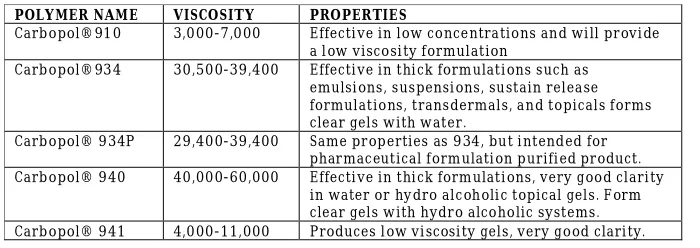
Carbopols
Also known as carbomer which is generic name.
Carbopols are dry powder with high
bulk densities and form acidic aqueous solution of 3.0 pH.
A neutralizer is added to increase the pH and cause the dispersion to thicken and gel.
Carbopols are carboxyvinyl
polymers of large molecular weight.
Table 2: Different Grades of Carbopol
POLY MER NAME VISCOSITY PROPERTIES
Carbopol® 910 3,000-7,000 Effecti ve in low concentrations and wi ll pr ovi de
a l ow viscosi ty formulation
Carbopol® 934 30,500-39,400 Effecti ve in thi ck form ulati ons such as
emulsi ons, suspensi ons, sustain release formulations, transdermals, and topicals forms clear gels with water .
Carbopol® 934P 29,400-39,400 Same pr operties as 934, but i ntended for
phar mac eutical form ulati on purifi ed pr oduct.
Carbopol® 940 40,000-60,000 Effecti ve in thi ck form ulati ons, very good clari ty
in water or hy dro alc oholi c topical gels. F orm clear gels with hydr o alcoholic systems.
89
Pectin
Pectin is obtain form plant tissue, act
as an intracellular.Cementing
material.It consists of linear D-
galacturonan.Pectins are water
soluble.
Peels of many fruits serve as
convenient source of pectin.
Most commercial pectin come from “apple pomace”.
It solution shows non-newtonian
flow.
“Sure gel” and “Certa” are pectin product widely used to make gel.
Poloxamers(Pluronics)
Poloxamers are copolymer of
polyoxy ethylene and polyoxy
propylene.
They form thermoreversible gels in concentration ranging from 15 to 50%.
Poloxamers are white, waxy granules
that form clear liquid when
dispersed in cold water.
“PLO” gel formed by combining
pluronic F-127 with lecithin an isopropyl palmitate.
Pluronic F-127 is a grade of
poloxamer.
Alginate
Algin is consisting of linear chains of uronic acid unit.
Algin is water soluble gum.
Marketed in form of sodium,
potassium, ammonium alginates.
In 5-10% concentration act as
dermatological vehicle.
Trace of calcium salt increase
viscosity of sodium alginate.
Beside calcium salt different
polyvalent metal ion affect its gel structure.
Gelatin
Produced by the hydrolysis of
collagen form the skin, white
connective tissue and bones of animal.
It is soluble in hot water.
It is in two form “pharmagel A” and “pharmagel B”.
Gelatins have adhesive property but easily remove from skin.
Gelatin hydrolysates are widely used for gel formulation.
Gelatin act as a raw material to form cross linked gelatin gel.Cross linked gelatin gel has a water content of 50 to 99 % w/w.
Cross linked gelatin gel cause
sustained releasing action.
Gelating concentration and cross linking agent concentration decides the water content in gel.
Starch
A translucent gel formed by starch solution.
Starch in combination with gelatin
and glycerin used for gel
formulation.
It has short shelf life.
Polyvinyalcohol
It is less soluble in cold water.
It used at 2.5% concentration to prepare gel.
Borax often adds in PVA solution.
It is formed from ploymerised vinyl acetate.
Povidone
High molecular weight substance.
It can be used to prepare gels in concentration up to 10%.
It has the advantage of being
compatible in solution with a wide range of inorganic salts, natural and synthetic resin.
90
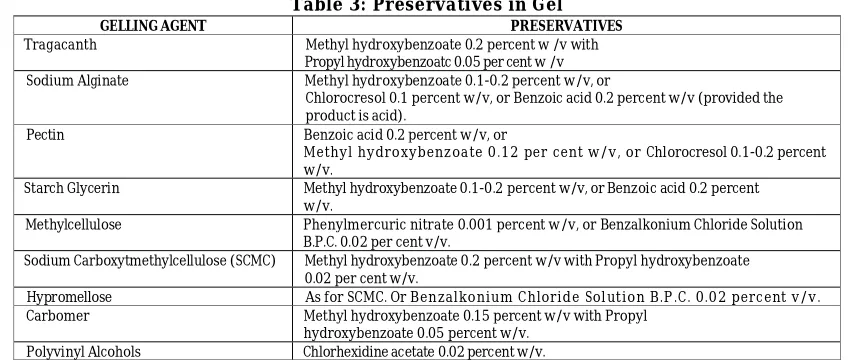
Table 3: Preservatives in Gel GELLING AGENT PRESERVATIVES
Tragacanth Methyl hydroxybenzoate 0.2 percent w /v with
Propyl hydroxybenzoatc 0.05 per cent w /v
Sodium Alginate Methyl hydroxybenzoate 0.1-0.2 percent w/v, or
Chlorocresol 0.1 percent w/v, or Benzoic acid 0.2 percent w/v (provided the product is acid).
Pectin Benzoic acid 0.2 percent w/v, or
Methyl hydroxybenzoate 0.12 per cent w/v , or Chlorocresol 0.1-0.2 percent w/v.
Starch Glycerin Methyl hydroxybenzoate 0.1-0.2 percent w/v, or Benzoic acid 0.2 percent
w/v.
Methylcellulose Phenylmercuric nitrate 0.001 percent w/v, or Benzalkonium Chloride Solution
B.P.C. 0.02 per cent v/v.
Sodium Carboxytmethylcellulose (SCMC) Methyl hydroxybenzoate 0.2 percent w/v with Propyl hydroxybenzoate
0.02 per cent w/v.
Hypromellose As for SCMC. Or Benzalkonium Chloride Sol ution B.P .C. 0.02 perc ent v/v .
Carbomer Methyl hydroxybenzoate 0.15 percent w/v with Propyl
hydroxybenzoate 0.05 percent w/v.
Polyvinyl Alcohols Chlorhexidine acetate 0.02 percent w/v.
HUMECTANT AND COSOLVANTS IN GEL
Humectant is a substance that absorbs or helps another substance retain moisture, as glycerol. A humectant is a hygroscopic substance. It is often a molecule with several hydrophilic groups, most often hydroxyl groups, but amines and carboxyl groups, sometimes esterifies, can be encountered as well; the affinity to form hydrogen bonds with molecules of water is crucial here
Examples
Glycerine, propylene glvcol (E 1520) and giyceryl triacetate (EI5I8). Others can be
polyols like sorbitol (E420), xylitol and maltitoi (E965). Or polymeric polyols like polvdextrose
(El 200) or natural extracts like quillaia (E999), or lactic acid or urea. Lithium Chloride is an excellent humectant.
STABILIZERS
Bases and medicaments sensitive to heavy metals are sometimes protected by
chelating agent, such as
E.D.T.A.(Ethlylene diamine tetra acetic acid.)
ADDITIVES IN CREAM AND LOTION Emulsifying Agents For Cream
Emulsifying agent used in cream
formulation as additive
A. W/o emulsifying agent – cleansing cream
B. O/W emulsifying agent – vanishing cream
W/O EMULSIFYING AGENT
Are also known as oily creams.
Wool Fat
Also known as anhydrous
lanolin.
It is the purified fats like substance obtain from the wool of sheap.
It can absorb about 50 % of its weight of water.
Also known as refined wool fat.
It contains the sterols
cholesterol and oxycholesterol
as well as triterpene and
aliphatic alcohol.
Insoluble in water but soluble in hot alcohol.
Yellow in colour melt between 36°C and 42°C.
Waxes
Waxes are esters of fatty acids.
Waxes often contain significant amounts of free alcohols, sterols, and fatty acids.
The sterols and hydrocarbons are unsaponifiable in waxes.
Waxes have high saponification value.
Bivalent Soaps
They are esters of higher fatty
acids or rosin acids.
They are formed either by
91
(Vegetables or animal oil) with alkalis or by reacting between fatty acids and alkaline materials.
The fatty acids must have a carbon chain of 12 to 18 atom.
Bivalent and trivalent soaps such as Cu, Mg, Ba, or Al soaps are hydrophobic.
Sorbitan Esters (Span)
Their hydrophillic part is
polyhydric alcohol compounds
such as glycerol or sorbitol.
They are generated by
esterification of fatty acid with sorbitol derivates .
They also known as arlacels.
Example-
Sorbitan Monolaurate (span-20) Sorbitan Monooleate (Span-80) Sorbitan Trioleate (Span-85) Sorbitan tristearate (Span-85) Sorbitan Monopalmitate (Span-40)
Wool Alcohol
It is obtained from wool fat by treating it with alkali and separate the fraction containing cholesterol and other alcohols.
It contains not less than 30 % of cholesterol.
Hydrous Wood Fat
It is hydrous lanolin.It is insoluble in
water but soluble in ether and
chloroform. It is mixture of 70% w/w fat and 30 % purified water.
O/W EULSIFYING AGENT Polysorbates
It is known as tween.These are non ionic
sufactant.It is a polyoxyethylene
derivative.
Example
Polyoxyethylene sorbitan monooleate – tween 80
Polyoxyethylene sorbitan monolaurate – tween 21
Polyoxyethylene sorbitan monopalmitate - tween 4030
Methyl Cellulose
Used in emulsion of mineral oils.Used in 2% concentration.
Monovalent Soap
Sodium ion, potassium ion, ammonium ion salt of soap acts as o/w emulsifying agent.
They are known as alkali soap.
Acacia
Ca, Mg, K Salts of polysaccharide Arabic acids. Insoluble in alcohol. Completely soluble in twice its weight of water. Prepare attractive emulsion. Stable at wide range of pH- 2-10.
Tragacanth
It consists of 70 % bassorin and 30% soluble gum. It is insoluble in alcohol, It is used as emulsifying agent to increase consistency.
Triethanolamine Oleate
It is a combination of triethanolamine and oleic acid. Prepare from mono and diaethanolamine.
ADDITIVES IN LOTION
Lotions are usually suspensions of solids in an aqueous medium. Some lotions are infact emulsion or solution.
Bentonite
It is a natural product. It is used as a suspending agent in preparation of lotion.
Methyl Cellulose OR Sodium CarboxyMethyl Cellulose
It holds the active ingredient in contact with the affected site and at the same time rinsed off easily with water.
Alcohol
The drying and cooling effect of a lotion may be accentuated by adding alcohol to the formula.
HUMECTANT
92
PRESERVATIVES IN LOTION AND CREAMS
Organic Acids
Benzoic acid is a good antifungal and antibacterial preservative provided the pH does not exceed 5. A concentration of 0.1% w/v is used with chloroform to preserve liquid paraffin emulsion B.P.C. Sodium benzoate is more soluble in water (1 in 2, compared with 1 in 350 for benzoic acid) but the same pH restriction applies, it is unsuitable for sodium alginate emulsions in which it causes excessive thickening.
Sorbic acid is also a good antifungal and anti-bacterial agent. Concentrations of 0.1 to 0.2 percent are used to preserve acacia and tragacanth mucilages and emulsions made with non-ionic surfactants. It is ineffective above pH 6-5 and it irritates the skin of some people.
Esters OF Parahydroxybenzoic Acid
The methyl, ethyl, propyl and butyl esters of para-hydroxy benzoic acid, and their sodium salts, are popular preservatives. They are stable, inert, non-toxic, odourless and tasteless, although slight numbing of the mouth is caused. They are active against moulds, veasts and, to a lesser extent, bacteria, and are most effective at pH 7to9.
Activity increases, but solubility decreases, with chain length of the alkyl group. The methyl ester is most soluble (1 in 500) and the higher compounds have to be used in near saturated solutions- Suitable concentrations range from 0.1 to 0.2 pe cent and mixtures are often preferred because they provide higher total activity and a wider bacterial spectrum. The commonest mixture contains 2 parts of methyl and 1 part of propyl ester (0.06 and 0.03 percent respectively). The activity of these esters is reduced in the presence of non-ionic emulgents.
Chloform
Chloroform is used with benzoic acid in liquid paraffin B.P.C. and, alone, in the same concentration (provided in this instance by chloroform spirit) in liquid paraffin and magnesium hydroxide
Chlorocresol
Chlorocresol is a powerful bactericideof lowtoxicity. A concentration of 0.1 percent is used to preserve aqueous creams and other external preparations. Its activity is reduced in alkaline solutions and when the product contains oils and fats of vegetable origin.
Phenoxyethanol
The outstanding characteristic of this compound is its activity against Pseudomonas aeruginosa, but because it is less active against other Gram-negative bacteria and relatively ineffective against Gram-positive species, it is generally formulated with other preservatives. A mixture with esters of parahydroxybenzoic acid is used to preserve creams and iotions .
Quaternary Ammonium Compounds
Cetrimide and other quaternary ammonium compounds are occasionally used, in concentration ranging from 0.002 to 0.01 percent, to preserve emulsified products for external use. They are bactericidal to vegetative forms of gram-positive organisms, much less effective against gram-negative species, particularly Pseudomonas aeruginosa. And inactive against bacterial spores. Their activity is greatly reduced by soaps and other anionic compounds and, above a certain proportion , they are incompatible with non-ionic emulgents.
Organic Mercurial Compounds
Phenylmercuric nitrate and acetate are sometimes employed, in concentrations of 0.004 to 0.01 percent, to preserve emulsified
preparations containing non- ionic
emulgents.To compensate for deficiencies of individual preservatives in respect of antibacterial activity, partitioning, binding and complexation etc., it may be advantageous to use mixtures of preservatives, as in Cetomacrogol Cream, Formula B, and B.P.C.
ADDITIVES IN TOPICAL POWDER
93
protect the skin from drying and irritation and should they be absolutely free from irritant effect. The powders meant for application to the surfaces, exuding appreciable quantities of fluids, should not
be highly sorptive otherwise crust
formation may take place. Dusting
powders are generally prepared by mixing two or more ingredients one of which must be starch, talc, or kaolin as one of the ingredients of the formulation. Talc and kaolin are more commonly used because these are chemically inert.
Talc
It is also known as Talcum, Purified Talc, French Chalk, Soapstone, Steatite. A native, hydrous magnesium silicate, sometimes containing a small proportion of aluminum silicate.
Description
Very fine, white, or grayish white crystalline powder, unctuous to the touch, adhering readily to the skin, and free from grittiness.
Uses
As dusting powder and pharmaceutical aid, in both categories it has many specific uses. Its medicinal use as a dusting powder depends on its desiccant and lubricant effects. When per-fumed, and sometimes medicated, it is used extensively for toilet purposes under the name talcum powder; for such use it should be in the form of an impalpable powder. When used as a filtration medium for clarifying liquids, a coarser powder is preferred to minimize passage through the pores of the filter paper; for this purpose it may be used for all classes of preparations with no danger of adsorption or retention of active principles. It is used as a lubricant in the manufacture of tablets and as a dusting powder when making handmade suppositories. Although it is used as a lubricant for putting on and removing rubber gloves, it should not be used on surgical gloves because even small amounts deposited in organs or healing wounds may cause gran-uloma formation.
STARCH
It is also known as Corn Starch, Wheat Starch, and Potato Starch
Description
Irregular angular, white masses or fine powder, odorless, slight, characteristic taste. Corn starch is polygonal, rounded, or
spheroidal granules up to about 35µm
diameter, which usually have a circular or several-rayed central cleft. Wheat starch is simple lenticular granules 20 to 50 µm in
diameter and spherical granules 5 to 10 µm in
diameter, striations faintly marked and concentric. Potato starch is simple granules,
irregularly ovoid or spherical, 30 to 100 µm. in
diameter, and small spherical granules 10 to
35 µm in diameter; striations well marked and
concentric.
Solubility
Insoluble in cold water or alcohol; when it is boiled with about 20 times its weight of hot water for a few minutes and then cooled, a translucent, whitish jelly results; aqueous suspension neutral to litmus.
Uses
Have absorbent and demulcent properties. It is used as a dusting powder and in various dermatological preparations also as a phar-maceutical aid (filler, binder, and disintegrant). Under the title pregelatinized starch, the NF recognizes starch that has been processed chemically or mechanically to rupture all or part of the granules in the presence of water and subsequently dried. Some types may be modified to render them compressible and flowable.
KAOLIN
It is also known as Light Kaolin, White Bole, China Clay, Kaolin-Pectin suspension.
A native hydrated aluminum silicate powdered and freed from gritty particles by elutriation.
Description
Soft, white or yellowish white powder, or lumps, characteristic earthy or clay-like taste and, when
moistened with water becomes darker and develops a pronounced clay-like odor.
Solubility
94
Uses
It is used medicinally as an adsorbent. Externally, kaolin has some use as a poultice, dusting powder, and an ingredient of toilet powders.
ZINC STEARATE
It is also known as octadecanoic acid, zinc salt.
Description
Fine, white, bulky powder, free from grittiness, with a faint characterstic colour.
Solubility
Insoluble in water, alcohol, ether. Soluble in benzene.
Uses
As a dusting powder in dermatological practice for its desiccating, astringent and protective effects. It makes the product soothing.
ZINC OXIDE
It is also known as flowers of zinc, zinc white. Very fine, amorphous, free from gritty particles, absorbs carbon dioxide from air.
Solubility
Insoluble in water or alcohol, soluble in dilute acids.
Uses
It is mild astringent and also has antiseptic properties. It also helps in relieving prickling caused by prickly heat during summer and rainy seasons.
ANTIPERSPIRANT AGENT
Aluminium chlorohydrate, aluminium
chlorhydrex, aluminium zirconium
chlorhydrex, aluminium zirconium
glycine complex used as antiperspirant agent.
ADDITIVES IN LINIMENTS
Liniments are alcoholic or oil-based solutions or emulsions containing therapeutic agents intended for external application. These preparations may be liquids or semisolids that are rubbed onto the affected area; because of this, they were once called embrocations.Liniments usually are applied with friction and rubbing of the skin, the oil or soap base providing for ease of application and massage. Alcoholic liniments are used
generally for their rubefacient,
counterirritant, mildly astringent, and penetrating effects. The oily liniments, therefore, are milder in their action lut are more useful when massage is required. Liniments should not be applied to skin that is bruised or broken.It is essential that these applications be marked clearly for External Use Only. Fixed oils are thick, viscous liquids. It contains unsaturated fatty acids.Unsaturated fatty cid cause good penetration into the skin.
CASTOR OIL
It is known as Emuls oil, Neoloid, PurgeThe fixed oil obtained from the seed of Ricinus
communis Linne (Family: Euphorbiaceae).
Description
Pale yellowish or almost colorless, transparent, viscid liquid with a faint, mild odor and a slightly acrid and usually nau-seating taste, specific gravity between 0.945 and 0.965.
Solubility
Soluble in alcohol; miscible with dehydrated alcohol, glacial acetic acid, chloroform, or ether.
Uses
Used externally as an emollient. The oil is bland and soothing to the skin. Castor oil is metabolized to ricinoleic acid, which stimulates water secretion in the intestine while decreasing glucose absorption. It also
stimulates colonic motility. When
administered orally it produces one or more copious stools within 2 to 6 hr after ingestion.
COTTON SEED OIL
It is known as Seed Oil and Cotton Oil
Description
Pale yellow, oily liquid with a bland taste; odorless or nearly so; particles of solid fat may separate below 1Q°C; Bolidifies at about 0 to -5°C; specific gravity 0.915 to 0.921.
Solubility
95
Uses
It also is used in the manufacture of soaps, oleomargarine, lard substitutes, glycerin, lubricants, and cosmetics
PEANUT OIL
It is also known as arachis oil, Groundnut oil, Nut oil, Earth-Nut oil
Description
Colorless or pale yellow, oily liquid, with a characteristic nutty odor and a bland taste; specific gravity 0.912 to 0.920.
Solubility
Very slightly soluble in alcohol; miscible with ether, chloroform, or carbon disulfide.
Uses
It also is used for ointments, plasters, and soaps, as a substitute for olive oil.
SESAME OIL
It is known as Veel Oil, Benne Oil, and Gingili Oil
Description
Pale yellow, almost odorless, oily liquid with a bland taste; specific gravity 0.916 to 0.921. Sesame oil contains glycerides which are mostly triunsaturated and diunsaturated with small quantities of mono unsaturated.
Solubility
Slightly soluble in alcohol; miscible with ether, chloroform, solvent hexane, or carbon disulfide.
Uses
A solvent and vehicle in official injections. It is used much like olive oil both medicinally and for food. It does not readily turn rancid. It also is used in the manufacture of cosmetics, iodized oil, liniments, ointments, and oleomargarine. Sesame oil contains good percentages of linoleic acid and oleic acid. They may give good permeation enhance
SUMMARY AND CONCLUSION
Skin is a largest organ of body. Protection from microorganism is main function of skin. It consists of three primary layers
epidermis, dermis and hypodermis.
Sensation, heat regulation, storage and
synthesis, excretion and absorption are main functions. Extent and the rate of drug absorption from the skin is affected by skin condition and formulation excipients. Topical dosages form like ointment, cream, paste, gel, lotion, powder; liniments are applied on the skin. Additives are inactive ingredients in dosages form. Additives are non drug component for structuring dosage form. Selection of topical vehicles depends on
various dermatological factors and
pharmaceutical factors. Dermatological factors are absorption penetration, skin
condition, compatibility, emollient
properties. Pharmaceutical factors are stability, solvent properties, emulsifying property. Ointment bases are very important vehicle for semisolid topical
dosages form. Oleaginous bases,
absorption bases, emulsion bases and water washable bases are four types of ointment bases. Gel is another semisolid topical dosage form. Various gelling agents are tragacanth, pectin, gelatin,
cellulose derivatives, carbopols,
polaxamers, alginates used in gel
formation. Cream formulation contains various emulsifying agents. Water in oil emulsifying agent and oil in water emulsifying agent are used in cream formulation. Topical powder is solid dosage form. It contains starch, kaolin and talc as additives. Cotton seed oil, castor oil, sesame oil used as additives in liniments formulation. Humectant is a hygroscopic substance. It is used in almost all topical dosages forms except topical powder. Its function is retaining moisture by absorb water from air. Preservatives act as stabilizer in topical dosages forms. Paraben, benzoic acid, phenol, benzalkonium chloride, actamer is used as preservative in topical dosages forms.
REFERENCES
1. http://en.wikipedia.org/wiki/skin
2. Idson B and Lazarus J. Semisolids. In lachman, l., Liberman, H.A. and Kanig, J.L. (Eds.), The Theory and Practice of Industrial Pharmacy,
Varghese Publishing House,
96
3. Mithal BM. A Text Book of
Pharmaceutical Formulation,
Vallabh Prakashan, New Delhi, 2003,pp.14-16,66-67,79,86,96-97,239-244.
4. Drug Delivery Systems, Lippincott Williams and Wilkens, Baltimore, 2005, pp. 298-300.
5. Jain, NK and Sharma SN. A Text Book of Professional Pharmacy, Vallabh Prakashan, New Delhi, 2003, pp. 261-267.
6. Lawrence HB. Medicated topical. In Gennaro, A.R.(Ed.), “Remington: The Science and Practice of Pharmacy”, Lippincott Williams and Wilkins, Baltimore, I,2005, pp. 880-881.
7. Sharma PP.