ISSN: 2231-5381
http://www.ijettjournal.org
Page 362
Parallel License Plate Location based on Multiagent
System
M. Ebrahimi#1, S. Ildarabadi#2, H. Ebrahimpour-komleh *3
#Islamic Azad University Lenjan Branch I. R. Iran, * Faculty of Computer Engineering, the University of Kashan, I. R. Iran
Abstract— Automatic license plate recognition is a necessary
step in intelligent traffic systems. Many methods are reported for License Plate Recognition (LPR) implementation until now. Real time LPR plays a major role in automatic monitoring of traffic rules and maintaining law enforcement on public roads. The automatic identification of vehicles by the contents of their license plates plays an important role in private transportation system applications. However there are a lot of systems in universal markets, but research and development are still continuing, and advanced solutions are reported.
In this paper initially, image processing concepts of LPR and multiagent systems are introduced. Then, based on the expressed concepts, a multiagent model for License Plate Location proposed. The proposed model uses three agents i.e., Accurate Gabor, Speedy Multiple Interlacing (MI) and Judgment agents. The accurate-gabor agent utilizes gabor filter. Speedy-MI agent uses the Multiple Interlacing approach in parallel, then those images that the speedy-MI agent has not been able to detect, is delegated to the accuracy-gabor agent by the judgment agent. The proposed system implemented and tested on 200 images. The results show that the overall accuracy has been improved, and tends to the accuracy of 100%, due to the cooperation of accuracy-gabor, Speedy-MI and judgment agents.
Keywords— License Plate Location (LPL), Multiagent Systems,
Multiple Interlacing, Gabor Transformation.
I. INTRODUCTION
During the past few years, intelligent transportation systems (ITSs) have had a wide impact in people’s life as their scope is to improve transportation safety and mobility and to enhance productivity through the use of advanced technologies. In this paper, we combined computer vision methods by use of multi agent systems contents for license plate location (LPL) in parallel.
LPL algorithms reported in previous research are barrelful. All papers are covered according to their major contribution in this section. The major goal of this section is to provide a brief reference source for the researchers involved in license plate identification and recognition, regardless of particular application areas (i.e., billing, traffic surveillance etc.).
In [1], a novel license plate detection method based on heuristic energy map suggested. that method could detect a
license plate within 130 milliseconds and its detection rate was 99.2% on a 3.10-GHz Intel Core i3-2100 (with 4.00 GB of RAM) personal computer.
As far as extraction of the plate region is concerned, techniques based upon combinations of edge statistics and mathematical morphology [2-5] featured very good results. In these methods, gradient magnitude and their local variance in an image are computed. They are based on the property that the brightness change in the license plate region is more remarkable and more frequent than otherwise. Block-based processing is also supported [6].
Then, regions with a high edge magnitude and high edge variance are identified as possible license plate regions. Since this method does not depend on the edge of license plate boundary, it can be applied to an image with unclear license plate boundary and can be implemented simply and fast. A disadvantage is that edge-based methods alone can hardly be applied to complex images, since they are too sensitive to unwanted edges, which may also show high edge magnitude or variance (e.g. the radiator region in the front view of the vehicle). In spite of this, when combined with morphological steps that eliminate unwanted edges in the processed images.
ISSN: 2231-5381
http://www.ijettjournal.org
Page 363
“approximate nearest neighbor” was adopted. The computational resource demand of this segmentation technique was the main drawback, since it yielded an execution time unacceptable for LPR (34 s).
In [14], a method is developed to scan a vehicle image with N row distance and count the existent edges. If the number of the edges is greater than a threshold value, this manifests the presence of a plate. If in the first scanning process the plate is not found, then the algorithm is repeated, reducing the threshold for counting edges. The method features very fast execution times as it scans some rows of the image. Nonetheless, this method is extremely simple to locate license plates in several scenarios, and moreover, it is not size or distance independent.
Fuzzy logic has been applied to the problem of locating license plates [15-17]. The authors made some intuitive rules to describe the license plate and gave some membership functions for the fuzzy sets “bright,” “dark,” “bright and dark sequence,” “texture,” and “yellowness” to get the horizontal and vertical plate positions, but these methods are sensitive to the license plate color and brightness and need longer processing time from the conventional color-based methods. Consequently, in spite of achieving better results, they still carry the disadvantages of the color-based schemes.
Gabor filters have been one of the major tools for texture analysis. This technique has the advantage of analyzing texture in an unlimited number of directions and scales. A method for license plate location based on the Gabor transform is presented in [18]. The results were encouraging (98% for LP detection) when applied to digital images acquired strictly in a fixed and specific angle, but the method is computationally expensive and slow for images with large analysis. For a two-dimensional (2-D) input image of size N × N and a 2-D Gabor filter of size W × W, the computational complexity of 2-D Gabor filtering is in the order of W2N2, given that the image orientation is fixed at a specific angle. Therefore, this method was tested on small sample images and it was reported that further work remain to be done in order to alleviate the limitations of 2-D Gabor filtering.
Genetic programming (GP) [19] and genetic algorithms (GAs) [20-21] were also implemented for the task of license plate location. GP is usually much more computationally intensive than the GAs, although the two evolutionary paradigms share the same basic algorithm. The higher requirements in terms of computing resources with respect to the GAs are essentially due to the much wider search space and to the higher complexity of the decoding process as well as of the crossover and mutation operators. The authors indicate that the research carried out in [19-21], despite being encouraging, is still very preliminary and requires a deeper analysis. While the authors in [19] and [21] did not report clearly the results of their work, in [20], the identification ratio reached 80.6% on average, with a very fast execution time (0.18 s). In [21], the GA was presented for license plate location in a video sequence. In the
method using Hough transform (HT), edges in the input image are detected first. Then, HT is applied to detect the license plate regions. In [22], the authors acknowledge that the execution time of the HT requires too much computation when applied to a binary image with great number of pixels. As a result, the algorithm they used was a combination of the HT and a Contour algorithm, which produced higher accuracy and faster speed so that it can be applied to real-time systems. However, as HT is very sensitive to deformation of boundaries this approach has difficulty in extracting license plate region when the boundary of the license plate is not clear or distorted or the images contain lots of vertical and horizontal edges around the radiator grilles. This method achieved very good results when applied to close shots of the vehicle. In [23], a strong classifier was trained for license plate identification using the adaptive boosting (AdaBoost) algorithm. When executed over several rounds, AdaBoost selects the best performing weak classifier from a set of weak classifiers, each acting on a single feature, and, once trained, combines their respective votes in a weighted manner. This strong classifier is then applied to sub regions of an image being scanned for likely license plate locations. Despite the fact that this paper has shown to be promising for the task of license plate detection, more work needs to be done. Additionally, since the classifier is applied to sub regions of specific dimension, the system could not detect plates of different size or images acquired from different view/distance without retraining.
A wavelet transform-based method is used in [24] for the extraction of important contrast features used as guides to search for desired license plates. The major advantage of wavelet transform, when applied for license plate location, is the fact that it can locate multiple plates with different orientations in one image. Nevertheless, the method is unreliable when the distance between the vehicle and the acquisition camera is either too far or too close.
Symmetry is also used as a feature for car license plate extraction. The generalized symmetry transform (GST) produces continuous features of symmetry between two points by combining locality constraint and reflect ional symmetry. This process is usually time-consuming because the number of possible symmetrical pixels in the image is huge. Moreover, a rotated or perspectively distorted car license plate image is impossible to detect. In [25], the authors propose a scan line decomposition method of calculating GST in order to achieve considerable reduction of computational load. The result is indeed encouraging as far as the computational time is concerned, but since the scan line-based GST evaluates symmetry between a pair of edge pixels along the scan lines, the execution time increases linearly with respect to the radius of the searching area. Thus, the algorithm set limits to its effective distance, as a closer view of the plate results to increased processing time. Moreover, this approach is insufficient when rotated or distorted plates appear.
ISSN: 2231-5381
http://www.ijettjournal.org
Page 364
proposed and implemented for plate identification, namely the pulse coupled neural networks (PCNNs), the time delay neural networks (TDNNs), and the discrete time cellular neural networks (DTCNNs). In [27], it was demonstrated that the computationally most intensive steps in LPR could be realized by DTCNNs. The tests demonstrated that the DTCNNs were capable of correctly identifying 85% of all license plates. The total system contained several DTCNNs whose templates were constructed by combining the appropriate morphological operations and traditional filter techniques. This paper was an extension of a previous work of the authors [16], where they used fuzzy logic rules for license plate location. In [28], the PCNN is used to generate candidate regions that may contain a license car plate. Candidate regions are generated from pulsed images, output from the PCNN. The results of these applications indicate that the PCNN is a good preprocessing element. The results have shown than in spite of being encouraging (85% for plate detection), a lot of research still remains to be performed. Impressively good results were achieved in [29], where the TDNN schema was implemented. TDNN is a multilayer feedforward network whose hidden neurons and output neurons are replicated across a time. It has the ability to represent relationships between events in time and to use them in trading relations for making optimal decisions. In this paper, the license plate segmentation module extracts the license plate using two TDNNs as filters for analyzing color and texture properties of the license plate. The results were remarkable in terms of speed and accuracy with the drawback of computational complexity, but as the method is color based, it is also country specific. It should be also noted that as the system was designed to check a fixed region, there was a rough knowledge of possible plate location, which also explains the fast execution time versus the complexity of the algorithm. In [29], a method based on vector quantization (VQ) to process vehicle images is presented. This technique makes it possible to perform superior picture compression for archival purposes and to support effective location at the same time. Compared to classical approaches, VQ encoding can give some hints about the contents of image regions. Such additional information can be exploited to boost location performance.
A sensing system with a wide dynamic range has been manufactured in [30] to acquire fine images of vehicles under varied illumination conditions. The developed sensing system can expand the dynamic range of the image (almost double in comparison with conventional CCDs) by combining a pair of images taken under different exposure conditions. This was achieved as a prism beam splitter installed a multilayered filter, and two charge-coupled devices are utilized to capture those images simultaneously. In this paper, a new algorithm for vehicle license plate location is proposed, on the basis of multi agent systems. The algorithm was tested with 1334 natural-scene graylevel vehicle images of different backgrounds and ambient illumination. The camera focused in the plate, while the angle of view and the distance from the vehicle varied according to the experimental setup. The
license plates properly segmented were 1287 over 1334 input images (96.5%). [31, 35]
II. MULTI-AGENT SYSTEMS OF ARTIFICIAL INTELLIGENCE
An agent is an intelligent computational structure which can be considered as a software program or a robot, having interactions with its environment and independent behavior and working somewhat based on its experiences. By an intelligent structure we mean an agent that works reasonably and flexibly in an environment, involving various occurrences. There are two main reasons to consider multi-agent systems which could have been the basic factors of the developments in this scientific field in recent years. The first reason is that multi-agent systems are capable of playing the main role in computer science and its applications now and in the future, because the growth of the complexity of computer systems and information systems leads to the increase of the complexity of applications, and limitless growth of calculations and centralizing them need processing more various data obtained from different locations. In such scenarios computers are considered as agents and their interactions need to be managed by technology. The second reason is that multi-agent systems are capable of playing an important role in analyzing and directing models and theories of human society’s interactions.
Being intelligent means that agents follow their goals and act through optimizing a set of factors of effectiveness. When it is said that agents are intelligent it doesn’t mean that they know every thing or they are omnipotent, but that they never make mistakes while functioning. It is better to say that they act reasonably and flexibly based on their information, understanding, and capabilities in various environmental situations.
The reason for focusing on the processes like problem solving, planning searching, decision making and learning is that showing the flexibility, reasonability and manipulation of such processes is more possible in multi-agent systems.
ISSN: 2231-5381
http://www.ijettjournal.org
Page 365
A useful list of the theories of multi-agent systems in [33] and a famous text about agents in chapter two of [34], have been presented.
III.PROPOSED MODEL
In the proposed model there are two kinds of methods to recognize the location of a car license plate:
1) Methods which focus on speed and thus have a high speed. Interlacing [14] is the one which is selected here.0
2) Methods which try to increase accuracy and lose time to obtain it. Utilizing gabor filter [18] is the selected method here.
Since we need accuracy only for some of the images and for others immediate methods are adequate, combining these two methods based on agents and independently has been proposed here.
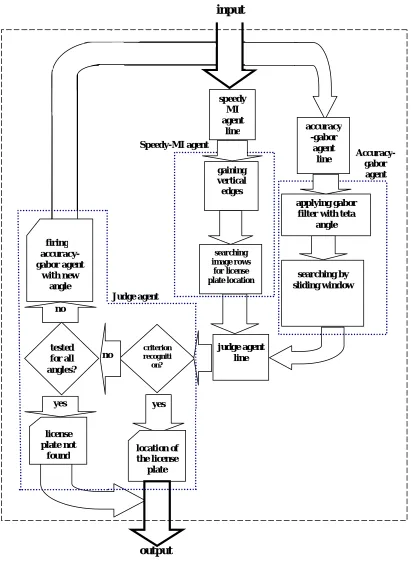
The model of the proposed system has been presented in figure (1). First, input picture is given to the Speedy-MI agent. This agent counts the vertical edges of each line in parallel, and in the case of being more than the threshold of being a plate recognize it as a license plate, and delivers it to the Judge agent. Judge agent that knows the color, texture and bounds of a license plate will compare the reported location with its standards and send it as the license plate location to the output, if there is no problem. Otherwise, the Judge agent will activate the Accuracy-gabor agent. Accuracy-gabor agent applies the gabor filter to the image. Using this filter through say 7*7 images and matrix convolution takes time. Then this agent obtains the vertical edges of the image, searches for a rectangle as large as a plate with the most edges in the image, and gives this location as the location of the plate to the Judge agent.
In the multiple interlacing methods the location of license plate is recognized through counting edges of each line in parallel.
Figure (2) shows the application of gabor filter with and 20. Gabor filter can reveal the edges in any direction
(here in direction) and change the number of edges in a certain direction. This characteristic helps us very well. The location of the plate in image includes identical vertical edges which are repeated alternatively. We can intensify these edges and modify other edges through this filter.
Table (1) provides the characteristics of the proposed systems from a multi-agent systems point of view. In the first column, agents characters such as agent numbers Have been presented. As you see the proposed system consists of 3 agents of Accuracy-gabor, Speedy-MI and Judge. They are non-homogeneous, and complementary. They have interactive structures and the capabilities of same of them, such as accuracy agent (applying gabor filter) have been developed. The relationship between the agents in this system is the presentation of the found location to the Judge agent by the Speedy-MI agent. And other relation involves recalling the Accuracy-gabor agent by the judge agent. The other one occurs between the Accuracy-gabor agent and the Judge agent in which the Judge agent receives the reported location from the Accuracy-gabor agent. Regarding frequency, the relation between agents is low as only at the end of Accuracy-gabor and Speedy-MI agents operations the relation occurs between them and the Judge agent.
The relation has a short-term and limited stability. The level of the relation which refers to the volume of information interchange is merely a report of a location. The relation model and control is non-centralized, because there is no leading or managing process in this system. The aim of the relation is cooperation through which a license plate location can be found.
TABLE (1): CHARACTERISTICS OF THE PROPOSED SYSTEM
Attributes Proposed system
Agents
Number 3
Uniformity Non-homogeneous
Goal Complementary
Architecture Reflective Frequency Simple, Developed
Relation
Level Low
Model Non-Centralized Variability
Purpose Cooperative
Predictability Unpredictable Accessibility Limited
Environ ment
Dynamic
Diversity Medium
Availability of recourse Exclusive
ISSN: 2231-5381
http://www.ijettjournal.org
Page 366
Figure (1) proposed system model
gaining vertical edges
searching image rows
for license plate location
yes
Speedy-MI agent
speedy MI agent
line accuracy
-gabor agent
line
applying gabor filter with teta
angle
searching by sliding window
judge agent line
Judge agent
firing accuracy-gabor agent
with new angle
no
criterion
recogniti on?
no tested
forall
angles?
license plate not
found
yes
location of the license
plate
input
Accuracy-gabor agent
ISSN: 2231-5381
http://www.ijettjournal.org
Page 367
Considering the fact that experiments were performed on data [14], the Judge agent was only the threshold that was easily obtained through image observation and a few tests.
Figure (2): gabor filter and its application, a) main image, b) image resulted from applying gabor filter, given that ,20, c) images of vertical
edges of images a and b
But in more real works this agent can be a database including different types of plates. An important point is that, if the Accuracy-gabor agent is not able to report the location of plate at the first step, it will be recalled again, and then it will apply the gabor filter with a changed angle.
Figure (3): obtaining vertical edges through applying the given sobel filter, a) main image, b) the vertical edges
Figure (4): obtaining location of the license plate by the multiple interlacing method
IV.EXPERIMENTS AND RESULTS
This system has been tested on data [14]. Figure (3) shows the way of obtaining vertical edges by applying sobel filter.
In figure (4) the way of obtaining the license plate location through the multiple interlacing method can be seen.
In figure (5) there are two examples of pictures in which the plate location can not be recognized by the multiple interlacing method.
Figure (5): images in which location of the plate can not be recognized by the multiple interlacing method
Figure (6) shows the location which have been recognize wrongly by the multiple interlacing method. The phrase "Cherokee Chief" in figure (5-a) and the light reflection in figure 5-b caused these errors.
Figure (6): locations which are recognized wrongly by the multiple interlacing method. Images are related to illustration (5)
Regarding the threshold bounds obtained through the investigation of the data base images, the judge agent has returned these images.
Figure (7): applying gabor filter to the images of illustration (5) and obtaining the license plate by means of sliding widow
Figure (7) is the result of applying gabor filter to the images of figure (5) and it is noticed that an accurate location of plate has been recognized by the sliding window and the edges.
The proposed system recognized the license plate location of all the images included in the experimental data and achieved to accuracy of 100 percent.
Figure (8) shows the whole time that Speedy-MI agent, accuracy-gabor agent and whole model consumed.
b a a b a b
0
0
5
253 253 253 253 253 … … … … … … … … … … … … … … … … … … … … … … … … … … … … … … … … … 1 0 1 2 0 2 1 0 1 100 tresold (a) Sobel filter … … … … … … … (a)(b) (c)
a b j i x y x j i y x j e y x g y x y x y x e y x g y x h / ) / 2 cos( ) ( ) sin cos ( 2 2 2 1 ) , ( ) cos sin , sin cos ( ) , ( ) , ( ) , (
ISSN: 2231-5381
http://www.ijettjournal.org
Page 368
Figure (8): Time comparing: Speedy-MI agent, accuracy-gabor agent and whole model
V. FUTURE WORKS
Establishing a database of various kinds of plates, finding the correlation between the found plate and database license plates, and using more accurate criteria for the judge agent seem to be essential. Considering the ability of the system, we can increase the license plate recognition agents easily, and perhaps raise the effectiveness and accuracy in real application.
REFERENCES
[1] Md.M. Kamal Sarker, S. Yoon, J. Lee, D. S. Park, "Novel License Plate
Detection Method Based on Heuristic Energy Map", Journal of Korea Information and Communications Society (J-KICS). Vol. 38, No. 12, pp. 1114-1125, 2013.
[2] F. Martín, M. García and L. Alba, “New methods for automatic reading of
VLP’s (Vehicle License Plates),” in Proc. IASTED Int. Conf. SPPRA, Jun. 2002. [Online].
http://www.gpi.tsc.uvigo.es/pub/papers/sppra02.pdf
[3] B. Hongliang and L. Changping, “A hybrid license plate extraction method
based on edge statistics and morphology,” in Proc. ICPR, 2004, pp. 831– 834.
[4] D. Zheng, Y. Zhao, and J. Wang, “An efficient method of license plate
location,” Pattern Recognit. Lett., vol. 26, no. 15, pp. 2431–2438, Nov. 2005.
[5] S. Z. Wang and H. M. Lee, “Detection and recognition of license plate
characters with different appearences,” in Proc. Conf. Intell. Transp. Syst., 2003, vol. 2, pp. 979–984.
[6] H.-J. Lee, S.-Y. Chen, and S.-Z. Wang, “Extraction and recognition of
license plates of motorcycles and vehicles on highways,” in Proc ICPR, 2004, pp. 356–359.
[7] T.-H. Wang, F.-C. Ni, K.-T. Li, and Y.-P. Chen, “Robust license plate
recognition based on dynamic projection warping,” in Proc. IEEE Int Conf. Netw., Sensing and Control, 2004, pp. 784–788.
[8] X. Shi,W. Zhao, and Y. Shen, “Automatic license plate recognition system
based on color image processing,” in Lecture Notes on Computer Science, vol. 3483, O. Gervasi et al., Eds. New York: Springer-Verlag, 2005, pp. 1159–1168.
[9] D. Yan, M. Hongqing, L. Jilin, and L. Langang, “A high performance
license plate recognition system based on the web technique,” in Proc. Conf. Intell. Transp. Syst., 2001, pp. 325–329.
[10] P. Comelli, P. Ferragina, M. N. Granieri, and F. Stabile, “Optical
recognition of motor vehicle license plates,” IEEE Trans. Veh. Technol., vol. 44, no. 4, pp. 790–799, Nov. 1995.
[11] S. Draghici, “A neural network based artificial vision system for license
plate recognition,” Int. J. Neural Syst., vol. 8, no. 1, pp. 113–126, Feb. 1997.
[12] K. I. Kim, K. Jung, and J. H. Kim, “Color texture-based object detection:
An application to license plate localization,” in Lecture Notes on Computer Science, vol. 2388, S.-W. Lee and A. Verri, Eds. New York: Springer-Verlag, pp. 293–309.
[13] J. Cano and J. C. Perez-Cortes, “Vehicle license plate segmentation in
natural images,” in Lecture Notes on Computer Science, vol. 2652, F. J. Perales et al., Eds. New York: Springer-Verlag, 2003, pp. 142–149.
[14] A. Broumandnia and M. Fathy, “Application of pattern recognition for Farsi
license plate recognition,” presented at the ICGST Int. Conf. Graphics,
Vision and Image Processing (GVIP), Dec. 2005. [Online].
http://www.icgst.com/gvip /v2/P1150439001.pdf
[15] N. Zimic, J. Ficzko, M. Mraz, and J. Virant, “The fuzzy logic approach to
the car numlber plate locating problem,” in Proc. IIS, 1997, pp. 227–230.
[16] J. A. G. Nijhuis, M. H. ter Brugge, K. A. Helmholt, J. P. W. Pluim, L.
Spaanenburg, R. S. Venema, and M. A. Westenberg, “Car license plate recognition with neural networks and fuzzy logic,” in Proc. IEEE Int. Conf. Neural Netw., 1995, vol. 5, pp. 2232–2236.
[17] S.-L. Chang, L.-S. Chen, Y.-C. Chung, and S.-W. Chen, “Automatic license
plate recognition,” IEEE Trans. Intell. Transp. Syst., vol. 5, no. 1, pp. 42–53, Mar. 2004.
[18] F. Kahraman, B. Kurt, and M. Gökmen, “License plate character
segmentation based on the gabor transform and vector quantization,” in Lecture Notes on Computer Science, vol. 2869, A. Yazici and C. Sener, Eds. New York: Springer-Verlag, 2003, pp. 381–388.
[19] G. Adorni, S. Cagnoni, M. Gori, and M. Mordonini, “Access contro system
with neuro-fuzzy supervision,” in Proc. Conf. Intell. Transp. Syst., 2001, pp. 472–477.
[20] S. Yoshimori, Y. Mitsukura, M. Fukumi, and N. Akamatsu, “License plate
detection using hereditary threshold determine method,” in Lecture Notes in Artificial Intelligence, vol. 2773, V. Palade, R. J. Howlett, and L. C. Jain, Eds. New York: Springer-Verlag, 2003, pp. 585–593.
[21] Y. Cui and Q. Huang, “Extracting characters of license plates from video
sequences,” Mach. Vis. Appl., vol. 10, no. 5/6, pp. 308–320, Apr. 1998.
[22] T. D. Duan, T. L. Hong Du, T. V. Phuoc, and N. V. Hoang, “Building an
automatic vehicle license plate recognition system,” in Proc. Int. Conf. Comput. Sci. RIVF, 2005, pp. 59–63.
[23] L. Dlagnekovin License Plate Detection Using AdaBoost. La Jolla: Comput.
Sci. Eng. Dept., Univ. California San Diego, Mar. 2004.[Online]. http://www.cse.ucsd.edu/classes/fa04/cse252c/projects/louka.pdf
[24] C.-T. Hsieh, Y.-S. Juan, and K.-M. Hung, “Multiple license plate detection
for complex background,” in Proc. Int. Conf. AINA, 2005, vol. 2, pp. 389– 392.
[25] D.-S. Kim and S.-I. Chien, “Automatic car license plate extraction using
modified generalized symmetry transform and image warping”, in Proc. ISIE, 2001, p 2022–2027.
[26] M. H. ter Brugge, J. H. Stevens, J. A. G. Nijhuis, and L. Spaanenburg,
“License plate recognition using DTCNNs,” in Proc. IEEE Int. Workshop Cellular Neural Netw. and Appl., 1998, pp. 212–217.
[27] M. I. Chacon and A. Zimmerman, “License plate location based on a
dynamic PCNN scheme,” in Proc. Int. Joint Conf. Neural Netw., 2003, vol. 2, pp. 1195–1200.
[28] K. K. Kim, K. I. Kim, J. B. Kim, and H. J. Kim, “Learningbased approach,
for license plate recognition,” in Proc. IEEE Signal Process. Soc. Workshop, Neural Netw. Signal Process, 2000, vol. 2, pp. 614–623.
[29] R. Zunino and S. Rovetta, “Vector quantization for license plate location
and image coding,” IEEE Trans. Industrial Electron., vol. 47, no. 1, pp. 159–167, Feb. 2000.
[30] T. Naito, T. Tsukada, K. Yamada, K. Kozuka, and S. Yamamoto, “Robust
license plate recognition method for passing vehicles under outside environment,” IEEE Trans. Veh. Technol., vol. 49, no. 6, pp. 2309– 2319, Nov. 2000.
[31] Anagnostopoulos, C.N.E. Anagnostopoulos, I.E. Loumos, V. Kayafas, E.
“A License Plate-Recognition Algorithm for Intelligent Transportation
System Applications”, Intelligent Transportation Systems, IEEE
Transactions on, Vol.7, pp.377-392, Sept. 2006.
[32] G. Weiss. Multiagent Systems A Modern Approach to Distributed Artificial
Intelligence. Computation system vol. 3 No 4 pp.1-23 2000.
[33] M .Wooldridge and N. R. Jennings, Editors. Special issue on Intelligent
agents and multi_agent systems applied artificial intelligence journal. Vol.9(4), 1995 and Vol. 10(!), 1996.
[34] S.J Russell and P. Norwig. Artificial Intelligence A modern Approach.
Prentice Hall, Englewood Cliffs, New Jersey, 1995.
[35] M. Ebrahimi, R. Monsefi , S. Ildarabadi, M. R. Akbarzadeh, M. Habibi,
“License Plate Location Based on Multi Agent Systems”, INES 2007, 11th International Conference on Intelligent Engineering Systems, Budapest, Hungary, 29 June – 1 July, 2007.
2786 2786
310
Speedy-MI Accuracy-gabor
The System
T
im
e (m
ill
is
e
c
o
n
d