© 2015 IJSRST | Volume 1 | Issue 3 | Print ISSN: 2395-6011 | Online ISSN: 2395-602X Themed Section: Science
Comparative Study of Some House-Hold Surface Active
Substances
Dr. Ashoke Hazra
Department of Chemistry, A.K.P.C. Mahavidyalaya, Subhasnagar, Bengai, Dist-Hooghly, West Bengal, India
ABSTRACT
Present study describes how surface tension changes of some house-hold substances that we have use in our daily life? Here we use four different surface active substances such as Face wash (Neem), Hand wash (Dettol) , Dish wash (Vim) and Shampoo (Clinic Plus). Surface tension of different solutions was measured by Stalagmometer (Drop weight method). Dish wash shows lower surface tension than the other three. Low surface tension helps to better cleansing propertry. All (house hold) surface active substances are compared with Sodium Laryl Sulfate.
Keywords: Cleansing Action, Surface Tension, Surface Active Agents, Dish Wash, Face Wash, Hand Wash, Shampoo.
I.
INTRODUCTION
In continuation of our earlier study [1] on lowering of surface tension by surface active agents, we report here similar study with some different house hold surface active(washing) substances which show high cleansing property with decrease their surface tension.
In the present report, I describe the solution preparation, density measurement, measuring the surface tension and their cleansing action. It is expected that dish wash (Vim) reduced surface tension in a great extent than the other washing liquids [14-16].
Dish washing liquid is usually a high-foaming mixture of surfactants with low skin irritation, and is primarily used for hand washing of glasses, plates and cooking utensils in a sink.
This is what happens at the interface between water and a hydrophobic surface such as a plastic mixing bowl or a windshield coated with oily material.
The surface tension of water can be reduced to about one-third of its normal value by adding some soap or synthetic detergent. These substances, known
collectively as surfactants, are generally hydrocarbon molecules having an ionic group on one end. The ionic group, being highly polar, is strongly attracted to water molecules; we say it is hydrophilic.
The hydrocarbon (hydrophobic) portion is just the opposite; inserting it into water would break up the local hydrogen-bonding forces and is therefore energetically unfavorable. What happens, then, is that the surfactant molecules migrate to the surface with their hydrophobic ends sticking out, effectively creating a new surface. Because hydrocarbons interact only through very weak dispersion forces, this new surface has a greatly reduced surface tension.
Surfactants are substances that, when present in low concentrations, have the ability to significantly alter the surface properties of the solvent. These compounds are generally composed of lyophobic and/or lyophilic when the lyophobic group lies within the solvent it disrupts the structure of the surface, thus decreasing the free energy of the system, while the lyophilic group prevents the complete expulsion of the surfactant from the solvent.
specific purpose is difficult and the following information can aid in the selection of the surfactant (Rosen, 1978).
1. Characteristic features of commercially available surfactants.
2. Expected interfacial phenomenon involved and the role of the surfactant.
3. Surface chemical properties of various structural types of surfactants.
All surfactants, however, can be categorized by the charge on the surface active component into : (1) anionic, (2) cationic, (3) nonionic, and (4) zwitterionic
(both positive and negative charges) .
Surfactants[11] reduce the amount of work necessary to create unit surface area, i .e ., surface tension of a solution is lowered[1] when surfactants are present. The following are a few generalizations regarding surface tension and surfactants, followed by a discussion of surfactants and dynamic surface tension.
Higher concentrations of surfactants lower the surface tension in comparison to the pure solvent state. The limiting value of surfactant concentration that produces a surface tension decrease is the critical micelle concentration [12] .
Furthermore, the steeper decrease in surface tension is evident only at high surfactant concentrations. Here we use to determine surface tension by Stalagmometer (drop volume method)[2-3, 10].
II.
METHODS AND MATERIAL
Materials
Household substances i.e, Face wash, dish wash, hand wash and Clinic Plus Shampoo are used to determine the surface tension in aqueous solution at 200C.
Apparatus
a) Stalagmometer fitted with rubber tubing and pinch cock b) Burette stand with clamp c) Burette d) Pipette e) Beaker.
Preparation of solutions
One ml. of each surface active agent was dissolved in 30 ml. of distilled water. Then shake it rigorously and after that solutions were settled for 30 minutes. Then the experiments were performed.
Surface tension study
Then surface tension of the above solutions was measured by Stalagmometer at 200C.
pH Study
pH study of the above solutions were measured with a pH meter [ Elico LI 614 pH Analyzer ].
III.
RESULTS AND DISCUSSION
Surface tensions of common liquids
The table shows the surface tensions of several liquids at room temperature. Note especially that
hydrocarbons and non-polar liquids such as ether have rather low values
one of the main functions of soaps and other surfactants is to reduce the surface tension of water
Reference liquid: Water
Here we use reference liquid as water. At 200C we can easily know the data of density and surface tension of water from the standard chart. Then we can calculate the value of surface tension of unknown washing liquid and shampoo solutions.
The walls of these bubbles consist of a thin layer of water molecules sandwiched between two layers of surfactant molecules. Their spherical shape is of course the result of water's surface tension. Although the surfactant (soap) initially reduces the surface tension, expansion of the bubble spreads the water into a thiner layer and spreads the surfactant molecules over a wider area deceasing their concentration. This, in turn, allows the water molecules to interact more strongly, increasing its surface tension and stabilizing the bubble as it expands.
The bright colors we see in bubbles arises from interference between light waves that are reflected back from the inner and outer surfaces, indicating that the
thickness of the water layer is comparable the range of visible light (around 400-600 nm).
Figure 1: Surfactant reduces surface tension of liquid
Table 1. Temperature, Density and Surface tension of the reference liquid water
W A T E R
Temperature Density(gm/cc) Surface tension(Dyne/cm)
200C 0.99823 72.75
Table 2. Density of the solution measured by Sp. Gravity Bottle Weight Method
Empty Sp. Gravity
Bottle(w1) gm
Sp. Gravity Bottle + water(w2) gm
Sp. Gravity Bottle + solution(w3) gm Relative Density
(w3-w1/w2-w1)
Density of solution (w3-w1/w2
-w1)xρwater gm/cc
11.5090 38.8294 1. Face wash 38.8090 0.9992 0.9974
2. Hand wash 38.7437 0.9968 0.9950
3. Dish wash 38.7852 0.9983 0.9965
4. Clinic plus 38.9304 1.0037 1.0019
5.SLS(Sodium Laryl Sulphate)
38.8470 1.0006 0.9988
Table 3. Number of drops and measurement of surface tension with the help of reference liquid water of different washing
solutions
Substances Number of drops Surface tension(Dyne/cm)
1.Water 55 72.75
2. Face wash(Neem) 142 28.15
3. Hand wash(Dettol) 163 24.46
4. Dish wash(Vim) 195 20.48
5. Clinic plus 189 21.24
Table 4. Density Vs. Surface tension of different washing solutions
Substances Density (gm/cc) Surface tension(Dyne/cm)
1.Water 0.99823 72.75
2. Face wash(Neem) 0.9974 28.15
3. Hand wash(Dettol) 0.9950 24.46
4. Dish wash(Vim) 0.9965 20.48
5. Clinic plus 1.0019 21.24
6.SLS(Sodium Laryl Sulphate) 0.9988 29.22
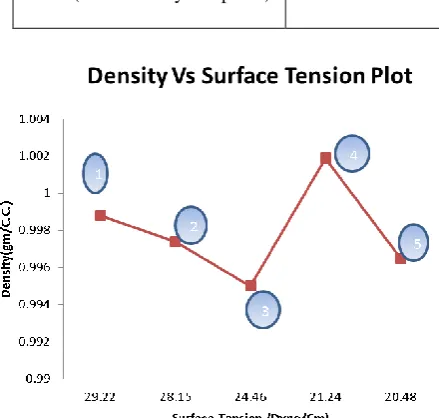
Where 1. SLS(Sodium Laryl Sulphate), 2. Face Wash, 3. Hand Wash. 4. Clinic Plus, 5. Dish Wash
Figure 2 : Variation of Surface Tension with Density.
From Table 1, shows the data of reference liquid of water at 200C.
From Table 2, it has been found that different solution shows different density value. Density of the shampoo solution and washing solutions were measured by weight of the Sp. Gravity Bottle weight method with the known density value of water at 200C. Clinic Plus shampoo shows greater density than the other household washing solutions. But surface tension of dish wash is to some extent less than that of Clinic Plus Shampoo.
This experiment was carried out by different washing liquids, liquid shampoo and they were standardized with standard surface active agent i.e, SLS(Sodium Laryl Sulphate). Then we determined the original density of the washing solutions and liquid shampoo with the help of specific gravity bottle method. The trends of the densities are as follows: dClinic Plus> dSLS >dFace Wash>dDish wash >dHand Wash. So, density trend and surface tension are not same, i.e, to some extent different.
This experiment was further carried out by (22ml water+5ml Bengene+0.02ml solution) this solution. Here we observed that the trend of the densities of these solution were same as above.
We test the additivity rule for these solutions to check the densities of the solutions. Here we also found that the density patterns of the solutions are same as above. So, additivity rule helps us to determine the density of these washing solutions.
Table 3 shows the number of drops and measurement of surface tension (with the help of reference liquid water) of washing solutions and different shampoo solutions. With increase the number of drops of the corresponding solutions, decrease the surface tension of those solutions. These are the surfactants which reduce the surface tension i.e, support the basic properties of surface tension of liquid.
Table 4 shows Density and Surface tension of different washing solutions and shampoo solution.
With increase the number of drops of the corresponding solutions, decrease the surface tension of those solutions.
Table 5 shows that pH value of standard surface active substances (SLS) is not so high than that of other washing substances as well as potential decreases. It is a better indication that house hold surface active substances that we choosing here are more or less same pH ranges i.e, nearly neutral pH range substances which helps us low skin irritation.
forces, this new surface has a greatly reduced surface tension.
Fig. 2 shows the Surface tension vs. Density plot of different household substances i.e, washing liquids and shampoo solution at 200C. With increase the number of drops of the corresponding solutions, decrease the surface tension of those solutions.
In case of solutions of long chain fatty acid and its salts, higher member alcohols, alkyl sulphonates, long chain quarternary amine and their salts, higher member esters etc. where the hydrophobic part contains a chain containing more than 8 to 10 carbon atoms. Such solutes due to the presence of long hydrophobic chain tendency to remain in the bulk phase. They remain mainly at the surface while the lower member analogues prefer to remain at the surface but have considerable bulk phase concentration also.
Here we found that all the washing liquids and shampoo solution act as surfactants depending on the increase of surface area. These findings support the basic properties of surface tension of liquid.
IV.
CONCLUSION
This study tried to compare different household surface active substances. All are very essential in our daily life. These surface active agents protect us in every space of our life. So, from our study it has been found that dish wash act as a good surfactant at 200C with increase their surface area than other washing liquids even shampoo solutions. Here also, it was observed that surface tension of water can be reduced to about 1/3.5 of its normal value by adding surfactants i.e, dish wash (Vim). This study will also helpful for consultant who easily differentiate between different house hold surface active substances with this easy method. We already showed our earlier studies that the surface tension of water can be reduced to about 1/3 of its normal value by adding surfactants i.e, Clinic Plus shampoo.
V.
ACKNOWLEDGEMENTS
The author is thankful to the Department of Chemistry, A.K.P.C. Mahavidyalaya for all types of necessary support.
VI.
REFERENCES
[1] A.Hazra, "Reduction of surface tension by surface active
agents", International J. of Pharmacy, Vol. 5(1), 2015, 42-45.
[2] Burcik, E.J., 'The Rate of Surface Tension Lowering and Its
Role in Foaming," J. Colloid Sci., Vol. 5, 1950, 421-436.
[3] Campbell, J., "Surface Tension Measurement by the
Drop-Weight Tech-nique," J. Physics D, Vol. 10, 1970, 1499-1504.
[4] du Nouy, P. Lecomte, "A New Apparatus for Measuring Surface
Tension," J.Gen. Physio., Vol. 1, 1918-1919, 521-524.
[5] Joos, P. and R. Ruyssen, 'The Foaming Properties of Saponins :
Time and Electrolytes Effects," in Chemistry, Physics and Application of Surface Active Agents, Proceedings of the IVth International Congress on Surface Active Substances, Brussels, 1964, Vol. II, J.Th.G. Overbeek, editor,Gordon and Breach Science Pub., New York, NY, 1967, 1143-1151.
[6] Lange, H., 'Dynamic Surface Tension of Detergent Solutions at
Constantand Variable Surface Area," J. Colloid Sci., Vol. 20, 1965, 50-61.
[7] Lauwers, A.R. and R. Ruyssen, "Foaming Properties of
Macromolecular Surface Active Agents -p-Lactoglobulin," in Chemistry, Physics and Application of Surface Active Agents, Proceedings of the IVth International Congress on Surface Active Substances, Brussels, 1964, Vol. II, J.Th.G. Overbeek, editor, Gordon and Breach Science Pub., New York, NY, 1967,1153-1159.
[8] Lunkenheimer, K. and I.D. Wante, "Determination of the
Surface Tension of Surfactant Solutions Applying the Method of Lecomte du Nouy (Ring Tensiometer)," Colloid Poly. Sci., Vol. 259, 1981, 354-366.
[9] Lynch, W.O. and C.N. Sawyer, 'Physical Behavior of Synthetic
Detergents. I. Preliminary Studies on Frothing and Oxygen Transfer," J. Water Poll.Control Fed., Vol. 26, 1954, 1193-1201. Nancy, I.H. and W.E. Barlage Jr., 'Mechanism of Interference of Surface Active Agents with Gas Transfer in Aeration Systems," Advances in Water 64
[10]Okun, D. and 1.1. Baars, 'Experimental Work on Effects of
Surface Active Agents on Bubble Formation," in Chemistry, Physics and Application 21 Surface Active Agents, Proceedings of the IVth International Congress on Surface Active Substances, Brussels, 1964, Vol. II, J.Th.G. Overbeek, editor, Gordan and Breach Science Pub., New York, NY, 1967, 1179-1188.
[11]Pierson, F.W. and S. Whitaker, "Studies of the Drop-Weight
Method for Surfactant Solutions. II. Experimental Results for Water and Surfactant Solutions," J. Colloid and Interface Sci., Vol. 54, 1976, 219-230.
[12]Prins, A. and M. vanden Tempel, "Effect of Minor Components
on Stability of Thin Liquid Films," in Chemistry, Physics and Application of Surface Active Agents, Proceedings of the IVth International Congress on SurfaceActive Substances, Brussels, 1964, Vol. II, J.Th.G. Overbeek, editor, Gordon and Breach Science Pub., New York, NY, 1967, 1119-1128. Rosen, M.J., Surfactants and Interfacial Phenomena, John Wiley and Sons, New York, NY, 1978.
[13]Caskey, J.A. and W.B. Barlage Jr., "An Improved Experimental
Technique for Determining Dynamic Surface Tension of Water and Surfactant Solutions," J_. Colloid and Interface Sci., Vol. 35, 1971, 46-52.
[14]Pubchem, "Sodium Carbonate-Na2CO3". Pubchem.ncbi.
nlm.nih.gov. Retrieved 10 January, 2015.
[15]Dills, Isabelle (17 June 2008). "Washington State Begins Ban
On Dishwashing Detergents". The Huffington Post Retrieved 10 January, 2015.
[16]abcd Rein, Lisa (23March 2007). "Maryland Takes Step To