Article
Generation of the Stream of Consciousness
by Neuronal Synaptic Interaction
Andrew Duggins 1, 2 *
1 Western Clinical School, Faculty of Medicine and Health, University of Sydney;
2 Department of Neurology, Westmead Hospital; [email protected]
* Correspondence: [email protected]; Tel.: +61-413-475-681
Abstract: In previous work, a quantum mathematical formalism associated an element of experience with a single sensory neuron, as a local reduction of a global mental state. In contrast to the binary objective states of neuronal polarisation/depolarisation, neuronal experience was modeled as a continuous variable, the instantaneous value of which could only be estimated statistically from an ensemble of evoked responses to stereotyped stimulus presentation. In the present work, the quantum operations formalism of energy dissipation through amplitude damping is adopted to explain how smooth evolution of conscious experience might arise from discrete spikes and discontinuous synaptic transmission between neurons.
Keywords: stream of consciousness; quantum mechanics; decoherence theory; synaptic transmission; spike; action potential; neural code; neural correlate of consciousness
1. Introduction
1.1. Conceptual Background
At the click of a Geiger counter, an observer infers that a nearby Americium-74 nucleus has
decayed to Neptunium-72, emitting an alpha particle. Yet before and after this nuclear
transmutation, the universe is in a coherent superposition of states of parent and of daughter
radionuclide. Moreover, the state vector of the universe moves smoothly and continuously through
Hilbert space over the lifetime of the radionuclide from the parent to daughter eigenspace, a decay
that had appeared spontaneous and random generated by the time-independent interaction
between nucleus and its immediate environment. Even considering only the reduced state of this
one nucleus, the probability weighting of the parent in an incoherent mixture with daughter
radionuclide must smoothly decay over time. These dynamics only appear as an abrupt transition
because out of the mixture of parent and daughter radionuclides only one or other can be manifest
in the world of the observer at a point in time.
This account raises the question whether other apparently discrete spontaneous events arising
in the natural world might be generated similarly. This would be particularly plausible where
transition events in subsystems were known to correlate with the state and smooth trajectory of a
spatially distributed system of which subsystems were all part. The brain is such a multipartite and
anatomically distributed system, in which the stream of unified consciousness is driven by
transition events in neuronal components. Specifically, we consider whether a single spike, and the
chemical synaptic transmission that results, might be modelled as a continuous interaction between
an efferent and afferent neuron.
1.2. Existing Model: axioms and quantum foundations
In the author’s previous work, two ‘bridging principles’ for the mind-brain relation were
presented as axiomatic foundations of a neuronal model of sensory perception. The first postulate was that the “contribution of a single sensory neuron to the neural code for the sensory
environment parallels the relationship between a neuronal element of experience and the overall sensory percept” [1]. As an example, if as suggested by the experiment of Britten [2] the organism’s
behavioural response to direction of visual motion, within a limited region of the visual field, can be predicted almost entirely by the response of a single, carefully selected neuron in the motion-sensitive cortex V5, then the neuron singlehandedly encodes this aspect of the sensory environment.
The first bridging principle goes further to say that such a V5 neuron also affords, within a limited region, this same limited aspect of motion experience. The second postulate extended the
mind-brain parallel to neuronal relations: “however the similarity between environmental features specified by a pair of neurons is encoded in their joint activity, this objective association parallels
the qualitative proximity of respective neuronal elements of experience” [3]. Previous work emphasised perceptual rather than conceptual experience, but in what follows it will be assumed
that these bridging principles can be extended to a more general correspondence between objective and subjective representation of information. A third and final bridging principle was suggested in
section 1.1 of the current paper, but is here stated again formally: neuronal synaptic transmission generates not only the evolution of an objective neural representation of information but also the dynamics of conscious experience (those elements of experience and their relations corresponding
to that objective representation by the first and second bridging principles).
Notwithstanding the close association, implied by these bridging principles, between elements of experience and their neural correlates, a purely physicalist approach, it was argued, would fail to
capture two essential features of consciousness, subjectivity and unity. A starting point to the development of a model to describe these features was the principle of evoked responses in
neurophysiology. Neural responses are quantised as spikes. Over an ensemble of stereotyped stimulus presentations, the best description of a sensory neuron’s response to the stimulus at a
point in time is its instantaneous firing rate, averaged across trials, not the number of spikes that have already occurred on an individual trial, or the objective state of the neuron that pertains at that moment. The quantum mathematical formalism is consistent with an interpretation that the state of
a system really exists and has statistical effects over an ensemble of trials with identical starting conditions, even though the state itself is not directly measurable. In the quantum mechanical
mathematical formalism of neural signaling that was developed, this feature of the quantum state was identified with the subjectivity of a neural element of experience. Spikes were considered to be
objective transition events between definite levels of neuronal potential, even as an element of experience, inaccessible to direct measurement, smoothly decayed (like the quantum conception of
was not only proportional to the instantaneous firing rate, but also to a scalar quantity of experience inherent in the inaccessible neural state (a ‘perception value’, see below).
If only this part of the quantum formalism had been appropriated, consciousness would have been neuro-anatomically locally explicable, consistent with the ‘microconsciousness’ theory of Zeki:
“Activity in each separate processing node generates a microconsciousness for the attribute for which that node is specialised. Consequently, there are several microconsciousnesses,
corresponding to the activity of cells at different nodes within different processing systems” [4]. It seemed to the author that such “summative atomism” was a poor description of the phenomenon:
“a sub-mind is an atrocious monstrosity, just as is a plural-mind - neither having any counterpart in anybody’s experience, neither being in any way imaginable” [5]. Indeed, the unity of consciousness seemed to be a fundamental feature. A unified consciousness was considered to be singular and not plural; complete in itself, not a fraction of a greater whole. In contrast, sensation, cognition, emotion
and volition were considered not complete experiences but aspects of the subject’s consciousness. Whatever level of perceptual or conceptual experience is introspected upon, it always seemed possible to consider a higher level at which the relation between simultaneous percepts or concepts
is experienced. The unified mental state was thus proposed to exist at the apex of a hierarchy of bound percepts and concepts. The author shared with Nagel the view that “It seems inevitable that
psychophysical explanation will apply first at the level of some kind of elements of experience; but if these elements come together in a single consciousness, they must also be components of a single
point of view” [6]. This suggested that, just as the bound percept might be resolved along multiple perceptual dimensions, perhaps a unified consciousness might usefully be represented as a mental state vector in a subjective space spanned by all of the dimensions of perceptual experience.
With these ideas in mind, two other features of the quantum mathematical formalism,
superposition of states and tensor product combination of state spaces, were applied to a neuronal model that had been extended to the whole brain. This facilitated description of the mental state as
a pure, inseparable state (a vector or uni-dimensional projector) on this combined system of vast dimension. There was proposed a direct correspondence between the unity of experience, a
property of the system as a whole, and such coherence of the state of that system. The reduced state of any subsystem of one or many neurons would be a mixed-state density operator. Were this not
so, the completeness privilege of consciousness described above would be lost. Such a mental state would be not only unified but also emergent: it would reduce to, but be not entirely constituted in the semi-classical phenomenal correlates of firing rate at the single neuron level, mentioned above.
The objective manifestation of an inseparable pure mental state would be firing correlations between neurons in anatomically remote regions that have no direct synaptic connection with each
other, perhaps correlations that could not have been established classically by synaptic input from a common source.
In a decoherence theoretic interpretation of quantum mechanics, the emergence of a
probability-weighted mixture of discrete objective states is the local manifestation of a smooth, unitary evolution generated by the interaction between a system and its environment [7]. In the
that such a decoherence theoretic framework can reconcile discontinuous synaptic transmission with the stream of consciousness. Specifically, complex neuronal vector spaces, which might have
seemed an unnecessary extravagance when modelling subjectivity and unity, will facilitate a description of unitary evolution of the mental state1. Of course, if this were merely the application of quantum physics to the brain, considered as an open quantum system, its quantum state would
no longer remain pure after a vanishingly small decoherence time, although the state of a very large composite system including the brain and some part of its physical environment would remain
pure. In order to maintain the picture of a pure mental state, the only interaction that will be considered in this neuronal model is that occurring at the synapse. Interactions that occur between
sub-neural structures and their physical environment will be neglected.
Of course, classical neural dynamics, generated by synaptic transmission, are already well described. At a synapse on the dendrite of a recipient neuron, excitatory neuro-transmitters,
released as a spike depolarises the pre-synaptic terminal, increase sodium permeability by opening chemically-gated channels and partially depolarise the post-synaptic membrane. Partial
depolarisation at the trigger zone, by passive (or ‘electrotonic’) conduction of this excitatory
post-synaptic potential, may reach a threshold at which voltage-gated sodium channels open, making the transmembrane potential abruptly positive. This opens similar channels in the adjacent neural
membrane, so that complete depolarisation extends rapidly throughout the neuron as a spike. What is to be presented here will challenge none of this. Partly this is because the model is a
coarse-grained description, neglecting all this subcellular activity to represent a spike as nothing more than a Dirac delta function. More importantly though, the contention is that the continuous evolution of the mental state reduces to the discrete synaptic transmission of information of the classical neuron
doctrine at a local level of explanation, in the same way that the click of the Geiger counter is a local manifestation of the unitary evolution of the state vector of the universe.
1.3. Existing Model: mathematical formalism
In previous work, a unified consciousness, or mental state, was modelled as a vector on a
composite tensor product of single neuronal complex vector spaces [3]. Each of these neuronal spaces was spanned by an orthonormal basis of integer ‘action potential’ states |𝑛⟩. These were eigenvectors of a hermitian number operator 𝑁: states of inevitability of corresponding integer spike counts 𝑛, but in contradistinction to conventional neuroscience not the depolarisation events themselves. A superposition principle was introduced in which pure states |𝜓⟩, sums of integer action potential states weighted by complex amplitudes ⟨𝑛|𝜓⟩, were all valid single neuronal states. If a state |𝜓⟩ were normalised, the squared modulus |⟨𝑛|𝜓⟩|2 would be the prior probability that a neuron in that state would ultimately spike n times, and the expectation value of 𝑁 , 〈𝑁〉, a sum of eigenvalues 𝑛 weighted by these respective probabilities, would be the expected spike count. The proposed equivalence of using the uni-dimensional projector |𝜓⟩⟨𝜓| or the vector |𝜓⟩ for the description of a pure state of a neuron implied that a global phase 𝑒𝑖𝜃across amplitudes ⟨𝑛|𝜓⟩
1Unitary evolution implies that the evolution operator when multiplied by its adjoint yields the identity (see section 3.1
would have no subjective or objective meaning. The significance of relative phase differences
(which remain in either description) will be revealed below.
Application of the same superposition principle to the composite space yielded entangled
mental states that were not tensor products of single neuronal states, putting the concept of
emergence of consciousness in mathematical form [3]. Consciousness still had a neural correlate,
however, in that local reduction of the pure mental state to the single neuron 𝐴 was shown to be the density matrix 𝜌𝐴, a probability-weighted mixture of uni-dimensional projectors. A ‘memoryless firing’ assumption, in which the posterior probability of a future spike would be unaffected by a
period of neuronal silence, implied that the instantaneous firing rate would be proportional to the
expected spike count with proportionality constant 𝑤 [1]. In the same way that the instantaneous firing rate might quantify a single sensory neuron’s contribution to the objective neural code for an environmental stimulus, it was proposed that a scalar ‘perception value’, also proportional
to 〈𝑁〉 but with constant 𝑟, would quantify that same neuron’s contribution to the subjective percept. Similarly, instantaneous firing rate dependence, a manifestation within a neuronal pair of
an entangled mental state, might quantify both an objective inter-neuronal code and subjective
phenomenal proximity between neural elements of experience [3].
2. Materials and Methods
Here we argue reductio ad absurdum that without synaptic transmission, action potentials
would remain sequestered in neurons, perception values would be unchanging and consciousness
static. We extend the quantum mechanical formalism summarised above to show that a single
neuron isolated in this way could nevertheless undergo a unitary evolution generated by 𝑁 in which integer action potential eigenstates remain unchanged but for acquisition of a relative
phase −𝑛𝜔𝑡. We extrapolate that in any neural system in which, by virtue of isolation, there is conservation of action potential, the subjective state of that system could nevertheless undergo a
unitary evolution 𝑈. But synaptic interaction within that system would require that the eigenvectors of 𝑈 were no longer single neuron integer action potential eigenstates. Applying this principle to a hypothetical isolated 2-neuron system, we model the oscillatory flow of a single action potential
between component neurons 𝐴 and 𝐵 by synaptic transmission as a Jaynes-Cummings interaction [8]. We use an operator sum formalism to reduce this unitary evolution to a description of the
continuous evolution of the single neuron state 𝜌𝐵. We qualify the perception value concept, replacing the general constant 𝑟 with ‘nervous energy’: a neuron-specific experience-per-spike dependent on 𝜔. We show how, in a realistic brain of polysynaptic neuronal interaction, this allows reconciliation of oscillatory flow of action potential between a neuronal pair with exponential decay
3. Results
3.1. Unitary dynamics of isolated neurons
If we were able to set 𝑤 = 0, and in doing so abruptly impose upon the brain complete
neuronal isolation, then a neuron’s action potential could no longer be realised as spikes. If a single neuron were in a pure state |𝜓⟩ with probability |⟨𝑛|𝜓⟩|2 of 𝑛 eventual spikes prior to this imposed isolation, it would still have the same probability of 𝑛 spikes after such isolation were relieved. While synaptic transmission to or from the neuron remained impossible, 〈𝑁〉 and perception value would remain constant. In the proposed mathematical formalism the evolution of single neuronal
elements of experience is entirely attributable to spikes and synaptic transmission.
Neuronal isolation would nevertheless be compatible with an evolution in which, over time 𝑡, incremental integer action potential states acquire a relative phase 𝜔𝑡. This implies an association between relative phase and experience that will be justified below. An operator 𝑈 on the single neuron space to effect such an evolution would be unitary, meaning that 𝑈†𝑈 is the identity 𝐼 for example the operator
𝑈(𝑡) = ∑ 𝑒−𝑖𝑛𝜔𝑡 𝑛
|𝑛⟩⟨𝑛|
𝑈†(𝑡)𝑈(𝑡) = ∑|𝑛⟩⟨𝑛| 𝑛
This particular 𝑈 is generated by 𝑁, and leaves the phase of the ground state |0⟩ unchanged. Of course any operator that imposed the same relative phase but a different global phase on the neural
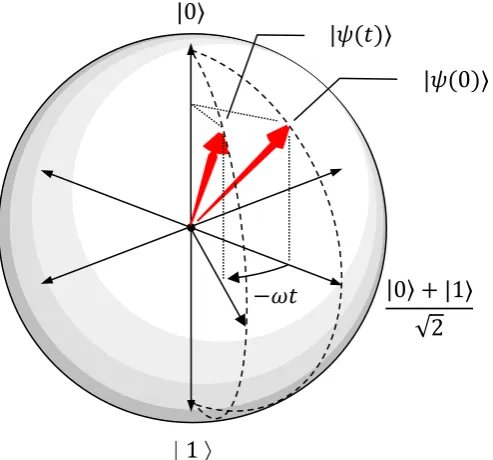
state would describe an identical evolution. The evolution of an isolated single neuron in a
superposition of 0- and 1-action potentials is depicted in Figure 1. It will be mathematically
convenient, when we consider the contribution of such single-neuron evolution to a multi-neuron
system, to use an equivalent 𝑈, generated by an operator sharing with 𝑁 eigenvectors belonging to eigenvalues of unit separation (so that they again acquire relative phase −𝜔𝑡), presented here in matrix form with respect to the basis {|𝑛⟩}:
−𝑍 2= [
−1
2 0
0 1 2
]
In a 2-neuron system within which individual neurons were isolated, an evolution on the
composite space could only impose a relative phase on tensor products of single neuron integer
action potential states, and could neither introduce nor abolish entanglement in a pure state
superposition thereof. The quality of a very limited consciousness would remain static. The tensor
product of single neuron unitary operators to effect this evolution, 𝑈𝐴⊗ 𝑈𝐵 might be generated by an ‘uncoupled’ operator [4]
−𝑍𝐴 2 ⊗ 𝐼
𝐵+ 𝐼𝐴⊗ −𝑍𝐵
2 = [
−1 0 0 0 0 0 0 0 0 0 0 0 0 0 0 1 ]
where the choice of −𝑍
Figure 1.Evolution on the Bloch sphere of a superposition state of an isolated single
neuron: |𝜓(0)⟩ = ⟨0|𝜓(0)⟩|0⟩ + ⟨1|𝜓(0)⟩|1⟩. |𝜓(0)⟩ is assumed to have a relative phase of 0. The
one-action potential state acquires a phase of−𝜔𝑡 over time 𝑡 (𝜔 assumed positive, phase
acquisition negative), relative to the zero-action potential state.
3.2. Unitary dynamics of synaptic interaction
More generally of course, a multi-neuron system might be isolated, in the sense that there
could be no synaptic transmission to or from the wider neural environment, even as such
interaction was ongoing between component neurons. Action potential would be conserved within
the system, even as it flowed between components. Within a 2-neuron system (Figure 2), an
interaction between neurons might generate a unitary evolution that would not preserve |0𝐴⟩|1𝐵⟩ or|1𝐴⟩|0𝐵⟩ eigenvectors, but would nevertheless conserve one action potential.
Figure 2.A fictitious isolated 2-neuron system. Like the isolated single neuron, the 2 -neuron
system should undergo unitary evolution, without gain or loss of action potential. Here
though, potential should flow between neurons as spikes.
|0⟩
1
|0⟩ + |1⟩
ξ2
−𝜔𝑡
|𝜓(0)⟩
|𝜓(𝑡)⟩
𝐴
If neuron 𝐵 is initially in the 1-action potential state, while 𝐴 is initially in the ground state, then with prior probability 𝑃(𝑡), after some brief time 𝑡 has elapsed, a single spike may have occurred in 𝐵. The reduced state of neuron 𝐵 will then be in a mixture of the 0-action potential state weighted by probability 𝑃(𝑡) and the 1-action potential state weighted by the probability 1 − 𝑃(𝑡):
𝜌𝐵= 𝑃(𝑡)|0𝐵⟩⟨0𝐵| + (1 − 𝑃(𝑡))|1𝐵⟩⟨1𝐵|
This is consistent with an evolution that takes the pure initial state |0𝐴⟩|1𝐵⟩ to a weighted superposition of |0𝐴⟩|1𝐵⟩ and |1𝐴⟩|0𝐵⟩, where the squared modulus of the amplitude of the second term is the firing probability:
|0𝐴⟩|1𝐵⟩→ √1 − 𝑃(𝑡)|0𝑡 𝐴⟩|1𝐵⟩ − 𝑖√𝑃(𝑡)|1𝐴⟩|0𝐵⟩
[ 0 1 0 0
]→𝑡 [
0 √1 − 𝑃(𝑡)
−𝑖√𝑃(𝑡) 0 ]
As in the non-interacting neuron model above, we choose an evolution in which |0𝐴⟩|0𝐵⟩ and |1𝐴⟩|1𝐵⟩ acquire a positive and negative phase respectively, determined by single neuron evolution, but the phase of the |0𝐴⟩|1𝐵⟩ term in the superposition does not change. The phase of the |1𝐴⟩|0𝐵⟩ term is chosen to simplify the mathematical form of the operator that generates this evolution.
The columns of the operator that achieves these transformations, 𝑈𝐴𝐵(𝑡), are orthonormal (since 𝑈𝐴𝐵 is unitary) and reflect the symmetry of the system:
𝑈𝐴𝐵(𝑡) =
[
𝑒𝑖𝜔𝑡 0 0 0
0 √1 − 𝑃(𝑡) −𝑖√𝑃(𝑡) 0 0 −𝑖√𝑃(𝑡) √1 − 𝑃(𝑡) 0 0 0 0 𝑒−𝑖𝜔𝑡]
3.3. Evolution of the reduced neural state: spike elements
More generally still, if neuron 𝐵 is initially in a superposition of 0- and 1-action potential states weighted by 𝑐0 and 𝑐1 respectively (and neuron 𝐴 is again assumed to start in the ground state) then a matrix equation for the unitary evolution of the initial product state is
[
𝑒𝑖𝜔𝑡 0 0 0
0 √1 − 𝑃(𝑡) −𝑖√𝑃(𝑡) 0 0 −𝑖√𝑃(𝑡) √1 − 𝑃(𝑡) 0 0 0 0 𝑒−𝑖𝜔𝑡]
× [ 𝑐0
𝑐1
0 0
] = [
𝑐0𝑒𝑖𝜔𝑡
𝑐1√1 − 𝑃(𝑡)
0 0 ]
+ [ 0 0 −𝑐1𝑖√𝑃(𝑡)
0 ]
𝑈𝐴𝐵(𝑡)|0𝐴⟩ ⊗ |𝜓𝐵(0)⟩ = |0𝐴⟩ ⊗ 𝑆
0(𝑡)|𝜓𝐵(0)⟩ + |1𝐴⟩ ⊗ 𝑆1(𝑡)|𝜓𝐵(0)⟩
where ‘spike elements’ 𝑆0 and 𝑆1 are operators ⟨0𝐴|𝑈𝐴𝐵|0𝐴⟩ and ⟨1𝐴|𝑈𝐴𝐵|0𝐴⟩ on 𝐵, representations of which are the submatrices of 𝑈𝐴𝐵, [𝑒𝑖𝜔𝑡 0
0 √1 − 𝑃(𝑡)] and [0 −𝑖ξ(𝑃(𝑡)0 0 ] respectively. The spike
probability is the squared modulus of the second term
⟨𝜓𝐵(0)|𝑆
1(𝑡)†𝑆1(𝑡)|𝜓𝐵(0)⟩ = 𝑃(𝑡)|𝑐1|2
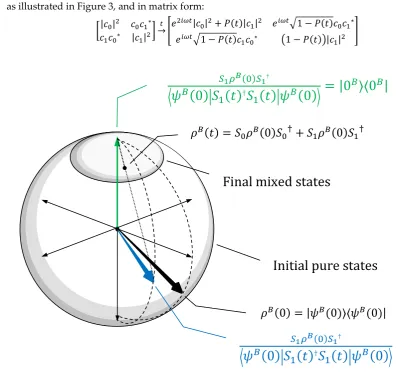
|𝜓𝐵(0)⟩⟨𝜓𝐵(0)| → 𝑆
0|𝜓𝐵(0)⟩⟨𝜓𝐵(0)|𝑆0†+ 𝑆1|𝜓𝐵(0)⟩⟨𝜓𝐵(0)|𝑆1† as illustrated in Figure 3, and in matrix form:
[|𝑐0|
2 𝑐 0𝑐1∗
𝑐1𝑐0∗ |𝑐1|2
]→ [𝑡 𝑒
2𝑖𝜔𝑡|𝑐
0|2+ 𝑃(𝑡)|𝑐1|2 𝑒𝑖𝜔𝑡√1 − 𝑃(𝑡)𝑐0𝑐1∗
𝑒𝑖𝜔𝑡√1 − 𝑃(𝑡)𝑐
1𝑐0∗ (1 − 𝑃(𝑡))|𝑐1|2
]
1
2
3
Figure 3.Evolution of the reduced state of neuron 𝐵, part of an isolated 2-neuron system as
4
in Figure 2. Here the initial composite state |0𝐴⟩|𝜓𝐵(0)⟩ is separable, so the initial reduced
5
state 𝜌𝐵(0) is pure, depicted as a black arrow on the surface of the Bloch sphere. Unitary
6
evolution of the combined system is equivalent to the operati on of spike elements 𝑆0 and 𝑆1
7
on the neural space of 𝐵. After a brief period of time, in which the probability of a spike in
8
neuron 𝐵 is approximately ⟨𝜓𝐵(0)|𝑆
1(𝑡)†𝑆1(𝑡)|𝜓𝐵(0)⟩, the reduced state evolves smoothly to a
9
weighted mixture 𝜌𝐵(𝑡) of the zero-action potential state (green arrow) and the no -spike
10
pure state (blue arrow), that mixture depicted as a point in the interior of the sphere.
11
12
13
𝜌
𝐵(0) = |𝜓
𝐵(0)⟩⟨𝜓
𝐵(0)|
𝑆1𝜌𝐵(0)𝑆1†
ർ𝜓𝐵
(0)ቚ𝑆
1(𝑡)
†𝑆
1
(𝑡)ቚ𝜓
𝐵(0)
𝑆1𝜌𝐵(0)𝑆1†ർ
𝜓
𝐵(0)
ቚ𝑆
1(𝑡)
†𝑆
1(𝑡)
ቚ𝜓
𝐵(0)
= |0
𝐵
⟩⟨0
𝐵|
𝜌
𝐵(𝑡) = 𝑆
0𝜌
𝐵(0)𝑆
0†+ 𝑆
1𝜌
𝐵(0)𝑆
1†3.4. Synaptic Interaction on the 1-action potential manifold: Part I
14
Entangled states of 1-action potential 1 ξ2(|0
𝐴⟩|1𝐵⟩ ± |1𝐴⟩|0𝐵⟩) are unchanged by the operation
15
of 𝑈𝐴𝐵, but for the acquisition of relative phase. On the 1-action potential manifold of states, these
16
states are also eigenvectors of an interaction operator 𝑋. We might insist, as previously, that relative
17
phase must accumulate linearly over time, in which case 𝑋 generates an evolution on this manifold
18
𝑒−𝑖𝑋𝑔𝑡
19
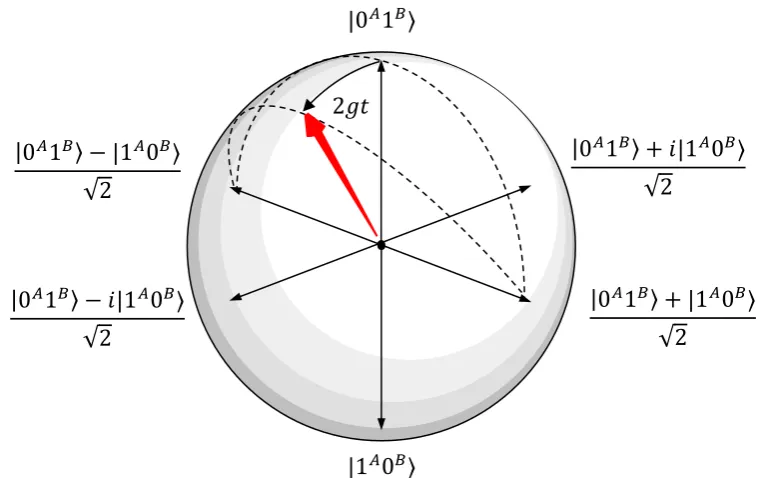
where 𝑔 parameterises the strength of synaptic coupling (Figure 4). We can equate this with the
20
central submatrix of 𝑈𝐴𝐵(𝑡), substituting sin2𝑔𝑡 for the prior probability of a single spike 𝑃(𝑡):
21
[−𝑖sin 𝑔𝑡cos 𝑔𝑡 −𝑖sin 𝑔𝑡cos 𝑔𝑡 ]
22
The action potential then ‘sloshes’ back and forth between neurons at a frequency of 𝑔𝜋
.
23
24
25
Figure 4.The |0𝐴1𝐵⟩, |1𝐴0𝐵⟩ manifold of states of the isolated 2-neuron system in Figure 2,
26
depicted as a Bloch sphere. After a brief period of time 𝑡, the initial separable state |0𝐴1𝐵⟩
27
has evolved to the entangled state cos 𝑔𝑡|0𝐴1𝐵⟩ − 𝑖 sin 𝑔𝑡|1𝐴0𝐵⟩, reflecting a spike probability
28
in neuron 𝐵 of approximately sin2𝑔𝑡.
29
30
31
|1
𝐴0
𝐵⟩
|0
𝐴1
𝐵⟩
|0
𝐴1
𝐵⟩ + 𝑖|1
𝐴0
𝐵⟩
ξ2
|0
𝐴1
𝐵⟩ − 𝑖|1
𝐴0
𝐵⟩
ξ2
|0
𝐴1
𝐵⟩ + |1
𝐴0
𝐵⟩
ξ2
|0
𝐴1
𝐵⟩ − |1
𝐴0
𝐵⟩
ξ2
3.5. A paradox: oscillation versus decay
32
There is an inconsistency here with our earlier prediction that 〈𝑁〉 and perception value should
33
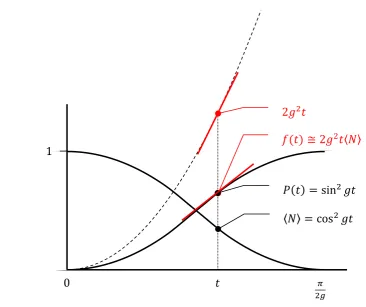
be proportional to a neuron’s instantaneous firing rate (Figure 5a). An instantaneous firing rate
34
must be the gradient with which spike probability increases over time. But in the unitary evolution
35
that we have described, over a brief time period 𝑡
36
𝑃(𝑡) = sin2𝑔𝑡 ≅ 𝑔2𝑡2
37
so the instantaneous firing rate of neuron B increases in proportion to time:
38
𝑓𝐵(𝑡) ≅ 2𝑔2𝑡
39
Initially, when 〈𝑁𝐵〉 is maximal, the instantaneous firing rate is zero (Figure 5b)!
40
41
42
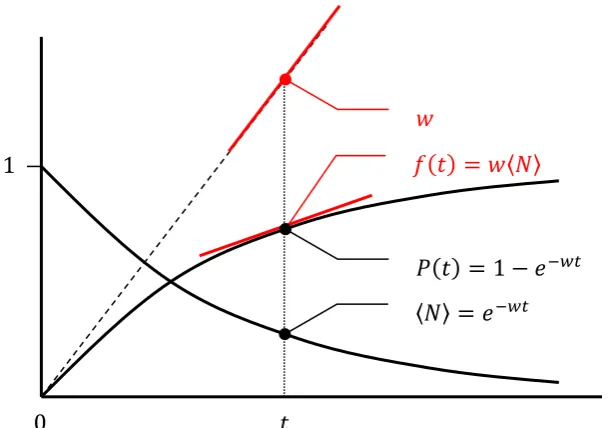
Figure 5a.Changes in 〈𝑁〉; spike probability 𝑃(𝑡); and instantaneous firing rate 𝑓(𝑡) in an
43
interacting neuron initially in the one-action potential state, according to the ‘memoryless
44
firing’ assumption. Compared with Figure 5b, the instantaneous firing rate decays
45
exponentially over time from an initial rate constant of 𝑤, remaining proportional to 〈𝑁〉.
46
47
𝑓(𝑡) = 𝑤〈𝑁〉
𝑡
〈𝑁〉 = 𝑒
−𝑤𝑡𝑃(𝑡) = 1 − 𝑒
−𝑤𝑡𝑤
48
49
50
Figure 5b.Changes in 〈𝑁〉; spike probability 𝑃(𝑡); and rate of accumulation of spike
51
probability, the instantaneous firing rate 𝑓(𝑡) in neuron 𝐵, part of the isolated 2-neuron
52
system in Figure 2 that is initially in the state |0𝐴1𝐵⟩. Initially, instantaneous firing rate
53
increases with time. These changes correspond to the evolution of the composite state
54
depicted in Figure 4, but they do not accord with the prediction that instantaneous firing
55
rate should vary with 〈𝑁〉.
56
57
The perception value was supposed to be a general description of the subjective
58
correlate of the neural response on a single trial, compatible with the instantaneous firing
59
rate as a description of the objective neural response over an infinite ensemble of
60
stimulus repetitions. We would be loath to abandon the simple linear relationship
61
between perception value and firing rate that follows from the memoryless firing
62
assumption [1]. Yet the current model is particularly attractive in that it links the
63
dynamics of experience to synaptic interaction, as most neuroscientists would require. In
64
fact, reconciliation between these positions is possible, if we recognise and overcome a
65
limitation of the current model.
66
3.6. Variable nervous energy of the action potential
67
We must reject the implicit assumption that different neurons with the same spike
68
potential (the same expected spike count 〈𝑁〉) should afford the same perception value (we
69
cannot assume that the proportionality constant 𝑟, between 〈𝑁〉 and the perception value,
70
is the same for different neurons). While it would seem essential, if a quantum formalism
71
is to have any validity in modeling brain activity, for all action potentials in a particular
72
neuron to be identical, action potentials of a pre -synaptic efferent and post-synaptic
73
𝑓(𝑡) ≅ 2𝑔
2𝑡〈𝑁〉
2𝑔
2𝑡
〈𝑁〉 = cos
2𝑔𝑡
𝑃(𝑡) = sin
2𝑔𝑡
1
0
𝑡
𝜋afferent neuron could differ. We have not uncovered any objective manifestation of the
74
value of 𝜔, so it would seem reasonable to allow the level of percep tual experience that
75
could be attributed to a neuron at a given instantaneous firing rate to be determined by a
76
neuron-specific 𝜔, if that would lead to a resolution of the paradox.
77
78
To achieve this, we will need a ‘nervous energy’ operator on the neuronal space
79
𝐻 = ℏ𝜔𝑁
80
where ℏ is a fundamental constant across all neurons, and ℏ𝜔 replaces 𝑟. The nervous
81
energy of 1 action potential
82
⟨1|𝐻|1⟩ = ℏ𝜔
83
is the ‘experience-per-spike’ of that neuron. Perception is an immeasurable quantity, and
84
a neuron’s contribution to consciousness can only be defined relative to other neurons, so
85
we might reasonably allocate ℏ a value of 1.
86
3.7. Synaptic Interaction on the 1-action potential manifold: Part II
87
The isolated single neuron will now evolve as
88
𝑈(𝑡) = 𝑒−𝑖𝐻𝑡
89
The uncoupled operator that generates the evolution of the 2-neuron system of isolated individual
90
neurons becomes:
91
−𝜔𝐴𝑍 𝐴
2 ⊗ 𝐼
𝐵− 𝐼𝐴⊗ 𝜔𝐵𝑍 𝐵
2
92
This adds a contribution δ to the nervous energy of synaptic interaction on the one action
93
potential manifold
94
[𝑔𝛿 −𝛿𝑔 ]
95
where 𝛿 is the deviation of each 𝜔 from the average
96
𝛿 =(𝜔
𝐵− 𝜔𝐴)
2
97
If we define a Rabi frequency
98
Ω = √𝑔2− 𝛿2
99
then the evolution generated on this manifold, illustrated in Figure 6, becomes
100
[
cos Ω𝑡 − 𝑖 (𝛿
Ω) sin Ω𝑡 −𝑖 ( 𝑔 Ω) sin Ω𝑡 −𝑖 (𝑔
Ω) sin Ω𝑡 cos Ω𝑡 + 𝑖 ( 𝛿 Ω) sin Ω𝑡
]
101
There is still an oscillatory flow of action potential, but as the discrepancy in 𝜔 between
102
efferent and afferent neuron increases, the weighting of the 1 -action potential state in 𝜌𝐵(𝑡)
103
dips to a lesser extent (𝑔2𝑔+𝛿22) and is more promptly restored (period
𝜋 Ω).
104
106
Figure 6.Evolution of the |0𝐴1𝐵⟩, |1𝐴0𝐵⟩ manifold of states of an isolated 2-neuron system on
107
the Bloch sphere. Compared with Figure 4, where the nervous energy of the one -action
108
potential state is the same in neurons 𝐴 and 𝐵, here 𝛿 =𝜔𝐵−𝜔2 𝐴 may be non-zero. As before 𝑔
109
parameterises the strength of synaptic coupl ing. The angular frequency of oscillatory flow
110
of action potential between neurons Ω = √𝑔2+ 𝛿2. Compared with the evolution of an initial
111
1-action potential state of 𝐵 plotted in Figure 5b, here the nadir of spike potential occurs
112
earlier and is less profound.
113
114
These dynamics describe the interaction between a single source and target neuron.
115
Only when we discard the fanciful model of two isolated but interacting neurons, and
116
impose instead the constraints of realistic neuronal connectivity, do these dynamics yield
117
the constant initial firing rate of the source that we require. The argument for a linear
118
accumulation of spike probability in this latter case is based on a standard derivation [ 10]
119
of ‘Fermi’s Golden Rule’ [11] in the parallel quantum mechanical formalism, and will be
120
presented here only in outline. In fact a single neuron is likely to provide synaptic input
121
to a large number of target neurons. The prior probability that a single spike in the source
122
will ultimately lead to a spike in any of one of these targets will be extremely small. We
123
will assume a constant weak coupling 𝑔 between a single source neuron 𝐵 and any one of
124
a large number of targets 𝐴.
125
126
If each target neuron were initially in the ground state then collectively they would
127
act as a reservoir: if 𝑡 remains small, the probability of spike occurrence in 𝐵 could be
128
approximated as the sum of weights for the |1𝐴⟩⟨1𝐴| state in each 𝜌𝐴(𝑡). In a target neuron
129
with similar angular velocity to the source, the weight of this state initially increases as
130
|1
𝐴0
𝐵⟩
|0
𝐴1
𝐵⟩
|0
𝐴1
𝐵⟩ + 𝑖|1
𝐴0
𝐵⟩
ξ2
|0
𝐴1
𝐵⟩ − 𝑖|1
𝐴0
𝐵⟩
ξ2
|0
𝐴1
𝐵⟩ + |1
𝐴0
𝐵⟩
ξ2
|0
𝐴1
𝐵⟩ − |1
𝐴0
𝐵⟩
ξ2
𝛿 Ω 𝑔 Ω
𝑔2 𝑔2+𝛿2sin
2Ω𝑡 ≅ 𝑔2𝑡2 (𝛿2≅ 0, 𝑡 small)
131
as in Figure 5b. Meanwhile, in a target neuron with angular velocity 𝜔𝐴 very different
132
to 𝜔𝐵, the weight of the |1𝐴⟩⟨1𝐴| state becomes a ‘sinc-squared’ function of 𝛿:
133
𝑔2 𝑔2+𝛿2sin
2Ω𝑡 ≅ 𝑔2 sin2𝛿𝑡
𝛿2 (𝑔
2≪ 𝛿2)
134
The width of this function narrows as1
𝑡 even as its peak increases with𝑡
2. Assuming
135
that there are so many target neurons that the distribution of target angular velocities 𝜔𝐴
136
around 𝜔𝐵 can be considered continuous, and moreover that the number of target
137
neurons within a narrow range ∆ 𝜔𝐴is relatively constant at 𝑞, the combination of these
138
effects that leads to a linear accumulation of spike probability:
139
𝑃(𝑡) = 𝜋𝑞𝑔2𝑡
140
The initial firing rate of the 1-action potential state in 𝐵 is constant, as we require (Figure
141
5a):
142
𝑤 = 𝜋𝑞𝑔2
143
3.8. Temporal frequency of the stream of consciousness
144
𝑤 is the rate constant of an exponential decay in the spike potential of the source,
145
expressed in terms of the strength and density of synapses on target neurons. Experience
146
will also have ‘relaxation’ dynamics, in which a proportion1
ⅇ of the initial perception
147
value decays within an average spike time of 1
𝑤. In effect, 𝑤 is the maximal temporal
148
frequency of the stream of consciousness. 1
𝑤 is also the minimal temporal resolution of
149
spike trace recording that is sufficient to make reliable inferences about consciousness.
150
For example, an estimate of spike frequency (across a finite number of trials) in bins of
151
width less than𝑤1 is sufficient to predict the continuously evolving perception value with
152
reasonable confidence. If the instantaneous firing rates of two neurons A and B are
153
dependent, so that
154
𝑓𝐴𝐵(𝑡)
𝑓𝐴(𝑡)𝑓𝐵(𝑡)
≠ 1
155
then some dependence in firing is likely to persist for at least a period𝑤1. This can be
156
thought of as the fundamental temporal (im)precision of firing correlation. A metric of
157
paired association between spike counts in coincident bins of width 1
𝑤 will capture the
158
qualitative proximity between neural elements of experience [3]
159
160
Although there is a spread of perception values among target neurons that is greater
161
with an increasing firing rate of the source (reminiscent of the energy -time uncertainty
relation of quantum mechanics) the perception value of the source neuron is single
-163
valued at an instant in time. Moreover, provided that we consider a closed neural system
164
that includes the source and all target neurons, the evolution of the mental state will still
165
be unitary and completely deterministic.
166
4. Discussion
167
While this paper has focused narrowly on neural state evolution, it is the third of a
168
triptych of papers outlining the author’s new model of consciousness (see references [1]
169
and [3]). At this point it is worth taking stock of what that model has achieved, and
170
defending some of the decisions that have been made in its development. After a brief
171
summary of the model, the first part of this Discussion will reflect again upon how the
172
model characterises the subjective representation of information, and its relationship to
173
the neural code. The second part reconsiders the quantum aspects of the model, and
174
implications for the function of consciousness; the final part the primitive evolution of
175
the isolated neuron characterised by 𝜔, and neural system evolution generated by
176
synaptic interaction. The Conclusions anticipate future directions of model development.
177
4.1. Model summary
178
Three features of consciousness are considered to be fundamental: subjectivity, un ity
179
and smooth evolution. A model of a consciousness with these features is constrained by
180
three bridging principles, this term and the modelling approach originally suggested by
181
Chalmers [12]. All three principles posit the subjective mirroring of objecti ve neural
182
information processing: the first relates single neuronal activity to a neural element of
183
experience, the second relates paired association in neural activity to the qualitative
184
relationship between such neural elements, the third relates the dyn amics of both
185
consciousness and objective neural representation to synaptic transmission. The
186
instantaneous firing rate and firing rate dependence are taken to be the relevant measures
187
of single neuronal activity and paired association between neurons resp ectively. The
188
model uses a quantum mechanical mathematical formalism, adapted to the inter -neuronal
189
synaptic level of interaction, to reconcile the existence of a mental state, having the three
190
fundamental features, with these relevant objective measures o f neural activity.
191
4.2. Subjective representation and the neural code
192
The definition of consciousness adopted in this paper is a general one provided by
193
Searle [13]: “Consciousness consists of inner, qualitative, subjective states and processes
194
of sentience or awareness.” It is worth noting that this descriptive domain, the scope of
195
the current model, is much broader than that considered by previous pioneers of
196
quantum consciousness, whose ideas on conscious evolution will be discussed below.
197
Penrose [14] concentrates more narrowly on conceptual rather than perceptual
198
experience, particularly the dawning of awareness of a solution to a difficult problem,
199
which seems to arise abruptly from unconscious processing. Stapp, on the other hand,
200
refers to both a stable volitional state of consciousness, and reflections upon primitive
experiences [15]. It is the author’s expectation that Searle’s broader consciousness, when
202
analysed through introspection by other human subjects, will be found to have the same
203
three features that the author considers fundamental: it seems likely, given the common
204
neuro-anatomy and physiology between humans, that the essential qualities of experience
205
are shared. On the other hand, it is possible that the three fundamentals reflect the
206
author’s particular cultural influences. Nevertheless, their statement seems important, to
207
establish terms of reference for the scheme.
208
209
Even if it were common to most subjects, one of these features of consciousness
210
might be claimed to be illusory, and the foundations of the model claimed unsound as a
211
result. For example a critic might assert that “The continuous evolution of my experience
212
is an illusion”. Such criticism is easier to defend. If we define an illusion to be a
213
subjective experience that deviates from reality, then the statement is as inte rnally
214
inconsistent as the assertion “This statement is false”. If the reality is that my experience
215
is discontinuous, then there is no such thing as “the continuous evolution of my
216
experience”. Conversely, if I do indeed experience continuous evolution, then this is a
217
subjective reality, and there is no illusion.
218
219
One might also question the validity of one or all of the three bridging principles. In
220
his original exposition, Chalmers considered “bridging principles . . . basic elements to
221
our theory, not to be further explained” that “add the minimal component” to objective
222
neuroscience to “bring subjective experience in” [12]. In the case of the three bridging
223
principles above, contemplation of a model of consciousness not bound by neural
224
constraints will be the only ‘further explanation’, offered not so much as proof by
225
contradiction, but as a parsimony defence. That chemical synaptic transmission is a
226
cardinal form of communication between neurons is beyond serious neuroscientific
227
dispute. There is also a weight of neuroscientific evidence that neurons represent
228
information in their firing rates and firing dependencies. Within this body of evidence,
229
there is an extensive literature that supports these representations being neural correlates
230
of consciousness in a range of experimental paradigms. So if consciousness is not neural,
231
then there must be two parallel pathways, one objective and one subjective, both
232
representing and transmitting the same information, separate but correlated. If this d oes
233
not already seem extravagant, consider that the information processing in the subjective
234
pathway would still need to influence behavioural outputs expressed as spike patterns in
235
motor cortex, lest consciousness were to be relegated to the status of epi phenomenon.
236
4.3. Quantum aspects and implications
237
The major achievement of the current model is the reconciliation of a mathematical
238
formalism, suited to the description of consciousness, with the classical neuron doctrine
239
of spikes and synaptic transmission. The model’s most serious potential pitfall is that
240
quantum mechanics, from which the formalism is borrowed, usually applies at a vastly
241
smaller physical scale. This is the level of certain biologic particles, fields and their
interactions, in the quantum physical description of which, others have attempted to
243
include consciousness. Here the fundamental units are not spikes but the atomic -level
244
particles of a quantum many-particle system, for example the unbound electrons
245
(fermions) of Valentine [16] or the Nambu-Goldstone boson modes of Vitiello [17].
246
Although the mathematical formalism of quantum field theory underlying such models is
247
well developed, the connection between the condensation of quantum fields and neuronal
248
membrane depolarisation often remains obscure, or at least nebulous: “a wave packet …
249
acting as a bridge from quantum dynamics at the atomic level through the microscopic
250
pulse trains of neurons to the macroscopic properties of large populations of neurons”
251
[18].
252
253
There is one other reason why quantum mechanics has been attractive for theorists of
254
consciousness: it has the potential to exploit a loophole in the causal closure contract of
255
classical neuroscience, thereby allowing consciousness a functional role. Chalmers argues
256
that to make the assumption that there are functional properties that distinguish a brain
257
endowed with conscious experience is to ignore, or at least trivialise the ‘hard problem’
258
[19]. According to this view, it would be impossible both to describe consciousness
259
adequately and to ascribe some function to it. It is true that if a model were to capture the
260
private and subjective quality of the conscious state, then the representation of that state
261
could not also be a directly observable neural property. However, it is not generally the
262
case that states or realities that are not directly observable have no statistically
263
measurable objective effects. The quantum mathematical formalism of the current model
264
expresses this duality even at a single neuron level. The perception value is a subjective
265
reality that exists when a sensory neuron responds to a stimulus, but is inaccessible
266
directly to neurophysiologic observation (see section 1.2). The instantaneous firing rate,
267
over an ensemble of stereotyped stimulus presentations, is the statistical objective effect.
268
269
So what then is this function of consciousness? We will consider this first from a
270
systems-neuroscience and second from a single cell perspective. It is common in
271
neuroscientific theorising to hear perceptual experience described as distillation of order
272
from the chaos of sensory input. Koch speculates that “Natural selection pursued a
273
strategy that amounts to summarizing most of the pertinent facts about t he outside world
274
compactly and sending this description to the planning stages to consider the organism’s
275
optimal course of action” ([20], 14.1). In the current model, this summary of pertinent
276
facts could be exponentially more compact than a purely classi cal neuronal register. A
277
linear increase in the number of neurons would be associated with an exponential
278
increase in the dimension of the tensor product of neural spaces. Just as a single neuron
279
could be in a superposition of 0- and 1-action potential states, a pure state of 𝑚 neurons
280
could be in a superposition of at least 2𝑚 states of definite spike potential. Perhaps then,
281
consideration of ‘optimal course of action’ is quantum computation on all this data.
282
Conceivably, myriad synaptic interactions that evolve a pure mental state may drive an
283
exponential number of parallel computations upon the sensory input, which might
284
ultimately interfere as some desirable behavioural result.
286
The model should also allow correlations between neurons in anatomically remote
287
higher-order sensory cortices that have no direct synaptic connection with each other,
288
correlations beyond what could have been established classically by common synaptic
289
input from some lower level of the sensory hierarchy. One would anticipate an increased
290
efficiency of spike generation afforded by synchronous inputs to a common target neuron
291
in motor cortex: “100 fast excitatory inputs, distributed over the dendritic tree of a large
292
pyramidal neuron, are sufficient to generate …(a spike)…if they are activated within a
293
millisecond of each other. If the presynaptic spikes arrive smeared out over a 25 msec
294
window, however, twice as many synapses are needed to fire the cell” ([20], 2.3).
295
296
A caveat to this discussion is that these putative benef its to brain function are
non-297
local effects of a pure mental state. They depend on the quantum mathematical formalism
298
applying simultaneously to interactions ongoing at two entirely different phy sical scales,
299
the atomic scale of quantum physics and the microscopic scale of synaptic transmission
300
(see Conclusions). Popescu’s application of a quantum model to statistical mechanics sets
301
a precedent for this kind of approach, offering an ontic rather than epistemic
302
interpretation of the probabilities that define entropy [21]. Applied to the context of
303
neuroscience, these results lend credence to the idea that we might just as well derive
304
firing probabilities from a density operator that is t he reduction of a definite pure mental
305
state as regard these probabilities as a manifestation of our lack of knowledge about of
306
the actual state of the brain.
307
4.4. Evolution of a closed neural system
308
If a model is to allow the state of a ‘closed’ multi-neuron system, lacking synaptic
309
interaction with external neurons, continuously to evolve (see Conclusions), then it must
310
also allow the individual neuronal constituents of that system, when isolated, to evolve
311
continuously in a more limited way. This was the origin of the idea of an immutable but
312
neuron-specific 𝜔, a rate of acquisition of relative phase of a 1 -action potential state of
313
the neuron. A critical step in the model’s further development was the introduction of
314
nervous energy, bringing together seemingly disparate concepts of a neuron’s
315
contribution to consciousness and its dynamics: the operator, the expectation value of
316
which describes the magnitude of a neural element of experience, is the very same one
317
that generates isolated neuronal evolution. In order for the perception value and
318
instantaneous firing rate of a source neuron to remain proportional, in the process of
319
synaptic transmission modelled as action potential flow, a reservoir of target neurons of
320
differing 𝜔 was found to be necessary. These target neurons then must also differ
321
according to 𝜔 in their contribution to consciousness, heuristically in magnitude of
322
experience-per-spike.
323
324
For the current computational model of brain to be implemented in the future, a
325
potential objective neural property constraining 𝜔 will need to be explored. The
326
conjecture of the author is that this may be related in some way to a neuron’s objective
size. When the vibrating length of an open violin A-string is shortened or ‘stopped’ by a
328
finger, its fundamental frequency or pitch rises, perhaps to B. Considering the A and B
329
fundamentals to be analogous to the 1-action potential 𝜔 of a larger or smaller neuron
330
respectively, natural/artificial harmonics created by lesser finger pressure at 12 ,13 ,14 of
331
the length of the string could be considered analogues of 2 -, 3-, 4-action potential states.
332
4.5. Evolution by synaptic interaction: measurement and decoherence
333
Nervous energy transfer in chemical synaptic transmission, as proposed, is analogous
334
to radiative energy dissipation by photon emission. Indeed, the model of synaptic
335
interaction between one source and many target neurons is formally identical to the
336
interaction of an atom in its first exited state with an environment, consisting of a
337
reservoir of simple harmonic oscillators prepared in the ground state. Experimental
338
interrogation of the environment for the occurrence of photon emission could be viewed
339
as causing a collapse of the atom to one or other definite energy state , which would not
340
have occurred without the experimenter’s intervention. However, if the interaction
341
between atom and environment admits an interpretation as a unitary evolution on the
342
combined system, there must simultaneously be photon emissions as discrete events,
343
even as the energy of the atom decays continuously. Analogously, in the current model
344
of neural dynamics, we allow spikes as discrete events, even as the nervous energy
345
decays continuously. We have adopted here not only a quantum mathematical formalism,
346
but a decoherence theoretic interpretation of quantum mechanics that sees measurement
347
as a local manifestation of unitary interaction between system and environment [7].
348
Although a quantum system undergoes an abrupt objective transition (with a probability
349
that is usually regarded as irreducible), the evolution of a pure state of system and
350
environment remains strictly deterministic.
351
352
When this model is extended to the level of the complex neural system that is the
353
whole brain, a multitude of synaptic interactions between comp onent neurons generates a
354
continuous unitary evolution of a coherent mental state in a tensor product neural space,
355
which is associated with the ‘stream of consciousness’. This clearly conflicts with other
356
quantum theories [14, 15], which attribute ‘moments’ of consciousness to collapse of the
357
state vector. This difference reflects both divergent concepts of consciousness and
358
interpretations of quantum mechanics.
359
360
Stapp stays true to von Neumann’s original division of quantum evolution into three
361
processes [22]. Applied to brain dynamics, Process 2 allows a superposition of physical
362
brain states to undergo unitary evolution until Process 3 intervenes such that the
363
superposition collapses to one specific physical state. In sensory perception, Stapp
364
imagines that a simple task of a sensory system may be to answer the question “is a
365
particular stimulus present?” If the system collapses to a neural representation of that
366
stimulus, the organism experiences “the conscious acquisition of the knowledge
367
associated with that answer ‘Yes.’”[23]. Process 1 is, according to von Neumann [22], the
determination of which question to ask, presumably in the case of brain dynamics a direct
369
consequence of the definite physical state of the brain that was realised by the last
370
Process 3 event.
371
372
Penrose [14] characterises von Neumann’s Process 3 as reduction R of a
373
superposition state that has previously evolved deterministically according to unitary
374
evolution U (Process 2). The issue of when R supervenes upon U is highlighted as the
375
measurement problem. Penrose speculates that R occurs whenever the states in
376
superposition diverge sufficiently in space-time to meet an objective threshold, hence
377
objective reduction OR. In the brain, Hameroff and Penrose [24] suggest that, via U
378
interactions between adjacent subunits, microtubule superpositions extend across
379
significant regions of the brain, before OR occurs as a moment of consciousness. Stapp
380
[23], eschewing an objective criterion, allows ‘conscious effort’ an influence in limiting
381
the duration of unitary evolution (Process 2) , thereby holding the focus of attention
382
before collapse occurs (Process 3). The experience of effort is, according to this
383
suggestion, something different from the experience of everything else (Process 3).
384
385
For other theorists, it is the experience of freely willed action that seems abrupt and
386
random, and that is modelled as a non-deterministic measurement process. Like Stapp,
387
Beck and Eccles [25] would like to give consciousness agency in influencing neural
388
events. To do so they propose a “mechanism (that) clearly lies beyond ordinary quantum
389
mechanics” [25]. For these authors, quantum measurement takes place at the synapse,
390
particularly in the supplementary motor cortex involved in planning movement. In
391
contrast to Stapp, their metaphysical force influences the probability of synaptic vesicle
392
release, a probability that would be irreducible in the standard quantum mechanical
393
sense: “the mental intention (the volition) becomes neurally effective by momentarily
394
increasing the probability of exocytosis in selected cortical areas” [25].
395
396
There has been telling criticism of previous quantum models of neural signalling.
397
Tegmark [26] equates objective states of neuronal polarisation or depolarisation to the
398
decoherence of about 106 sodium ions into a definite position outside or inside the
399
membrane respectively. He calculates that decoherence occurs within a time (𝑇2) of order
400
10−19 seconds, much less than the “characteristic dynamical time scale of cognitive
401
processes”, which he estimates to be somewhere between 10−2 and 100seconds. The
402
implications are that pure superposition states do not survive long enough even in a
403
single neuron to allow quantum computation, and certainly not across the “complex
404
network of ~ 1011 neurons …linked to our subjective perceptions” that we would need to
405
invoke some unity of consciousness.
406
407
Even so, Tegmark argues that if one adopts, as we have done, the reasonable
408
assumption that “different neuron firing patterns correspond in some way to different
409
conscious perceptions, then consciousness itself cannot be of a quantum nature even if
there is a yet undiscovered physical process in the brain with a very long decoherence
411
time…The reason is that as soon as such a quantum subsystem communicates with the
412
constantly decohering neurons to create conscious experience, everything decoheres”
413
[26]. This seems a powerful argument against any of the pre-existing quantum theories of
414
consciousness mentioned above.
415
5. Conclusions
416
The formalism of consciousness developed in this paper preserves a pure mental
417
state because it is limited to a description of interactions between neurons. We have
418
chosen to treat the brain as an isolated system precisely so that we can maintain the
419
picture of the unity of consciousness. The flow of action potential in synaptic
420
transmission is equivalent to nervous energy dissipation, rendering reduced states of
421
single neurons mixed [3], and quantum effects negligible at the single cell level.
422
Superpositions of 0- and 1-action potential states, of neural histories in which a spike has
423
and has not occurred, are not evident to the neuroscientist. The lack of any local neuronal
424
footprint of consciousness is also entirely consistent with the theory. However, prediction
425
of quantum effects at a neural system or whole brain level will depend on how the
426
formalism can be reconciled with quantum physics: specifically, how quantum coherence
427
might be preserved within a neural system, in the face of continuous interaction between
428
neurons and their extracellular environment. Perhaps it is evolution that has resolved this
429
paradox, through natural selection of a concatenated neural architecture to refocus the
430
mental state on a conscious neuronal subspace, thereby achieving a superlative feat of
431
quantum error correction. Only if this turns out to be possible could one start to consider
432
attributing experience to a non-biologic quantum computer. However, even if such
433
attempts at reconciliation ultimately prove futile, it is hoped that they will illuminate the
434
way in which standard quantum mechanics may require modification to become a
435
satisfactory description of consciousness.
436
437
Quite apart from these big questions of context of the current theory in contemporary
438
science, there remains, of course, much to be don e to extend the model to ever more
439
realistic neural systems. Firstly we need to acknowledge that spikes rarely occur as
440
isolated events. Future work will need to relate the decay of superposition states of
441
multiple action potentials to the probability dist ribution of multiple-spike trains.
442
443
Secondly, there is a need to explore how a directional flow of action potential through
444
a neuron can be modelled. All that has been described in the current paper is the continuous
445
evolution of a neural element of experience that parallels objective discontinuous spike
446
formation and synaptic transmission. Considering the subjective aspect, the specific
447
starting condition considered in the paper, one action potential in the source neuron and
448
no action potentials in a reservoir of target neurons, is a highly structured state. In an
449
information theoretic sense, the entropy of the combined subjective state increases through
450
synaptic transmission. The dynamics that ensue from this specific starting condition are
indeed irreversible in time. It is acknowledged, however, that there is more to the story
452
that will need to be told in future work. The limitation of the current model that it seemed
453
to allow bidirectional or reversible flow of action potential through the neural circu it: not
454
only synaptic transmission forward from axon to dendrite, but backward from dendrite to
455
axon. Moreover, in what has been presented, there is a lack of sustainability of evolution
456
in time. In time, all neurons connected by synapses would relax to ab out the same spike
457
potential: a maximum entropy state of brain.
458
459
Examining the su