van de Rakt, Jan and Mccarthy-Grunwald, Steven (2018) Diagonals part six.
Standing up and the static reaction. Italian Journal of Sports Rehabilitation and
Posturology, 5 (2). pp. 926-989.
Downloaded from: http://insight.cumbria.ac.uk/id/eprint/3457/
Usage of any items from the University of Cumbria’s institutional repository ‘Insight’ must conform to the following fair usage guidelines.
Any item and its associated metadata held in the University of Cumbria’s institutional repository Insight (unless stated otherwise on the metadata record) may becopied, displayed or performed, and stored in line with the JISC fair dealing guidelines (available here) for educational and not-for-profit activities
provided that
• the authors, title and full bibliographic details of the item are cited clearly when any part of the work is referred to verbally or in the written form
• a hyperlink/URL to the original Insight record of that item is included in any citations of the work
• the content is not changed in any way
• all files required for usage of the item are kept together with the main item file.
You may not
• sell any part of an item
• refer to any part of an item without citation
• amend any item or contextualise it in a way that will impugn the creator’s reputation
• remove or alter the copyright statement on an item.
The full policy can be found here.
Jan van de Rakt, Steve McCarthy-Grunwald
Diagonals Part six . Standing up and the static reaction Ita J Sports Reh Po 2018; 5 ; 2 ; 926 - 989
ISSN 2385-1988 [online] IBSN 007-111-19-55 CGIJ OAJI :0,101
926
Diagonals Part six . Standing up and the static
reaction
Authors: Jan van de Rakt1, Steve McCarthy-Grunwald2.
1 Physical Therapist NDT teacher IBITA, Course Leader and teacher on the Dutch Institute for Allied Health Sciences
Nu si g Ho e Wael i k i E ijk The Nethe la ds
2 MSc BSc RMN Lecturer in Mental Health Nursing with Dementia Specialty. University of Cumbria, Bowerham Road,
Jan van de Rakt, Steve McCarthy-Grunwald
Diagonals Part six . Standing up and the static reaction Ita J Sports Reh Po 2018; 5 ; 2 ; 926 - 989
ISSN 2385-1988 [online] IBSN 007-111-19-55 CGIJ OAJI :0,101
927
Abstract
In this part standing up train and learn on other way is the central issue. In part 5 we expressed the difficulty of the low transfer as possibility to get severe stroke individual out of the bed without using the passive elevator, but the low transfer has his limits and to learn an low transfer with extension of the trunk isn’t logic. Therefore we search for an solution for an standup movement behind an table or bed with an flexion of the upper trunk and support on the not-affected arm in front of the individual.
That is the solution to go further after the low transfer. Individuals with an severe stroke are able with facilitation to learn this movement and we have than the possibility to train with task-specific resistance treatment. That will improve the coordination and the power of the muscle pattern and stimulated the learning process and that stimulation goes further in the implantation of this standing up exercise in the A.D.L. in their own context. That context is so full of variation and that is the best learning environment that exist. Therefore must this environment and that at home be so good that it increase the possibilities of the individual independency. Train with this three pillars Task-specific resistance treatment , Differential learning and implementation in the A.D.L. are the best guarantee for success. Further in this part ; an explanation why active elevator are very dangerous for the developmental or the conservation of what the individual after an stroke has achieve. The active elevator in the A.D.L. can destroy the standing up possibility within an few month totally. The appendix of part 6 goes about the static reactions. Static reaction plays by neurological patient an very important roll and should be known by all team members, that works with neurological patients. Jan van de Rakt, Steve McCarthy-Grunwald Diagonals Part six . Standing up and the static reaction Ita. J. Sports Reh. Po. 2018; 5 ; 2 ; 926 – 989 ISSN 2385-1988 [online] IBSN 007-111-19-55 CGIJ OAJI :0,101
Keywords : Upper trunk forward standing up strategy, diagonals, stroke, task specific resistance therapy.
Diagonals Part six .Pathology
The Stroke patient , how we can train the diagonals to create an better result.
Introduction
Part five stop with the low transfer but the last performance was with an trunk in extension on lumbar level. This is an heavy exercise, and not suitable in combination with the ADL .
It makes the possibilities for the individual to participate in the ADL , washing and clothing not better. And it increase the danger for shoulder complaints. Furthermore especially by elderly is
this often a e te sio that is t possi le a o e a d ill lead to a lot of ti e aist. We can of course use load on the low transfer to strengthening the body, but more suitable is
Jan van de Rakt, Steve McCarthy-Grunwald
Diagonals Part six . Standing up and the static reaction Ita J Sports Reh Po 2018; 5 ; 2 ; 926 - 989
ISSN 2385-1988 [online] IBSN 007-111-19-55 CGIJ OAJI :0,101
928
We combined the possibilities of the upper trunk flexion to the front with support on the not-affected elbow with an facilitation of this movement and extension of both legs and create an standing up technique that can follow after the low transfers without the need of extension of the trunk.
Stand up and sitting down.
In an old investigation was counting the amount of stand ups, we - normal – make through the day. That is almost 100 times a day and when we look, which strategy we used than is the variation huge. We vary because the environment ask this. Now look to the individual with an stroke and the environment he has. There the variation is very little, because the caregivers created that variation and we have often an environment that will never train the individual for
the g eat Wo ld . The efoe we must try to get on the ward the standup movement with assistance and the stand possibility necessary for ADL, because standing up and sitting down and stand is an very important part of All Day Living ( A.D.L.) movement.
But also the a d is t e ual ith the e i o e t that people afte a st oke ill fi d he
they are return to their own home, because all items are design to help the caregiver in doing his job. This we see also occur when the home situation is change and adapt for the individual
ith a st oke. The ost i po ta t ha ges a e ofte fo the a egi e s to get a good o ki g pla e a d height !
An example the toilet. Often the adaptation of this room is that the space is very much increased and suitable for an wheelchair . The individual can now alk o his o ut this a ha ge in the future. But this futuristic change makes it for an male individual after an stroke impossible to stand for the toilet and urinated. In his old toilet he stand with his shoulder against the wall but that wall is gone and the cannot hold his balance when he is urinated in an standing position because he need his not-affected hand to hold the balance. He therefore must sit down and turn twice without the support of the wall or an railing in front of him. Now all support point are beside him on sit level. The environment is so important and the amount of support points and the place is essential often for the individual to get and hold his independency. Therefore be careful to created beautiful bathrooms/toilets that are easy for the caregivers but dangerous for the individual with an stroke. More about environment influence in this part latter one.
Analyze the normal standing.
Normal standing up is an action of two legs and very often also two arms. We can do it without arms but then we always will use two legs to lift the weight and create an standing balance. The first difference with the standing procedure of an individual after an stroke.
The movement start with an movement from the lower trunk forwards and that is an movement in the hips and when the hip are almost 90 °, we see that the placing of the feet is started and ready before there is weight on it. The second problem of an individual after an stroke because
ofte the sele ti it of the affe ted leg is t so good that this gi e ot the ight foot pla e e t o the affe ted side a d that a sta di g up ith t o legs is t possi le.
Jan van de Rakt, Steve McCarthy-Grunwald
Diagonals Part six . Standing up and the static reaction Ita J Sports Reh Po 2018; 5 ; 2 ; 926 - 989
ISSN 2385-1988 [online] IBSN 007-111-19-55 CGIJ OAJI :0,101
929
An individual after an stroke with an severe – moderate even sometimes an slight handicap will have problems to do this on this way because;
- He will not have the movement of the trunk ( lower trunk forward and movement that occur in the lower trunk and hip and ask for selectivity) together with an good placement of the paretic leg , he must often correct his affected leg. That ask for more cognitive capacity to attend to this
position.
– Often he has to little power in his affected leg and then especially in the hip and knee extensors.
– And he has no good balance opportunities in his affected leg .
- and often the mobility of his affected ankle is too poor to get the proper adjustment to get the balance perfect. ( striker foot)
– Last but not least he cannot used his arm often on the affected side.
The diagonals are interrupted and the concentration for standing up and stand will go to the not-affected side. The most part of the standing up movement will be done by the not-affected arm by pushing on the arm –rest of the chair and that activated the back diagonal in the that arm all away to the affected leg. That will give an lower trunk backward with extension in the affected leg and no good pla e e t of the affe ted foot ut also o o lage of the t u k o the not-affected side to the front.
The affected leg will be placed correctly or even further behind but together with the not-affected arm this will often end in an movement far to early total extension and will keep the balance on the backside of the heel and often only on one leg.
That means that we must search for a way to get the affected side more involved in the standing up act and balance in stand. I pa t e ha e dis ussed ho to t ai the Vo lage ith a upper trunk forward ( flexion of the trunk ) and parts of the exercises we use now as an base to get the standing up possible and with more involvement of the affected site.
Jan van de Rakt, Steve McCarthy-Grunwald
Diagonals Part six . Standing up and the static reaction Ita J Sports Reh Po 2018; 5 ; 2 ; 926 - 989
ISSN 2385-1988 [online] IBSN 007-111-19-55 CGIJ OAJI :0,101
930
An individual with an stroke must be capable, when his affected leg is not involved in the standing up movement , to do this with one leg and that means that his hip- and knee muscles must now lift 8 times the body-weight. Furthermore standing up with one leg and arm ( two points (on the only one side – the unaffected side) makes it very difficult for the individual to stand easy up and stand and keep balance. Therefore every action of the affected leg will make this easier. In an investigation of Rozendal, we see which muscle when and with how many power must act by standing up.
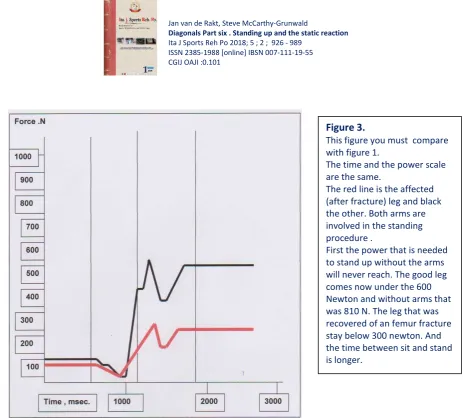
In an investigation of Kniess, we see what arms can help to decrease the heaviness and difficulty. She investigated the reaction by people with an femur fracture when she use the arms to get from sit to stand.
Figure.1 Show how heavy and difficult standing up is. From sitting position we go in standing position in 1 -2 second and that ask for an force of 810.Newton That means that we must create an balance from sit to stand in 1-2 second and that the legs must have the power to lift our body from sit to stand. For the hip and knee extensors is calculated that this is about 4 times your weight this muscles must lift. Now you understand why we are so fast to use our arms.
Figure 2.
E.M.G.- data from the muscle ( T.A. -Tibialis anterior, R.F. -Rectus femoris, B.F. -Biceps femoris, V.L. -Vastus lateralis, Gast.-Gastronemicus, SOL.- Soleus, Glut.Max.- Gluteus maximus.
We see that the most leg muscles must work from the moment (an little bit for this moment) that the buttock comes free from the surface.
Jan van de Rakt, Steve McCarthy-Grunwald
Diagonals Part six . Standing up and the static reaction Ita J Sports Reh Po 2018; 5 ; 2 ; 926 - 989
ISSN 2385-1988 [online] IBSN 007-111-19-55 CGIJ OAJI :0,101
931
Arms involvement will reduce the amount of power that is needed to stand up, but there is another difference that is very important. The time that is needed to get up is greater and therefore is the time to create an balance longer because we have more points of support. Or with this support on the arms there is more time needed to get an good balance, because the support is not in the front but on side of the chair ( see photo 4a)
An conclusion from the investigation of Kniess and the co-workers was :
That st e gthe i g of the us les of the affe ted leg as t possi le e ause the amount of force –intensity- as to lo a d e e ith epetitio this leg do t e fatigue a d ill ot ha e an stimulus to increase in power and coordination.
Figure 3. This figure you must compare with figure 1. The time and the power scale are the same. The red line is the affected
Jan van de Rakt, Steve McCarthy-Grunwald
Diagonals Part six . Standing up and the static reaction Ita J Sports Reh Po 2018; 5 ; 2 ; 926 - 989
ISSN 2385-1988 [online] IBSN 007-111-19-55 CGIJ OAJI :0,101
932
Figure 3 and the Photo 4a,4b and 4c gives not an real picture of an individual with an stroke because in both cases the people use two arms and legs. But the figures gives an indication what the individual after an stroke must use with his not-affected arm to get up. That makes it very important when we go train this and how we incorporated this in their environment and in the ADL.
An first example is the choice of the chair, sitting part equal and ( see part 5) the height of the chair. In all Dutch rehabilitation centre, but also abroad and in rehabilitation department of nursing homes I see people moving herself in an wheelchair with the not-affected leg. Often the affected leg lay on an support that is up because otherwise he cannot manage the obstacles. That means that the trunk/pelvis must rotated back in an lumbar flexion because the extension in the affected leg ask for an adjustment in the hip and lumbar spine. This will give an thorax collapse and an cervical extension that can influenced the possibility of the muscles involved by the swallowing procedure. But the worse thing is that the patient need assistance to get out of the wheelchair and we want him to be independent so soon as possible. Now he is independent in the wheelchair riding but loss his possibility to stand up and walk. Because the wheelchair is
to lo a d the po e of o e leg is t e ough to get alo e out this low wheelchair. Photo 4a.
The position of the people that where investigated in the investigation of Kniess ( figure 3).
This photo let us see ;
1. The affected leg on the right side is flat. That is an sign that the tone of the muscle around the hip is less and that has also his influence on the coordination and the power.
Jan van de Rakt, Steve McCarthy-Grunwald
Diagonals Part six . Standing up and the static reaction Ita J Sports Reh Po 2018; 5 ; 2 ; 926 - 989
ISSN 2385-1988 [online] IBSN 007-111-19-55 CGIJ OAJI :0,101
933
Photo 4 b and 4 c.
The same situation as on photo 4 a but now we see that the power in the arms lead to an situation that the upper trunk is too far to the back and that he stay out of balance and is not capable to restore this balance.
The sign that he is out of balance are the two fore foot that are in the air. And that is present on both photos. That means that he start out of balance and make the standing procedure without the possibility to transfer the weight on one leg and place the other further back and create an balance. This end with an fall back in the chair or asking for help or the chair will slip to the back and now it is
e da ge ous. A d he is t i depe de t a o e !! Further look to the construction of the chair !
Is the height good , knee lower than the hip joint and never the back of the sitting part lower than the front. This is not the case and will make it difficult for him to get good on the front of the chair. On this photo he stand against the edge of the chair and pushed with his leg immediately the chair to the back and makes an creation of the balance much more difficult.
Agai the pla i g of the feet is t o e t e ause the o e e t of the t u k o e the hip is t complete.
This illustrated the influence of the environment on the movement possibilities to hold the independency.
Jan van de Rakt, Steve McCarthy-Grunwald
Diagonals Part six . Standing up and the static reaction Ita J Sports Reh Po 2018; 5 ; 2 ; 926 - 989
ISSN 2385-1988 [online] IBSN 007-111-19-55 CGIJ OAJI :0,101
934
Their complain was knee pain on the inside of the knee after sitting in the wheelchair and that make it hard to start with walking. Through the extension synergy there was, when she sit and much more when she drive, an movement of the whole leg to endorotation and adduction. That movement was braced by heel bake, but that created an force on the medial and lateral part of her affected knee and that has an negative effect on here walking capacity, especially the start.
“ta di g up out this heel hai as t possi le ithout assista e. The fo e that she had i
the not-affected leg and not-affected arm with the possibilities in the affected leg was to little
even with the right technique to get to an standing position without assistance. The soft bottom of the wheelchair makes things worse. The legs will turn more in adduction and
endorotation and that stimulated the pelvis rotation to the back and the extensor synergy in the affected leg and makes the force on her affected knee greater.
That means that when she sit in an wheelchair that makes standing up on their own impossible and decrease her walking capacity, instead improve it !
Photo 5.
Individual with an moderate stroke with the affected side right. Sitting in an low chair with the affected leg support up and with bottom of the
wheelchair that is soft. We discover that she was not capable to standup out of this chair. But after giving her another wheelchair ( photo 6) her standing up was independent furthermore here walking was better and she has no complaint about here affected knee. Further she was capable of drive this wheelchair.
This was too heavy to the front and she did it backward.
Through the extension of the affected leg the pelvis is rotated to the back and that makes it difficult to get enough power in the not-affected leg for the flexion in the knee and especially in the hip.
Jan van de Rakt, Steve McCarthy-Grunwald
Diagonals Part six . Standing up and the static reaction Ita J Sports Reh Po 2018; 5 ; 2 ; 926 - 989
ISSN 2385-1988 [online] IBSN 007-111-19-55 CGIJ OAJI :0,101
935
We have this investigation with this two type of wheelchair done by 8 patient and after two hours sitting and driving we have examine two elements;
1. We have done the Up and Go test starting from an normal chair. 2. Have measure the angle of the knee.
The conclusion was that people sitting in wheelchair Photo 5 had more steps and time needing to do the Up and Go test and that the angle of the knee in wheelchair (photo 5) was always on the medial side 2ᵒ- 10ᵒ greater. That means that this chair makes standing up and walking almost impossible and affects the affected knee. Look out for this type of wheelchair and be aware that sitting in an low chair makes driving easy but standing up and sitting difficult. And be aware that knee get into trouble !!!
Vorlage. In photo 6 this lady was capable to stand up on their own with the assistance of an table in front
Photo 6.
We change the wheelchair and give her an wheelchair that was ;
1. Higher, now the knee was always lower than the hip. 2. The sitting part of the
wheelchair was now robust and that will prevent the legs for endorotation and adduction.
3. The foot plate that support the affected leg was now placed that the foot stand almost under the knee. The deviation in the knee
disappear and she was able to push with here affected leg on the footplate to hold their sitting position under control or changed it.
4. Standing up is now possible with support of the not-affected arm with the assistance of an table in front of here and she can drive the wheelchair with her not-affected hand and leg forwards. But this was more difficult as in the other wheelchair.
5. And there was no pain in the knee anymore.
Jan van de Rakt, Steve McCarthy-Grunwald
Diagonals Part six . Standing up and the static reaction Ita J Sports Reh Po 2018; 5 ; 2 ; 926 - 989
ISSN 2385-1988 [online] IBSN 007-111-19-55 CGIJ OAJI :0,101
936
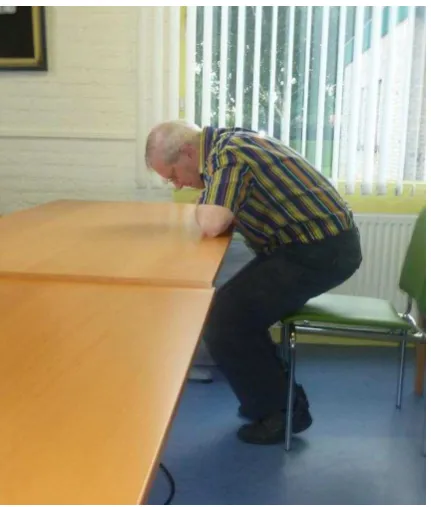
of their. In the low transfer we train and have done this transfer in the ADL , thus will the individual be able to perform an Vorlage, but now we go further than only an little lift of the buttock , now we want end in an standing position. We start with an chair that is of an good height, knee lower than the hip. And placed the individual for an table or bench.
Support on an table or bench in the front will created an movement and an balance that makes standing up and standing in balance easier .
And the learning and task specific resistance treatment, even ADL, is better possible without the danger that we learn an negative perception of the body with an great deviation to the not-affected side.
Standing up always with the not-affected leg and arm ( on the side rest of the chair) will teach the individual that there is the power. That is correct but the influence of the affected side is minimal and because the upper trunk is always backward the affected leg will never stand on the right place.
Therefore when we going to train and practice the right movement than must we search for an movement that created an inhibition of this upper trunk backward and also the lower trunk backward with an extensor synergy.
That is the movement when people go so far to the front and take support on an table with the elbow bended and with support on it.
1. That will asked for an upper trunk forward that will move the trunk over the hip and create the movement that is normal when we want to stand up. The not-affected side will response with an perfect placing of the foot behind the knee but often the affected leg go also in much more flexion in hip and knee because this movement of the upper trunk inhibits the extensor synergy.
2. The support on the table must be an real one , otherwise the upper trunk forward will not occur as wanted and the reaction of the legs will be less. That means that individuals with an stroke must learn that support taken and that can be learn by placing this people on normal table when they are eating or make their meal.
Photo 7
Jan van de Rakt, Steve McCarthy-Grunwald
Diagonals Part six . Standing up and the static reaction Ita J Sports Reh Po 2018; 5 ; 2 ; 926 - 989
ISSN 2385-1988 [online] IBSN 007-111-19-55 CGIJ OAJI :0,101
937
This activity of this stroke survivor on an normal table with support on the table will created by this person an automatic movement of the upper trunk but also of the lower trunk and will make standing up in balance easier but it asked for an environment in which he can do this.
3. After sitting on this table he will often have too much support to the front that heels are free and when he will train the standing up movement, he can started with pushing his heels in the floor, but with holding the support on the table. This will give an action of the leg muscle that is equal with standing up and also pushing away the chair. Facilitation will be very effective when we give an push on the knee in the direction of
the f ee heel.
4. In this position it is what difficult to stretch the legs totally, but that is in the start of the treatment very important before the individual leave the elbow support.
We know how important it is to get up out the chair and stay in standing position in balance that this is one of the first exercise that will be exercised when the low transfer is too easy and we search than for two goals;
A. Created an task specific resistance treatment in which the affected leg has an great part of the standing procedure
B. Search for an way that this can be done on the ward or at home with an good assistance or even without .
Picture 1.
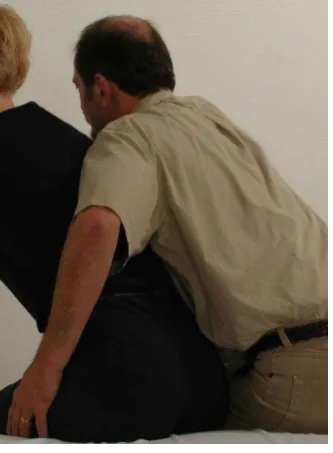
We want to learn the individual which movement he must make and we use an facilitation technique that makes this possible.
Facilitation: The caregiver push the upper trunk to the front, i easi g the Vo lage a d pushed the knee in the direction of the heel to stimulated the extension of the affected knee. But what must the individual do ! Photo 7a.
Exercise in making an sandwiches with the assistance of the therapist on the affected side .
In this case the support is giving on the elbow on the affected side but the effect is that both legs are standing symmetrical under the chair with the heel even an little bit of the floor.
Jan van de Rakt, Steve McCarthy-Grunwald
Diagonals Part six . Standing up and the static reaction Ita J Sports Reh Po 2018; 5 ; 2 ; 926 - 989
ISSN 2385-1988 [online] IBSN 007-111-19-55 CGIJ OAJI :0,101
938
The movement that the individual must make is ;
1. Reach so far as possible on the table or in picture 1 an bed or an bench. On the bed this movement can be the best performed on the feet end. There is in the middle often an support for the matrass. There must the individual hold his hand and the height must be so that he can easy support on the elbow. On this moment the vorlage is complete and that means that the automatic leg movement must be there otherwise is correction needed.
2. Tha the i di idual a pull o the at ass-support ( but the elbow remain on the surface with support) and on the same time push his heels in the floor. That will stimulated the standing up movement. And the facilitation makes this movement – upper trunk to the front and extension knees better possible
The efo e fa ilitatio is a sti ulatio of the o e e t a d po e e plosio of the muscles.
Therefore our hands lies ; A- One on the upper affected leg just above the knee and we push this knee down and that will
bring the heel on the floor and gives the individual the feeling of extension in the knee. B- The other arm goes to the not –affected side to hold the individual optimal in the center or
when we can ask more of the affected leg, than pull him more on the affected leg. But this arm does more, the shoulder of the therapist is placed against the shoulder blade of the patients and makes an movement to the front and facilitated the upper trunk forward.( photo 8)
Now the patient stand with the knee in extension and the upper trunk in flexion support on the elbow. The balance must be good, but by using an table the balance is much more to the front and will be firm and then we can asked to make more extension in the hips and trunk.
Photo 8.
The position of the shoulder of the therapist in fa ilitati g the Vo lage of the i di idual to the f o t- upper trunk forward with the eyes of both looking to the table. Never ask for an extension because than the individual with an stroke will always starting with his head make an upper trunk backward ( activation of the back diagonal). The extension must first come from the leg and the head is the last joint that goes in extension. The hand lies on the not-affected side and can create the best possible weight bearing on the affected leg. Together with the push on the affected knee an perfect stimulation and with load on the affected leg.
Jan van de Rakt, Steve McCarthy-Grunwald
Diagonals Part six . Standing up and the static reaction Ita J Sports Reh Po 2018; 5 ; 2 ; 926 - 989
ISSN 2385-1988 [online] IBSN 007-111-19-55 CGIJ OAJI :0,101
939
Often the last part of the knee extension is difficult. And it is important to achieve optimal extension in the knee to get the best position for the balance. The last part must be stimulated and the extension must be there in both legs.
Now there are an lot of possi ilit s to ake f o this o e e t a task-specific resistance treatment with an learning aspect and an training of the coordination and power.
We used the diagonal support on the unaffected side to the affected leg and we know that the angle to get the best diagonal is not good, but we can change that when the power increased. And we can search for an possibility to bring it in the ADL of every day on the ward and then is standing up important but stand and get washed and dressed more important for individual and all caregivers.
First, increasing the coordination and power of the standing up movement and stand position. When we facilitated, we feel how may assistance an patient need. When that assistance is not
there the movement cannot be done by the individual, therefore we can calculated how many support is needing to create an R.M. of 75 % and we can exercise this 10 times behind each other and create an muscle fatigue ( 3 session of 10, 2-3 times a week). Or we can change the height of the chair and create so the possibility that the patient can do it without assistance and then we can pull the weight more on the affected leg and create an better diagonal angle. We can change the table and take a bench or an bed. Than the support area is different and will the reaction with elbow on, be changed. But very important is, do it with ( Toine van der Goolberg)
overload , make it difficult and heavy the muscle but also the brain must work.
Increasing the power in standing position.
To hold this standing position with support on the elbow and optimal extension in the knee is now possible, but is it also possible when we pull or push on the elbow. Push or pull on the not-affected elbow gives an reaction in the all diagonals and of course will the reaction not be perfect, but that is often not possible in this stage of rehabilitation.
Picture2. Chain and diagonal . Of all chain will work is depended of the support possibilities of the affected arm on the elbow. This is an isometric contraction that means no change of muscle length but the tone of the muscle pattern will increased.
Jan van de Rakt, Steve McCarthy-Grunwald
Diagonals Part six . Standing up and the static reaction Ita J Sports Reh Po 2018; 5 ; 2 ; 926 - 989
ISSN 2385-1988 [online] IBSN 007-111-19-55 CGIJ OAJI :0,101
940
Is the support on the elbow is on both side present. Of course will the support on the affected be lesser but there we give an minor pull or push intervention. The patient must hold his elbow on the bench/table or bed and when we pull on the upper arm to the therapist, we try to get
close to his repetition maximum (R.M. 90% thus with 4 of 5 rehearsal ). Now The individual must make in the arms/shoulder an retroflexion and retraction ( back
diagonal upper part) but also the front diagonal in both legs to hold the flexion in the hip and extension in the hip/ knee and hold the feet flat on the floor. All this signs determined how heavy it is, and is this his maximum. The chain between the arm and legs , the diagonals and both the homolateral structure must work to get the job done.( 6 chains). When the affected arm cannot give an resistance than we will see 3 chain, between both legs, the diagonal from the
not-affected arm to the not-affected leg and the homolateral structure on the not-not-affected side. Now we push the upper arms to the patient, his answer must we anteflexion with protraction(
the m. serratus anterior ) and the stomach muscle must work, but also the hip flexors /extensors and knee extensors and he must hold his feet flat on the floor. The R.M. is on his max. and 4-5 rehearsal and we can varied by quit change in the pull and push direction. The last exercise (picture 3) must give an concentric contraction of the m.gluteus maximus, the keystone of the dorsal diagonal and start with no load extra, this is needed to get more coordination and power in this part of the dorsal diagonals.
The extinction reaction can makes this exercises difficult. To copy with this phenomena we can create more movement in the upper trunk. Support on the bench and then again up or the same trunk movement but with an different placing of the feet .
But when we want to create an task-specific resistance treatment and the danger of extinction is present give the affected knee an back splint that fixated total or only an little the knee, now we can use the muscle spindles to create through the muscle an feeling that can decrease the extinction phenomena. In the part about the pusher we will use this back splint very often and that is very important to create an perception that can alter the possibilities for this individuals with that type of an stroke !!
Picture 3.
Jan van de Rakt, Steve McCarthy-Grunwald
Diagonals Part six . Standing up and the static reaction Ita J Sports Reh Po 2018; 5 ; 2 ; 926 - 989
ISSN 2385-1988 [online] IBSN 007-111-19-55 CGIJ OAJI :0,101
941
A.D.L.
When individuals have this ability, it is time to make the shift to the A.D.L. and let the individual use the new ability in his context. That means that the individual know what he must do and this
can with facilitation and the nurses know how to facilitated and how much. The importance of this implementation is so big, that the present of the therapist on the ward
every day is very important. Now he can teach the individual and the nurse to get which little changes the optimal result and create an situation in which the individual with an stroke can make with everyone this stand-up and stand exercises and we create amount of exercises that is phenomenal !
The individual after an stroke was not able to stand after going to the toilet. And that means that cleaning and dressing must be done in bed. That means that the individual must go back to bed with an elevator or an low transfer. This is now not necessary because we create an situation that he can stand up and stand and can after the cleaning and dressing in the wheelchair and can go further. But there ust e stru ture i this i reasi g of his a ility’s.
When he can stand-up and stand supporting on his elbow that means going to an normal toilet
is t possi le, e ause he ust the sta d a d tu .
That last o e is t possi le thus e ake use of the ed o the a d a d use a toilet -wheelchair.
The bed we can set on the right height and we must take an toilet-wheelchair , that has the right height. ( hip higher than the knee)
But they are individuals that cannot defecated well without foot support and then the toilet chair must can lower. And higher when the patient is standing up , otherwise it is an to great effort for the individual. Here we needed therefore toilet - wheelchair that are in high adjustable because we choose this training pad to create an standing up movement and stand position that can do the individual latter on his own.
Of course will an great part of the individual with an stroke latter on going over on another strategy of standing up and stand but be aware that an great group of stroke survivors will need this strategy to get out of the chair, wheelchair , toilet , douche or bed.
And then it is sad to see that very often the adaptations in rehabilitation center, nursing home department for rehabilitation , long care living facilities but also in their home , are not present to get up and stand with this standing up strategy.
In the rehabilitation institution it looks like the space must be there for the nurses and other care givers and never will there be an table in front for the individual with stroke be realized. Even for the standing up (electric) chair there may never stand an table because that space is for the rollator frame.
And an rollator frame will be never an good assistance for an standing up movement what the table can do very well. And this table will give in the beginning an good balance and the opportunity to walk along the table. The equipment of all this institution must be directed to the individual with an stroke , how he or she can perform independent so soon as possible and can work on an higher level.
Jan van de Rakt, Steve McCarthy-Grunwald
Diagonals Part six . Standing up and the static reaction Ita J Sports Reh Po 2018; 5 ; 2 ; 926 - 989
ISSN 2385-1988 [online] IBSN 007-111-19-55 CGIJ OAJI :0,101
942
The nurse ( this movement is known by the individual, because it is train on the therapy ward and on the department were the patient stay) placed his knee in front of the affected knee and turn here body and goes over the patient and hold the trunk with their upper arm .
The first attempts always do it with two persons but when the individual after an stroke and the nurse has confidence, this can be done through one person. The fixation of the knee and the upper arm is enough and the nurse has two hands free.
This can also be done after an shower , or when an patient has pain on his buttock. Be aware that when someone can do this, he knows why he must stand so long and will be more motivated to do this and that means that we will see an increase on standing power through this technique in the ADL and this will increase his ability to improve but also improve the possibilities of his affected side.
Many therapist and nurses ask the individual to stretch . Be carefully this individual cannot stretch in the lower trunk and will thus make an upper trunk backward and that can give an movement too far to the back. Always pay attention that the individual look downward.
The individual will ask for an fixed point that give more safety, that is possible but only when
the elbow is supporting on the bed, bench or table. Without the support on the surface every pull to get stand up gives an upper trunk backward
and activated the back diagonal to much!
Picture 4 and 5.
With facilitation stand up and stay in the standing position with facilitation.
On the ward of the nursing home this technique will be done by the nurse when the patient must go to the toilet.
Only we take an toilet – wheelchair, because this individual can now learned and exercise standing up and stand, not turn or walk .
The standing up procedure is the same : The feet in the right position , an upper trunk forward on the bed with support on the elbow and then facilitation through the pressure on the knee and the movement of shoulder of the therapist against the shoulder of the individual to the front. Special attention on the knee , be sure that this in his optimal extension.
Now makes the nurse an move and take another position.
But we aware that this is exercised before, through the therapist and can also be used as an Task specific resistance exercise.
Jan van de Rakt, Steve McCarthy-Grunwald
Diagonals Part six . Standing up and the static reaction Ita J Sports Reh Po 2018; 5 ; 2 ; 926 - 989
ISSN 2385-1988 [online] IBSN 007-111-19-55 CGIJ OAJI :0,101
943
Only when the elbow is bending and supporting, will give an pull with the not-affected arm/hand an upper trunk forward, an front diagonal activity !!!
The next step in the rehabilitation will be turn in the position with support for the bed/table and bench and how difficult is that and how important is the upper trunk forward again !!
The transfer of individual who can do this in the ADL is now no longer an low transfer. Very important because this milestone is often an possibility to get in and out in an car and visited others more frequently. But be aware that that transfer in and out an car is very important for learning and training standing up and turn.
Because this people can now move with an more power, but the step to the next achievement is out this position turn of minimal 90ᵒ.
Unfortunately we see transfer- tools that are be used to increase the speed of the work on the ward. This will never be important for the rehabilitation of the individual ( Nielsen ). Regrettable there are almost no investigation that have investigated what the effect are of the use of this transfer- tools. In practice we see almost never an recovery of the individual by using that transfer-tools , the opposite we have seen that the possibilities of the patient fast decreased.
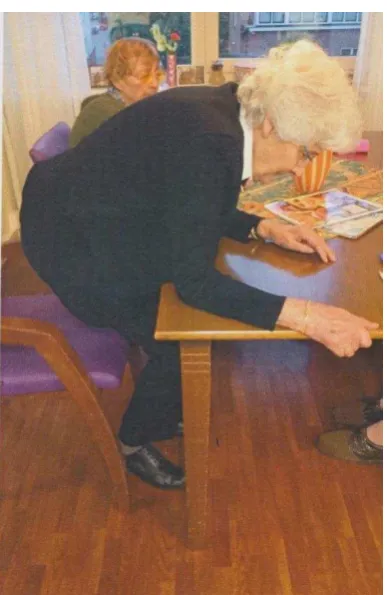
Photo 9. An example of an individual that has create an possibility to stand up on the table with elbow supporting pull. An lady with an stroke on the left side.
Jan van de Rakt, Steve McCarthy-Grunwald
Diagonals Part six . Standing up and the static reaction Ita J Sports Reh Po 2018; 5 ; 2 ; 926 - 989
ISSN 2385-1988 [online] IBSN 007-111-19-55 CGIJ OAJI :0,101
944
The next step must be therefore an learning program that makes it possible that the patient knows and can :
1. Standing up from all chairs especially chair that are lower and different. 2. Standing up and stand without a support of a bed because than there are more possibilities
for the patients to stand up and stand in different places and situation.
3. Start with making in stand movements that makes the transfers easy and the first independency will be created. And the movement that are very important now are turning movement , walk backwards and walk side wards. Not walking forward that is important for the individual but on the ward and the ADL is backward, sideways walking and turning the most important walking movement that the individual must master.
Again we start with learning how to do this movement, than make it to an task-specific resistance treatment to build up more coordination and power and when there is an good base the movement will be incorporated in the ADL.
The variation can now also involved the standing up movement.
You can now make the standing up movement with an load or of an lower chair or without the support on the front. And even an total new strategy can be possible and then the standing is
al ost o al; Not an upper trunk forward but more to an lower trunk forward .
Upper trunk forward gives an flexion of the trunk with an protraction of the shoulder blade and
the o lage is e ough ( sitti g o a hai that eate that hips are higher than the knee) and that makes extension of the knee easy. Lower trunk Forward create an extension in the trunk what gives an retraction of the shoulde lade, that gi es ot e ough o lage ut ell the est posture that will give the best flexion in the hip and knee. But there must be an movement in
the ankle joint to create the best distribution of the body weight. Only a few individuals with stroke will do this movement perfect, most individual will have great
difficulties to get the affected leg in the wright position. When that is not possible the weight bearing will be done by the not-affected leg and when that leg is not so powerful to do this with the help of the not-affected arm. That means that when the using of the affected leg is very little, that this will be never an real ADL o e e t . We choice than for the upper trunk forward strategy and the lower trunk forward only as an variation in the training program. But
that s o l possi le he the e i o e t is so that this strategy is everywhere possible !
Turning, standing for the bed ask for an replacement of the legs, the first steps.
By individual with an stroke is turning, supporting on the not-affected arm the
easy way. Turning the other way means losing the support of the not-affected
arm.
Still is this one of the most fearful moment when the affected leg must go to the
back because now there is no diagonal only the homolateral structure on the
not-affected side. But with the not-not-affected side stand against the bed, this will be
the safest way to do it , thus we go to train/learn it.
And we have an be
di g upper tru k , thus the affe ted leg goes ………easier
Jan van de Rakt, Steve McCarthy-Grunwald
Diagonals Part six . Standing up and the static reaction Ita J Sports Reh Po 2018; 5 ; 2 ; 926 - 989
ISSN 2385-1988 [online] IBSN 007-111-19-55 CGIJ OAJI :0,101
945
First we try to change the support situation with the not-affected arm, not on bed but with an chair and created on an later moment for the individual the opportunity that he can go to an toilet when is capable to set one or two steps. A hai is t hea e ough to use the pull with the bended elbow and the strategy must be therefore more support on the chair to get the upper trunk forward and weight on the chair.
Second the extension in standing will be further training and that with load but also with little support from the bed in front of him ( training of balance in standing position) Figure 3.
Picture 6.
Technique upper trunk forward with an bended elbow as support point. The facilitation technique stay the same and important the extension of both knee.
The extension of the trunk can take place with an support only with the hand. But let this extension start in the trunk not in the head. Keep the head in flexion.
Test:
How much do the legs and how much do the arm the job.
A person with both Achilles tendon rupture stand for an bench and must train the
remaining muscle.
He placed his
hands on the en h and stay perfe t on his toe. When he don’t use his
arms, he is incapable to lift his heel for more than 1 cm. The load that this patient has
on his arm is very much , see figure 3. And
Jan van de Rakt, Steve McCarthy-Grunwald
Diagonals Part six . Standing up and the static reaction Ita J Sports Reh Po 2018; 5 ; 2 ; 926 - 989
ISSN 2385-1988 [online] IBSN 007-111-19-55 CGIJ OAJI :0,101
946
This is more difficult than the support on the bed. We say (photo 9) that an pull movement on an table or bed is possible and stimulated the upper trunk forward. That is now not possible because the chair will capsize. The individual must therefore set enough weight on the chair to prevent that and that ca o l he he akes a good o lage .
Task-specific resistance treatment is now possible because when the patient need assistance than we know what R.M. max. is and we can give support and repeat that movement still muscle fatigue appears. When we are with the training on this point, we have an execution on ADL level but in the therapy we going to search for possibilities to increase power, coordination and variation. Standing up on this way will not stimulated very much the extension of the hip joint, the only positive point is that by moving the upper trunk in an flexion position the muscle gluteus maximus on the affected side stands every time in an elongation stand. That means that the muscle is long and that his action can be help the standing up movement but it is never the
dominant action as normal standing because this muscle act only eccentric, never concentric. When the support stay on the chair the action of the leg muscle is not very high and certainly
not on the affected side , therefore make it always an Task-specific resistance treatment and train the muscle with overload.
Further a bended elbow makes the angle to the other site in the hip greater than 45ᵒ and that
means that the adductor take the extension function of the hip. The support on the chair takes much load of the leg away and will without an load or overload
almost never give an fatigue reaction and thus no increase in coordination and muscle power in the affected leg .
The chain is by individual an stroke often only three because the affected arm can often not
have an supported function certainly not on an chair rest.
The approach must be ;
- make it difficult. ( resistance – load) - search for rehearsal and muscle fatigue.
– be assure that the activity in the muscle, is there where you want him.
Make not the mistake to choose for an hands-off approach because everyone will seek for the manner that the movement can be done easy .
In this stage of the rehabilitation is the hands-on approach so important because now the therapist is capable to shift the body to the affected side and stimulated this side in working and feel the muscle action.
The individual with an stroke that must stand up will never be able to shift the weight to the affected leg while he is standing up and after 5-8 times when the fatigue comes in his not-affected leg he is on his limit. But with Faciliation in the standing up and the weight shift to the affected leg both legs will be fatigue and that means that there is something change in the affected leg.
Jan van de Rakt, Steve McCarthy-Grunwald
Diagonals Part six . Standing up and the static reaction Ita J Sports Reh Po 2018; 5 ; 2 ; 926 - 989
ISSN 2385-1988 [online] IBSN 007-111-19-55 CGIJ OAJI :0,101
947
Can we make the load greater by asking more extension of the upper trunk ?
Of course is that possible. But the upper trunk in an backward position will asked for an retraction in the scapula and on the same time anteflexion in the gleno-humeral joint and that can caused damage the affected shoulder. That will be occur when to early the lower trunk forward together with the upper trunk backward is asked from the individual with an stroke and
he the pa eti a is t apa le to get out the s e g .
But the risk on shoulder damage stay because the greatest part will be done by the not-affected leg and especially now much concentric work must be done by the m. gluteus maximus on the not-affected side. That will give in the dorsal diagonal, starting in the leg on the not-affected side an increase an muscle tone and that will also go in the rest of the diagonal. That means that the shoulder will go in an retraction and at same time we ask for anteflexion in the gleno-humeral joint.
That can damages the structures that lies between the roof and the joint cavity of the shoulder girdle. To prevent this the not-affected leg must be decreased in activity by placing him more to the front ( picture 8a), now the affected leg must work hard and still we have an change of an
et a tio ut ot so high e ause the u affe ted leg is t so do inant , but still be careful. This is an concentric contraction of the buttock muscle that is asked for the first time in the
exercise – standing up and stand and stand with no support directly on the front. In the practice on the ward /at home and by the ADL this way of standing up will be never done because this is so heavy and dangerous. But an very good exercise!
Picture.7. Standing up technique with the support on an side rest of an chair. The same technique but now with the support on the side rest , that gives still an upper trunk forward but also another search to stabilization. Too much pushing abroad gives an tilt of the chair and that forced the patient to seek for an proper solution. (learning !)
Jan van de Rakt, Steve McCarthy-Grunwald
Diagonals Part six . Standing up and the static reaction Ita J Sports Reh Po 2018; 5 ; 2 ; 926 - 989
ISSN 2385-1988 [online] IBSN 007-111-19-55 CGIJ OAJI :0,101
948
Photo 10 .
With the affected hand in pray grip by the not-affected hand.
This has as an advantage that the mobility of the fingers and wrist will hold and see that the affected thumb is on top. On this way we prevent that too much pressure of the not-affected thumb the affected thumb damaged. The chair is the point of rest and after the patient makes extension an try to hold this position. When the R.M. is less than 75% you can work with load. The facilitation is almost the same as by standing up with an upper trunk forward, only the hand on the knee must now make an slight movement to the front. Further the hand on the not-affected side is important to bring the weight good on the affected leg.
Picture 8 Standing up movement with more
extension of the trunk and with hand on the chair rest.
The facilitation is an little bit different because now must the knee move an little bit to the front bevor the
Jan van de Rakt, Steve McCarthy-Grunwald
Diagonals Part six . Standing up and the static reaction Ita J Sports Reh Po 2018; 5 ; 2 ; 926 - 989
ISSN 2385-1988 [online] IBSN 007-111-19-55 CGIJ OAJI :0,101
949
This can also be an Task-specific resistance treatment because when the individual cannot makes this on his one, than is that more than 100% and with facilitation we can decrease to 75% and we can repeated it often 10 times till we have muscle fatigue. Muscle fatigue we feel because or we must more facilitated or the moment is slowing down or the trunk extension change in an trunk flexion or all three together.
Now the level of the individual is so high that he is capable to stand up on his own or with very little facilitation and standing on the chair, we must teach and train in standing position makes
the turn and walk sideways, forward and backwards with the table as support point. Furthermore it is now time to train and learn variation of standing up to stimulated the brain for
an search to solve problems. The most important variation is different chairs , height or support points on different places and height.
Be aware that an individual; that train this program makes an recovery to almost normal. An individual that has recover from an severe stroke will be dependent to execute the standing up strategy with the upper trunk forward. Still is than the turn and walking side- ,for- and backward possible with the support of the table.
Turn on the table and walk side way .
Start with in an standing position after the exercises to increase the power and coordination in this position ( picture 2 and 3) and then start with walking sideway.
The difference between fatigue and muscle fatigue is, that the recovery of muscle
fatigue is very fast , in 5-10 minute you can do the exercise again on the same level but
the number of repetition can be lower.
Now we have stimulated the system to create an adaptation of the coordination and
muscle power ( Frans Bosch )
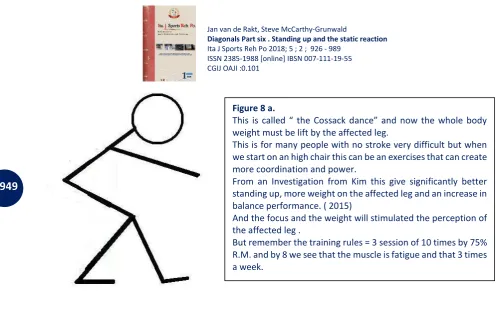
Figure 8 a.
This is alled the Cossa k da e a d o the hole od weight must be lift by the affected leg.
This is for many people with no stroke very difficult but when we start on an high chair this can be an exercises that can create more coordination and power.
From an Investigation from Kim this give significantly better standing up, more weight on the affected leg and an increase in balance performance. ( 2015)
And the focus and the weight will stimulated the perception of the affected leg .
Jan van de Rakt, Steve McCarthy-Grunwald
Diagonals Part six . Standing up and the static reaction Ita J Sports Reh Po 2018; 5 ; 2 ; 926 - 989
ISSN 2385-1988 [online] IBSN 007-111-19-55 CGIJ OAJI :0,101
950
Placing the foot outside asked for an trunk movement of the other side and because the homolateral structure are weak, start with an upper trunk sideway. That gives on the standing
side a sho te i g of the t u k ut also a ki ki g a a o e e t of the f ee leg . That is the
start to place one leg away and place than the other near to that leg and we walk sideway and directly exercise this in both direction and even the around the whole table.
But this attitude has another great advantage because backward walking is very easy and is often
o e of the g eatest p o le s fo st oke su i o e ause the ha e t lea ed the uppe t u k
forward strategy proper.
When the arm (s) stay on the table the free leg will go easy to the back and holding the hand on the bench/table often they can walk very soon an little bit to the back and integrate this with side way. The support on the table makes forward walking light but only in the stand phase because than the back diagonal is long and the muscle that must work are elongated. The difficult part is to swing the affected leg free leg to the front.
When there is an good weight distribution the swing phase is very simple to facilitated and then we created with the right assistance the starting of walking pattern around the table. This we need when the individual is capable to stand up with an table and to move along the table or start for an turn and take an walking support to go from this table away.
Picture 9.
Walk sideway along the table with an upper trunk forward attitude . In the picture are two hand to support but often the individual with an stroke cannot do this. Look what he find the easy way to start, placing the not-affected hand more away so that the upper trunk on the not-affected side is shortening and then place the affected leg away and take weight on it place the not affected leg against it. Or placed the not-affected hand in the middle for his body and take weight on the affected leg and place the not –affected leg sideway , take weight on it and swing the affected leg near the not-affected leg. This last manoeuvre of the affected leg is difficult because the trunk is often still in shortening position.
Jan van de Rakt, Steve McCarthy-Grunwald
Diagonals Part six . Standing up and the static reaction Ita J Sports Reh Po 2018; 5 ; 2 ; 926 - 989
ISSN 2385-1988 [online] IBSN 007-111-19-55 CGIJ OAJI :0,101
951
An rollator frame used by an individual with an stroke will be often only controlled by the not-affected arm /hand and thumb.
And the placement of the support bar must be on the same place as where the handle are of the o al rollator frame. It is often wrong this handle turn to each other and than make an bar between them.
Better is to place the bar on the end where the handle were, because then the support point is the same as before and that is on or behind the rear wheels of the rollator frame ( see picture 9c and d)
Picture 9a and b.
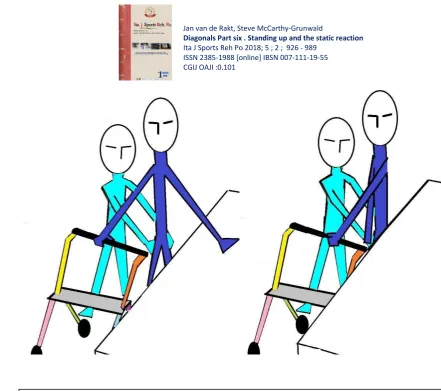
Starting with standing up with the support on the elbow of the not-affected arm and pulling on the edge of the table. And in this picture with the facilitation to stimulated the movement – upper trunk forward- and activation of the affected leg into the knee extension.
Than we must start with the turn and in this picture the not-affected arm stay on the table together with the hip of the not-affected side against the table, both can give this and stable support. It is always possible when the affected arm has some function to place an chair there for an extra support.
Jan van de Rakt, Steve McCarthy-Grunwald
Diagonals Part six . Standing up and the static reaction Ita J Sports Reh Po 2018; 5 ; 2 ; 926 - 989
ISSN 2385-1988 [online] IBSN 007-111-19-55 CGIJ OAJI :0,101
952
It is obvious that it is so important that the individual had the change to solve problems and that ask from everyone that is near the individual always the though : Must I assit or ot .
And where is the border what we can asked on the ward and at home in the rehabilitation period.
What is possible in the rehabilitation through the day. All movements are rehabilitation but must be all movements be at the limit !
We know, that you will ask: This should be done every time that ill sti ulated fa o e a d that is correct , we want to, but when you have read this whole article in one time, how you will
stand up out you easy chair? Exactly with your hand on the rest of the chair !! Through the day the load cannot stay high the whole time. The ADL situation must have an lower
load because nobody can hold the whole day his top level, therefore it is important what and when an training will be implemented on the ward or at home. And in the ADL there always
Picture 9c and d.
The difference how we want to turn. At the end it is important that both turns are possible but often the turn will be done over the not-affected side and then will be picture 9 d the next step. But when there is some activity in the affected arm, choose when it is possible, also for the turn over the affected side. And in this case we turn after standing up to get the walking aid to go away from the table.
This item is so important that this is an exercise also for on the ward and at home because the problem that there occur are often unexpected and now has the brain some experience more, to solve that problem.
Jan van de Rakt, Steve McCarthy-Grunwald
Diagonals Part six . Standing up and the static reaction Ita J Sports Reh Po 2018; 5 ; 2 ; 926 - 989
ISSN 2385-1988 [online] IBSN 007-111-19-55 CGIJ OAJI :0,101
953
more elements that the individual after an stroke must master. That means that he must do often more task together and can the damaged brain that a d the it is t the ight o e t to ask an very difficult movement . But is the rehabilitation-ward the best place for teaching and
learning to move at home ?
Variation, regrettable, is often on rehabilitation-ward very little, all chairs have an the side rest but also on the toilet we see this very often. That is different at home, there is the toilet so small that the supports are sitting on the wall or an the wall in front of the individual. That will increase
the a ou t of o lage and make standing up and coming in balance easier.
That means that on many rehabilitation department only one way of teaching of standing up is possible and that is standing up with the side rest on the not-affected side and that will be give no learning effect because the patient learn only one senso- motoric track and has great difficulty with other chairs/toilet etcetera .
Therefore we always start with standing up behind an table and after that with an chair on different ways and difficulty, that gives the individual an great number of possibilities that he can use to solve an problem that he has not experience in the rehabilitation -period. The support on the toilet at home is far more better than in the most rehabilitation wards because not only
the o lage is stimulated but also there is an support when the individual stand. We see this also happen by older people living in an nursing home and we see that this has an
negative effect on the possibilities of the people. Every time standing up on the same way will give an wrong senso- motoric track and will decrease the possibilities much sooner than an variation of standing up possibilities and certainly in combination with task- specific resistance treatment. Toine van de Goolberg exercises an group 80+ that was not able anymore to walk on the stairs. There was no other pathology but only the amount of movement and always the same movement has make the coordination, the muscle power and the condition so weak that the stair walking was too heavy. He started one year ago with training task-specific with load and exercises for muscle fatigue but also total fatigue ( condition improvement ). Within an year all his participants walk stairs on an normal way and not one stair but more without rest.
Photo 11. Standing up from an toilet with support on both side. The hip stand higher than the knee but the trunk has e te sio a d the Vo lage is too little. Furthermore the placing of the feet is not correct because they must further back. Therefore this movement will be done with the arms and the balance seeking is thus difficult because there is no supporting point in the front. The individual with an stroke will go to the not-affected side and even has greater problems.
Jan van de Rakt, Steve McCarthy-Grunwald
Diagonals Part six . Standing up and the static reaction Ita J Sports Reh Po 2018; 5 ; 2 ; 926 - 989
ISSN 2385-1988 [online] IBSN 007-111-19-55 CGIJ OAJI :0,101
954
Photo 11 gives us an picture what happen as people stand up always on the same way. The senso motoric track is always the same and the brain translated this balance action. That means that the standing up and standing position with too much body weight behind the feet can feel after an time as normal. The next photo gives an picture what the reaction will be as someone gives the wrong facilitation and make the standing up movement and stand dependent from others.
Individuals with an stroke will react much more heavy, because the senso -motoric track is damaged and they must act with the unaffected arm and leg and the arm must be used often
because there is too little power to lift the whole body with the unaffected leg. Therefore it is extremely important that through good task-specific resistance treatment the
right senso-motoric track will be train. But also that the environment makes it possible for the
individual to execute his standing up strategy.
When we should train the standing up movement as in photo 12 the affected leg will go in an extension synergy and will never can have an contribution in the standing up movement and
the balance will be only be control by the unaffected leg. Investigation ( Dr. v.d.Haart, Prof. Geurts) has shown that the unaffected leg has the greatest
control over the balance by stroke patient.
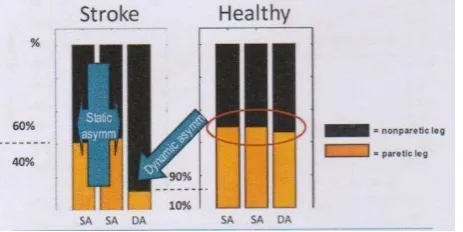
Dr. Buurke gives an difference from 60% on the unaffected leg and 40% on the affected leg in an standing position by individuals after an stroke in the rehabilitation center ( 10 % of the individuals with an stroke in the Netherlands ).
But when the individual after an stroke was walking and in this investigation only the walking movements to the front were included, than was the distribution 90% on the unaffected side
and 10% !!! on the affected side. Photo 12.
The support is on the left shoulder from behind, this support will be answered through the individual with an left upper trunk back- ward – an action of the back diagonal on the left and in the upper part- we see the translation of the body because the right foot stand now further to the front. And then makes the care giver another mistake by asking to watch to here, because that gives an extension rotation to that side . Now this lady cannot stand up on there one but also she is not capable to stand on her one !!
Jan van de Rakt, Steve McCarthy-Grunwald
Diagonals Part six . Standing up and the static reaction Ita J Sports Reh Po 2018; 5 ; 2 ; 926 - 989
ISSN 2385-1988 [online] IBSN 007-111-19-55 CGIJ OAJI :0,101
955
Of course this outcome was correlated from individuals in an rehabilitation center but the individual in nursing home will do worse.
There are no data what is happening by an movement as standing up, but we think that it is comparable with walking, maybe even worse and that the balance situation is very dangerous on such an toilet or shower.
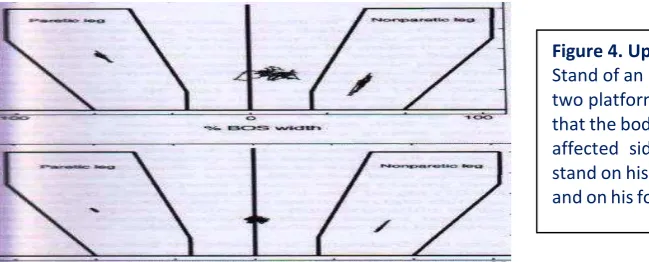
The upper part of the figure 4 is when the investigation start and the lower part is after 3 months. There is an improvement in the standing situation but the affected foot stand still on the forefoot and when this person go to walk ( and maybe also by standing up) and the investigators saw no further improvement of this after 6 months.
Standing on the fore foot can be the only solution when an person has an striker foot and that occur often very early in the rehabilitation. This occur in the bed in seeking stabilization in the affected leg to move the not-affected leg – Striker foot!
Figure 4. Upper part .
Jan van de Rakt, Steve McCarthy-Grunwald
Diagonals Part six . Standing up and the static reaction Ita J Sports Reh Po 2018; 5 ; 2 ; 926 - 989
ISSN 2385-1988 [online] IBSN 007-111-19-55 CGIJ OAJI :0,101
956
The patient of photo 13 will need an support to be able to start with walking and an support to stand alone. He perform an standing up movement behind an chair and then he makes an upper trunk forward to hold the balance on his best and to move the affected leg to the back. Because when the trunk goes in an upper trunk forward the affected leg that is free of the ground will go to back and he is capable to get an support on the affected leg with no danger of falling to the rear!!
Photo 13.
Individual with the affected side on the left side standing up without support from an bench. We see the standing position and we see the control of the unaffected side with an arm abduction, the trunk is move from the upper part over his hip and the knee /hip stand in flexion to give more possibilities to react i the joi t he the ala e is t ight . The affe ted side is t pa t of the eight earing and no part in the balance seeking. His whole standing up and standing is done and controlled by the unaffected side and no input- perception of the affected side will enter the brain that will be the case when he try to walk!! The affected arm in an flexor (Movement ? ) synergy because the unaffected leg use all his power to make extension. The diagonal on the back starting in the unaffected leg is dominant and created an retraction in the affected arm. The affected leg has an extensor synergy, the diagonal to the unaffected arm goes not trough the hip but on the inside of the affected leg and the adductors act as extensors.
He can do this but will never so stand without someone that watching him and therefore never at home without an support!
Figure 4a.
Jan van de Rakt, Steve McCarthy-Grunwald
Diagonals Part six . Standing up and the static reaction Ita J Sports Reh Po 2018; 5 ; 2 ; 926 - 989
ISSN 2385-1988 [online] IBSN 007-111-19-55 CGIJ OAJI :0,101
957
The route for him to get more control on the affected side and more power and