70
Role & Value Of Usability In Educational
Learning Via Game Based Apps
Sumaira Shafiq, Tamim A. Khan
Abstract: The widespread use of applications services will only be accepted by users if their understandability (usability) is of acceptable level. It is therefore of high interest to be able to estimate, or to predict the usability (usability attribute) of a system under observation. Clear and visible navigations, consistent styles and color, concise content, appropriate help and searching means easily accessible are various usability factors to affect end user’s satisfaction. Mobile applications are now a de-factor standard for judging, using the medical or other systems to be built in the current era of technology. Due to ongoing research and improvements in mobile technology, the data/ information and their applications contained in this context are constantly evolving and are subject to the professional judgments and interpretation of the practitioner due to the uniqueness of a clinical situation. By usability in mobile App (mobile computing) we exactly mean to have an effective, efficient and at the same time customers satisfaction via feasible use of the mentioned APP. If the usability of these APPs under discussion is that of valuable standard, the users of these mobile applications can effectively attain all their tasks. In this work we have highlighted the importance of usability in the educational applications in mobile. That is, our study here evaluates the usability of selected mobile educational applications regarding two subject categories maths and reading skills to identify the usability problems found by the participants. After evaluating usability via testing these mobile applications on school children the comparisons are made between results gathered from usability and learning evaluation to prove our hypothetical statement that usability has a strong impact on learning.
Index Terms: APP, Mobile Computing, HCI, Monster Math, Math, Metric
————————————————————
1 Introduction
In recent years, the usefulness, worthiness of mobile devices is on the rise day by day. Game based mobile learning is becoming progressively famous in the world of quick logical and innovative changes. Children games have become one of the most popular online content. An overview led by Pastore [1], uncovered that individuals spent a normal of 20 hours for every week on the Internet in which 48% of the hours spent was to play computerized, mobile or web based games. Currently, the increased use of the technology has contributed much to the advancement in game development. Being the source of entertainment, certain games have been utilized for educational and learning purposes. In this regard mobile phones are being used as platform for learning and teaching. To support real-time communication and deliver learning materials, use of smartphones is being incorporated within existing education systems. However, unlike computers, the screen size and resolution bound mobile phones in displaying content [3]. Our study is focused on importance of usability for educational games being part of the recent education system and played by most of the children to learn new concepts. Usability is very important ingredient in games. Usability plays an important role in designing of games and software’s. Considering games, usability plays very important part in keeping the players focused on screen and to fulfill their goals. In games, efficiency and satisfaction is very important attributes that each game must provide. Usability is a prime ingredient in designing of educational games as well. Games, like other software systems, have an interface that provides users an efficient and effective means to interact with a program.
Playability of a game is an integral part of a game's usability and it is evident that it can seriously affect learning process if playability or usability is poorly handled. However, most of the mobile games or mobile applications used for learning or educational purposes have complex user interface. This affect the learning process very badly. Effective and efficient learning is impractical unless usability is completely concerned in designing and development process of any educational application. Ease of use is one of the key traits in learning or educational games and mobile applications. Many high quality existing applications are not successful due to their confusing and unappealing interface. Thus, the requirements of the users must be considered when designing a user interface for mobile learning games or applications. Mobile learning and mobile technology can be twists as an educational stage only when the future research into the territory of versatile learning incorporates profitable examination and execution in all aspects of usability i.e. learnability, understandability, convenience, effectiveness, efficiency and productivity of game based mobile learning [7] [4]. In our study, we first evaluate the usability of selected mobile educational applications using usability evaluation frameworks or problems categorize for usability aspects. After evaluating the usability of these applications, we evaluate the Learning through these apps .In the third stage of this study, comparison have been made between usability and learning evaluations results to find the relationship between usability and learning, and the impact of usability on learning achievements or learning outcomes through selected applications. The paper is organized into the following sections. Section II presents the literature review, Section III describes the Research design and Methodology, Section IV presents the Experiment procedure, Section V presents the Results of an analysis and the Discussions and section VI presents the Conclusion and Future work.
2
LITERATURE
REVIEW
To start, in the ISO 9241-11 [8], standard, usability is defined as ―the extent to which a product can be used by specified users to achieve specified goals with effectiveness, efficiency and satisfaction in a specified context of use‖. However, ISO/IEC 91261 [7], states that usability is ―the capability of the software product to be understood, learned, used and
___________________________
Sumaira Shafiq currently pursuing PhD degree program in Computer Science from Iqra University,Islamabad
campus, Pakistan, E-mail: [email protected]
Dr. Tamim Ahmed Khan, Assisstant professor in Bahria
University, Islamabad Campus, Pakistan. E-mail:
71
attractive to the user, when used under specified conditions‖ [9].
2.1 Game based Mobile Learning as new trend
Mobile learning is the kind of learning that can be happen anywhere and anytime. The term ―game based mobile learning‖ is gaining more and more attention of modern researchers with a new fashion focusing on k-12 education. This new trend recommend that preschoolers and elementary school age kids (k-5) would be using the mobile devices perfectly first at their homes and then in the classrooms of 2015 as a normal part of growing up in this digital age. The results indicate that by the end of 2015, around 80% of world population will have access to mobile devices [10]. The well-designed educational games and different learning applications are very effective for children learning. Children take more interest in these type of interactive mode of education rather than manual or traditional methods.
2.2 Game based Mobile Learning and Usability
Current research illustrates that in game based mobile learning, interface design and more attention to usability will lead to better mobile learning [11]. To measure the effectiveness and usefulness of game based mobile learning applications usability is a key quality attribute. Without concentrating on usability in learning applications, effective learning is not possible. Usability has a great influence on learning through games or apps especially in game based mobile learning applications. Studies point out that after incorporating the touch screen devices and learning apps in classrooms, students achieved higher percentage in math’s and reading skills [10]. By using the game based mobile learning applications in classrooms as learning tools, students are able to get more clear concepts regarding their studies. Learning Effectiveness of Concept Map-Based Science Book is also increased as if it can be done by using mobile learning or reading via Mobile Devices [17]. Conventional approaches of usability are limited to metrics concerning time to complete task, throughput, efforts to complete task and the user’s satisfaction. However, for learning applications and mobile learning researchers now recommend to go ahead of this by combining the specialized usability criteria (such as efficiency, reliability, consistency, satisfaction and learning etc.) with the pedagogical usability components together with enthusiasm, learner control, response and learner activity [7]. The usability requirements should be handled in a different way when it is being considered in the context of learning and education. Desktop applications are designed by using existing usability heuristics or guidelines [13]. However, there are no such guidelines available for game based mobile leaning.
2.3 Usability Evaluation
Although several methods used to evaluate usability exist, that initiates with cognitive walkthroughs, interviews, and observation to questionnaires. One of the widely used or effective methods to evaluate usability is through heuristic evaluation. Concept of usability has been defined in numerous ways [13]. Some existing usability models consist of Nielsen (1993), Shneiderman (1992), Preece et al. (1994), Shackel (1991) and Constantine & Lockwood (1999). Similarly the International Organization for Standardization (ISO) has also developed a number of usability models but no one model covers all aspects of usability. ISO 9241-11 (1998) is broadly
used model for desktop and also for mobile usability [14] [1]. It identifies efficiency, effectiveness, and satisfaction as key attributes. As far as our study is concerned, usability is an important aspect to make the game based learning especially game based mobile learning effective or efficient. Hence, usability is a key quality attribute for learning. The success of game based mobile learning requires positive student attitudes to mobile-learning, together with suitable usability and good user experience in the systems [15]. With the use of better technology in smarts phone, number of mobile applications have developed but in most of the applications usability are not primarily focused, which is the main reason of failure of such applications . In our study we evaluate the usability of our selected game based mobile learning apps by using a ―Framework for evaluating the usability of mobile educational applications for Children‖ proposed in [14]. All tables and figures will be processed as images. You need to embed the images in the paper itself. Please don’t send the images as separate files.
Fig 1: Usability Evaluation Framework [16]
2.4 Learning dependency on usability
72
some design techniques that can be used to meet the requirements. Florence et al [18] research focused to evaluate different UI designs and input methods for touch screen mobile phones. As these are the important aspects of usability for learning through games. Research shows that ―games have a special role in building students’ self confidence‖ and ―they can reduce the gap between quicker and slower learners‖ [19].If the usability is not accurately addressed and interactivity is not properly handled by learning apps or games, than these applications are not able to provide effective learning.
Fig 2: Advantages of game based learning [19] [3]
The success of game based mobile learning is extremely dependent on end user’s experience. To provide the end user’s the above mentioned advantages regarding learning, games and applications used for learning should follow the usability concepts. Therefore, a mobile phone application focused towards education or learning must be designed and developed keeping in mind
Ease of use. Interactive
Attitude and intention to use. Attractive
Effectiveness. Efficiency.
3
RESEARCH
DESIGN
AND
METHODOLOGY
The design and methodology of this research is explained as follows.
3.1 Research Questions
Our study targets to answer the following questions
1. What categories should be integrated in existing usability evaluation framework for mobile learning environments or game based mobile learning?
2. Is usability has an impact on learning, and usability plays any role to make the game based learning effective? 3. What is the relation between usability and learning?
3.2 Research Design Methodology
Fig 3: Research Design Methodology
3.3 Participants
The participants were 30 children of ages 4-8 from two classes of a school in Islamabad (Roots Millennium). One class was assigned to be Experimental group 1 (N=15) and other as Experimental group 2 (N=15).Selected apps for Maths is evaluated through Group 1, and English (Reading Skills) apps are evaluated trough Group 2.
3.4 Selection of Game based mobile Learning Applications
73 Maths
1-Quick Math Jr1
2-Monster Math
Reading Skills App:
1-Inference Ace3:
2-Kids Learn to Read (Lite) 4
4
EXPERIMENTAL
PROCEDURE
The study was conducted in a peaceful and pleasant room in school. Before usability testing a consent form was marked by the guardians for giving their children participate in the study.
The guardians were guaranteed that their own data will be kept secret. During usability evaluation every participant was requested that experience both educational applications. All members were required to finish 06 tasks with each of the two applications. The members were offered time to openly investigate the applications before finishing the tasks. For usability testing two evaluators were present in the room with one user at time. A teacher was also present during the test so that children may not feel uncomfortable with outsiders. The members were given a brief presentation in the start with respect to the reason for the study and use of applications being used in this experiment. Figure 8 shows the experimental procedure, which consists of three phases, that is, conducting the training session, introduction to the apps and learning tasks, pre-tests to evaluate usability of given educational Apps.After evaluating usability , the apps are given the teachers to teach the students through that applications for next 5 days. Than after 5 days, conducting the post-tests and the post-questionnaire to evaluate the learning outcomes or learning scores (Maths skills and reading skills) .Post-test comprises the questions related to learning material given in app e.g. questions to test improvement in their maths sills and reading skills. After analysing the learning result, we compare the learning ratio or learning score of both subject apps against its usability ratio or usability score.
Fig 4: Experimental Procedure
74
learning accomplishments of the students after using the selected educational applications. The questionnaire consisted of 10 fill in the blanks, 10 MCQ’s regarding Maths and 10 oral questions and 10 MCQ’s regarding Reading Skills, with a total score of 20 for Maths and 20 for Reading Skills.
TABLE1
PRE-TEST QUESTIONNAIRE PART
4.1 Usability Evaluation of Selected Apps
A usability study is carried out to evaluate the usability of selected mobile educational application for two categories (Maths, Reading Skills).Usability testing was conducted to test the interface elements of the applications as well as some selected usability aspects from the existing framework [16] used in our study to evaluate usability. To evaluate the usability, we categorize the usability problems in to 8 categories [in table II] found by the children’s and teacher’s using these applications during experiment. Pre-test for each application constitutes 16 Questions (2 questions related to each problem category) is taken to evaluate usability .Detail analysis and result of Experiment is shown in Result and Discussions section.
4.2 Problem Categorization for Evaluating Usability
TABLE2
PROBLEM CATEGORIZATIONS TO USABILITY
4.3 Learning Evaluation of selected Apps
Learning evaluation is carried out to evaluate the learning achievements done by the students using these educational applications. As we use four applications in this study to evaluate usability and learning. We use 2 applications regarding Maths skills (Quick Math and Monster’s Math) and 2 applications for reading comprehension or skills (Inference Ace and Kids learn to read).Two applications from each category have almost same content but have different usability. Hence, to evaluate the learning we design a questionnaire in a way that can efficiently tests the students’ knowledge or skills they learn by using these applications for 5 days. Learning testing specifically conducted to compare which application is more effective for learning. At the end comparison made between the Learning and usability to find
out the relationship of usability with learning. Heuristic: Is the usability of educational applications directly affecting the learning? Or Usability has no impact on learning? The answer of this research question is described in Result and Discussions section.
5
RESULTS
AN
DISCUSSIONS
The results of both Usability and learning evaluation for both categories of educational applications (Maths and Reading skills) used in study is presented separately .The comparison between usability and learning of selected applications are also presented to check significant relation between usability and learning. Total mean value for evaluating each problem is 5.
5.1 Usability Evaluation Results
TABLE3
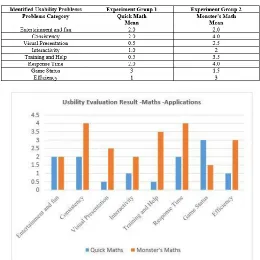
USABILITY EVALUATION –MATH APPLICATIONS
The results indicate that Monster’s Maths app has higher failure and number of mistakes for all problem categories measures for usability in Figure 9, except for game status. Therefore, it is evident that Quick Maths has better usability than Monster’s Math.
TABLE 4
75 FIG 6: Usability Evaluation of Selected Reading Skills Apps
The results indicate that Inference Ace app has higher failure and number of problems for all problem categories measures for usability in Figure 10, except for Interactivity and trainings and help. Therefore it evident that kids Learn to read app has better usability than Inference Ace.
5.2 Learning Evaluation Results
After usability evaluation, here we evaluate the learning achievements or knowledge students get by using these applications are presented in terms of scored points in Table 5 and 6.
Results by Scored Points (Maths)
TABLE 5
Result of Learning Achievement (Maths)
The results indicate that by using the Quick Math’s as educational tool students get high score in Math’s posttest. This means Quick Math is more effective for learning maths concepts, contents and practices than Monster’s Maths.
Results by Scored Points (Reading)
TABLE 6
Result of Learning Achievements (Reading)
Result shown in Table 6 indicates that students get more score in Reading skills by using Kids Learn to Read as an educational tool than Inference Ace. This shows that Kids Learn to read is more effective app to increase the reading
skills .It improves the student’s reading skills more efficiently than Inference Ace.
5.3 Comparison
By analysing the result of Usability Evaluation (in section 5.1) and Learning Evaluation (in section 5.2), we compare the usability and Learning to assess the Relationship between them. The result of our study shows that usability has a direct relation with learning. During the design phases of educational apps, focus should be placed on usability of apps along with its content to increase the progress and market of Mobile educational applications or game based learning.
Comparison of evaluation results verified that, if usability of educational applications clearly handled, it helps to improve the learning through apps more effectively. Adequate usability in an educational app leads to effective learning through that app. If the educational apps contain usability issues, such apps are not able to provide effective learning skills. The overall analysis demonstrates that both usability and learning results correlate. Without handling the usability aspects, effective learning is not possible. The verification of this fact will be really helpful for the designers of educational games and applications in motivating them to focus on usability issues along with content. Overall quality of any educational application is dependent on both usability and content’s quality.
6
CONCLUSION
AND
FUTURE
WORK
The motivation behind educational applications in mobile computing is to support learning. A major challenge for designers and Human Computer Interaction (HCI) engineers, researchers is to develop software applications that also involve the learners, that is who are very beginners and to support their learning. Our study evaluates the usability of selected mobile educational applications regarding two subject categories math’s and reading skills to identify the usability problems found by the participants, after evaluating usability, we evaluate the learning achievements using these apps in terms of scored points. At the evaluation stage, comparisons are made between results gathered from usability and learning evaluation to prove our hypothetical statement that usability has a strong impact on learning. To make the educational applications effective for learning and to increase the progress and market of these apps, focus should be place on usability along with learning content. This serve as the foundation of designing and development of new mobile educational applications to make the mobile game based learning more effective and useful in today’s world of technology and mobiles. The paper highlights some directions for future work. The testing or evaluation characterized in this study has a few limitations, since it was performed with little group of students. Based on overall good results we gained interest and support of some of the faculties and that of academic staff, so the next step would be implementation and later evaluation of learning and usability impacts with larger group of students including children with learning disabilities or slow learners. In next coming work we have developed some mobile applications for
76
special children and we will show our findings in this especially for the deaf and dumb children in the same school we already have elaborated.
R
EFERENCES[1]. Basit Shahzad, Mehmet A. Orgun, Christoph Thuemmler, Fundamental Issues in Mobile Healthcare Information Systems, Hindawi Publishing Corporation Mobile Information Systems Volume 2016,
[2]. Pastore, M. (1999). Half of PC Time Spent Online. CyberAtlas. Internet Statistics and Market Research for Web Marketers.
[3]. Wang, S. & Dey, S. (2013) ―Adaptive mobile cloud computing to enable rich mobile multimedia applications‖, IEEE Transactions on Multimedia, pp 1-14.
[4]. Parsons, D. & Ryu, H. (2006) ―A framework for assessing the quality of mobile learning‖, 11th International Conference for Process Improvement, Research and Education (INSPIRE), UK, Southampton Solent University, pp 17-27.
[5]. ISO FDIS 9241-11 (1997) Ergonomic requirements for office work with visual display terminals (VDT´s), Part 11: Guidance on Usability specification and measures.
[6]. ISO/IEC, ISO/IEC 9126 in practice: what do we need to know?. [Online] Available at: http://www.essi.upc.edu/~webgessi/publicacions/SMEF%2 704-ISOQualityModels.pdf.
[7]. Zhang, D., & Adipat, B. (2005) ―Challenges, methodologies, and issues in the usability testing of mobile applications‖, International Journal of Human-Computer Interaction, vol. 18, No 3, pp 293308.
[8]. Chou, Chientzu Candace, Lanise Block, and Renee Jesness(2012). "A case study of mobile learning pilot project in K-12 schools." Journal of Educational Technology Development and Exchange 5.2, 2012, 11-26.
[9]. Eyal Eshed (2014), On Designing Mobile Education Apps, citizentekk, January 2014.
[10].Yang, C., Hwang, G., Hung, C., & Tseng, S. (2013) ―An Evaluation of the Learning Effectiveness of Concept Map-Based Science Book Reading via Mobile Devices‖, Journal of Educational Technology & Society, Vol. 16, No 3, pp167-178.
[11].Raza, A., Capretz, L.F. & Ahmed, F. (2012) ―An open source usability maturity model (OS-UMM)‖, Computers in Human Behavior, Elsevier Science, vol. 28, No 4, pp 1109-1121.
[12].Seffah, Ahmed, Mohammad Donyaee, Rex B. Kline, and Harkirat K. Padda (2006). "Usability measurement and metrics: A consolidated model." Software Quality Journal 14.2, 159-178, 2006.
[13].Kunjachan, Mary Ann Chiramattel (2011). "Evaluation of
Usability on Mobile User Interface." University of Washington, Bothell, 2011.
[14].P. Harpur and R. De Villiers,(2015) "MUUX-E, a framework of criteria for evaluating the usability, user experience and educational features of m-learning environments", South African Computer Journal, vol. 56, no. 1, 2015.
[15].Rabail Tahir and Fahim Arif, (2014) ― Framework for Evaluating the Usability of Mobile Educational Applications for Children‖ The Third International Conference on Informatics Engineering and Information Science (ICIEIS2014), At Lodz University of Technology, Lodz, ISBN:978-0-9891305-8-5 SDIWC Poland,pp 156-170
[16].Tafreshi, Fakhteh Soltani, and Taghi Miri,"User Interface Design and Evaluation for Mobile Educational Games for children." EUROSIS, MESM'2010, December 1-3, 2010, 134-138.
[17].Balagtas-Fernandez, Florence, Jenny Forrai, and Heinrich Hussmann. "Evaluation of user interface design and input methods for applications on mobile touch screen devices." Human-Computer Interaction, INTERACT 2009. Springer Berlin Heidelberg, 243246, 2009.
[18].Yahsi Yazicioglu , ―Game-based research in education and action training (GREAT) as a lifelong learning project‖ European Journal of Research on Education, 2014, Special Issue: Educational Technology and Lifelong Learning, 58-61.
[19].Basit Shahzad, Esam Alwagait, Utilizing Technology in Education Environment: A Case Study, 10th International Conference on Information Technology: New Generations, IEEE, 2013
[20].Sayudh Sarkar (2014) ,―The top benefits of Mobile learning Apps for Kids.‖http://www.storytimeforkids.info/app/top-benefitsmobile-learning-apps-kids/
[21].Esam Alwagaita, Basit Shahzad, Sophia Alimb, Impact of social media usage on students’ academic performance in Saudi Arabia, Computers in Human Behavior 51 (2015) 1092–1097.
[22].Esam Alwagaita, Basit Shahzad, Maximization of Tweet's Viewership with respect to Time, Computer Applications & Research (WSCAR), 2014 World Symposium on, IEEE, 2014.
[23].B. Shahzad, T. Afzal, R. Irfan, Enhanced Risk Analysis-Relative Impact Factorization, Information and Communication Technologies, ICICT 2005. First International Conference on Information and Communication, IEEE, 2005.
77
[25].M. Ikram Ullah Lali etc., Finding Healthcare Issues with Search Engine Queries and Social Network Data, International Journal on Semantic Web and Information Systems (IJSWIS) 13(1), IJSWIS, 2017.
[26].Shahbaz Ahmed Khan Ghayyur, Daud Awan, A Case of Engineering Quality for Mobile Healthcare Applications Using Augmented Personal Software Process Improvement,, Hindawi Publishing Corporation Mobile Information Systems, 2016
![Fig 2: Advantages of game based learning [19] [3]](https://thumb-us.123doks.com/thumbv2/123dok_us/8644324.1434032/3.612.324.555.62.336/fig-advantages-game-based-learning.webp)