Three-body Force Effects on the Longitudinal Response Function of
4He
S. Bacca1, N. Barnea2, W. Leidemann3, and G. Orlandini3,a
1 TRIUMF, 4004 Wesbrook Mall, Vancouver, B.C. V6J 2A3, Canada 2 Racah Institute of Physics, Hebrew University, 91904, Jerusalem, Israel
3 Dipartimento di Fisica, Universit`a di Trento, and Istituto Nazionale di Fisica Nucleare, Gruppo Collegato di Trento,
I-38123 Trento, Italy
Abstract. In this contribution we summarize recent results on the longitudinal response function of4He. It is
intended to give an important contribution to one of the most interesting and much discussed topics in nuclear physics at present, i.e. the nuclear many-body forces. The longitudinal response is considered as a possible observable, involving many body scattering states, sensitive to the three-nucleon force (3NF). Such a sensitivity is predicted by ab initio calculations performed using the Lorentz Integral transform (LIT) method. The kinematics that are more interesting to measure are discussed.
1 Introduction
The nuclear potential has clearly aneffectivenature, there-fore it is in principle a many-body operator. After several decades of theoretical and experimental studies of nucleon-nucleon (NN) scattering observables the two-body part of this operator is rather well known. For the determination of arealisticthree-body potential or to discriminate among different models one needs to find A≥ 3 observables that are sensitive to it. One direction that has been followed [1, 2] is to calculate accurately bound properties of nuclei of increasing A. In fact it has been realized that stronger and stronger discrepancies exist between the binding energies calculated with high precision two-body potentials and the experimental values. Another very promising direction is to study electromagnetic reactions to states in the contin-uum. In fact many years of electron scattering experiments have demonstrated the power of this kind of reactions, and in particular of the inelastic ones, because of the possibil-ity to vary energyωand momentum|q|transferred by the electron to the nucleus. This allows one to focus on dif-ferent dynamical aspects at different ranges and one might find regions where the searched three-body effects are siz-able.
The 4He nucleus is particularly appropriate for these studies because of the following considerations: i) the ra-tio between the number of triplets and of pairs goes like (A−2)/3, therefore it is double for4He than for3He; ii) the-oretical results on hadron scattering observables involving four nucleons [3] as well as4He-N phase shifts [4] seem to imply that three-body effects are rather large.
a e-mail:[email protected]
2 Formalism
For electron scattering reactions the inclusive differential cross section is given by
dσ dΩedω
=
= σM Q
4
|q|4 ∑
n
| hn|ρˆ|0i|2δ(En − E0 − ω)+
+
(
Q2
2|q|2 +tg 2θ
2 ) ∑
n
| hn|JTˆ |0i|2δ(En − E0 −ω) ≡ VL(q, ω)RL +VT(q, ω, θ)RT, (1)
whereσM denotes the Mott cross section, Q2 = −q2µ =
q2−ω2 the squared four momentum transfer withωand q as energy and three-momentum transfers, respectively, andθthe electron scattering angle. The states|0iand|ni
represent the initial (generally the ground state) and fi-nal states of the system, respectively. In the energy con-servingδ-function the final energy, represented byEn, in-cludes both the internal energy of the system En and the recoil energy acquired by the nucleus (non relativistically
Erec=|q|2/2M2AwithMArepresenting the mass of the nu-cleus).
The nuclear dynamics is in the so called response func-tionsRLandRT. They differ by the electromagnetic oper-ators ˆρand ˆJT representing the nuclear charge and trans-verse current density operators, respectively. Their knowl-edge requires models about explicitandimplicitdegrees of freedom in the nuclear Hamiltonian. While the explicit ones (protons and neutrons) are obvious at the nuclear scale, the implicit ones are not. The latter are in fact the degrees of freedom underlying the potential model. For example for one boson exchange potentials they are represented by DOI:10.1051/epjconf/201004009
the exchanged bosons whose charges and currents can cou-ple to the electromagnetic field generated by the electrons. For phenomenological potentials they are unknown. It is clear that this uncertainty represents a problem if one wants to extract information on the potential, by comparing the-ory and experiment. Fortunately one can show [5] that the contributions to ˆρ and ˆJT of subnuclear degrees of free-dom appear at different relativistic orders. At lowest order the charge density operator contains only proton (and neu-tron if nucleons are thought as extended objects) degrees of freedom. Therefore the use of the simple one-body density operator
ˆ ρ(q)= e
2 ∑
k
(1+τ3k) exp [iq·rk], (2)
whereeis the proton charge andτ3kthe isospin third com-ponent of nucleonk. allows to concentrate on the nuclear dynamics generated by the potential.
For the reasons exposed above we concentrate on the longitudinal response functionRL at low energy and mo-mentum transfer, where a consistent non relativistic quan-tum mechanical calculation can be performed. In particu-lar, as the momentum transfer decreases we have the op-portunity to see the evolution of the searched effects from the short range regime to the long range one.
It is well known that beyond the three-body break-up energies the calculation of scattering states for a four-body system is out of reach. We overcome the problem using the Lorentz Integral Transform (LIT) approach [6, 7] which reduces the scattering problem to a bound state problem.
The LIT method consists in considering instead ofRL an integral transformLL(σ,q) with a Lorentzian kernel de-fined for a complex parameterσ=σR+iσI by
LL(σ,q)= ∫
dω RL(ω,q)
(ω−σR)2+σ2I
=hΨeσ,ρq|Ψeσ,ρqi. (3)
The parameterσI determines the resolution of the trans-form and is kept at a constant finite value (σI , 0). The key point of the method is the theorem assuring thatLL can be evaluated from the norm of a functionΨeσ,ρq, that is the unique solution of the inhomogeneous equation
( ˆH−E0−σ)|Ψeσ,ρqi=ρˆ(q)|Ψ0i. (4)
Here ˆH denotes the nuclear Hamiltonian. The existence of the integral in Eq. (3) implies thatΨeσ,ρqhas asymptotic boundary conditions similar to a bound state. Thus, one can apply bound-state techniques for its solution. The re-sults presented here use the effective interaction hyperspher-ical harmonics (EIHH) method [8, 9].
3 Results and Discussion
In the following results for the longitudinal response func-tions of4He are presented [10]. They are obtained using the the phenomenological Argonne V18 (AV18) NN po-tential [11] and two different 3NF, namely the Urbana IX (UIX) [12] and the Tucson-Melbourne (TM’) [13].
In order to compare with experimental data both proton and neutron form factors have been included in the calcu-lation, in particular the proton electric form factor has been described by the usual dipole parameterization
GpE(Q2)=GD(Q2)= 1 (
1+QΛ2)2
(5)
(Λ =18.43 fm−2) and the neutron electric form factor by the parameterization from [14].
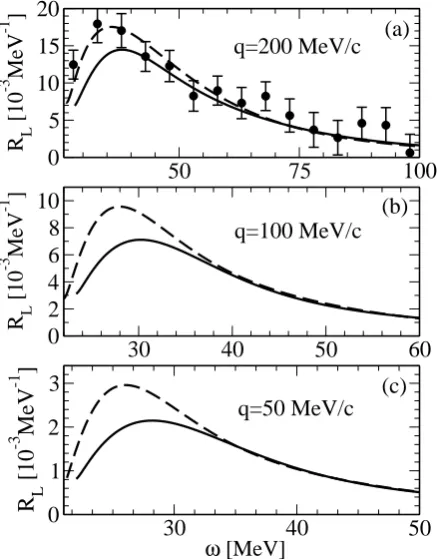
Figure 1 shows the evolution of the 3NF effects onRL as the momentum transfer decreases. The effect atq =50 Mev/c is especially large. Unfortunately no data are
avail-50
75
100
0
5
10
15
20
R
L[10
-3MeV
-1]
30
40
50
60
0
2
4
6
8
10
R
L[10
-3MeV
-1]
30
40
50
ω
[MeV]
0
1
2
3
R
L[10
-3MeV
-1]
q=100 MeV/c
q=200 MeV/c
q=50 MeV/c
(a)
(b)
(c)
Fig. 1.RL(ω,q) forq=200,100 and 50 MeV/c using AV18 only
(dashed) and AV18+UIX (solid). Data from [15] .
able at the moment for the lowestq-values and the data at
q =200 [15] MeV/c are too inaccurate to allow any con-clusion.
Fig. 2.RL(ω,q) forq = 300,400 and 500 MeV/c using AV18 only (dashed) and AV18+UIX (solid). The dotted line represents the quasi-elastic approximation. Data from [16] (squares), [17] (circles), [18] (open triangles).
Having found observables that show sizable effects of the UIX three-body potential one may wonder whether they can be used to discriminate between different 3NF. To this aim we can compare the results in Fig. 1 with those ob-tained with the TM’ potential [13]. The comparison is shown in Fig. 3.
30 40 50 60 70
0 2 4 6 8 10
25 30 35 40 45 50
ω [MeV]
0 1 2 3
R L
[10
-3 MeV -1 ]
q=100 MeV/c
q=50 MeV/c
Fig. 3.RL(ω,q) forq = 100 and 50 MeV/c using AV18 only
(dotted), AV18+UIX (solid) and AV18+TM (dashed).
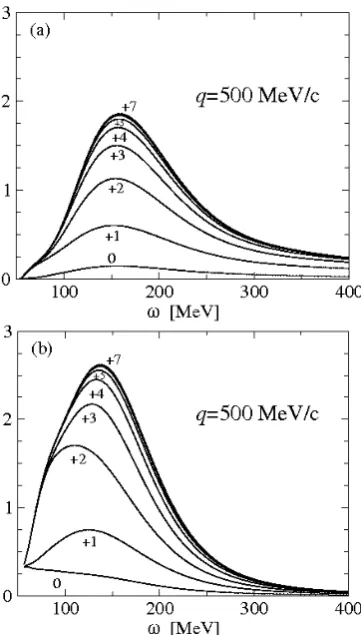
Since the charge density operator in Eq. (2) has an isoscalar and an isovector part, the longitudinal response has been obtained calculating the isoscalar and isovector contributions separately. Moreover, each of them has been obtained as a sum of multipole contributions. It is interest-ing to investigate which multipole is most affected by the 3NF. At first, however, it is instructive to see how the diff er-ent multipoles contribute at different momentum transfer. To this aim in Figs. 4 and 5 we show how the isoscalar and isovector parts of RL are built up from their multi-pole contributions at a higher (500 MeV/c) and a lower (100 MeV/c) value ofq. As expected, the higher the mo-mentum transfer, the larger the number of multipoles that one has to consider to reach convergence. For q = 500 MeV/c up to seven multipoles are needed, while forq =
100 MeV/c only three multipoles are required for a con-verged result. From the same figure one can infer that at higherq the strength is almost equally distributed among the first isovector multipoles, while in the isoscalar chan-nel the quadrupole gives the largest contribution. At low
q, as expected, the response is dominated by the isovector dipole contribution, the isoscalar dipole is completely neg-ligible and the isoscalar quadrupole contributes a few per-cent. Negligible strength is found for the multipoles higher than the quadrupole (similar to the isoscalar dipole case).
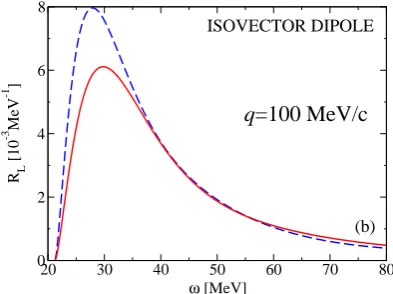
Coming to the 3NF effects, in Fig. 6 the dominating dipole contribution to the longitudinal response function is shown. On can notice that the effect of the 3NF is very similar to that in Fig. 1(b). This is due both to the fact that this is the dominant contribution and to some cancellations of the 3NF contributions to the other multipoles.
Fig. 4. (a) and (b): isovector and isoscalar response functions,
respectively, built up from the lowest Jmultipole contributions forq=500 MeV/c. The results are obtained with the AV18+UIX potential.
Fig. 5.The same as Fig. 4, but forq=100 MeV/c.
20 30 40 50 60 70 80
ω [MeV] 0
2 4 6 8
RL
[10
-3 MeV -1 ]
q=100 MeV/c
(b) ISOVECTOR DIPOLE
Fig. 6. Response function of the isovector dipole for q =
100 MeV/c with the AV18 (dashed) and AV18+UIX (solid) po-tentials.
CSR(q)≡ ∫
ωthdωRL(ω,q)=Z+Z(Z−1)fpp(q)−Z 2|F(q)|2,
(6) whereF(q) is the nuclear elastic form factor. Therefore it is interesting to see what is the effect of the 3NF onfpp(q). This is shown in Fig. 7. One can see that the effect in-creases up to 25% atq=400 MeV/c. However, in view of the fact that Eq. (6) has been obtained with the operator
0 100 200 300 400 500
q [ fm-1]
-30 -25 -20 -15 -10 -5 0
%
Fig. 7.Percent difference between fpp(q) calculated with AV18
only and AV18+UIX.
in Eq. (2), which neglects contributions of higher relativis-tic order, one has to keep in mind that only kinemarelativis-tics at
q .300 MeV/c, where the effect amounts up to 15%, can be considered safe for a possible comparison with experi-mental data, giving also an idea of the required experimen-tal accuracy.
4 Conclusions
In this contribution we have shown that the longitudinal re-sponse function of4He is potentially a crucial observable for the search of 3NF effects. In fact at the lowest momen-tum transfers investigated (50-100 MeV/c) the comparison of the results obtained with and without 3NF shows large effects of the 3NF, up to 30-40%. Moreover, using two phe-nomenological potentials one finds slightly shifted peaks. The result is a difference between the two responses that can be as large as 10-15%. The multipole analysis shows that the largest 3NF effect is just on the dominating isovec-tor dipole.
Three-body force effects are visible in the Coulomb sum rule as well, i.e. on the Fourier transform of the proton-proton correlation function. Three-body correlations due to the potential reach the maximum around 300-400 MeV/c. This could reflect the intermediate-long range nature of the 3NF.
At present experimental data are available forq≥200 MeV/c, where the 3NF effects are smaller and are not suffi -ciently precise to draw any conclusion. A Rosenbluth sep-aration of the inclusive electron scattering cross section of 4He at momentum transferq ≤ 200 MeV/c would be of high value in view of a more accurate determination of the three-body force and in general of the intermediate-long range dynamics of this system.
References
2. R. B. Wiringa, Steven C. Pieper, J. Carlson, and V. R. Pandharipande, Phys. Rev.C62, (2000) 014001 3. A. Deltuva, A.C. Fonseca, and P.U. Sauer, Phys. Lett.
B660, (2008) 471
4. K.M. Nollett, S.C. Pieper, R.B. Wiringa, J. Carlson, and G.M. Hale, Phys. Rev. Lett.99, (2007) 022502 5. L.L. Foldy and S.A. Wouthuysen, Phys. Rev. 78,
(1950) 29
6. V.D. Efros, W. Leidemann, and G. Orlandini, Phys. Lett.B338, (1994) 130
7. V.D. Efros, W. Leidemann, G. Orlandini, and N. Barnea, J. Phys. G: Nucl. Part. Phys.34, (2007) R459 8. N. Barnea, W. Leidemann, and G. Orlandini, Phys. Rev. C61, (2000) 054001; Nucl. Phys. A693,(2001) 565
9. N. Barnea, V. D. Efros, W. Leidemann, and G. Orlan-dini, Few-Body Syst.35, (2004) 155
10. S. Bacca, N. Barnea, W. Leidemann, and G. Orlandini, Phys. Rev. Lett.102, (2009) 162501; Phys. Rev. C80, (2009) 064001
11. R.B. Wiringa, V.G.J. Stoks, and R. Schiavilla, Phys. Rev. CC51, (1995) 38
12. B. S. Pudliner and V. R. Pandharipande, J. Carlson, S. C. Pieper, and R. B. Wiringa, Phys. Rev.C56, (1997) 1720
13. S. A. Coon and H. K. Hahn, Few-Body Syst. 30, (2001) 131
14. S. Galsteret al., Nucl. Phys.B32, (1971) 221
15. A. Yu. Buki, I. S. Timchenko, N. G. Shevchenko, and I. A. Nenko, Phys. Lett.B641, (2006) 156
16. S. A. Dytmanet al., Phys. Rev.C38, (1988) 800 17. A. Zghicheet al., Nucl. Phys.A572, (1994) 513 18. J. Carlson, J. Jourdan, R. Schiavilla, and I. Sick, Phys.
Rev.C65, (2002) 024002
19. G. Orlandini and M. Traini, Rep. Prog. Phys. 54, (1991) 257